Introduction
Intestinal parasites, in particular helminthiasis, remain major contributors to morbidity, especially in children in developing countries. Among the adverse health effects are growth retardation, intestinal obstruction, hepatic and biliary diseases, impaired cognitive development, and nutritional effects such as iron deficiency anaemia (Simeon et al., Reference Simeon, Grantham-McGregor, Callender and Wong1995). In the Kashmir valley, cases of helminthiasis are seen with considerable frequency. For example, in one hospital-based study by Ahmad et al. (Reference Ahmed, Ahmad and Ahangar2003), ascariasis was found in 62.5% of 480 patients examined. Currently the burden of helminthiasis in Kashmir valley is poorly understood as only a few restricted studies on the prevalence of helminth infections have been conducted (Wani et al., Reference Wani, Ahmad, Zargar, Ahmad, Ahmad and Tak2007). Hence community-based control measures can not be developed. Therefore, our objective was to determine the prevalence of intestinal helminth infection among children in the Kashmir valley, India, and to assess their risk factors.
Materials and methods
Study area
Kashmir valley, with a total population of 5 million people, is situated at an altitude of 1829 m. It forms a major portion of Jammu and Kashmir State, consisting of six districts, namely Annantnag, Baramulla, Budgam, Kupwara, Pulwama and Srinagar, with about 26 tehsils (administrative zones of districts) and 33 towns (Gupta, Reference Gupta2005). In each district, a rural and an urban study location were selected. Ethical clearance for conducting this study was obtained from the departmental ethical committee of the Zoology Department, University of Kashmir. Written informed consent was obtained from each study participant or from their parents. Children requiring medical assistance were properly treated or referred for medical attention.
Sampling
This study was carried out between March and November 2007. In the field, meetings were held with the parents and children from the study sites, and the study protocol was explained. The value of having their stools examined and the methods of collecting specimens were also made thoroughly clear. A population of 2256 children between the ages of 0 and 15 years (mean = 9.1 ± 4.1 years), with no disabilities and not receiving antiparasitic treatment, was included in this study. At first 2510 children were enrolled, but later 254 records were omitted because either the faecal samples were contaminated or the participants decided not to participate. Study participants were provided with a labelled clean stool container, containing l0 ml of 10% formalin. Toilet tissue paper and a clean piece of stick were given to collect a fresh morning stool specimen on the next day. In addition, a prepared cellotape slide for the examination of Enterobius infection was also provided. Every child was instructed to bring his/her own stool, so that no mixing occurred.
To maintain an age stratification, the study population was divided into three different age groups of 0–5, 6–10 and 11–15 years. The 0–5-year age group comprised 293 boys and 229 girls, i.e. 56.13% and 43.86% of the study group, respectively. The 6–10-year age group comprised 469 boys and 285 girls, i.e. 62.20% and 37.79% of the study group, respectively. The 11–15-year age group comprised 589 boys and 391 girls, i.e. 60.10% and 39.89% of the study group, respectively. In total 1351 boys and 905 girls were included in the study, i.e. 59.88% and 40.11% of the study group, respectively.
Questionnaire
Assessment of risk factors was carried out using a structured questionnaire. The interviews were administered face to face with mothers in children's schools and in homes. The level of education of the mothers, type of sanitation facilities, type of drinking water (tap, well or stream/pond water) and defecation site (open or modern sanitary latrine) were recorded as proxy variables of socio-economic conditions. The children's ages were obtained from school records.
Analysis of samples
Samples were transported to the Parasitology Laboratory, Department of Zoology, University of Kashmir, Srinagar for processing. Specimens were examined by direct smear and zinc sulphate floatation concentration techniques. Intensity of infection of Ascaris lumbricoides and Trichuris trichiura was assessed by using Stoll's egg-counting technique. Intensity of infection was differentiated as ‘light’, ‘moderate’ and ‘heavy’, for A. lumbricoides (1–5000 epg, 5000–50,000 epg and ≥ 50,000 epg, respectively) and T. trichiura (1–1000 epg, 1000–10,000 epg and ≥ 10,000 epg, respectively) (Montressor et al., Reference Montressor, Crompton, Hall, Bundy and Salvioli1998). The helminth parasites recovered were identified by the keys provided in Chatterjee (1995).
Data entry and analysis
A computer program (SPSS 10.05 for windows; SPSS Inc., Chicago, Illinois, USA) was used for data analysis. Mean, standard error (SE) and range were calculated for intensity of infections. The chi-square test was used to associate risk factors with infection status. Differences were considered significant when P values of less than 0.05 were obtained.
Results
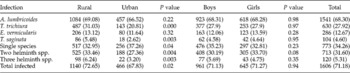
Stool samples were collected from 2256 children, including both boys and girls from rural as well as urban areas of Kashmir valley. Overall 1606 (71.18%) children were infected with at least one species of intestinal helminth parasites. Four species of intestinal helminths, A. lumbricoides, T. trichiura, Enterobius vermicularis and Taenia saginata were diagnosed. Overall prevalence of A. lumbricoides was 68.30%, followed by T. trichiura (27.92%), E. vermicularis (12.67%) and T. saginata (4.60%). The number of children infected by a single helminth species was 773 (34.26%), whereas 713 (31.60%) and 120 (5.31%) were infected by two and three helminth species simultaneously (table 1). The district-wise prevalence showed the highest rate of infection in Budgam (79.28%), followed by Baramulla (75.28%), Pulwama (73.36%), Kupwara (72.84%), Srinagar (71.52%) and Annantnag (56.98%).
Prevalence and condition of infection in children of Kashmir valley (%).

The prevalence of A. lumbricoides peaked in the 6–10-year age group (prevalence of 78.51%), followed by the older (71.22%), and by the younger children (48.8%) (P = 0.0001). Prevalence of T. trichiura peaked in the older age group (34.79%), rather than in younger age groups (6–10-year age group, 26.92%; 0–5-year age group, 16.47%) (P = 0.01). Interestingly, the prevalence of E. vermicularis was high in the younger age group (22.60%), followed by the middle age group (21.08%). In the oldest group, the prevalence of E. vermicularis was negligible (0.91%). In contrast to enterobiasis, taeniasis peaked in the age group of 11–15 years (6.02%), followed by the 6–10-year age group (3.71%) and the 0–5-year age group (3.2%).
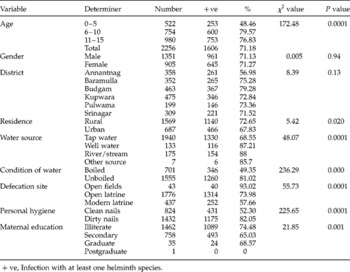
Risk factor analysis and infection status are summarized in table 2. Except for gender and district, all the other risk factors that were considered as proxy variables were found to be significantly associated with the prevalence of infection (P < 0.05).
Factors associated with the prevalence of intestinal helminths.

+ve, Infection with at least one helminth species.
The intensity of infection with A. lumbricoides and T. trichiura is summarized in table 3. For A. lumbricoides, 57.10% and 42.8% children had light and moderate intensity of infection, respectively. For T. trichiura, 92.3% and 7.61% of children had light and moderate intensity of infection, respectively. No case of severe intensity of infection was observed, either with A. lumbricoides or T. trichiura.
Intensity of A. lumbricoides and T. trichiura in children of Kashmir valley.

epg, eggs per gram; SE, standard error.
Discussion
A high prevalence of 71.18% of helminth infection was found in the children of Kashmir valley, with A. lumbricoides being the most common parasite, followed by T. trichiura, E. vermicularis and T. saginata. The risk factors associated with the higher prevalence of infection included age, residence, type of water source, condition of water, type of latrine used, personal hygiene and maternal education. Gender and district were not found to be associated with the prevalence of infection.
Present prevalence rates, when compared with other parts of the world, show that Kashmir valley is an endemic region for intestinal helminthiasis. Studies conducted by Bundy et al. (Reference Bundy, Kan and Rose1988) showed a high overall prevalence of 62% among the urban slum children of Malaysia. Rodriguez et al. (Reference Rodriguez, Lozano, Diaz, Cheng and Rucson2000) reported a high prevalence of 72% among the schoolchildren in Maracaibo, Venezuela. Legesse & Erko (Reference Legesse and Erko2004) also noted the high prevalence of 88.2% among the schoolchildren in rural Ethopia, while Kabaterine et al. (2001) reported an overall prevalence of 56% among the schoolchildren of southern Uganda.
In the present study, it was found that A. lumbricoides was the most common helminth parasite. Similar results were shown by Martin et al. (Reference Martin, Keymer, Isherwood and Wainwright1983), in northern Bangladesh and Ulukanligil & Seyrek (Reference Ulukanligil and Seyrek2003) in Turkey. It was found in the present study that prevalence of T. trichiura increased with age. Similar results were found by Bundy et al. (Reference Bundy, Cooper, Thompson, Anderson and Didier1987). Other studies have also shown peak intensity of Trichuris infection in individuals aged 10–29 years (Anderson et al., Reference Anderson, Romeroabal and Jaewike1993), indicating that Trichuris may be a more chronic infection than Ascaris. We found a negative association between prevalence of infection with E. vermicularis and age. The cause for its high prevalence in the youngest children is most probably due to lack of personal hygiene. At this age children seldom wash their anal area and rarely wash hands after defecation. The present study has shown a low prevalence of taeniasis, suggesting that meat in the diet was properly cooked.
The prevalence of infection peaked at the age of 6–10 years, followed by the age groups 11–15 years and 0–5 years. The reason for this type of distribution is that the children in the age group 0–5 years mostly remain indoors and are not exposed to infections. As their age advances, children start to play outside and so get exposed to infections. In the 6–10-year age group, the prevalence is highest, because at this age children have little knowledge regarding personal hygiene, but as their age advances children become aware of hygienic habits and so the prevalence of infection starts decreasing. Also, as age advances, development of immunity against helminth infections cannot be ruled out. The present findings are consistent with the results of Bundy et al. (Reference Bundy, Kan and Rose1988) and Ibrahim (Reference Ibrahim2002).
In the present study, rural children were found to be more infected than urban children. Similar results were shown by Onubogu (Reference Onubogu1978), who found rural children to be significantly more infected than urban children. It was found that prevalence of infection differed in different districts, as the highest prevalence was observed in district Budgam and the lowest in district Annantnag, although the differences were insignificant. The difference in the prevalence rates between different districts could be due to differences in hygiene practices, like drinking contaminated water and open defecation. The origins of major rivers that flow through Kashmir valley, are in district Annantnag. They are not initially contaminated when they flow through this district; but they become contaminated when they flow northwards, so people residing in other districts are at more risk of infection.
Children who used drinking water from rivers or streams and wells were found to harbour a greater prevalence of infection than those who had access to tap water. This pattern of infection was confirmed in the study of Narain et al. (Reference Narain, Raj guru and Mahanta2000). Curtis et al. (Reference Curtis, Kanki, Meretens, Traore, Diallo, Tall and Cousens1995) demonstrated that mothers from a poor community in Burkina-Faso, with access to tap water in the yard, were more likely to use safe hygiene practices than mothers using wells in the yard.
It is argued that in highly contaminated environments, faecal transmission in defecation grounds may not be the single most important site for helminth infection (Feachem et al., Reference Feachem, Guy, Harrison, Iwugo, Marshall, Mbere, Muller and Wright1983), but it was found in the present study to be a significant univariate risk factor for infection with intestinal helminthiasis. In Kashmir valley children are at particular risk, with nearly 70% of children less than the age of 15 years defecating outdoors in either open latrines or nearby fields. Moreover, at this age non-supervised children may be more prone to defecating in sites that are already polluted by faeces and therefore may be exposed to more frequent and heavy infections than adults (Hominick et al., 1987).
It is also evident from the present study that children with better personal hygiene had lower prevalence of intestinal parasitic infections than those living in less hygienic conditions (P = 0.0001). The present results are in agreement with those of Okayay et al. (2004) and Saathoff et al. (2004), who regarded personal hygiene as an important predictor of intestinal parasitism. In our study, it was also found that a low level of maternal education was a significant risk factor for the prevalence of infection. Apparently, this factor contributes extensively to controlling risk factors for intestinal infections. Lack of maternal education has also been found to be the most important risk factor for parasitism in other studies (Phiri et al., Reference Phiri, Whitty, Graham and Ssembatya-lule2000).
In the present study, light and moderate intensities of infections with A. lumbricoides were about equal, whereas in the case of T. trichiura, a majority of children harboured light infections. Interestingly, no case of heavy infection, with either A. lumbricoides or T. trichiura, was found. Similar results were obtained by Palmer & Bundy (Reference Palmer and Bundy1995), who observed that often a minority of a population produce large numbers of eggs, indicating heavy infections, while the majority have light infections and produce very few eggs. The reason for not having a heavy intensity of infection is unknown, but the immune system appears to have a role, by mounting an effective immunological response to heavy infections.
The present study demonstrates the high abundance of intestinal helminth infections among the schoolchildren of Kashmir valley. This situation calls for adequate control measures, including mass drug administration, improvement of sanitation facilities and practices, and provision and utilization of clean water. The impact of each measure would be maximized through a health education programme directed at schoolchildren and their parents, in particular, and to the communities in general.
Acknowledgements
We are thankful to all children, their parents and teachers for their untiring cooperation.