Implications
No clear evidence of a specific grazing behaviour of Valdostana cows was found compared to high genetic merit cows, when exposed to difficult grazing conditions on species-rich mountain pastures. The difference from production potential was similar in Holstein and Valdostana cows and lower in Montbéliarde cows. Breed differences in plant selection were small; slope affected space use. Accordingly, all cows grazed preferentially on the flat areas of steep plots, even when the most palatable plants had been consumed. In dairy breed choice, other criteria have to be considered on the long-term and system scale for sustainability of extensive grazing systems.
Introduction
The presence of ruminants using mesotrophic natural mountain grasslands is essential to maintain biodiversity and landscapes (Santini et al., Reference Santini, Guri, Gomez and Paloma2013). However, these pastures are heterogeneous, steep and often provide a low forage quality (Tamburini et al., Reference Tamburini, Gusmeroli, Roveda and Succi2005). In mountain dairy systems, autochthonous dairy cattle are often preferred to exploit mountain pastures linked with the production of region-specific dairy products (Sturaro et al., Reference Sturaro, Marchiori, Cocca, Penasa, Ramanzin and Bittante2013). Their robustness, which includes numerous traits that allow carrying on various activities in the face of environmental constraints (Friggens et al., Reference Friggens, Blanc, Berry and Puillet2017), is helpful in harsh mountain conditions. Due to the multitrait selection applied (including lower BW and limited milk yield (MY) compared to high genetic merit breeds), autochthonous cows may tolerate low forage quality and hesitate less to climb steep slopes. Indeed, under severe nutritional restriction, Coulon and D’Hour (Reference Coulon and D’Hour1994) found that primiparous Tarentaise cows decreased their MY, whereas high genetic merit Holstein cows maintained it at the expense of BW and reproductive performance. On pasture, these results may be linked to the grazed behaviour. McCarthy et al. (Reference McCarthy, Horan, Rath, Linnane, O’Connor and Dillon2007) found that less productive cows graze longer than high genetic merit cows. In other studies, the grazing time of both cow types was similar, but the cows of lower genetic merit spent more time walking and playing on pasture (Saether et al., Reference Saether, Sickel, Norderhaug, Sickel and Vangen2006), selected herbage of greater quality in spring (Aharoni et al., Reference Aharoni, Henkin, Ezra, Dolev, Shabtay, Orlov, Yehuda and Brosh2009) and had a lower grass Dry Matter (DM) intake per bite and per unit of BW (Prendiville et al., Reference Prendiville, Lewis, Pierce and Buckley2010). However, in some other studies, differences in the diet choices made by traditional and improved cattle were small (Dumont et al., Reference Dumont, Rook, Coran and Röver2007a; Coppa et al., Reference Coppa, Farruggia, Ravaglia, Pomiès, Borreani, Le Morvan and Ferlay2015). In summary, results are available for high-yielding cows (mainly Holstein) in comparison to lower yielding breeds, but there are contradictory. Concerning autochthonous cows, it is difficult to find information about grazing behaviour and selection as they are often rarely investigated local breeds. Therefore, a comprehensive comparison of the behaviour of different breeds under difficult grazing conditions is needed.
Other factors such as seasonal evolution of the pasture or topography are likely to interact with breed concerning the animal’s diet choices. Indeed, large seasonal variations in behaviour and performance of cows along with herbage growth and availability were found (Kohler et al., Reference Kohler, Gillet, Reust, Wagner, Gadallah, Gobat and Buttler2006, Farruggia et al., Reference Farruggia, Pomiès, Coppa, Ferlay, Verdier-Metz, Le Morvan, Bethier, Pompanon, Troquier and Martin2014). Space use on pasture was found to change with season due to pasture morphology. Accordingly, cows initially grazed the entrance of large plots and flat fertile areas before gradually exploring the entire pasture (Farruggia et al., Reference Farruggia, Pomiès, Coppa, Ferlay, Verdier-Metz, Le Morvan, Bethier, Pompanon, Troquier and Martin2014). In beef calves, the use of steep slopes increased lying time even though feeding time was apparently not affected (Gangnat et al., Reference Gangnat, Leiber, Dufey, Silacci, Kreuzer and Bérard2016). However, there is no report about the effect of steep slopes on actual diet selection and space use of lactating cows of different breeds on pastures.
Therefore, in the present study, the following hypotheses were tested through a controlled grazing experiment involving three breeds of cows with a gradient in genetic merit. With increasing genetic merit, dairy cows adapt their (i) diet selection according to the biodiversity and (ii) grazing behaviour according to the slope, in order to match their lactation requirements.
Materials and methods
Animals and experimental design
The experiment was performed in 2017 at Marcenat, INRA’s experimental farm (Herbipôle, 45°15’N, 2°55’E; 1135 to 1215 m a.s.l.), which is an approved animal experimental unit (Certificate of Authorization to Experiment on Living Animals N° D 15-114-01). Thirty-six late-lactating multiparous dairy cows with different experience backgrounds and increasing genetic merit for MY were monitored: 12 Valdostana Red Pied (Va, 173 ± 32 days in milk (DIM)), 12 Montbéliarde (Mo, 219 ± 33 DIM) and 12 Holstein (Ho, 199 ± 23 DIM). The Ho and Mo cows originated from Marcenat and had experienced rotational grazing on moderately biodiverse pastures. The Va cows had been transferred to Marcenat by truck from the Institut Agricole Régional (IAR), Aosta, Italy, 1 month before the experiment started. In Italy, Va cows had strip grazed on lowland and biodiverse mountain pastures. Cows were milked at 0700 h and 1600 h. Three weeks after the arrival of the Va cows, a herd of 12 cows per breed was formed and no concentrate was provided anymore. In calendar week 22, cows were divided in a randomised way into three equivalent groups balanced by breed (four cows per breed), MY (within breed) and stage of lactation. At that time, Ho cows produced 22.9 ± 3.9 kg milk/day with fat and protein contents of 37.6 ± 5.6 g/kg and 31.6 ± 2.2 g/kg, respectively. The corresponding values of the Mo cows were 24.1 ± 3.3 kg milk/day, 38.4 ± 4.3 g fat/kg and 32.8 ± 2.3 g protein/kg, those of the Va cows were 14.7 ± 2.3 kg milk/day, 35.4 ± 4.5 g fat/kg and 32.7 ± 1.7 g protein/kg. Cows of the three groups were grazing (0.3 ha/cow) on (i) a flat grass-dominated control pasture with low botanical diversity (13 species) (L, 2°), comprising mainly Poa pratensis (32%), Trifolium repens (21%) and Dactylis glomerata (19%) and (ii) two adjacent semi-natural pastures both with a very similar botanical composition (39 species on average) but with different slopes (7° and 22°; H7 and H22). The latter pastures were composed of three zones differing in slope and biodiversity (Supplementary Figure S1). Zone Z1 at the lower end of the slope, near the water supply and less diverse (26 plant species), was dominated by Dactilys glomerata (30%), Agrostis capillaris (20%) and Poa pratensis (15%). Zone Z2 at mid slope (36 species) was dominated by Agrostis capillaris (22%), Festuca gr. rubra (19%) and Dactylis glomerata (15%). Zone Z3, the upper and most biodiverse zone of the pasture (56 species), was dominated by Thymus gr. serpyllum (16%), Festuca gr. rubra (14%) and Agrostis capillaris (10%). Botanical composition was determined using the vertical point-quadrat method (Daget and Poissonet, Reference Daget and Poissonet1971). Because of its homogeneity, no zones were distinguished on L.
Experimental design
The experiment lasted for 8 weeks (from calendar weeks 22 to 30), with measurements on swards and animals performed after 2 weeks of grazing in calendar week 24 (early in 1st grazing cycle) and 26 (late in 1st grazing cycle) and in week 30 (early in 2nd grazing cycle). Aiming to maximise grazing selection, extensive rotational grazing with long duration of paddock utilisation was applied as described in Coppa et al. (Reference Coppa, Farruggia, Ravaglia, Pomiès, Borreani, Le Morvan and Ferlay2015) with cows being moved off pastures between weeks 26 and 30 to allow a minimal regrowth. In each of the measurement weeks, five grass samples of 10 cm × 1 m per zone were taken on H-pastures, and five samples from the entire pasture on L plot. These five samples were pooled by zone (H7 and H22) or pasture (L), oven-dried at 60°C during 72 h and then analysed as described by Coppa et al. (Reference Coppa, Farruggia, Ravaglia, Pomiès, Borreani, Le Morvan and Ferlay2015) for proximate composition in order to describe the nutritional value of the herbage. Contents of net energy for lactation (NEL) of the samples were estimated using the calculation module of the official Swiss feeding recommendations for ruminants (Agroscope, 2018).
Feeding behaviour was measured in the 3 weeks during two consecutive days by scan sampling of the cow’s bites at 5-min intervals (Dumont et al., Reference Dumont, Rook, Coran and Röver2007a). Eighteen cows (two per breed per group) were observed for 3 h after the morning milking and for 3 h in the afternoon (from 1.30 h before to 1.30 h after milking). Observers were recording activities first, which were distinguished into resting (lying, standing still and ruminating), grazing and other activities (walking, exploring, drinking, etc.). Bite type was characterised by botanical group and vegetation stage (Dumont et al., Reference Dumont, Garel, Ginane, Decuq, Farruggia, Pradel, Rigolot and Petit2007b). Vegetation was distinguished into short vegetative (height <10 cm, leaf development), tall vegetative (>10 cm, stem elongation) and mature vegetation (regrouping inflorescence emergence, heading and dead materials) (Coppa et al., Reference Coppa, Farruggia, Ravaglia, Pomiès, Borreani, Le Morvan and Ferlay2015). In addition, grasses, legumes and forbs were defined as main botanical groups. On H7 and H22, the zones the cow grazed on were recorded. During each measurement week, the available herbage on the plot was characterised through 30 cm2 random samples (100 per zone) on the day before the behavioural observations were performed. These samples were described for vegetation stage and botanical groups similarly to cow’s bites. Diet selection, defined as the proportion of a bite’s type in the diet in relation to its available proportion in the plot, was quantified by calculating the indices of selectivity (IS) using Jacobs’ (Reference Jacobs1974) modification of Ivlev’s selectivity index (Dumont et al., Reference Dumont, Garel, Ginane, Decuq, Farruggia, Pradel, Rigolot and Petit2007b). These indices range from −1 (aversion) to +1 (preference), with 0 meaning indifference.
Two days after observing behaviour, faeces samples from the 36 cows were collected after morning and evening milking. They were analysed for CP and ADF according to Farruggia et al. (Reference Farruggia, Pomiès, Coppa, Ferlay, Verdier-Metz, Le Morvan, Bethier, Pompanon, Troquier and Martin2014). Organic matter digestibility (OMD) was estimated as described by Mesquita et al. (Reference Mesquita, Farruggia, Andueza, Piccard, Le Morvan, Quereuil, Carvalho, Fournier, Pomiès and Casasús2016) with the following equation: OMD = 0.980 to 2.474/faecal CP (% of organic matter) – 0.00276 × faecal ADF (% of organic matter).
In the measurement weeks and, additionally, in the pre-experimental period, MY and BW were determined at each milking and averaged per week. The potential MY (MYpot) was calculated by the model of Coulon and Pérochon (Reference Coulon and Pérochon2000), with ΔMY being the difference between MY and MYpot. On the days of behaviour observation, individual 20 ml samples from four consecutive milkings were sampled and conserved at +4°C until being analysed for fat and protein contents (MIRS, NF ISO 9622).
Statistical analysis
Data on MY, MYpot and milk composition collected in the pre-experimental period were used as a breed-centred covariate. For IS, means were weighted by the number of observations per zone. All data were analysed using SAS 9.4 (SAS Institute Inc., Cary, NC, USA). Normality was checked using the Shapiro–Wilk test. The following variables underwent a Box-Cox transformation in order to reach normal distribution: IS, proportion of other activities, time spent in Z3. All variables were analysed by ANOVA using a repeated measures mixed model considering grazing period, animal breed, pasture type and their interactions as fixed effects. Grazing period was defined as repeated factor, and cow as subject. The random factor was the cow nested within its pasture type. Student t tests were performed on the IS to assess aversion (IS < 0), indifference (IS = 0) or preference (IS > 0). For transformed variables, standard error of the mean was calculated using the non-transformed data.
Results
Qualitative description of vegetation characteristics
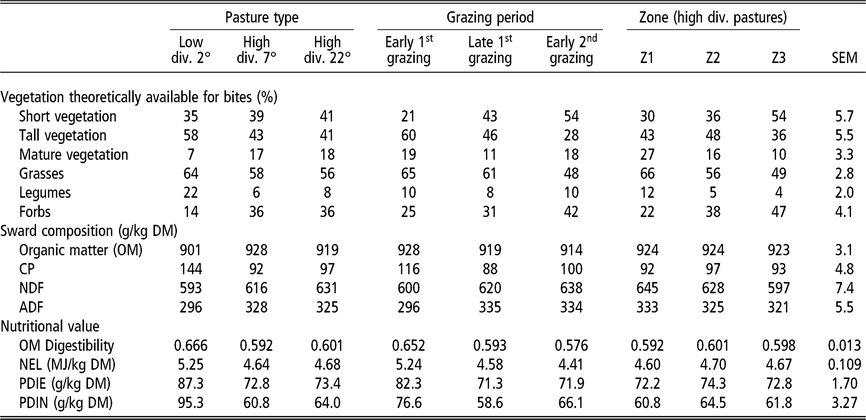
At the beginning of the experiment, L-pasture was dominated by tall vegetative patches (Supplementary Table S1). On H-pastures, a decreasing gradient in vegetation stage was observed along zones: Z1 was rich in tall vegetative and mature patches, Z2 in tall vegetative patches and Z3 in short and tall vegetative patches (Supplementary Table S2). Zones Z1 and Z2 were richer in grasses than Z3. Zone Z1 had the highest proportion of legumes, and forbs increased in proportion from Z1 to Z2 and to Z3. The forage from the L-pasture contained more NEL than that of the H-pastures, and this across all seasons (Table 1). Zones on H-pastures did not differ in NEL content. The L-pasture was richer in CP and lower in ADF than the H-pastures, accompanied by a lower OMD of the latter, and this was similar in all zones. Throughout the experiment, a decrease in the proportion of grasses was observed on all pastures (Table 1). This was compensated by an increase in legume proportion on L-pasture and in forb proportion on H-pastures (Supplementary Table S1). With progressing season, the proportion of short vegetative patches increased, replacing the tall vegetative patches. In Z1 and Z2, these changes took place at late 1st grazing cycle, whereas in Z3, it happened at early 2nd grazing cycle (Supplementary Table S2). During the latter period, the nutritional quality of forage on the H-pastures decreased in Z1 and Z2, but not Z3. The OMD also decreased with progressing season in all zones, but during the 2nd grazing cycle, it was higher in Z3 than in Z2 and Z1.
Characterisation of the cows’ pastures type, grazing period and zone within the two high botanical diversity pastures (arithmetic means and standard error of the mean)

Low div. 2°: low botanical diversity, slope 2°; High div. 7°: high botanical diversity, slope 7°, High div. 22°: high botanical diversity, slope 22°; NEL: net energy for lactation; PDIE: absorbable protein at the duodenum according to supply with fermentable energy and rumen undegradable protein; PDIN: absorbable protein at the duodenum according to supply with rumen degradable and undegradable protein.
Breed differences
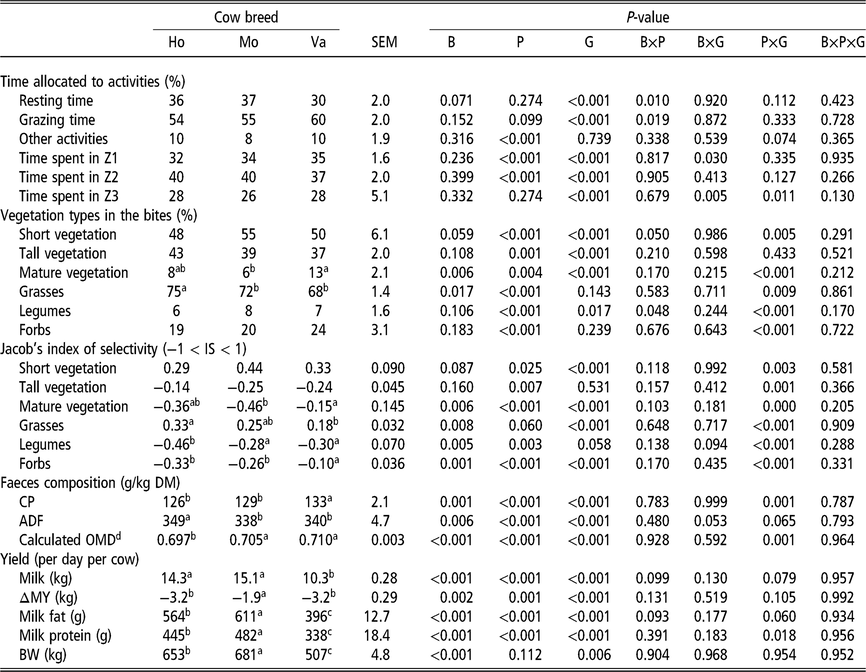
There was no breed difference in the time allocated to the main activities and times spent in the zones (Table 2). The Ho preferentially selected grasses (IS > 0) more than Va and were found to have a higher proportion of grasses in their bites as compared to Mo and Va. The Va were indifferent to forbs and mature vegetation (IS ≤ 0), whereas Ho and Mo cows avoided them (IS < 0). In Va bites, the proportion of mature vegetation was higher than in those of Mo. The Va faeces contained more CP and less ADF than that of Ho and more CP than that of Mo. The estimated OMD was higher in Va and Mo compared to Ho. The MY was lower in Va compared to Ho and Mo but MY loss, as compared to the calculated MYpot, was the same in Ho and Va. Loss of MY was on average by 40% less severe in Mo than Ho and Va. The Mo had the highest yield of milk fat and protein and BW, always followed by Ho, then Va.
Effects of cow breed, pasture type, grazing period and their interactions on cow’s behaviour, diet selection, faecal composition and performance

Ho: Holstein; Mo: Montbéliarde; Va: Valdostana; B: breed; P: pasture type; G: grazing period.
a–cWithin same trait and effect, values without common superscripts differ; dOMG: organic matter digestibility, for calculation see Materials and methods.
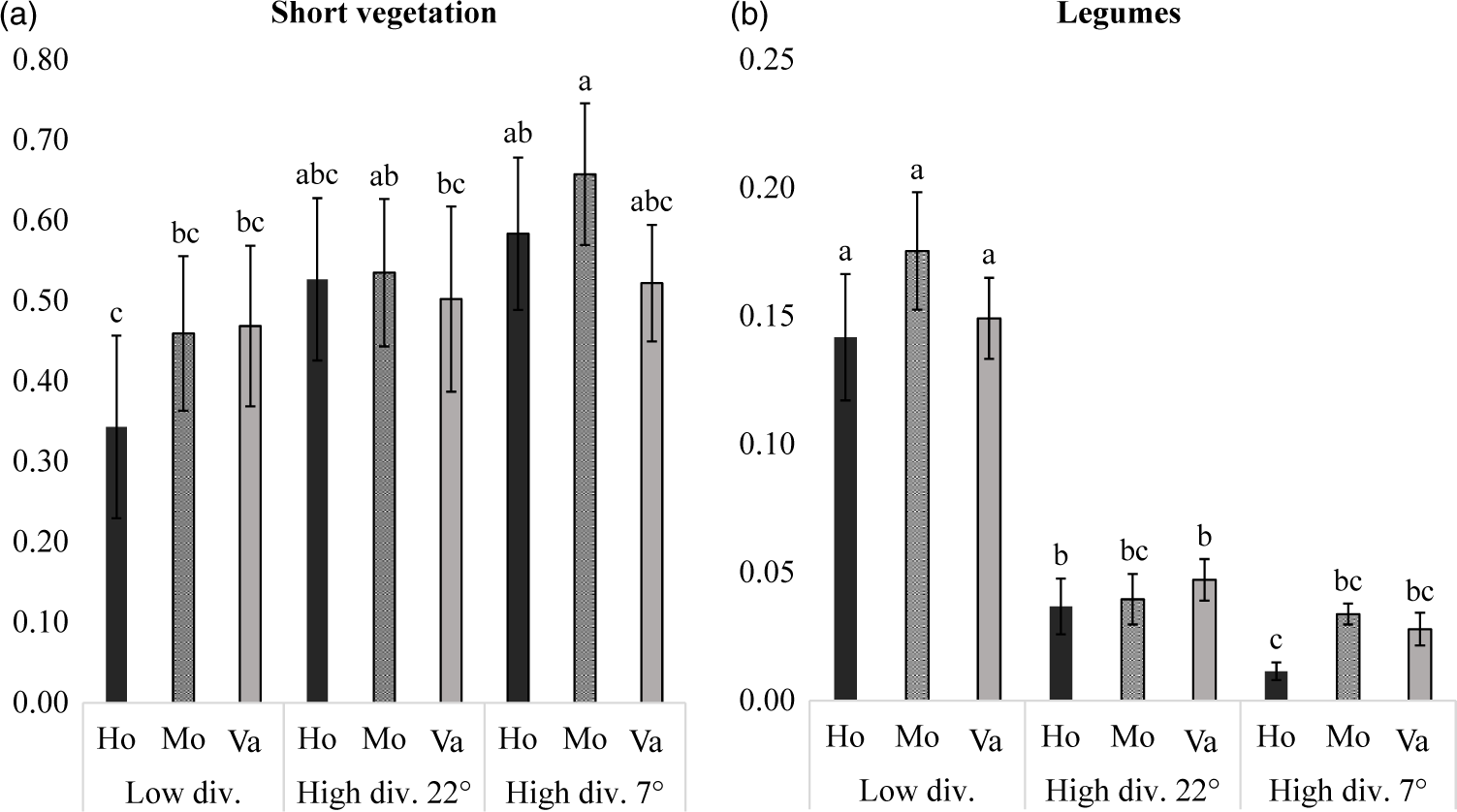
There were only few interactions between breed and either pasture type or grazing period (Table 2). The Va allocated more time for grazing than Mo at the expense of resting, but this only on the L-pasture (Figure 1a). The three breeds visited the zones similarly except for early 2nd grazing cycle, where Mo spent less time in Z3 than Ho and Va, this in favour of Z2, whereas Ho spent a shorter time on Z1 than Va (Figure 1b). The observed proportion of short vegetative patches was higher in the bites of Ho and Mo grazing the H7- instead of the L-pasture, whereas this was not the case for Va (Figure 2a). On H7-pasture, Ho had a smaller proportion of legumes in their bites than on H22-pasture (Figure 2b), whereas this was not the case for Mo and Va. The Ho and Mo tended to have a smaller MY on H7- than on L-pasture, whereas Va had a similar MY on all three pastures (Figure 3a). The difference to MYpot (ΔMY) expressed in % was similar in Mo and Va, except on L-pasture where ΔMY was only −5% in Mo and as high as −23% in the Va (Figure 3b). The Ho had a larger ΔMY on H22 than Mo.
Proportion of time allocated to (a) grazing, resting and other activities on the three pasture types (breed × pasture type, P < 0.05) and (b) the different zones of the high-diversity pastures at the three grazing stages (breed × grazing stage, P < 0.05) by Holstein (Ho), Montbéliarde (Mo) and Valdostana (Va) cows. Low div.: low botanical diversity; High div. 22°: high botanical diversity, slope 22°; High div 7°: high botanical diversity, slope 7°. Within variable, bars without common superscript differ with P < 0.05.

Proportion of (a) short vegetation and (b) legumes in the diet of Holstein (Ho), Montbéliarde (Mo) and Valdostana (Va) cows on the three pasture types (breed × pasture type, P < 0.05). Low div.: low botanical diversity; High div. 22°: high botanical diversity, slope 22°; High div 7°: high botanical diversity, slope 7°. Within variable, bars without common superscript differ with P < 0.05.

Milk yield (a) and MY change (b) of Holstein (Ho), Montbéliarde (Mo) and Valdostana (Va) cows on the three pastures types (breed × pasture type, P < 0.05). Low div.: low botanical diversity; High div. 22°: high botanical diversity, slope 22°; High div 7°: high botanical diversity, slope 7°. Within variable, bars without common letter differ at P < 0.05 or tend to differ at P < 0.10.

Pasture type, grazing stage and their interaction
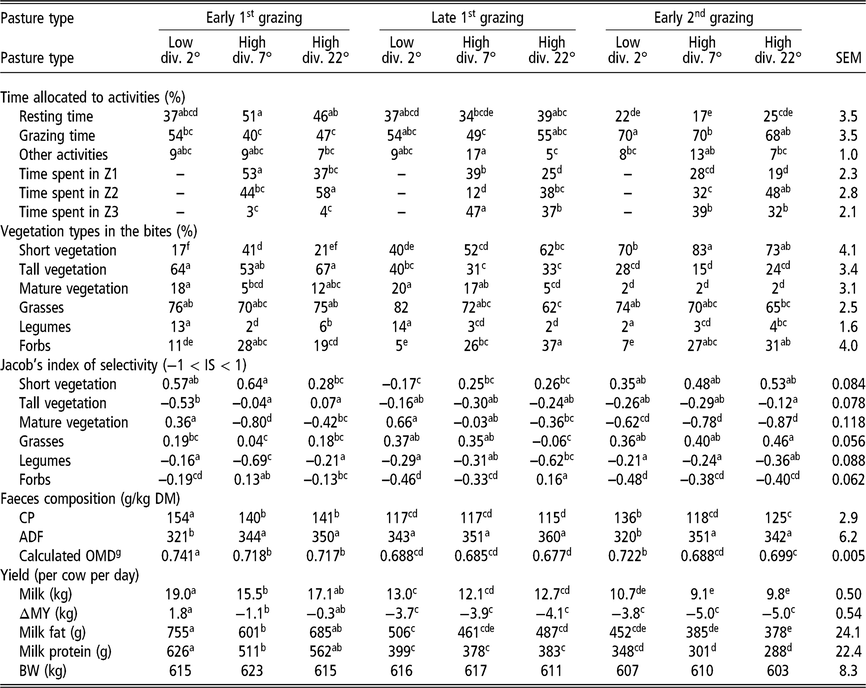
The interaction between pasture type and grazing period was significant for almost every variable (Table 2). Globally, cows spent more time on other activities (i.e. walking, exploring, drinking, etc.) on H7 than on H22 and L (Supplementary Table S3). Along with the progressing season, the time allocated for resting decreased and that for grazing increased (not significant at the transition from early to late 1st grazing cycle). These shifts were also found on the different pasture types (Table 3). Cows stayed longer in Z1 and Z3 and shorter in Z2 on H7 compared to H22 (Supplementary Table S3). With progressing season, Z1 and Z2 were less intensively visited than Z3. On a closer look, during early 1st grazing cycle, cows on H-pastures barely spent time in Z3 (Table 3). With the advancement of the season they started to visit Z3 more frequently. During late 1st grazing cycle, cows spent less time in Z3 on H22 than on H7. In early 2nd grazing cycle, cows spent the same time in Z3 on both H-pastures.
Least Square means of the grazing period × pasture-type interaction on cow’s behaviour, diet selection, faecal composition and performance

Low div. 2°: low botanical diversity, slope 2°; High div. 22°: high botanical diversity, slope 22°; High div. 7°: high botanical diversity, slope 7°.
a–f Within the same trait and effect, values without common superscripts differ; gOMG, for calculation see Materials and methods.
P-values for interaction of pasture type and grazing period (P×G) are reported in Table 2.
The proportion of short vegetation in the bites increased with progressing season (Supplementary Table S3) at the expense of tall vegetative patches, especially on L. This occurred earlier on H22 (Table 3, late 1st grazing cycle) than on H7 (early 2nd grazing cycle). During the 1st grazing cycle, IS for mature vegetation was higher on L, whereas it decreased during the 2nd grazing cycle. On H-pastures, it was already low in early 1st grazing cycle and lower on H7 than on H22 (Table 3). The IS for mature vegetation increased on H7 during the late 1st grazing cycle but decreased again during the 2nd grazing cycle. The botanical composition of the vegetation consumed stayed quite constant across the season, with some differences in the legume proportion. A preference for grasses was observed on all pastures (IS > 0), except in the late 1st grazing cycle on H22 (IS ≥ 0) (Table 3). In that period, H22 cows did not climb the steep slope to Z3 to select grasses but selected forbs in the lower parts instead (IS > 0). This resulted in a higher proportion of forbs in the cows’ bites at that time on H22. In the early 2nd grazing cycle, no differences between H7 and H22 were observed anymore.
The estimated OMD was higher on L- than on H-pastures, except during the late 1st grazing cycle where it was equivalent in all pastures (Table 3). Yield of total milk, fat and protein across all breeds was higher and ΔMY was lower on L- than on H-pastures (Supplementary Table S3). The MY substantially decreased with progressing season, leading to a high ΔMY in late 1st and early 2nd grazing cycles. Pasture type had no influence on BW, but BW declined from early 1st to 2nd grazing cycle. A closer look at this data shows that the difference in MY and in ΔMY between L- and H-pastures mainly originated from early 1st grazing cycle, whereas pasture type was less important in the two later grazing periods (Table 3).
Discussion
Breed differences according to pasture biodiversity
Unlike our hypotheses, differences in diet selection and performance between cow breeds and interactions between breed and pasture type during the season were minimal. The Va were expected to exhibit a less-selective grazing behaviour and maintain BW despite MY, as anticipated for alpine breeds (Coulon and D’Hour, Reference Coulon and D’Hour1994). However, even though the difference to MYpot was higher in percentage in Va than in Ho and especially Mo, no breed difference in BW loss along the season occurred. Still, Va were generally a little less selective towards vegetation stage and botanical composition, and this not only on high biodiversity pastures. This could also be related to their previous early experience, as suggested by Lopes et al. (Reference Lopes, Coblentz, Hoffman and Combs2013). Indeed, the strip-grazing method traditionally used for this breed in their native environment (Coppa et al., Reference Coppa, Gorlier, Lonati, Martin, Russo and Lombardi2012) aims at optimising the consumption of mature and tall swards, reducing opportunities for plant selection. Still, the lower faecal ADF content of Va compared to Ho could suggest that Va might have ingested the best digestible parts of forbs and mature vegetation. The differences shown in diet selection by Va highlighted a certain independence of the latter from the other two breeds, even though cows from all breeds were kept together.
An increasing gradient from Va to Mo and to Ho was also expected in the selection of vegetative patches, which should provide most energy to cover requirements for the prioritised milk production. Actually, the selection behaviour towards grasses differed only in Ho. It seems though that this was not sufficient to maintain a higher MY than Mo, and also not to cover the extra energy required by grazing without concentrate, as supported by the low milk protein yield. McCarthy et al. (Reference McCarthy, Horan, Rath, Linnane, O’Connor and Dillon2007) already suggested that cows selected for high MY are not able to achieve their full potential under exclusively grazing conditions. The Ho might have instead increased their total daily grazing time, as previously observed by Heublein et al. (Reference Heublein, Dohme-Meier, Sudekum, Bruckmaier, Thanner and Schori2017) and Romanzin et al. (Reference Romanzin, Corazzin, Piasentier and Bovolenta2018). Mesquita et al. (Reference Mesquita, Farruggia, Andueza, Piccard, Le Morvan, Quereuil, Carvalho, Fournier, Pomiès and Casasús2016) found minor differences between Ho and Mo on the same type of pasture, but these authors faced difficulties to link it to a more selective behaviour.
The low ΔMY of the Mo could be partly explained by their tendency to select especially short vegetative patches, and most of all their ability to avoid less digestible herbage such as forbs and mature vegetation. Moreover, cows from the three breeds showed a strong apparent aversion against legumes, which was probably due to their low height, making them difficult to access and choose without consuming tall vegetation at the same time (Coppa et al., Reference Coppa, Farruggia, Ravaglia, Pomiès, Borreani, Le Morvan and Ferlay2015). Out of the three breeds, Mo avoided legumes the least. The lower faecal ADF content of Mo compared to Ho also points towards avoidance of low-quality fibrous stems and other plants. The Mo is widespread in French mountainous regions, and thus may have well adapted to this kind of pasture. Other resilience indicators such as a high fertility and body condition score (Hazel et al., Reference Hazel, Heins and Hansen2017) as well as a high technological quality of the milk (Puppel et al., Reference Puppel, Bogusz, Golebiewski, Nalecz-Tarwacka, Kuczynska, Slorarz, Budzinski, Solarczyk, Kunowska-Slosarz and Przysucha2018) are reasons for using this breed in mountainous regions, and considering it to improve other cattle breeds in lowland systems.
Breed differences according to slope and slope effect
Both high biodiversity pastures became more heterogeneous and lost nutritional value when the season progressed, as is typical for extensive grazing systems (Farruggia et al., Reference Farruggia, Pomiès, Coppa, Ferlay, Verdier-Metz, Le Morvan, Bethier, Pompanon, Troquier and Martin2014). The Va were expected to explore the upper zones from H-pastures sooner than Mo and especially Ho, because they are lighter and had already experienced steep slopes on mountainous pastures. However, even with their assumed better agility and lower energy requirements for maintenance, just like the other breeds, Va also switched to the previously avoided zones only when the feed available was getting scarce, a phenomenon also observed by Putfarken et al. (Reference Putfarken, Dengler, Lehmann and Hardtle2008).
When abundantly available, grasses were preferred and forbs were avoided by all cows, regardless of breed, as previously shown by Dumont et al. (Reference Dumont, Garel, Ginane, Decuq, Farruggia, Pradel, Rigolot and Petit2007b) and Farruggia et al. (Reference Farruggia, Pomiès, Coppa, Ferlay, Verdier-Metz, Le Morvan, Bethier, Pompanon, Troquier and Martin2014). In addition, cows generally preferred short and tall vegetative grasses, and therefore regrazed the lower and flat zones first rather than selecting mature vegetation. This behaviour, called ‘patch grazing’ (Adler et al., Reference Adler, Raff and Lauenroth2001) was also reported by Farruggia et al. (Reference Farruggia, Pomiès, Coppa, Ferlay, Verdier-Metz, Le Morvan, Bethier, Pompanon, Troquier and Martin2014). Along with the decrease of the nutritional value of the grass, and of the grass abundance on the preferred patches, cows, regardless of breed, progressively explored the further parts of the plot, as observed by Dumont et al. (Reference Dumont, Garel, Ginane, Decuq, Farruggia, Pradel, Rigolot and Petit2007b) and Coppa et al. (Reference Coppa, Farruggia, Pradel, Lombardi and Martin2011). It seems that a higher nutritional value was maintained in the upper zone due to its more biodiverse botanical composition, different from the lower zones. However, during late 1st grazing cycle, even when the nutritional value of the herbage was not different between zones, cows grazing on pasture H7 went up to the upper zone and selected grasses which were still abundant there. On the pasture with the steepest slope, cows had to make a decision for a trade-off between having access to the most palatable feed and the physical strain to get there. They seem to have chosen to avoid the extra physical effort, as they stayed longer in the lower zone where they selected forbs. During the 2nd grazing cycle, when the nutritive value of the sward was higher on the upper zone than on the lower zone, cows chose to go up despite the physical effort needed, regardless of breed. In their own way, cows have to choose where to put priority between lactation, reproduction or ability to survive and then adapt their behaviour and physiology accordingly (Blanc et al., Reference Blanc, Bocquier, Agabriel, D’Hour and Chilliard2006). In the present experiment, in late lactation and on mountain pastures, cows might have avoided the extra physical effort of climbing slope in order to maintain their BW which was barely affected along the grazing season. Regardless of breed, their grazing behaviour was determined by their choices in the trade-off between milk production and body condition for reproduction or coping with the environmental conditions. According to Friggens et al. (Reference Friggens, Blanc, Berry and Puillet2017), repeated measurements over time have a high potential for quantification of the animal’s ability to cope with environmental challenges. Therefore, on mountain pastures, a deeper investigation on the long term, which takes into account the main life functions, is necessary.
Conclusion
In our study, only small differences in grazing behaviour and performance were observed between cows with increasing gradient of genetic merit for MY late in the lactation period. The Va was a little less selective than Mo and especially Ho, regardless of the pasture biodiversity. In the end, all breeds exhibited similar grazing behaviour by selecting preferentially vegetative grasses on all pasture types. This resulted in a similar MY decrease for all cows, regardless of pasture type and breed, even when having different previous grazing experiences. The cows’ grazing behaviour was actually more influenced by the steepness of the slope than the breed. When the season progressed, all cows looked for the best trade-off between grazing the usually preferred vegetation patches and the physical effort of climbing the steep slope to get grass with a higher nutritional value. Grazing behaviour may thus not be a trait contributing to a possibly higher short-term resilience of performance of low genetic merit cows on complex mountain pastures, compared to adapted high genetic merit cows. Therefore, the breed choice on such grasslands has to be based on system scale criteria such as longevity, fertility and possibility for local valorisation of the milk. Concerning the best use of steep mountainous pastures, the trade-off of the cows in order to save energy has to be taken into account.
Acknowledgements
The authors acknowledge the support by the French government IDEX-ISITE initiative 16-IDEX-0001 (CAP 20-25).
Declaration of interest
All authors confirm that there is no conflict of interest.
Ethics committee
The experiment was performed at Marcenat, INRA’s experimental farm (Certificate of Authorization to Experiment on Living Animals N° D 15-114-01). No ethical approval was required because of defined severity level 0.
Software and data repository resources
None of the data were deposited in an official repository.
Supplementary material
To view supplementary material for this article, please visit https://doi.org/10.1017/S175173111900079X