Executive Function (EF) is a multidimensional construct that includes a wide range of cognitive abilities that allow solving goal-directed behaviors efficiently (Lezak, Reference Lezak1995; Shallice, Reference Shallice1990; Stuss, Reference Stuss1992). EF involves identifying the problem, anticipating the necessary steps to solve it, generating a plan, organizing time and space, monitoring the plan and recalling the already accomplished steps, and showing flexibility in case there is a change in the plan. Different authors agree that EF is composed of three separated but yet integrated components: attentional control (selective and sustained attention), cognitive flexibility (working memory, attentional shifting and self-monitoring), and the establishment of goals (initiation, planning, problem solving, and strategic behavior) (Bull, Espy, & Senn, Reference Bull, Espy and Senn2004; Lezak, Reference Lezak1995; Luria, Reference Luria1973; Miyake et al., Reference Miyake, Friedman, Emerson, Witzki, Howerter and Wager2000; Neisser, Reference Neisser1967; Shallice, Reference Shallice1990; Soprano, Reference Soprano2003; Stuss, Reference Stuss1992; Walsh, Reference Walsh1978).
The development of EF begins during early childhood and continues through adolescence. The ability to plan with anticipation, to learn about the contingencies between benefits and costs of decision-making tasks, and to control and reduce impulsive behaviors continues growing through adolescence and even through the first years of adulthood (Steinberg, Reference Steinberg2007). Physiological evidence shows that the neuroanatomic regions that support EF are located in the prefrontal cortex (Boghi et al., Reference Boghi, Rasetti, Avidano, Manzone, Orsi, D'Agata and Mortara2006; Newman, Carpenter, Varma, & Just, Reference Newman, Carpenter, Varma and Just2003; Stuss & Alexander, Reference Stuss and Alexander2007), and that the neural fibers are myelinated and the frontal structure matures during childhood and adolescence (Fuster, Reference Fuster2002). This maturation process is correlated with the gradual acquisition of the abilities involved in EF, since the transmission of neural information becomes faster with the increase in myelin in the axons (Fuster, Reference Fuster2002).
A key aspect of EF is planning, which is defined as the capacity to generate and organize the necessary step sequence to carry out goal-directed behaviors (Lezak, Reference Lezak1995; Soprano, Reference Soprano2003). Traditional planning tasks, such as mazes and tower tests -as Tower of Hanoi or Tower of London- (Bull, Espy, & Wiebe, Reference Bull, Espy and Wiebe2008; Lezak, Reference Lezak1995) involve accomplishing a goal following specific rules, without a predetermined path, and within a limited period of time (Lezak, Reference Lezak1995; Shallice, Reference Shallice1990; Willcutt, Doyle, Nigg, Faraone, & Pennington, Reference Willcutt, Doyle, Nigg, Faraone and Pennington2005). Other Executive Functions, such as inhibition, cognitive flexibility, and working memory, are also involved in these tasks because to be able to solve them efficiently it is necessary to analyze possible alternatives, to choose the most adequate and inhibit the others, and to be able to recall the generated plan (Bull et al., Reference Bull, Espy and Senn2004).
The Tower of London is a planning and problem-solving task that requires a set of processes such as task organization, plan initiation, ability to retain the plan in the memory during its realization, ability to inhibit possible distracters, and the flexibility to change the strategy when necessary. The Tower of London task is a modification made by Shallice (Reference Shallice1982) to the Tower of Hanoi task (Klahr, Reference Klahr and Siegler1978; Simon, Reference Simon1975). In the Tower of London task, participants are presented with two identical tower structures, one for the examinee and the other for the examiner, with three balls of different colors (red, blue, and yellow) and three vertical rods of different height (one in which three balls can be placed, one in which two balls can be placed, and one in which only one ball can be placed). From an initial model presented (e.g. the blue ball on the short rod, the yellow one on the long rod, and the red ball on top of the yellow one), the examinee must try to match the target configuration presented on the examiner tower structure (by placing for example the yellow ball on the short rod, the blue ball on the medium-length rod and the red ball on the long rod and then following the instructions explained by the examiner, i.e. that only one ball can be moved at a time and that the problem presented has to be solved in a certain number of moves -in our example, 4-, and within a certain amount of time. To have a good performance in the Tower of London task, the participant has to have efficient planning abilities to solve the problem in the minimum number of moves possible, within a limited period of time.
Two planning measures can be obtained from this task: the score and the planning time. The score is the number of solved problems, and is the most used planning measure. The planning time is the time between the presentation of the target model and the first move, and is also called latency time. This is the period of time were an initial plan to solve the problem is generated. Problems that require more movements to be solved should need a longer planning time than problems of fewer movements. Another measure that can be obtained from this task is the level achieved in the task, where each level represents the minimum number of moves necessary to solve the items included in it, although is not frequently used. A less used measure is the total number of moves made on the tasks. This measure doesn´t discriminate the level of difficulty of the problem solved, it only sums the amount of movements made by the children. Other time measures that can be obtained from this instrument are the execution time, which is the time between the first movement and the last one, and the total time, that is the planning time plus the execution time. This last time measure is used to determine whether the participant has solved the problem within the time limit given by the examiner, and is one of the elements that is taken into consideration to determine if the problem is correctly solved. Execution time can give information about subject variables such as distractibility or even lack of interest in solving the task, but not about the ability to generate and organize the necessary step sequence to solve the problem.
Regarding the number of problems solved as a planning measure, different works have demonstrated that the efficiency in the performance of the Tower of London task progressively increases between 3 and 14 years of age, where it reaches that of an adult (Krikorian, Bartok, & Gay, 1994b; Lipina, Martelli, Vuelta, Injoque Ricle, & Colombo, Reference Lipina, Martelli, Vuelta, Injoque Ricle and Colombo2004; Mahone et al., Reference Mahone, Cirino, Cutting, Cerrone, Hagelthorn, Hiemenz and Dencklaa2002; Malloy-Diniz et al., Reference Malloy-Diniz, Cardoso-Martins, Nassif, Levy, Leite and Fuentes2008). Fewer studies have been carried out regarding planning or latency time as a planning measure, especially in normal samples. In a study with young adults between 18 and 25 years old, Phillips, Wynn, Gilhooly, Della Sala, and Logie (Reference Phillips, Wynn, Gilhooly, Della Sala and Logie1999) found that planning time increases along with the number of moves necessary to solve the problem. On the other hand, Huizinga, Dolan, and van der Molen (Reference Huizinga, Dolan and van der Molen2006) worked with groups of 7, 11, 15, and 21 years old and found that planning time decreases between 7 and 15 years of age, and that the planning time of the 15-year-old participants was not significantly different from that of the 21-year-old ones. The sum of the number of moves to solution of all the problems of the task is rarely used as planning measure. In a developmental study of planning using Tower of Hanoi in children from 6 to 12 years old, Díaz et al. (2012) concluded that planning progressively improves with age and found three different moments: the performance of the first grade children was significantly lower than the performance of the rest of the sample, the performance of the children from second to fourth grade was similar, with no significant differences, and the performance of the children from fifth and sixth grade was significantly higher than that of the rest of the sample, with no significant differences between each other.
Knowing the normal development of EF has a great importance since its normal functioning is crucial to the performance of a great deal of every-day tasks, including some that are important to accomplish good academic achievements. In addition, its functioning is impaired in different developmental disorders such as ADHD (Happé, Booth, Charlton, & Hughes, Reference Happé, Booth, Charlton and Hughes2006; Shimoni, Engel-Yeger, & Tirosh, Reference Shimoni, Engel-Yeger and Tirosh2012; Willcutt et al., Reference Willcutt, Doyle, Nigg, Faraone and Pennington2005) or autism (Gilbert, Bird, Brindley, Frith, & Burgess, Reference Gilbert, Bird, Brindley, Frith and Burgess2008; Happé et al., Reference Happé, Booth, Charlton and Hughes2006; Hill, Reference Hill2004; Robinson, Goddard, Dritschel, Wisley, & Howlin, Reference Robinson, Goddard, Dritschel, Wisley and Howlin2009). Therefore, having information about the normal development of the EF allows professionals to detect its impairment.
The aim of this study was to assess the normal development of planning in children, measured in terms of planning time in the Tower of London task, and to determine if planning time is a valid measure of planning. We evaluated if planning time increases along with the difficulty of the problems, and if within a same level of difficulty, it decreases as the age of the children increases.
Method
Participants
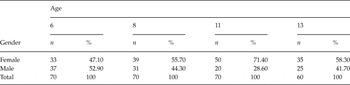
A total of 270 children participated in the study. They belonged to four age groups: 6- (n = 70), 8- (n = 70), 11- (n = 70), and 13 years old (n = 60). Descriptive statistics and distribution of gender by group are shown in Table 1. The 6- (mean age in months = 78.90, SD = 3.30), 8- (mean age in months = 101.17, SD = 3.35), and 11-year-old groups (mean age in months = 137.95, SD = 2.79) attended two middle-class public elementary-level schools in the city of Buenos Aires, whereas the 13-year-old group (mean age in months = 161.62, SD = 3.79) attended a middle-class public high school in Buenos Aires City. The participants represent a sample of convenience. All children participated with the informed consent of their parents, after attending an informative meeting about the study. Children with diagnosed psychiatric or neurological condition, language or hearing impairment, or with a history of academic failure (repeating course) were excluded from the study. This information was provided by the school registers.
Descriptive Statistics and Gender Distribution by Age Group

Instruments
Tower of London (TOL; Injoque-Ricle & Burin, Reference Injoque-Ricle and Burin2008, Reference Injoque-Ricle and Burin2011; Shallice, Reference Shallice1982). The TOL consists of two wooden tower structures with a 26 x 4.5 x 3.5 cm base, three 0.8 diameters vertical rods of different length (4.5, 9, and 15 cm), and three 5 cm diameter balls (a red, a yellow and a blue one). The task has seven levels of increasing difficulty, with three problems each. Difficulty of the problems was tested on a previous study. Increase in the difficulty of the problems along with the increase in movements -inter-level difficulty-, and that all problems of the same level had similar level of difficulty -intra-level difficulty- was verified (see Injoque-Ricle & Burin, Reference Injoque-Ricle and Burin2008). To move to the next level, which involves problems with one more move than the previous one, the participants have to solve at least two of the three problems of that level efficiently. A problem is considered solved when the final configuration -shown in the examiner’s tower structure- is reached, within the certain number of moves and within a certain period of time: 15 seconds for levels 1 and 2, 30 seconds for levels 3 and 4, 45 seconds for levels 5 and 6, and 60 seconds for level 7 (see Injoque-Ricle & Burin, Reference Injoque-Ricle and Burin2008 for a detailed explanation of how this time limits were estimated). A score is given for each problem solved correctly. One point is given when a problem is solved correctly in the first level; two points are given to correct solved problems in the second level, and so on for the next five levels. Finally, all partial scores are added, thus obtaining a total task score. A schematic representation of the solution of one of the problems can be found on Injoque-Ricle and Burin (Reference Injoque-Ricle and Burin2008).
Regarding psychometric properties, within the adaptation process (Injoque-Ricle & Burin, Reference Injoque-Ricle and Burin2008, Reference Injoque-Ricle and Burin2011) acceptable reliability indexes were found (α = .73) and evidence of convergent and discriminant validity were found.
Procedure
Each child was tested in a quiet room inside the school during a 30-minute session.
Data analysis
To determine whether there were statistical differences between the age groups regarding total score and level, two one-way analyses of variance (ANOVA) and a Bonferroni post hoc analysis for multiple group comparison were conducted. Planning times -the time between the presentation of the target model and the first move- were compared by a repeated measures ANOVA. To compare the planning times of the correct and incorrect problems in each level, a 6 x 2 (level x correct/incorrect) repeated measures ANOVA was conducted. To compare the planning times of the correct problems within each level across all age groups and across all levels within one age group, a second repeated measures ANOVA was conducted. Finally, a 6 x 4 x 2 (the planning times of the correct problems x age x gender) repeated measures ANOVA was conducted to establish differences in planning time of correct problems between boys and girls within each age group. All analyses were conducted using the statistical software SPSS.21.
Results
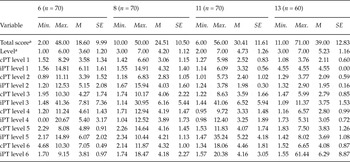
Total TOL score, level, planning time of the correct problems by level, and planning time for the incorrect levels were analyzed. Since none of the 6-year-old children were able to do any of the seventh level problems, this level was excluded from the analysis, although descriptive statistics (shown on Table 2) are presented for the complete task for the variables “score” and “level”. Errors on level one were due to extra movements -children made a first erroneous movement and corrected it immediately-.
Descriptive Statistics of the Variables for Each Group Age

Note: cPT: Correct problems planning time in seconds ; iPC: Incorrect problems planning time in seconds; a: “Total score” and “Level” variables were estimated including all seven levels of the task, even when the data analysis were conducted with the first six levels.
Differences in total scores among all ages were found F(3, 266) = 38.870; MSE = 125.915; p < .01; η2 = .305. Post hoc analysis showed significant differences between all groups (6–8: p = .01; 8–11: p = .01; 11–13: p < .01). Regarding the level reached in the different age groups, the one-way ANOVA showed significant differences F(3, 266) = 22.911; MSE = 1.408; p < .01; η2 = .205. Post hoc analysis showed differences only between the 6-year-old and the 8-year-old groups (p = .02).
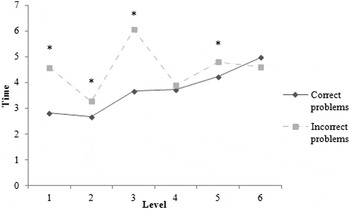
The analysis of the planning time of correct problems vs. that of the incorrect problems showed a significant interaction effect with the level F(5, 1345) = 23.477; MSE = 6.460; p < .01; η2 = .080. The difference between the planning time of correct and incorrect problems was significant in levels 1 (p < .01), 2 (p < .01), 3 (p < .01), and 5 (p < .01) (see Figure 1).
Planning times of correct and incorrect problem means for each TOL level.

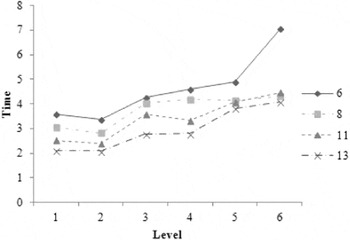
Because significant differences between the planning times of correct and incorrect problems were found in most levels, the following analyses were conducted using only the planning time of correct problems (from now on referred simply as “planning time”). The first repeated measures ANOVA showed an interaction effect between level*age F(15, 1330) = 8.787; MSE = 1.441; p < .01; η2 =.090. For each age group, we found that the planning time increased along with the level, starting at level 2. Level 1 had in all cases higher planning time than level two, although no significant differences were found. Within the 6-year-old group, the increase in planning time was significant between levels 2 and 3 (p < .01), and between levels 5 and 6 (p < .01). Within the 8-year-old group, the planning time increased significantly between levels 2 and 3 (p < .01), and decreased between levels 4 and 5, although not significantly. Within the 11-year-old group, the planning time increased significantly between levels 2 and 3 (p < .01), 4 and 5 (p < .01), and 5 and 6 (p < .05), and decreased not significantly between levels 3 and 4. Finally, within the 13-year-old group, the planning time increased significantly between levels 2 and 3 (p < .01), and 4 and 5 (p < .01) (Figure 2).
Mean planning times of correct problems on different levels by age group.

When the planning times of a same level were compared along the four age groups, the analysis showed for level 1 that it decreased significantly and progressively as the age increased (p < .01). The same was found in level 2 (6–8 and 8–11: p < .01; 11–13: p < .05). In level 3, the time also decreased progressively between the age groups, but only significantly between the 8-year-old and the 11-year-old groups (p < .05) and between the 11-year-old and the 13-year-old groups (p < .01). In level 4 results showed the same pattern as in levels 1 and 2 (6–8: p < .05; 8–11 and 11–13: p < .01). Regarding level 5, although the planning time decreased between all age groups, it was significant only between the 6-year-old and the 8-year-old groups (p < .01). Finally, in level 6 the planning time decreased significantly between the 6-year-old and the 8-year-old groups (p < .01), and between the 8-year-old and the 11-year-old groups (p < .05), and increased between the 11-year-old and the 13-year-old groups, although not significantly (Figure 2).
No interaction was found between level and gender F(5, 1310) = 1.953; MSE = 1.431; p = .083; η2 = .007 and among level, gender and age F(15, 1310) = 1.355; MSE = 1.431; p = .162; η2 = .015.
Discussion
Planning is a key aspect of EF. Allows an individual to generate and organize the step sequence involved in goal-directed behaviors. This ability is essential in every-day life, and in childhood its related to academic achievement, since its involved in arithmetic problem solving and in the correct execution of all assignments that implies accomplishing a goal and a following a series of steps. Several studies have investigated the impairment of planning and other EF during childhood in developmental disorders (Gilbert et al., Reference Gilbert, Bird, Brindley, Frith and Burgess2008; Happé et al., Reference Happé, Booth, Charlton and Hughes2006; Hill, Reference Hill2004; Robinson et al., Reference Robinson, Goddard, Dritschel, Wisley and Howlin2009; Shimoni et al., Reference Shimoni, Engel-Yeger and Tirosh2012; Willcutt et al., Reference Willcutt, Doyle, Nigg, Faraone and Pennington2005), but a few have studied the normal development of these functions. That is why the main aim of this study was to assess the development of planning in children. Also, another aim was to determine if planning or latency time is a valid measure of planning. For this purpose, the Tower of London task was used in 270 children divided in four age groups (6, 8, 11, and 13 years old). The measure of planning used was the time between the presentation of the target and the first move done by the participant, but also the total score and the level reached.
An initial approach to the data was through the performance of the task, measured as the total score achieved. The analysis showed that the performance improved with age. These findings are in the same line of those of Krikorian et al. (Reference Krikorian, Bartok and Gay1994), Lipina et al. (Reference Lipina, Martelli, Vuelta, Injoque Ricle and Colombo2004), Malloy-Diniz (Reference Malloy-Diniz, Cardoso-Martins, Nassif, Levy, Leite and Fuentes2008), and Steinberg (2002), who found a progressive improvement in the scores in the Tower of London between 3 and 14 years of age. Regarding the maximum number of moves reached, the 6-year-old group differentiated from the rest of the groups, reaching the maximum possible level of the task. Although there were no differences in the maximum number of moves that the three older groups could do, there were differences regarding the efficiency with which they reach it. That is shown by the differences found in the performance of each group.
The analysis made with planning time first showed that there were differences between the planning time of the correct problems and the one of the incorrect problems in all levels except levels 4 and 6. A short planning time could represent a rapid plan elaboration or an impulsive behavior to start solving the task without having a plan of action. When solving a TOL problem, an impulsive behavior generally implies extra movements, since it becomes a trial and error problem solution, and this result in an incorrect problem. Because of this, the next analyses were conducted using the correct problems. To determine whether the planning time increases along with the complexity of the task, the planning time of all levels were compared within each group. Results showed that the planning time increases progressively from level two, and that this increase was significant in half of the cases. When the increase was not significant, it could indicate that although the problems of consecutive levels of difficulty in terms of number of minimum moves required to solve the problem, the time needed to generate and organize the sequence of steps for its resolution is the same. An example of this can be between levels 3 and 4 in the 6-, 8-, or 11-years old groups. The same conclusion can be drawn from the fact that in some cases the planning time of a lower difficulty level was non-significantly higher than the planning time of a higher difficulty level, as levels 4 and 5 in the 8-year-old group or levels 3 and 4 in the 11-year-old group. It can thus be concluded that the amount of time required to generate and organize the plan increases along with the difficulty of the problems. This follows the results found by Phillips et al. (Reference Phillips, Wynn, Gilhooly, Della Sala and Logie1999). The last analysis made with the planning time of the correct problems explored if the planning time of a level decreased along with the increase in the age. In levels 1, 2, and 4, the results showed that planning time decreased progressively and significantly across all groups. In level 3, although the time decreased from the 6-year-old to the 8-year-old groups, the difference was not significant. In level 5, the decrease was significant only between the 6-year-old and the 8-year-old groups. Finally, in level 6, a significant decrease was found between the 6-year-old and the 8-year-old groups and between the 11-year-old and the 13-year-old groups. In this level, an increase in the planning time between the 8-year-old and the 11-year-old groups was found, although it was non-significant. These results could indicate that although the decrease in the planning time is not always significant, when the children are older they need less time to generate and organize the necessary step sequence to solve the same problems than when they are younger. These results also agree with those found by Huizinga et al. (2006), who, even if they did not carry out a detailed analysis by levels, reported a decrease in planning time between the ages of 7 and 15, and a lack of differences between the ages of 15 and 21.
The findings of both analyses of the planning times of the correct problems are congruent between each other, and indicate that the time required to generate and organize the step sequence to carry out a goal-directed problem is longer as the difficulty of the level increases, and that older children need less time to solve problems with a certain level of difficulty than younger children. This demonstrates the evolutional development of planning through childhood and the first years of adolescence.
Finally, the analysis of the planning time, along with the analysis of the total scores, show evidence in favor of construct validity of the Tower of London task, and both measures demonstrated to be valid planning measures.
This study provides information about the validity of two measures of the Tower of London task, along with information about the normal development of planning ability in children, which is important for educational and psychological professionals to early identify impairments in this EF aspect.
This research was supported by the Consejo Nacional de Investigaciones Científicas y Técnicas (CONICET; Res. N° 258/06 and Res. N° 3100/08) and by the Secretaría de Ciencia y Técnica, Universidad de Buenos Aires (SECyT; UBACyT P016).