INTRODUCTION
The number of over-exploited fish and shellfish stocks has increased markedly over the years (Jackson et al., Reference Jackson, Kirby, Berger, Bjorndal, Botsford, Bourque, Bradbury, Cooke, Erlandson, Estes, Hughes, Kidwell, Lange, Lenihan, Pandolfi, Peterson, Steneck, Tegner and Warner2001; Myers & Worm, Reference Myers and Worm2003) and this has led to a greater need to protect and conserve fished populations. Fishery management has traditionally been done in two forms: management of catch by restrictions of gear or catch limits, or management of effort, which can include limitation of the number of vessels or licences and the establishment of closed seasons (Roberts & Polunin, Reference Roberts and Polunin1991). These approaches, although mainly designed for single-species fisheries (Roberts & Polunin, Reference Roberts and Polunin1991), have been successful in many cases, leading to increased yields of exploited species (Ye, Reference Ye1998; Govender et al., Reference Govender, Al-Oufi, McIlwain and Claereboudt2006; Fernández-Rueda & García-Florez, Reference Fernández-Rueda and García-Florez2007). The establishment of no-take marine reserves, areas closed to fishing or any extractive activity, has been suggested as a viable alternative to single-species fishery-management approaches (Roberts & Polunin, Reference Roberts and Polunin1991; Lubchenco et al., Reference Lubchenco, Palumbi, Gaines and Andelman2003) and there is mounting evidence that marine reserves have a diverse range of effects that are generally regarded as positive (Halpern & Warner, Reference Halpern and Warner2002; Halpern, Reference Halpern2003; Micheli et al., Reference Micheli, Halpern, Botsford and Warner2004; Guidetti & Sala, Reference Guidetti and Sala2007; Claudet et al., Reference Claudet, Osenberg, Benedetti-Cecchi, Domenici, García-Charton, Ruzafa, Badalamenti, Bayle-Sempere, Brito, Bulleri, Culioli, Dimech, Falco, Guala, Milazzo, Sánchez-Meca, Somerfield, Stobart, Vandeperre, Valle and Planes2008), making marine reserves an important tool in coastal management and conservation. For instance, since all fishing methods are size-selective, most targeting the larger individuals, fishing pressure will lead to a decrease in average size of target species. Cessation of fishing has been shown to increase average size of target species compared to fished areas (Branch, Reference Branch1975; Bell, Reference Bell1983; McClanahan & Muthiga, Reference McClanahan and Muthiga1988; Lasiak, Reference Lasiak1993; Branch & Moreno, Reference Branch, Moreno and Siegfried1994). Reduced mortality rates within reserves also result in increasing abundances of fished stocks (Bell, Reference Bell1983; Alcala, Reference Alcala1988; Halpern, Reference Halpern2003; Micheli et al., Reference Micheli, Halpern, Botsford and Warner2004; Guidetti & Sala, Reference Guidetti and Sala2007). The combined effects of increased abundance and size can benefit adjacent fished areas via emigration of adults and juveniles across borders (spill-over effects) and via increased production and export of pelagic eggs and larvae (Gell & Roberts, Reference Gell and Roberts2003; Kaunda-Arara & Rose, Reference Kaunda-Arara and Rose2004; Abesamis & Russ, Reference Abesamis and Russ2005). The effects of marine reserves appear stable and long-lasting (Shears & Babcock, Reference Shears and Babcock2003) indicating that they can be used as a valuable strategy for the protection and management of fisheries.
The Azores archipelago is located in the North Atlantic (between 37°N25°W and 40°N31°W) and comprises nine volcanic islands and several small islets. Human occupation dates back to the 15th Century and there is a local tradition of exploiting coastal biotic resources such as fish, lobsters, algae, limpets and barnacles for food (Morton et al., Reference Morton, Britton and Martins1998). Limpets have been harvested probably since the islands were first colonized and were once the 6th most profitable fishery in the region, being an important source of income for many families (Ferraz et al., Reference Ferraz, Menezes and Santos2001). Due to their low mobility, intertidal limpets can be particularly vulnerable to harvesting. For instance, harvesting of the limpet Cymbula oculus in South Africa resulted in significant reductions in size, density, biomass, survivorship, reproductive output and in distorted sex-ratios (Branch & Odendaal, Reference Branch and Odendaal2003). In the Azores, uncontrolled harvesting of limpets during the early 1980s resulted in dramatic decline in limpet populations and the fishery collapsed in 1985 (Martins et al., Reference Martins, Santos and Hawkins1987; Santos et al., Reference Santos, Martins and Hawkins1990; Hawkins et al., Reference Hawkins, Côrte-Real, Pannacciulli, Weber and Bishop2000) leading to dramatic changes in the community structure and functioning of Azorean coasts (Martins et al., Reference Martins, Jenkins, Hawkins, Neto and Thompson2008a). In 1993, legislation was passed to protect this resource including the establishment of limpet protected zones (LPZs), seasonal fishing closures and minimum legal catch sizes. LPZs comprise stretches of coast of a few kilometres where the collection of limpets is strictly prohibited throughout the year, although other extractive activities are permitted. Three to four LPZs were established in each of the nine islands of the archipelago. Management of LPZs is done via regular visits by the local authorities to the protected areas but no physical barriers exist.
In 2006, a monitoring programme was established in São Miguel, the most exploited of the nine islands (Martins et al., Reference Martins, Jenkins, Hawkins, Neto and Thompson2008a), to assess the effectiveness of LPZs and here we report on the first 3-years of data. The extent to which illegal harvesting could affect the success of LPZs was also examined.
MATERIALS AND METHODS
Study sites
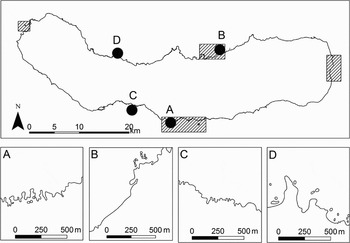
The study was done in São Miguel Island, Azores. São Miguel is the most developed island of the archipelago with a human population of ~130,000 in 2007 (SREA—Secretaria Regional de Estatística dos Açores). The main economic activities are dairy and fisheries although tourism is a developing industry. The study described and compared the population structure of limpets between two LPZs established in 1993, Caloura and Maia, and two locations outside LPZs, Lagoa and Fenais-da-Luz (Figure 1), during 3 replicate years (2006–2008). Inside LPZs, limpet harvesting is completely prohibited throughout the year. Outside the LPZs, there is a seasonal fishing closure between October and May that prohibits the harvesting of limpets. However, between June and September, limpet harvesting is allowed although there are minimum legal catch sizes of 30 and 55 mm shell length for Patella candei d'Orbigny, 1840 and P. aspera Röding, 1798, respectively. The two locations selected outside the LPZs (hereafter referred to as seasonal closed areas (SCAs)) were considered to be representative of the remainder of the coast.
Map of São Miguel Island showing the established limpet protected zones (shaded areas) and the sampled locations (filled circles): A, Caloura; B, Maia; C, Lagoa; D, Fenais.

The four locations examined each comprised a stretch of the coast of 500 m and supported similar assemblages of animals and plants. The dominant space occupiers were turf-forming algae (e.g. articulated coralline algae, Gelidium spp. and Caulacanthus ustulatus) lower on the shore and the chthamalid barnacle Chathamalus stellatus upper on the shore. The four locations were all exposed to wave-action, had steep slope and were made of basaltic rock. There was no a priori reason to believe that LPZs and SCAs differ in any way other than the level of protection. However, since the two selected LPZs were located respectively on the southern or northern coasts, which may differ in exposure to swell due to the prevailing north-easterly winds (Instituto Hidrográfico, 2006), the two SCAs were respectively selected on the northern and southern coasts to match conditions in the two LPZs.
Sampling design
Data on limpet population structure from periods prior to the establishment of LPZs were not available. Hence, to examine the effectiveness of LPZs in enhancing the stocks of limpets, the population structure of the exploited limpet Patella candei was compared between the four locations over a period of 3 years. Formal comparisons were made for P. candei, but not P. aspera, as the latter is rare in the intertidal throughout São Miguel (Martins et al., Reference Martins, Jenkins, Hawkins, Neto and Thompson2008a).
At each location, a total of four sites were haphazardly selected at least 30 m apart. Two interspersed sites were assigned to the open harvesting season, whereas the remaining two sites were assigned to the closed harvesting season (see below for further details). Within each site, all P. candei within ten 25 × 25 cm quadrats were counted and their shell length measured to the nearest millimetre. No animals were dislodged during sampling. The vertical position of samples was defined by the major biological patterns on the shore. Sampling was done in the barnacle zone immediately above the upper vertical limit of the dense cover of turf-forming algae that characterized the lower shore. This corresponded to the tidal level where the abundance of P. candei was greatest (Martins et al., Reference Martins, Thompson, Hawkins, Neto and Jenkins2008b). Analysis of data considered limpet density, size and biomass. The weight of each limpet was estimated indirectly using a previously calculated length–weight relationship (biomass (g) = 0.0001 × shell length (mm)2.79, r2 = 0.96; Martins et al., Reference Martins, Jenkins, Hawkins, Neto and Thompson2008a; Martins, Reference Martins2009). The estimated biomass of all animals in each quadrat was summed and used in the analysis.
Illegal harvesting of limpets was known to occur in the Azores (Martins, personal observation). To estimate its intensity, the number of limpet harvesters was recorded during each field trip to the shore (these were not restricted to visits made for the purpose of the present study). Although these data were not collected in a structured way (with respect to times of day, season, or number of replicates) they did provide an indication of the frequency of limpet harvesting throughout the study period. In the first 2 years of the study, analyses of limpet abundance revealed no significant differences between fished areas and LPZs (see Tables 2 & 3), suggesting that illegal harvesting was nullifying the intended protection of limpets in LPZs. This motivated a more standardized estimation of the intensity of illegal harvesting, which was done during the third year of the study. This was accomplished by assessing the number of limpet harvesters per day on each of 10 randomly selected occasions in each of two seasons: closed and open. Each sampling event had a fixed duration of 2 hours (starting ~1 hour before low tide). Due to logistical constraints, data on harvesting were collected only at two of the four locations: Caloura (LPZ) and Lagoa (SCA), which are both on the south coast. We recognize that this design is pseudo-replicated in that only one location per level of protection was sampled. However, given the logistical constraints, we opted to maximize sampling effort by increasing the number of visits made to two locations at the expense of a properly balanced design. The results must therefore be interpreted with caution, and in the light of other potential influences on the effectiveness of LPZs. The data on harvesting gathered in the first 2 years in an unstructured manner are hereafter referred to as ‘non-standardized’, and the data gathered in a formal manner in the third year as ‘standardized’.
Data analysis
Data were analysed using analysis of variance (ANOVA). Prior to analysis, data were checked for heterogeneity of variances using the Cochran's test and transformations were applied where appropriate (Underwood, Reference Underwood1997). To examine the cumulative effects of protection, data were first analysed by combining data corresponding to each site from each of the 3 years. Mean limpet density and biomass were analysed using a four-way mixed model ANOVA with season (2 levels: open and closed; fixed and orthogonal), protection (2 levels: LPZ and SC; fixed and orthogonal), location (2 levels random and nested within protection), site (2 levels random and nested within time, protection and location) and 30 replicates (10 per year). Data were further examined by running the analysis separately for each year. The factor year was not considered in the analyses in order to provide a denominator for the terms of interest (Underwood, Reference Underwood1997). These analyses allowed us to examine the cumulative effects of protection (all years combined) as well as the inter-annual variability in the effect of LPZs.
The size structure of limpet populations in LPZs and SCAs was compared using the Kolmogorov–Smirnov test. For each year, data were combined among spatial scales (locations and sites) within each level of protection.
The non-standardized estimates of limpet harvesting intensity were analysed using 95% confidence intervals. For the standardized data, a two-way factorial ANOVA with season (2 levels fixed) and location (2 levels fixed) and 10 replicates was used.
RESULTS
Limpet population structure
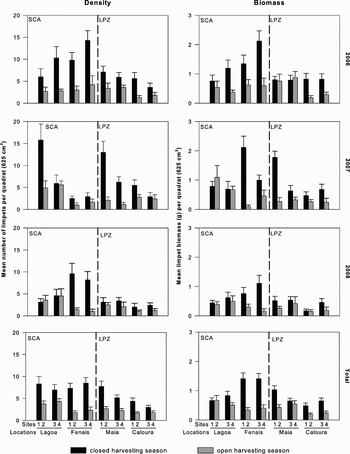
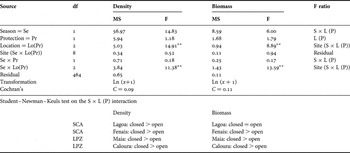
A total of 2150 Patella candei was counted during the 3 years of the study and had a mean shell length of 12.4 ± 0.1 mm (mean ± 1SE) and 13.0 ± 0.1 mm outside and inside LPZs, respectively. When considering cumulative effects of LPZs (all the 3-years combined), although data suggest that, on average, SCAs supported a greater abundance of limpets than did LPZs (Figure 2) the difference was not significant (Table 1). There was, however, a significant ‘season × location’ interaction (Table 1). Student–Newman–Keuls (SNK) tests revealed that limpet density was significantly greater by the end of the closed fishing season regardless of the level of protection (Figure 2; Table 1). Similar results were also obtained for the limpet biomass (Figure 2; Table 1).
Mean (±1SE) density and biomass of Patella candei at the end of the open and closed harvesting seasons. Data are presented for each year separately and combined. SCA, seasonal closed area; LPZ, limpet protected zone. Numbers 1–4 indicate the sites examined within each location at each of the harvesting seasons, respectively.

Four-way mixed model ANOVA comparing the abundance and biomass of Patella candei at the end of the open and closed harvesting seasons in areas differing in the level of protection (limpet protected zone versus seasonally closed area). Data were pooled over the three years of the study.

Here and afterwards: *, P < 0.05; **, P < 0.01; ***, P < 0.001.
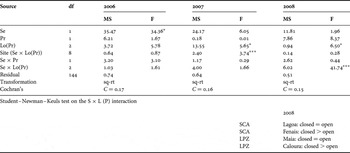
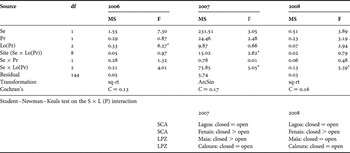
Despite significant variation in space and time, the main factor ‘protection’ and the interaction ‘protection × season’ were never significant in any of the 3 years examined (Tables 2 & 3) suggesting that there was no inter-annual variation in the effect of protection between LPZs and SCAs. There was, however, a significant effect of season in limpet density in 2006 (Table 2) and interactive effects of season and location (within levels of protection) on density of limpets in 2008 (Table 2) and on biomass of limpets in both 2007 and 2008 (Table 3). SNK analyses revealed that limpet abundance and biomass generally tended to be greater by the end of the closed harvesting season.
Four-way mixed model ANOVA comparing the abundance of Patella candei at the end of the open and closed harvesting seasons in areas differing in the level of protection (limpet protected zone versus seasonally closed area). Legend and P values as in Table 1.

Four-way mixed model ANOVA comparing the biomass of Patella candei at the end of the open and closed harvesting seasons in areas differing in the level of protection (limpet protected zone versus seasonally closed area). Legend and P values as in Table 1.

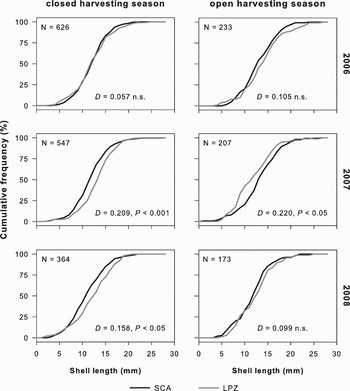
Analysis of size structure showed inconsistent results between years (Figure 3). At the end of the closed harvesting season, limpets were significantly larger outside the LPZ in 2007 and 2008 but not in 2006. At the end of the open harvesting season, however, limpets inside the LPZs were larger than in SCAs only in 2007, suggesting that protection in the form of LPZs is generally ineffective.
Cumulative frequency of population size structure of Patella candei. Data were pooled among locations. The result of the Kolmogorov–Smirnov test is shown. SCA, seasonally closed area; LPZ, limpet protected zone; n.s., not significant at α = 0.05.

It should be noted that the density of limpets decreased by the end of the open fishing season in both LPZs and SCAs and that no specimen was larger than the legal minimum size (30 mm shell length). Hence, it would appear that illegal exploitation was occurring inside LPZs.
Limpet harvesting
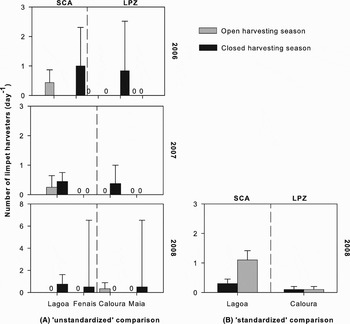
Limpet harvesting was observed in both the LPZs and SCAs. The non-standardized data (Figure 4A) showed that, over a period of 3 years, limpets were collected irrespective of location status (LPZ versus SCA) or season (open versus closed harvesting season). Note that sampling effort was substantially different among locations. For instance, Lagoa and Maia were visited over 15 times per year, whilst Fenais and Maia were visited only 2–3 times per year. This probably explains the greater number of zeros at these locations (Figure 4A).
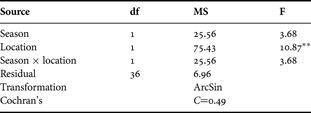
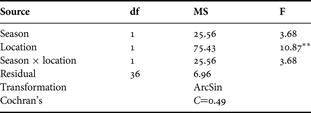
The standardized analysis (Figure 4B) showed that harvesting frequency was significantly greater in the SCA with a per-day number of harvesters of 0.7 ± 0.2 (mean ± 1SE) in comparison with the 0.1 ± 0.1 in the LPZ (Table 4). The number of harvesters did not show significant variation between seasons although it tended to be greater during the open fishing season in the SCA (closed fishing season: 0.3 ± 0.2 harvesters.day−1; open fishing season: 1.1 ± 0.3 harvesters.day−1).
Mean (+CI) number of limpet harvesters recorded over the 3 years of the study estimated in an ‘unstandardized’ way (A) and mean (+SE) number of limpet harvesters recorded in 2008 in a ‘standardized’ way (see Materials and Methods for further description) (B). SCA, seasonally closed area; LPZ, limpet protected zone. Zeros (‘0’) indicate that no harvesters were seen during sampling. Note differences in y-axes scales and that only one location was used per level of protection (SCA versus LPZ) in the ‘standardized’ comparison.

Two-way factorial ANOVA comparing the per day mean number of limpet harvesters in two locations (one limpet protected zone and one seasonally closed area) during the open and closed harvesting seasons of 2008. This corresponds to the analysis of the ‘standardized’ comparison (see Materials and Methods for further details).
DISCUSSION
Two main reasons are usually advocated for use of closed fishing seasons: reduction of effort and avoidance of disturbance during reproduction. The latter argument is of little importance for species such as limpets that do not aggregate to reproduce or whose reproduction is not affected by the act of harvesting (Arendse et al., Reference Arendse, Govender and Branch2007). Closed fishing seasons can, however, be an effective means of reducing overall fishing effort. In our study, the cumulative effects of LPZs and SCAs on limpet abundance and biomass were similar and there was only a marginal effect of LPZs on mean animal size. This could suggest either that harvesting of limpets during the open fishing season has little effect on limpet population structure, or that LPZs are ineffective. Considering that population structure of limpets (both in LPZs and SCAs) showed clear signs of exploitation (no individuals were larger than the legal catch size and the abundance decreased during the open fishing season), this suggests that inefficiency of LPZs (e.g. due to illegal harvesting) is a more plausible explanation.
Martins et al. (Reference Martins, Santos and Hawkins1987) have argued that the opportunistic life-history of P. candei renders it relatively insensitive to recruitment exploitation. However, populations of P. candei are now extinct in all but one of the 9 islands of the Canaries (Núñez et al., Reference Núñez, Brito, Riera, Docoito and Monterroso2003). In the Azores, there was evidence of recruitment failure in the smaller islands (Martins et al., Reference Martins, Jenkins, Hawkins, Neto and Thompson2008a). In addition, compared to 1988 (Hawkins et al., Reference Hawkins, Burnay, Neto, Cunha and Martins1990), the mean abundance of Patella candei decreased from ~ 61 to 7.2 m−2 (Caloura, was used for comparison and data were pooled over the 3 years for the present study). Such dramatic decrease in population despite 16 years of ostensible protection suggests that not only is P. candei susceptible to recruitment exploitation but that LPZs and SCAs have been largely ineffective as a means of protection.
Generally, only season had a significant effect on limpet abundance, which was greater at the end of the closed fishing season. However, this was evident in both LPZs and SCAs suggesting that this was not the result of fishing closed seasons per se. Although P. candei can spawn throughout the year (Martins et al., Reference Martins, Santos and Hawkins1987), recent work has shown that there is a peak spawning event occurring in late summer (Cúrdia et al., Reference Cúrdia, Rodrigues, Martins and Costa2005). Hence, the greater abundance of limpets by the end of the closed harvesting season was probably the result of previous recruitment.
The abundance and size of exploited species generally increases after the establishment of marine reserves (Halpern & Warner, Reference Halpern and Warner2002; Halpern, Reference Halpern2003; Micheli et al., Reference Micheli, Halpern, Botsford and Warner2004; Guidetti & Sala, Reference Guidetti and Sala2007; Claudet et al., Reference Claudet, Osenberg, Benedetti-Cecchi, Domenici, García-Charton, Ruzafa, Badalamenti, Bayle-Sempere, Brito, Bulleri, Culioli, Dimech, Falco, Guala, Milazzo, Sánchez-Meca, Somerfield, Stobart, Vandeperre, Valle and Planes2008). What is affecting the lack of recovery of limpet stocks in the Azores? Lack of significant effects of marine reserves have also been reported. For instance, Parnell et al. (Reference Parnell, Lennert-Cody, Stanley and Dayton2005) showed no clear benefits from protection in a marine reserve in California 30 years after fishing ceased. Likewise, Denny & Babcock (Reference Denny and Babcock2004) showed that a seasonal restriction to fishing in New Zealand was ineffective in protecting the locally exploited stocks of snappers. Illegal harvesting can severely influence the success of conservation strategies (Kritzer, Reference Kritzer2004; Little et al., Reference Little, Smith, McDonald, Punt, Mapstone, Pantus and Davies2005; Samoilys et al., Reference Samoilys, Martin-Smith, Giles, Cabrera, Anticamara, Bruno and Vincent2007; Guidetti et al., Reference Guidetti, Milazzo, Bussoti, Molinaru, Murenu, Pais, Spanó, Balzano, Boero, Carrada, Cattaneo-Vietti, Cau, Chemello, Greco, Manganaro, Sciara, Russo and Tunesi2008), especially in the intertidal where the resources are accessible and have no refuge from harvesters, and a single collection can be extensive and result in long-lasting effects. The increasing perception that no-take marine reserves are areas of biomass accumulation where target species occur at larger numbers and attain a larger size may also increase the appeal for poaching (Sethi & Hilborn, Reference Sethi and Hilborn2008). Keough & Quinn (Reference Keough and Quinn2000) found that effective protection of Australian marine reserves required physical barriers and greatly increased enforcement to prevent human harvesting. Guidetti et al. (Reference Guidetti, Milazzo, Bussoti, Molinaru, Murenu, Pais, Spanó, Balzano, Boero, Carrada, Cattaneo-Vietti, Cau, Chemello, Greco, Manganaro, Sciara, Russo and Tunesi2008) also showed that the success of marine protected areas along the Italian coast was related to the level of enforcement and that of the 15 marine reserves examined, only 3 had levels of enforcement that were adequate to effectively protect exploited stocks. Illegal harvesting is a worldwide phenomenon and may explain why some marine protected areas, including those examined here, fail to fulfil their role.
Although variable in space and time, limpet harvesting was recorded regardless of the level of protection (LPZ versus SCA) or fishing season (open versus closed) and this was true for all the four locations examined. Our standardized estimates indicate that LPZs could receive at least 37 harvesters per year. Although this level of exploitation was much lower than that recorded in the SCA, it could still severely impact limpet populations. Inspection of illegal catches showed that large amounts of animals were caught (approximately 2–3 kg per visit) and that only 3% of these were larger than the legal catch size (Martins, unpublished data). Clearly, legislation and current levels of enforcement are insufficient to protect these populations and greater levels of enforcement, the establishment of physical barriers and other protective strategies should be considered to protect limpet populations.
Patellid limpets are keystone grazers with an important ecological role (e.g. Hawkins & Hartnoll, Reference Hawkins and Hartnoll1983; Coleman et al., Reference Coleman, Underwood, Benedetti-Cecchi, Åberg, Arenas, Arrontes, Castro, Hartnoll, Jenkins, Paula, Della Santina and Hawkins2006) and their over-exploitation will likely be followed by changes in the structure and functioning of intertidal ecosystems. For instance, compared to Flores where limpet abundance is significantly greater, the mid-tidal zone of the rocky intertidal of São Miguel has a far greater cover of turf-forming algae whilst the cover of barnacles has been reduced (Martins et al., Reference Martins, Jenkins, Hawkins, Neto and Thompson2008a) thus shifting the ecosystem balance between consumers and primary producers. Limpets are also an important component of the diet of a number of marine predators such as birds and crabs. Hence, decreasing abundances of limpets may also affect the structure of intertidal systems at higher trophic levels. For instance, Hockey (Reference Hockey1987) suggested that the extinction of the Canarian black oystercatcher was the result of depletion of limpets by human harvesting.
In the absence of adequate enforcement, a complementary approach that has had positive results is co-management (Costello et al., Reference Costello, Gaines and Lynham2008). For instance, in Chile the so-called Management and Exploitation Areas for Benthic Resources (MEABRs), grant territorial user rights to small-scale fishers who share the management of local resources in well-defined coastal areas (Odendaal et al., Reference Odendaal, Bergh, Branch and Siegfried1994; Gelcich et al., Reference Gelcich, Edwards-Jones and Kaiser2005, Reference Gelcich, Godoy, Prado and Castilla2008) thus promoting the sustainable exploitation of resources. MEABRs arise from an increasing awareness of the need to increase ownership of conservation areas and to involve all interested parties in the development of management schemes (Baxter, Reference Baxter2001; Thompson et al., Reference Thompson, Crowe and Hawkins2002).
ACKNOWLEDGEMENTS
This study was conducted in partial fulfilment of a PhD by G.M.M. and funded by Fundação para a Ciência e Tecnologia (SFRH/BD/22009/2005). S.J.H. and S.R.J. were funded by NERC grant-in-aid to the Marine Biological Association and more recently the Oceans 2025 Programme. The present manuscript greatly benefited from comments of two anonymous referees.