




No CrossRef data available.
Article contents
Implicit learning of non-spatial sequences in schizophrenia
Published online by Cambridge University Press: 21 October 2005
Abstract
Recent studies have reported abnormal implicit learning of sequential patterns in patients with schizophrenia. Because these studies were based on visuospatial cues, the question remained whether patients were impaired simply due to the demands of spatial processing. This study examined implicit sequence learning in 24 patients with schizophrenia and 24 healthy controls using a non-spatial variation of the serial reaction time test (SRT) in which pattern stimuli alternated with random stimuli on every other trial. Both groups showed learning by responding faster and more accurately to pattern trials than to random trials. Patients, however, showed a smaller magnitude of sequence learning. Both groups were unable to demonstrate explicit knowledge of the nature of the pattern, confirming that learning occurred without awareness. Clinical variables were not correlated with the patients' learning deficits. Patients with schizophrenia have a decreased ability to develop sensitivity to regularly occurring sequences of events within their environment. This type of deficit may affect an array of cognitive and motor functions that rely on the perception of event regularity. (JINS, 2005, 11, 659–667.)
Information
- Type
- Research Article
- Information
- Journal of the International Neuropsychological Society , Volume 11 , Issue 6 , October 2005 , pp. 659 - 667
- Copyright
- © 2005 The International Neuropsychological Society
INTRODUCTION
Implicit learning characterizes the way people acquire knowledge about structural relations between events without the intention to learn and without explicit awareness that learning has taken place. One type of structural relation that can be learned implicitly is sequential information. Sequence learning is a fundamental aspect of human activity that underlies the ability to perceive sounds in speech, play musical instruments, excel at sports, or drive a car.
It has been suggested that implicit learning forms the basis of social intuition (Lieberman, 2000). Intuition may simply reflect the subjective experience of societal rules, or abstract sequences, that have been acquired through implicit learning. One psychiatric population that has well-known deficits in social cognition is schizophrenia (Pinkham et al., 2003); however, few studies have specifically examined implicit sequence learning in schizophrenia.
Green et al. (1997) used a version of the Serial Reaction Time (SRT) test in which subjects responded to a repeating 10-item sequence of visual targets presented on a video monitor by pressing keys that corresponded to the targets. Patients with schizophrenia learned the sequence of spatial locations but did so to a lesser degree than did controls. One question of Green et al.'s study was whether subjects developed explicit awareness of the sequence. Prior studies have shown that subjects can become aware of the sequence during the course of training on the SRT test (Nissen & Bullemer, 1987), and that explicit knowledge of the sequence improves performance (Pascual-Leone et al., 1993). In light of explicit memory disturbances found in patients with schizophrenia (Gras-Vincendon et al., 1994), patients' reduced learning possibly resulted from an inability to draw on explicit strategies in the way that healthy controls did.
Schwartz et al. (2003) examined sequence learning in schizophrenia using the alternating SRT (ASRT) test developed by J. Howard and D. Howard (1997). The ASRT test uses a probabilistic sequence in which predictable pattern items alternate with random items. One advantage of the ASRT paradigm is that subjects can be given extensive exposure to the sequence of elements without developing explicit awareness of the sequence (Feeney et al., 2002; D. Howard et al., 2004; J. Howard & D. Howard, 1997; J. Howard et al., 2004; Japikse et al., 2003; Negash et al., 2003). Although patients showed learning by responding faster and more accurately to pattern versus random trials, their magnitude of learning was smaller than that of controls.
Deficits in implicit sequence learning in schizophrenia may not, however, be the result of sequencing deficits per se but, instead, may be due to difficulties in visuospatial processing. Studies to date that have examined SRT-type learning in this population have used visuospatial sequences (Green et al., 1997; Kumari et al., 2002; Schwartz et al., 2003). Schizophrenia patients are known to have problems holding spatial information in mind (Park & Holzman, 1992), shifting attention (Braff, 1993), and directing eye movements (Phillips & David, 1997). These impairments could contribute to deficits in learning sequential information in the spatial SRT test.
To address these issues, the present study examined implicit sequence learning in schizophrenia using a “non-spatial” letter-sequence test, developed by Negash et al. (2003), in which subjects viewed single letter targets (i.e., A, B, C, or D) that were presented in the center of the screen. They responded to each target by pressing a key that corresponded to each letter. Trials that followed a fixed pattern alternated with random trials. In this version of the ASRT test, learning is demonstrated by a divergence in performance (accuracy or RT) between pattern and random trials, referred to as the trial-type effect. This trial-type effect is driven by declining performance on random trials specifically (Curran, 1997; Dennis et al., 2003; Feeney et al., 2002; D. Howard & J. Howard, 2001; D. Howard et al., 2004; J. Howard & D. Howard, 1997; J. Howard et al., 2004; Negash et al., 2003; Schvaneveldt & Gomez, 1998; Schwartz et al., 2003). Participants were given extensive exposure to the letter sequence over six 1 hr sessions so that patients had sufficient opportunity to learn the sequence. We hypothesized that patients would show a deficit in the “non-spatial” ASRT test, suggesting a fundamental deficit in implicit sequence learning.
A critical issue in the study of implicit sequence learning is whether learning occurs in the absence of explicit awareness of the sequence. If so, then deficits in sequence learning in schizophrenia can be attributed to deficits in implicit processing specifically. In this study, explicit awareness of the letter sequence was assessed by three measures: verbal report, free generation, and recognition card sort. Although explicit and implicit systems can operate independently, and would not be expected to correlate with each other (Reber & Squire, 1998), we included a measure of explicit sequence learning to examine the relation between explicit and implicit sequence learning in schizophrenia.
METHODS
Research Participants
Twenty-four patients with schizophrenia (n = 13) or schizoaffective disorder (n = 11) and 24 healthy controls participated. Their demographic information is summarized in Table 1. Participants provided written informed consent and received payment for their testing.
Participants' demographic information

Patients were recruited from the Washington DC Veterans Affairs Medical Center's inpatient and outpatient psychiatry programs. Diagnoses were determined on the basis of the Structured Clinical Interview for DSM–IV Axis I Disorders (SCID–I; First et al., 1997).a
In 3 cases, a SCID interview was unable to be conducted; in these instances, diagnoses were confirmed by extensive chart review and discussion with each patient's physician.
One patient did not feel comfortable participating in the PANSS, so she completed a yes/no questionnaire that was administered by the patient's case manager. Information obtained from this questionnaire was then converted into itemized PANSS scores.
Healthy control participants were recruited from hospital staff and community volunteers. They were equated with patients for sex, handedness, age, education, and premorbid intelligence, assessed by the revised NART (Blair & Spreen, 1989), with all p-values exceeding .10. Controls were held to the same exclusionary criteria as were patients, with the exception that controls did not have a history of drug or alcohol dependence or psychiatric disorders.
Design
The ASRT test design was a 2 × 2 × 6 (Group × Trial Type × Session) mixed factorial, with group (patients vs. controls) as a between-subjects variable and trial type (pattern vs. random) and session (1–6) as within-subjects variables.
Stimuli and Apparatus
Testing was performed on an iMac computer (Apple Computer, Inc., Cupertino, CA). Participants were seated at the computer and asked to place their right hand on a standard keyboard labeled A, B, C, and D (keys j, k, l, and ;, respectively). They were instructed to place their index finger on A, second finger on B, third finger on C, and fourth finger on D. On each trial, one of the four letters (A, B, C, or D) was presented in a square in the center of the video screen. Participants responded to each letter by pressing the corresponding key. Participants were given one of six possible letter sequences: ArBrCrDr, ArBrDrCr, ArCrBrDr, ArCrDrBr, ArDrBrCr, and ArDrCrBr, where A, B, C, and D represent pattern trials and r represents a random trial in which one of the letters (A, B, C, or D) is randomly selected by the computer. The six 8-item letter sequences were counterbalanced across participants.
Procedure
The ASRT test was administered twice a day on 3 consecutive days for six sessions. In 4 cases (2 controls and 2 patients), the six sessions occurred over 5 days instead of three due to scheduling conflicts. Each session lasted approximately 1 hr, with at least 1 hr between sessions.
Participants were told that this study examined the effects of practice on motor performance; they were not informed about any regularity in the way letters were presented on the screen. They were asked to respond as quickly and as accurately as possible by pressing the key that corresponded to the letter shown on the video screen. The letter remained on the screen until the correct response was made, and the next letter appeared following a 120 ms response–stimulus interval.
In each of the six sessions, people responded to 21 blocks of 90 trials. The first 10 trials of each block were determined randomly. The next 80 trials consisted of the eight-item sequence presented 10 times. Participants received feedback on their performance after each block. If accuracy was above 92%, participants were encouraged to increase their speed. If accuracy fell below 91%, they were encouraged to increase their accuracy. When accuracy levels were at 91 to 92%, participants were told that their performance was “about right.” People were encouraged to take short breaks (30 s) between blocks to minimize fatigue.
Tests for Explicit Knowledge of the ASRT Pattern
Verbal report
After each test session, participants were asked questions to probe for any knowledge of the sequence. Specific questions have been described previously in Schwartz et al. (2003). In brief, participants were asked whether they happened to notice regularities or patterns throughout the course of testing, and if so, to describe them to the best of their ability.
Free generation
The generation test was administered at the end of the sixth session. Participants were instructed to press keys to generate a series of letters similar to the series of letters they had seen throughout the test sessions. Participants pressed letters A, B, C, or D, which resulted in the letter filling an empty square on the screen. Thus, instead of responding to targets that appeared on the video monitor, participants pressed keys to generate a sequence of letters on their own. Participants performed four blocks of 80 trials.
Recognition card sort
Participants were presented with sixty-four 3 × 5 index cards. Each card represented three consecutive events (e.g., B–A–C) that were presented during the ASRT test. Participants were asked to sort these triplets into one of three categories according to the perceived frequency of occurrence during testing: occurred most often, occurred often, or occurred least often. There were no time restrictions on this test.
The recognition card sort test detects the minimal amount of sequence structure that can be learned in the ASRT test; namely, sequences of three items, or triplets. Learning triplet structure has been demonstrated in both healthy controls (D. Howard et al., 2004; J. Howard & D. Howard, 1997; Negash et al., 2003) and in patients with schizophrenia (Schwartz et al., 2003). The test is considered a more sensitive measure of awareness than explicit recall, the cognitive strategy putatively reflected in the verbal report method (Quamme et al., 2004). Although no test is process-pure, the recognition card sort is not subject to the potential influence of motor fluency that might enhance performance in the free generation test.
Explicit memory for serial order
In the multi-trial serial recall task, participants were asked to memorize a sequence of nine letters: G–S–K–X–N–L–Q–R–F. Participants were shown one letter at a time on an index card and asked to repeat each letter aloud. When all nine letters of the sequence had been presented, the participant was asked to recall as many letters in the correct order as possible. Presentation of the sequence continued until all nine letters had been recalled in the correct sequence, or 10 trials had passed. Performance was based on the number of trials to criterion and the number of letters recalled in the correct order. This task was given at the end of the third session.
RESULTS
ASRT Data Reduction
The first 10 trials of each block were random items that were excluded from the analyses. Median response times (RT) for correct responses were derived separately for each trial type (pattern and random) in each block. The mean of the median RT was calculated for each trial type across blocks for each session. Accuracy was calculated as the mean proportion correct for each trial type in each block. The mean accuracy across blocks was calculated for each trial type to determine an accuracy score for each session. The alpha level was .05 for all analyses.
ASRT Test
An initial comparison of ASRT test performance between patients with schizophrenia versus patients with schizoaffective disorder did not yield group differences. Therefore, data for these two patient groups were collapsed in subsequent analyses. Figure 1 shows accuracy for pattern and random trials over the six sessions for patients and controls. A 2 (Group) × 2 (Trial Type) × 6 (Session) analysis of variance (ANOVA) on accuracy scores yielded several significant findings. The main effects of trial type and session were both significant [F(1,46) = 93.20, p < .001] and [F(5,230) = 7.15, p < .001], respectively, indicating that accuracy was higher for pattern than random trials, although accuracy decreased over sessions. Higher accuracy for pattern trials relative to random trials replicates the typical trial type effect that has been found in studies using the ASRT paradigm (e.g., J. Howard & D. Howard, 1997). The decline in accuracy with practice for random trials reveals sequence learning because as people acquire knowledge of the sequence structure, they increasingly use this knowledge to guide responses, which leads to increased errors on random, unpredictable trials. In addition, accuracy is decreasing (rather than increasing) over sessions because the end-of-block feedback is pushing people toward 92% accuracy in a successful attempt to equate accuracy across the two groups. Separate group analyses showed that both controls and patients were sensitive to the letter patterns, in that each group showed a significant trial type effect [F(1,23) = 56.57, p < .001] and [F(1,23) = 39.78, p < .001], respectively. In the overall analysis, the two-way interaction of Trial Type × Session was significant [F(5,230) = 10.45, p < .001], showing that the trial type effect increased over sessions. As can be seen in Figure 1, the trial type effect is smaller in the patient group than in the control group. This observation was confirmed by a significant two-way interaction of Group × Trial Type [F(1,46) = 11.77, p < .01]. Finally, sensitivity to letter patterns increased across sessions more for controls than for patients, shown by a significant three-way interaction of Group × Trial Type × Session [F(5,230) = 4.30, p < .01]. This deficit in sequence learning for the patients occurred despite the finding that overall accuracy did not differ between patients and controls.c
Trial type effects were seen in the first session for both patients and controls. In order to examine whether trial type differences were evident from the outset (i.e., resulting from an unknown artifact), or whether trial type differences emerged over time with repeated exposure to the pattern, performance was examined for each block of trials within the first session. This detailed analysis showed that participants acquired sensitivity to the pattern within the first 50–100 repetitions of exposure to the sequence. The magnitude of learning, however, was not different between the groups during the first session.
When patients with a prior history of drug or alcohol dependence (n = 12) were removed from analyses, the three-way interaction of Group × Trial Type × Session remained [F(5,170) = 2.456, p = .03].

Mean accuracy as a function of session, group, and trial type. Error bars represent 1 standard error.
Figure 2 shows response times (RT) for pattern and random trials across test sessions for both groups. A 2 (Group) × 2 (Trial Type) × 6 (Session) ANOVA on RT yielded significant main effects for all three variables [group: F(1,46) = 15.87, p < .001; trial type: F(1,46) = 129.86, p < .001; session: F(5,230) = 105.81, p < .001]. The group effect shows that patients responded more slowly to stimuli than did controls. The session and trial type effects indicate that reaction times generally decreased across sessions, but responses were faster to pattern trials than to random trials. Separation of the data by group resulted in a significant trial type effect for controls [F(1,23) = 62.59, p < .001] and patients [F(1,23) = 68.65, p < .001]. There was no interaction of Group × Trial Type, Group × Session, Trial Type × Session, or Group × Trial Type × Session (all p-values > .10).

Mean of the median reaction times (ms) for correct responses as a function of session, group, and trial type. Error bars of 1 standard error are plotted for each data point but are visible only when greater in magnitude than the size of the plotted symbol.
In summary, the data for both accuracy and RT measures show that pattern learning occurred for patients and controls, evidenced by significant trial type effects for both groups. However, the accuracy data indicated that the controls showed greater sensitivity to sequence structure than did the patients.e
Two types of triplets occurred only during random trials in this task: repetitions (e.g., BBB) and spans (e.g., ABA). In order to examine whether trial type effects were related to artifacts that selectively influenced random trials (Remillard & Clark, 2001), additional analyses were performed. When repetition and span triplets were removed from analyses, trial type effects remained for both the RT and accuracy measures. For the accuracy measure only, there also was a Group × Trial Type and Trial Type × Session interaction. Closer inspection of the accuracy data verified that both groups showed trial type effects, but only controls revealed a Trial Type × Session interaction. The interaction of Group × Trial Type × Session, however, did not reach significance in the overall accuracy analyses. Nonetheless, these data support the original finding that both groups were sensitive to letter sequences, with controls developing a greater degree of sensitivity to the pattern than did patients.
Tests for Explicit Knowledge of the Sequence
The following section describes the results of three tasks that were given to ascertain whether people gained awareness of the letter sequence while performing the ASRT test.
Verbal report
People were asked at the end of each session whether they noticed any regularity in the presentation of the letters. None of the participants in the study spontaneously commented on the appearance of a sequence in the letters, nor did they report seeing an alternating pattern of letters when asked direct questions about possible patterns in the task at the end of the last session.
Free generation
In the ASRT test, given the alternating structure of the sequence, the minimum that people can learn is the relative frequency with which three items (triplets) occur (D. Howard et al., 2004; Negash et al., 2003; Schwartz et al., 2003). For example, with every repetition of the sequence ArBrDrCr, participants will experience at least one triplet that begins with A and ends with B (e.g., ABB, where the italicized letters represent pattern trials). Participants occasionally see a triplet that begins with A and ends with C when these letters are chosen at random to occur before and after a pattern trial (e.g., ABC). The frequency of occurrence of such a triplet, however, is determined by chance and therefore occurs less often than triplets that occur regularly as part of the pattern. Thus, if explicit knowledge of the pattern developed during the ASRT test, then participants should be able to freely generate triplets that are part of the pattern because these triplets were presented with frequent regularity throughout the test.
Data were analyzed in accordance with the methods described in a previous study by D. Howard et al. (2004). Briefly, we divided the generated letters into a series of triplets by applying a three-event sliding window across consecutive responses. For example, responses ABBAC produced triplets ABB, BBA, and BAC. Triplets were then divided into two category types: triplets that were pattern-consistent (C; e.g., ABB in the pattern ArBr …) or pattern-inconsistent (I; e.g., ABC in the pattern ArBr …). Triplets known as spans that began and ended with the same letter (e.g., ABA) and repetitions (e.g., BBB) were not included in the analyses because they were never consistent with the pattern for any participant. By comparison, C and I triplets were counterbalanced across participants such that a given pattern-consistent triplet for one individual was pattern-inconsistent for another. Any differences between the group generation rates of C and I triplets, therefore, would be due to sensitivity to the particular pattern each individual had been assigned (D. Howard et al., 2004). Thus the comparison of interest in this and subsequent analyses is between C and I triplets only.
The total number of generated C and I triplets was tallied for each participant. Because there were 16 possible C triplets and 32 possible I triplets, the total number of triplets in each condition was normalized by dividing by either 16 or 32, depending on the condition. These normalized rates for each person were then used in the statistical analyses.
The mean normalized number (± SD) of C- and I-generated triplets for controls was 5.21 (1.08) and 4.95 (.33), and for patients was 4.96 (.91) and 4.90 (.53), respectively. A 2 (Group) × 2 (Triplet) ANOVA on the normalized rate of triplets per condition showed no significant results (all p-values > .10). These data indicate that neither controls nor patients were able to apply their knowledge of triplet regularities in the free generation task and suggest that participants did not acquire explicit awareness of the pattern.
Recognition card sort
Analysis of this task follows the logic regarding triplets for the free generation task. If people had explicit awareness of the pattern, then C triplets that occurred more frequently would have been sorted in the occurred most often category rather than in the occurred least often category, whereas I triplets that occurred less frequently would have been placed in the occurred least often category (Japikse et al., 2001). In other words, explicit awareness of the sequence would have been demonstrated statistically by a crossover interaction between triplet type (C or I) and frequency category (occurred most often, occurred often, occurred least often).
The total number of C and I triplet types were tallied across categories of presentation frequency and normalized by the number of unique triplets in each triplet type, as described in the previous free generation data analyses section, and following D. Howard et al., 2004. Figure 3 shows the mean proportion of C and I triplets assigned to each of the three frequency categories. A 2 (Group) × 3 (Frequency Category) × 2 (Triplet Type) ANOVA on the normalized triplet rate yielded an overall main effect of frequency category showing that people had a tendency to place cards in the middle, occurred often category [F(2,92) = 3.24, p < .05]. Importantly, there was no interaction of Frequency Category × Triplet Type [F(2,92) = 1.02, p = .37], indicating that people sorted C and I triplets similarly. There also was no Group × Frequency Category × Triplet Type interaction to suggest a group difference in awareness of the sequence [F(2,92) = 1.16, p = .32]. However, because there was some suggestion in the graphical data that patients sorted consistent items as occurring more frequently than inconsistent items, further analyses were conducted. A 2 (Frequency Category: occurred most often, occurred least often) by 2 (triplet type) ANOVA on the normalized triplet rate within the patient group revealed a significant interaction [F(1,23) = 6.18, p < .03]. Post-hoc paired t tests of C–I triplets in each frequency category indicated that there was a C–I difference in the expected direction for the occurred most often category [t(23) = 2.28, p < .04], but not for the occurred least often category [t(23) = 1.23, p = .23]. Thus, patients were unable to accurately sort consistent and inconsistent items across the frequency categories, as would be expected if they had developed explicit awareness of the sequence (Japikse et al., 2001). The finding that patients sorted consistent items in the occurred most often category was unexpected, and it suggests that patients may have acquired information about the probability of occurrence of frequent triplets. Without a clear distinction made between C and I triplets, however, we cannot infer that the patients gained explicit knowledge of the sequence. Instead, data from three probes for explicit knowledge of the letter pattern suggest that patients and controls did not have explicit awareness of the sequence they had learned in the ASRT task.

Each group's distribution of triplets across card sort categories according to a triplet's perceived frequency of occurrence during testing. Error bars represent standard error.
Explicit Memory for Serial Order
Figure 4 shows the mean number of trials to recall the nine-letter sequence. Participants were given up to 10 trials to reach criterion; those who failed to achieve perfect recall were coded as reaching criterion on Trial 11 in the data analysis (i.e., 6 controls and 11 patients). Memory for the sequence was also examined by tabulating the total number of items recalled in the correct order for each trial. The highest number of consecutive items recalled was entered into analyses (i.e., a score of 4 for X–N–L–Q). A 2 (Group) × 10 (Trial) ANOVA yielded a main effect of group [F(1,46) = 5.04, p < .04], and a main effect of trial [F(9,414) = 48.91, p < .001], indicating that participants' overall performance improved across trials, and controls recalled a higher number of items than did patients.f
Groups did not differ in the number of letter intrusions or repetitions of letters within a trial, p-values >.10 for both measures.

Mean number of letters recalled in the correct order as a function of trials for both groups. Error bars represent standard error.
The correlation between explicit memory for serial order and implicit sequence learning on the ASRT task was examined. The measure of explicit memory was the number of letters recalled in the correct order on the last trial (Trial 10). The measure of implicit learning was performance on pattern trials minus performance on random trials (P − R) during Session 6 for both RT and accuracy measures. Implicit sequence learning did not correlate to explicit memory (RT: r = −.2848, p = .18 for controls and r = .0356, p = .87 for patients; accuracy: r = −.0891, p =.68 for controls and r = −.2435, p = .25 for patients).
Implicit Learning and Clinical Variables
There were no significant correlations between positive, negative, or general psychopathology scores on the PANSS and implicit sequence learning. Similarly, AIMS scores and chlorpromazine equivalents (estimate of patients' daily dose of antipsychotic medications) did not correlate to overall implicit sequence learning for the patients (all p-values > .10).
DISCUSSION
This study examined the ability of schizophrenia patients to learn about sequence structure in a non-spatial ASRT test. Four main findings emerged. First, both groups demonstrated sequence learning, as evidenced by a divergence in performance between the pattern and random trials. Second, learning in the ASRT test occurred in the absence of explicit awareness of the sequence for both patients and controls. Third, although schizophrenia patients developed sensitivity to the sequential pattern of letters across sessions, their magnitude of learning was less pronounced than that of controls. Fourth, sequence learning was not correlated with severity of symptoms, disturbances in movement, or medication level.
This study also was designed to compare explicit memory for serial order of letters to implicit learning of letter sequences in schizophrenia. Consistent with the literature (Elvevag et al., 2000), the present results showed that patients were impaired in recalling a sequence of letters. Although both implicit and explicit measures assessed knowledge of sequence structure and patients were impaired on both measures, there was no relationship between the deficits in implicit learning and explicit memory. In other words, within each group, individuals who were relatively poor at one of these measures were not necessarily poor at the other. This lack of correlation between explicit and implicit sequencing measures suggests that there may be two cognitive systems related to sequence processing (Nissen et al., 1989; Reber & Squire, 1998), and both are affected in schizophrenia.
Results of this experiment extend what is currently known about implicit learning in schizophrenia. Deficits in learning sequential information persisted even when demands of visuospatial processing, attention-shifting, and eye movements were greatly reduced in the non-spatial version of the ASRT test. Because responses in the ASRT test required mapping the letter sequence to a motor response, patients' deficits might result from learning a sequence of motor responses. Similarly, others have reported motor sequencing and coordination problems in schizophrenia (e.g., the Fist–Edge–Palm Test; Marvel et al., 2004; Sullivan et al., 2001, 2004).
It is also possible that schizophrenia patients are impaired in sequence learning because of deficits in contextual processing. Events that occur regularly together and are temporally connected form a context that allows people to anticipate upcoming events (Manschreck et al., 2000). In the ASRT test, context is defined by pattern trials that occur two elements apart (e.g., ArB). Much research has shown that the ability to construct and maintain a context of temporally connected events is impaired in schizophrenia (Barch et al., 2003; Cohen & Servan-Schreiber, 1992; Manschreck et al., 2000; Posada et al., 2001). In the ASRT test, patients might be unable to maintain information about the two previous items in the triplet in order to associate items and learn the sequence. By contrast, controls maintain information about previous items in the sequence (i.e., create a context) that allows them to predict the third element in the triplet. This context, however, was only advantageous on pattern trials but led to errors on random trials when the anticipated elements in the sequence did not occur.
Differences in sequence learning between the schizophrenia patients and controls were found with the accuracy measure but not the RT measure. This pattern of findings is consistent with those reported by Negash et al. (2003) who used a similar non-spatial ASRT paradigm to examine sequence learning in young and older adults. Her study also found group differences in the accuracy measure but not the RT measure. In contrast, previous findings using the spatial version of the ASRT have reported group differences in both accuracy and RT measures (e.g., Schwartz et al., 2003). One possible reason for the different pattern of findings between spatial and non-spatial versions of the test is that the non-spatial version is more challenging. A direct comparison of control data in the non-spatial test in this study with the control data in the spatial test of a prior study (Schwartz et al. 2003) showed that RTs were faster and the magnitude of RT trial-type effects were larger in the spatial test. This suggests that removing the spatial element of the test increases the difficulty of performing the ASRT test as well as reduces learning (trial type) effects for the control group. The smaller size of the learning effect for controls may have resulted in a floor effect that did not leave room for the patients to show less learning on the same measure. A second possibility is that variability on the RT measure may have been too high in the patient group to detect group differences. We observed greater overall variability for the patients relative to the controls in the RT measure but not in the accuracy measure. Thus, high variability in the RT data for patients may have masked differences in trial type effects between the groups.
This research extends what is known about the limitations of implicit processing in schizophrenia. Specifically, this research demonstrates that schizophrenia patients have implicit sequence-learning impairments in a non-spatial context. It is compelling to delineate the boundaries of impairment within the implicit domain in order to better understand the nature of this impairment and its possible role in other disturbances found in this disorder.
ACKNOWLEDGMENTS
This research was conducted as part of C.L.M.'s dissertation research. Funding was provided by a pre-doctoral fellowship from the National Institute of Mental Health to C.L.M. (F31 MH12207) and by a grant from the National Alliance for Research on Schizophrenia and Depression (NARSAD) and the Essel Foundation to B.L.S. Preliminary reports of these data were presented at the British Psychological Society meeting, Glasgow, Scotland, April 2001. We are grateful to Amy Drapalski for her assistance with patient recruitment and diagnostic interviews, and to Alexandra Hovaguimian for her guidance in analytical software. The authors also would like to thank Eliot Hazeltine, Karin Japikse, Daniel O'Leary, Chandan Vaidya, and three anonymous reviewers for their helpful comments on earlier versions of this manuscript.
References
REFERENCES
Barch, D.M.,
Carter, C.S.,
MacDonald, A.W., 3rd,
Braver, T.S., &
Cohen, J.D.
(2003).
Context-processing deficits in schizophrenia: Diagnostic
specificity, 4-week course, and relationships to clinical symptoms.
Journal of Abnormal Psychology,
112,
132–143.Google Scholar
Blair, J.R. &
Spreen, O.
(1989).
Predicting premorbid I.Q.: A revision of the National Adult Reading
Test.
Clinical Neuropsychologist,
43,
129–136.Google Scholar
Braff, D.L.
(1993).
Information processing and attention dysfunctions in
schizophrenia.
Schizophrenic Bulletin,
19,
233–259.CrossRefGoogle Scholar
Cohen, J.D. &
Servan-Schreiber, D.
(1992).
Context, cortex, and dopamine: A connectionist approach to behavior
and biology in schizophrenia.
Psychological Review,
99,
45–77.Google Scholar
Curran, T.
(1997).
Effects of aging on implicit sequence learning: accounting for
sequence structure and explicit knowledge.
Psychological Research,
60,
24–41.Google Scholar
Dennis, N.A.,
Howard, J.H., Jr., &
Howard, D.V.
(2003).
Age deficits in learning sequences of spoken words.
Journal of Gerontology B: Psychological Science Social
Science,
58,
P224–227.Google Scholar
Elvevag, B.,
Egan, M.F., &
Goldberg, T.E.
(2000).
Memory for temporal order in patients with schizophrenia.
Schizophrenia Research,
46,
187–193.Google Scholar
Feeney, J.J.,
Howard, J.H., Jr., &
Howard, D.V.
(2002).
Implicit learning of higher order sequences in middle age.
Psychology and Aging,
17,
351–355.Google Scholar
First, M.,
Spitzer, R.,
Gibbon, M., &
Williams, J.
(1997).
User's guide for the Structured Clinical Interview for
DSM–IV Axis I Disorders–Clinical version
(SCID–IV).
Washington, DC:
American Psychiatric Press.
Gras-Vincendon, A.,
Danion, J.-M.,
Grange, D.,
Bilik, M.,
Willard-Schroeder, D.,
Sichel, J.-P., &
Singer, L.
(1994).
Explicit memory, repetition priming and cognitive skill learning in
schizophrenia.
Schizophrenia Research,
13,
117–126.Google Scholar
Green, M.,
Kern, R.,
Williams, O.,
McGurk, S., &
Kee, K.
(1997).
Procedural learning in schizophrenia: Evidence from serial reaction
time.
Cognitive Neuropsychiatry,
2,
123–134.Google Scholar
Howard, D.V. &
Howard, J.H., Jr.
(2001).
When it does hurt to try: adult age differences in the effects of
instructions on implicit pattern learning.
Psychonomic Bulletin and Review,
8,
798–805.Google Scholar
Howard, D.V.,
Howard, J.H., Jr.,
Japikse, K.C.,
DiYanni, C.,
Thompson, A., &
Somberg, R.
(2004).
Implicit sequence learning: Effects of level of structure, adult
age, and extended practice.
Psychology and Aging,
19,
79–92.Google Scholar
Howard, J.H., Jr. &
Howard, D.V.
(1997).
Age differences in implicit learning of higher order dependencies in
serial patterns.
Psychology and Aging,
12,
634–656.Google Scholar
Howard, J.H., Jr.,
Howard, D.V.,
Dennis, N.A.,
Yankovich, H., &
Vaidya, C.J.
(2004).
Implicit spatial contextual learning in healthy aging.
Neuropsychology,
18,
124–134.Google Scholar
Japikse, K.C.,
Howard, D.V., &
Howard, J.H., Jr.
(2001).
Evaluation of a direct nonverbal measure of declarative sequence
knowledge [Abstract].
Journal of Cognitive Neuroscience
(Suppl. 13),
62.Google Scholar
Japikse, K.C.,
Negash, S.,
Howard, J.H., Jr., &
Howard, D.V.
(2003).
Intermanual transfer of procedural learning after extended practice
of probabilistic sequences.
Experimental Brain Research,
148,
38–49.Google Scholar
Kay, S.,
Opler, L., &
Fiszbein, A.
(1986).
Positive and Negative Syndrome Scale.
North Tonawanda, NY:
Multi-Health Systems.
Kumari, V.,
Gray, J.A.,
Honey, G.D.,
Soni, W.,
Bullmore, E.T.,
Williams, S.C.,
Ng, V.W.,
Vythelingum, G.N.,
Simmons, A.,
Suckling, J.,
Corr, P.J., &
Sharma, T.
(2002).
Procedural learning in schizophrenia: A functional magnetic
resonance imaging investigation.
Schizophrenia Research,
57,
97–107.Google Scholar
Lieberman, M.D.
(2000).
Intuition: A social cognitive neuroscience approach.
Psychological Bulletin,
126,
109–137.Google Scholar
Manschreck, T.C.,
Maher, B.A.,
Candela, S.F.,
Redmond, D.,
Yurgelun-Todd, D., &
Tsuang, M.
(2000).
Impaired verbal memory is associated with impaired motor performance
in schizophrenia: Relationship to brain structure.
Schizophrenia Research,
43,
21–32.Google Scholar
Marvel, C.L.,
Schwartz, B.L., &
Rosse, R.B.
(2004).
A quantitative measure of postural sway deficits in
schizophrenia.
Schizophrenia Research,
68,
363–372.Google Scholar
Negash, S.,
Howard, D.V.,
Japikse, K.C., &
Howard, J.H., Jr.
(2003).
Age-related differences in implicit learning of non-spatial
sequential patterns.
Aging, Neuropsychology and Cognition,
10,
108–121.Google Scholar
NIMH.
(1976).
Abnormal Involuntary Movement Scale.
Rockville, MD:
US Department of Health, Education and Welfare.
Nissen, M.J. &
Bullemer, P.
(1987).
Attentional requirements of learning: Evidence from performance
measures.
Cognitive Psychology,
19,
1–32.Google Scholar
Nissen, M.J.,
Willingham, D., &
Hartman, M.
(1989).
Explicit and implicit remembering: When is learning preserved in
amnesia?
Neuropsychologia,
27,
341–352.Google Scholar
Park, S. &
Holzman, P.S.
(1992).
Schizophrenics show spatial working memory deficits.
Archives of General Psychiatry,
49,
975–982.Google Scholar
Pascual-Leone, A.,
Grafman, J.,
Clark, K.,
Stewart, M.,
Massaquoi, S.,
Lou, J.S., &
Hallet, M.
(1993).
Procedural learning in Parkinson's disease and cerebellar
degeneration.
Annals of Neurology,
34,
594–602.Google Scholar
Phillips, M.L. &
David, A.S.
(1997).
Viewing strategies for simple and chimeric faces: An investigation
of perceptual bias in normals and schizophrenic patients using visual scan
paths.
Brain Cognition,
35,
225–238.Google Scholar
Pinkham, A.E.,
Penn, D.L.,
Perkins, D.O., &
Lieberman, J.
(2003).
Implications for the neural basis of social cognition for the study
of schizophrenia.
American Journal of Psychiatry,
160,
815–824.Google Scholar
Posada, A.,
Franck, N.,
Georgieff, N., &
Jeannerod, M.
(2001).
Anticipating incoming events: An impaired cognitive process in
schizophrenia.
Cognition,
81,
209–225.Google Scholar
Quamme, J.R.,
Yonelinas, A.P.,
Widaman, K.F.,
Kroll, N.E., &
Sauve, M.J.
(2004).
Recall and recognition in mild hypoxia: Using covariance structural
modeling to test competing theories of explicit memory.
Neuropsychologia,
42,
672–691.Google Scholar
Reber, P.J. &
Squire, L.R.
(1998).
Encapsulation of implicit and explicit memory in sequence
learning.
Journal of Cognitive Neuroscience,
10,
248–263.Google Scholar
Remillard, G. &
Clark, J.M.
(2001).
Implicit learning of first-, second-, and third-order transition
probabilities.
Journal of Experimental Psychology: Learning, Memory and
Cognition,
27,
483–498.Google Scholar
Schvaneveldt, R. &
Gomez, R.
(1998).
Attention and probabilistic sequence learning.
Psychological Research,
61,
175–190.Google Scholar
Schwartz, B.L.,
Howard, D.V.,
Howard, J.H., Jr.,
Hovaguimian, A., &
Deutsch, S.I.
(2003).
Implicit learning of visuospatial sequences in schizophrenia.
Neuropsychology,
17,
517–533.Google Scholar
Sullivan, E.V.,
Fama, R.,
Shear, P.K.,
Cahn-Weiner, D.A.,
Stein, M.,
Zipursky, R.B., &
Pfefferbaum, A.
(2001).
Motor sequencing deficits in schizophrenia: A comparison with
Parkinson's disease.
Neuropsychology,
15,
342–350.Google Scholar
Sullivan, E.V.,
Rosenbloom, M.J., &
Pfefferbaum, A.
(2004).
Balance and gait deficits in schizophrenia compounded by the
comorbidity of alcoholism.
American Journal of Psychiatry,
161,
751–755.Google Scholar

Participants' demographic information

Mean accuracy as a function of session, group, and trial type. Error bars represent 1 standard error.
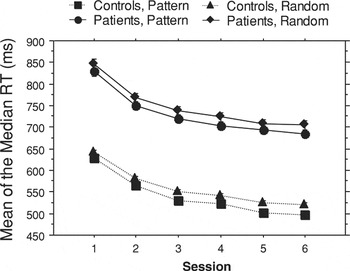
Mean of the median reaction times (ms) for correct responses as a function of session, group, and trial type. Error bars of 1 standard error are plotted for each data point but are visible only when greater in magnitude than the size of the plotted symbol.
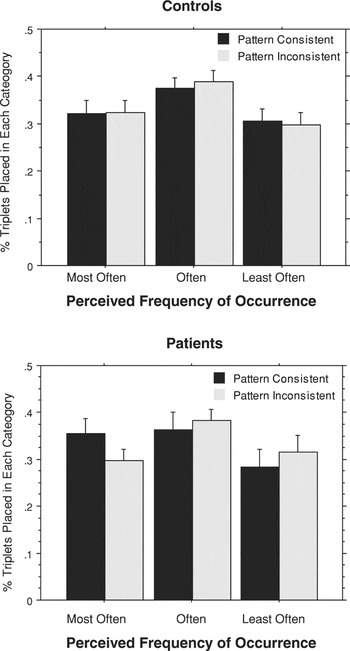
Each group's distribution of triplets across card sort categories according to a triplet's perceived frequency of occurrence during testing. Error bars represent standard error.
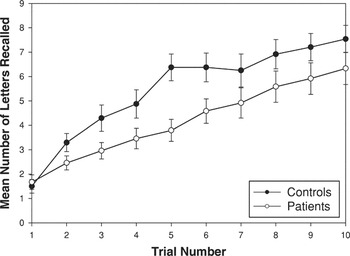
Mean number of letters recalled in the correct order as a function of trials for both groups. Error bars represent standard error.
 You have
Access
- 16
- Cited by