INTRODUCTION
Hamamy syndrome is a rare genetic disorder, with only five reported instances in the literature, none of which focus on neuropsychological aspects (Buget, Canbolat, Akgul & Kucukay, Reference Buget, Canbolat, Akgul and Kucukay2015). In this case study, we report for the first time, results of a neuropsychological evaluation and follow-up, conducted on a child diagnosed with Hamamy syndrome who presented to the Department of Psychiatry at the American University of Beirut Medical Center.
The syndrome was first described by Hamamy, Teebi, Oudjhane, Shegem, and Ajlouni (Reference Hamamy, Teebi, Oudjhane, Shegem and Ajlouni2007) in a case study describing two brothers aged 8 and 10 years, who presented with strikingly severe hypertelorism not seen in any recognized illness. The authors concluded that the new syndrome, named Hamamy, was characterized by brachycephaly, bulging midface, repeated bone fractures, hearing loss, low-set ears, severe hypertelorism, laterally sparse eyebrows, and severe myopia. They also estimated through incidental observations, that the brothers probably had borderline intelligence, and impaired speech and language. The brothers were born to double first-cousin Jordanian Arab parents and had no perinatal or developmental insults. More recently, Bonnard et al. (Reference Bonnard, Strobl, Shboul, Lee, Merriman, Nelson and Reversade2012) studied the Jordanian brothers described by Hamamy as well as two Turkish brothers, also born to double cousins. They suggested that the unique set of physiological characteristics described in patients with Hamamy syndrome is due to a mutation in a single gene called IRX5, responsible for modulating the migration of progenitor cell populations in the head and genitals of the developing fetus (Bonnard et al., Reference Bonnard, Strobl, Shboul, Lee, Merriman, Nelson and Reversade2012).
Since the initial report by Hamamy et al. (Reference Hamamy, Teebi, Oudjhane, Shegem and Ajlouni2007), there have been only five reported cases of the syndrome in the literature (Buget et al., Reference Buget, Canbolat, Akgul and Kucukay2015). Studies have investigated dental deformities and rehabilitation (Guler & Keskin, Reference Guler and Keskin2013), and anesthesia management (Buget et al., Reference Buget, Canbolat, Akgul and Kucukay2015). However, to our knowledge, there are no reports of neuropsychological findings in children or adults with Hamamy syndrome. This study uses a case-study approach to describe the neuropsychological impairments noted in a Lebanese male patient with Hamamy syndrome tested at age 6 years, 0 month and again at 7 years, 7 months.
INITIAL EVALUATION
Case History and Presenting Concerns
The patient first presented to the Psychiatry Department of the American University of Beirut at the age of 6. Initial genetic testing revealed an IRX5 gene mutation typically seen in individuals with Hamamy syndrome (Bonnard et al., Reference Bonnard, Strobl, Shboul, Lee, Merriman, Nelson and Reversade2012). Further genetic testing using high throughput or next-generation sequencing (NGS) was conducted on the patient, his biological parents, and his maternal cousin who was also suspected of having the syndrome. Results showed that 11 of 873 variants shared by the patient and his cousin had a frequency less than 1% in the Genome Aggregation Database. After further filtering with Lebanese genetic samples, results showed five rare variants within the area of interest. Specifically, one mutation (c.503G<A) was found on chromosome 16.q12.2, gene IRX5 (NM_005853), and noted to be responsible for the autosomal recessive Hamamy syndrome. To our knowledge, only the patient and his maternal cousin (who is also born to consanguineous parents) have the genetic mutation, while other family members do not.
History revealed that he was born to first-degree cousin parents, following an unremarkable pregnancy, and full-term gestation. He was born through elective C-section, and required hospitalization for 20 days due to reported swallowing difficulties. Medical history includes multiple surgeries for leg fractures due to recurrent falls, and dacryocystorhinostomy (DCR) surgery to restore the flow of tears. Patient currently wears prescription glasses for myopia (−3.0 and −4.25). Regarding patient’s hearing, even though it was not, to our knowledge, formally assessed, it was reported as typical following medical evaluations and clinical checkups.
Patient’s early developmental history was described as delayed across receptive and expressive language (including articulation of most sounds); motor, cognitive, and socio-emotional skills; and he was engaged in speech and language therapy and occupational therapy since the age of 5 (at the rate of once per week). He said his first words at age 2, put two to three words together at age 3, and made a full sentence by age 5. He walked alone at age 2, and rode a bicycle at age 4. Fine-motor skills also developed late: the patient first grasped a pencil correctly and ate independently using a fork-grip at the age of 5 years. He was fully toilet trained by the age of 3 years. Early socio-emotional indicators of eye contact and pointing were reported as typical; however, play and social skills were reportedly delayed during his first year of schooling (kindergarten 1), as he would not play with his peers in an age-appropriate way.
Academically, the patient attended a mainstream kindergarten (KG1) at the age of 5 years where he received full-time learning support with a shadow teacher who assisted him throughout the school day. He was able to do one-digit additions, recognize four shapes, hold a pencil to write and draw, but could not read three-letter words, or accurately copy shapes and capital letters. Compared to acquisition of literacy skills, number concepts and additions/subtractions were said to be easier to acquire with partial support, although extensive difficulties in “geometry” were observed such as lack of precision when copying shapes.
Behaviorally, he was also described as lagging behind in social skills, and requiring assistance in most daily life activities. Finally, the boy was reportedly inattentive and hyperactive at home and at school, and required significant behavioral interventions from adults to remain on task.
Procedures
Following a 1-hour clinical interview, the patient was assessed by a clinical neuropsychologist during an outpatient visit of 4 hours, including breaks. The test battery was selected based on age, estimated abilities, and language. Interpretations were made by comparing the child’s scores to normative data (U.S. samples), but more importantly by corroborating evidence from the history and behavioral observations, as well as within-subject comparison of strengths and weaknesses. The patient did not meet basal items for several subtests of the Wechsler Intelligence Scale for Children (WISC-IV). All tests were performed in English, which is the patients’ language of instruction at school, and second language spoken at home. Scores were compared to U.S.-based norms, unless stated otherwise. In addition to formal measures, the patient’s parent also completed a series of scales that measure broad childhood problems (Child Behavioral Checklist; CBCL), childhood depression (Mood and Feelings Questionnaire), anxiety (Screen for Childhood Anxiety Related Disorders), autism (Gilliam Autism Rating Scale – Second Edition), executive functioning (Behavior Rating Inventory of Executive Function), adaptive functioning (Adaptive Behavior Assessment System - Second Edition), and a symptom checklist of attention deficit and hyperactivity disorder (ADHD). All scales were completed in English, and compared against U.S. or local norms when available. The patient’s behavior was also observed extensively in structured and unstructured settings. Consent to publish findings were obtained from the patient’s parents.
Neuropsychological Test Results
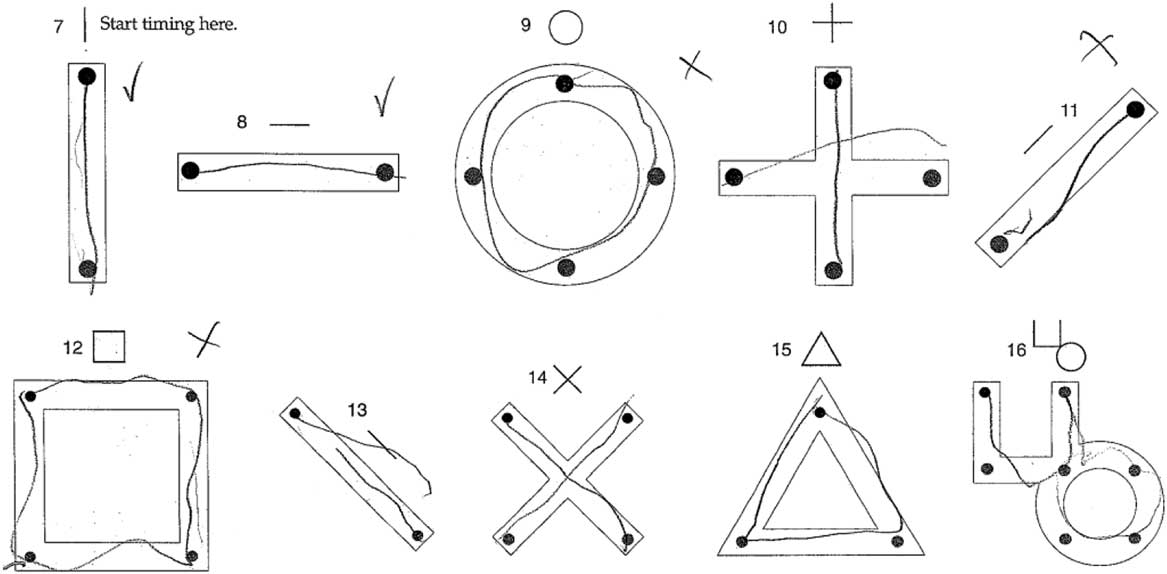
Table 1 reports raw and standard scores on the neuropsychological measures at the time of patient’s first evaluation. The patient showed impaired verbal reasoning (Wechsler Preschool and Primary Scale of Intelligence – Third Edition [WPPSI III] Word Reasoning), retrieval of acquired knowledge (WPPSI III Information), and retrieval and expression of lexical fund (WPPSI III Vocabulary), while single-word expressive abilities were borderline-impaired (WPPSI III Picture Naming). Receptive abilities of single words and instructions of increasing complexity were borderline-impaired (WPPSI III Receptive Vocabulary; DAS-II Verbal Comprehension). The child also showed difficulties repeating words and articulating sounds. Non-verbal reasoning was within typical limits (WPPSI III Matrix Reasoning), and borderline-impaired on tasks of visuospatial reasoning (WPPSI III Block Design), nonverbal abstract reasoning (WPPSI III Picture Concepts), and visual perception (Beery Visual Perception). Sustained and selective attention was borderline-impaired to impaired on paper-and-pencil tasks requiring scanning of visual items (WPPSI III Symbol Search & Cancellation), and rapidly and accurately matching shapes (WPPSI III Coding). Working memory was borderline-impaired (WPPSI III Picture Memory). Motor coordination was impaired on a task of tracing (Beery VMI Motor Coordination). Figure 1 illustrates the child’s attempts at tracing 2-dimensional designs.
Scores on neuropsychological measures at 6 years 0 months

Note. WPPSI-III = Wechsler Preschool and Primary Scale of Intelligence - Third USA Edition; WPPSI –IV = Wechsler Preschool and Primary Scale of Intelligence – Fourth French Edition; DAS-II = Differential Abilities Scales-II Early Years; Beery VMI 6th edition = Beery-Buktenica Developmental Test of Visual-Motor Integration 6thedition; VMI = Visual-Motor Integration.
a Z-scores equal or less than 2 are considered to be impaired, Z-scores between +1 and −1 are considered to be within normal limits, Z-scores between −2 and −1 are considered borderline-impaired.
b Scaled Scores with a mean of 10 and standard deviation of 3.
c T-scores with a mean of 50 and standard deviation of 10.
d Standard Scores with a mean of 100 and a standard deviation of 15.
Sample work of the Beery VMI Motor Coordination.

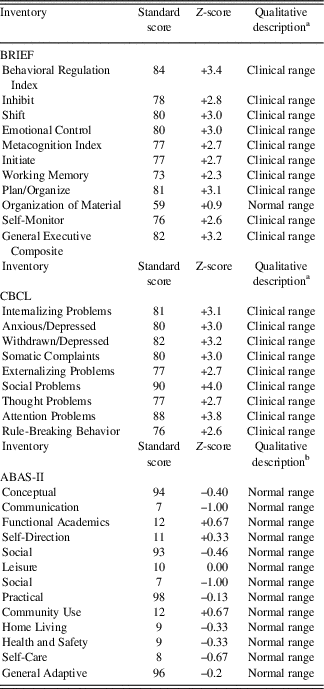
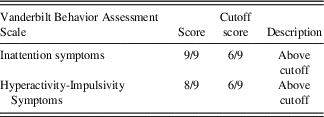
Parents’ ratings of psychopathology and behavior (Tables 2 and 3) show clinically significant concerns with executive functioning (BRIEF), specifically regarding his ability to regulate his behaviors and impulses, and be aware of his own thinking and behavior. Relatedly, on a symptom checklist of ADHD symptoms, they also noted concerns with attention (9/9 DSM IV symptoms), hyperactivity/impulsivity (8/9 DSM IV symptoms). On the CBCL, they endorsed clinically significant problems with internalizing and externalizing behaviors (i.e., cannot stay still, restless, or hyperactive; destroys his own things, breaks rules at home and school, throws temper tantrums, impulsive or acts without thinking, withdraws, does not get involved with others, too fearful or anxious). Adaptive functioning, as assessed through interview, was estimated to be less than age expectations, although parental reports on the Adaptive Behavior Assessment System, Second Edition (ABAS-II) yielded typical scores.
Scores on rating scales completed by the parents at 6 years 0 months

Note. BRIEF = Behavioral Rating Inventory of Executive Functions – parent form; CBCL 6-18 = Childhood Behavior Checklist for Ages 6–18 – parent form, Lebanon norms; ABAS-II = Adaptive Behavior Assessment System, Second Edition, parent form.
a Z scores above +1.5 are considered to be in the clinical range Z-scores less than or equal to +1.5 are considered to be in the normal range.
b Z-scores between −2 and −1 are considered borderline-impaired, Z-scores between +1 and −1 are considered to be within normal limits.
Scores on behavioral symptom checklist during the initial evaluation at 6 years 0 months

Diagnostically, at this point in time, the patient met criteria for a DSM-5 Language Disorder, Speech-Sound Disorder (oral-motor apraxia), and Attention Deficit Hyperactivity Disorder, combined presentation. Recommendations were made for speech-language therapy, occupational therapy, inclusive specialized education, and pharmacotherapy for ADHD.
FOLLOW-UP EVALUATION
The patient was seen for a follow-up evaluation at age 7 years, 7 months. In the interim year, he had engaged in treatment for ADHD, and was placed on Ritalin (0.5 mg daily). The patient was also enrolled in a school that provided him with informal specialized education such as a shadow teacher and reading sessions, but no individualized education plan. Occupational therapy and speech therapy were not initiated.
Interim history reported by the parents, revealed that the patient continued to show significant difficulties across areas of higher-order functioning, language, motor, and adaptive functioning. On one hand, he had progressed by being able to climb stairs independently, understand two-step instructions, express himself in two- to three-word sentences, color inside limited spaces, read three-letter sight words, and add and subtract single digits. Nonetheless, the patient continued to show difficulties in constructing grammatically correct sentences, articulating sounds, understanding complex directions, and engaging in a back and forth conversation.
He also continued to show motor difficulties: was slower than peers in writing, showed an irregular handwriting, and continued to need assistance on tasks that require fine motor control such as brushing teeth, cutting food, and tying shoelaces. Even though significant improvement in gross motor development was reported, the patient was observed to limp when walking and running due to a history of multiple leg fractures.
Academically, the patient continued to show difficulties in decoding new words. He was reported to show a relative strength in numerical calculations, but continued to require assistance in understanding shapes, and Math word problems. Regarding behavior, parent reported that, despite significant improvement in attention and level of hyperactivity following treatment with psychostimulants, the patient continued to show symptoms of ADHD that were impairing his academic and daily functioning. He frequently threw temper-tantrums, would easily loose temper, had irritable mood, and was argumentative with adults. Additionally, he recently started to show a strong interest in stuffed animals, which he carried along with him. Socially, the patient was reported to have improved in joining group activities but still had difficulties maintaining friendships, because he could not express himself clearly and did not follow the rules of a game.
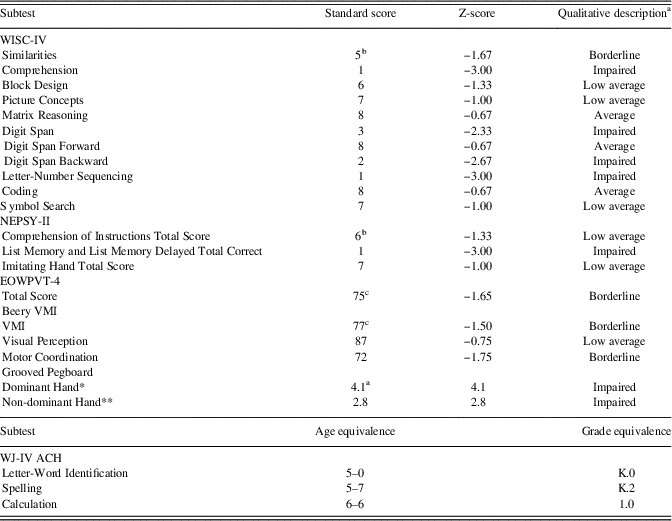
Tables 4, 5, and 6 report standard scores on the neuropsychological measures at the time of patient’s follow-up evaluation, at age 7. At this time, intellectual abilities estimated through subtests of non-verbal reasoning were still in the low-average range (WISC IV, Perceptual Reasoning Index). On language tasks, the patient continued to show impairments in verbal reasoning (WISC IV, Verbal Comprehension Index), naming (EOWPVT-4), and general verbal knowledge (WISC IV, Comprehension). Verbal comprehension skills ranged from impaired to low-average (WISC IV, Comprehension; NEPSY-II Comprehension of Instructions). On visuospatial skills, visuomotor abilities were borderline-impaired (Beery-VMI-6, Beery VMI), and visuoconstruction (WISC IV, Block design) and visual perception of shapes (Beery-VMI-6, Visual Perception) were low-average.
Scores on neuropsychological measures at age 7

Note. WISC-IV = Wechsler Intelligence Scale for Intelligence - Fourth USA Edition; NEPSY-II = NEPSY – Second USA Edition; EOWPVT-4 = Expressive One Word Picture Vocabulary Test – Fourth USA Edition; Beery VMI 6th edition = Beery-Buktenica Developmental Test of Visual-Motor Integration 6thedition; VMI = Visual-Motor Integration; WJ-IV ACH = Woodcock Johnson Tests of Achievement – Fourth USA Edition.
a Z-scores equal or less than 2 are considered to be impaired, Z-scores between +1 and −1 are considered to be within normal limits, Z-scores between −2 and −1 are considered borderline-impaired.
b Scaled scores with a mean of 10 and standard deviation of 3.
c Standard scores with a mean of 100 and a standard deviation of 15.
* Right hand.
** Left hand.
Scores on rating scales completed by parents at age 7

Note. MFQ = Mood and Feelings Questionnaire - Parent Form; SCARED = Screen for Child Anxiety Related Disorders Parent Form; GARS-II = Gilliam Autism Rating Scale – Second Edition.
a The cutoff score for the Arabic MFQ is 22 for the parent version (Tavitian et al., Reference Tavitian, Atwi, Bawab, Hariz, Zeinoun, Khani and Maalouf2014).
b The cutoff score for the Arabic SCARED is 24 for the parent version (Hariz et al., Reference Hariz, Bawab, Atwi, Tavitian, Zeinoun, Khani and Maalouf2013).
c Index scores have a mean of 100 and a standard deviation of 15.
d Scaled scores have a mean of 10 and a standard deviation of 3.
* Probability of Autisms.
Behavioral symptom checklist at follow-up

Sensorimotor skills were impaired with borderline-impaired motor control while copying shapes (Beery VMI-6, Motor Coordination) and fine motor dexterity was impaired bilaterally (Grooved Pegboard). Conversely, the patient showed low-average performance on a task requiring him to imitate hand positions (NEPSY-II, Imitating Hand Total). On a continuous performance test of sustained attention, the patient showed impaired performance, with slow and variable response time and a high rate of omission errors for the first 8 min (Test of Variables of Attention; TOVA). The administration was discontinued because he could not tolerate the attentional demand of the test.
On selected measures of executive functions, the patient showed impaired working memory (WISC IV, Working Memory Index) and low-average processing speed (WISC IV, Processing Speed Index). On a task of anterograde verbal memory, (NEPSY-II, List Memory & List Memory Delayed), the patient showed impaired abilities to recall words whether immediately or after a 15-min delay. On achievement tests (WJ-IV), the patient showed impaired abilities to read and spell sight words like the, at, and but could name and spell individual letters correctly. In contrast, he showed better performance in Math calculation, where he was able to compute single digit addition and subtraction, and obtained a raw score equivalent to children aged 6 in the U.S. school system (Table 4).
Parents’ ratings of their child’s behavior (Tables 5 and 6) show continuous clinically significant concerns with attention-deficit (9/9 DSM IV symptoms), and hyperactivity/impulsivity (8/9 DSM IV symptoms). They also endorsed symptoms of anxiety as measured by SCARED, specifically related to separation anxiety disorder, even though the total score was below the clinical cutoff score.
DISCUSSION
A boy with Hamamy syndrome was assessed at age 6 and found to have relatively spared nonverbal intelligence that spanned within the low-average range of functioning, borderline-impaired expressive and receptive language, impaired speech sound production, and impaired verbal reasoning, attention, and motor coordination. Following a diagnosis of ADHD, Language Disorder and Speech-Sound Disorder (oral-motor apraxia), he was put on psychostimulants and enrolled in an informal special education setting. At age 7, he showed progress while his neuropsychological profile of strengths and weaknesses remained rather unchanged. This is the first published study that reports on the neuropsychological sequelae of Hamamy syndrome.
At the age of 6, the patient could not follow two-step instructions, but he did follow instructions that were broken down to simple parts, repeated as often as necessary, and augmented with gestures. He used short phrases with incorrect grammar, and words were often phonologically incorrect and poorly articulated. He frequently omitted or substituted sounds of words (e.g., “labydu” for “ladybug”). The patient also showed word retrieval difficulties and often replaced words with nonverbal gestures. For example, he placed his hands over his head when asked to name the word “umbrella.” He also compensated for his poor verbal expression by expressing associated concepts. For example, on a task requiring him to define English words, the patient was not able to formulate a full sentence explaining the meaning of the word “dog,” but instead he said “wouf,” indicating a certain degree of understanding of the concept.
There was notable improvement at age 7. Although direct comparisons of raw scores cannot be made, it is observed that at age 7 he was able to construct two- to three-word sentences, understand two-step instructions, and perform similarly to a typical 4- to 10-year-old child in the United States on a picture-naming task.
Attention, executive functioning, and behavioral dysregulation were also consistent across parental reports, formal rating scales, and observations at both times. Not only did he obtain broadly impaired scores on formal tasks of attention, the patient was also notably overactive throughout the sessions, impulsive in responding, and was significantly distracted. However, at age 7, while under the effect of psychostimulants, he appeared to respond better to firm boundaries, and behavioral techniques to keep him on task and in his seat, but could not work independently without such measures.
The finding of relatively spared non-verbal reasoning was noted in both evaluations, and likely contributed to his positive response to the interventions provided (Catts, Fey, Tomblin, & Zhang, Reference Catts, Fey, Tomblin and Zhang2002). Furthermore, his academic skills showed discrepancies with relatively better mathematical reasoning, as opposed to reading, writing, and working with shapes and word problems. This is consistent with the neuropsychological profile at both ages, and places him at risk for a Specific Learning Disorder in Reading.
Finally, regarding emotional well-being, although the boy’s parents endorsed many symptoms of withdrawn and depressed behaviors, upon examination of the actual items that the parents endorsed on scales, we notice that the elevation of the scores on the scales was driven by endorsement of items related to feeling irritable, moody, and marginalized, and not by items related to low mood. These symptoms are likely related to the boy’s emotional dysregulation seen in ADHD, and not a sign of pediatric depression, especially that parents reported no symptoms of depression during the interviews, and the child’s affect was unremarkable.
In terms of recommendations, we emphasized the need to re-engage in speech-and-language therapy with an emphasis on phonological awareness, articulation, and academic pre-requisites. Improving articulation may later help the patient use assistive technology of speech-to-text. We also recommended continued pharmacotherapy and consultation with a child psychiatrist regarding adjustment of dosage in addition to interventions targeting behavior dysregulation as this is associated with significantly lower levels of inattention and hyperactivity/impulsivity symptoms at school-age (Jones, Daley, Hutchings, Bywater, & Eames, Reference Jones, Daley, Hutchings, Bywater and Eames2007). Due to the motor difficulties presented, and because children with ADHD often present with co-existing impairments in motor abilities, we also recommended occupational therapy (Pitcher, Piek, & Hay, Reference Pitcher, Piek and Hay2003). The patient will now remain in an inclusive school that provides specialized education.
CONCLUSION
In this case study, we report for the first time, results of neuropsychological testing at ages 6 and 7, conducted on a child diagnosed with the newly identified genetic disorder of Hamamy syndrome. The boy was found to meet DSM-V criteria for the diagnoses of Language Disorder, Speech Sound Disorder, and ADHD, Combined Presentation. The described cognitive and behavioral impairments were found to be in the context of relatively spared nonverbal intelligence. Based on our findings, early neuropsychological evaluation and rehabilitation is recommended in children diagnosed with Hamamy syndrome. Early intervention in speech and language therapy, occupational therapy, and behavioral intervention, as well as pharmacotherapy when warranted, will likely lead to improved cognitive and behavioral functioning.
To further understand the range of functioning, developmental trajectory, and CNS involvement of this condition, future studies ought to identify more cases, assess the individuals across several years, include pedigree information, and add repeated imaging studies and hearing tests.
Acknowledgments
The authors do not have any conflict of interest nor did they receive financial support for this study.