Introduction
Giant chickweed [Myosoton aquaticum (L.) Moench], a competitive broadleaf weed species belonging to the Caryophyllaceae family, is widespread in winter wheat (Triticum aestivum L.) fields, especially in regions with wheat–rice (Oryza sativa L.) rotation systems in eastern China (Zhang Reference Zhang2003). Myosoton aquaticum has a life cycle similar to that of winter wheat, and generally, most seedlings emerge before winter (late October to early November) in the southern Yellow River region, whereas most seedlings emerge in spring (mid-February to mid-March of the following year) in the northern Yellow River region. The plants flower and mature in May and June the following year, producing 2,000 to 5,000 seeds per plant (Liu Reference Liu2015; Tu Reference Tu2003). This weed strongly competes for light, water, and nutrients with crop plants and possesses the ability to produce numerous branches, causing a 37.7% to 61.1% loss of grain yield when its density is 450 to 1,800 plants m−2 (Tu Reference Tu2003). Meanwhile, its branches can form a thick vegetative mat, which is unfavorable for crop harvest operations and causes seeds and straw of M. aquaticum to be mixed with wheat grains, decreasing wheat grain quality. Furthermore, M. aquaticum seeds mixed with wheat seeds are spread widely as wheat seeds are transported across provinces or countries (Liu Reference Liu2015). These features result in the development of M. aquaticum as a troublesome weed in winter wheat fields and make it difficult to control by agricultural measures (Chen and Yu Reference Chen and Yu1992). Chemical control, especially the application of acetolactate synthase (ALS; EC 4.1.3.18)-inhibiting herbicides such as tribenuron-methyl and florasulam, has become the most acceptable and widely used method for managing M. aquaticum in winter wheat fields in China. However, both target-site resistance (with gene mutations conferring resistance to ALS-inhibiting herbicides) and non–target site resistance (generally due to enhanced metabolism, with a corresponding decrease in the amount of herbicide reaching ALS) have been reported in an increasing number of M. aquaticum populations in China (Bai et al. Reference Bai, Liu, Wang, Zhao, Jia, Zou, Guo and Wang2018, Reference Bai, Zhang, Li, Wang, Wang, Wang, Liu and Bai2019; Liu et al. Reference Liu, Bi, Li, Yuan and Wang2013, Reference Liu, Wu, Guo, Du, Yuan and Wang2015a, Reference Liu, Yuan, Du, Guo, Li, Bi and Wang2015b, Reference Liu, Bai, Zhao, Jia, Li, Zhang and Wang2018). Moreover, cross-resistance to multiple herbicides has also been confirmed in M. aquaticum (Bai et al. Reference Bai, Zhang, Li, Wang, Wang, Wang, Liu and Bai2019). The rapid evolution of herbicide resistance in M. aquaticum greatly reduces the service life of existing herbicides and threatens crop production. Thus, integrated M. aquaticum management is urgently needed.
Germination is one of the most significant stages in weed population establishment. The ability of weed seeds to germinate under a wide range of environmental conditions greatly contributes to successful population establishment (Tang et al. Reference Tang, Xu, Shen and Chen2015). Several environmental factors can affect germination, such as soil moisture, NaCl concentration, temperature, light, and pH (Chauhan et al. Reference Chauhan, Gill and Preston2006), and seedling emergence can be affected by burial depth and seed size (Keshtkar et al. Reference Keshtkar, Kordbacheh, Mesgaran, Mashhadi and Alizadeh2010). Understanding such ecology will enable the identification of important weed characteristics that can be used in integrated weed management programs. For example, light has been recognized as an important environmental factor affecting germination (Crisraudo et al. Reference Crisraudo, Gresta, Luciani and Resticcia2007), and photoblastic weed germination is inhibited by mulch application due to the decrease in light availability (Chauhan and Johnson Reference Chauhan and Johnson2010). Meanwhile, determining seedling emergence patterns at different burial depths can contribute to the development of agricultural measures based on tillage (Iqbal et al. Reference Iqbal, Manalil, Chauhan and Adkins2019). In addition to contributing to the development of integrated weed management programs, knowledge of the germination ecology of weeds also helps us predict potential new areas where those species may invade due to changes in the climate and crop systems and take effective measures in time to stop them from spreading farther (Wang et al. Reference Wang, Huang, Zhang, Liu and Wang2018).
To the best of our knowledge, no detailed research has been conducted on the germination and emergence ecology of M. aquaticum. In most of the existing studies about weed germination and emergence ecology, only one population was used (Nosratti et al. Reference Nosratti, Amiri, Bagheri and Chauhan2018; Tanveer et al. Reference Tanveer, Khan, Ali, Javaid, Raza and Chauhan2020; Wu et al. Reference Wu, Li, Xu and Dong2015; Zhao et al. Reference Zhao, Li, Guo, Zhang and Wang2018). However, seed gemination and seedling emergence patterns may vary among different populations within a species, because the environmental conditions during plant growth can strongly influence the germination and emergence pattern of weeds by affecting the supply of hormones and nutrients to the embryo (Gorecki et al. Reference Gorecki, Long, Flematti and Stevens2012; Leon and Owen Reference Leon and Owen2006; Leon et al. Reference Leon, Bassham and Owen2006). In China, different environmental conditions exist in regions where M. aquaticum spreads due to different crop systems, climates, rainfall amounts, and altitudes (Wei et al. Reference Wei, Qiang, Ma and Wei2005), and the germination and seedling emergence of different M. aquaticum populations in China may respond differently to environmental factors. Thus, the objective of this study was to determine the effects of osmotic potential, NaCl concentration, pH, temperature, photoperiod, and burial depth on germination and seedling emergence in three M. aquaticum populations from different geographic regions in China.
Materials and Methods
Seed Source
To reduce the potential variation among populations caused by different growing conditions, three M. aquaticum populations from different geographic regions were selected in the present study, named JS, HN, and AH, representing Jiangsu, Henan and Anhui provinces, respectively, according to where they were collected (Table 1). HN Province is located in the central part of China, where the maize–wheat rotation system is mainly implemented; JS and AH provinces are located eastern China, which is rich in water resources and where the rice–wheat rotation system is mainly implemented. Seeds from each population were collected randomly from more than 30 mature plants in winter wheat fields and bulked in late May 2013. The seeds were cleaned, sun-dried, vernalized in paper bags at 4 C for 3 mo to break dormancy, and then stored at room temperature (25 C) for approximately 6 mo before use. The color of mature M. aquaticum seeds was brown or sepia, and the 1,000-seed weight was 405, 421, and 386 mg for the JS, HN, and AH populations, respectively.
Geographic information for the locations in China where the three Myosoton aquaticum populations were collected.

a Data from the National Meteorological Information Center (http://www.nmic.cn).
b Data from the China Soil Database (http://gis.soil.csdb.cn).
General Germination Tests
For all germination tests, the following procedures were used, except when specific environmental conditions were needed. Forty M. aquaticum seeds were placed evenly in a 9-cm petri dish containing two pieces of filter paper (No. 1, Whatman, Maidstone, UK). The filter papers were moistened with 5 ml of distilled water (pH = 6.8) or solutions differing in pH, osmotic potential, or NaCl concentration. To minimize evaporation, the petri dishes were sealed with parafilm (M. Bemis, Oshkosh, WI, USA) and placed in a growth chamber that had fluorescent lamps (200 μmol m−2 s−1 photosynthetic photon flux density) (model RXZ, Ningbojiangnan Instrument Factory, Ningbo, China) at 15 to 25 C under a 12/12-h dark/light photoperiod (optimal conditions). The seeds were considered germinated when the radicle was visible (Chauhan and Johnson Reference Chauhan and Johnson2008). The germinated seeds/emerged seedlings were counted daily for a total of 21 d after sowing. Germination/emergence percentages were calculated as the total number of seeds germinated/emerged divided by the total number of seeds in the petri dish/pot, multiplied by 100%. Before each experiment, the seeds of each M. aquaticum population were placed in petri dishes containing deionized water in a growth chamber as described earlier to test their viability, and the germination percentages were all greater than 90% (at least 100 seeds for each population).
Effect of Temperature on Germination
Seeds of the three M. aquaticum populations were studied under seven constant temperatures (5, 10, 15, 20, 25, 30, and 35 C) and five fluctuating day/night temperatures (15/5, 20/10, 25/15, 30/20, and 35/25 C) with respective average temperatures of 10, 15, 20, 25, and 30 C.
Effect of Light on Germination
Seeds of the three M. aquaticum populations were studied under three photoperiods (24/0-h dark/light, 12/12-h dark/light, and 0/24-h dark/light). The 24/0-h dark/light treatment was imposed by wrapping the dishes in two layers of aluminum foil (CF-2, Kelinlai, Shanghai, China) immediately after sowing (Wang et al. Reference Wang, Huang, Zhang, Liu and Wang2018).
Effect of pH on Germination
Seeds of the three M. aquaticum populations were imbibed in buffered solutions with pH of 3, 4, 5, 6, 7, 8, 9, or 10 (Chachalis and Reddy Reference Chachalis and Reddy2000). These values include the pH values of surface soil in China (3.7 to 9.7) (Dai et al. Reference Dai, Huang, Wu and Yu2009). Deionized water (pH = 6.8) was used as a control.
Effect of Osmotic Potential and NaCl Concentration on Germination
To assess the effect of osmotic potential on M. aquaticum germination, seeds of the three M. aquaticum populations were placed in 0, −0.1, −0.3, −0.5, −0.7, −0.9, −1.1, and −1.3 MPa solutions prepared by dissolving polyethylene glycol 6000 (Beijing Yili Fine Chemicals, Beijing, China) in distilled water (Michel and Kaufmann Reference Michel and Kaufmann1973). To assess the effect of NaCl concentration on M. aquaticum germination, seeds of the three M. aquaticum populations were placed in 0, 20, 40, 80, 120, 160, 200, 240, 280, 320, 360, and 400 mM NaCl solutions prepared as described by Cochavi et al. (Reference Cochavi, Goldwasser, Horesh, Igbariya and Lati2018). At the end of the test, the ungerminated seeds were removed, rinsed, and placed in deionized water to check their viability.
Effect of Burial Depth on Seedling Emergence
Ten seeds of three M. aquaticum populations were sown at depths of 0, 0.5, 1, 1.5, 2, 2.5, 3, 4, and 5 cm below the soil surface in plastic pots with a 7-cm length, 7-cm width, and 8-cm height. The soil was loam, had been passed through a 3-mm sieve, and had a pH of 7.67, organic matter content of 15.79 g kg−1, total N content of 14.28 g kg−1, total P content of 2.00 g kg−1, and total K content of 23.15 g kg−1. Pots without sown seeds were used as controls to confirm that there was no seedbank of M. aquaticum in the soil used in the present study. The experiment was conducted in a growth chamber as described in the “General Germination Tests” section. The pots were watered by subirrigation as needed, and the seedlings were considered to have emerged when their coleoptiles were visible. At the end of the test, the soil in pots with nonemerged plants was removed to check whether the coleoptiles failed to emerge or the seeds failed to germinate.
Statistical Analyses
A randomized complete block design was used in all experiments, and the experiments were conducted twice, with three replicates. The replicates were considered blocks and arranged on different benches in the incubators. The untransformed germination percentage values from repeated experiments were analyzed by ANOVA using SPSS (v. 17.0; IBM, Armonk, NY, USA), because the homogeneity of variances was not improved by arcsine square-root transformation, according to Bartlett’s test. The data were pooled for the final analysis because of the nonsignificant difference (P > 0.05) between repeated experiments. The means were separated using Fisher’s protected LSD test at the 5% significance level.
The number of days required to reach an 80% germination percentage (t 80) under different temperatures was calculated according to the following formula:
 $$t_{80} = (H_{p} - L_{p}) - 1 + L$$
where L is the last day before 80% germination was reached, L p is the germination percentage observed on day L, and H p is the germination percentage observed on the day when germination reached or exceeded 80% (Leon et al. Reference Leon, Knapp and Owen2004).
The germination rates (%) of the M. aquaticum seeds under different NaCl concentrations were fit to a three-parameter sigmoid function model as follows:
 $$G(\% ) = {G_{{\rm{max}}}}/\{ 1 + {\rm{exp}}[ - (x - {x_{50}})/{G_{{\rm{rate}}}}]\} $$
where G is the total germination percentage (%) at a given NaCl concentration x, G max is the maximum germination percentage (%), x 50 is the NaCl concentration causing 50% inhibition of G max, and G rate is the slope near x 50.
The germination rates (%) of the M. aquaticum seeds at different osmotic potentials were fit to a three-parameter logistic function model as follows:
 $$G(\% ) = {G_{{\rm{max}}}}/[1 + {(x/{x_{50}})^{G_{\rm{rate}}}}]$$
where G is the total germination percentage (%) at a given osmotic potential x, G max is the maximum germination percentage (%), x 50 is the osmotic potential causing 50% inhibition of G max, and G rate is the slope near x 50.
The emergence rates (%) of the M. aquaticum seeds at different burial depths were fit to a three-parameter sigmoid function model as follows:
 $$E(\% ) = {E_{{\rm{max}}}}/\{ 1 + {\rm{exp}}[ - (x - {x_{50}})/{E_{{\rm{rate}}}}]\} $$
where E is the total emergence percentage (%) from burial depth x, E max is the maximum emergence percentage (%), x 50 is the burial depth leading to 50% inhibition of E max, and E rate is the slope near x 50.
All regression analyses and graphs were conducted and constructed, respectively, via SigmaPlot software (v. 12.5; Systat Software, San Jose, CA, USA).
Results and Discussion
Temperature
Final Germination
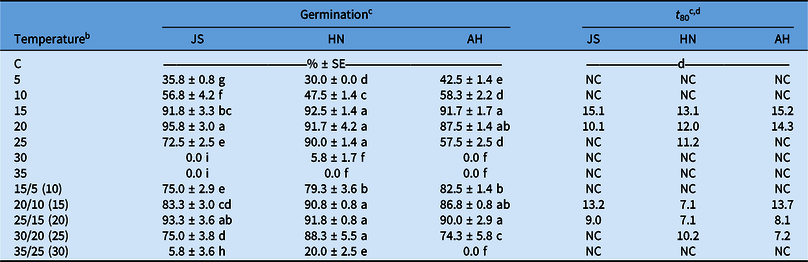
Under constant temperature conditions, the seeds of all M. aquaticum populations germinated at a relatively wide range of temperatures (5 to 25 C), with a final germination of 30% to 96% (Table 2). However, the optimum temperature for final germination (more than 80%) differed among the M. aquaticum populations: 15 to 20 C for the JS and AH populations and 15 to 25 C for the HN population (Table 2). Higher final germination was observed in the HN population at 25 C, which may be because the HN population was collected from an area with a warmer climate (Table 1). There may be differences in the temperature requirements for germination among weed species. For example, it was reported that low temperature (5 to 10 C) did not reduce the final germination of field brome (Bromus arvensis L.) seeds (Li et al. Reference Li, Tan, Li, Yuan, Du, Ma and Wang2015), but in the present study, both low and high temperatures reduced the final germination of M. aquaticum seeds (Table 2), similar to the results observed for winter wheat (Yang et al. Reference Yang, Wang and Yang1991), which may partially explain why M. aquaticum has become a troublesome weed in winter wheat fields. No germination was observed at 30 or 35 C, except for the HN population at 30 C, which yielded a final germination of 5.8% (Table 2).
Germination percentage a and days required to reach 80% germination (t 80) for Myosoton aquaticum seeds exposed to 12 temperature treatments under a 12/12-h dark/light photoperiod for 21 d.

a The values (means ± SEs) followed by different letters within the columns indicate significant differences at the P < 0.05 level according to Fisher’s protected LSD test.
b Numbers in parentheses represent the mean temperatures.
c JS, HN, and AH indicate the three Myosoton aquaticum populations that were collected from Jiangsu, Henan, and Anhui provinces in China, respectively.
d Calculated according to the formula t 80 = (H p − L p)−1 + L, where L is the last day before 80% germination was reached, L p is the observed germination percentage on day L, and H p is the observed germination percentage on the day when the germination reached or exceeded 80%. NC, not calculated, as the germination percentage did not reach 80%.
Compared with constant temperatures, fluctuating temperatures with the same means (except for 20/10 C) improved the final germination of the seeds of all M. aquaticum populations (Table 2). The largest average increase in germination of 24.7% was observed at the lowest fluctuating temperature of 15/5 C (compared with the constant temperature of 10 C), whereas for the other temperatures, the average increases ranged from 0.1% to 6.7% (Table 2). These results suggested that fluctuating temperatures are favorable for germination of M. aquaticum, possibly because fluctuating temperatures simulate the temperature variation between day and night in natural environments and break secondary dormancy (Leon et al. Reference Leon, Knapp and Owen2004; Thompson et al. Reference Thompson, Grime and Mason1977). Similar results were reported for Asia minor bluegrass (Polypogon fugax Nees ex Steud.) and trumpet creeper [Campsis radicans (L.) Seem. ex Bureau] (Chachalis and Reddy Reference Chachalis and Reddy2000; Tang et al. Reference Tang, Xu, Shen and Chen2015; Wu et al. Reference Wu, Li, Xu and Dong2015). Conversely, constant temperature was more suitable for germination of shortawn foxtail (Alopecurus aequalis Sobol.) and B. arvensis (Li et al. Reference Li, Tan, Li, Yuan, Du, Ma and Wang2015; Zhao et al. Reference Zhao, Li, Guo, Zhang and Wang2018).
Germination Time (t80)
The time required to reach an 80% germination percentage (t 80) of M. aquaticum seeds decreased as the temperature increased for all populations under both constant and fluctuating temperatures, except for the HN population at 25/15 and 30/20 C (Table 2). Moreover, the fluctuating temperatures shortened the t 80 compared with the t 80 at constant temperatures matching their means. Similar results were observed in B. arvensis and Japanese foxtail (Alopecurus japonicus Steud.) (Haferkamp et al. Reference Haferkamp, Karl and MacNeil1994; Li et al. Reference Li, Tan, Li, Yuan, Du, Ma and Wang2015; Wang et al. Reference Wang, Huang, Zhang, Liu and Wang2018).
All tested M. aquaticum populations germinated across a relatively wide range of temperatures and thus have considerable opportunities to emerge during autumn, early winter, and spring in winter wheat fields in China. Moreover, fluctuating temperatures of 20/10 C and 25/15 C were very favorable for germination of M. aquaticum. Based on these results, M. aquaticum has a high potential to invade winter wheat fields in the Sichuan Basin and on the Yun-Gui Plateau, where the average temperature in early autumn is 15 to 16 C (Ding et al. Reference Ding, Gu and Miao2006). Myosoton aquaticum is not yet a troublesome weed species in these regions; however, due to its perceived potential to flourish there, measures should be taken to prevent its invasion.
Light
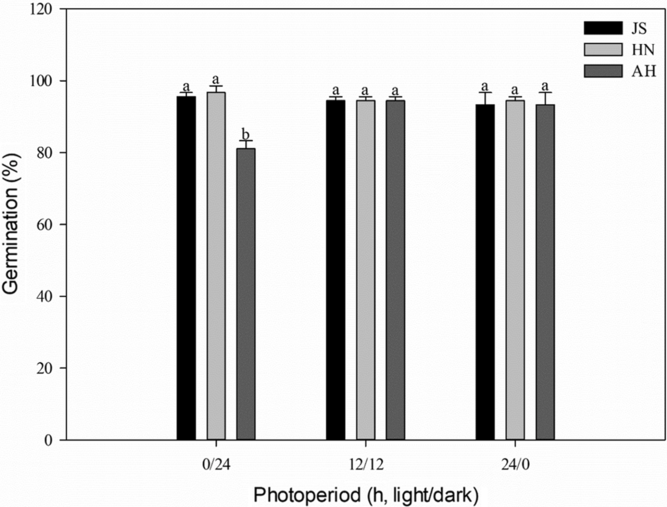
Exposure to light had a significant effect on the germination of the AH population. When seeds were exposed to the 0/24-h light/dark photoperiod, the final germination percentage for the AH population was 81%, which was significantly lower than those (93% to 94%) observed under the 12/12- and 24/0-h light/dark photoperiods (Figure 1). However, the JS and HN populations exhibited similar final germination percentages (93% to 97%) under the 0/24-, 12/12-, and 24/0-h light/dark photoperiods (Figure 1). Seed dormancy is advantageous from an ecological point of view (Keshtkar et al. Reference Keshtkar, Abdolshahi, Sasanfar, Zand, Beffa, Dayan and Kudsk2019), because it enables many weed species to be successful in nature and survive in hostile environments by germinating over a protracted period of time, increasing the odds of more seeds germinating during a permissive growing period. However, effective weed management strategies are not based solely on the disadvantages of weed species (Cousens et al. Reference Cousens, Gill and Speijers1997). Because almost no light (less than 1%) can be received by seeds buried in soil at a depth of more than 0.2 cm (Egley Reference Egley1986), seed burial through cultivation or ground cover with crop residues could be used to inhibit germination of the AH M. aquaticum population, which may be helpful in reducing viable weed numbers. However, the occurrence of M. aquaticum in AH Province may be encouraged due to the development of no-till winter wheat fields in large areas of China (Cai et al. Reference Cai, Zhang, Lin and Hong2018), where more weed seeds remain on the soil surface and are thus exposed to light.
Effect of light on the germination of three Myosoton aquaticum populations (JS, HN, and AH) at 25/15 C for 21 d. The error bars represent the SEs of the means (n = 6). Different letters indicate significant differences at the P < 0.05 level according to Fisher’s protected LSD test.

pH
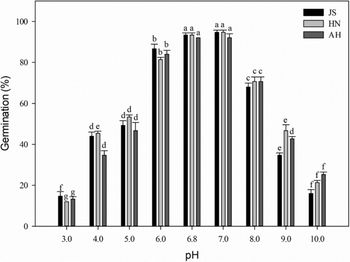
The seeds of M. aquaticum germinated over a wide pH range of 3 to 10 (Figure 2), which was similar to the results observed for seeds of American sloughgrass [Beckmannia syzigachne (Steud.) Fernald], Sophora alopecuroides L., Mexican fireplant (Euphorbia heterophylla L.), and Australian fingergrass (Chloris truncata R. Br.) (Chauhan et al. Reference Chauhan, Manalil, Florentine and Jha2018; Cochavi et al. Reference Cochavi, Goldwasser, Horesh, Igbariya and Lati2018; Nosratti et al. Reference Nosratti, Amiri, Bagheri and Chauhan2018; Rao et al. Reference Rao, Dong, Li and Zhang2008). However, the optimal pH for the germination of M. aquaticum was found to be in the range of 6 to 7, leading to a final germination percentage of 81% to 95%, which was significantly greater than the germination percentage observed at all other pH levels (Figure 2). Therefore, neutral-pH or slightly acidic conditions are more favorable for the germination of M. aquaticum seeds. According to an official soil survey, slightly alkaline soils (pH of 5.0 to 6.5) and near-neutral soils (pH of 6.5 to 7.5) account for 37.2% and 38.8% of the paddy soils in JS Province, respectively (Wang et al. Reference Wang, Zhao, Liao, Huang, Sun, Qi, Shi and Yu2008), which partly explains why M. aquaticum is malignant in JS Province (Zhang Reference Zhang2003).
Effects of pH on the germination of three Myosoton aquaticum populations (JS, HN, and AH) at 25/15 C and under a 12/12-h dark/light photoperiod for 21 d. The error bars represent the SEs of the means (n = 6). Different letters within a population indicate significant differences at the P < 0.05 level according to Fisher’s protected LSD test.

Although soil pH is not a limiting factor for germination of M. aquaticum in China, where most soil pH values are 4.5 to 9.0, neutral-pH or slightly acidic soils may stimulate M. aquaticum germination and could be used as a tool to restrict their spread. For example, farmers can promote M. aquaticum germination by maintaining neutral-pH or slightly acidic soil in conjunction with light surface tillage to further stimulate germination before planting crops and then apply a nonselective herbicide such as glyphosate or use mechanical tillage to control the germinated weeds (Boyd et al. Reference Boyd, Brennan and Fennimore2006; Rasmussen Reference Rasmussen2004).
Osmotic Potential
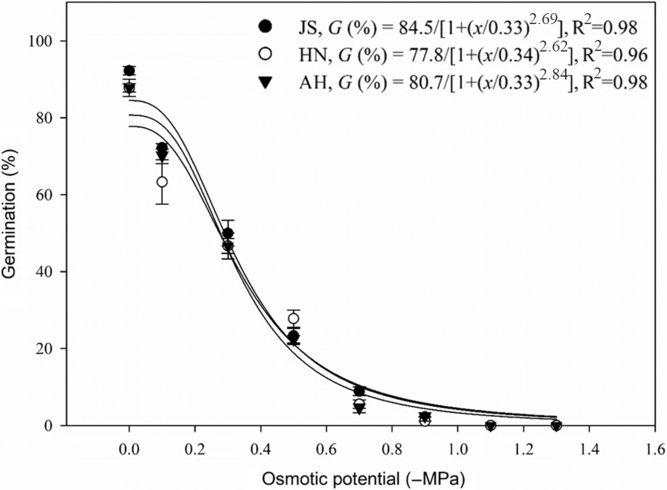
As shown in Figure 3, the germination of all M. aquaticum populations decreased sharply when the osmotic potential decreased from 0 to −0.9 MPa, and no germination occurred when the osmotic potential was lower than −1.1 MPa. Here, similar tolerances of osmotic potential in terms of germination among the three populations of M. aquaticum were observed, with an osmotic potential x 50 (the osmotic potential at which 50% inhibition of the maximum germination was observed) of −0.33, −0.34, and −0.33 MPa for the JS, HN, and AH populations, respectively.
Effects of osmotic potential on the germination of three Myosoton aquaticum populations (JS, HN, and AH) at 25/15 C and under a 12/12-h dark/light photoperiod for 21 d. The error bars represent the SEs of the means (n = 6).

The germination of M. aquaticum seeds is sensitive to osmotic potential, and an osmotic potential of −0.3 MPa reduced germination by more than 50% in all tested M. aquaticum populations according to the fitted model (Figure 3). Similar results were observed for A. aequalis, A. japonicus, P. fugax, and nakedstem dewflower [Murdannia nudiflora (L.) Brenan] (Ahmed et al. Reference Ahmed, Opeña and Chauhan2015; Wang et al. Reference Wang, Huang, Zhang, Liu and Wang2018; Wu et al. Reference Wu, Li, Xu and Dong2015; Zhao et al. Reference Zhao, Li, Guo, Zhang and Wang2018), whereas the seeds of Mediterranean rabbitsfoot grass (Polypogon maritimus Willd.) germinated well, even at an osmotic potential of −1.6 MPa (Atia et al. Reference Atia, Smaoui, Barhoumi, Abdelly and Debez2011). Our finding that M. aquaticum seeds could not germinate at a low osmotic potential partly explains why M. aquaticum has become a troublesome weed in wheat fields in regions with wheat–rice rotation systems (annual precipitation of 1,000 to 1,500 mm) (Rao et al. Reference Rao, Dong, Li and Zhang2008). Fields with previous paddy planting have high soil moisture, which is favorable for the germination of M. aquaticum seeds. Conversely, the low annual precipitation ranging from 500 to 800 mm in northern China somewhat restricts the spread of M. aquaticum to areas with other rotations not including paddy rice (Zhao et al. Reference Zhao, Li, Guo, Zhang and Wang2018).
In the present study, seeds that failed to germinate at an osmotic potential of −1.1 MPa germinated (>80%) when they were removed after the 21-d incubation period, rinsed, and placed in distilled water, which indicated that M. aquaticum seeds remain dormant under dry conditions until soil moisture is suitable for germination.
NaCl Concentration
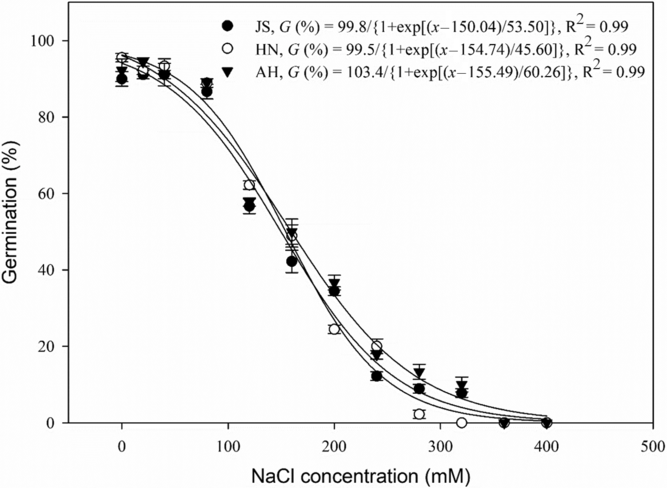
The germination of all M. aquaticum populations decreased with increasing NaCl concentration, and no germination was observed at a NaCl concentration of 360 mM. The JS, HN, and AH populations showed similar x 50 values (the NaCl concentration for 50% inhibition of maximum germination) of 150.04 mM, 154.74 mM, and 155.49 mM, respectively; however, at extreme NaCl concentrations (280 and 320 mM), the germination of the HN population was significantly lower than that of the JS and AH populations (Figure 4). Many types of solutes in the environment can lower the osmotic potential to inhibit germination, while specific ions adversely affect seed viability through chemical toxicity (Ungar Reference Ungar1991). In the present study, the final germination was greater than 80% (data not shown) when M. aquaticum seeds that failed to germinate at a NaCl concentration of 360 mM were removed after the 21-d incubation period, rinsed, and placed in deionized water, which indicated that seed dormancy may be caused by low osmotic potential rather than a specific ion effect.
Effects of NaCl concentration on the germination of three Myosoton aquaticum populations (JS, HN, and AH) at 25/15 C and under a 12/12-h dark/light photoperiod for 21 d. The error bars represent the SEs of the means (n = 6).

Soil with a NaCl concentration of 20 mM is identified as salt-affected soil (Abrol et al. Reference Abrol, Yadav and Massoud1988). The ability to germinate under high NaCl concentration (greater than 280 mM) conditions could contribute to M. aquaticum invading a greater diversity of crop environments (Javaid and Tanveer Reference Javaid and Tanveer2014), such as crops in saline–alkali regions. Similar to seeds of M. aquaticum, those of S. alopecuroides and B. japonicus can also germinate in high-salinity environments (Li et al. Reference Li, Tan, Li, Yuan, Du, Ma and Wang2015; Nosratti et al. Reference Nosratti, Amiri, Bagheri and Chauhan2018).
Burial Depth
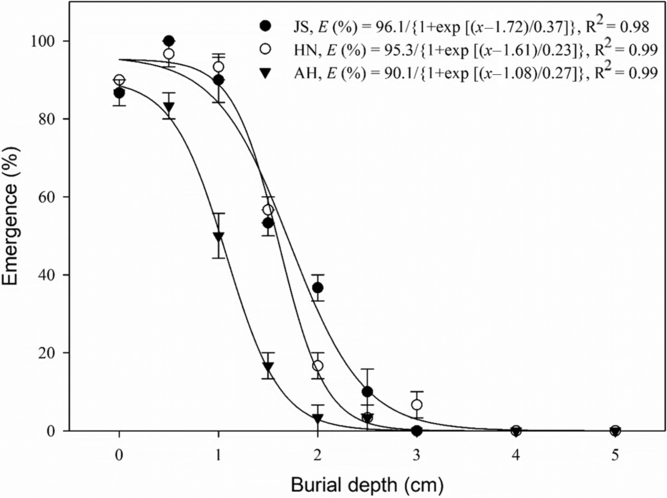
The seedling emergence of all M. aquaticum populations decreased significantly with increasing burial depth, and the maximum seedling emergence of the JS and HN populations was observed at a burial depth of 0.5 cm, whereas that of the AH population was observed at the soil surface (Figure 5). Meanwhile, the AH population possessed higher sensitivity to burial depth than did the other populations. The x 50 value (burial depth for 50% inhibition of the maximum emergence rate) of the AH population was 1.08 cm, which was significantly lower than those of the JS and HN populations (1.72 and 1.61 cm, respectively) (Figure 5). This difference was most likely associated with the relatively low germination of the AH population under the 0/24-h light/dark photoperiod.
Effects of burial depth on the seedling emergence of three Myosoton aquaticum populations (JS, HN, and AH) at 25/15 C and under a 12/12-h dark/light photoperiod for 21 d. The error bars represent the SEs of the means (n = 6).

No emergence occurred when the seeds of all M. aquaticum populations were buried more than 3 cm below the soil surface. Wang et al. (Reference Wang, Huang, Zhang, Liu and Wang2018) reported that the failed seedling emergence of A. japonicus in deep soil resulted from fatal germination, because the A. japonicus seeds were too small to provide sufficient nutrition for the coleoptiles to reach the soil surface. However, in the present study, the failed M. aquaticum seedling emergence was mainly caused by continued seed dormancy, because the seeds germinated when brought to the soil surface (data not shown). Because M. aquaticum seeds can germinate even without light, the decreased germination may have resulted from the lower temperature fluctuation and lower gas diffusion rates found in relatively deep soil layers (Benvenuti Reference Benvenuti2003; Wang et al. Reference Wang, Huang, Zhang, Liu and Wang2018). Dormancy imposed by soil depth contributes to permanent soil seedbanks of weeds and represents a significant survival strategy for weeds (Benvenuti et al. Reference Benvenuti, Macchia and Miele2001).
Burying M. aquaticum seeds at depths below 4 cm by deep plowing is helpful and fully encouraged as an agronomic practice for managing this species. However, in regions with rice–wheat rotation systems, increasing numbers of Chinese farmers tend to grow crops without deep tillage due to savings of labor and time (Farooq et al. Reference Farooq, Siddique, Rehman, Aziz, Lee and Wahid2011; Xu et al. Reference Xu, Liao, Tan and Shao2013), which has led to an increase in the size of weed seedbanks on the soil surface. This increase in seedbank size has promoted the occurrence of M. aquaticum, which exhibits a high germination percentage of more than 86% on the soil surface (Figure 5).
In summary, many environmental factors can affect germination and seedling emergence (Baskin and Baskin Reference Baskin and Baskin1998; Nonogaki et al. Reference Nonogaki, Bassel and Bewley2010). Here, we found that the seeds of three tested M. aquaticum populations could germinate under various photoperiod regimes, temperatures, pH values, and salinity levels, which gives this weed considerable opportunities to spread in most winter wheat–growing areas in China. Seeds of M. aquaticum are sensitive to osmotic potential, but it is not a limiting factor for their germination in wheat fields, because the optimal osmotic stress for wheat seedling emergence ranges from −0.07 to −0.02 MPa (Jiang and Chang Reference Jiang and Chang2003; Liu and Chen Reference Liu and Chen1988), which is sufficient for M. aquaticum germination. Myosoton aquaticum seedling emergence greatly decreased with increasing burial depth, and no emergence was observed when the seeds were buried more than 3 cm. If properly exploited, this characteristic could be one of the most important keys to combating this weed, as it can lead to zero emergence. A neutral-pH or slightly acidic environment was favorable for M. aquaticum germination; thus, sprinkling sulfur or quicklime powder (when appropriate) to stimulate greater germination combined with inversion tillage or nonselective herbicide application before planting could reduce the size of weed seedbanks. Under dark conditions, the germination of the AH population was significantly lower than that of the other populations, suggesting that ground cover with crop residues or mulch might help reduce viable weed numbers. The results presented here will contribute to the successful management of M. aquaticum if these ecological characteristics are combined with agronomic weed management practices. Lutman et al. (Reference Lutman, Moss, Cook and Welham2013) reported that the population size of slender meadow foxtail (Alopecurus myosuroides Huds.) was reduced by 50% and 69% by delayed sowing and plowing in autumn, respectively. Here, deep plowing and late sowing of autumn-sown wheat are also proposed and practicable for managing M. aquaticum, as it showed low germination at low temperature and under relatively deep burial. However, the results of the present study were obtained under laboratory conditions, and their applicability in M. aquaticum management should be verified under field conditions.
Acknowledgments
This work was funded by the National Natural Science Foundation of China (31601653), the Project of Shandong Province Higher Educational Science and Technology Program (J18KA134), the Major Science and Technology Innovation Project in Shandong Province (2018CXGC0213), and the Funds of the Shandong “Double Tops” Program (SYL2017XTTD11). The authors thank the editor Bhagirath Singh Chauhan and two anonymous reviewers for their useful comments on the draft versions of the article. The authors also thank American Journal Experts (certificate verification key: 0DAF-EAF3-FB8E-DDB6-CE52) for their professional English-language editing services. No conflicts of interest have been declared.