Introduction
Traumatic facial nerve injury is the second most prevalent cause of facial paralysis after Bell's palsy, and affects 7–10 per cent of patients with a temporal bone fracture.Reference Hato, Nota, Hakuba, Gyo and Yanagihara1 Facial nerve palsy results in impaired facial muscle movement, facial asymmetry, difficulties in eating, drinking and complete eye closure, and significantly impairs patients’ quality of life.Reference Ho, Scott, Klassen, Cano, Pusic and Van Laeken2 Therefore, management of facial nerve paralysis is required.
In the case of delayed or incomplete paresis of facial nerve, patients may benefit from corticosteroids,Reference Lee, Liang, Huang and Liao3 but surgery is recommended in patients with immediate and complete facial nerve paralysis. However, there is no consensus on the surgical timing and approach of the surgery.Reference Xie, Wu, Zhang, Xu, Yang and Sun4 The choice of surgical approach depends on many factors, such as the patient's condition, site of injury, hearing status and ossicular chain condition.Reference Darrouzet, Duclos, Liguoro, Truilhe, De Bonfils and Bebear5
The most common site of facial nerve injury in the case of temporal bone fracture is the perigeniculate area, followed by the tympanic segment.Reference Rajati, Rad, Irani, Khorsandi and Zarandy6 A middle cranial fossa approach is appropriate to access these two sites of injury, especially in the case of preserved hearing. In patients with severe to profound sensorineural hearing loss, the translabyrinthine approach can be used. Transmastoid facial nerve decompression is another approach for accessing the tympanic and mastoid segments of the facial nerve.
Our improved anatomical knowledge and experience has led to an increase in endoscopic ear surgery, and several otological procedures are now performed via endoscopic transcanal ear surgery.Reference Marchioni, Alicandri-Ciufelli, Mattioli, Nogeira, Tarabichi and Villari7–Reference Daneshi and Jahandideh11 The current study aimed to approach traumatic facial nerve paralysis by totally endoscopic transcanal facial nerve decompression, from the geniculate ganglion to the mastoid segment, and to evaluate facial nerve function improvement via this technique.
Materials and methods
Study design
The current study represents a case series of patients with traumatic facial nerve paralysis who underwent endoscopic transcanal facial nerve decompression at an affiliated tertiary hospital from April 2020 to April 2021. It is an anonymous, retrospective study of patients’ charts and surgical videos, and has been approved by the ethics committee of the affiliated university (approval number: IR.IUMS.REC.1400.1233).
Pre-operative evaluations
Facial nerve function was evaluated using the House–Brackmann scale, which is a valid and widely used grading system composed of six levels.Reference House12
All patients underwent pure tone audiometry to determine the presence of any conductive and/or sensorineural hearing losses. The air–bone gap was calculated in 0.5, 1, 2 and 4 kHz frequencies. High-resolution axial and coronal temporal bone computed tomography (CT) scanning was performed in all patients, and the temporal bone fracture line passing the facial nerve canal and the continuity of the ossicular chain were evaluated.
Patient selection
Regarding the inclusion criteria, all patients in the study were: (1) adults aged above 18 years; (2) who had a traumatic facial nerve injury; (3) with a House–Brackmann grade VI before surgery; (4) and with a high-resolution temporal bone CT scan that revealed the temporal bone fracture line bypassing the tympanic or mastoid segments of the facial nerve; and (5) who underwent endoscopic transcanal facial nerve decompression.
Patients with a history of previous ear surgery, facial paralysis due to Bell's palsy or tumours, and those who failed to attend follow-up appointments for at least 12 months post-operatively were excluded from the study.
Surgical technique
All operations were performed under general anaesthesia by the senior author. Each patient was placed in a supine position, and the head was tilted towards the contralateral ear. A 0° endoscope (4 mm in diameter, 18 cm long), a high-definition monitor (Karl Storz, Tuttlingen, Germany), and a camera with an image enhancement system (Image1 Storz Professional Image Enhancement System; Karl Storz) were used.
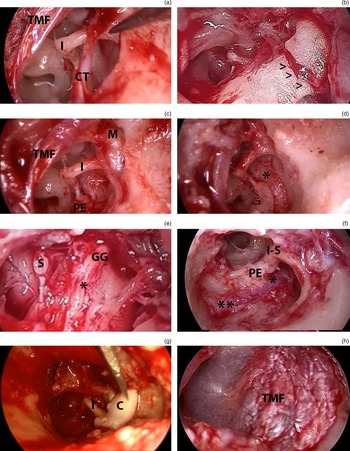
After canal examination and a lidocaine with adrenaline injection, a posterior tympanomeatal flap was elevated, preserving the chorda tympani (Fig. 1a). The lateral wall of the attic was removed by curette, exposing the incudomalleolar joint, and allowing adequate exposure of the anterior and superior epitympanum (Fig. 1b). The fracture site was evaluated. The delicate bony wall over the tympanic segment of the facial nerve was removed by a round knife or a microsurgery hook (Fig. 1c and d). In the case of extension of the fracture line to the proximal tympanic segment or the geniculate ganglion, the incudostapedial joint was dislocated, and the incus was removed. The neck of the malleus was cut, and the head of the malleus was extracted, preserving the malleus handle attached to the tympanic membrane. Considering the cochleariform process as a landmark of the geniculate ganglion, the bony wall inferior and anterior to this process was removed (Fig. 1e).
Endoscopic transcanal facial nerve decompression. (a) Tympanomeatal flap was elevated. (b) Lateral wall of the attic was removed (arrowheads reflect fracture line). (c & d) Tympanic segment of the facial nerve was decompressed, with preservation of the ossicular chain. (e) Tympanic segment and geniculate ganglion of the facial nerve were decompressed after removal of the incus and head of the malleus. (f) Tympanic and proximal mastoid segments were decompressed. (g) Canal wall was reconstructed with tragal cartilage. (h) Tympanomeatal flap was repositioned. *Tympanic segment of the facial nerve. **Mastoid segment of the facial nerve. TMF = tympanomeatal flap; I = incus; CT = chorda tympani; M = malleus; PE = pyramidal eminence; S = stapes; GG = geniculate ganglion; I-S = incudostapedial joint; C = cartilage

For better exposure of the base of the pyramidal eminence, the posterior canal wall (lateral to the retrotympanum) was removed with a curette or via fine diamond drilling. The second genu of the facial nerve was distinguished between the base of the pyramidal eminence and the lateral semicircular canal. The dissection was continued inferiorly and laterally to expose the mastoid segment of the facial nerve (Fig. 1f). This approach exposes the facial nerve from the geniculate ganglion to the proximal part of the mastoid segment. In the case of nerve oedema, unroofing of the fallopian canal was continued, to expose about 180° of the trauma site, and about 5 mm distal and proximal to the site of injury. Then, the epineurium was incised and opened by a hook. In the case of nerve transection, the bony canal wall of the nerve was drilled by a diamond burr, the ends of the nerve were reapproximated tension-free, then a piece of temporalis fascia was harvested and placed over the injury site.
After facial nerve decompression, the ossicular chain was reconstructed with a partial or total ossicular replacement prosthesis if applicable. The lateral attic wall was reconstructed using a piece of cartilage with perichondrium harvested from the tragus or concha (Fig. 1g), and the tympanomeatal flap was repositioned (Fig. 1h).
Post-operative evaluation
All patients were asked to take photographs of their faces every 3 months for at least the next 12 months post-operatively. The facial nerve function was evaluated by House–Brackmann grading. Patients’ hearing status was evaluated by pure tone audiometry at three months post-operatively.
Data collection
A chart review was performed for patients’ demographics and hearing status data. Two surgeons (MKA and MM) evaluated the patients’ photographs to determine the pre- and post-operative House–Brackmann grading scores. Any discrepancies were resolved by discussion. The pre-operative high-resolution temporal bone CT scans were evaluated to determine the site of injury. The video recordings of the surgical procedure were reviewed for details of the surgery.
Results
Patient demographics
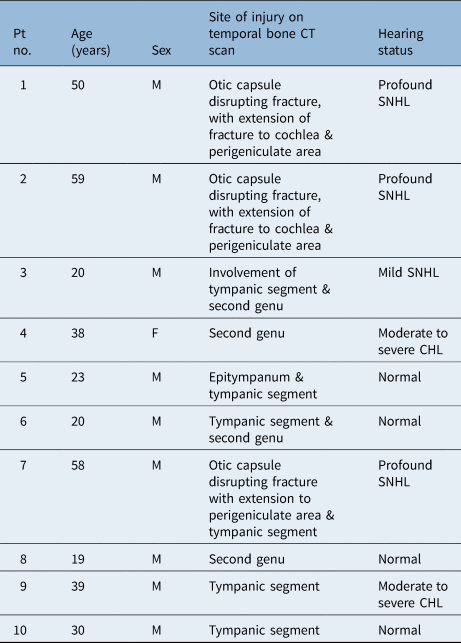
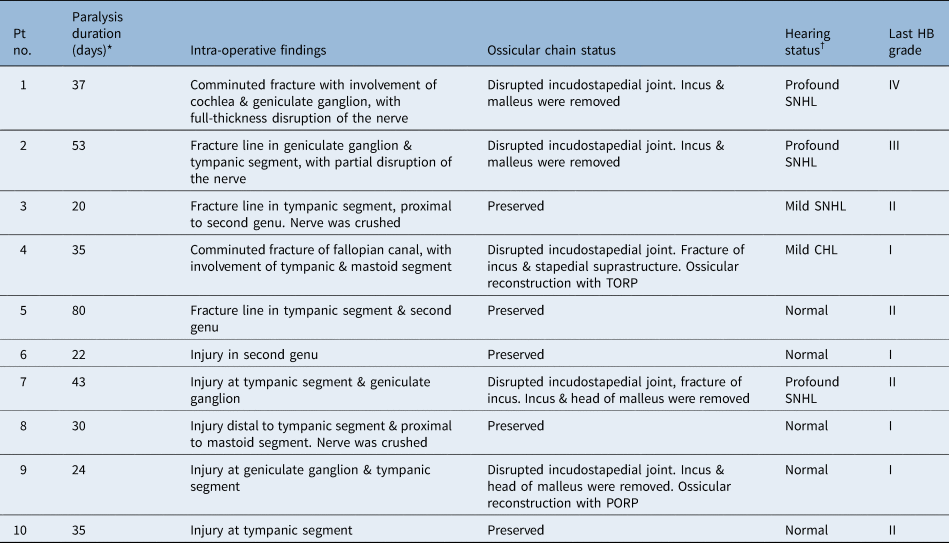
Ten patients (nine males and one female) who met the inclusion criteria were included in the study. The patients’ median age was 34.0 years, with an interquartile range of 20.0 and 52.0 years (range, 19–59 years; mean, 35.6 ± 15.7 years) (Table 1). The average time between the onset of facial nerve paralysis and decompression surgery was 37.9 ± 17.9 days (Table 2).
Patients’ demographics and pre-operative findings

Pt no. = patient number; CT = computed tomography; M = male; SNHL = sensorineural hearing loss; F = female; CHL = conductive hearing loss
Intra- and post-operative findings of endoscopic transcanal facial nerve decompression patients

*Time between facial nerve paralysis diagnosis and surgery. †Based on pure tone audiogram performed three months after surgery. Pt no. = patient number; HB = House–Brackmann; SNHL = sensorineural hearing loss; TORP = total ossicular replacement prosthesis; CHL = conductive hearing loss; PORP = partial ossicular replacement prosthesis
Injury site and intra-operative findings
In three patients, the trauma was otic capsule disrupting, based on the temporal CT scan (Table 1). The fallopian canal was involved in all the patients, with extension to geniculate ganglion in four cases (Table 2). All injury sites were approached with an endoscopic transcanal procedure. Changing to a microscopic approach or mastoidectomy were not necessary.
The ossicular chain was disrupted in five patients. In these cases, the incus and head of the malleus were removed, and reconstruction with the prosthesis was performed (Table 2). There were no complications, except for chorda tympani nerve transection in two patients.
Facial nerve recovery
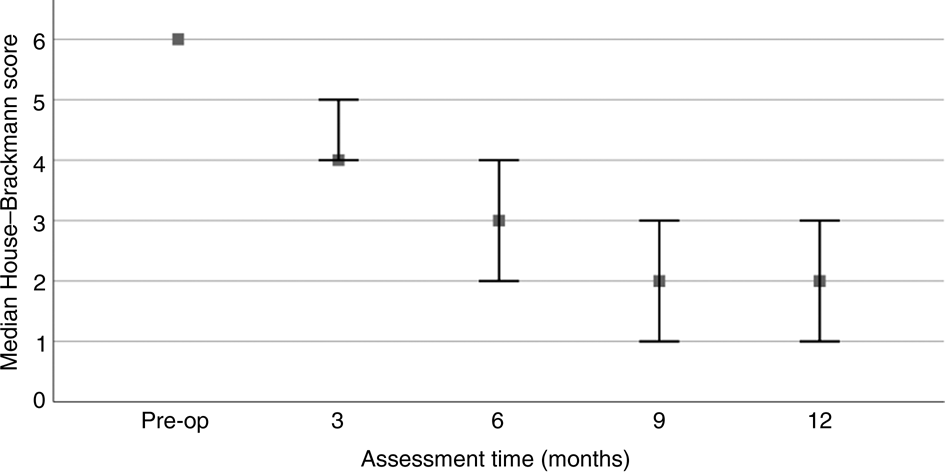
The post-operative facial nerve function results based on House–Brackmann grading are reported in Fig. 2. The median House–Brackmann score at 12 months after surgery was 2, with an interquartile range of 1 and 2.25. Eight patients experienced complete or near-complete recovery (House–Brackmann grade of I or II), while the other two patients had partial recovery (House–Brackmann grade III and grade IV) 12 months after surgery.
The median House–Brackmann scores pre-operatively (pre-op) and during 12 months post-operatively. The whiskers show 95 per cent confidence interval of the median.

Hearing recovery
Three patients with an otic capsule disrupting fracture had profound sensorineural hearing loss, with no improvement observed in the three-month post-operative audiogram. Ossicular chain disruption was present in five patients (three with cochlear involvement). Ossicular chain reconstruction was performed in the remaining two patients. The hearing status of these latter two patients improved from moderately severe conductive hearing loss to normal or mild hearing loss in the three-month post-operative audiogram. The ossicular chain was intact in five patients, and the continuity was preserved during the surgery, with no hearing loss observed in the three-month post-operative audiogram (Tables 1 and 2).
Discussion
This study describes facial nerve decompression performed by an endoscopic transcanal approach, from the geniculate ganglion to the mastoid segment, in 10 patients with complete facial nerve paralysis after temporal bone injury. To the best of our knowledge, this is the first study to report totally endoscopic facial nerve decompression from the geniculate ganglion to the mastoid segment in patients with traumatic facial nerve injury. Twelve months after surgical decompression, eight patients demonstrated complete or near-complete recovery, with partial recovery in two patients. None of the patients experienced worsening of the hearing threshold post-operatively.
The perigeniculate region is the most common site of injury in traumatic facial nerve paralysis.Reference Rajati, Rad, Irani, Khorsandi and Zarandy6,Reference Coker, Kendall, Jenkins and Alford13 Therefore, the surgical decompression approach should address this area. The middle cranial fossa approach is a well-established route for addressing the labyrinthine segment, geniculate ganglion and proximal portion of the tympanic segment, and allows preservation of hearing function.Reference Soloperto, Di Maro, Le Pera and Marchioni14 Because of the anatomical complexity of this area, this approach should be performed by an expert surgeon. Nevertheless, this approach involves craniotomy and temporal lobe retraction, with the potential associated risks of brain oedema, haematoma (subdural, subarachnoid and parenchymal), seizure, cerebrospinal fluid (CSF) leakage, meningitis and brain abscess.Reference Soloperto, Di Maro, Le Pera and Marchioni14,Reference Sun, Andresen and Gantz15
Bento et al. evaluated the results of the middle cranial fossa approach for traumatic facial nerve injury in 156 patients. They reported complications in 23 patients: CSF leakage in 8 patients, epidural haematoma in 4, meningitis in 4 patients, sensorineural hearing loss in 4 and seizure in 3 patients. Transient vertigo occurred in 20 patients.Reference Bento, Pirana, Sweet, Castillo and Brito Neto16 In a study performed by Cannon et al., 3 of 18 patients experienced minor complications (such as vertigo, autophony and tinnitus) after a middle cranial fossa approach for traumatic facial nerve paralysis. Wound infection and abscess developed in one patient.Reference Cannon, Thomson, Shelton and Gurgel17 Aslan et al. performed middle cranial fossa decompression of the facial nerve after traumatic nerve injury without serious complication.Reference Aslan, Songu, Eren, Başoğlu, Özkul and Ateş18
The transmastoid approach is a widely used route for decompression of the mastoid segment of the facial nerve. Exposure of the tympanic segment involves posterior tympanotomy and removal of the incus, and requires ossicular chain reconstruction.Reference Goh, Tan, Madzhi and Tang19–Reference Kim, Ryu, Lim and Kim21 This approach provides the surgeon with good access for ossicular chain reconstruction, CSF leak repair and tympanoplasty.Reference Yanagihara22 However, this approach needs excessive bone drilling and it is time-consuming. In addition, exposure of the geniculate ganglion and tympanic segment of the facial nerve is limited in patients with a low-lying tegmen tympanicum or poorly pneumatised mastoid bone.Reference Alicandri-Ciufelli, Fermi, Di Maro, Soloperto, Marchioni and Presutti23 Potential complications after transmastoid facial nerve decompression include conductive or sensorineural hearing loss, posterior canal wall damage, facial nerve or chorda tympani injury, or damage to the other surrounding structures.Reference May and Klein24 Ignoring the mild conductive hearing loss due to incus removal and subsequent ossicular chain reconstruction, recent studies have reported no surgical complications after transmastoid facial nerve decompression.Reference Gür, Görür, İsmi, Vayısoğlu, Bal and Özcan20,Reference Liu, Liu, Li, Chen, Sun and Li25
The translabyrinthine approach to the facial nerve can provide wide access to the labyrinthine and tympanic segments, and to the mastoid segment when combined with a transmastoid approach, but hearing is sacrificed; the approach is thus reserved for patients with pre-operative profound sensorineural hearing loss.Reference Soloperto, Di Maro, Le Pera and Marchioni14
Recently, with the improvement of our anatomical knowledge and experience in endoscopic middle-ear surgery, endoscopic transcanal ear surgery is being performed more frequently. Furthermore, different types of ear surgery are being performed using an endoscope, with comparable results to those of traditional microscopic procedures.Reference Daneshi and Jahandideh11,Reference Daneshi, Daneshvar, Asghari, Farhadi, Mohebbi and Mohseni26–Reference Daneshi, Asghari, Mohebbi, Farhadi, Farahani and Mohseni28
A few studies have utilised an endoscopic transcanal approach for decompression of the facial nerve. Marchioni and colleagues, in 2011, described the dissection of the tympanic segment of the facial nerve, from the geniculate ganglion to the second genu, in 12 temporal bone specimens and 2 patients with chronic middle-ear disease.Reference Marchioni, Alicandri-Ciufelli, Piccinini, Genovese, Monzani and Tarabichi29 Kahinga et al. reported endoscopic transcanal facial nerve decompression in two patients after traumatic facial nerve injury limited to the tympanic segment of the nerve. The facial nerve function improved to House–Brackmann grades II and III after surgery.Reference Kahinga, Han and Moon30 Alicandri-Ciufelli and colleagues reported the results of endoscopic transcanal facial nerve decompression in six patients with traumatic facial nerve injury limited to the tympanic and/or perigeniculate segment of the facial nerve. They reported mastoid segment involvement as a contraindication for endoscopic transcanal facial nerve decompression. Recovery of facial nerve function was complete in five patients and incomplete in one patient at six months after surgery.Reference Alicandri-Ciufelli, Fermi, Di Maro, Soloperto, Marchioni and Presutti23
Endoscopic transcanal facial nerve decompression is a minimally invasive approach allowing direct exposure of the geniculate ganglion, tympanic segment and the second genu of the facial nerve.Reference Soloperto, Di Maro, Le Pera and Marchioni14 In the current study, endoscopic transcanal facial nerve decompression was used to approach the geniculate ganglion, tympanic segment, second genu and mastoid segment of the facial nerve. This technique obviates the need for excessive mastoid air cell removal and shortens the operating time. In addition, it is possible to reconstruct the ossicular chain or repair tympanic membrane perforations simultaneously.
There were no major complications in the current study. Chorda tympani nerve transection occurred in two patients. Nevertheless, endoscopic transcanal facial nerve decompression has some limitations. For instance, this approach requires adequate dimensions of the external ear canal. Removal of the incus and malleolar head is necessary for geniculate ganglion exposure. Although decompression of the distal portion of the labyrinthine segment of the facial nerve has been reported using the endoscopic transcanal approach,Reference Marchioni, Alicandri-Ciufelli, Piccinini, Genovese, Monzani and Tarabichi29,Reference Wang, Chai, Chen, Wu and Wang31 this approach becomes limited when access to the proximal part of the labyrinthine segment is needed. In addition, there is a potential risk of injury to stapes or lateral semicircular canal during endoscopic transcanal facial nerve decompression. Furthermore, the occurrence of some complications, such as excessive intra-operative bleeding, can necessitate changing the surgical exposure to a microscopic approach.
Several factors may alter the post-operative facial nerve recovery outcomes, such as the anatomical site of the facial nerve injury, the time of surgery and the type of surgical procedure being performed.Reference Hato, Nota, Hakuba, Gyo and Yanagihara1 In the current study, 8 out of 10 patients (80 per cent) experienced complete or near-complete recovery at 12 months after surgery, which is comparable with the outcomes of other approaches. Aslan et al. reported that 54 per cent of patients with traumatic facial nerve injury showed complete or near-complete recovery, two months after decompression of the nerve with a middle cranial fossa approach.Reference Aslan, Songu, Eren, Başoğlu, Özkul and Ateş18 The short-term follow-up period may explain their worse outcomes compared to the results of our study. Bento et al. reported the outcomes of combined facial nerve decompression surgery (middle cranial fossa and transmastoid approaches) in 156 patients with traumatic facial nerve injury. A total of 125 patients (80.1 per cent) experienced complete or near-complete recovery at one year after surgery,Reference Bento, Pirana, Sweet, Castillo and Brito Neto16 which is comparable with the results of our study. The facial nerve outcomes after transmastoid facial nerve decompression are varied. Liu et al. reported that 15 patients (83 per cent) experienced complete or near-complete facial nerve recovery (comparable to the results of our study).Reference Liu, Liu, Li, Chen, Sun and Li25 In contrast, Gür et al. reported complete or near-complete facial nerve recovery in 46 per cent of patients.Reference Gür, Görür, İsmi, Vayısoğlu, Bal and Özcan20
• Traumatic facial nerve injury is the second most prevalent cause of facial paralysis
• Surgery is recommended in patients with immediate and complete facial nerve paralysis
• Routinely, transmastoid or middle cranial fossa approaches are used for facial nerve decompression
• Endoscopic transcanal facial nerve decompression is a safe and effective approach for post-traumatic facial nerve paralysis
• Decompression of the facial nerve, from the geniculate ganglion to the mastoid segment, is possible using this approach
The current study has some limitations. For instance, facial nerve function was evaluated based on patients’ photographs, instead of physical examination, because of the study's retrospective nature. In addition, although the House–Brackmann scale is a widely used grading system, it has a subjective nature, and does not consider the occurrence of facial synkinesis and spasms. Based on these limitations, more prospective studies with larger numbers of participants are recommended.
Conclusion
Endoscopic transcanal facial nerve decompression is a safe and effective approach in patients with traumatic facial nerve injury. Exposure of the geniculate ganglion, tympanic segment, second genu and mastoid segment of the facial nerve is possible in expert hands.
Competing interests
None declared.