The fact that the Japanese foot consists of morae rather than syllables points to the independence of the mora as a phonological constituent. It also poses a problem for advocates of the position that morae are subconstituents of syllables, since the boundaries of feet, composed of morae, need not coincide with syllable boundaries. (Poser Reference Poser1990: 103)
A veteran and witness of many of the changes that had affected phonological theory (including excesses), although the syllable had previously been maligned in generative phonology, I was struck in the early 1980s by how all was forgiven. Everyone loved the syllable, which was now everywhere in evidence. I wondered if it was being overplayed. (Hyman Reference Hyman2003: xvii)
1 Introduction
Following McCawley (Reference McCawley1968: 134), who claimed that ‘the prosodic unit of [Tokyo] Japanese is the syllable and not the mora’, and that Japanese must be categorised as a ‘mora-counting syllable language’, the syllable has been assumed by a number of phonologists to be a fundamental unit for the description and analysis of Tokyo Japanese, in keeping with the phonological dogma which holds that the syllable is a universal constituent present in all languages. Yet a very striking fact of Tokyo Japanese is how little it seems to care for the syllable in comparison to other languages, whereas the mora and the foot are omnipresent, and cannot be dispensed with in the analysis of many phonological and morphological facts.
Interestingly, the Japanese linguistic tradition, which has a long history of remarkable achievements in the fields of philological description and analysis, has never felt the need to refer to a unit such as the syllable in opposition to the mora in accounts of Tokyo Japanese. A number of modern Japanese phonologists belonging to the traditional school of Japanese linguistic analysis continue this tradition. Some of them (for instance Hirayama et al. Reference Hirayama1993 and Satô Reference Satô, Hida and Satô2002) even operate with an explicit distinction between mora-based and syllable-based dialects. Dialects such as Aomori and Akita (North HonshÛ), and Kagoshima (South KyÛshÛ), are held to be indisputably syllabic, while others, for instance the Osaka dialect and the Izu dialect (south of Tokyo) are clearly moraic, and are considered to be such even by some advocates of a syllabic analysis of Tokyo Japanese. It is actually Tokyo Japanese (Standard Japanese), the most extensively studied dialect, which poses a problem with regard to classification as a mora or syllable dialect, as it has been analysed both as only moraic and as syllabic with moras.
In this context, it seems legitimate to reexamine the issue of the syllable in the phonology of Tokyo Japanese (and, where relevant, in other dialects), in relation to the mora and the foot. This is the aim of this paper.
As we shall see, the result of this investigation shows that whereas the mora and the foot are present and active everywhere, the syllable is rather inconspicuous. Moreover the linguistic facts that support the relevance of the syllable in Tokyo Japanese can always receive an alternative, syllable-free account, which works at least as well as the syllabic analysis.
Building on these observations, I claim that Tokyo Japanese makes no use of the syllable, and that it is a mora-counting mora language, thus rehabilitating the Japanese native linguistic tradition, which has long made use of what corresponds to the mora for the analysis of the various prosodic phenomena of the language.
This paper is organised as follows. §2 and §3 review the evidence demonstrating the central role played by the mora and the foot in Japanese phonology. §4 critically reassesses the role and relevance of the syllable in the language, through a review of the scholarship and reexamination of the alleged evidence in favour of the syllabic approach. In §5, I present a new model of the basic prosodic unit of Japanese, in which two different types of units are distinguished: (a) regular, or full, and (b) weak, or deficient. After considering and evaluating alternative proposals to the one made here, I conclude that this basic prosodic unit of Japanese is indeed the mora, and that the mora is a direct subconstituent of the foot in Japanese. In addition, I propose that feet obey a number of well-formedness constraints which result in their optimally beginning with a full mora.
Although this paper is concerned primarily with Japanese-internal issues, I believe that the facts discussed below provide evidence for a reconsideration of the status of the syllable in current phonological theory, as well as of how prosodic units interact in the prosodic hierarchy. These two points are dealt with in the final section of this paper, which provides a general discussion about the universality of the syllable and the status of the mora as a genuine prosodic unit, and proposes that all levels of the prosodic hierarchy are optional, rather than obligatory.
2 The mora
The mora is the unit of rhythm and of prosodic measurement of the Japanese language. It is the only prosodic unit which has been recognised by the native linguistic tradition, which calls it the haku (see work by the Japanese scholars Kamei Takashi, Kindaichi Haruhiko and Akinaga Kazue), moora (Hattori Shirô) or onsetsu (Arisaka Hideo). Kindaichi (Reference Kindaichi1972) offers a general discussion of these questions.Footnote 1 Each mora constitutes one rhythmic unit, and is perceived as being isochronous with other moras (see Warner & Arai Reference Warner and Arai2001 for a review of the phonetic research on the Japanese mora as an isochronous unit). In traditional Japanese phonological theories, where the mora is considered to be the only relevant prosodic unit, two types of moras are distinguished: ‘regular’ moras and ‘special’ moras,Footnote 2 as shown in (1).Footnote 3
(1)


The word /hoNtoR/ hontoo ‘true’ is therefore of the same phonological length as /kaminari/ kaminari ‘thunder’, i.e. four moras.
The major phenomena which attest to the reality of the mora as the basic prosodic unit of Japanese are well known and undisputed (see Vance Reference Vance1987, Kubozono Reference Kubozono1999, Labrune 2012, among many others). The mora is the metric unit of Japanese verse in poetry and singing. It is also granted a graphic status in the kana writing system, so that any mora, including the second part of a long vowel, the moraic nasal or the first part of a geminate, occupies one graphic square on the sheet (with the exception of CyV moras).
Any Japanese speaker is capable of counting and identifying moras, for example in the shiritori (literally ‘buttock taking’) game, as described by Katada (Reference Katada1990). It also functions as the major prosodic unit in a number of other language games, for example the babibu language analysed by Haraguchi (Reference Haraguchi1991: 50–61).
It also provides phonetic support for pitch accent in Tokyo Japanese, in the sense that two moras belonging to what is generally considered a heavy syllable can be produced in two different tonal registers. For example, in the trimoraic word kyooto HL ‘Kyoto’, the pitch fall occurs after the initial mora kyo, and before the second part of the long vowel.
Note that in some special cases, even the second mora of what corresponds to a heavy syllable can function as the accent-bearing unit (or tone-bearing unit, i.e. the mora to which the H of the HL tonal melody will be linked), as in obaasa nkko ‘child cherished by grandmother’ or tekkyo o-shika ‘only the iron bridge’ (see §4.2.3 for discussion), showing that the mora has primary status as a prosodic unit.
Several psycholinguistic studies, in particular those of Otake et al. (Reference Otake, Hatano, Cutler and Mehler1993), Kureta et al. (Reference Kureta, Fushimi and Tatsumi2006) and Verdonschot (Reference Verdonschot2011), have established that it is the mora, rather than the phoneme or the syllable, which constitutes the basic unit of processing, production and perception in Japanese. Such studies have shown, for example, that Japanese listeners detect the target unit mo in the stimulus word monka as fast as they do in monaka, which means that monka and monaka begin with the same prosodic unit, and that they should consequently be segmented as mo.n.ka and mo.na.ka, using a mora-based segmentation procedure, rather than as mon.ka and mo.na.ka, using a syllable-based segmentation procedure. This contrasts radically with the responses of listeners whose native language is syllabic, when they are asked to perform the same type of task (Mehler et al. Reference Mehler, Dommergues and Frauenfelder1981).
Finally, Japanese moras behave as independent constituents with respect to speech errors. Kubozono (Reference Kubozono1985, cited in Kubozono Reference Kubozono, Connell and Arvaniti1995, Reference Kubozono1996) reports that CVV or CVC sequences are replaced by CVCV sequences more frequently than by CV sequences. This suggests that what can be analysed as a heavy syllable is phonologically equivalent in weight to a sequence of two short syllables. This constitutes evidence that postnuclear C or V elements serve as single prosodic units, just like CV sequences. Kubozono (Reference Kubozono, Connell and Arvaniti1995) also demonstrates that Japanese speakers tend to segment words on a mora-based pattern in the formation of blends.
The positive evidence for the mora as a basic, independent prosodic unit in Japanese is thus well established.
3 The foot
The canonical Japanese foot is bimoraic. It can have the following structures: (C)VCV, (C)VV, (C)VC (the prevocalic C can be palatalised, i.e. Cy). In (C)VC, the final C is the moraic nasal (/N/) or the first part of a geminate (/Q/). In (C)VV, the second V can be /R/ (i.e. the second part of a long vowel) or any other vowel.
Although recognition of the foot in Japanese phonology is rather recent, dating from Poser's seminal 1990 work, the evidence for its relevance is massive and uncontroversial. Poser provides a number of foot-based phenomena which demonstrate the significant role of the bimoraic (rather than bisyllabic) foot in Japanese morphophonology: geisha client names, kinship terms, rustic girl names, verbal reduplication, mimetic bases, the secret language of jazzmen, and compound accentuation. Other foot-based phenomena include derivatives used in the feminine language (nyooboo kotoba) and abbreviated loanwords (see below).
To illustrate the relevance of the foot, let us just consider two phenomena (see Labrune Reference Labrune2012): nyooboo kotoba derivatives (nyooboo kotoba was originally a secret language used by court ladies, and is still productive) and compound loan truncations.
Nyooboo kotoba forms are obtained by truncation of the base to foot size, with addition of the polite prefix o-, as shown in (2). Note that the truncated base must be equivalent to two light syllables or to one heavy syllable in a syllable-based approach, but to no other bisyllabic combination (*heavy–light, *light–heavy, *heavy–heavy), showing that feet are made up of moras rather than syllables.
(2)
The foot is also used as the basic unit in compound abbreviated loanwords. A large majority of them (around 80% according to Labrune Reference Labrune, Delais-Roussarie and Labrune (2007) are built by extracting one bimoraic foot – generally the initial one – from each component of the original form, thus yielding a two-foot long derivative, as shown in (3).Footnote 4
(3)
The foot is also the prosodic domain within which certain accent shifts occur. Whenever several vowels in the environment of a devoiced vowel are eligible to receive accent as a consequence of accent shift, the basic principle seems to be that accent will remain within the same foot (Tanaka Reference Tanaka2001). Other studies by Tanaka (Reference Tanaka1998, Reference Tanaka2008: 199ff) highlight the fact that evaluation of the relative sonority of vowels in certain cases occurs within the head foot in order to determine accent placement. The accent then falls on the most sonorous vowel in the foot.
4 The syllable
While there is no doubt about the relevance of the mora and foot in Japanese phonology, things are much less clear with regard to the syllable in the most usual sense of the term.
McCawley (Reference McCawley1968), the first modern linguist to propose a thorough analysis in favour of the syllable in Tokyo Japanese, posits two syllable types in the language: short syllables and long syllables, and claims that Japanese is a ‘mora-counting syllable language’.Footnote 5
With practically no exceptions, McCawley's generativist and post-generativist successors (from linear SPE-type phonologists to OT adherents) make explicit or implicit reference to the syllable in their accounts of Japanese phonology.Footnote 6 The syllable, or to be more precise, the distinction between two syllable weights, light and heavy, is thus taken to be essential to the description and analysis of Japanese. For McCawley and his successors, among whom Kubozono (Reference Kubozono1999, Reference Kubozono, Féry and van de Vijver2003), Itô & Mester (Reference Ito, Mester, Honma, Okazaki, Tabata and Tanaka2003, among other works) and Tanaka (Reference Tanaka2008), Japanese thus possesses light syllables, which are either (C)V or CyV, and heavy syllables, which are (C)VC or CyVC, and (C)VV or CyVV. Superheavy syllables, such as sain (CVVN) or kaat in kaatto (CVRQ), must be added to this inventory, but they are less common.
For the majority of the studies which have tackled the question, the issue is not so much that of the existence of the syllable itself; this point is taken for granted, since the syllable is supposed to be present in all the languages of the world. Rather, it is the existence of the heavy syllable, CVC or CVV, which is relevant. Therefore, those linguists who claim to be dealing with the issue of the syllable in Japanese, or who attempt to prove that the syllable exists in the language, are actually addressing the question of the existence of heavy syllables in Japanese.
However, one should remember that in their accounts of the phonology of their native language Japanese scholars of the traditional linguistic school generally make no use of the syllable as a unit which can be light or heavy. Even in Western accounts of Japanese, the syllable has not always been used. For instance, Bloch (Reference Bloch1950) provides an in-depth analysis of Japanese phonology without referring to heavy syllables. What he calls a ‘syllable’ corresponds to a mora, with the moraic nasal, the first part of a geminate and the second part of a long vowel all labelled as syllables. A similar approach is adopted by Hockett (Reference Hockett1955: 59), who states that nippon ‘Japan’ has four syllables.Footnote 7 In this context, it is indeed relevant to question the syllable's role and significance in Japanese.
As we shall see in the following sections, the syllable problem in Tokyo Japanese is actually threefold. First, syllable units, or their constituents, are not present where one usually expects to encounter them on the basis of what can be inferred from typological or cross-linguistic data. Of course, lack of positive evidence does not automatically provide negative evidence, but it should at least lead us to question the initial postulate that Japanese is a syllable language. Second, the alleged evidence which has been presented in favour of the syllabic analysis is slight and questionable, either because additional data have not been considered or because they can be given an alternative, syllable-free analysis. Finally, a number of inconsistencies and unorthodoxies can be identified in the models of the Japanese syllable which have been proposed in the literature. These three issues will be addressed in turn in the following subsections.
4.1 Lack of positive evidence in favour of the syllable or its constituents
4.1.1 Lack of psycholinguistic evidence
The first and probably most important point to be acknowledged is that none of the many psycholinguistic studies which have been conducted has been able to establish the cognitive reality of the syllable in Japanese, whereas many works have established the central role of the mora both at the perceptive and cognitive levels (see the papers in Otake & Cutler Reference Otake and Cutler1996, Kureta et al. Reference Kureta, Fushimi and Tatsumi2006 and Verdonschot Reference Verdonschot2011).
4.1.2 Speech errors
The examination of speech errors provides extremely interesting clues. According to Kubozono (Reference Kubozono1989, Reference Kubozono, Connell and Arvaniti1995, Reference Kubozono, Nakayama, Mazuka and Shirai2006a), in slips of the tongue what corresponds to a ‘heavy syllable’ tends to be replaced by a succession of two ‘light syllables’ or a ‘heavy syllable’ more often than by a ‘light syllable’, for example in Kyoono Kikujiroo (proper name)>Kikuno Kikujiroo and juugo paasento ‘fifteen per cent’ >juugo pansento. This shows that the syllable does not have cognitive reality, since one would otherwise expect a heavy syllable to alternate with a light syllable more often than with two syllables. An analysis of this phenomenon based on the mora or the foot provides a better understanding of the data: a mora is replaced by a mora, and a foot is replaced by a foot. Furthermore, studies by Terao (Reference Terao1992, Reference Terao2002, Reference Terao2008) establish that the fundamental unit on which speech errors operate in Japanese is the mora, rather than the syllable. This constitutes negative evidence against the syllable.
4.1.3 Absence of phonetic clues for the existence of a rhyme-like constituent
There is considerable evidence pointing to the non-existence of a rhyme constituent in Japanese ‘syllables’. Segments which can be interpreted as belonging to the rhyme of a heavy syllable do not behave as expected of rhymes or of codas, on the basis of what can be observed in other languages.
First, vowels which occur in ‘closed syllables’ of the shape CVC are not phonetically shorter than those that occur in ‘open’ CV syllables (Homma Reference Homma1981). Indeed, the opposite holds: vowels can be longer in allegedly closed syllables. Han (Reference Han1994) and Idemaru (Reference Idemaru2005) show that a vowel preceding a geminate consonant in a /CVQCV/ trimoraic sequence is longer than a vowel preceding a singleton in a bimoraic /CVCV/. Kubozono (Reference Kubozono1999: 34) states that ‘in Japanese, vowel duration is independent of the difference in syllable structure … These exceptional temporal patterns shown by Japanese can be properly accounted for if the mora is posited as a unit of temporal organization in the language’. This situation contrasts radically with what is observed in languages with closed syllables like English, in which phenomena of temporal compensation exist between the nucleus and the coda (Maddieson Reference Maddieson and Fromkin1985). This provides evidence against the existence of a rhyme constituent in the Japanese syllable symmetric to the onset, and justifies our considering that CVC sequences must be divided as CV.C, just as CVCV is divided as CV.CV.
It can also be observed that the link between C and V is phonetically tighter in Japanese than the link between V and C or between V1 and V2 in a ‘heavy’ syllable. Many restrictions hold between an onset consonant and a following vowel, but there are no such restrictions between a vowel and a following ‘tautosyllabic’ consonant (Kubozono Reference Kubozono, Nakayama, Mazuka and Shirai2006a). To take just one example, /t/ becomes [ts] before /u/, and [tç] before /i/. If heavy syllables existed, one would expect restrictions similar to those occurring between two distinct syllabic components (the onset and the nucleus) to be even more frequent within a single syllabic component, i.e. a branching nucleus in the case of a V1V2 sequence, or a rhyme in the case of VC. However, this is not the case. According to Kubozono (Reference Kubozono, Nakayama, Mazuka and Shirai2006a), this shows that ‘coda’ consonants are phonologically independent of a preceding vowel.
In addition, Campbell & Sagisaka (Reference Campbell and Sagisaka1991), cited by Kubozono (Reference Kubozono, Connell and Arvaniti1995), show that effects of temporal compensation hold between the onset and the nucleus in Japanese. The duration of a nuclear vowel is inversely proportional to the intrinsic duration of the consonant preceding it. This causes the same onset consonant to be shorter before /a/ than before /i/ and /u/, the two shortest vowels in Japanese. Even within analytical frameworks which do not recognise the rhyme, one would expect phonetic assimilations or temporal compensation to occur at least as frequently between segments in positions 1 and 2 as between segments in positions 2 and 3 within a single putative syllable. However, this does not happen in Tokyo Japanese, suggesting that a unit such as the heavy syllable is not phonologically relevant.
4.1.4 Absence of onset optimisation
A further convincing argument against the existence of heavy syllables at the phonological level can be found in the behaviour of the moraic nasal /N/. A VNV sequence is never syllabified as V.NV (two moras), but rather as V.N.V (three moras). This contradicts what is generally assumed in phonology, as reported for instance by Golston & van der Hulst (Reference Golston, van der Hulst, Hermans and van Oostendorp1999: 159), who state that ‘it is a widely observed fact that a sequence of a closed syllable followed by a syllable that starts with a vowel, is empirically unattested’. However, counterexamples to this principle can be readily found in Japanese. Consider the contrasts in (4).
(4)
Here, (4a) corresponds exactly to the type which is claimed by Golston & van der Hulst (Reference Golston, van der Hulst, Hermans and van Oostendorp1999) to be empirically unattested if analysed syllabically. The moraic /i/ behaves similarly to the moraic nasal with respect to onset non-optimisation. In the word baiorin° /baioriN/ ‘violin’, the palatal does not group with the following vowel o (*ba.yo.ri.n) in the standard variety of the language.Footnote 8 It keeps its moraic status: ba.i.o.ri.n. This word is thus realised with five moras, not four. This can be taken as evidence that /N/ and /i/ are not codas, but prosodic units in their own right which possess greater autonomy than syllabic codas, thus casting further doubt on syllabic analyses of Japanese.
4.1.5 Non-coincidence of foot and syllable boundaries
As cited in the epigraph, Poser (Reference Poser1990: 103) observes that ‘the boundaries of feet, composed of morae, need not coincide with syllable boundaries’ in Japanese. Examples of this mismatch between foot and syllable occur for instance in the truncated form of roriita konpur ekkusu ‘Lolita complex’→rori-kon°, which would be *rorii-kon° if foot and syllable boundaries coincided.Footnote 9 This mismatch calls into question the ‘strict layer hypothesis’ (Nespor & Vogel Reference Nespor and Vogel1986), according to which each prosodic constituent is included in its entirety in the immediately higher-ranked constituent.
A possible explanation is that if foot and syllable boundaries do not coincide, this is because syllables do not exist. In the model to be presented below in more detail, moras are directly linked to feet, with no intervening syllable layer, so that the only boundaries which coincide are mora and foot boundaries.
4.2 The questionable nature of the alleged evidence for the syllable
Let us now reexamine the internal evidence which is generally presented in favour of the recognition of a light vs. heavy syllable opposition in Tokyo Japanese. In this subsection, I will carry out a critical examination of the main arguments which have been offered in support of the existence of heavy syllables in the language, and consider alternative syllable-free analyses.
The phenomena that will be examined here are the following: initial lowering, unaccentedness of the moraic elements /N Q R i/, exceptional accentuation of /N R i/, loanword accentuation, loanword truncation, accentuation of nouns before the enclitic particle no, accentuation patterns of compound personal names whose second member is -taroo and the ban on trimoraic syllables.
4.2.1 Initial lowering
Initial lowering (or initial dissimilation) is a phenomenon which is generally accounted for with reference to the syllable (see for instance Yoshida Reference Yoshida1990 and Haraguchi Reference Haraguchi1999). Tokyo Japanese obeys a principle which stipulates that an accentual phrase which does not bear an initial lexical accent begins with a LH pitch sequence. However, this principle only applies optionally in phrases beginning with a CV+special mora sequence, i.e. a putative heavy syllable. Rather, such phrases can start with a HH pattern (Hattori Reference Hattori1954). Compare, for instance, kokusai° ‘international’, realised as LHHH, with koosai° ‘exchange’ (HHHH or LHHH).
At first sight, the correct description of this phenomenon requires reference to the syllable: initial lowering supposedly does not apply when the word starts with a heavy syllable. However, this is nothing more than an ad hoc statement. Compare the two following formulations: (i) initial lowering does not occur when the word starts with a heavy syllable; (ii) initial lowering does not occur before a special mora (where the second mora of the word is a special mora). The statement in (i) does not have more explanatory power than the one in (ii), nor is it simpler.
Moreover, even if one adopts a syllabic analysis of Japanese, the formulation of the process at hand is not fully adequate, and therefore cannot be held as definite evidence for the involvement of the syllable, because it appears that only a subset of the putative heavy syllables, namely those ending in /R/ and /N/, are involved in this phenomenon. When they end in /Q/ or /i/ (the two other arguably possible syllabic codas of Japanese), the behaviour is different. Unaccented Cvi-initial words behave like CVCV-initial words, for instance koikuchi° ‘strongly flavoured’ is pronounced LHHH, while unaccented CVQ-initial words are pronounced with a sequence of two low pitches, e.g. gakkoo° LLHH ‘school’ (Haraguchi Reference Haraguchi1977: 34–35, Tanaka Reference Tanaka2008: 210). Furthermore, Poser (Reference Poser1984) and Pierrehumbert & Beckman (Reference Pierrehumbert and Beckman1988: 26–27) show that there is often a LH contour even in words beginning with what can be interpreted as a heavy syllable containing a long vowel. Thus the issue is actually more complicated and controversial than it at first sight appears.
4.2.2 The unaccentedness of /N Q R/ and moraic /i/
The phenomenon most frequently invoked in favour of an opposition between light and heavy syllables in Tokyo Japanese involves the prosodic status of the ‘special moras’ /N Q R/ and the moraic vowel /i/, i.e. the elements which in languages like English, Chinese or Arabic are likely to constitute the second part of a heavy syllable.
First, these elements themselves in principle cannot bear accent. They have the property of causing a leftward shift of the accent when they occupy a prosodic position where an accent would be expected to occur. Consider for example the case of loanwords of Western origin, in which a default accent is assigned to the antepenultimate mora. The traditional approach, represented by Kindaichi & Akinaga (Reference Kindaichi and Akinaga2001), adopts the following rule: accent falls on the antepenultimate mora; if the antepenultimate mora consists of a special mora, accent moves to the preceding mora, falling on the pre-antepenultimate. Compare for instance a.na.ku.ro.ni.zu.mu (μμμμμμμ) ‘anachronism’ with di.su.ka.s.sho.n (μμμμμμ) ‘discussion’, rather than *di.su.ka.s.sho.n (μμμμμμ) (dots are used to denote mora boundaries). This approach, which is widely followed by traditional mainstream Japanese scholars, has no need to refer to the syllable to account for such accentual patterns.
McCawley (Reference McCawley1968: 134) proposes a different analysis: for him, examples such as the above would support the claim that the syllable rather than the mora is the prosodic unit of Japanese, because in a heavy syllable, only the first mora can be accented. Following his approach, disukasshon has four syllables: di-su-kas-shon (where hyphens denote syllable boundaries). The default accent rule of Japanese, which applies to foreign loans, can accordingly be reformulated as follows: accent is placed on the syllable containing the third from last mora. Japanese would thus be categorised as a ‘mora-counting syllable language’, whose prosodic unit is supposed to be the syllable and not the mora, even though McCawley also recognises that the mora plays a major role in Japanese, as a ‘unit of phonological distance’. Notice that, as pointed out by Uwano (Reference Uwano, Kitahara and Uwano2003: 74), the moraic and the syllabic approaches provide similar accounts here.
However, the main objection to McCawley's analysis is that if the syllable is indeed the prosodic unit in Japanese, how can we explain that in an accented heavy syllable, the third component (the coda in the syllabic approach) is never of the same pitch as the onset and nucleus? In words such as kyooto ‘Kyoto’ or nihon ‘Japan’, the fall in pitch that marks the location of the accent occurs before a special mora (before the second part of the long vowel in kyo↓oto and before the moraic nasal in niho↓n).The categorisation of Japanese as a syllable-accenting language thus appears inappropriate, since only a subpart of the syllable is likely to carry the pitch. It is therefore not empirically true to state that the syllable is accented, because only the first part of it bears the high pitch. This situation is radically different from what occurs in syllabic languages like English, in which heavy syllables never contrast stress or accent placement on their two component moras. Moreover, it seems rather complicated, not to say cognitively illogical, to assume that one counts one type of unit (moras) in order to accent some other type of unit (syllables). The most straightforward and simple analysis is to assume that Japanese both counts and accentuates moras, since pitches coincide with moras, but that, as we shall see below in more detail, one category of moras cannot normally receive accent, because of their structural weakness or lack of prominence.
4.2.3 Exceptional cases of accentuation of /N R i/
A rather puzzling fact is that even the second part of what could be interpreted as a long syllable by proponents of the syllabic analysis can receive an accent in Tokyo Japanese, thus contradicting McCawley's assumption that only the first part of a long syllable can receive accent.
McCawley's conception of the mechanisms of Japanese accent appears even more inadequate in cases involving a sequence of special moras. It sometimes happens that /N/, /R/ or /i/ receives the accent.Footnote 10 In words like obaasa nkko /obaRsaNQko/ ‘child cherished by grandmother’ or che enten /tjeRNteN/ ‘chain store’, the accent does not fall on what would constitute the accentual peak of the syllable in McCawley's model, but on the first special mora after the nucleus, here /N/ and /R/ respectively.
Higurashi (Reference Higurashi1983: 32ff) reports another case in which the ‘second part’ of a heavy syllable is accented. When the pre-accenting enclitic particle shika ‘only’ is combined with an unaccented noun, the final mora of the noun, including /N/, /R/ and moraic /i/ in the speech of some Tokyo speakers, receives an accent. Consider the following examples.
(5)
Not only is it not the entire syllable which receives the accent, it is not even the heart of the syllable, i.e. its nucleus, which does. Such cases are rather marginal, but it is obvious that they cannot be accounted for in McCawley's approach, thus weakening the syllabic analysis of Japanese. In addition, one has to take into account the fact that some dialects very closely related to Tokyo Japanese allow special moras to receive an accent in a very general fashion. For example, as already mentioned, in the Izu dialect, which belongs to the Tokyo sub-family of dialects and is located 100 km southwest of the capital city, there is a possible contrast between to o LH ‘ten’ and too HL ‘political party’, or between ka i LH ‘shell’ and kai HL ‘a paddle’ (Uwano Reference Uwano, Kitahara and Uwano2003). As Uwano observes, this type of contrast would be totally impossible in a syllable-based language like English.
4.2.4 The accentuation of loanwords
Another classical case of the alleged necessity for the syllable is provided by Kubozono (Reference Kubozono1996). Examining the assignment of accent in foreign toponyms, a subclass representative of accent-assignment processes in loanwords, Kubozono observes that although the default accentuation rule stated above applies quite generally in accented loans, whatever formulation of the rule one adopts – be it à la Kindaichi & Akinaga or à la McCawley – it encounters a number of exceptions which are accented on the fourth or fifth mora from the end, as in monburan /moNburaN/ ‘Mont Blanc’, amazon /amazoN/ ‘the Amazon’, pirenee /pireneR/ ‘the Pyrenees’, senegaru /senegaru/ ‘Senegal’, rather than *mon buran, *a mazon, *pi renee, *se negaru, as predicted both by Kindaichi & Akinaga's and McCawley's analyses. Interestingly, all such examples end in a special mora, or a mora containing an epenthetic vowel.
Taking such examples into consideration, Kubozono (Reference Kubozono1996: 74) posits the following accentuation rule for four and five-mora long words: ‘if the word ends with a heavy syllable (or a light syllable containing an epenthetic /u/) accent is placed on the initial syllable, whether it is light or heavy’.
Although this formulation seems perfectly correct on the descriptive level, referring to the syllable has no explanatory power. Why should the presence of a heavy syllable word finally have such an accentual effect on the pre-antepenultimate syllable? We could reformulate this in the traditional approach by saying that ‘if the word ends with a special mora (or a mora containing an epenthetic /u/) accent is placed on the initial mora’.
4.2.5 Loanword truncation
Loanword truncation is a productive process in Japanese, which readily admits some truncation patterns but disfavours others. It has been claimed that some of the unproductive patterns can be understood in terms of syllable weight (Itô Reference Itô1990, Labrune Reference Labrune2002, Itô & Mester Reference Ito, Mester, Honma, Okazaki, Tabata and Tanaka2003, Kubozono Reference Kubozono, Féry and van de Vijver2003).Footnote 11
For instance, Itô (Reference Itô1990) shows that ‘monosyllabic’ L and H truncations are non-productive, contrary to ‘bisyllabic’ LL or HL ones, so that a form like sandoitchi ‘sandwich’ is truncated as sando rather than *sa or *san, while rejisutaa ‘cash register’ is truncated as reji. Itô (Reference Itô1990) and Itô & Mester (Reference Ito, Mester, Honma, Okazaki, Tabata and Tanaka2003) propose that this is due to a minimality requirement which demands that the prosodic word be minimally bisyllabic (rather than bimoraic).
Itô's study also establishes that *LH is rare and unproductive. Itô & Mester (Reference Ito, Mester, Honma, Okazaki, Tabata and Tanaka2003) argue that the ill-formedness of *LH can be explained by the operation of a Left Edge Matching constraint, which requires that left word edges preferentially coincide with foot edges. Accordingly, the abbreviated form for demonsutoreeshon ‘demonstration’ can only be demo. The other possible candidate, *demon, is ruled out because it would be parsed as *(de)(mon), which begins with a degenerate foot, *(demon), which corresponds to a trimoraic foot, *(demo)n, which infringes syllable integrity, or *de(mon), which violates the Left Edge Matching constraint. Finally, another pattern, the *LHL pattern, also appears as unproductive in Itô's survey. This is accounted for by the operation of a constraint demanding that truncated forms be binary in feet or in syllables. For instance, *demonsu, from demonsutoreeshon, with the structure (de)(mon)(su), is not binary in feet, and is therefore ill-formed. This analysis, which relies largely on the role of the syllable, apparently provides a convincing account of the productive patterns in loanword truncation.
However, here again, careful reexamination of the data reveals that a syllable-free approach is possible and that it provides a satisfactory treatment of the truncation facts.
Truncation patterns in loanwords.

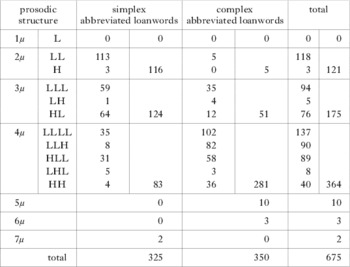
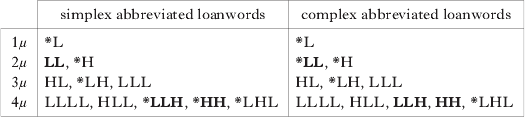
In order to get an accurate picture of the phenomena, we first need to reconsider the typology of Japanese abbreviated loanwords, and operate a strict distinction between simplex abbreviated loanwords (hereafter SALs) and compound abbreviated loanwords (CALs), as shown by Labrune (Reference Labrune2002, Reference Labrune, Delais-Roussarie and Labrune (2007). This is because the two types exhibit different prosodic patterns, showing that the mechanisms which govern their formation differ significantly.Footnote 12Table I, taken from Labrune (Reference Labrune2002), provides statistical data on the possible truncation patterns in SALs and CALs. The table shows that whereas some patterns are common to both types, others are not. One major difference between SALs and CALs is that SALs are overwhelmingly bimoraic or trimoraic (74%), whereas CALs are predominantly quadrimoraic (80%). The productive patterns also differ according to whether the truncated form is a SAL or a CAL. Putting aside truncated forms longer than five moras, whose detailed prosodic structure is not provided in the table and which in any case amount only to a small number of cases, the generalisations in Table II regarding productive and unproductive patterns emerge.
Productive and unproductive patterns in simplex and complex abbreviated loanwords. Patterns in bold are those whose productivity level differs in SALs and CALs.
When SALs alone are considered, it appears that there are more impossible patterns than suggested by Itô (Reference Itô1990). Not only are *L, *H, *LH and *LHL impossible SALs, but so are *HH and *LLH. This impossibility can be accounted for neither by the minimality requirement nor by the binarity or Left Edge Matching constraint, because the two patterns both form two feet which can be neatly aligned with the left edge: (H)(H) and (LL)(H).
Consequently, one should take into consideration the fact that it is not only *H and *LH that are impossible in SALs, but also *LLH and *HH – in other words, all SALs ending in a putative H syllable. So it is not the number of syllables which is relevant, but the type of prosodic unit in which a SAL may end. This is the approach adopted by Labrune (Reference Labrune2002), who, in order to account for the scarcity of *H, *LH, *LLH and *HH in SALs, argues for a constraint *H#, which bans heavy syllables word-finally. In a syllable-free approach based only on feet and moras, this constraint could simply be reformulated as a constraint demanding that SALs do not end with a special mora. Accordingly, the scarcity of the *H pattern (as well as that of *LH, *HH and *LLH in SALs) is due to its ending in a special mora, not to its alleged monosyllabicity. Note that for CALs the explanation must be different, but this is the case whether a syllable-based approach or a syllable-free approach is adopted, so we shall not consider the details of CAL formation, nor the other aspects of SAL-truncation mechanisms (on these issues, see the references mentioned above).
Finally, the ill-formedness of *L and *LHL can now be explained by the application of a binarity constraint resembling the ‘Word Binarity’ requirement postulated by Itô & Mester (Reference Ito, Mester, Honma, Okazaki, Tabata and Tanaka2003: 40), except that binarity is now based on feet or moras rather than on feet or syllables.
4.2.6 The accentual behaviour of nouns before no
Another example of interest is examined by Miyake (Reference Miyake1943), Vance (Reference Vance1987: 81ff), Haraguchi (Reference Haraguchi1999), Kubozono (Reference Kubozono1999) and Uwano (Reference Uwano, Kitahara and Uwano2003), among others. It involves the genitive particle no, whose accentual behaviour is rather peculiar. When no occurs after a noun, that noun sometimes undergoes deaccentuation, depending on its lexical accent pattern. Consider the examples in (6).
(6)
According to Kubozono, an adequate description of these examples can only be made through explicit reference to the syllable, and should be formulated as follows: words longer than one syllable which are accented on the final syllable, such as ya ma and oto ko in (a), and ni hon and ki noo in (b), become unaccented when followed by the no particle, while monosyllabic words (whose only syllable is either heavy or light and bears an accent) like me, doo, ten and kai in (d) and (e) maintain the original accent. This phenomenon might appear to be the most convincing of those considered here for the justification of the relevance of heavy syllables.
However, many apparent exceptions can be found (see Vance Reference Vance1987: 82, Reference Vance2008: 156–157 for lists and additional references). For instance, taku san ‘much’ and tsu gi ‘next’ are not deaccented before no: taku san+no and tsu gi+no yield taku san-no and tsu gi-no, not *takusan-no° and *tsugi-no°. In addition, some Tokyo Japanese speakers do not realise (6b) as shown above, but maintain the final lexical accent of the noun, so there is considerable variation in the data. It seems that words such as ni hon or ki noo, which undergo deaccentuation before no, are actually lexical exceptions (Takayama Tomoaki, personal communication 2009), belonging to a small closed set, while the taku san type, which does not yield deaccentuation, is more likely to be the general default type.
An alternative, non-syllabic approach to these data would involve the claim that the words belonging to types (6b) and (6e), which end in a special mora and bear a surface accent on the penultimate mora, actually have an underlying accent on the final mora, e.g. /nihoN/, /kinoR, /doR/, /teN/, /kai/. Interestingly, the noun kai HL ‘shell’ is phonetically accented on the final mora in the closely related Izu dialect (ka i LH), which allows special moras to receive an accent. This analysis is also suggested by Uwano (Reference Uwano, Kitahara and Uwano2003: 75), and further developed in Labrune (Reference Labrune2012). The underlyingly final accent is shifted one mora to the left by virtue of the very general principle that special moras cannot bear an accent at the level of phonetic realisation (except in a few exceptional cases; see the shika and obaasa nkko examples previously mentioned). This analysis accounts very easily for exceptions like taku san, because taku san is accented on the mora sa at the underlying level, as well as at the surface level, as opposed to the words in (6b) and (d), which, I argue, actually carry an accent on their final mora at the underlying level. This is why they behave exactly like ya ma and oto ko in (6a), rather than like ko koro in (6c). In doo, ten and kai, it is the initial mora of the word which, on the surface, receives the accent. In this case, deaccentuation does not occur, and the accent is maintained on the initial mora, a phenomenon which probably has to do with the fact that the beginning of a word constitutes a privileged position, where contrasts are more often preserved and neutralisations avoided (Beckman Reference Beckman1999).
The issue is therefore controversial, and no consensus has been reached. The data would need further investigation to determine which pattern is regular: the pattern involving deaccentuation or the pattern involving no deaccentuation. This is probably one of the reasons why specialists in Japanese phonology such as Vance (Reference Vance1987: 83) and Uwano (Reference Uwano, Kitahara and Uwano2003) assume that accent deletion before no should not be taken as reliable evidence for syllable structure.
4.2.7 Personal compound names whose second member is -taroo
Let us now consider the personal names in (7) (all from Kubozono Reference Kubozono1999: 46, with romanisation adapted; when no accent information is provided, the morpheme does not have its proper accent pattern, because it never occurs in isolation).
(7)
According to Kubozono (Reference Kubozono1999), the accent behaviour of the compounds with -taroo is predictable on the basis of both the syllable and mora structure of the first member. When the first member is monosyllabic, the compound is unaccented, whether monomoraic as in (7a) or bimoraic as in (7b). Otherwise, it is accented. Note that -taroo exhibits two different accent patterns when combined with a bimoraic first member: a monosyllabic first member (7b) yields an unaccented compound just like a monomoraic one (7a), whereas forms with a bisyllabic initial constituent receive accent on the first member (7c).
However, once more, an alternative account is possible. First, as Kubozono (Reference Kubozono1999) mentions, personal compound names with -jiroo behave differently, insofar as they do not trigger the same accent behaviour. Thus kin (7b) behaves like momo° (7c) when combined with -jiroo, not like ki (7a), yielding kinjiroo rather than *kinjiroo°. This shows that the conditioning of the accent rule is probably lexical rather than strictly phonological. Second, examination of the examples in (7) shows that trimoraic bisyllabic initial constituents behave like trimoraic trisyllabic ones (7d), suggesting that it is not the weight of the initial element's ‘final syllable’ which is crucial, but something else. Here again, we can achieve a correct descriptive account of these data by reference simply to the foot and the mora. The rule can be reformulated as follows: when the first member is equivalent to a monomoraic foot or to a bimoraic foot ending in a special mora, the compound is unaccented (7a, b). When the first element is a bimoraic foot ending in a regular mora, accent is placed on its final mora (7c). Finally, when the initial element is longer than one foot, accent is placed on the initial mora of -taroo. One could also invoke a constraint banning compounds ending in -taroo from bearing initial accent.
4.2.8 The ban on trimoraic syllables
According to Kubozono (Reference Kubozono1999), a convincing argument in favour of the syllable comes from the analysis of putative trimoraic syllables, or superheavy syllables.Footnote 13 According to him, Japanese avoids creating trimoraic syllabic structures in the process of borrowing. For instance, the English word range is adapted as /re.N-zi/ renji rather than */re.i.N-zi/ *reinji, and corned beef as /ko.N-bi.i-hu/ kon biifu rather than */ko.o.N-bi.i-hu/ *koonbiifu (as before, hyphens denote syllable boundaries and dots mora boundaries). Similar cases can be found outside the Western stratum of the lexicon. In the native and Sino-Japanese strata, superheavy syllables are occasionally created at morpheme boundaries, e.g. /ho.N.Q/ in /ho.N.Q-te/ hontte ‘book+citative’ and /ko.R.Q/ in /ko.R.Q-ta°/ kootta° ‘freeze+past’, but they are often reduced to a bimoraic sequence (a ‘heavy syllable’) in fast speech. This type of phenomenon can certainly be seen as resulting from a constraint banning trimoraic syllables. However, in all these cases, a similar degree of generalisation can be captured without invoking syllable weight, by simply stating that Japanese feet are optimally bimoraic and that they must begin with a full mora (see §5). The adaptation of range and corned beef as renji and kon biifu, and the optional reduction of hontte to honte or kootta° to kotta° thus comes down to the application of a constraint prohibiting trimoraic feet, a process which is no less natural or less usual than the reduction of a superheavy syllable to a heavy syllable, especially in the context of Japanese phonology, where the foot is a more robustly established constituent than the syllable.
4.3 Discrepancies between the models of the Japanese syllable
The moraic framework developed by Hayes (Reference Hayes1989) and Hyman (Reference Hyman2003) has been frequently appealed to in prosodic analyses of Japanese. In this model, heavy syllables have a ternary structure, consisting of an onset which has no moraic weight, a nucleus which weighs one mora and a final element V or C, also weighing one mora, as shown in the representation in (8a).
(8)
To account for the Japanese case, it has sometimes been proposed that the onset is attached to the mora containing the nucleus, as in (8b), not directly to the syllable (Kubozono Reference Kubozono1985, Reference Kubozono1989). Other analyses (Terao Reference Terao1992, Kubozono Reference Kubozono1994, Reference Kubozono1998) have gone as far as to dissociate the mora and the syllable (8c), each being directly and independently associated to the segments, so that the mora is no longer a syllable-dependent constituent. This dissociation of the mora from the syllable is rather unorthodox, and not really defended by its proponents. It clearly constitutes an attempt to bypass the extremely thorny problem of how the mora and the syllable are supposed to interact with each other in Japanese, as Poser (Reference Poser1990) persuasively points out in his conclusion (see the epigraph to this paper): ‘the fact that the Japanese foot consists of morae rather than syllables points to the independence of the mora as a phonological constituent. It also poses a problem for advocates of the position that morae are subconstituents of syllables’.
Lastly, Haraguchi (Reference Haraguchi, de Weijer, van Heuven and Hulst2003) proposes that the syllable is structured with a ‘core’ and a coda, the core itself being divided into an onset and a nucleus, as in (8d).
The models presented in (8b–d) share a common characteristic: contrary to most current general approaches to syllable organisation, none of them recognises the existence of a rhyme constituent (consisting of a nucleus and a coda) which is relatively autonomous with respect to the onset. This choice reflects a striking particularity of Japanese, and is justified by the massive evidence showing both that the rhyme does not exist in Japanese as a subconstituent, as seen above in §4.2 (see also Vance Reference Vance2008: 120), and that the initial C and V display strong solidarity.
The branching rhyme approach, in which a heavy syllable consists of an onset and a rhyme, itself divided into a nucleus and coda, has sometimes been adopted for Tokyo Japanese. See for example Yoshida (Reference Yoshida1990, Reference Yoshida1991), whose work is cast within the framework of government phonology. Although Yoshida argues that heavy syllables must be analysed as bisyllabic sequences with two nuclei (in his model, kuukoo /kuRkoR/ ‘airport’ and konpon /koNpoN/ ‘base’ consist of four ‘syllables’, each corresponding to what is generally called a mora), he does not abandon the idea that certain Japanese syllables have branching rhymes: according to him, this would be true of sequences where two special moras follow each other in so-called heavy syllables, as in hontte /hoNQte/, where the first part of the geminate is considered to be associated to the rhyme of the syllable whose nucleus is the moraic nasal.
Clearly, whatever the theoretical framework, the conceptions and representation of the Japanese syllable differ significantly from those of most current models of phonology. The fact that a number of leading specialists of Japanese phonology have come to adopt a rather unorthodox view of the Japanese syllable is, by itself, revealing of the existence of a major problem concerning the representation of the mora, the syllable and the foot in the prosodic hierarchy of Tokyo Japanese.
4.4 Conclusion
Cross-linguistically, syllable-related phenomena are widely attested in any of the following: metrical or poetic schemas, language games, speech errors, truncations, allophonic processes, phonotactic generalisations, psycholinguistic experimental evidence, orthography and writing systems. However, the data reviewed so far show that no clear evidence of these types can be found which would unambiguously establish the reality of the syllable as a phonological unit in Tokyo Japanese. Either the evidence is totally absent or the linguistic data are not as clear-cut as they appear, and alternative analyses without the syllable are possible, with no significant loss at the descriptive level. Moreover, the formal analysis of the Japanese syllable which has been proposed in the literature reflects the existence of a problem with regard to the unit labelled as ‘syllable’. In other words, the discussion in the preceding sections shows that there are no cases where the data allegedly requiring reference to the syllable could not instead be accounted for in terms of moras and/or feet, whereas there are mora- and/or foot-based accounts which cannot be reformulated in terms of syllables. This state of affairs is anomalous, because the syllable is generally assumed to be the central, organising unit in the prosodic architecture of languages, the element in terms of which both the mora and the foot are defined and constructed. In most standard approaches, moras are seen as subconstituents of the syllable, without which they cannot exist, while the foot is usually defined as a unit made up of two syllables. In Tokyo Japanese, however, the syllable cannot be assigned such a pivotal role.
The question which now arises is the following: how should we interpret this discrepancy in the relative importance of the mora, the syllable and the foot in the phonology of Tokyo Japanese? The analysis that I will develop in the following section is that the reason for syllables being so inconspicuous in Tokyo Japanese is that the language has no syllables. My assumption is it has only moras and feet, but that two types of moras must be distinguished: (i) regular CV moras, and (ii) weak, or deficient, moras, which lack one of the two components V or C. In addition, I will argue that feet obey a set of structural constraints which require that every foot starts with a regular mora. In this framework, the mora does the job of the light syllable, and the foot that of the heavy syllable.
Although this analysis is not uncontroversial – some readers might still feel that the no-particle facts, the initial lowering facts or some other piece of evidence presented in §4.2 make a case for the syllable, or that the cost of accepting that some languages might lack syllables would be too high for phonological theory in particular and for the theory of universals in general – I believe that the attempt is worthwhile because the Japanese data obviously constitute a challenge to the traditional view of the syllable as the basic unit of the prosodic architecture.
5 An alternative account: Japanese as a mora-counting mora language
5.1 The structure of the basic prosodic unit in Japanese
The ideas to be developed here are inspired by Hyman's (Reference Hyman2003) theory of phonological weight, which argues that the universal phonological anchor tier consists of weight units, or beats, which correspond to moras, and that the syllable is not a universal constituent, but a language-particular construct built out of the weight units.
On the basis of the evidence reviewed so far, I claim that the basic prosodic unit of Tokyo Japanese, or, in Trubetzkoy's (Reference Trubetzkoy1939: 179) terms, the prosodeme, is maximally binary, i.e. with two positions: position 1, the onset (ideally realised by C), and position 2, the nucleus (ideally realised by V), as shown in (9).Footnote 14
(9)
The CV unit in (9) corresponds to the unmarked, canonical prosodeme of Japanese.
In the model argued for here there is no need for a more complex structure such as the heavy syllable, i.e. a three-position prosodic unit. Any element which can be analysed as belonging to the third position within a syllable in competing approaches is analysed as a distinct prosodeme.
Furthermore, and importantly, some prosodemes are to be considered as structurally incomplete, in the sense that they contain an empty position, either the onset or the nucleus. These units will be called ‘weak’, ‘degenerate’ or ‘deficient’, and are considered to be marked with respect to full prosodemes.
Deficient prosodemes may belong to any of the four types in (10).
(10)
The units recognised as deficient prosodemes here do not correspond exactly to the special moras of the Japanese traditional phonology approach, nor to the final parts of a heavy syllable, since they also include onsetless vowels other than /i/, as well as moras containing a devoiced or an epenthetic vowel.Footnote 15
Let us now examine the structure and representation of the deficient prosodemes.
(11)
The representation in (11) is that of onsetless prosodemes whose nucleus is filled by a vocoid, for instance e in kangaeru ‘to think’ or a and i in akai ‘red’.
The ‘special’ moras /N Q R/ are deficient prosodemes which, I assume, have the representations in (12).
(12)
/R/ consists of a [−consonantal] segmental specification, while /Q/ is [+consonantal]. /N/ is also [+consonantal], but note that it contains an additional segmental specification in comparison to /Q/, the nasality feature. In fact, except for the [±consonantal] feature specification, which simply encodes their vocoid or contoid nature, /R/ and /Q/ have no segmental specification of their own at the underlying level.
Let us now examine two other types of deficient prosodemes: those containing a devoiced vowel and those containing an epenthetic vowel.
(13)
In the case of devoiced vowels, the V segment present in the underlying form is phonetically reduced on the surface, but the structural position initially associated with the nucleus V is not.Footnote 16 The prosodeme containing the orphan consonant preserves its prosodic weight and still counts as one rhythmic unit, as for instance in suki ‘likeable’, which is realised as [ ki] after the full devoicing of /u/, but nevertheless still counts as two moras. This is one of the reasons why the vowel position cannot be considered to be deleted at the phonological level. Another reason is that the preceding consonant might retain phonetic traces of the quality of the devoiced vowel (Beckman & Shoji Reference Beckman and Shoji1984, Faber & Vance Reference Faber, Vance, Nakayama and Quinn2000, Ogasawara & Warner Reference Ogasawara and Warner2009). Thus the nucleus is left empty, but remains as a position at the phonological level (possibly with a [−consonantal] feature), yielding a deficient unit.
(14)
The exact phonological status of epenthetic vowels in phonological representations and derivations constitutes a major and complex problem for phonological theory, which still awaits a proper solution. Nevertheless, whatever the theoretical framework, an epenthetic vowel involves an empty position at the most underlying level receiving a default phonetic realisation. In this sense, epenthetic vowels can be considered to be the mirror image of devoiced vowels, since devoiced vowels correspond to an initially filled position which loses its phonetic content.
Onsetless prosodemes, those containing epenthetic and devoiced vowels, and special moras thus display strong representational similarity in the approach proposed here: they all contain an empty position. This is a very desirable result, because these four types of units share a common empirical characteristic which has not received sufficient attention in previous studies: they are not readily accentable. We have already mentioned the fact that /N Q R/ are not, under normal conditions, able to receive accent in Tokyo Japanese, but it is also a well-established fact that onsetless vowels, epenthetic vowels and devoiced vowels sometimes repel accent even when they occur in a position in which they are expected to receive one, as the examples in (15) illustrate.
(15)
As we will see at the end of §5, there are a number of cases where devoiced vowels, onsetless vowels and epenthetic vowels are accented, but the point is that these three types of moras do not generally fully behave in the same way as regular moras. For instance, the fact that moras containing an epenthetic vowel do not behave like those containing an underlying vowel, but rather like special moras, is further demonstrated by the fact that four-mora loanwords that end in a sequence of two CV moras are mostly (90%) unaccented if their final vowel is underlying, for instance arizona° ‘Arizona’, while the ratio drops to 30% if the final vowel is epenthetic, as in senegaru ‘Senegal’ (Kubozono Reference Kubozono1996, Reference Kubozono2006b), a percentage which is close to that displayed by words ending in a supposedly heavy syllable, i.e. words ending in a special mora, such as pirenee ‘the Pyrenees’. So not only are epenthetic vowels difficult to accentuate, but their presence also causes computation of accent to differ significantly when they occur word-finally.
Note that the ability of onsetless moras to repel accent constitutes a serious problem for phonology, because it is generally assumed that onsets do not contribute to prosodic weight. However, the data under examination contradict this assumption if analysed through the syllabic mirror.Footnote 17 In the present approach, this can be accounted for by the fact that onsetless moras, just like moras containing an epenthetic or a devoiced vowel, are structurally phonological objects which contain a position with no segmental specification. At the phonetic level, this corresponds to a lack of acoustic prominence, which renders them unsuitable for receiving accent. The syllabic framework does not allow us to capture onsetless, devoiced and epenthetic vowels and ‘third position syllable constituents’ (i.e. codas) as entities belonging to the same category, whereas the model developed here does, because all four elements are conceived as containing an empty slot. The presence of this empty slot explains their relative weakness or transparency, but still allows them to count as one unit metrically.
The relevance of the onset for prosodic weight was in fact attested in the Man'yôshÛ, a compilation of poems dating back to the 8th century. The metre of Japanese poetry is fixed, and is based on the number of moras per verse. The verses of tanka, the most represented genre of Japanese classical poetry, are composed of 5-7-5-7-7 moras.
Interestingly, this metre is not always respected. This happens particularly when the verse contains an onsetless vowel, as illustrated by the two examples from the Man'yôshÛ in (16).
(16)
Such hypermetric poetic licences are called jiamari. It is important to note that the onsetless vowel can occur at the beginning of the verse, as in the first example, thus excluding an analysis in terms of syneresis.
In the representations above, empty positions generally represent the vestiges of segmental material which has been dissociated, from either a diachronic or a synchronic perspective. From the diachronic point of view, the special moras /N Q R/ are known to result from consonant or vowel deletion in Yamato Japanese (see Labrune 2012: 137–138), a process which leaves an empty structural position in the underlying representation. Interestingly, morpheme-internal onsetless vowels are also the result of a similar process. Archaic Japanese did not allow onsetless vowels morpheme-internally, so that all occurrences of morpheme-internal V1V2 sequences in the modern language are the result of the loss of a consonant.
5.2 Japanese as a language without syllables
The question which now arises is the following: what is the phonological unit represented above in (11)–(14)?
The reader will have noticed that the model of the Japanese prosodeme proposed here corresponds to what phonologists generally call a mora, even if the mora is a unit which, to the best of my knowledge, does not seem to have ever received any definition independently of the syllable.Footnote 18 It is thus logical to consider that the central prosodeme of Japanese is the mora, with the structure in (17).
(17)
Recall that in the case of special moras, one of the two positions, C or V, is left empty.
However, three other lines of analysis of the prosodic structure of Japanese ought to be considered. It is important to examine them in order to justify the claim that the unit represented in (17) is a mora. These alternatives are given in (18a–c); (18d) represents the analysis which is adopted here.
(18)
The first representation, (18a), involves the claim that moras and syllables, although isomorphic, coexist in Japanese, and that they are organised hierarchically. This option is undoubtedly the most cautious one. In this representation, however, there is a redundancy between the mora and the syllable, so that the principle of Occam's Razor leads us to adopt one of the three remaining possibilities in (18).
The second option, (18b), is the least challenging one for the model which is dominant in current phonological theory. However, the facts examined throughout this paper have not provided any evidence that there would be any advantage in attaching the onset directly to the syllable, with the nucleus associated to a mora. Indeed, the reverse holds: we have seen that there is a remarkable cohesion between the C and V of a prosodeme in Japanese. Such a close cohesion is better accounted for if a representation like (18a), (c) or (d) is posited. Data taken from stuttering provides additional evidence. According to Ujihira & Kubozono (Reference Kubozono1994) and Kubozono (Reference Kubozono, Nakayama, Mazuka and Shirai2006a), the portion repeated by Japanese stutterers at the beginning of words starting with a consonant is a CV unit in 88·6% of the cases (for instance, na-na-na/nde ‘why’). Only in 1·2% of the cases is it a C unit. This, as Kubozono observes, differs from, for example, English, where initial segmentation generally occurs before the vowel (n-n-n-n/ever).Footnote 19 If we assume that it is not the syllable and its constituents which are the units of prosodic encoding, but rather a prosodeme corresponding to the mora, these data can be accounted for quite naturally. Also, recall that the temporal adjustment between C and V is much more important in Japanese than it appears to be in syllabic languages. We can interpret this as a consequence of the strictly binary structure of the basic Japanese prosodic unit, and of the strong solidarity and equality of status which exists between its two components. Since (18b) fails to reflect this cohesion and equality between C and V, it will not be adopted here.
(18c) considers the syllable as the only necessary constituent, but one which has a maximally binary structure, more or less in the fashion of Lowenstamm (Reference Lowenstamm, Durand and Laks1996) and Scheer (Reference Scheer2004), who defend the idea that all syllables, in all languages, consist fundamentally of a CV structure. If we adopt this position, the references to the mora can be then simply replaced by references to the syllable. This choice would have the advantage of not questioning the largely followed (but, in my opinion, not yet fully demonstrated) postulate that all languages have syllables, which views the mora as an optional constituent. However, it seems desirable to maintain a conceptual distinction between the mora and the light syllable, thus ensuring that these two terms are not understood as different ways of describing the same entity. We therefore adopt the hypothesis in (18d), which also has the advantage of providing a way of differentiating the phonological status of moraic and syllabic ‘onsets’, thus accounting for the particular properties of the Japanese prosodeme, for instance the very close link which exists between its two elements.Footnote 20
5.3 The mora hierarchy
In §5.1, we saw that two types of moras have to be distinguished at the functional and structural levels: full moras, which have a CV structure, and weak or deficient moras, in which one of the two positions is empty. However, this conception of the Japanese mora needs some further refinements. Recall that the principal empirical differences between full and deficient moras is that deficient moras are not able to receive accent under normal conditions, or, to put it differently, that not all moras have the same ability to function as tone-bearing units.
In addition, I claim that the opposition between full and deficient moras is not a dichotomous one. Japanese moras can be classified on a scalar hierarchy, according to their acoustic prominence. This proposal is based on the observation that the unaccentedness of deficient moras is not an absolute principle. As already stated, any deficient mora except /Q/ can, under certain specific conditions, bear accent. Variation is frequently observed, especially with regard to onsetless and epenthetic vowels, which may or may not be accented. The moraic nasal /N/ can also receive the accent in certain special cases, as seen above, whereas the first part of a geminate /Q/, for instance, cannot. Reliable and phonetically controlled data which would inform us about the factors which condition this variation, especially in the case of the accentuation of onsetless and epenthetic vowels, is still needed, but in (19) I propose a general scale of Japanese moras according to their relative capacity to work as tone-bearing units, where • denotes an empty position.
(19)
The three major mora classes can be subdivided as in (20).Footnote 21
(20)
The three traditional special moras of the Japanese tradition occupy the lowest end of the hierarchy. The most sonorous and stable moras, Ca, Co and Ce, are at the opposite end. In between, we find the units which display ambivalent behaviour, since they do not always behave like the traditional special moras, but cannot simply be classified with regular moras with respect to their phonological behaviour. It is in this sense that the opposition between full and deficient moras is not dichotomous. Note also that •i, •u, CVdevoiced and CVepenthetic occupy the same position in the hierarchy, between •e and /R/.
The relative capacity of a given mora to be an accent-bearing unit is conditioned by its intrinsic phonetic prominence and acoustic energy, as well as by the number of filled structural positions it contains. Any consonant followed by a high vowel (for instance mi, ku), the moraic nasal or the first part of a geminate, as well as voiceless consonants when followed by a devocalised nucleus vowel, are quite unsurprisingly characterised by their relative lack of prominence. Onsetless vowels, especially /i/, /u/ and /e/, can also be considered as relatively weak, in any case weaker than CV moras. This may be more unexpected at first sight, but, following Burzio (Reference Burzio1994: 158), we can assume that onset consonants contribute to acoustic energy, so that onsetless units are prosodically weaker. As for moras containing an epenthetic vowel, e.g. those occurring in loanwords, I assume that their lack of prominence is phonological (or representational) rather than phonetic. /o/ (when not epenthetic) and especially /a/ seldom behave as deficient moras, because of their stronger prominence as non-high and non-anterior vowels, even in onsetless moras.
In addition to its phonological structure, the intrinsic sonority of the mora thus unquestionably conditions its capacity to stand as an accent-bearing unit.Footnote 22 However, I argue that the relationship between accent, sonority and structure is not direct. Rather, it is mediated by reference to the foot.
5.4 Foot structure
Recall, as seen in §3, that the canonical Japanese foot has one of the following shapes: (C)VCV, (C)VV or (C)VC. Assuming, on the basis of the evidence reviewed so far, that the level of the syllable is not relevant in the prosodic hierarchy of Japanese, I claim, following Poser (Reference Poser1990), that feet are directly made up of moras, as shown in (21).
(21)
The second C or V may be absent, if the second mora is deficient. In the prosodic model of Japanese proposed here, the role usually taken by the heavy syllable is entirely assumed by the foot. A supposedly heavy CVC or CVV syllable is simply reinterpreted as a foot containing a deficient mora in the second position, i.e. CVC• or CV•V.
However, I propose that the inability of deficient moras to bear accent does not derive directly from their weak sonority or structural incompleteness. It results from the interaction of a set of foot-structure constraints. These constraints crucially demand that (i) Japanese feet possess a head (Headedness: Zec Reference Zec1988, Reference Zec, Féry and van de Vijver2003 and references therein); (ii) this head correspond to a mora with relative prominence (Peak.rominence, which stipulates that more prominent elements make better prosodic peaks within a foot; cf. Prince & Smolensky Reference Prince and Smolensky1993: 39); (iii) Japanese feet be left-headed, i.e. trochaic, as shown by Poser (Reference Poser1990), Shinohara (Reference Shinohara2000), Labrune (Reference Labrune2002), Kubozono (Reference Kubozono, Féry and van de Vijver2003), among others (Rhythm.ype = Trochee).
The relationship between sonority, accent and foot construction in Japanese has been examined in a number of recent works (e.g. Yokotani Reference Yokotani1997, Tanaka Reference Tanaka1998, Reference Tanaka2008: 159–160, Labrune 2012: 221–222). It is also attested for other languages (Kenstowicz Reference Kenstowicz1994, Hayes Reference Hayes1995: 291–292, Zec Reference Zec, Féry and van de Vijver2003).
The interaction of these three constraints entails that moras situated at the lower end of the hierarchy in (20) are not in a position to receive accent except under special conditions. This is obviously the case for /N Q R/, even if exceptions can be found, as seen in §4. It is less obvious for onsetless, epenthetic and devoiced vowels. This reasoning predicts that words which start with moras containing such vowels cannot be accented on the initial. Yet such words do exist in Japanese. For instance, ito ‘thread’ and amazon ‘the Amazon’ begin with an onsetless accented vowel. Similarly, the words purasu ‘plus’ and doramu ‘drum’, borrowed from English, bear an initial accent even though their initial mora contains an epenthetic vowel (see below). Finally, recall that moras tend to preserve their lexical accent even when the vowel they contain undergoes devoicing in contemporary Tokyo Japanese, thus tsuku [ˈtsɯkɯ] ‘arrive’ now remains initially accented after the devoicing, i.e. [ˈts kɯ], whereas a more conservative pronunciation would be tsu ku [tsˈkɯ], with accent shift.
However, all three types of moras unquestionably take accent less readily than regular moras, even when they occur as the initial mora of a word. For instance, a statistical survey that I carried out on a corpus of 211 toponyms of Western origin given in NHK (1998), a class of words in which accent is normally assigned according to the general default principles which govern Japanese accentuation, shows that vowel-initial words are less frequently accented on the initial mora than consonant-initial words, in a statistically significant manner: 52% of #V words are initially accented, as opposed to 70% of #CV words, all other things being equal.Footnote 23 This simply indicates the probable operation of one or more other constraints, one presumably demanding that left word edges coincide with foot edges (as proposed by Itô & Mester Reference Ito, Mester, Honma, Okazaki, Tabata and Tanaka2003; see above) and another requiring that no material be deleted. Similarly, words whose initial epenthetic vowel is accented, such as doramu or purasu, are notorious cases of exceptions which resist explanation whether a syllabic or a non-syllabic analysis is adopted.Footnote 24 Additional research is needed to investigate the details of such variation in the exceptional accentuation of deficient moras, because all deficient moras except /Q/ are likely to be accented under certain conditions, albeit not to the same extent. We thus find an accent on an epenthetic vowel in doramu ‘drum’, on an onsetless vowel in mi eru ‘to be visible’ and ito ‘thread’, on /N/ in obaasa nkko ‘child cherished by grandmother’ and on /R/ in che enten ‘chain store’.
6 Implications beyond Japanese and conclusion
In this paper, I have argued that the heavy syllable plays no relevant role in Tokyo Japanese, and that reference to the mora, a unit of rhythmic and temporal organisation, and to the foot, a domain of mora grouping, is sufficient for the understanding and analysis of the phonology of Tokyo Japanese at the lowest levels of prosodic organisation. Under the present approach, all normally syllable-linked phenomena are replaced by reference to the foot and mora, without affecting the description and understanding of the phenomena.Footnote 25 Tokyo Japanese can therefore be characterised as a mora language without syllables, thus reflecting native speakers' intuitions that moras, not syllables, are the natural, basic units of the language.
This approach contrasts with a number of previous analyses of Tokyo Japanese as a syllabic language, but it is rather close to most analyses conducted within the traditional Japanese phonological school. One of the reasons why the syllable has been thought to play a central role in Japanese phonology might be that an allegedly universal model has been applied to it. Here, one cannot but share Hyman's doubt (2003: xvii; see the epigraph to this paper) when he observes how phonologists, after having maligned the syllable for so many years, came to love it so much in the 1980s, seeing the syllable everywhere. This makes Hyman wonder whether the ‘love for the syllable’ has not been overplayed. My position is that it has, at least in the case of Japanese.
One of the advantages of the approach adopted in this paper is that it enables us to capture in one category phonological objects which share a number of characteristics in Japanese phonology, namely onsetless vowels, epenthetic vowels, voiceless vowels, the moraic nasal, the first part of a geminate and the second part of a long vowel, which a syllabic analysis completely fails to characterise as similar entities.
The proposal that a language lacks syllables contrasts sharply with the current orthodoxy in mainstream phonology, which assumes that the syllable is not an optional unit in human languages, but a universal constituent, whose existence cannot be called into question. The assumption that all languages possess syllables seems to be an old and firmly established dogma. For instance, Trubetzkoy (Reference Trubetzkoy1939: 99, 174–175, 179–180) implicitly follows this line, since he considers that there are two types of languages: mora-counting languages – which also have syllables – and syllable-counting languages, which may or may not have moras. Three decades later, Fudge (Reference Fudge1969: 253) explicitly asserts that ‘the syllable is a phonological universal’. In arguing that any prosodic constituent must be exhaustively dominated by a constituent of the immediately higher level (Strict Layer Hypothesis), Selkirk (Reference Selkirk1984) confirms that the syllable, and all other constituents of the prosodic hierarchy with the exception of the mora, are units that cannot be dispensed with.
It is thus part of the phonological vulgate that the syllable is a phonological universal, even though, to the best of my knowledge, no one has ever brought concrete evidence to support this claim. In a paper which addresses the question of what is universal in phonology, Hyman (Reference Hyman2008), examining the claim that ‘all languages have syllables’, observes how hard it is to falsify.Footnote 26
Nevertheless, a small number of scholars have questioned the universality of the syllable. But it must be recognised that the impact of their work does not seem to have undermined the established dogma of syllable universality. For instance, Kohler (Reference Kohler1966: 207) takes the (in my view too) extreme stand that ‘the syllable is either an unnecessary concept … or an impossible one … or even a harmful one’. It is also a well-known fact that the syllable was virtually absent in the SPE generative phonology framework (Chomsky & Halle Reference Chomsky and Halle1968), before making its comeback in the 1970s, through the development of non-linear phonology and the renewed interest in the study of prosodic phenomena.
The most important attempt to challenge the syllable has been that of moraic phonology. As already mentioned, Hyman (Reference Hyman2003) claims that the syllable is not a universal constituent, but a language-particular construct built out of weight units (which corresponds to moras). According to him, some languages, in particular Gokana, a Nigerian language for which he proposes a thorough analysis, simply do not construct syllables. However, although occasionally mentioned in the literature, views which question the universality of the syllable have remained marginal and generally ignored by the phonological community. Yet recent research about linguistic universals shows that there are probably fewer absolute universals than generally assumed (see Hyman Reference Hyman2008 and Evans & Levinson Reference Evans and Levinson2009 for fruitful discussions).
A corollary of the claim that some languages lack syllables is that no layer of the prosodic hierarchy, including the syllable, is obligatorily present in all languages. This is not to say that the syllable does not exist or is of no relevance in the phonology of some (and probably of a majority of) languages. The syllable is simply one of the possible constituents of the prosodic hierarchy, but it is not universal as a phonological constituent. This is the hypothesis that Itô & Mester (Reference Ito, Mester, Honma, Okazaki, Tabata and Tanaka2003) also set forth, proposing that the prosodic hierarchy should be reinterpreted as a universal inventory of choices rather than as an absolute universal (see Selkirk Reference Selkirk, Beckman, Dickey and Urbanczyk1995 for a similar claim). However, Itô & Mester allow the mora no independent existence, and consider that it can only exist as a subpart of the syllable.Footnote 27 So, in their conception, the mora is clearly excluded from this set of possible choices, a view which is essentially the same as Trubetzkoy's. This assumption concerning the dependence of the mora is another one that needs to be reconsidered. ContraTrubetzkoy (Reference Trubetzkoy1939) and Itô & Mester (Reference Ito, Mester, Honma, Okazaki, Tabata and Tanaka2003), I claim that the mora constitutes a genuine prosodic constituent in its own right, which can operate without being licensed by the syllable and has the capacity to directly license segments (this latter claim is also made by Bagemihl Reference Bagemihl1991 and Lin Reference Lin1997). The mora is therefore one of the possible constituents of the prosodic hierarchy: it is the lowest one, and not necessarily a subpart of a syllable.
There thus exist languages which have both syllables and moras, like Latin and English, languages with syllables but without moras, like French,Footnote 28 and languages without syllables but with moras, like Japanese or Gokana. This conception of prosodic typology actually seems more adequate, and more likely to accommodate the different linguistic realities than the one which presently predominates, according to which the syllable is universal, whereas the mora is not. It is hard to see why one of the constituents of the prosodic hierarchy would be universal, while the others would not, especially when we consider the fact that nothing in the representation or conception of this organisation encodes the fact that one layer is universal: nothing distinguishes the syllable from the other constituents in any model of the prosodic hierarchy that I know of, so the alleged universality of the syllable appears to be nothing but an ad hoc requirement, which can be justified neither formally nor empirically.
Prosodic constituents higher than the syllable, in particular the foot and the prosodic word, are also predicted to be absent in some languages. According to Schiering et al. (Reference Schiering, Bickel and Hildebrandt2010), this would be the case in Vietnamese, which, they claim, lacks any phonological evidence for the prosodic word. One of Schiering et al.'s conclusions is the same as Itô & Mester's, namely that the prosodic hierarchy constitutes a universal inventory of choices, rather than an absolute universal.
This conception is fully compatible with, and actually lends support to, a property-driven approach to typology and universals such as the one advocated in Hyman (Reference Hyman2009, Reference Hyman2011), which is more pragmatic and allows more flexibility in the description and analysis of phonological diversity in language. This approach is concerned with the manner in which different languages systematise the phonetic substance available to all languages, rather than seeking to assign categorical labels to languages and establish a list of universals which, for various reasons (both technical and theoretical) cannot be empirically verified. In this conception, we do not expect every language to exploit every available feature or structure. Japanese would thus constitute the case of a language that does not exploit the syllable.
One should now consider whether the same type of syllable-free analysis could be applied to languages other than Japanese or Gokana, a question which cannot be fully addressed here. However, it seems reasonable to assume that a language like Piro, which has been claimed by Lin (Reference Lin1997) to have only CV syllables and extrasyllabic consonants which are licensed by moras and do not count in stress assignment, could be reanalysed as a syllable-less language, with full and deficient moras licensed by the foot. The same might go for Bella Coola, which was claimed by Newman (Reference Newman1947) to have no syllables, and later reanalysed as a language allowing unsyllabified consonants. Ancient Greek might also fall into this category, as well as a number of other languages which seem to display characteristics similar to Japanese with respect to prosodic organisation.