During interactions with the social environment, detecting and responding to emotional signals serves as an important ability that allows us to predict future behavior of others and coordinate our own behavior during such interactions (Frijda & Mesquita, Reference Frijda, Mesquita, Shinobu and Markus1994; Frith, Reference Frith2009). In the first year of life, infants develop the ability to detect and discriminate between emotional signals conveyed to them by others (Leppänen & Nelson, Reference Leppänen and Nelson2009; Vaish, Grossmann, & Woodward, Reference Vaish, Grossmann and Woodward2008). This ability can also be traced at the neural level as the infant brain becomes tuned to distinguish between negative and positive emotional information from face, voice, and body cues during this period of development (Missana, Atkinson, & Grossmann, Reference Missana, Atkinson and Grossmann2015; Peltola, Leppänen, Mäki, & Hietanen, Reference Peltola, Leppänen, Mäki and Hietanen2009). Despite the well-mapped developmental emergence of emotion perception in infancy, very little is known about how infants differ in their neural sensitivity to emotional signals and what factors contribute to such individual differences. In adults, it has been shown that personality factors and psychiatric disorders are characterized by specific and marked differences regarding the behavioral and neural sensitivity to emotional expressions displayed by others (Canli, Reference Canli2004; Leppänen, Reference Leppänen2006). Thus, a better understanding of what contributes to individual differences in infants’ emotional sensitivity can shed important light on how certain biases in emotional information processing that might have long-term beneficial (protective) effects or detrimental effects for the individual come about and develop (Fox, Reference Fox1991; Sharot, Reference Sharot2011; Vaish et al., Reference Vaish, Grossmann and Woodward2008).
The concept of temperament is considered to capture the nature of how individual infants’ behavior differs in terms of their emotional reactions and the ability to regulate these reactions across situations and contexts (Martinos, Matheson, & de Haan, Reference Martinos, Matheson and de Haan2012). It therefore seems very likely that individual differences in infant temperament may be systematically linked to differences in infants’ brain responses to emotional expressions displayed by others. However, hitherto there have only been very few studies that have tried to examine whether and how infant temperament is linked to differences in the neural processing of emotions displayed by others. Prior event-related potential (ERP) work with infants has focused on understanding the link between infant temperament and the neural processing of emotions by examining effects on the Negative component (Nc; Martinos et al., Reference Martinos, Matheson and de Haan2012). The infant Nc is thought to be an index of attention allocation to a visual stimulus with a greater Nc reflecting a greater allocation of attention (Ackles & Cook, Reference Ackles and Cook1998; Richards, Reference Richards2003; Vaughan & Kurtzberg, Reference Vaughan, Kurtzberg, Gunnar and Nelson1992). This work has revealed that infant temperament and in particular the infants’ tendency to express and regulate their negative emotions is associated with differences in their allocation of attention to negative (fearful) facial expressions (De Haan, Belsky, Reid, Volein, & Johnson, Reference De Haan, Belsky, Reid, Volein and Johnson2004; Grossmann et al., Reference Grossmann, Johnson, Vaish, Hughes, Quinque and Stoneking2011; Martinos et al., Reference Martinos, Matheson and de Haan2012).
However, it is not known whether associations between infant temperament and individual differences in neural emotion processing are specific to facial expressions or can also be observed in response to emotional information from other relevant sources. In particular, body expressions have been argued to be the most evolutionarily preserved and immediate means of conveying emotional information (De Gelder, Reference De Gelder2006) and there is evidence to suggest that body cues strongly impact adults’ perception of emotions (Aviezer, Trope, & Todorov, Reference Aviezer, Trope and Todorov2012; Meeren, van Heijnsbergen, & De Gelder, Reference Meeren, van Heijnsbergen and De Gelder2005). For example, it has been reported that when body and face convey conflicting information, the emotion perception from the face is impeded (Meeren et al., Reference Meeren, van Heijnsbergen and De Gelder2005) or even biased into the direction of the body expression (Aviezer et al., Reference Aviezer, Trope and Todorov2012). This suggests that body expressions provide powerful emotional cues that greatly impact emotion perception in adults. Despite the importance of body expressions for the perception of emotions, research on infants’ responses to emotional body expressions has only recently begun. This work shows that during the first year of life, infants develop the ability to discriminate between emotional body expressions (Missana et al., Reference Missana, Atkinson and Grossmann2015; Zieber, Kangas, Hock, & Bhatt, Reference Zieber, Kangas, Hock and Bhatt2013). Specifically, 8-month-old infants, but not 4-month-old infants, discriminate between happy and fearful body expressions (Missana et al., Reference Missana, Atkinson and Grossmann2015). Furthermore, at the age of 8 months, infants discriminate between fearful and happy body expressions regardless of whether they view moving bodies or body postures (Missana, Rajhans, Atkinson, & Grossmann, Reference Missana, Rajhans, Atkinson and Grossmann2014). Thus, the current study's goal was to extend prior work by examining the link between infant temperament and the neural processing of emotional body expressions.
Our proposal is that temperament, that is, the biologically predisposed tendencies of responding to the environment, fundamentally impacts the way in which the infant views and interacts with the environment and in particular other people's emotional expressions. Therefore, the current study was designed to examine whether individual differences in temperament as measured by parental report are linked to differences in the neural processing of emotions as measured by ERPs by focusing on two fundamental traits in infant temperament, namely, infants’ tendency to approach novelty and infants’ fearfulness. We chose to examine these two temperament traits because prior work has found that both approach of novelty and fearfulness critically contribute to infants’ and children's emotional responses and experiences (Davidson, Reference Davidson, Izzard, Kagan and Zajonc1984; Fox & Davidson, Reference Fox, Davidson, Fox and Davidson1984; Kinsbourne, Reference Kinsbourne1978). Moreover, these temperament traits are of great significance for existing accounts of individual differences in socioemotional functioning and personality also with respect to psychopathological models of anxiety, because approach to novelty is thought to be conceptually linked to the behavioral activation system and because fearfulness is thought to be conceptually linked to the behavioral inhibition system (Fox, Reference Fox1991; Gray, Reference Gray1982). More specifically, increased fearfulness and decreased approach to novelty in infancy and childhood have been identified as risk factors for developing anxiety disorders later in life (Bar-Haim, Lamy, Pergamin, Bakermans-Kranenburg, & van IJzendoorn, Reference Bar-Haim, Lamy, Pergamin, Bakermans-Kranenburg and van IJzendoorn2007; Kagan, Reference Kagan1997; Pérez-Edgar et al., Reference Pérez-Edgar, Reeb-Sutherland, McDermott, White, Henderson and Degnan2011; Rosenbaum et al., Reference Rosenbaum, Biederman, Bolduc-Murphy, Faraone, Chaloff and Hirshfeld1993). Given the importance of these temperament traits for social development, it is vital to elucidate whether and how temperament is associated with the neural processing of emotional information in infancy. Moreover, investigating individual differences in the neural processes that underpin emotion perception in infancy will help to gain insights into the mechanisms that may confer risk and result in resilience in early emotional development. In the following paragraphs, we will outline the specific hypotheses that were tested in the current study.
First, we hypothesized that individual differences in both approach to novelty and fearfulness are associated with differences in responding to fearful expressions but not happy expressions because these temperament traits are most likely to impact the processing of novel or negative information (Hypothesis 1: Emotional selectivity). This hypothesis is based on prior behavioral work discussed above (Davidson, Reference Davidson, Izzard, Kagan and Zajonc1984; Fox & Davidson, Reference Fox, Davidson, Fox and Davidson1984; Kinsbourne, Reference Kinsbourne1978), pointing to the direction of such a link. Second, we hypothesized that individual differences in approach to novelty and fearfulness represent independent temperamental dimensions (Fox, Reference Fox1991), possibly resulting in opposing effects on processing fearful expressions (Hypothesis 2: Differential impact of approach versus fearfulness). More specifically, fearful expressions are relatively novel to the infants when compared to happy expressions (Vaish et al., Reference Vaish, Grossmann and Woodward2008) and might therefore be processed differently according to the approach tendency toward novelty displayed by the infant. Furthermore, individual differences in infants’ own fearfulness are indicative of the frequency and intensity to which the infant experiences fear and possibly related to how much the infant avoids fear-inducing and novel situations. Therefore, such differences in the experience of fear are likely to impact infants’ neural responses to watching others in fear. While our study design allows for the investigation of the direction of the association between infant temperament and neural sensitivity (attention allocation), we had no specific predictions as to whether fearfulness or approach would systematically increase or decrease the neural sensitivity (attention allocation) to fear. This is because it is plausible that either approach, through its association with novelty processing, or fearfulness, through its association with heightened alertness to threat signals (Bar-Haim et al., Reference Bar-Haim, Lamy, Pergamin, Bakermans-Kranenburg and van IJzendoorn2007; Nakagawa & Sukigara, Reference Nakagawa and Sukigara2012; Pérez-Edgar et al., Reference Pérez-Edgar, Reeb-Sutherland, McDermott, White, Henderson and Degnan2011), may sensitize the infant brain to fearful expressions.
In addition to studying how intrinsic factors such as infant temperament shape responding to others’ emotions, it is also important to elucidate how certain extrinsic (environmental) factors are linked to emotion perception and its neural underpinnings in infancy. Prior research has recognized the general importance of maternal behavior and care in the early development and programming of the mammalian offspring's brain (Kappeler & Meaney, Reference Kappeler and Meaney2010; Weaver et al., Reference Weaver, Cervoni, Champagne, D'Alessio, Sharma and Seckl2004). Among the maternal characteristics that have been investigated in humans, maternal empathy is a vital part of positive parenting and has been found to play a key role in early socioemotional development (Feshbach, Reference Feshbach, Eisenberg and Strayer1987). Specifically, maternal empathy and related attributes such as sympathy, understanding, and caring have positive effects on the development of the child, while a lack of or strongly reduced maternal empathy is related to psychopathological developments in the child (Cicchetti, Reference Cicchetti1987). We therefore decided to examine the association between maternal dispositional empathy and in particular maternal empathic concern, defined as the tendency to experience feelings of sympathy and compassion for unfortunate others (Davis, Reference Davis1983), and the neural processing of emotional expressions in infants. We hypothesized that maternal empathic concern is positively associated with a greater neural sensitivity (attention allocation) to negative (fearful) as compared to positive (happy) expressions, because, either through social learning or through genetic association, mothers with greater empathic concern for others in distress (including fear) may have infants who are also more prone to sensitively respond to others in distress (fear; Hypothesis 3: Mother–infant shared sensitivity). This hypothesis is based on the idea that infants’ and mothers’ emotional responding is tightly linked and coregulated (Fonagy, Gergely, & Target, Reference Fonagy, Gergely and Target2007).
Moreover, we also assessed whether there were any interactions between maternal empathy and infant temperament on the neural responsiveness to emotional expressions. This is of importance because effects of maternal empathy on infants’ neural processing of emotions might depend on (or be moderated by) the temperament of the infant. It is conceivable that infant temperament interacts with maternal empathy in shaping infants’ brain responses to emotions. One possibility is that infants who are more fearful are also more sensitive to maternal empathic behaviors (especially those behaviors that concern emotional responding to distress as captured by maternal empathic concern), as fearful children have been shown to be more responsive to environmental variables more generally (Pluess & Belsky, Reference Pluess and Belsky2010). Specifically, it has been argued that fearful individuals are more susceptible to both negative (risk-enhancing) and positive (development-enhancing) environmental conditions (Ellis, Boyce, Belsky, Bakermans-Kranenburg, & van IJzendoorn, Reference Ellis, Boyce, Belsky, Bakermans-Kranenburg and van IJzendoorn2011). According to this scenario, variation in maternal empathy might impact the neural responses to emotions more strongly in infants that score high in fear when compared to infants who score low in fear (Hypothesis 4: Temperament-based differential susceptibility to maternal empathy). Whether this is the case and whether growing up with highly empathic mothers enhances or reduces neural responding to emotions in fearful infants was also assessed in the current study.
Methods
Participants
In the present study, the infants were recruited via the database of the Max Planck Institute for Human Cognitive and Brain Sciences, Leipzig, Germany. The final sample consisted of 27 8-month-old infants, who came from middle-class German families and were between 243 and 261 days (13 females, median age = 251 days, range = 18 days). The infants were born full-term (between 37 and 41 weeks) and had a normal birth weight (>2500 g). Note that this sample of infants also participated in a study that concerned the effects of duration of exclusive breastfeeding on emotional processing (Krol, Rajhans, Missana, & Grossmann, Reference Krol, Rajhans, Missana and Grossmann2015).Footnote 1 An additional 11 8-month-old infants were tested, but had to be excluded from the final sample due to missing questionnaire data (n = 6), too many EEG artifacts (n = 3), or experimenter error (n = 2). All parents provided informed consent prior to participation and were compensated with travel money and a toy for the infant.
Stimuli
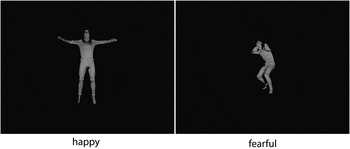
The stimulus material consisted of full-light static body expressions displaying six different fearful and six different happy expressions in both upright and inverted orientations. Still frames of a previous data set of dynamic body expressions were selected at the peak of emotional expression (Atkinson, Dittrich, Gemmell, & Young, Reference Atkinson, Dittrich, Gemmell and Young2004; see Figure 1). From the original set of eight stimuli per condition, six were chosen for each emotion on the basis of recognition rate by a group of adult raters (Atkinson et al., Reference Atkinson, Dittrich, Gemmell and Young2004), indicating at least 40% average correct identification of the displayed emotion (chance level was 16.7%; see online-only supplementary material Figure S.1 for a complete set of the stimulus material used in the current study). In order to establish a link with the literature on facial expression processing, the current study utilized static displays of body expressions because most ERP work on infants’ processing of emotional facial expressions has mainly focused on static but not dynamic expressions.
Examples of the stimuli used in the current study (happy and fearful body expression).

Procedure
The infants were seated on their parent's lap in a dimly lit, sound attenuated, and electrically shielded room during the experimental session. The stimuli were presented in the center of the screen on a black background, using a 70-Hz 17-in. computer screen at a distance of 70 cm. In order to attract the infants’ attention to the screen, each full-light body expression was preceded by an alerting sound and a fixation cross (1000 ms), followed by a black screen (400 ms), followed by the stimuli (2000 ms). During the interstimulus interval, infants were presented with an abstract screensaver for the purpose of keeping infants’ attention. The stimuli were presented in a randomized order with the exception that no two stimuli with the same emotion and orientation combination were presented consecutively. The sessions were video recorded to control for infants’ attention to the stimuli. The EEG session ended when the infant became fussy or inattentive. The mean number of trials presented to the infants was 15.38. The mean number of trials included in the ERP average was 4.74 for the fearful upright condition, 5.93 for the happy upright condition, 4.58 for the fearful inverted condition, and 5.71 for the happy inverted condition.
ERP analysis
The EEG was recorded from 27 Ag/AgCl electrodes attached to an elastic cap (EasyCap GmbH, Germany) using the 10–20 system of electrode placement. The data was online referenced to the CZ electrode and offline rereferenced to the algebraic mean of the left and right mastoid electrodes. The horizontal electrooculogram (EOG) was recorded from two electrodes (F9, F10) that are part of the cap located at the outer canthi of both eyes. The vertical EOG was recorded from an electrode on the supraorbital ridge (Fp2) that is part of the cap and an additional single electrode on the infraorbital ridge of the right eye. The EEG was amplified using a Porti-32/M-REFA amplifier (Twente Medical Systems International) and digitized at a rate of 500 Hz. Electrode impedances were kept between 5 and 20 kΩ. Data processing for ERP analysis was performed using an in-house software package EEP, commercially available under the name EEProbeTM (Advanced Neuro Technology, Enschede). The raw EEG data was bandpass filtered between 0.3 and 20 Hz. The recordings were segmented into epochs time-locked to the stimulus onset, lasting from 200 ms before onset until the offset of the frame (total duration = 2200 ms). The epochs were baseline corrected by subtracting the average voltage in the 200-ms baseline period (prior to video or picture onset) from each poststimulus data point. The baseline period contained a 200-ms black screen. Data epochs were rejected offline whenever the standard deviation within a gliding window of 200 ms exceeded 80 μV in any of the two bipolar EOG channels and 60 μV at EEG electrodes. EEG data was also visually inspected offline for artifacts.
Questionnaire measures
Infant temperament
Maternal assessment of infant temperament was obtained from the Infant Behavior Questionnaire—Revised, German version (IBQ-R; Gartstein & Rothbart, Reference Gartstein and Rothbart2003). The IBQ-R includes the following subscales: approach, vocal reactivity, high-intensity pleasure, smile and laughter, activity level, perceptual sensitivity, sadness, distress to limitations, fear, rate of recovery from distress, low-intensity pleasure, cuddliness, duration of orienting, and soothability. The items in this questionnaire ask the parents to report, on a 7-point scale the relative frequency of occurrence of specified infant reactions in concrete situations (1 = situations they think that are extremely untrue for their infant, 7 = situations extremely true for their infant), during the past 2 weeks. This format is used in order to minimize problems associated with recall (Gartstein & Rothbart, Reference Gartstein and Rothbart2003). Temperament analyses in the present study were limited to two dimensions of infant temperament, namely, infants’ tendency to approach novelty and infants’ fearfulness because prior work has found that approach of novelty and fearfulness contribute to infants’ and children's emotional responses and experiences. In addition, increased fearfulness and reduced approach to novelty in these two temperamental traits has been often linked to psychopathological development relevant for anxiety disorders (Kagan, Reference Kagan1997; Rosenbaum et al., Reference Rosenbaum, Biederman, Bolduc-Murphy, Faraone, Chaloff and Hirshfeld1993). The scores were calculated by taking the average of scores reported by the parent for the specific questions that belonged to a temperament trait.
Maternal empathy
To assess individual differences in empathic disposition, mothers filled out the self-report questionnaire Interpersonal Reactivity Index (IRI), German version (Davis, Reference Davis1980, Reference Davis1983; Paulus, Reference Paulus2009). The questionnaire consists of four subscales that are related to empathy. Each subscale contained four items, and the mothers were asked to report their responses on a 5-point scale. The two subscales empathic concern and personal distress are related to the emotional component of empathy. The perspective-taking subscale is related to the cognitive dimension of empathy, and the fantasy–empathy subscale represents the ability to identify with fictional characters in movies and novels. We focused our analysis on the emotional components (empathic concern) of empathy, because this seems most relevant for the current research questions. In particular, empathic concern (or sympathy), but not personal distress, has been linked with prosocial behaviors (helping) in adults (Eisenberg et al., Reference Eisenberg, Fabes, Miller, Fultz, Shell and Mathy1989) and is therefore an important variable to assess in mothers in the current sample, because this might relate to how mothers react when their infants experience distress and may thus influence the infants’ responses to emotionally arousing situations. Maternal empathic concern scores were calculated by taking the sum of the values of the four items relevant to the empathic concern scale (range = 6–20).
Both the IBQ-R and the IRI were sent home with the parents after the experimental session and the completed versions were received within 10 days of the visit to the laboratory. Prior to the testing, we obtained information regarding birth weight, gestational age, and maternal education. This allowed us to rule out the possibility that these variables had an effect on the results presented in the current study.
Data analysis
For data analysis, a time window of 700 to 800 ms was selected at two regions of interest (ROIs) over the right hemisphere (F4, C4, P4) and the left hemisphere (F3, C3, P3) in order to evaluate effects on the amplitude of the Nc. The selection of the time window and ROI was based on a prior analysis of the ERP correlates (including the Nc) of emotional body expression processing (Missana et al., Reference Missana, Rajhans, Atkinson and Grossmann2014). The Nc can be seen as an index of attention allocation to a visual stimulus with greater negative amplitude indicating increased attention to that stimulus (Richards, Reference Richards2003). To date, only one study has examined the neural correlates of emotion discrimination from static body expressions in infants. Missana et al. (Reference Missana, Rajhans, Atkinson and Grossmann2014) found evidence for discrimination of emotion at the late peak of the Nc, but not within the early peak of the Nc. We therefore chose to focus our analysis on the same time window (700–800 ms) as used in prior work (see online-only supplementary material Figure S.2 for the grand-average ERP responses and Table S.1 for the descriptive statistics, which were obtained in the current sample of 27 infants). The three main dependent variables used for statistical analysis were Nc amplitude to fearful body expressions, Nc amplitude to happy body expressions, and difference between happy and fear calculated by subtracting fearful Nc amplitude from happy Nc amplitude, as an index of whether infants were biased (in their attention allocation) with respect to processing either fearful expression or happy expressions.Footnote 2 The relationship of the between-subjects variables, infant temperament and maternal empathy, to the aforementioned dependent variables was examined using Pearson correlations. This analysis was then followed up by independent t tests using the between-subjects variables categorically based on a mean splitFootnote 3 (high vs. low; maternal empathy: low M = 12.09, SD = 2.38; high M = 16.44, SD = 1.71; infant approach: low M = 4.74, SD = 0.44; high M = 5.96, SD = 0.50; infant fear: low M = 1.68, SD = 0.38; high M = 3.36, SD = 0.66).
Results
Infant temperament
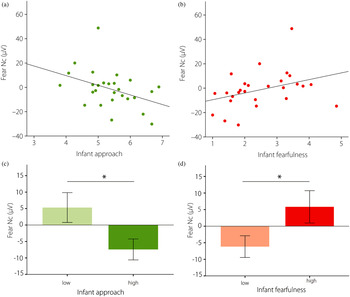
In line with our predictions (Hypothesis 1), our analysis revealed that both differences in infants’ tendency to approach novelty and in infants’ fearfulness correlated with differences in the brain response to fearful body expressions (see Figure 2). Specifically, a significant negative correlation was found between infants’ tendency to approach and their ERP response (Nc) to fearful body expression (r = –.401, p = .038) but not to happy body expressions (r = –.202, p = .313), while a marginally significant positive correlation was found between infants’ fearfulness and their ERP response (Nc) to fearful body expression (r = .359, p = .066) but not to happy body expressions (r = .02, p = .922), confirming our prediction of a differential impact of approach versus fearfulness (Hypothesis 2; see Figure 2). Thus, infants who scored high on the approach scale showed brain responses (Nc) that showed a more negative ERP response (Nc) than did infants who scored low on the approach scale, indexing greater attention allocation to fearful body expressions, whereas infants scoring high and low on the fearfulness scale showed the opposite pattern. The opposing effects of fearfulness and approach on the Nc are further supported by a significant difference obtained when comparing between the correlations of fearfulness and approach with the Nc to fearful bodies (z = 2.67, p = .008; Lee & Preacher, Reference Lee and Preacher2013). It should be noted that while both approach and fearfulness were found to be significantly correlated only with the Nc to fearful bodies, when comparing correlations obtained for Nc to fearful bodies and Nc to happy bodies, neither infants’ tendency to approach novelty nor infants’ fearfulness resulted in significant differences between correlations (z = 0.77, p = .44 and z = –1.27, p = .21, respectively). Moreover, no association effects were observed when the difference between happy and fear, calculated by subtracting fearful Nc amplitude from happy Nc amplitude, was used as the dependent variable. The difference in the neural sensitivity to fearful body expressions between infants who show high approach scores when compared to those who show low approach scores was corroborated by an independent t test comparing between high- and low-approach infants based on a mean split, t (25) = 2.33, p = .028 (see Figure 2). Conversely, infants who scored high on the fearfulness scale showed brain responses (Nc) that showed a more positive ERP response (Nc), indexing smaller attention allocation to fearful body expressions than infants who scored low on the fearfulness scale. This difference in the neural sensitivity to fearful body expressions between infants who show high fearfulness scores when compared to those who show low fearfulness scores was corroborated by an independent t test comparing between high- and low-fear infants based on a mean split, t (25) = –2.34, p = .028 (see Figure 2). Given that infant temperament traits of approach and fearfulness had opposite effects on the neural processing of fearful expressions, one may expect to find that these temperament traits are negatively correlated; however, there was no such correlation between the scores obtained for the approach scale and the fearfulness scale (r = –.152, p = .45, two-tailed). See online-only supplementary material Table S.2 for a correlation matrix providing information regarding the associations between infants’ temperament (fearfulness and approach to novelty) and maternal empathy (empathic concern) variables.
(Color online) The graphs show that both infants’ tendencies to approach novelty and infants’ fearfulness were associated with differences in the brain responses to fearful body expressions. (a) A significant negative correlation was found between infants’ tendency to approach and their event-related potential responses to fearful body expressions, and (b) a marginally significant positive relationship was found between infant fearfulness and their event-related potential response to fearful body expressions. This figure further shows that the neural sensitivity to fearful expressions differed between infants scoring (c) high and low in approach and (d) high and low in fearfulness.

Maternal empathy
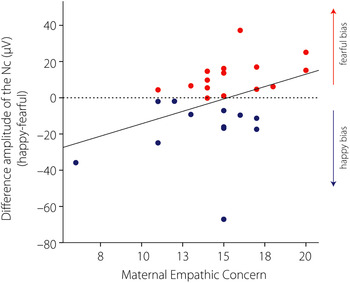
In line with our predictions (Hypothesis 3), our analysis revealed that differences in maternal empathic concern correlated with differences in the brain responses to fearful and happy body expressions (see Figure 3). Specifically, a significant positive correlation was found between maternal empathic concern and the difference score calculated by subtracting ERP response (Nc) to fearful body expression from the ERP response (Nc) to happy body expressions (r = .391, p = .044, two tailed). Thus, infants whose mothers scored high on dispositional empathic concern showed a more negative ERP response (Nc) to fearful body expressions than happy body expressions, indexing greater attention allocation to fearful than happy expressions (negativity/novelty bias), while infants whose mothers scored low on dispositional empathic concern showed a more positive ERP response (Nc) to fearful body expressions than happy body expressions, indexing greater attention allocation to happy expressions than fearful expressions (positivity/familiarity bias). No significant associations were observed when the Nc to fearful or the Nc to happy body expressions was used as the dependent variable. Moreover, when maternal empathic concern was entered as a covariate into the analysis of the Nc (repeated measures analysis of variance [ANOVA] with emotion as within-subject factor), we did obtain a significant interaction between emotion and maternal empathic concern, F (1, 25) = 4.502, p = .044. This confirms the correlational analysis presented above and shows that the exact modulation of the Nc by emotion depends on variation in maternal empathy. In addition, we performed a repeated measures ANOVA using empathic concern (high vs. low based on a mean split) as a (categorical) between-subjects factor. However, this analysis did not reveal a significant interaction between empathic concern and emotion. This pattern of results indicates that the effect of maternal empathy is dimensional (continuous covariate) rather than categorical (two groups low vs. high empathy) in nature.
(Color online) The graph shows that differences in maternal empathic concern correlated with differences in the brain responses to fearful compared to happy body expressions. We observed a significant positive correlation between maternal empathic concern and the event-related potential (ERP) difference score calculated by subtracting ERP response (negative component) to fearful body expression from the ERP response to happy body expressions.

Interactions between infant temperament and maternal empathy
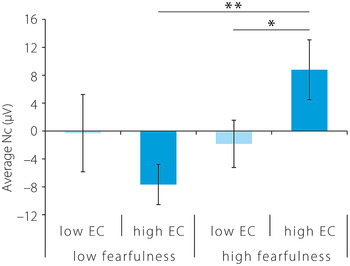
A repeated measures ANOVA revealed that there was a significant two-way interaction between the between-subjects factors infant fearfulness (high fearfulness vs. low fearfulness) and maternal empathy (high empathic concern vs. low empathic concern) regardless of the emotional body expression watched by the infants, F (1, 19) = 6.52, p = .019 (see Figure 4). Specifically, in line with our predictions (Hypothesis 4), we found that within the high-fear group there were significant differences between infants with mothers high in empathic concern and low in empathic concern, F (1, 11) = 9.759, p = .01, whereas there were no such differences in the low-fear group, F (1, 12) = 0.885, p = .365 (see Figure 4). This confirms the hypothesis that infants scoring high on fearfulness are more susceptible to maternal empathic responding. Moreover, while infants in the low-fear group with mothers scoring high on empathic concern showed negative-going ERP responses (Nc), infants in the high-fear group with mothers scoring high on empathic concern showed positive-going ERP responses (Nc), F (1, 15) = 9.063, p = .009. In contrast, infants with mothers scoring low on empathic concern did not show any differences in their ERP responses as a function of fearfulness, F (1, 15) = 0.067, p = .801 (see Figure 4).
(Color online) The graph depicts a significant interaction between infant fearfulness (high vs. low fearfulness) and maternal empathy (high vs. low empathic concern) regardless of the emotion being watched by the infant.

It is critical that all of the effects regarding our four main hypotheses described above were specific to upright-presented emotional body expressions, because additional analysis performed on the ERP responses to inverted fearful and happy body expressions (body expression presented upside down) failed to reveal any significant effects.
Further analysis revealed that there were no differences in birth weight, gestation duration, or in the years of maternal education between infants scoring low and high in fear, F (1, 24) = 0.055, p = .533; F (1, 24) = 0.027, p = .870; F (1, 24) = 0.873, p = .359, respectively, and for infants scoring low and high in approach, F (1, 24) = 0.025, p = .87; F (1, 24) = 0.006, p = .940; F (1, 24) = 0.075, p = .787, respectively. There were no group differences in birth weight, gestation duration, or years of maternal education for maternal empathy, F (1, 24) = 0.401, p = .533; F (1, 24) = 0.238, p = .630; F (1, 24) = 0.011, p = .919, respectively. Thus, none of the observed effects can be explained by birth weight, time of gestation, or years of maternal education.Footnote 4
Discussion
The present study examined the role of infant temperament and maternal empathy in the neural processing of emotional body expressions in 8-month-old infants. Our results revealed that differences in both infant temperament and maternal empathy are systematically related to differences in the neural processing of emotional body expressions, demonstrating that these are factors that critically shape the way in which infants’ brains respond to emotional information. These findings suggest that emotion perception in the developing infant brain is best understood as a process that is sensitive to the context in which it occurs (Barrett, Mesquita, & Gendron, Reference Barrett, Mesquita and Gendron2011; Mareschal et al., Reference Mareschal, Johnson, Sirois, Spratling, Thomas and Westermann2007).
With respect to the two traits of infant temperament considered, we found that both differences in infants’ tendency to approach novelty and infants’ fearfulness were linked to differences in their brain responses to fearful but not happy body expressions. This finding confirms our first hypothesis (emotion selectivity) according to which we had predicted to find that both temperament traits are linked to differences in the neural sensitivity to fearful (novel) stimuli. This suggests that the infant temperament traits examined in the current study are not associated with general differences in emotion perception but might be more specifically linked to the processing of negative (fearful) body expressions. However, future work is needed to further corroborate this finding, because our analysis did not reveal clear evidence for strict emotion specificity (comparing correlation coefficients between Nc to fearful bodies and Nc to happy bodies were not significantly different from each other for the two temperament traits, see Results). Nevertheless, our data revealed that, in line with our second hypothesis (differential impact of fearfulness vs. approach), there was a positive association between infant fearfulness and the ERP response to fearful expressions, whereas there was a negative association between infant approach to novelty and the ERP response to fearful expressions.
More specifically, infants who scored high on the approach scale showed brain responses (Nc) that were more negative in response to fearful expressions, indexing a greater allocation of attention to fearful expressions than infants who scored low on the approach scale. This finding might be explained by the fact that infants at this age have relatively little experience with fearful expressions and might thus perceive them as novel stimuli, while happy expressions are highly familiar to them (Vaish et al., Reference Vaish, Grossmann and Woodward2008). It is thus plausible that general differences in approaching novelty as reflected in the temperament measure impact the neural processing of specific emotions (particularly negative emotions) that are relatively novel to the infant. In light of this finding, it is interesting to note that in prior work with 7-month-olds, infants who, on the basis of their genotype (methionine carriers of the catechol-O-methyltransferase gene [val158met]), are thought to have increased levels of dopamine in the prefrontal cortex, showed greater neural sensitivity (attention allocation) to fearful facial expressions as indexed by a greater Nc (Grossmann et al., Reference Grossmann, Johnson, Vaish, Hughes, Quinque and Stoneking2011). Increased levels of dopamine in turn have been associated with greater levels of approach and in particular novelty seeking in adults. Therefore, the current findings, in concert with prior work assessing genetic variation in the dopaminergic system (Grossmann et al., Reference Grossmann, Johnson, Vaish, Hughes, Quinque and Stoneking2011), suggest that infants’ sensitivity to fearful expressions is linked to individual differences in approach to novelty, and this might be based on differences in dopaminergic function. This account is in agreement with existing accounts of individual differences in socioemotional functioning and personality that have conceptually linked approach tendencies to novelty seeking and dopaminergic function (Goldberg & Weinberger, Reference Goldberg and Weinberger2004; Kagan & Snidman, Reference Kagan and Snidman2004).
Contrary to the findings regarding infant approach, concerning infant fearfulness, we found that infants who scored high on fearfulness showed brain responses (Nc) that were more positive in response to fearful expressions, indexing reduced allocation of attention to fearful body expressions than did infants who scored low on fearfulness. This shows that a fearful temperament, rather than increasing infants’ neural responsiveness (increased attention) to fearful body expressions as commonly assumed, appears to decrease infants’ neural responsiveness to fearful expressions. This is in contrast to work suggesting that there is a link between fearfulness and a heightened sensitivity to threatening signals (see Bar-Haim et al., Reference Bar-Haim, Lamy, Pergamin, Bakermans-Kranenburg and van IJzendoorn2007). However, it should be noted that the link between heightened sensitivity to threat and fearfulness in children and adults is relatively weak and might be moderated by factors not assessed in the current study (Pérez-Edgar et al., Reference Pérez-Edgar, Reeb-Sutherland, McDermott, White, Henderson and Degnan2011). The current finding of a decreased attentional sensitivity to fearful bodies might be explained by a scenario, according to which fearful infants show decreased interest in (or even avoidance of) novel stimuli, including fearful body expressions. This explanation based on infants’ differing sensitivity to novelty could also account for the finding that approach and fearfulness are associated with opposite effects on the neural processing of fearful expressions because greater fearfulness may reflect a greater avoidance of novelty, while greater approach may reflect greater interest in novelty. This explanatory framework is supported by a host of studies on infant temperament, demonstrating that infants systematically differ in their reactions to novelty, and these differences in infants’ sensitivity to novelty predict whether a child will show an inhibited or uninhibited temperament later in development (Kagan & Snidman, Reference Kagan and Snidman2004). Negative emotions such as fear are less frequently encountered in daily life than are positive emotions (in typical development), confounding novelty with negative expressions. It has been argued that novelty plays a critical role in guiding responses to negative emotions and helps infants learn about negative emotional expressions (Vaish et al., Reference Vaish, Grossmann and Woodward2008).
With respect to the role of maternal empathy in infants’ neural sensitivity to emotions, our analysis revealed that differences in maternal empathic concern (defined as the tendency to experience feelings of sympathy and compassion for others in distress) correlated with differences in the brain responses to fearful and happy body expressions. Specifically, we found that infants whose mothers scored high on dispositional empathic concern showed a more negative ERP response (Nc) to fearful body expressions than to happy body expressions, indexing greater attention allocation to fearful than happy expressions (novelty/negativity bias), while infants whose mothers scored low on dispositional empathic concern showed a more positive ERP response (Nc) to fearful body expressions than happy body expressions, indexing greater attention allocation to happy expressions than fearful expressions (familiarity/positivity bias). This finding confirms our hypothesis that mothers with greater empathic concern for others in distress (fear) have infants who are also more prone to sensitively respond to others in distress (fear) and is in line with prior work emphasizing the role of maternal empathy in early socioemotional development (Davis, Reference Davis1980, Reference Davis1983; Feshbach, Reference Feshbach, Eisenberg and Strayer1987). From the current analysis, it is unclear whether this association between maternal empathic concern and infants’ neural sensitivity to emotional expressions is genetic in nature or based on social learning. Prior work suggests that genetic factors contribute to children's emotional responses to others in distress as individual differences in empathic concern have been shown to be moderately heritable (0.25; Knafo et al., Reference Knafo, Zahn-Waxler, Davidov, Van Hulle, Robinson and Rhee2009). More recently, Knafo and Uzefovsky (Reference Knafo, Uzefovsky, Legerstee, Haley and Bornstein2013) have shown that individual differences in empathic concern in children are explained by an interaction between maternal behavior and the genotype of the child. Namely, in that study, maternal negativity showed a negative association with empathic concern but only among children who carried the 7-repeat allele of the dopamine receptor D4 gene. It is thus particularly important to examine how the infants’ predispositions (including temperament) interact with the maternal environment to understand how children's characteristics can influence the effects of the environment on them (Davidov, Knafo-Noam, Serbin, & Moss, Reference Davidov, Knafo-Noam, Serbin and Moss2015).
Our study revealed that individual differences in the neural responses to emotional information are explained by an interaction between maternal empathic concern (high and low empathic concern) and infant temperament (high and low fearfulness). In line with our prediction, we found that within the high-fear group there were significant differences between infants with mothers high in empathic concern and low in empathic concern, whereas there were no such differences in the low-fear group, suggesting that highly fearful infants are particularly sensitive to their caregivers’ empathic concern. This is in line with differential susceptibility accounts that propose that fearful temperament is related to a greater sensitivity to environmental factors, including maternal behaviors (Belsky, Reference Belsky, Ellis and Bjorklund2005; Ellis et al., Reference Ellis, Boyce, Belsky, Bakermans-Kranenburg and van IJzendoorn2011). The observed pattern of fearful infants with mothers scoring high on empathic concern showing reduced neural responsiveness to emotional body expressions and those with mothers scoring low on empathic concern showing increased neural responsiveness to emotional body expressions perhaps points to protective effects of maternal empathy on fearful infants’ emotional reactivity. This is because reducing the sensitivity to emotional stimuli may help fearful infants to cope with emotionally arousing situations and thus represents an adaptive strategy. This strategy may be fostered in fearful infants in this context because highly empathic mothers are more responsive (or involved) during situations in which their infants become emotionally aroused, as adults scoring high on empathic concern/sympathy have been shown to be more inclined to help and intervene (Eisenberg et al., Reference Eisenberg, Fabes, Miller, Fultz, Shell and Mathy1989). It is important to mention that all infants were tested in the presence of their mothers. Therefore, it is possible that this impacted the way in which infants responded to the emotional stimuli in the current study. It is probable that especially for fearful infants, having a highly empathic (and presumably responsive) mother present during testing may have contributed to attenuating neural responses to emotional stimuli. The view that having a person that has a close relationship present during emotionally arousing and potentially threatening situations reduces emotional reactivity is supported by a host of studies in adults (Brown & Coan, in press; Coan & Maresh, in press). In adults it has also been shown that relationship quality matters in this context, as the reduction of the person's response to threat was found to be strongest when the person being threatened was in close contact with a spouse rated high in marital quality (Coan, Schaefer, & Davidson, Reference Coan, Schaefer and Davidson2006). With respect to the current findings, it seems important for future work to more systematically investigate the possibility that maternal presence may have similar effects by obtaining information regarding relationship quality (attachment) and observing mother–infant interactions in a more naturalistic context in which emotions are elicited in the infant.
Moreover, we found that, regardless of the emotion being watched by the infants, infants in the low-fear group with mothers scoring high in empathic concern showed negative-going ERP responses (Nc), while infants in the high-fear group with mothers scoring high in empathic concern showed positive-going ERP responses (Nc). This demonstrates that, maternal empathy impacts infants’ neural responses to emotional body expressions differently, depending on infant fearfulness. This finding further supports the notion that it is not enough to look at effects of maternal empathy in isolation but that it is important to examine how infant characteristics such as temperament influence (or interact with) the impact of the maternal environment. This is because our data suggest that the effects of maternal empathy depend on (reverse as a function of) infant temperament. As argued above, the reason why fearful infants with high-empathy mothers showed attenuated neural responses to emotional body expressions might have to do with the fact that increased maternal empathy might help fearful infants to cope with emotionally arousing situations. Taken together, these findings are in general agreement with recent work highlighting the existence and importance of interactions between inherited traits and environmental factors in shaping socioemotional functioning (Avinun & Knafo, Reference Avinun and Knafo2013) and thus provides further evidence for how children's characteristics can influence the effects of the environment on them (Davidov, Knafo-Noam, Serbin, & Moss, Reference Davidov, Knafo-Noam, Serbin and Moss2015). Nonetheless, more work is needed to further examine this interaction between temperament and maternal empathy across development and across tasks to get a better understanding of its nature and its long-term effects on developmental outcomes.
Before we summarize the current findings, it is important to acknowledge the limitations of the current study. In particular, there are two main limiting factors that deserve attention. First, the sample size of the current study is relatively small, which is particularly problematic when investigating individual differences by dividing the sample into smaller groups, for example, infants low in fearfulness and high in fearfulness. This is why most of our results are based on correlational analyses that do not require for the sample to be divided and then followed up by independent t tests using groups as a dichotomous between-subjects factor. However, our results concerning the interaction between infant temperament and maternal empathy rely on splitting the sample into four fairly small groups. These results should thus be seen as suggestive but not conclusive and be replicated in a larger sample of infants. Second, our measurement of infant temperament and maternal empathy rely on self-report measures by the mothers. While these measures are trusted and established instruments in this area of research, they might suffer from reporting biases and might not always directly map onto overtly expressed behavior. Therefore, in future work, it is critical to extend this work by examining infant temperament and maternal empathy using behavioral tasks.
In summary, the current study shows that infant temperament and maternal empathy, as well as the interaction of the two, play an important role in the development of infant brain functioning with respect to processing emotional information from body cues. In particular, individual differences in the neural sensitivity reflecting the allocation of attention to visually presented emotions systematically vary as a function of intrinsic (temperament) and extrinsic (maternal empathy) factors. Our results add an early developmental neuroscience dimension to existing accounts of socioemotional functioning, suggesting a complex and integrative picture of how and why infants’ emotional experiences might vary.
Future directions for translating research on the influential child into preventive interventions
The present study, by informing our understanding of the nature of individual differences in emotional responding in typical development, might have important implications for developmental processes involved in atypical development, because it points to potential sources that contribute to individual variation in emotional responsiveness that in extreme cases might be linked to psychopathological development.
More specifically, infant fearfulness has been discussed as an early precursor to behavioral inhibition in childhood and might therefore be linked to anxiety disorders (Degnan & Fox, Reference Degnan and Fox2007). Given that our results suggest that infant fearful temperament interacts in critical ways with maternal empathy in shaping affective brain responding in infancy, it seems particularly important to take this interaction into account when considering factors contributing to risk and resilience in the development of anxiety disorders. In line with the idea of a differential susceptibility to environmental influences on children's socioemotional development (Belsky, Reference Belsky, Ellis and Bjorklund2005), our data show that highly fearful infants are the most susceptible to environmental influences, namely, maternal empathic behavior. This suggests that in highly fearful infants, who are presumably at a higher risk for developing anxiety disorders, there might be a greater scope for change/plasticity resulting in the potential to improve mental health outcomes. Our findings may thus offer important implications with respect to the design and evaluation of particular preventative measures to tackle psychopathological issues related to anxiety disorders.
One way of translating the current research into preventive intervention would involve a two-step approach. First, it would be required to identify infants with an elevated risk of developing anxiety-related issues. This could be done not only by making parents aware of the fact that individual differences regarding fearful temperament exist and are associated with an increased risk for developing anxiety but also by pointing out that this risk might be mitigated by the caregivers’ empathic responsiveness. This first step could be achieved through various educational means including freely available online platforms. In addition, screening procedures should be put into place to allow parents to find out whether their infant has a fearful temperament (based on relevant IBQ-R items) and what their own empathic dispositions (based on relevant IRI items) are, which could be done through online temperament and empathy questionnaires. Second, once an infant has been identified as fearful and having a primary caregiver scoring low in empathic concern, it would be important to offer the possibility to provide support. This support could consist of helping the parent to improve his or her empathic concern. How such training can be achieved is currently being heavily researched (Klimecki, Leiberg, Lamm, & Singer, Reference Klimecki, Leiberg, Lamm and Singer2013; Klimecki, Leiberg, Ricard, & Singer, Reference Klimecki, Leiberg, Ricard and Singer2013; Leiberg, Klimecki, & Singer, Reference Leiberg, Klimecki and Singer2011). One promising avenue for training empathic concern (sympathy and compassion) is based on the concept of mindfulness and certain meditative practices rooted in the Buddhist tradition (Bornemann & Singer, Reference Bornemann, Singer, Singer and Bolz2013; Davidson et al., Reference Davidson, Kabat-Zinn, Schumacher, Rosenkranz, Muller and Santorelli2003; Siegel, Reference Siegel2007). However, there might also be more direct ways of improving this ability in caregivers that could be achieved through observation of free-play interactions between caregivers and their fearful infants by a therapist. This could provide the therapist with clues as to how to improve emotional communication between the caregiver and the infant through increases in the caregiver's empathic responding to their infant. To summarize, the suggested intervention might help the caregivers to identify whether their child is at a risk of developing anxiety disorders early on in infancy and provide information about necessary steps that may help prevent the onset of anxiety disorders during development. At the end, we would like to add a cautionary note, because this should only be seen as a tentative proposal. Clearly, more systematic work following a larger sample of children across development is required to establish that certain combinations of infant temperament and maternal empathy pose a risk for developing anxiety-related issues.
Supplementary Material
To view the supplementary material for this article, please visit http://dx.doi.org/10.1017/S0954579415000772.