Although impressive advancements have been made in the treatment of paediatric congenital and acquired heart disease over the past few decades, high rates of morbidity and mortality remain. Among infants born with critical CHDs (i.e., requiring surgery or catheterisation in the first year of life), approximately 1 in 4 will die in their first year of life.Reference Oster, Lee, Honein, Riehle-Colarusso, Shin and Correa1 For those surviving infancy, long-term risks remain. For example, approximately 14,000 children experience heart-failure-related hospitalisations annually in the US. Among this group, 7% die during their hospitalisation – a mortality rate nearly 20 times greater than that of children without heart failure and approximately double that in adult heart failure.Reference Rossano, Kim and Decker2 Rates of hospital-based deaths accompanied by costly and invasive interventions near the end of life are also high in paediatric advanced heart disease.Reference Blume, Balkin and Aiyagari3–Reference Cousino, Yu and Blume5 Among those with CHD or heart failure referred for heart transplantation, which is often viewed as a life-extending therapy for those with most critical heart diseases, up to 25% do not survive to transplantation,Reference Rossano, Singh and Cherikh6 10% die in the first year post-transplant, and approximately 20% die within five years post-transplant.Reference Rossano, Singh and Cherikh6–Reference Rossano, Cherikh and Chambers8
Moreover, nearly half (47%) of parents of children who died of advanced heart disease believed their child suffered at the end of life. An even greater portion (71%) felt their child’s quality of life in their last month of life was “poor” or “fair”.Reference Blume, Balkin and Aiyagari3 Palliative care seeks to improve quality of life in those with serious illnesses through symptom management, the elicitation of goals of care, and decision-making support. Palliative care is provided throughout the course of serious illness, and not just at end of life. End-of-life care is used to specify the medical, psychosocial, and spiritual support provided in the time surrounding death. Despite high mortality rates and suffering at end of life in paediatric advanced heart disease, a recent scoping review highlighted how little attention has been paid to both research and clinical advancements in palliative and end-of-life care in paediatric cardiology.Reference Morell, Moynihan, Wolfe and Blume9 The science of both palliative and end-of-life care in paediatric cardiology is at an opportune juncture – there is growing interest and recognition of the field’s importance,Reference Morell, Moynihan, Wolfe and Blume9 but a meaningful, collaborative research agenda must be thoughtfully crafted by invested scholars, clinicians, and stakeholders from various disciplines and specialties.
Workshop participants and format
The Radcliffe Institute for Advanced Study at Harvard University brings together interdisciplinary scholars, learners, and practitioners across the fields of humanities, sciences, social sciences, arts, and professions to foster creative, cross-disciplinary advancements. Academic Ventures was created in 2009 as part of the Radcliffe Institute for Advanced Study to create opportunities for scientific exploration and collaboration through hosting and funding multidisciplinary workshops and seminars. The Radcliffe Accelerator Workshop Program is a competitive, grant-funded initiative, which emphasises innovative, diverse collaboration to move forward an academic or public outcome, such as a grant application or course curriculum (www.radcliffe.harvard.edu). The Palliative and End-of-Life Care in Pediatric Cardiology: State of the Science and Future Directions Radcliffe Accelerator Workshop aimed to answer the following:
-
What is the current state of the science on palliative and end-of-life care in paediatric cardiology?
-
What are the next steps to advance the science of palliative and end-of-life care in paediatric cardiology?
-
What are the research priorities for the next five years?
-
Which measures and research methodologies should be applied to address these priorities?
-
How do we overcome the challenges associated with end-of-life care research in paediatric cardiology to address our research priorities?
-
-
How do we translate and widely disseminate the science of palliative and end-of-life care to improve the clinical care provided to our cardiac patient and family populations?
The workshop was co-led by a paediatric cardiologist (EB) and paediatric psychologist (MC), both of whom are established clinicians and researchers in the fields of paediatric advanced heart disease and palliative and end-of-life care in paediatric cardiology. Workshop participants were identified by co-leaders on the basis of their 1) career development or independent funding in this area of science, 2) track record of scholarly products in the field, or 3) established expertise in a uniquely related field (i.e., health services research, oncology). All invitees agreed to participate in the workshop. In total, the 18 workshop participants included 12 physicians, spanning the fields of cardiology (fetal, heart failure/transplant, adult CHD, cardiac critical care), palliative care, critical care, and oncology, one paediatric psychologist, one former social worker, one palliative care nurse practitioner, one health services scientist, and three bereaved parents (cardiac, oncologic, and genetics). Clinical and research participants ranged from senior leaders to emerging early career experts in the field. Our resultant workgroup had diverse representation of numerous stakeholder groups, including the National Heart, Lung and Blood Institute, Courageous Parents Network, Cardiac Networks United, and 10 US academic medical centres.
While the intention was to address these guiding questions over the course of a 3-day in-person workshop in May 2020 in Boston, Massachusetts, the COVID-19 pandemic necessitated transitioning the meeting to a four-session virtual workshop with 2-h meetings held May–September 2020. Smaller workgroup discussions were held between the monthly, larger sessions. Modelled in part after the Pediatric Palliative Care Research Network Workshop,Reference Feudtner, Rosenberg and Boss10 the virtual workshop series included a research blitz with presentations by all workshop participants, special topic presentations on methodologies, lessons learned from the fields of adult and paediatric palliative care and paediatric oncology,Reference Rosenberg and Wolfe11 funding tips and opportunities, and parent perspectives.
Workshop participants also completed a Qualtrics survey on research priorities and barriers, which was developed by workshop co-leaders. The survey consisted of six questions, including a rank ordering of 16 research topics and a rank ordering of 12 research barriers. Both rank-order lists were derived from group discussion in the first workshop session and literature review. Remaining items assessed participants’ current areas of research focus and wishes for the field at large, patients/families, and one’s own career (Box 1). Survey results guided further discussion and consensus building. Descriptive statistics were performed on survey data. Means were used to generate rank-order lists for both research priorities and barriers with the top 50% described in this workshop preceding. Most workshop participants completed the survey (14/18; 78% completion rate). To ensure confidentiality of responses, we did not collect demographic data from respondents, given the small, known sample of workshop participants. It is important to acknowledge that these priorities and barriers represent the views of this consensus workshop group.
Sample free text comments from workshop participants
Wishes for the Field of Palliative and End-of-Life Care in Peadiatric Cardiology
“Build stronger, collaborative networks.”
“True multicenter research.”
“Advance recognition of the importance of this topic.”
“To create a more robust evidence base to guide care.”
Wishes for Patients and Families Cared For
“Comprehensive access to palliative care early in care.”
“Skillful care that aligns with children and families, leading to less suffering and better lives, throughout the illness trajectory.”
“To experience less suffering, physical and psychological.”
“Access to quality research and interventions.”
Wishes for One’s Career
“Forge new connections that foster new projects.”
“Funding to test and implement interventions in multiple centers across the country.”
“Successful collaboration with both patients and colleagues to advance this field.”
“Advance psychosocial care in paediatric cardiology through funded research and program development.”
Research priorities
Seven priorities were identified by Feudtner et al Reference Feudtner, Rosenberg and Boss10 for the science of paediatric palliative care at large and included (a) enhance training and development of paediatric palliative care researchers, (b) develop and share core resources (e.g., databases), (c) advance symptom measurement (e.g., best practices for assessment, consistent use of tools to allow comparisons), (d) improve symptom management and quality of life interventions, (e) improve communication and decision-making supports, (f) assess family impact and provide intervention, and (g) examine systems, policy, and education on paediatric palliative care.
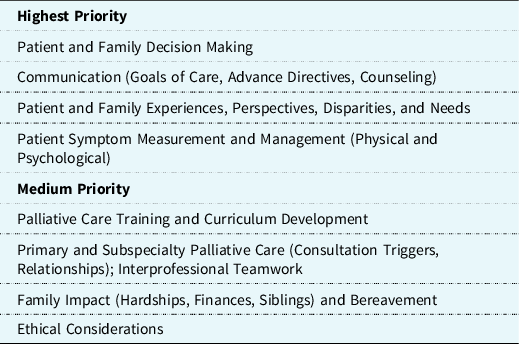
Through the discussions and survey, our workshop participants built upon these scoping priorities to lay out the eight highest ranked research priorities for the field of palliative and end-of-life care in paediatric cardiology to pursue over the next five years (top 25% = highest priority; top 26–50% = medium priority; Table 1). Patient and family-centred research questions, specifically patient and family decision making, communication, patient and family experiences, and symptom management, were ranked highest by the group. Decision making and communication were indicated as top areas for investigation. Patient and family decision making in critical paediatric heart disease is complicated. Complicating factors include a multitude of surgical, interventional and innovative therapies, variations in heart centre practices and recommendations, and serious risks of treatment complications and long-term sequelae. While some have begun to examine decision making in paediatric heart disease,Reference Cousino, Miller and Smith12 much remains unknown. Further, research is needed aimed at understanding decision-making preferences, correlates of decision making, and interventions to support shared decision making across the paediatric heart disease course, from fetal diagnosis to adult CHD care. Specifically, studies examining patient and parent perspectives and needs on how decision making are approached across the heart disease course is an important next step. Both qualitative and quantitative study methods will be important for understanding the intricacies of such preferences. We also must seek to understand how demographic and disease-related correlates, such as illness severity or cardiac history, may impact decision making.
Research priorities

Descriptive investigations of decision making, communication, and advance care planning in paediatricReference Cousino, Miller and Smith12–Reference Kovacevic, Simmelbauer and Starystach17 and adult CHDReference Steiner, Stout, Soine, Kirkpatrick and Curtis18,Reference Steiner, Kirkpatrick and Heckbert19 have provided a starting point; the next clear step is intervention design and implementation. Communication interventions at the clinician, team, and patient/family levels are needed, specifically targeting difficult conversations during the heart disease course, such as fetal diagnosis,Reference Kovacevic, Simmelbauer and Starystach17,Reference Bratt, Järvholm, Ekman-Joelsson, Mattson and Mellander20 transplant,Reference Cousino, Schumacher and Magee13 or ventricular assist device evaluation or deactivation,Reference Machado, Hollander, Murray, Philip, Bleiweis and Kittelson21,Reference Kaufman, Hollander and Zhang22 and need for advanced therapies, such as ECMO (i.e., extracorporeal membrane oxygenation). Decision-making interventions and support tools that have been developed and utilised in other paediatric conditions, and adult heart disease should be adapted and trialed for use in paediatric cardiology. Interventions targeting when and how to consult sub-specialty palliative care are another area of opportunity for communication interventions.
Also ranked as high priority for investigation were patient and family experiences and needs. Patient-reported outcomes (PRO) are integral to clinical care, research, and policy efforts. Various calls for action have encouraged the uptake of PRO-based research.Reference Kaltman, Burns and Pearson23 The APPROACH-IS (Assessment of Patterns of Patient Reported Outcomes in Adults with Congenital Heart Disease – International Study) enrolled over 4000 adults with CHD from 15 countries to improve understanding of the patient experience globally.Reference Moons, Luyckx and Thomet24 Similar efforts specific to the paediatric experience, including development and implementation of both patient and parent/caregiver-reported outcome measures, are necessary next steps. Two large paediatric heart centres demonstrated that parent-reported longitudinal data can be collected as part of standard care following cardiac operations as shown with data collection from >90% of patients obtained. Over half of parents completed the surveys via an automated email system.Reference Pasquali, Ravishankar and Romano25 Efforts are underway across Cardiac Networks United learning networks and other organisations to implement, collect, and analyse PROs, harnessing the power of collaboration.Reference Marino, Sood and Cassidy26–Reference Pickles, Lannon and Wooton30 Including patients and parents in research design is particularly important to the study of palliative and end-of-life care in paediatric cardiology as this will help to ensure that the PROs captured are of important to patients and families themselves, while also helping to inform clinical intervention based on PRO findings Lastly, attention to health care disparities and intentional inclusion of more diverse populations is essential.
Patient symptom measurement and management, both physical and psychological, were also identified as areas with high research need. In earlier work on suffering and quality of life at end-of-life in paediatric advanced heart disease, nearly half of parents felt their child suffered, with breathing and feeding difficulties causing greatest suffering for young children and fatigue and sleeping difficulties causing greatest suffering for older children.Reference Blume, Balkin and Aiyagari3 To our collective knowledge, no symptom management interventions have been trialed specific to paediatric cardiology patients at end-of-life. As Feudtner highlighted,Reference Feudtner, Rosenberg and Boss10 interventions targeting symptom burden could include medication trials, psychological and behavioral interventions, and complementary and combination therapies. Interventions related to symptoms and quality of life that have shown promise among other paediatric serious illness groups,Reference Rosenberg, Yi-Frazier and Eaton31,Reference Rosenberg, Bradford and McCauley32 as well as models of care and palliative care interventions in adult heart failureReference Rogers, Patel and Mentz33,Reference Kavalieratos, Gelfman and Tycon34 can be adapted and trialed within paediatric cardiology for quicker translation and dissemination.
Further, symptom measurement is poorly defined in paediatric advanced heart disease. Efforts to define, quantify, and monitor symptom burden and outcomes are needed.Reference Friedel, Aujoulat, Dubois and Degryse35 Recently, Almond and colleaguesReference Almond, Chen and Dykes36 developed a 4-point ordinal heart failure severity score across three symptom domains for children hospitalised with acute decompensated heart failure. Similar efforts to better classify and grade symptoms and risks in paediatric and young adult single ventricle heart disease through a multi-institutional effort are also underway (PIs: KS and MC). These tools and efforts towards a shared language and classification of disease and symptom burden are necessary for future intervention efforts, such as the standardisation of referral for advanced cardiac therapies and/or palliative care involvement.
Additional areas for research focus identified by the group included primary palliative care training (i.e., a palliative care approach taken by a non-palliative care clinician, such as the cardiologist)Reference Gelfman, Kavalieratos, Teuteberg, Lala and Goldstein37 and curriculum development for paediatric cardiology clinicians;Reference Balkin, Kirkpatrick and Kaufman38 improved understanding of the roles of primary and subspecialty palliative care in paediatric cardiology, as well as the relations of interprofessional teams;Reference Walter, Schall and DeWitt14,Reference Walter, Sachs and Schall15,Reference Moynihan, Snaman and Kaye39,Reference Balkin, Sleeper and Kirkpatrick40 examination of the impact of paediatric advanced heart disease and bereavement on families; and exploration of ethical considerations in paediatric advanced heart disease, such as use of technological interventions and cardiac device deactivation.Reference Char and Hollander41
In sum, while scientific investigation related to palliative and end-of-life care in paediatric cardiology has increased over the past decade, much work remains. Certainly, there are nuances specific to heart disease in children, particularly symptom measurement and decision making about cardiac interventions, but, many of the values and priorities for patients and families are consistent across paediatric serious illness groups. Thus, it will be critical for the field to build upon the cross-sectional and interventional research in other paediatric critical illness groups to more rapidly bring about advancements in palliative and end-of-life care in paediatric cardiology.
Research barriers
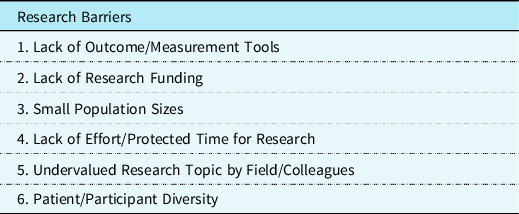
Workshop participants also identified notable barriers to palliative and end-of-life care research in paediatric cardiology (Table 2). Lack of outcome or measurement tools, such as what defines “goal concordant care” or “a good death” for patients and families, was identified as a top barrier. As discussed above, the lack of standard symptom measurement tools and classification for disease and symptom burden, was also highlighted as a top barrier. Lack of funding, limited dedicated time/effort for research, and small and diverse populations were also noted as prominent barriers, which have been similarly noted as barriers for paediatric palliative care research at large.Reference Feudtner, Rosenberg and Boss10 With the incredible energy and investment being made in collaborative registries and quality improvement networks across paediatric cardiology, sample size and population barriers will hopefully decrease in the years to come. Intentional inclusion of underrepresented minority patients and families will ensure representation of the diverse population impacted by paediatric heart disease.
Research barriers

Limited funding and dedicated effort to conduct such research remain noteworthy challenges. For this area of clinical science to move forward, dedicated research time for faculty and staff pursuing work in this field will be important. Obtaining large-scale funding is challenging, especially in paediatrics.Reference Good, McElroy, Berger and Wynn42 However, among workshop participants, three federally funded grants related to palliative and end-of-life care in paediatric cardiology were recently funded and are underway, pointing to a growing landscape of research on which to build. Additional sources for funding were also discussed, including the Palliative Care Research Collaborative Group, the Cambia Health Foundation, the National Palliative Care Research Center, and the American Heart Association. Participants highlighted the role of philanthropic donors as a meaningful source of additional funding support for this area of research.
Notably, workshop participants also identified palliative and end-of-life focused research to be undervalued by the field of paediatric cardiology and paediatric cardiac surgery, as well as by their colleagues or leadership. The same driving forces contributing to the delayed uptake of this research when compared to other paediatric serious illness groups, such as the field’s attention on “fixing” the heart via surgical intervention and the growing availability of technological interventions for advanced heart disease, likely contribute to the under appreciation of this research topic by the field. A primary driver of this workshop, with strong support and representation from the National Institutes of Health, non-profit/foundational and cardiac learning networks, was to establish palliative and end-of-life care research in paediatric cardiology as a distinct and critically important topic.
Interestingly, the Radcliffe group did not identify the presumed burden of palliative and end-of-life care focused research on participants, including institutional review board protections, as a top barrier, which was recently identified as a common challenge for the field of paediatric palliative care research as a whole.Reference Feudtner, Rosenberg and Boss10 Participating bereaved parents, representing both cardiac and non-cardiac populations, stressed that families are eager to contribute to the body of knowledge about the lived patient and family experience. Parent participants framed research involvement as part responsibility to their child’s struggle and memory, while also recognising research participation as meaning making and therapeutic. Parent participants noted that while not all patients and families will elect to participate in research, most will not be offended by the invitation to contribute, with the goal of improving the care experience for others.
Moving forward
Discussion during each of the workshop sessions included strong recommendations for the field of paediatric cardiology to build upon the more established palliative and end-of-life care focused research in other paediatric serious illness groups. This will allow the field to more rapidly move towards intervention and implementation science. Specifically, it was discussed that descriptive studies should be limited to a few investigations within original cohorts, such as fetal intervention and technological support, and then combined with research from other paediatric serious illness groups to provide the foundation for intervention design in paediatric cardiology. Understanding the specific needs of cardiology clinicians and the patients and families affected by heart disease must be balanced with the knowledge and interventions created within the paediatric palliative care field at large. Further, as has been outlined for the field of paediatric CHD research as a whole, collaborative, multidisciplinary science and the utilisation of big data will be important for palliative care focused research in paediatric cardiology as well. As evidenced by the conference proceedings, psychosocially oriented research topics are of priority in this field, underscoring the necessity of including experts across disciplines, including psychology, social work, ethics, and spiritual care, among others, in research design and implementation. Clinical trials within the large, ever-growing paediatric cardiac registries will improve research efficiency. Data sharing and linking, as well as the use of non-traditional data capture methods,Reference Kaltman, Burns and Pearson23 such as social media-based researchReference Schumacher, Stringer and Donohue43,Reference Schumacher and Lee44 and crowdsourcing methods,Reference Sood, Wysocki and Alderfer45 will also advance collaboration, learning, and wide dissemination of successful interventions in this emerging area of science.
Advances in paediatric cardiology and cardiac surgery have improved survival and quality of life for many children, adolescents, and young adults living with critical heart disease. The Harvard Radcliffe Accelerator Workshop “State of the Science and Future Directions in Palliative and End-of-Life Care in Pediatric Cardiology,” allowed for a diverse group of dedicated researchers, clinicians, and parents to understand the current research landscape, while also outlining future research initiatives at the intersection of paediatric palliative care and paediatric cardiology. Many unanswered questions remain. With parent input, the Harvard Radcliffe Accelerate Workshop Group was able to prioritise the multitude of initiatives. Understanding the patient and family experience, improving communication around prognosis and decision making, and understanding and managing symptom burden were priorities along with improving primary palliative care skills in cardiology clinicians. Working collaboratively across disciplines while staying guided by patient and family needs will serve as the compass to move this important field forward.
Acknowledgements
Drs. Cousino and Blume obtained the workshop grant funding, invited workshop participants, designed the workshop content, led the workshop meetings, collected data, drafted the initial manuscript, and reviewed and revised the manuscript.
Drs. Walter, Rosenberg and Hollander contributed to workshop design and content.
Ms. Lord contributed to the initial manuscript draft and reviewed and revised the manuscript.
All authors and workshop participants presented content during the meeting, participated in discussions, and contributed to data collection. All authors contributed to and approved the final manuscript as submitted and agree to be accountable for all aspects of the work.