All insects pass through successive moulting events to reach adulthood. These moults typically allow general body growth and the development (or loss) of specific appendix and organs that become essential (or useless) at a certain period of their life (Chapman and Reynolds Reference Chapman and Reynolds2013). This is the case, for instance, of the genitalia and sexual ornaments that often appear only after the last moult into adulthood (Belles Reference Belles2011; Rolff et al. Reference Rolff, Johnston and Reynolds2019). The number and temporality of moulting events during insect development are under strong selection pressure, because they typically reflect age-specific physiological constraints and newly moulted individuals are often more vulnerable to pathogens and predation due to their resulting soft cuticle (Field et al. Reference Field, Chapman, Taylor, Neil and Vickerman1992; Corteel et al. Reference Corteel, Dantas-Lima, Wille, Alday-Sanz, Pensaert, Sorgeloos and Nauwynck2009).
Somewhat surprisingly, the number of moulting events that occur during the development of the European earwig Forficula auricularia L. (Dermaptera: Forficulidae) remains unclear. This insect is present worldwide and exhibits a relatively long lifespan, with males and females living up to two years. Females typically produce a clutch of 30–60 eggs in early winter (Tourneur and Gingras Reference Tourneur and Gingras1992; Meunier et al. Reference Meunier, Wong, Gómez, Kuttler, Röllin, Stucki and Kölliker2012; Tourneur and Meunier Reference Tourneur and Meunier2020), provide them with extensive forms of care through winter, and then remain with the newly hatched juveniles for several weeks during which they continue providing post-hatching care (Lamb Reference Lamb1976; Kölliker Reference Kölliker2007; Koch and Meunier Reference Koch and Meunier2014; Diehl and Meunier Reference Diehl and Meunier2018; Van Meyel et al. Reference Van Meyel, Devers and Meunier2019). Whereas it is generally assumed that the number of larval stages present in this species is four (L1–L4) and thus that larva passes through four moulting events during their lifetime (L1–L2, L2–L3, L3–L4, and then L4 to adults; Jones Reference Jones1917; Fulton Reference Fulton1924; Crumb et al. Reference Crumb, Eide and Bonn1941; Lhoste Reference Lhoste1942; Henson Reference Henson1946, Reference Henson1947; Behura Reference Behura1956), the literature contains contrasting support for this claim. In particular, Chapman (Reference Chapman1917a) mentioned the presence of six “ecdyses” while reporting only four moults in his subsequent paper (Chapman Reference Chapman1917b). Moreover, the occurrence of a moult immediately after egg hatching (a process commonly known as the intermediate moult; Chapman and Reynolds Reference Chapman and Reynolds2013) has been reported in a few other dermapteran species (Albouy and Caussanel Reference Albouy and Caussanel1990) such as Marava arachidis (Yersin) (Dermaptera: Spongiphoridae), where the first developmental stage lasts only the time of hatching (Herter Reference Herter1943). Finally, a few studies report that F. auricularia larvae are already well developed at the end of egg development (Fulton Reference Fulton1924; Behura Reference Behura1956), suggesting that an intermediate moult could be possible just before or immediately after egg hatching (Chapman Reference Chapman2013). Whether this moult indeed occurs in F. auricularia remained unknown (Lhoste Reference Lhoste1942).
In this study, we used observational and quantitative approaches to demonstrate that an intermediate moult occurs immediately after egg hatching in F. auricularia. Our observations and measurements are based on 33 F. auricularia families originating from earwig females field sampled in August 2019 in Ripon, Québec, Canada (75° 14′ 77′′ W, 45° 81′ 06′′ N, altitude 195 m) and then maintained under standard conditions (Meunier et al. Reference Meunier, Wong, Gómez, Kuttler, Röllin, Stucki and Kölliker2012). Of the sister species A and B currently included under the species name F. auricularia (Wirth et al. Reference Wirth, Le Guellec, Vancassel and Veuille1998), the population studied here belongs to subspecies A (Tourneur Reference Tourneur2018). From field sampling to the day of oviposition, the females were fed with fresh carrots (Apiaceae) and an artificial diet (dry power of egg yolk 1/3, bee-collected pollen 1/3, and cricket 1/3) weekly. At oviposition, each female was isolated in a new Petri dish (diameter 10 cm) with a thin layer of humid sand. At that time, males and food sources were also removed to prevent egg cannibalism by males and because females stop foraging activity during the period of egg care (Kölliker Reference Kölliker2007). After hatching, the larvae were maintained under the same standard conditions to conduct morphological measurements until they reached adulthood (see below).
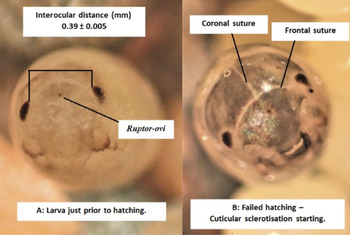
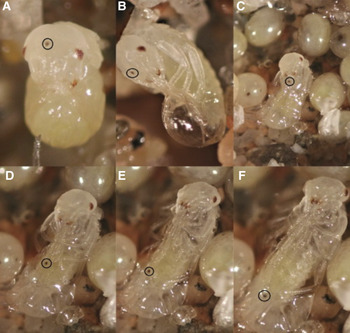
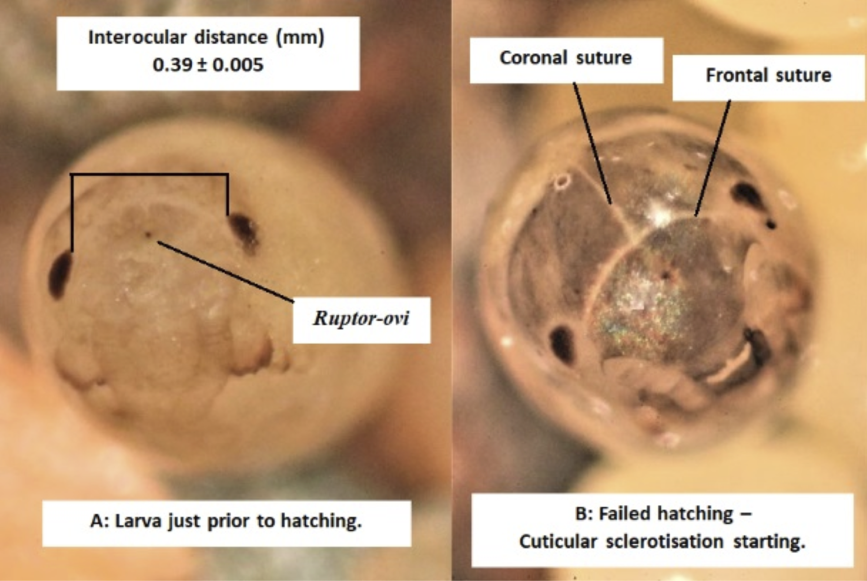
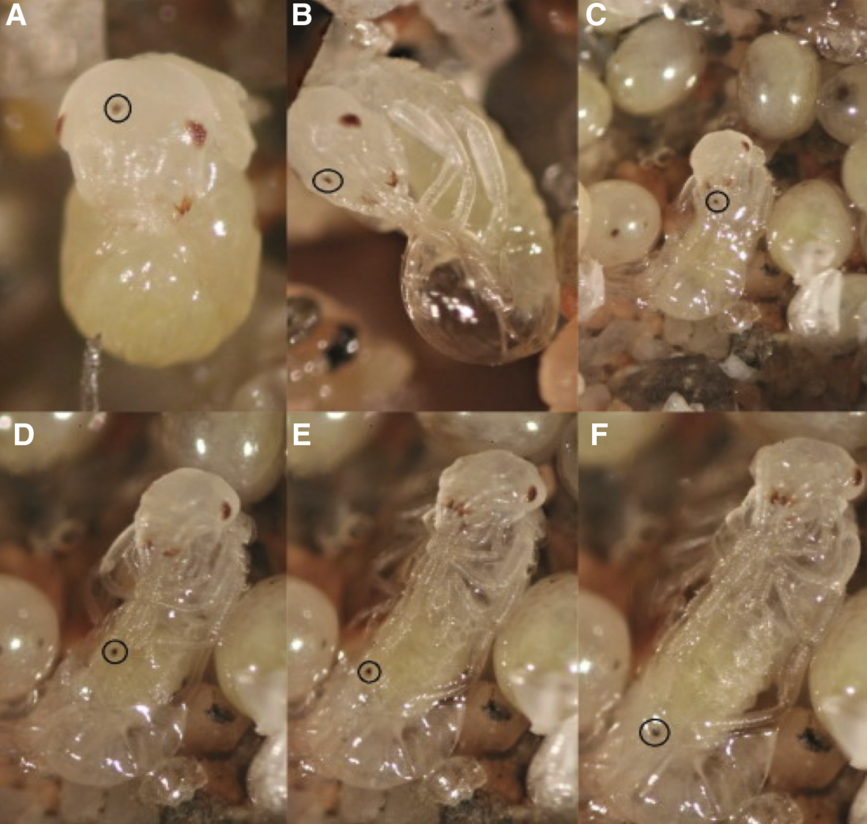
Our observations of the intermediate moult began at the end of egg development. At that time, the eyes, mandibles, and ruptor ovi of the larvae present in the eggs are already visible (Fig. 1). The ruptor ovi (also called egg burster) is a tooth-like projection that an insect embryo or larva typically uses to break the embryonic envelope and egg chorion when hatching (Cooper Reference Cooper1966; Cai and Hua Reference Cai and Hua2009). In F. auricularia, the ruptor ovi is located on the larval frons (Fig. 1A). We observed that this first moult begins with the rupture of the frontal and coronal sutures and occurs immediately after egg hatching. During this phase, the larva swallows a large quantity of air, which greatly distends its abdomen and thus facilitates the exuviation. As the exuviation takes place, the ruptor ovi initially present at the front position (of the larval stage thereafter called L0) slides between the next stage’s mandibles to the base of the abdomen (Fig. 2A to F). We propose naming the first stage “L0”, because such a pharate first-stage larva is not always considered as a larval instar in insects (Chapman and Reynolds Reference Chapman and Reynolds2013) and to remain consistent with existing literature referring to L1–L4 larva in the European earwig (e.g., Jones Reference Jones1917; Fulton Reference Fulton1924; Crumb et al. Reference Crumb, Eide and Bonn1941; Lhoste Reference Lhoste1942; Henson Reference Henson1946, Reference Henson1947; Behura Reference Behura1956; Vogelweith et al. Reference Vogelweith, Körner, Foitzik and Meunier2017). The fact that the exuvia remains stuck at the base of the chorion facilitates the exuviation of the antennae, legs, and abdominal cerci. Once the larva is released (the frontal ovi ruptor is no longer present), it regurgitates its abdominal air and thus allows its abdomen, the intersegmental membranes of which have been distended, to return to normal size and shape. The sclerotisation of the cephalic capsule of the resulting L1 larva then begins. Our description of this additional moult in the European earwig fits with the description of intermediate moults reported in other groups of insects, such as Orthoptera and Hemiptera (Chapman and Reynolds Reference Chapman and Reynolds2013).
View of A, a L0 larva inside its egg; B, a dead L0 larva that did not manage to shed its embryonic cuticle and started cuticular sclerotinisation inside its egg.
Migration of the ruptor ovi after hatching and during first exuviation (from A to F). A circle locates the ruptor ovi in each picture.
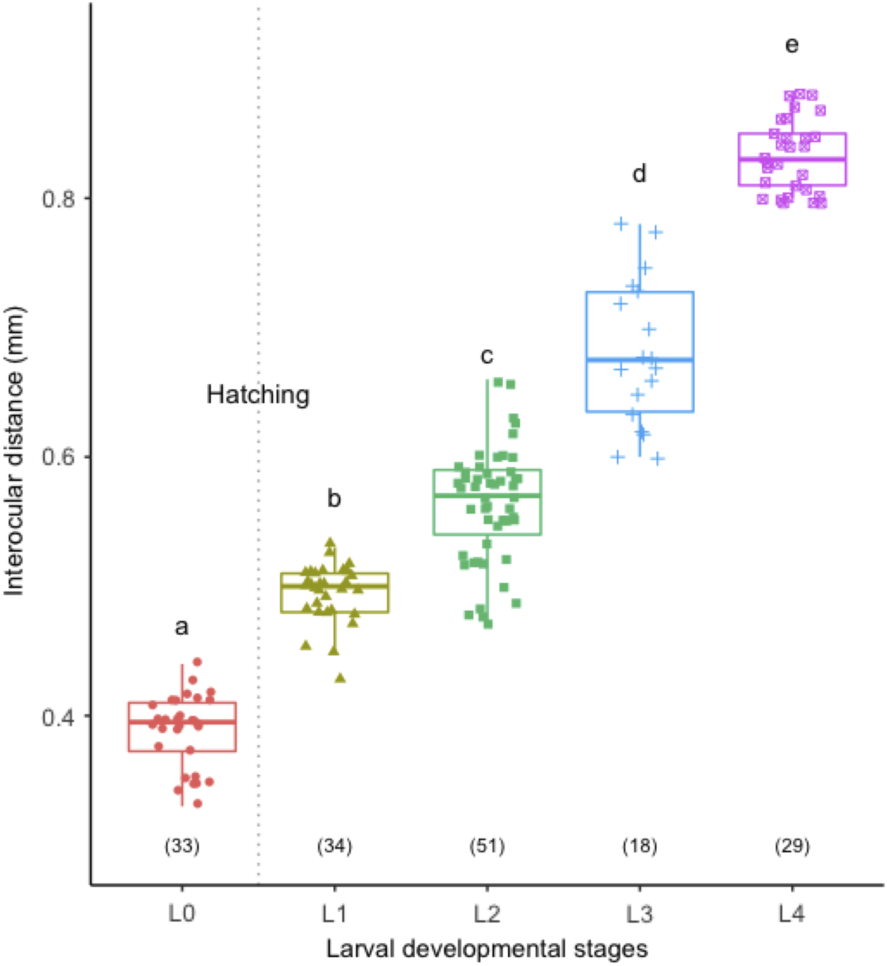
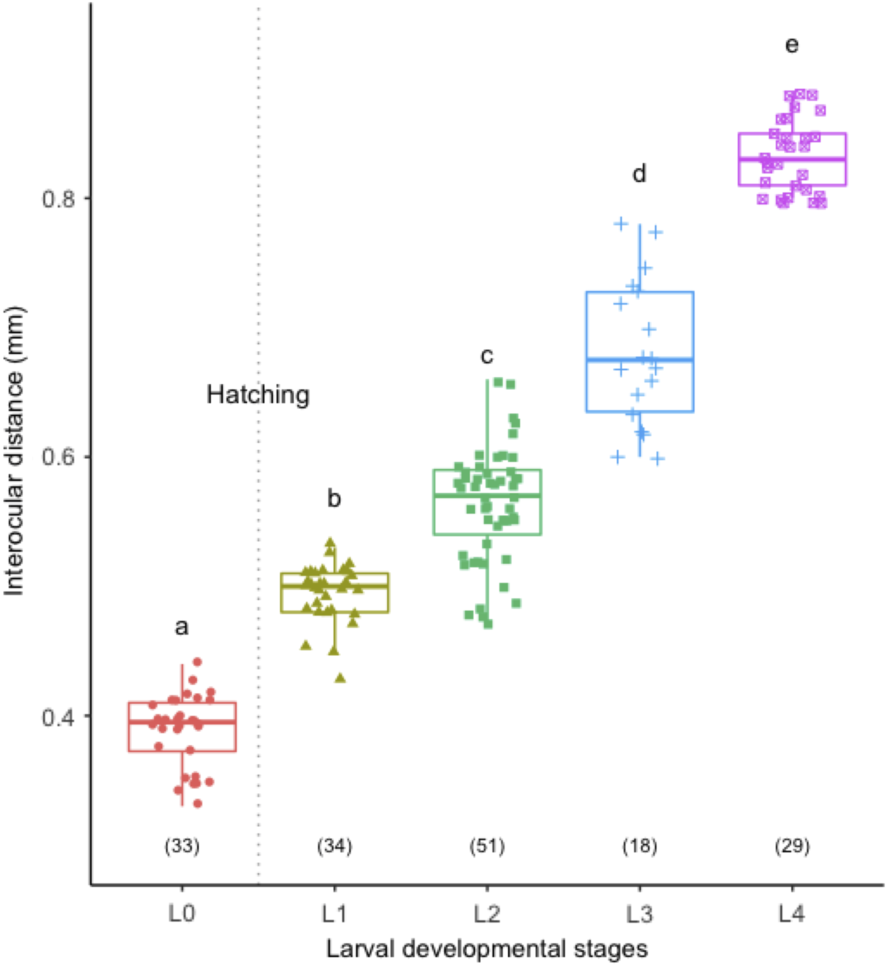
To confirm that the larvae visible in the eggs just before hatching belong to a different developmental stage (L0) than the larvae resulting from egg hatching (L1), we measured and compared the interocular distance of larvae from each of the newly defined five developmental instars. These measurements were conducted to the 0.01 mm using a binocular scope (Nikon-SMZ-2T; Nikon Canada Inc., Mississauga, Ontario, Canada) on 18–51 larvae per instar (Fig. 3). The eyespots are the first cephalic structures observable in the first developmental stage, and their measurement is possible through the larvae’s translucent chorion (Fig. 1A). Our results confirm that the interocular distances of the measured larvae differed amongst the five developmental stages (linear model; F 154,4 = 623.6, P < 0.0001) with mean values (± SE) of 0.389 ± 0.005 mm in the newly defined L0 larva (in the eggs), 0.495 ± 0.004 mm in L1, 0.563 ± 0.006 mm in L2, 0.681 ± 0.013 mm in L3, and 0.834 ± 0.005 mm in L4 (Fig. 3). Each interocular distance differed significantly from the others, including between the interocular distances of L0 larvae measured through the eggshell and of L1 larva measured at egg hatching (pairwise comparisons based on the estimated marginal means of the linear model presented above, with P-values corrected for multiple testing using Tukey methods; all P < 0.0001; Fig. 3). Finally, these interocular distances (Fig. 1) fitted a straight line across the five newly defined larval stages (R 2 = 0.92; y ~ 10.81 × x + 26.56; x being the larval stage), a result in line with predictions of Dyar’s Law (Dyar Reference Dyar1890). This law, which predicts that the head width of a larva should follow a regular geometrical progression in its successive instars, was originally formulated to define the number of moults across insects (Dyar Reference Dyar1890; Shull et al. Reference Shull, Stewart and Paulson2010) and therefore confirms the presence of an intermediate moult in F. auricularia.
Interocular distances measured in each of the five larval developmental stages. Boxplots depict median (bold bar) and interquartile range (light bar), with whiskers extending to 1.5 times the interquartile range and dots representing experimental values. Pairwise comparisons between developmental stages were conducted using estimated marginal means, and the P-values were corrected for multiple testing using Tukey methods. The different letters correspond to P < 0.0001. The numbers of measured larvae are indicated in parentheses at the bottom of each bar. The dashed line illustrates the period of egg hatching.
Overall, our data reveal the presence of an intermediate moult in F. auricularia (and thus a total of five, not four, moults, as commonly stated in the literature), which occurs almost immediately after egg hatching. This finding may open new opportunities for follow-up studies to improve our general understanding of the taxonomy, biology, and evolution of this species. For example, number of moults is an important criterion in taxonomy (Chapman and Reynolds Reference Chapman and Reynolds2013), and these results call for future work to explore whether this new information could be used to discriminate amongst the sister species A and B currently included under the species name, F. auricularia (Wirth et al. Reference Wirth, Le Guellec, Vancassel and Veuille1998). Similarly, natural variation in environmental constraints might affect the success, timing, and duration of this intermediate moult, as it does for any moulting event (Chapman Reference Chapman2013); our findings thus suggest investigations into the possible impacts of these constraints and of their potential stability in the invasion success of the European earwig worldwide (Quarrell et al. Reference Quarrell, Arabi, Suwalski, Veuille, Wirth and Allen2018; Tourneur and Meunier Reference Tourneur and Meunier2020). Finally, maternal care towards the eggs is both extended and essential in this species (Boos et al. Reference Boos, Meunier, Pichon and Kölliker2014; Koch and Meunier Reference Koch and Meunier2014; Van Meyel et al. Reference Van Meyel, Devers and Meunier2019); our results prompt further tests to shed light on this behaviour’s possible impact on the success of this first moulting event (e.g., Fig. 1B reports the case of a failed intermediate moult resulting in the death of a sclerotinised L1 larva in the eggs).