

Introduction
The Philippines fruit fly Bactrocera philippinensis Drew & Hancock is being reared successfully in the laboratory using an artificial diet. For more than 30 years, a diet based on yellow sweet potatoes and rice bran has enabled the consistent mass production of fruit flies for research, fruit disinfestation treatments and feasibility studies on the sterile insect technique (Rejesus et al., Reference Rejesus, Fernandez-Garcia and Bautista1975; Manoto et al., Reference Manoto, Resilva, Obra, Golez, Covacha and Bignayan1998; Resilva et al., Reference Resilva, Obra, Zamora and Gaitan2007). This formulated artificial diet has sweet potatoes and rice bran as the main ingredients; it contains essential nutrients and serves as a good larval substrate. However, yellow sweet potato is difficult to prepare (cooking and mashing), expensive, scarce, perishable and difficult to store for mass production purposes, especially during the rainy season. Rice bran also has some problems associated with handling, procurement and storage, similar to wheat-based bulking agents used in other mass-rearing facilities.
The development and adaptation of liquid larval diet technology may solve these problems in fruit fly mass production systems. This new technology is now recommended for rearing some species of Bactrocera and is currently being used in mass-rearing of the melon fly Bactrocera cucurbitae (Coquillett) at the Agricultural Research Service (ARS), United States Department of Agriculture (USDA), Manoa, Hawaii. In 2005, a Material Transfer Agreement was signed between the Philippine Nuclear Research Institute (PNRI) and the ARS, USDA, to evaluate the rearing of B. philippinensis on a liquefied substrate. This agreement included a ‘Fruit Fly Liquid Diet Starter Kit’ that contained samples of the liquid diet ingredients, rearing materials and a step-by-step diet preparation guide. Preliminary experiments with the original liquid diet starter kit revealed larval growth rates and pupal weights to be comparable to those obtained using the usual artificial diet. This article reports the results of the first attempt made to rear B. philippinensis on a liquid diet. Specifically, the study aimed to: (a) replace wheat germ oil with corn (maize) oil as an ingredient in the liquid larval diet and (b) evaluate various absorbent materials as a support matrix for feeding larvae.
Materials and methods
Replacement of wheat germ oil with corn (maize) oil as an ingredient in the liquid larval diet
Wheat germ oil is an essential ingredient in the liquid diet formulated by Chang et al. (Reference Chang, Caceres and Jang2004). As the Philippines is not a wheat-producing country, wheat germ oil is very expensive and scarce in local supermarkets; a cheaper and locally available alternative is needed. Preliminary studies revealed that corn oil is a potential substitute for wheat germ oil. Various amounts of corn oil, e.g. 0, 0.5, 1.5 and 2.5 ml/l of liquid diet, were tested to replace wheat germ oil. Corn oil was mixed with other ingredients, and then the liquid diet solutions were dispensed into larval trays and seeded with 0.5 g eggs per tray. For each diet treatment, larval growth was monitored closely from the day of hatching to the day of maturation. The amount of corn oil suitable for the development of B. philippinensis was evaluated based on pupation, pupal recovery, pupal weight, adult emergence and fliers, fecundity, fertility and longevity. The study was conducted for five consecutive generations using five replications to determine the appropriate amount of corn oil to be added to the standard liquid diet solution.
Evaluation of various absorbent materials as a support matrix for feeding larvae
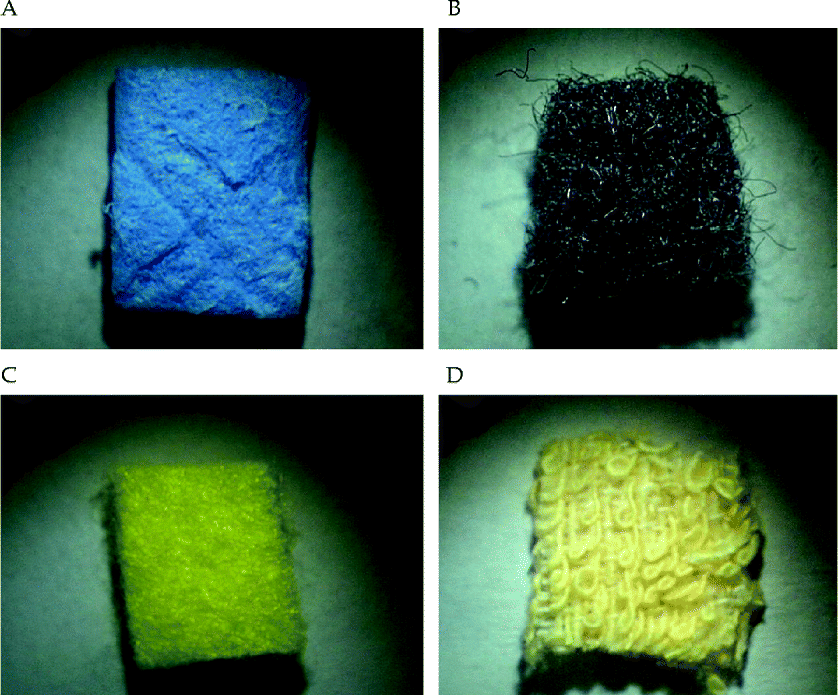
Various types of locally available absorbent materials, e.g. impregnated coated fabric, all-purpose rag and towel cotton fabric, were compared with the standard sponge ‘Kalle’ cloth as a support matrix for feeding larvae (Fig. 1). The materials were cut to a size similar to that of the standard sponge ‘Kalle’ cloth. The liquid diet was prepared and dispensed into disposable plastic trays as described above. Approximately 20,000 eggs were seeded onto the trays. After egg seeding, the tray cultures were held at room temperature until larval maturity. The larvae and pupae were handled according to the standard procedures on fruit fly rearing in the laboratory. For each absorbent material, life table parameters such as pupation, pupal weight, adult emergence and fliers, fecundity and fertility were measured following the methods of Vargas et al. (Reference Vargas, Miyashita and Nishida1984) and FAO/IAEA/USDA (2003).
(colour online) Four absorbent materials used as a support matrix for feeding larvae on a liquid diet. (A) Standard sponge ‘Kalle’ cloth, (B) impregnated coated fabric, (C) all-purpose rag and (D) towel cotton fabric.

Mass-rearing of Bactrocera philippinensis using a liquid diet
Eggs of the Philippines fruit fly were collected for a period of 1 h from stock colonies reared on the sweet potato–rice bran diet at the PNRI fruit fly mass-rearing facility. This strain has been maintained for 150 generations. About 0.25 g eggs placed on rectangular strips of sponge cloth were weighed using a torsion balance (Sartorius) and kept at room temperature.
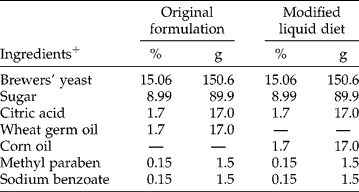
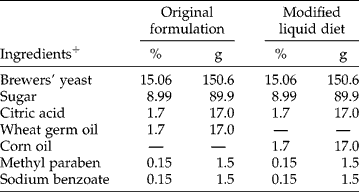
Table 1 summarizes the composition of the larval diet. It also lists the original contents of the diet developed by Chang et al. (Reference Chang, Caceres and Jang2004), which was modified by replacing wheat germ oil with corn oil because the former is not available locally. The liquid diet medium was prepared according to the quantity of materials indicated and mixed with hot water in a beaker using a spatula. The mixture was passed through a sieve to completely dissolve and homogenize all the diet ingredients. The final mixture of the liquid diet had a pH of 4.0. Upon cooling, 150 ml of the prepared aliquot were poured into disposable plastic trays (16 × 10 × 3 cm). A sponge cloth on top of a nylon screen was fitted and layered at the bottom of the trays. Eggs previously weighed in rectangular strips were introduced into the middle of the sponge cloth of each tray, covered with a transparent lid and set inside larval trays containing fine coconut coir dust for pupation. Eggs seeded in the liquid substrate were allowed to settle and develop in a stable place and then maintained at room temperature. The cultures were closely monitored for daily changes in larval development. Photographs of the developing larvae were taken – from the day of hatching to the day of maturation.
Ingredients of the liquid diet developed by Chang et al. (Reference Chang, Caceres and Jang2004)
+ Amount needed for 1 litre diet.
When mature larvae began to leave the rearing medium, the lid of the diet tray was removed to permit crawling larvae to pop out and burrow into the moistened coconut coir dust in the collecting larval trays. Collected larvae were allowed to pupate and were handled according to the standard procedures of fruit fly rearing in the laboratory. The efficiency and suitability of the liquid diet as a larval medium for B. philippinensis were evaluated. The standard life table parameters were monitored, e.g. percentage of pupal recovery, pupal weight, number of pupae collected per tray of diet, adult emergence, adult fliers and sex ratio. The percentage of egg hatchability and number of eggs per female were determined following the methods of Vargas (Reference Vargas1984), Vargas et al. (Reference Vargas, Miyashita and Nishida1984) and FAO/IAEA/USDA (2003).
For fertility and fecundity studies, 10 pairs of newly emerged adults were placed in small cages provided with adult diet. Eggs were collected using a small egging receptacle enclosing a small slice of ripe guava fruit to attract gravid female flies for oviposition. Eggs were collected for 24 h, starting at 08.00 h until 08.00 h the following day, once a week for three consecutive weeks. The collected eggs were spread out and counted on a black piece of linen cloth and held in Petri dishes for the determination of egg hatch. The sweet potato–rice bran standard diet presently used in the laboratory served as the control diet.
Data analysis
Data on the effect of corn oil and various absorbent feeding substrates on the percentage of pupal recovery, pupal weight, percentage of adult emergence and fliers, sex ratio, fecundity and percentage of egg hatch were analysed by one-way analysis of variance (ANOVA) and the means compared by Tukey's multiple range test (SAS Institute, 1990).
Results and Discussion
Replacement of wheat germ oil with corn oil as an ingredient in the liquid larval diet
Table 2 summarizes the quality control data obtained for the Philippines fruit fly colony reared on various concentrations of corn oil added per litre of liquid diet. The results obtained for the effects of adding corn oil to the liquid larval diet on fly development indicated that, with the inclusion of corn oil, pupal recovery increased significantly (F= 15.09; df=3, 16; P= 0.0001). Pupal weights (F= 4.06; df=3, 16; P= 0.0253) of larvae reared on a diet with corn oil were significantly higher than those of larvae reared on a diet without corn oil. Egg production (F= 12.26; df=3, 16; P= 0.002) in adults reared as larvae on a diet with corn oil was also significantly higher than that in adults reared on the same diet without corn oil. On the other hand, adult emergence (F= 0.09; df=3, 16; P>0.9646), percentage of fliers (F= 0.15; df=3, 16; P>0.9255) and egg hatchability (F= 0.26; df=3, 16; P= 0.8529) were not significantly different among all the diet treatment groups. There was little deviation from the 1:1 male:female ratio, indicating that corn oil has no effect on the adult sex ratio.
Percentage of pupal recovery, pupal weight, adult emergence, fliers, fecundity and fertility of Bactrocera philippinensis reared on a liquid diet using various amounts of corn oil+

Mean values in the same column followed by the same letter are not significantly different (Tukey's studentized range test; P< 0.05).
+ Values are means ( ± SE) of five replicates.
The significant increases observed in pupal recovery, pupal weight and fecundity for all the tested concentrations of corn oil were probably caused by the essential nutrients and vitamins present in corn oil (similar to wheat germ oil). This study showed that the development of B. philippinensis was improved when corn oil was added to the liquid larval diet. These findings are in agreement with those of Chang and Vargas (Reference Chang and Vargas2007) on the beneficial effects of wheat germ oil in a liquid diet. Additional studies will be conducted on the growth rate of a B. philippinensis population in a large-scale rearing operation.
Evaluation of various absorbent materials as a support matrix for feeding larvae
The ANOVA results were as follows: percentage of pupal recovery – F= 11.31; df = 3, 16; P< 0.0003; pupal weight – F= 0.18; df = 3, 16; P= 0.9093; percentage of adult emergence – F= 0.38; df = 3, 16; P= 0.7720; percentage of fliers – F= 1.15; df = 3, 16; P= 0.3593; fecundity – F= 12.26; df = 3, 16; P= 0.002; and percentage of egg hatch – F= 0.82; df = 3, 16; P= 0.5022.
Table 3 summarizes the mean percentage of pupation, pupal weight, adult emergence, fliers, sex ratio, fecundity and fertility of the Philippines fruit fly reared on various absorbent materials used as a support matrix for larvae feeding on the liquid diet. A significantly higher pupal recovery was observed on the standard sponge ‘Kalle’ cloth (33%) than on the impregnated coated fabric (25%), all-purpose rag (24%) and towel cloth (24%). However, no significant differences were found for the other parameters (pupal weight, adult emergence, fliers, sex ratio, fecundity and fertility). There were apparent weight uniformities among pupae recovered from all the feeding substrates ranging from 13.2 ± 0.3 to 13.3 ± 0.3 mg per pupa. The percentage of adult emergence on the basis of pupae recovered fell within a closer range (96.2 ± 1.3–97.2 ± 2.1%). The mean values obtained for adult fliers ranged between 94.0 ± 2.5 and 96.4 ± 1.7%. The sex ratio of the newly emerged adults did not differ significantly and was close to 1:1. Adults emerging from the different absorbent materials were tested for fecundity and fertility. The mean egg production per female per week varied considerably from 315.9 ± 42.0 to 365.0 ± 82.3 eggs in all the treatment groups, with egg hatchability ranging from 74.2 ± 3.3 to 77.8 ± 3.8%.
Percentage of pupal recovery, pupal weight, adult emergence, fliers, fecundity and fertility of Bactrocera philippinensis reared on a liquid diet using various absorbent materials+
Mean values in the same column followed by the same letter are not significantly different (Tukey's studentized range test; P< 0.05).
+ Values are means ( ± SE) of five replicates.
With respect to egg production, it was found that the three locally available absorbent materials tested could produce acceptable adults compared with the standard sponge ‘Kalle’ cloth. However, considering the criteria for absorbent material efficiency, at present, the selection of the final support matrix from the three absorbent materials tested is still undecided due to the low percentage, e.g. < 30%, of pupae recovered. Further studies to screen other potential absorbent materials available in the local market will be carried out to find an effective substitute for the standard sponge ‘Kalle’ cloth.
Mass-rearing of Bactrocera philippinensis using a liquid diet
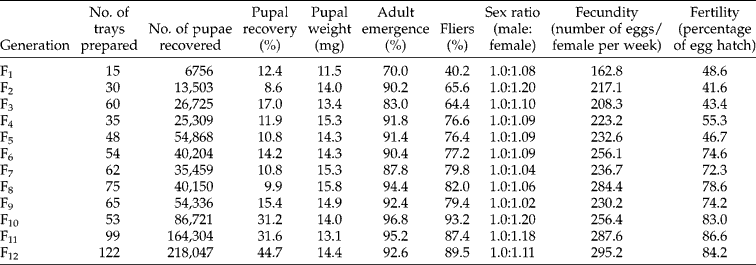
The Philippines fruit fly B. philippinensis exhibited a positive response when reared on Chang's liquid diet. A reduced pupal recovery, due to low egg hatchability, was obtained for nine consecutive generations (from F1 to F9), considered to be a critical period (Table 4). The observed poor performance of the flies was due to their slow adaptation to the new diet formulation and feeding substrate. However, pupae reared on the liquid diet consistently had a high pupal weight, e.g. 13.5 mg, throughout the study period (Table 4), higher than the weight of pupae (11.0 mg) reared on the standard sweet potato–rice bran diet (Resilva et al., Reference Resilva, Obra, Zamora and Gaitan2007). Our results differed from those reported by Chang et al. (Reference Chang, Caceres and Jang2004), who found that pupae reared on the liquid diet weighed less than those reared on the standard solid artificial diet. We suggest that the high weight of pupae reared on the liquid diet was related to a more uniform distribution of nutrients on the sponge ‘Kalle’ cloth once the homogenized liquid diet was absorbed.
Quality control data for Bactrocera philippinensis reared on a liquid diet
After F10, all the indicators indicated that fly development and performance improved significantly (Table 4). These results were similar to those reported by de Souza et al. (Reference de Souza, Matioli and de Souza1988), who reared the Mediterranean fruit fly Ceratitis capitata (Wiedemann) – at least 10 consecutive generations were needed for the insect to adapt and completely recolonize.
The ultimate goal of this study was to show that B. philippinensis could be reared using a liquid diet similar to that used for B. cucurbitae in Hawaii. The study has demonstrated that a liquid diet formulation is a viable alternative to the standard sweet potato–rice bran diet for rearing the Philippines fruit fly. From generation F1 to generation F12, a total of 766,382 pupae were collected from 718 trays of liquid diet. However, at present, pupal recovery on the liquid diet is still less than half that obtained when the insects are reared on the standard solid diet; nevertheless, this situation can be improved.
Future work will focus on the techniques of mass-producing flies at the factory level.
Acknowledgements
The authors are grateful to Ricky Garcia and Flora Isip for their help in the preparation of biological material and for their technical assistance. This project was partially funded by the International Atomic Energy Agency, Research Contract No. 13025/RBF.