On 27 April 2016, actor David Tennant appeared on The Late Show with Stephen Colbert for an interview during which Colbert inquired, “Why do you think Shakespeare is still so resonant to us today?” Tennant observed that Shakespeare speaks to a “universal human condition.”Footnote 1 Similar language characterized a range of 2016 promotional materials for celebrations of the four hundredth anniversary of the Bard's death, with descriptors like “lasting legacy,” “relevance,” “timeless,” and “international appeal” recurring. These are, essentially, claims for a universal Shakespeare.
Appeals to Shakespeare's universality are not solely the provenance of late-night repartee or celebratory promotions. Harold Bloom famously argues that Shakespeare is “a more adequate representer of the universe of fact than anyone else.”Footnote 2 Recently revisiting Shakespeare's universal appeal, Kiernan Ryan contends that problems with universality lie with “the conservative construction,”Footnote 3 which fails to account for Shakespeare's use “to make class society, patriarchy, racial divisions and colonial domination vanish behind the smokescreen of the eternal human predicament his drama allegedly reflects.”Footnote 4 Instead, Ryan calls for attention to what he terms Shakespeare's “universal human potential … the potential of human beings, then and now, to base their lives together on values that possess universal validity, because they are founded on the simple, irrefutable fact that we belong to the same species.”Footnote 5
Yet others remind us to be wary about universalizing claims. Ayanna Thompson analyzes the films Suture and Bringing Down the House, which she maintains depict differing visions of Shakespearean universality based on color-blindness to cultural differences and on an “exclusive and excluding white culture” that eliminates “other cultural productions.”Footnote 6 Both versions are “not only suspect but also dangerous.”Footnote 7 More recently, Peter Erickson and Kim F. Hall stress the challenge of “considering the vulnerabilities and limitations that universality glosses over,” such as “the prospect that Shakespeare's work cannot always adequately address current issues of racism and racial justice.”Footnote 8 Assertions of universality thus gloss over Shakespeare as an alienating entity – a shibboleth for approved “high” culture often imagined as white.
In this critical vein, during the 2016 White House Correspondents’ Dinner, President Barack Obama complicated Shakespeare's universality. Recently returned from London, Obama remarked, “I did have lunch with Her Majesty the Queen, took in a performance of Shakespeare, hit the links with David Cameron.”Footnote 9 His punchline, “just in case anybody is still debating whether I'm black enough, I think that settles the debate,” suggests that Obama is indeed not black enough. With Shakespeare included amongst unstated signifiers of whiteness, Obama's joke indicates that Shakespeare functions not as a symbol of a universal human condition, but rather as a decidedly white, socially elite one.
Comedy duo Keegan-Michael Key and Jordan Peele likewise tackled Shakespeare's exclusionary whiteness with much more pointed results. A sketch entitled “Othello Tis My Shite” appeared in Season 3 of their Comedy Central sketch show Key & Peele, which often explored, critiqued, and upended issues of race and identity.Footnote 10 Like Obama's remarks, Key & Peele's satire invokes Shakespeare in order to explore the racialized boundaries of the dramatist and his iconic work. A close reading of the sketch reveals how Key and Peele interrogate Shakespeare's representation of black masculinity: here, Shakespeare's universality finds its limits in Othello’s inauthentic depiction of black male experience.Footnote 11
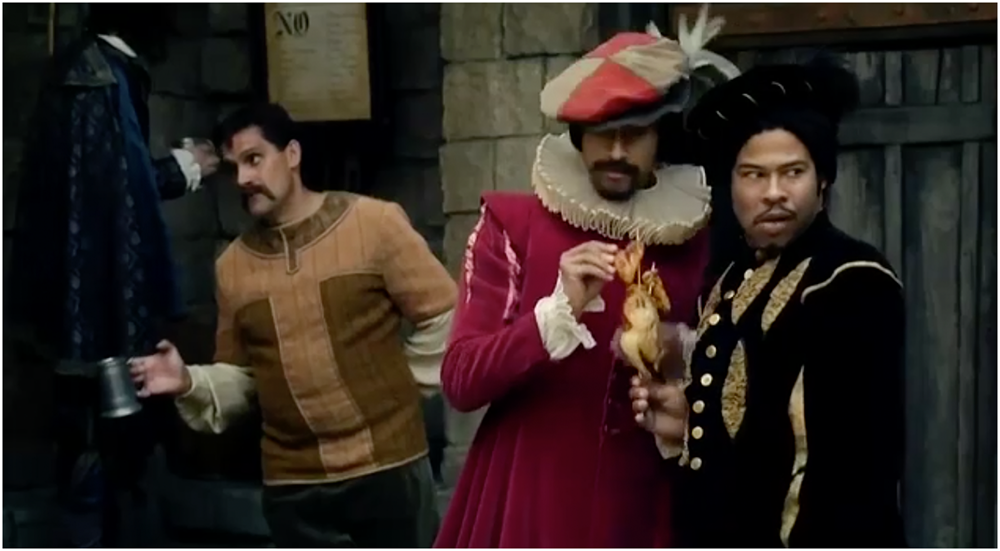
Set in seventeenth-century England, the sketch finds two black men, Martinzion and Lashawnio, attending Othello. According to Key and Peele, they serve as the “spiritual ancestors” of the recurring “Liam Neesons” action-movie lovers, also known as the Valets.Footnote 12 In typical Valet sketches, the men discuss a favorite action hero, pluralize his name (“Liam Neesons”), and articulate their adoration for the actor and his oeuvre, escalating their praise as they go (in one sketch, the head of one of them explodes). “Othello Tis My Shite” emphasizes the men's blackness more than other Valet sketches both through their skin color amidst an all-white Globe audience and through various signifiers of black male identity.Footnote 13 These signifiers show Key and Peele walking the line between characterization and stereotyping. Take, for example, the men's names, which if stripped of their Renaissance affectations become Martin and Lashawn. The former could reference Dr. Martin Luther King Jr. while the latter exemplifies a black name white culture commonly designates as “unusual” and which Key and Peele recurringly send up.Footnote 14 Though the men use a mixture of modern and “Shakespearean” English, their speech likewise signals as “black” with words such as “brother,” “dope,” and “pimpin” peppering their exchange. Martinzion and Lashawnio's behavior also registers stereotypical blackness. During intermission, Martinzion turns down Lashawnio's offer to “borrow two ducats for a capon,” pulling out a “concealed” Cornish game hen from his doublet, the side eye he gives suggesting that he snuck it in because he was too cheap to pay for the Globe's concessions (Figure 1). Thus Martinzion and Lashawnio snack on the early modern version of fried chicken. Yet even as their depiction threatens to devolve into stereotype, the fact that these Moors attend a Shakespearean play, analyze it, even enjoy it, situates them as connoisseurs of high culture, thus fleshing out their portrayal. The sketch's point, in fact, is that black men that can and do fit stereotypes often associated with assumptions about low socioeconomic status, can and do relish the decidedly high-status works of Shakespeare.
Keegan-Michael Key and Jordan Peele as Lashawnio and Martinzion, “Othello Tis My Shite” (directed by Peter Atencio), The Key & Peele Show, 2013 (screenshot by the author).

What Martinzion and Lashawnio value in Othello communicates their perception of authentic black entertainment and black masculinity. As precursors to the Valet action-movie lovers, Martinzion and Lashawnio unsurprisingly enjoy the violence in Shakespeare's drama. Though Othello does not kill any “white person” until the last act, the two “Moors” bound out of the Globe squealing in delight at intermission: “If I know Shakespeare, Othello about to kill everybody up in this bitch.” This time, a black man participates in the action. Furthermore, they find the first half of the play enticing because Othello “doth the beast with two backs with that comely white maiden, and didst not anyone speaketh against him! He straight pimpin!” This exclamation praises the seeming equality achieved by Othello. At the same time, however, these celebratory interjections invoke racist caricatures of black masculinity. The image of Othello killing “everybody” in a community identified expressly as white echoes the “brute” criminal black man even as it brings to mind the modern-day action star. Moreover, by articulating Othello's status as a pimp in relation to a white woman, these men also associate Othello with negative characterizations of black male sexuality. In other words, even as the sketch unfolds in Renaissance England, it also plays with modernization, invoking current and often distinctly American conceptions of black masculinity.Footnote 15 The sketch thus communicates tensions relevant to black male experience and raises the question of Othello’s relation to them. Stated differently, Key and Peele repeatedly stress blackness and its complications as a means of questioning Shakespeare's intersection with black male identity.
Initially, the sketch appears to present the often-revered universal Shakespeare by suggesting that, through Othello, he may finally speak to black people, or at least black men. Martinzion and Lashawnio take pleasure in seeing black masculinity represented on Shakespeare's stage, exclaiming, “This play doth seem dope to me!” In this imaginary world, Shakespeare's reputation as a great dramatist seems established. Thus, focussing on a black man in one of Shakespeare's dramas invokes the idea of the great Shakespeare ahead of his time who, finally, depicts the Other in an empowering way. Indeed, they happily declare, “And ’tis about time Shakespeare doth scriven the play that placeth a brother amongst the firmament!” This comment simultaneously notes the lack of diversity in Shakespeare's canon while praising Shakespeare's new, inspiring black protagonist. In fact, Martinzion affirms Othello's depiction, noting, “Methinks things are looking up for people of the darker hue.” These enthusiastic responses depict a progressive Shakespeare who represents black male experience in high-status ways. According to the sketch, even in his own age, Shakespeare speaks to and therefore influences all people, including those often marginalized both in seventeenth-century England and today.
Yet the sketch takes an ideological turn that destabilizes the idea of universal Shakespeare. At the play's close, Martinzion and Lashawnio lament, “How they goin' to kill Othello?” Their rage stems from the fact that “[a] black man got it goin' on and you [Shakespeare] shuffle off his mortal coil?” The men thus critique Shakespeare's participation in the problematic representation of black masculinity, making it clear that Key & Peele's quasi-stereotypical characterization of Martinzion and Lashawnio is self-aware about black representation. The message of the sketch is that, at least in Othello, Shakespeare decidedly does not know or understand the black man's experience, instead falling into anticipated representational traps. They declare the play's ending unbelievable because no reasonable black man would commit suicide after breaking up with a “white bitch” or “this world would be bereft of brothers.” Invoking Hamlet, Lashawnio replies, “And you'd be talking to a skull right now,” whereupon Martinzion responds with a knowing, emphatic, “Oooh-kay!” These comments suggest a commonality between black men united by their romantic relationships with white women. They have not killed themselves, and their very existence points to the inaccuracy and inauthenticity of Shakespeare's representation of black male experience. Thus, through these critiques of Othello, the men, and therefore the sketch, suggest that Shakespeare's engagement with and depiction of the black male fails both then and now, for this play is largely understood as Shakespeare's racial legacy, and it is clearly insufficient.
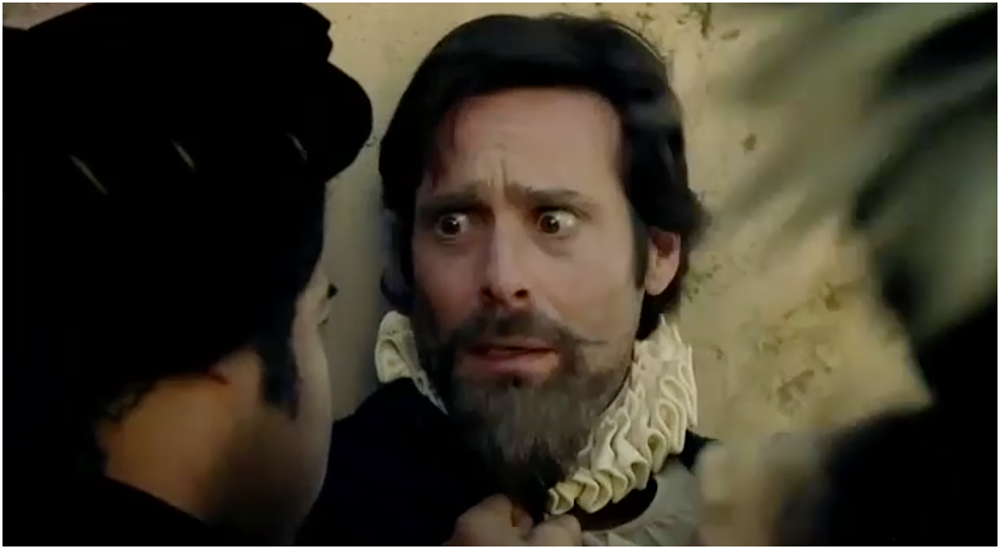
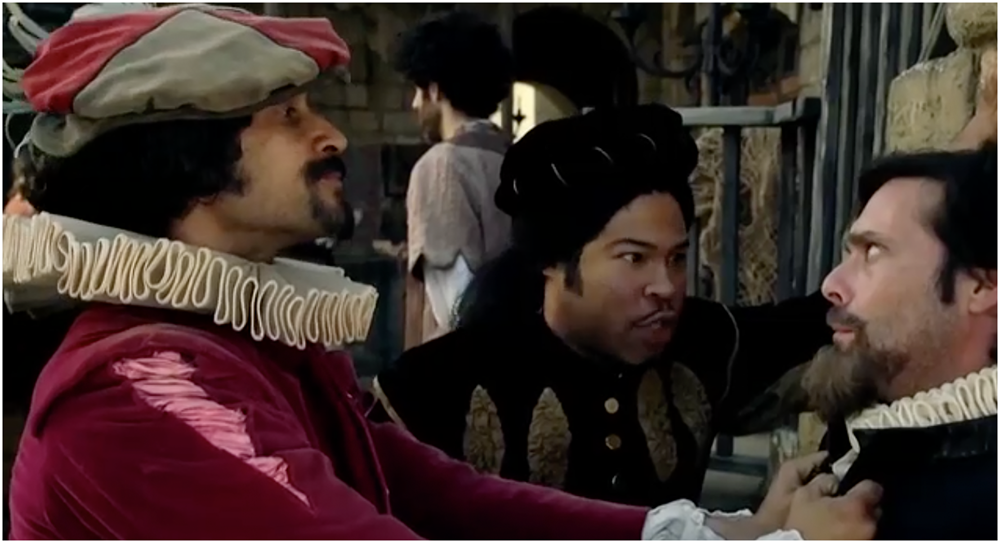
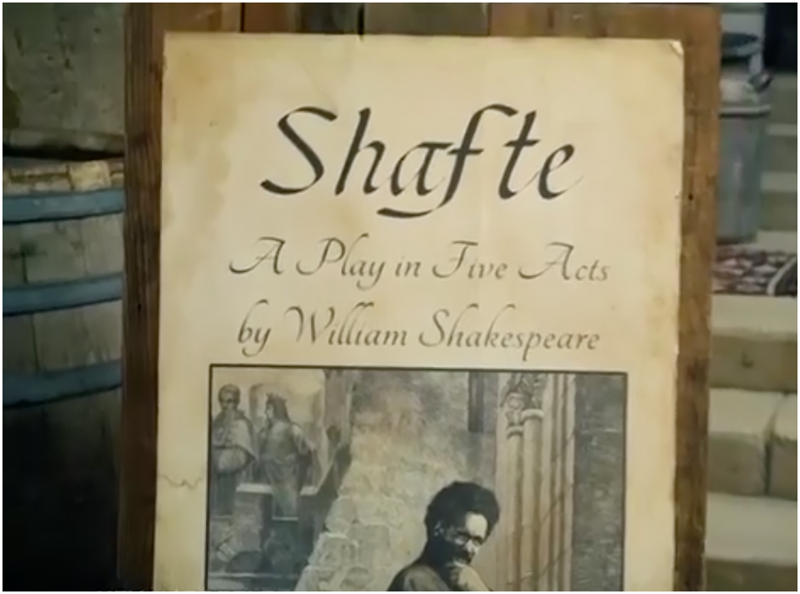
Even as the men challenge Shakespearean universality, however, they cannot ignore the siren song of Shakespeare's cultural authorization. Martinzion and Lashawnio confront the Bard after the performance, almost strangling him just as Othello strangled Desdemona. This clash results in a sniveling Shakespeare who thrusts authorial responsibility upon Marlowe (Figure 2). But they do not believe his authorial renunciation (“Nay! Nay!”) (Figure 3).Footnote 16 Shakespeare attempts to placate them, stating, “Twill not be long before another black hero graceth the stage.” But the men take this as another of Shakespeare's deflections. They insist, “You goin to write that hero … now.” The scene cuts to a sign promoting Shafte: A Play in Five Acts. By choosing Shafte as Shakespeare's new drama, the men force Shakespeare to shift the genre from one associated with whiteness to one decisively associated with blackness (Figure 4). Shaft is a foundational blaxploitation film, a genre that “focused on black narratives [and] featured black casts in action-adventures in an urban setting.”Footnote 17 Blaxploitation films also “exploded what they saw as the old fantasies of black masculinity” by pushing back against white America's stereotypical assumptions.Footnote 18 Closely tied to black power rhetoric and ideology, Blaxploitation films staged violence as a form of freedom.Footnote 19 In the 1971 Shaft, this violence serves the black male community when John Shaft rescues Bumpy Jones's daughter, Marcy, in a caper that ends up providing the Black Panthers with sufficient money to free numerous “brothers and sisters” from jail.Footnote 20 Thus Shaft functions as “a paladin-warrior, more concerned with protecting a particular community, in this case a Black one, than in preserving the state.”Footnote 21 In contrast, as the sole Moor, Othello can never serve his own community. And though the play initially celebrates his martial violence, this violence ultimately threatens the white, Venetian community and thus must be eliminated. Also central to blaxploitation films is their depiction of sexuality as under black rather than white control. For instance, Shaft sleeps with two women, Ellie, his black girlfriend, and Linda, a white woman. With Linda, Shaft exerts control over the sexual encounter by insisting on an abrupt morning-after dismissal in order to complete some business, to which she retorts: “You're really great in the sack. But, um, you're pretty shitty afterwards, you know that?” He laughs and defuses her critique by literally shrugging it off. In contrast, Shakespeare's text never makes it clear whether Othello experiences sexual freedom with Desdemona. Rather, their mutual desire soon sours due to Othello's (supposed) lack of sexual control over a white woman – the very opposite of Shaft. Thus, by offering the depiction of a black man's physical prowess on the streets and between the sheets – all authorized by the Swan of Avon himself – Shafte provides the desired corrective for Shakespeare's duped, emasculated, and ultimately eradicated Othello.
James Callis as Shakespeare in “Othello Tis My Shite” (screenshot by the author).
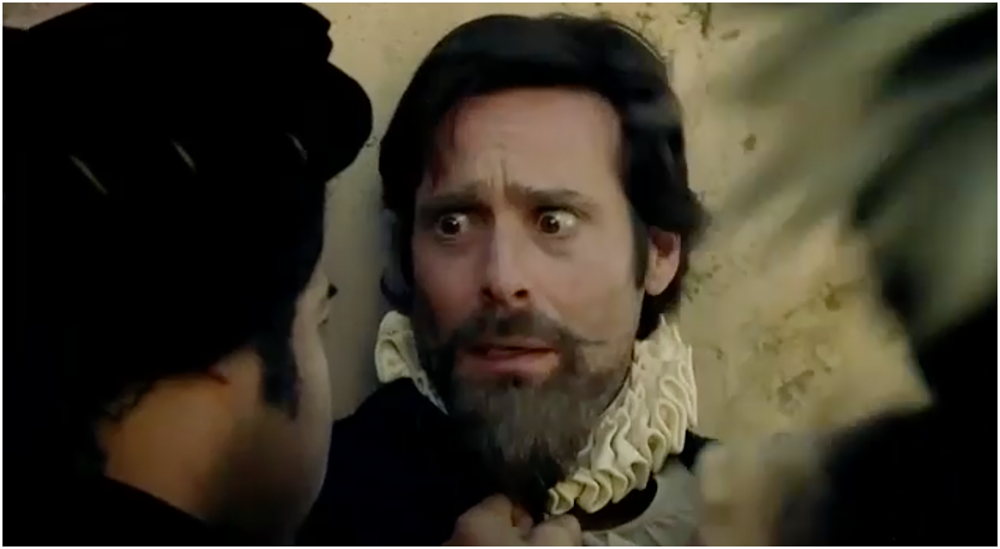
Martinzion (Keegan-Michael Key) and Lashawnio (Jordan Peele) confront the Bard (James Callis). “Othello Tis My Shite” (screenshot by the author).

Advertisement for a new Shakespeare play, Shafte: A Play in Five Acts. Final shot of “Othello Tis My Shite” (screenshot by the author).

Yet Shaft does not offer an uncomplicated version of black masculinity. His sexual proficiency comes alongside a treatment of women as disposable. Furthermore, it remains unclear whether Key and Peele hope the audience references the 1971 Shaft or the 2000 remake. The reference point matters, for as Matthew Henry explains, the 2000 film trades sexuality for heightened police violence that reinforces the state by threatening men of color.Footnote 22 These complications raise the question, why reference Shaft? Without straying too far from Shakespeare, this choice stresses the limited black entertainment produced by Hollywood. Where should the action-movie lovers turn for inspiration? Slave narratives that immerse the viewer in racial oppression? The minstrel world of Tyler Perry's Madea films? The movies enjoyed by the Valets may feature a black character and appeal to a black audience, but they are not specialized entertainment. That very fact positions them as white entertainment. Thus both Hollywood and Shakespeare create a similar problem: they provide these men with limited options within which they can find themselves represented.
This sketch's conclusion holds in tension its competing ideologies. On the one hand, Shakespeare inaccurately and ineffectively represents black male experience. Moreover, Shakespeare's Shafte does not exist. As such, the sketch ends with the idea that perhaps Shakespeare never can and never will speak to all people, including black ones. Universal Shakespeare may be appealing, but, like Shafte, it is just a fantasy. Yet the sketch's creation and content suggest one possible means of recuperating the Bard and his works. For all its critique, the sketch's ending indicates the potential Shakespeare may hold regarding the representation of black masculinity. Rather than overinvesting in the idea of Shakespeare's universality, both the sketch and its allusion to Shaft appropriate and reimagine Shakespeare speaking to the very audiences that may deem him irrelevant. Considered in light of a year celebrating Shakespeare because he “lives on,” this sketch helpfully reminds us that Shakespeare may not speak to all people. But it also reminds us that we can imaginatively transform Shakespeare in ways that may extend his relevance and authenticity for those often excluded from thoughtful representation on his page and stage.