Introduction
Cigarette smoking is the most preventable cause of morbidity and mortality (Centers for Disease Control and Prevention (CDC), 2002). Although smoking cessation is considered as one of the most cost effective intervention in medicine (Orleans, Woolf, Rothemich, Marks, & Isham, Reference Orleans, Woolf, Rothemich, Marks and Isham2006; Edward, Reference Edward2004), it is still not sufficiently implemented. Healthcare providers can have an essential role in smoking cessation as simple advice by health professionals can help to enhance smoking cessation (Lancaster & Stead, Reference Lancaster and Stead2004; Laniado-Laborín, Reference Laniado-Laborín2010). Interventions implemented by health professionals to enhance smoking cessation include various activities such as giving an advice to quit, structural actions in clinics, providing self help materials, and prescribing nicotine substitutes and antidepressants (Lancaster, Stead, Silagy, & Sowden, Reference Lancaster, Stead, Silagy and Sowden2000). Such interventions should be routinely implemented in medical practice according to smoking cessation guidelines (Laniado-Laborín, Reference Laniado-Laborín2010; West, McNeill, Raw, Reference West, McNeill and Raw2000) which are insufficiently implemented in practice (O'Loughlin et al., Reference O'Loughlin, Makni, Tremblay, Lacroix, Gervais, Déry, Meshefedjian and Paradis2001; Young & Ward, Reference Young and Ward2001; McEwen & West, Reference McEwen and West2001).
It is believed that primary care physicians have a major role in providing smoking cessation interventions (Epps & Manley, Reference Epps and Manley1992). Such interventions by general practitioners are both effective in decreasing smoking prevalence and cost effective in decreasing the mortality and morbidity in relation to patients smoking outcomes.
According to the global status report on non-communicable diseases (2010), the 2008 age-standardised prevalence rate of daily tobacco smoking among Jordanian adults aged ≥15 years was 26.3% with a large gender disparity (47.6% in males and 4.9% in females).
Other studies in Jordan provide an evidence for high rates of smoking, particularly among Jordanian adults. Therefore, understanding of the various factors that facilitate or impede family physicians smoking counselling behaviours is crucial to implement programmes effectively. In developing countries there is insufficient data related to family physicians engagement in smoking cessation. This study was conducted among family physicians in Jordan to assess the smoking cessation counselling practices of family physicians in Jordan and assess their perception about the availability of smoking cessation resources and about the barriers to effective smoking cessation practices.
Methods
Study population
The study population consists of family physicians (specialists and residents) practicing at Ministry of Health (MOH) primary health care centres and university teaching health centres in Jordan. All primary health centres in Jordan that have practicing family physicians, were visited during the period of three months from 1 February to 30 April 2009 by the researcher and invited to participate in the study. Of the 130 physicians who were invited, 124 physicians agreed to complete a self-administrated questionnaire with a response rate of 95%.
Questionnaire
All respondents were asked to complete a questionnaire. The first section sought information about personal and professional characteristics of respondents’ including gender, age, number of years in practice, number of patients seen per month, and place of work. The second section outlined the smoking counselling practices. In this part, all participating physicians were asked about their practices; whether they ask about smoking status, provide assistance to their patients on a regular basis to stop smoking, discuss options with smokers, prepare smokers for withdrawal symptoms to stop smoking, and discuss different pharmacotherapies with the smokers. For each smoking counselling behaviour, the family physicians were asked to indicate whether they perform that behaviour or not. The third part of questionnaire was structured to identify the availability of resources, guidelines, posters or pamphlets, and web-based smoking cessation programmes. In the fourth part, all participating physicians were asked about the barriers to effective smoking cessation behaviours. A list of possible barriers was developed based on the previous literature that included few resources, limited organisational supports, and lacking interventions that are effective in helping patients to quit.
Statistical analysis
Data were analysed using Statistical Package for Social Sciences (SPSS, Inc., Chicago, ΙΙΙ, Version 15). Means and standard deviations, frequency and percentage were used to describe data wherever appropriate. The differences between proportions were tested using Chi-square test. A p-value of 0.05 or less was considered statistically significant.
Results
Family physicians’ characteristics
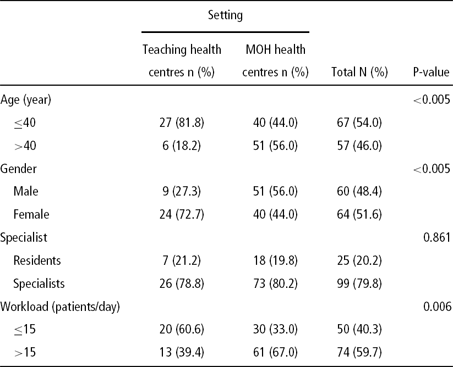
A total of 124 physicians (60 males and 64 females) aged between 25 and 56 with a mean (SD) of 39.5 (8.7) were included in this study. Of those, 26.6% were practicing in teaching health centres and 73.4% were practicing in MOH health centres. The demographic, practice, and relevant characteristics of family physicians are shown in Table 1. Physicians practicing in teaching health centres were predominantly females. MOH physicians were older and had higher workload than physicians in teaching health centres. Overall, 40.3% (48.5% in teaching health centres and 37.4% in MOH health centres) had received training about smoking cessation. More than half of male physicians (56.7%) and 20.3% of female physicians were smokers.
The demographic, practice, and relevant characteristics of 124 physicians practicing in Ministry of Health (MOH) and teaching health centres

Smoking counselling practices
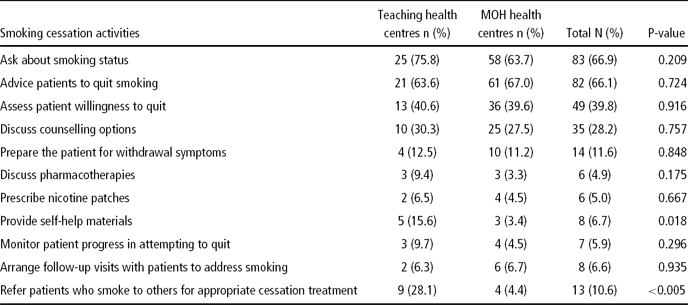
All physicians surveyed believe that it is their role to help patients to quit smoking. While about two thirds (66.6%) of physicians reported that they usually ask patients about smoking status and advise them to stop smoking, they do not regularly provide extensive assistance to help their patients to quit smoking (Table 2). Only 39.8% reported that they assess the willingness of the patients to quit smoking and 28.2% reported that they discuss counselling options with smokers. Considerably fewer percentages of physicians reported that they prepare their patients for withdrawal symptoms (11.6%), discuss pharmacotherapies (4.9%), describe a nicotine patch (5.0%), and provide patients with self-help materials (6.7%). Monitoring progress in attempting to quit, arranging follow up visits with patients to address smoking, and referring smokers to other appropriate cessation treatments were reported to be done by a small percentage of physicians (5.9%, 6.6%, and 10.6% retrospectively). Patients in teaching health centres were more likely than physicians in MOH health centres to provide self-help materials (15.6% vs. 3.4%, p = 0.018) and to refer patients who smoke to others for appropriate cessation treatment (28.1% vs. 4.4%, p-value <0.005).
Smoking cessation activities reported by family physicians practicing in Ministry of Health (MOH) and teaching health centres in Jordan
When asked about whether they counselled patients about stopping smoking in the last month, 16.1% of physicians reported that they did not counsel patients, 15.3% counselled patients for <1 minute, 30.6% for 1‒2 minutes, 27.4% for 3‒5 minutes, and 10.4% for more than 5 minutes. About 60.6% of physicians reported they are somewhat effective and 5.7% reported they are very effective at changing their patients’ behaviours with respect to smoking cessation. Less than half of physicians (46.7%) indicated they sometimes use educational resources for educating patients and only 4.1% do that routinely.
Services and resources
A high proportion of physicians reported that resources are unavailable to assist patients to stop smoking. Only 18.5% reported the availability of guidelines and protocols about smoking cessation and 27.4% reported the availability of posters or pamphlets about smoking cessation. Smoking cessation activities were reported to be available by 22.6% of physicians. Only 13.7% of physicians reported that the staff is dedicated to provide tobacco dependence treatment. Physicians in teaching health centres were more likely than physicians in MOH health centres to report the availability of guidelines, posters or pamphlets, and smoking cessation activities.
Barriers to effective smoking cessation behaviours
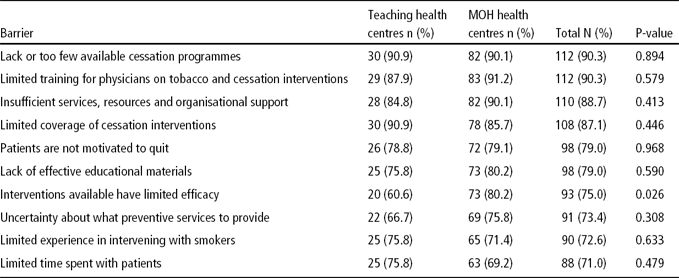
The two factors cited most often by physicians as significant barriers to smoking cessation counseling were lack or too few cessation programmes (90.3%) and limited training for physicians on tobacco and cessation interventions (90.3%) (Table 3). These are followed by insufficient services, resources and organisational support (88.7%) and limited coverage of cessation interventions (87.1%). Physicians in teaching health centres were less likely than those in MOH health centres to report ‘Interventions available have limited efficacy’ as a barrier to effective smoking cessation counselling.
Family physicians’ perceived barriers to effective smoking cessation counselling practices
Discussion
In spite of the recent strong evidence that smoking cessation intervention by general practitioners (GP) is cost-effective, there is still a gap exists between evidence-based recommendations for smoking cessation and GP practices (Brotons et al., Reference Brotons, Bjfrkelund, Bulc, Ciurana, Godycki-Cwirko, Jurgova, Kloppe, Lionis, Mierzecki, Pin˜eiro, Pullerits, Sammut, Sheehan, Tataradze, Thireos and Vuchak2005).
Family physicians are in a unique position to initiate smoking cessation. While about two thirds of physicians in our survey reported that they usually ask patients about smoking status and advise them to stop smoking, fewer participated in activities such as assessing the willingness of patients to quit and discussing both counselling options and pharmacotherapies with smokers. These findings are consistent with the finding in the US survey where 59.3% of family medicine residents reported assessing tobacco use and 80.9% advising their patients to quit but only minority (7.3‒21.9%) reported providing specific counselling behaviours (Gottlieb, Guo, Blozis, & Huang, Reference Gottlieb, Guo, Blozis and Huang2001). The Canadian survey reported that a high proportion of GP reported asking patients about smoking status but relatively few offered adjunct support (O'Loughlin et al., Reference O'Loughlin, Makni, Tremblay, Lacroix, Gervais, Déry, Meshefedjian and Paradis2001).
In Europe, a multicentre study across 12 countries revealed that overall, one third of health professionals reported regularly advising patients to quit smoking (Puska, Barrueco, Roussos, Hider, & Hogue, Reference Puska, Barrueco, Roussos, Hider and Hogue2005). In Italy, only 22% of smokers stated receiving advice to quit smoking from their family physicians in the previous year (Ferketich et al., Reference Ferketich, Gallus, Colombo, Fossati, Apolone, Zuccaro and La Vecchia2008). The finding that the majority of physicians assess patients’ tobacco status and advise quitting but do not provide regular extensive assistance to smokers is consistent with the findings observed in other studies (Crawford et al., Reference Crawford, Woodby, Russell, Turner, Hardin and Harrington2005; Gallefoss & Drangsholt, Reference Gallefoss and Drangsholt2002).
Thorough training of GPs in smoking cessation proved to be cost effective (Crawford et al., Reference Crawford, Woodby, Russell, Turner, Hardin and Harrington2005; Prignot et al., Reference Prignot, Bartsch, Vermeire, Jamart, Wanlin, Uydebrouck and Thijs1998; Boldemann, GillJam, Lund, & Helgason, Reference Boldemann, GillJam, Lund and Helgason2006). However, such training is still inadequate. In the present study 40.3% of physicians surveyed received smoking cessation training. In a German study (Twardella, Reference Twardella2005), only one third of GPs rated their training as adequate. In an Italian study (Pizzo, Chellini, Grazzini, Cardone, & Badellino, Reference Pizzo, Chellini, Grazzini, Cardone and Badellino2003), only one tenth to one third of GPs surveyed stated that they had received training in smoking cessation. In two studies in United Kingdom (Roddy, Rubin, & Britton, Reference Roddy, Rubin and Britton2004) and United States (Ferry, Grissino, & Runfola, Reference Ferry, Grissino and Runfola1999), the majority of practicing physicians reported that they did not receive adequate training during their formal medical education. In Sweden, Norway, Iceland and Finland the proportion of GPs who received training in smoking cessation were 60%, 55%, 48% and 28%, respectively (Helgason & Lund, Reference Helgason and Lund2002).
The four main perceived barriers in our survey towards smoking cessation were lack of availability of cessation programme (90.3%), limited training for physicians on tobacco and cessation interventions, insufficient services, resources and organisational support (88.7%), and limited coverage of cessation interventions (87.1%). In other studies (Gottlieb, Guo, Blozis, & Huang, Reference Gottlieb, Guo, Blozis and Huang2001; Twardella, Reference Twardella2005; Ulbricht et al., Reference Ulbricht, Meyer, Schumann, Rumpf, Hapke and John2006), lack of time and patient insufficient motivation to change have been reported as major barriers against the provision of smoking interventions by general practitioners. Perceived lack of training was the main major barrier in other studies (Twardella, Reference Twardella2005; Revell & Schroeder, Reference Revell and Schroeder2005).
A major problem to influence smokers to quit is the failure to take into account the readiness of smokers to change their behaviour. The most common and important intervention is a brief 5 As (ask, advise, assess, assist, and arrange) that if integrated into routine primary care can effectively influence the smokers’ behaviours. On the other hand, one of possible factors that might have an influence on the effective smoking cessation behaviours among physician is the high prevalence rate of smoking among physicians themselves. In this study, 56.7% of male physicians and 20.3% of female physicians were smokers. These high rates, which exceed the rates for the population of Jordanian adults (47.6% in males and 4.9% in females), might explain the finding that Jordanian physicians do not regularly provide extensive assistance to help their patients to quit smoking. Studies in Greece (Sotiropoulos et al., Reference Sotiropoulos, Gikas, Spanou, Dimitrelos, Karakostas, Skliros, Apostolou, Politakis and Pappas2007), Finland (Barengo, Sandström, Jormanainen, & Myllykangas, Reference Barengo, Sandström, Jormanainen and Myllykangas2005) and Austria (Kössler, Lanzenberger, Zwick, Reference Kössler, Lanzenberger and Zwick2002) found that physicians who smoke were less likely to report giving cessation advice comparing to physicians who did not smoke.
Limitations
There are two limitations that need to be addressed regarding the present study. The first limitation concerns the cross-sectional nature of this study. Another limitation of this study is that the practices of family physicians were self-reported.
In conclusion, while a high proportion of Jordanian family physicians reported that they usually ask patients about smoking status and advise them to stop smoking, they do not regularly provide extensive assistance to help their patients to quit smoking. Considerably fewer numbers of physicians reported that they prepare their patients for withdrawal symptoms, discuss pharmacotherapies, describe a nicotine patch, and provide patients with self-help materials. Lack of or too few cessation programmes and limited training for physicians on tobacco and cessation interventions were identified by the family physicians as the two major barriers to effective smoking cessation counselling. The continued high prevalence of smoking in Jordan and the high morbidity and mortality related to tobacco use merits promoting effective smoking cessation strategies, addressing the barriers to the delivery of smoking cessation counselling, reinforcement of counselling elements in continuing medical education and residency training as well as ensuring that smokers receive the intensive interventions needed for effective cessation.
Financial Support
This research received no specific grant from any funding agency, commercial or not-for-profit sectors.
Conflict of Interest
The authors declare that they have no conflicts of interest.
Ethical Standards
The authors assert that all procedures contributing to this work comply with the ethical standards of the relevant national and institutional committees on human experimentation and with the Helsinki Declaration of 1975, as revised in 2008.