Introduction
Conductive hearing loss secondary to acute otitis media is a common occurrence. In contrast, acute infective sensorineural hearing loss (SNHL) is well recognised but much less frequent, with an incidence of less than 10 per cent reported in one series.Reference Park, Park, Kim and Park 1 The mainstay of treatment for idiopathic sudden SNHL is steroid therapy. The use of steroids in the presence of infection was controversial until recently, and there remains little robust evidence to support their use in acute otitis media. The evidence on both the clinical benefits and histological effects of steroids in acute otitis media is conflicting.Reference Roland, Kreisler, Reese, Anon, Lanier and Conroy 2 – Reference MacArthur, DeGagne, Kempton and Trune 4
The treatment of acute infective SNHL with steroids has received very little attention in the published literature. Toxic substances crossing the round window membrane can result in perilymphatic inflammation spreading apically from the basal turn, with resultant SNHL.Reference Joglekar, Morita, Cureoglu, Schachern, Deroee and Tsuprun 5 It therefore seems logical that, in addition to antibacterial treatment of the underlying infection, application of steroids to the middle ear in anticipation of their diffusion through to the cochlea may help to combat intracochlear inflammation and address the SNHL.
Steroids for idiopathic sudden SNHL are usually initiated as oral therapy. Intratympanic steroids have generally been reserved for patients who cannot tolerate systemic steroid therapy or who are refractory to it. However, intratympanic steroids are becoming more commonplace as a first-line treatment in order to deliver a higher treatment dose locally without systemic side effects.
This study aimed to evaluate a small cohort of patients who presented with symptoms and signs consistent with acute infective SNHL who were treated with intratympanic steroids.
Materials and methods
A retrospective case note review of seven consecutive patients diagnosed with acute otitis media with accompanying SNHL on pure tone audiometry was performed. Patients presented with pain and/or a preceding upper respiratory tract infection in addition to unilateral hearing loss. All patients were seen between November 2006 and October 2013. Mean patient age was 47.1 years (range, 36–64 years). There were five men and two women. The left ear was affected in three cases and the right ear in four cases. Patients presented at a mean of 8 days after the onset of symptoms (range, 2–21 days).
Full otological examination and investigations for an identifiable cause, including magnetic resonance imaging, were undertaken. All investigation results were negative.
All patients were prescribed a 7-day course of oral antibiotics and oral prednisolone. Patients were offered intratympanic steroids thereafter, given the failure of improvement in hearing thresholds.
Three intratympanic injections of methylprednisolone (0.5 ml of 40 mg/ml) were administered at weekly intervals via a Shepard™ ventilation tube. A one-week course of dexamethasone 0.1 per cent drops applied four times daily was prescribed for out-patient self-administration following the first intratympanic injection. The first intratympanic injection was given at a mean of 29 days after the onset of symptoms (range, 13–42 days).
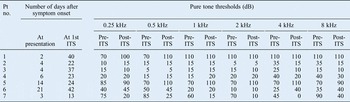
All patients underwent pure tone audiometry before and after oral treatment and after intratympanic steroid therapy (Table I). The mean follow-up time after the final dose of intratympanic steroid therapy was 45 days (range, 1–92 days).
Patient data

Pt no. = patient number; ITS = intratympanic steroids
Results
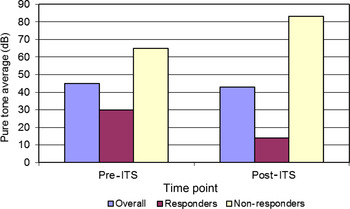
The change in pure tone average (PTA) (for 0.5, 1, 2 and 4 kHz) was calculated. Mean PTA overall was 45 dB pre-intratympanic steroids and 43 dB post-intratympanic steroids (Figure 1). Patients were considered to have significant hearing improvement following intratympanic steroid therapy (‘responders’) if the average change in threshold was equal to or greater than 10 dB. This was the case in only 14 per cent of patients (one out of seven). The improvement in PTA in this patient was 52 dB.
Mean pure tone average (for 0.5, 1, 2 and 4 kHz) pre- and post-intratympanic steroids: overall versus responders to intratympanic steroid therapy versus non-responders. ITS = intratympanic steroids

On more detailed analysis of the results, it was noted that the SNHL at presentation was isolated to the high frequencies (4 and 8 kHz) in three patients (patients two, three and four). The thresholds at other frequencies were equivalent to those in the contralateral ear. The use of PTA as an indicator of change post-intratympanic steroid therapy masked improvement in the affected high frequencies in this group and would lead one to believe that there was no response to intratympanic steroids in this group. In fact, all three patients achieved a return to normal hearing across all frequencies following intratympanic steroid therapy. Therefore, in these patients the mean threshold at 4 and 8 kHz was also calculated pre- and post-intratympanic steroids to better assess the change in the affected frequencies. The mean threshold at 4 and 8 kHz was 32 dB pre-intratympanic steroids and 17 dB post-intratympanic steroids, demonstrating a mean improvement of 15 dB. These three patients were also therefore considered to be responders to intratympanic steroid therapy.
Overall, 57 per cent of patients (four out of seven) were considered to be responders to intratympanic steroid therapy. The mean improvement in this group was 24 dB (range, 10–52 dB). Three of these four patients presented with a mild hearing loss (maximum threshold of 40 dB) confined to the high frequencies; the other patient had a moderate to profound sensorineural loss affecting all frequencies.
Among the non-responders, patient one had a severe hearing loss in the low frequencies and a profound loss in the mid to high frequencies at presentation, which progressed to a profound loss across all frequencies despite treatment. Patient five had severe sensorineural loss across all frequencies at presentation; again this progressed to a profound loss across all frequencies despite treatment. Patient six had a mild to moderate low frequency loss, which remained unchanged despite treatment.
The magnitude of the SNHL at presentation was less in responders than in non-responders (mean PTA in responders 30 dB pre-intratympanic steroids and 14 dB post-intratympanic steroids; mean PTA in non-responders 65 dB pre-intratympanic steroids and 83 dB post-intratympanic steroids) (Figure 1).
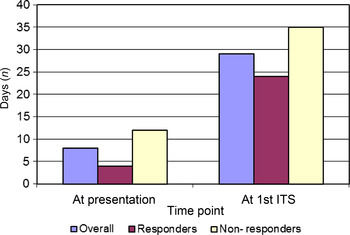
The mean number of days following onset of symptoms at which responders presented was less than that at which non-responders presented (4 days (range, 3–6 days) vs 12 days (range, 2–21 days)) (Figure 2). The mean number of days after onset of symptoms at which patients received their first intratympanic steroid treatment was also earlier in the responder group (24 days (range, 13–37 days) vs 35 days (range 24–42 days)) (Figure 2). The statistical significance of these differences was not tested given the small sample size.
Mean number of days after onset of symptoms, at presentation and at first intratympanic steroid administration: overall versus responders to intratympanic steroid therapy versus non-responders. ITS = intratympanic steroids

Discussion
In this small study, the patients generally fell into two distinct groups: (1) those with mild high frequency SNHL associated with acute otitis media, who responded to intratympanic steroids and whose hearing returned to normal across all frequencies; and (2) those with severe to profound SNHL across all frequencies, who did not respond to intratympanic steroids. This may reflect duration of exposure of the cochlea to inflammatory mediators, toxicity of bacterial products or other unknown factors affecting steroid response.
It is notable that the SNHL was isolated to the high frequencies in most responders to intratympanic steroid therapy. This is in contrast to idiopathic sudden SNHL, where although it might be expected that steroid diffusion through the round window might benefit the high frequencies preferentially, intratympanic steroids seem to be more beneficial in the low frequencies.Reference Seggas, Koltsidopoulos, Bibas, Tzonou and Sismanis 6
The mechanism of acute infective SNHL has been investigated extensively in vivo though it is still not fully understood. Animal studies suggest that the bacterial products and inflammatory mediators present in the middle ear during an episode of acute otitis media increase round window membrane permeability, enabling the passage of noxious macromolecules such as proteases into the cochlea, altering protein expression and disturbing cochlear ion homeostasis.Reference Joglekar, Morita, Cureoglu, Schachern, Deroee and Tsuprun 5 , Reference Engel, Blatz, Kellner, Palmer, Weiler and Bhakdi 7 – Reference Jang, Cho, Choi, Park and Pak 9 Inflammation within the perilymphatic space spreads apically from the basal turn, with resultant SNHL.
-
• Acute infective sensorineural hearing loss (SNHL) is well recognised but uncommon
-
• Treatment of acute infective SNHL with steroids has received little attention in published literature
-
• In this study, patients with SNHL associated with acute otitis media who responded to intratympanic steroids had mild high frequency loss
-
• Those who did not respond to intratympanic steroids had severe to profound SNHL across all frequencies
-
• Intratympanic steroids are valuable in acute infective SNHL treatment and may have a concentrated local steroid effect in patients who do not respond to antibiotics
Although the literature regarding steroid treatment of acute infective SNHL is sparse, there is limited evidence of a beneficial effect. Elevated sensorineural thresholds following endotoxin-induced otitis media decreased significantly after intratympanic dexamethasone administration in rats.Reference Jang, Cho, Choi, Park and Pak 9 Fearrington and Weider reported a case of SNHL associated with acute otitis media that resolved following treatment with systemic prednisone.Reference Fearrington and Weider 10 Park et al. studied a group of eight patients, of whom all had a high frequency loss and three had pan frequency loss.Reference Park, Park, Kim and Park 1 Seven of the patients received oral steroid therapy as part of their treatment and the hearing improved in six. Song et al. reported a variable benefit from topical or oral steroids in their study of eight patients.Reference Song, Sapthavee, Cager and Saadia-Redleaf 11 They emphasised the importance of correctly diagnosing acute infective SNHL as distinct from idiopathic sudden SNHL, and advocated initial aggressive treatment with myringotomy and antibiotics, reserving steroids for subsequent management if the SNHL persists. They did not comment on the affected frequencies, but generally patients with higher thresholds and poorer speech discrimination scores at presentation were less likely to recover, despite treatment with myringotomy, antibiotics and steroids.
The reasons behind improvement of acute infective SNHL following antibiotics alone in some cases, steroids in other cases and no improvement at all in others remain unknown. At present, there is no optimal treatment regimen for these patients, and both the underlying pathophysiology and the effects of treatment require further investigation. The results of our study suggest that intratympanic steroids provide a valuable contribution to the treatment of acute infective SNHL, and may provide additional benefit by virtue of a concentrated local steroid effect in patients who do not respond to antibiotics. A larger study investigating the timing of intratympanic administration, either after antibiotics alone or after oral steroid treatment, would be valuable.