Implications
Hulless barleys contain carbohydrates such as β-glucan and resistant starch that are fermented by the intestinal microbiota in pigs and may thereby favor the development of a health-promoting bacterial population. The choice of varieties of hulless barleys with high levels of these carbohydrate fractions could thus be a part of a strategy to maintain pig herd health and improve the competitiveness of the pork industry.
Introduction
Cereal non-starch polysaccharides (NSPs) influence the digestive processes and gut microbiota composition in pigs (Bach Knudsen and Hansen, Reference Bach Knudsen and Hansen1991; Bach Knudsen et al., Reference Bach Knudsen, Borgjensen, Andersen and Hansen1991). Part of the NSP is fermented by distal tract intestinal microbiota, resulting in the formation of short-chain fatty acids (SCFAs) (Daniel et al., Reference Daniel, Wisker, Rave and Feldheim1997). Furthermore, NSP stimulate the activity of the microbial population, and some types of NSP may stimulate the growth of health-promoting bacteria, such as lactobacilli and bifidobacteria (Brown et al., Reference Brown, Warhurst, Arcot, Playne, Illman and Topping1997; Charalampopoulos et al., Reference Charalampopoulos, Wang, Pandiella and Webb2002), and thus can contribute to the gut health maintenance (Bouhnik et al., Reference Bouhnik, Raskine, Simoneau, Vicaut, Neut, Flourié, Brouns and Bornet2004; Wong et al., Reference Wong, de Souza, Kendall, Emam and Jenkins2006). β-glucan, the primary sNSP in barley and oat, are being evaluated as potential gut ecosystem modulators in human nutrition (Brennan and Cleary, Reference Brennan and Cleary2005).
NSP such as β-glucan, have mainly been studied in isolated form, whereas swine diets are usually composed of cereals containing large amounts of fermentable carbohydrates (CHO) in the grain matrix. The major components in barley fibers are β-glucan and the arabinoxylans, located in the cell wall of the endosperm and the aleurone layer (Holtekjolen et al., Reference Holtekjolen, Uhlen, Brathen, Sahlstrom and Knutsen2006). The fermentation rate of these carbohydrates in the intestinal tract will thus depend on their composition, form and physical properties (Le Goff et al., Reference Le Goff, Noblet and Cherbut2003). As a consequence, cereal NSP in isolated form or within a matrix may act differently in the gastrointestinal tract (GIT; Topping, Reference Topping2007).
It was hypothesized that the fermentation of carbohydrates, especially soluble NSP (sNSP) such as β-glucan and resistant starch from hulless barley, would increase the SCFA and lactic acid (LA) production and decrease ammonia production in the pig’s gastrointestinal tract, and if confirmed, this would make it possible, within the same cereal species, to select cultivars with desirable properties to be used in swine nutrition to improve gut health.
Altering the carbohydrate structure and content of cereals such as barley and oat has been a major goal of plant breeders in the past decades, and collections of hulless barleys and oat cultivars with a wide content in β-glucan or altered amylose/amylopectin ratio are now available (Izydorczyk et al., Reference Izydorczyk, Storsley, Labossiere, MacGregor and Rossnagel2000). Utilizing some of these cultivars a companion study revealed that hulless barleys differing in their β-glucan (41 to 84 g/kg) and amylose content (70 to 430 g/kg of total starch) have strong potential to alter the intestinal microbial composition of weaned pigs, as compared with hulled barleys and oats (Pieper et al., Reference Pieper, Jha, Rossnagel, Van Kessel, Souffrant and Leterme2008). The results presented here were obtained from the same study and describe the effect of these barley and oat cultivars on the ileal and total tract nutrient digestibility and fermentation metabolites in weaned pigs.
Material and methods
The animal experiment was performed in accordance with the recommendations of the Canadian Council on Animal Care (CCAC, 1993) as specified in the Guide to the Care and Use of Experimental Animals and the Standard Animal Care Protocol (no. 970019) approved by the University of Saskatchewan Committee on Animal Care and Supply.
Animals and housing
The experiment was carried out at the Prairie Swine Centre Inc. (Saskatoon, SK, Canada). Seventy-two piglets (Camborough Plus females × C337 sires, PIC Canada Ltd, Winnipeg, Canada) were used in a completely randomized experiment, where individual pig was the experimental unit. Animals were weaned at 21 days of life and reared for 2 weeks in group pens. Creep feeding was not employed. At week 5, pigs (12.8 ± 1.9 kg) were moved to individual pens (1.2 × 0.6 m), with free access to water and randomly allocated to one of nine experimental diets with eight piglets/diet. Standard rearing conditions (24°C temperature, ∼45% humidity and a 12 to 12 h light/dark lighting program) were maintained during the whole experimental period. No antibiotics, for either prophylactic or therapeutic purpose, were administered to the animals during the study.
Experimental diets
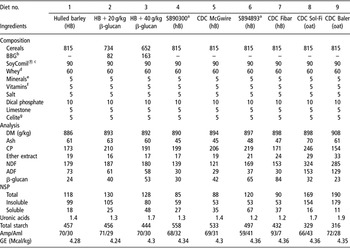
Nine experimental diets were formulated: three diets with hulled barley, supplemented or not with isolated β-glucan concentrate (BBG; isolated by dry fractionation, containing 270 g/kg β-glucan, 170 g/kg CP, 320 g/kg starch, 320 g/kg total dietary fiber, 30 g/kg fat and 20 g/kg ash on dry weight; Parrheim Foods, Saskatoon, SK, Canada), four hulless barley cultivars with β-glucan content from 41 to 84 g/kg and two oat cultivars. Their composition is detailed in Table 1. In the BBG-supplemented diets, 82 g/kg or 163 g/kg (w/w) BBG, containing 270 g/kg β-glucan, was added at the expense of hulled barley. The diet was offered in mash form (110 g/kg BW0.75) for 60 min twice daily (0800 and 1600 h) for 15 days and residuals were collected subsequently and stored at −20°C.
Slaughtering and sample collection
After an adaptation period of 12 days to individual cages, fecal samples were collected over three consecutive days. On day 16, exactly 4 h after the last meal, pigs were killed by captive bolt and exsanguination. After killing, the abdomen was opened and the GIT was removed. Digesta samples from the ileum (last quarter of the small intestine, defined as ileum) and the colon (medial colon, 20 cm) were collected and homogenized on ice. The pH of digesta contents was measured immediately by using a digital pH-meter (SymPHony, VWR, Westchester, PA, USA). Aliquots for SCFA, LA and ammonia analyses were snap frozen and stored at −80°C until analysis. Residual digesta were frozen in containers for subsequent analysis of nutrients and acid-insoluble ash (AIA).
Analyses and calculations
Proximate nutrients
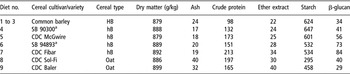
All the ingredients, diets, ileal and fecal samples were ground with a laboratory mill (Restch Mill ZM1, Newton, PA, USA) to pass through a 1-mm screen and chemical analyses were performed according to the Association of Official Analytical Chemists standard procedures (AOAC, 2007) with specific methods as follows: dry matter (DM; AOAC 930.15, using drying oven, Fisher Scientific Company, Ottawa, ON, Canada), nitrogen (N; AOAC 968.06 using an elemental analyzer; LECO FP528, St Joseph, MI, USA; CP = N × 6.25), ether extract (AOAC 920.39 using Soxhlet apparatus (Labconco Corporation, Kansas City, MO, USA) and petroleum ether), ash (AOAC 942.05), ADF (AOAC 973.18), NDF (AOAC 2002.04) and gross energy (GE; PARR 1281 calorimeter, Meline, IL, USA). The composition of the ingredients and diets is presented in Tables 1 and 2, respectively.
Chemical composition (g/kg dry matter) of the barley and oat varieties

HB = hulled barley, hB = hulless barley; CDC = Crop Development Centre.
aBreeding lines (CDC, University of Saskatchewan).
Composition and chemical analysis (g/kg dry matter) of experimental diets

HB = hulled barley; hB = hulless barley; BBG = isolated barley mixed-linked β-glucan concentrate; CDC = Crop Development Centre; DM = dry matter; NSP = non-starch polysaccharides; Amp/Aml = amylopectin and amylose ratio (%) of total starch; GE = gross energy.
aBreeding lines (CDC, University of Saskatchewan).
bIsolated barley β-glucan concentrate, containing 270 g/kg β-glucan, 170 g/kg CP, 320 g/kg starch, 320 g/kg total dietary fiber, maximum 30 g/kg fat and maximum 30 g/kg ash on dry weight basis (Parrheim Foods, Saskatoon, SK, Canada).
cSoyComil® (CP, 650 g/kg, DM, 930 g/kg) – Archer Daniels Midland (ADM) specialty ingredients (Europe) BV, PO Box 2 1540 AA, Koog aan de Zaan, The Netherlands.
dCrino whey powder (CP, 90 g/kg; lactose, 800 g/kg; DM, 920 g/kg; Ash, 120 g/kg) – Agropur Co-operative Granby, Quebec, Canada.
eMineral premix – providing (per kilogram of diet) Zn, 100 mg as zinc sulphate; Fe, 80 mg as ferrous sulphate; Cu, 50 mg as copper sulphate; Mn, 25 mg as manganous sulphate; I, 0.50 mg as calcium iodate; Se, 0.10 mg as sodium selenite.
fVitamin premix – providing (per kilogram of diet), vitamin A, 8250 IU; vitamin D3 825 IU; vitamin E, 40 IU; niacin, 35 mg; d-pantothenic acid, 15 mg; 5 mg; menadione, 4 mg; folacin, 2 mg; thiamine, 1 mg; d-biotin, 0.2 mg; vitamin B12, 25 μg.
gCelite 545, Celite Corporation, Lompoc, CA, USA.
Carbohydrate composition
All the ingredients, diets and ileal and fecal samples were ground to pass through a 0.5-mm mesh screen with a laboratory mill (Restch Mill ZM1) for β-glucan, total starch and NSP analysis. Commercial test kits (Megazyme International Ltd, Bray, Co. Wicklow, Ireland) were used to determine mixed-linked β-glucan content (AOAC 995.16), total starch (AOAC 996.11) and amylose/amylopectin ratio (Yun and Matheson, Reference Yun and Matheson1990). NSPs, based on individual monomer contents, were analyzed by gas chromatography (GC) after hydrolysis of total and insoluble fractions with 12 M H2SO4, as described by Englyst et al. (Reference Englyst, Quigley and Hudson1994). GC analysis was carried out using a GC system (Agilent 6890 system, Agilent Technologies Inc., Waldbron, Germany) equipped with a flame ionization detector (FID) and fused-silica capillary column (DB-17 HT, Agilent Technologies, Wilmington, DE, USA), using 2-deoxy-d-glucose as the internal standard.
Fermentation metabolites in intestinal contents
The SCFA and LA of the ileal and colon samples were analyzed using a GC (Agilent 6890 system) fitted with a FID and fused-silica capillary column (ZB-FFAP, Phenomenex, Torrance, CA, USA), using crotonic acid as the internal standard. Branched-chain fatty acids (BCFAs) were calculated as the sum of isobutyric and isovaleric acids. Ammonia concentration was determined as described by Novozamsky et al. (Reference Novozamsky, van Eck, van Schouwenburg and Walinga1974) with slight modifications. Briefly, ammonia was oxidized by sodium hypochloride in the presence of sodium nitroprusside and the resulting complex was measured at 600 nm using a spectrophotometer (Pharmacia LKB – Ultraspec III; Amersham, Freiburg, Germany).
Nutrient digestibility
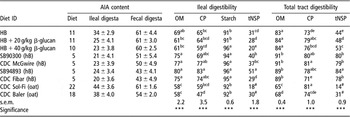
Nutrients (DM, ash, CP, starch and NSP) in the ileal, colonic and fecal contents were analyzed as described above. For determination of ileal and fecal starch and NSP content, two samples of the same treatment, but from consecutive replicates were pooled resulting in four samples per treatment. The diets and the ileal and fecal digesta were analyzed for their AIA content by gravimetry, after treatment with 3N HCl (AOAC 971.33). The results are presented in Table 3.
Acid-insoluble ash content of diets and digesta samples (g/kg dry matter, mean ± s.d.) and ileal and total tract digestibility (%) of different nutrients in pigs fed diets containing different barley and oat cultivars

AIA = acid-insoluble ash; HB = hulled barley; hB = hulless barley; OM = organic matter; tNSP = total non-starch polysaccharides; CDC = Crop Development Centre.
Removed from the pool for statistical analysis.
*Mean values with different superscript letters within column are significantly different (P < 0.05).
The ileal and fecal apparent digestibility (AD) of the different nutrients were calculated for each pig based on the correction of the AIA content, using the equation:

where IAd and IAf are the AIA contents in the diets and feces, respectively, and Nd and Nf are the nutrient contents in the diets and feces, respectively.
Statistical analysis
Data were analyzed using the mixed model procedure of SAS 9.1 software (SAS, 2003) using ‘diet’ as the main effect and with the statistical model:

where Y is the parameter to be tested, μ is the overall mean, αi is the effect of diet and εij is the experimental error. Means were separated using the Tukey method. An α level of 0.05 was used to assess significant differences between means, unless otherwise stated.
Results
All piglets remained healthy throughout the experiment. Daily feed intake and weight gain (data not shown) were similar to pigs of similar age and fed a commercial diet. There was no effect (P > 0.05) of either cereal type or variety on these parameters. The DM content of the colonic digesta (data not shown) was higher (P < 0.05) in pigs fed oat.
Digestibility
All digestibility coefficients were affected by cereal type, both at ileal and total tract levels (P < 0.05, Table 3). Ileal organic matter (OM) digestibility was higher (P < 0.05) for diets based on hulless barley, as compared with hulled barley and oat, but without any difference (P > 0.05) within cereal types. Similar trends were found for total tract OM digestibility. Ileal CP digestibility was the highest for diets based on hulless barley, followed by those based on hulled barley and oat. On the contrary, the total tract CP digestibility was lower (P < 0.001) with diets containing the CDC Fibar hulless barley. Hulless barley starch was more completely digested (P < 0.05) than that of hulled barley and oat. Ileal digestibility of total NSP (tNSP) decreased when β-glucan content increased in hulless barley diets, with the exception of the SB94893 barley. Similar trends were noted for diets supplemented with BBG. tNSP digestibility for hulless barley was also higher (P < 0.001) than that of hulled barley. There was a negative flow of NSP in the lower gut of the pigs fed oat. Therefore, it was decided to remove the results of the oat diets from the statistical analysis for tNSP digestibility (as indicated in Table 3) to improve the accuracy of the comparison between barley cultivars.
Fermentation metabolites and pH in intestinal contents
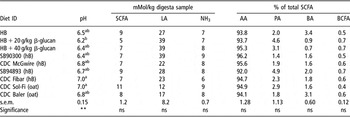
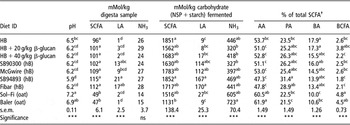
The absolute values of fermentation metabolites are presented in Tables 4 and 5. In addition, as carbohydrates (NSP and starch) are the main sources of fermentation in the large intestine, the relative amount of metabolites per gram of fermented carbohydrates was calculated. The pH values of the intestinal contents were, in general, influenced by fermentation metabolite concentration in the gut segments, but not in a direct manner (Tables 4 and 5). The pH of the ileal content of the pigs fed with CDC Fibar hulless barley was higher than that of the pigs fed the other diets (P < 0.05). The pH of the colonic digesta of the pigs fed oat was higher (P < 0.05) than that of the pigs fed with hulless barley. There was no dietary effect (P > 0.05) on the ileal SCFA content, whereas in the colon, SCFA concentrations were lower in pigs fed oat-based diets. The LA concentration was higher (P < 0.001) in the colon of pigs fed hulless barley, as compared with the other cereal types. Among hulless barley cultivars, the LA concentration was higher for the SB94893 cultivar, which has a high sNSP content, followed by the high β-glucan cultivar CDC Fibar. The ammonia concentration, calculated per kilogram fermented carbohydrate, was lower in the colonic content of pigs fed 82 g/kg BBG or the SB90300 hB cultivar and higher for the oat-based diets. However, when expressed per kilogram digesta sample, neither the ammonia concentration nor the SCFA/ammonia ratio (data not shown) was different (P > 0.05) at the ileum or colon level. No dietary effect (P > 0.05) was detected for the proportion of the individual SCFA in ileal contents. Pigs fed oat with low sNSP content had higher acetic and lower butyric acid concentration in the colon. On the other hand, higher propionic and lower BCFA levels were found for diets containing SB94893, the hulless barley cultivar with high sNSP content.
pH and fermentation metabolites in the ileal digesta of pigs fed diets containing different barley and oat cultivars

HB = hulled barley; hB = hulless barley; SCFA = short-chain fatty acids; LA = lactic acid; NH3 = ammonia; AA = acetic acid; PA = propionic acid; BA = butyric acid; BCFA = branched-chain fatty acids (sum of isobutyric and isovaleric acids); CDC = Crop Development Centre; ns = non-significant.
*Mean values with different superscript letters within column are significantly different (P < 0.05).
pH and fermentation metabolites in the colonic digesta of pigs fed diets containing different barley and oat cultivars

HB = hulled barley; hB = hulless barley; SCFA = short-chain fatty acids; LA = lactic acid; NH3 = ammonia; AA = acetic acid; PA = propionic acid; BA = butyric acid; BCFA = branched-chain fatty acids (sum of isobutyric and isovaleric acids); NSP = non-starch polysaccharides; ns = non-significant.
*Mean values with different superscript letters within column are significantly different (P < 0.05).
†Based on mMol/kg digesta sample.
Discussion
This study was aimed at evaluating the effect of differential carbohydrate composition in barley and oat cultivars on ileal and total tract nutrient digestibility and intestinal fermentation activity in weaned pigs. Overall, differences in digestibility and fermentation activity can be explained by differences in chemical composition of the cereals used in the diets. The lower OM and starch digestibility of the hulled barleys and oats was likely due to greater insoluble fiber content, which negatively affects accessibility and the action of endogenous enzymes required for insoluble fiber digestion in the upper gut and microbial fermentation in the lower gut (Bach Knudsen, Reference Bach Knudsen2001). Higher ileal CP digestibility in the SB94893 barley cultivar and lower CP total tract digestibility of the CDC Fibar barley cultivar could be explained by the CP and sNSP content in the respective diets. This interaction might be not only due to the negative effect of sNSP on the digestive processes, but also due to an increase in endogenous N excretion, which causes decreased apparent protein digestibility (de Lange et al., Reference de Lange, Sauer, Mosenthin and Souffrant1989; Leterme et al., Reference Leterme, Souffrant and Thewis2000). In this study, there was considerable variation in total tract digestibility of tNSP within and between hulled and hulless barley cultivars due to differences in their physical structure and chemical composition. Variation in NSP digestibility can also be explained by the lignin content since the latter is neither digested nor fermented and prevents digestion (Van Soest, Reference Van Soest1985). Lignin was not analyzed here, but variation in lignin content in barley cultivars has been reported (Oscarsson et al., Reference Oscarsson, Andersson, Salomonsson and Åman1996; Bhatty, Reference Bhatty1999), and its presence negatively affected NSP disappearance in the pig intestines (Stanogias and Pearce, Reference Stanogias and Pearce1985).
The results of this study confirm the initial hypothesis that variation in NSP composition of the cereals has similar, if not greater, effect on digestion and fiber fermentation than the addition of isolated NSP (Topping, Reference Topping2007). Within the hulless barley group, the tNSP content varied from 85 to 120 g/kg with β-glucan content ranging from 30 to 84 g/kg (Table 2). This obviously affected ileal digestibility and colonic fermentation (Tables 3 and 5).
The addition of isolated β-glucan also had a significant influence, but the specific effect of β-glucan cannot be definitely clarified from these results, as the concentrate used here (BBG) contained only 270 g/kg pure β-glucan. Diets 2 and 3 thus contained approximately 20 and 40 g/kg pure β-glucan, respectively, and this might have been insufficient to affect the digestive and fermentative processes. The remaining portion of the BBG contained significant amounts of starch and total dietary fiber (320 g/kg each), but the nature of latter was not characterized during this study and its contribution in the fermentation process was not determined. Differences in total SCFA, LA and ammonia produced per kilogram carbohydrate (Tables 4 and 5) are thus ascribable to differences in the type and form of NSP and starch molecules (amylase/amylopectin ratio). This is consistent with other studies (Bach Knudsen and Canibe, Reference Bach Knudsen and Canibe2000; Dongowski et al., Reference Dongowski, Huth, Gebhardt and Flamme2002). Only slight differences were found between the diets containing 20 to 40 g/kg β-glucan content in this study as well as in the companion study (Pieper et al., Reference Pieper, Jha, Rossnagel, Van Kessel, Souffrant and Leterme2008).
Supplementation of a diet with isolated dietary fiber normally results in the increased fermentation-end products (Awati et al., Reference Awati, Williams, Bosch, Gerrits and Verstegen2006) and beneficial microbiota (Bouhnik et al., Reference Bouhnik, Raskine, Simoneau, Vicaut, Neut, Flourié, Brouns and Bornet2004). However, inconsistent effects on metabolite concentrations for cereals supplement with isolated BBG or with high NSP and β-glucan content diets were found in this study. This can be attributed to the complex fermentation process in vivo, which is affected not only by the substrate available for fermentation in the gut, but also by the host, its microbiota and interactions between them (Williams et al., Reference Williams, Bosch, Awati, Konstantinov, Smidt, Akkermans, Verstegen and Tamminga2005). SCFAs, which are basically the fermentation products of carbohydrates (Bach Knudsen et al., Reference Bach Knudsen, Jensen and Hansen1993a), did not show concentration variation among treatments at the ileum, whereas in the colon, SCFA concentration was markedly lower in pigs fed oat, a cereal with higher insoluble NSP (iNSP) content. This can be explained by the fermentation characteristics of the fiber fraction, as lignified and insoluble fibers, in general, are less fermentable than soluble fibers (Bach Knudsen and Hansen, Reference Bach Knudsen and Hansen1991). On the other hand, a higher variability and inconsistent results were obtained in relation to tNSP and β-glucan content of the diets and resulting fermentation-end products. Similar results were reported by Pluske et al. (Reference Pluske, Black, Pethick, Mullan and Hampson2003) studying different DF sources in pig diets. According to Laerke et al. (Reference Laerke, Hedemann, Bach Knudsen, Laurinen, Lindberg and Pedersen2007), the change and variation in microbial population in the pig intestines is not specifically limited to dietary composition, which in turn affect the fermentation process in the gut. Moreover, in the dynamic in vivo system, absorption of the SCFA produced in the large intestine is an ongoing process with varying rates; it is not only affected by the diet composition, but also by the host, the microbiota and their interaction in the gut (Macfarlane and Macfarlane, Reference Macfarlane and Macfarlane2003).
LA is the predominant fermentation-end product in the terminal small intestine of weanling pigs, most likely due to the predominance of lactobacilli at this site (Pieper et al., Reference Pieper, Jha, Rossnagel, Van Kessel, Souffrant and Leterme2008). Although not statistically significant, there was more LA in the ileal contents of pigs fed diets supplemented with BBG as compared with those fed with high β-glucan hulless barleys, suggesting higher activity of LA bacteria. This is supported by the result of the companion study (Pieper et al., Reference Pieper, Jha, Rossnagel, Van Kessel, Souffrant and Leterme2008) in which higher numbers of lactobacilli were found in the small intestine of pigs fed hulled barley diets supplemented with BBG isolates. Moreover, it has previously been shown that significant amounts of soluble β-glucan are already fermented in the upper GIT (Johansen et al., Reference Johansen, Bach Knudsen, Wood and Fulcher1997). In the large intestine, LA is metabolized to SCFA, mainly to n-butyrate by cross feeding between bacterial species in the gut ecosystem (Flint et al., Reference Flint, Bayer, Rincon, Lamed and White2008). Among different dietary treatments, higher concentrations of LA and n-butyrate were found in the colon of pigs fed hulless barleys SB94893 and CDC Fibar, which confirms higher flow rates and colonic fermentation of sNSP and β-glucan trapped within the grain matrix. Individual SCFAs in the ileum were not affected by dietary treatment, which is in agreement with the lack of bacterial diversity observed in the companion study (Pieper et al., Reference Pieper, Jha, Rossnagel, Van Kessel, Souffrant and Leterme2008). This can be partially ascribed to the high starch digestibility in the small intestine of pigs in all diets.
Differences in the proportion of individual SCFA reflect the amount and type of substrate fermented and microbial diversity present in the gut. In this study, the oat-based diets contained more iNSP, which increase the passage rate of digesta and provide less available substrate for microbiota fermentation, thus resulting in more acetic and less butyric acid in the colon. The reverse scenario explains the higher ratio of propionic acid found in pigs fed hulless barley (breeding line SB94893), which contained more sNSP. In addition, cross feeding between species might have some influence, such as the metabolism of lactic to propionic acid (Flint et al., Reference Flint, Bayer, Rincon, Lamed and White2008). According to Macfarlane and Macfarlane (Reference Macfarlane and Macfarlane2003), there is greater propionic and butyric acid, whereas acetic acid decreases considerably in the presence of diverse microbiota and high substrate availability. Ammonia and BCFA are the products of protein fermentation, which increases when the level of carbohydrate for fermentation decreases (Macfarlane et al., Reference Macfarlane, Gibson, Beatty and Cummings1992). Differences in ammonia concentration, expressed per kilogram fermented tNSP, and the absence of dietary effect on the ratio of SCFA and ammonia, either in the ileum or in the colon, again support the hypothesis that both the amount of NSP and the matrix affect fermentation.
Two oat cultivars were included in thisstudy as references for their high-insoluble fiber content. The reason for the negative digestibility of NSP of some diets is unclear. Other authors have made similar observations (Bach Knudsen et al., Reference Bach Knudsen, Jensen and Hansen1993a and Reference Bach Knudsen, Jensen and Hansen1993b). This is to be ascribed to methodological problems related to the collection of ileal samples (slaughter method), the use of AIA as a marker (Van Leeuwen et al., Reference Van Leeuwen, Veldman, Boisen, Deuring, Van Kempen, Derksen, Verstegen and Schaafsma1996) and the analysis of NSP in a complex matrix.
There was no linear effect of β-glucan concentration, neither in isolated form nor in the matrix, which corroborates earlier observations on gut microbiota in the companion study (Pieper et al., Reference Pieper, Jha, Rossnagel, Van Kessel, Souffrant and Leterme2008). For most of the parameters, the response was also higher when β-glucan was embedded in a matrix. It might be explained by the dose–response pattern of utilization of the β-glucan by the gut microbiota (Bach Knudsen et al., Reference Bach Knudsen, Laerke and Jorgensen2008). Moreover, digesta viscosity is affected by the concentration and molecular weight of β-glucan (Gómez et al., Reference Gómez, Navarro, Manzanares, Horta and Carbonell1997), which ultimately affects the physiological effects of β-glucan in the GI tract. Finally, the presence of lactose in the experimental diets may have affected β-glucan utilization, as lactose has a negative effect on the utilization of β-glucan (Lynch et al., Reference Lynch, Callan and O’Doherty2008).
Conclusion
In conclusion, both the ileal and total tract nutrient digestibility of starch and NSP were greater in pigs fed hulless barleys than in pigs receiving hulled barleys or oats, and the difference is likely due to differences in sNSP and amylose content. Similar patterns were found for fermentation metabolites in the large intestine, but with, in general, higher SCFA and LA for hulless barley-based diets than those based on hulled barleys or oats. However, there was no marked effect of β-glucan level, either in isolated form or in the cereal matrix. This study gives a broader view on the positive effects of β-glucan and resistant starch embedded in the matrix of specialty hulless barleys for the pig’s gut health.
Acknowledgments
We express our thanks to the National Pork Board (project no. 06-117) and Alberta Barley Commission (project no. 60-192) for funding this study. The continuing core support of the Prairie Swine Centre received from Sask Pork, Manitoba Pork Council, Alberta Pork and the Saskatchewan Agriculture Development Fund is gratefully acknowledged. We also thank ‘Parrheim Foods, SK, Canada’ for the supply of the isolated barley β-glucan concentrate and financial support. Thanks to the technical staff of the Prairie Swine Centre Inc. and the Department of Animal and Poultry Science at the University of Saskatchewan for their help provided during experiment, especially Pam Kish for her help during laboratory analysis works.