I. INTRODUCTION
Over the decade since the inception of click chemistry, this series of reactions has grown substantially. Cu(I)-catalyzed 1,3-dipolar cycloaddition between an organic azide and a terminal alkyne is the most important reaction in this family because of its simplicity, reliability, and stereospecificity.Reference Kolb, Finn and Sharpless1 Surface scientists have recognized the click reaction as a powerful tool for binding the linkages onto a surface. Clickable materials, species with click reaction capability, should contain the azide or alkyne groups. In this way, clickable polymers have been prepared using an acetylene-containing monomer.Reference Sinha, Sahoo and Kumar2 The click reaction was also used for the modification of block copolymersReference Fleischmann, Komber and Voit3 and cylindrical brush polymers.Reference Sun, Hu, Liu, Xiao, He and Lu4 In addition, click reaction is suitable for the functionalization of metal nanoparticles,Reference Gole and Murphy5 silicon wafer,Reference Haensch, Hoeppener and Schubert6 silicon rugate filters,Reference Ciampi, Böcking, Kilian, Harper and Gooding7 and porous silica surfaces.Reference Schlossbauer, Schaffert, Kecht, Wagner and Bein8, Reference Gallant, Lavery, Amis and Becker9
Recently, some significant researches on clickable mesoporous silica have been reported in the literatures. For example, grafting of monosaccharides on the surface of ordered mesoporous silica,Reference Huang, Dolai, Raja and Kruk10 immobilization of pincer catalysts on high pore volume, low surface area silica materials,Reference McDonald, Dijkstra, Suijkerbuijk, van Klink and Koten11 and bi-functionalization of porous silicon rugate filters for biosensing applications.Reference Guan, Ciampi, Saux, Gaus and Gooding12 Clickable mesoporous silica is a suitable target for functionalization by biomolecules such as enzymes because of its very high grafting yield.Reference Schlossbauer, Schaffert, Kecht, Wagner and Bein8
Currently, immobilization of ionic liquids onto the organic and inorganic supports such as polymers, carbon nanotubes, silica, and alumina has attracted attention for different applications in catalysis,Reference Hagiwara and Ito13–Reference Olivier-Bourbigou and Magna17 extraction,Reference Welton18, Reference Huddleston, Visser, Reichert, Willauer, Broker and Rogers19 and also in solar cells.Reference Gorlov and Kloo20 Alkyl imidazolium cation is a common commercially available ionic liquid. Modification of TiO2 nanoparticles,Reference Kato, Kado, Tanaka, Okazaki and Hayase21 nanocomposites,Reference Gorlov and Kloo20 and MCM-41Reference Trewyn, Whitman and Lin22 using this cation has also been reported. Among functionalization methods, ionic liquids have not been immobilized on the silica surface via click reaction. The importance of click chemistry in supported materials is not only because of anchoring an arbitrary species onto the surface but also because of the triazole ring formed during this reaction which often improves properties such as adsorption capacity and surface hydrophobicity. In this work, first we synthesized 3-ethynyl-1-methylimidazole and then immobilized this ionic liquid on the surface via clicking on the clickable nanoporous surface. Finally, we show the adsorption potential of this supported ionic liquid against anionic pollutant pigments such as sodium 5-amino-4-hydroxy-7-sulfonaphthalene-2-sulfonate (H-acid).Reference Hunger23, Reference Kirk-Othmer24
II. EXPERIMENTAL
A. Materials
Pluronic P123 triblock copolymer was purchased from Aldrich (London, UK). Tetraethyl orthosilicate, (3-chloropropyl) trimethoxysilane, sodium 5-amino-4-hydroxy-7-sulfonaphthalene-2-sulfonate, trimethylchlorosilane (TMS), hexamethyldisiloxane (HMDS), 1-methylimidazol, propargyl bromide, sodium azide, and solvents were obtained from Merck (Frankfurt, Germany). All solvents were dried according to the standard purification methods.Reference Armarego and Perrin25
B. Instruments
Small angle x-ray scattering spectra were recorded by SAXS spectrometer, Hecus S3-MICROpix, (Graz, Austria, X516 /8910-980) equipped with a one-dimensional PSD detector using Cu Kα radiation over a range of 0.5–10° 2θ. The textural properties of the nanoporous materials were obtained from N2 adsorption isotherms at 77 K on the BELSORP Mini (Toyonaka-city, Japan). Brunauer-Emmett-Teller (BET) surface areas were determined from recorded adsorption data in the range 0.05 ≤ P/P0 ≤ 0.3, while the pore volume and pore-size distribution were determined by the Barrett–Joyner–Halenda (BJH) method.Reference Barrett, Joyner and Halenda26 Fourier transform infrared spectroscopy (FTIR) spectra were recorded with EQUINOX 55BRUKER model FTIR spectrophotometer (Ettlingen, Germany). The thermal gravimetric analysis (TGA) measurement was performed on TA Q50 instrument in the temperature range from 293 to 1120 K with heating rate of 10 K/min in a stream of N2. Elemental analysis was carried out on a Perkin Elmer 2400 series 2 instrument (Waltham, MA). All fluorescence measurements were carried out on a Perkin-Elmer LS50B luminescence spectrometer.
C. Synthesis of SBA-15
SBA-15 was prepared according to literature procedures.Reference Zhao, Huo, Feng, Chmelka and Stucky27, Reference Javanbakht, Divsar, Badiei, Fatollahi, Khaniani, Ganjali, Norouzi, Chaloosi and Mohammadi Ziarani28
D. Synthesis of chloro-functionalized SBA-15
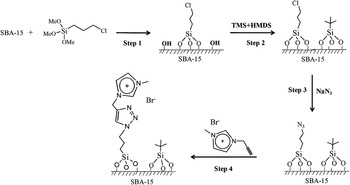
Calcinated SBA-15 was dried at 373 K under vacuum for 3 h. The organosilane (3-chloropropyl) trimethoxysilane (16 mL) was added to a suspension of 10 g of the dried SBA-15 in 50 mL of dried toluene, and the mixture was refluxed for 4 h. The contents were filtered and washed with toluene, methanol, and water. The resulting white powder was named SBA-Cl (Fig. 1, step 1).
Preparation of clickable SBA-15 (steps 1–3) click reaction (step 4).

E. Capping of SBA-Cl
SBA-Cl (3 g) was silylated by refluxing with organochlorosilanes in the absence of water. SBA-Cl and a mixture of TMS (18 mL) with HMDS (11 mL) were dissolved in dehydrated toluene. The mixed solution was refluxed for 24 h under nitrogen atmosphere. Then, the capped SBA-Cl was separated, washed with toluene to remove the excess silanes, and dried at 323 K (Fig. 1, step 2).
F. Synthesis of azido-functionalized SBA-15
Two grams of capped SBA-Cl in 100 mL saturated solution of NaN3 in dimethylformamide (DMF) was stirred for 8 h at 363 K. After completion of the reaction, the contents were cooled, filtered, and washed with DMF. The product was called SBA-N3 (Fig. 1, step 3).
G. Synthesis of 3-ethynyl-1-methylimidazole
Into a 100 mL flask, 1-methylimidazol (1 g), propargyl bromide (1.9 mL), and acetone (50 mL) were added. The mixture was refluxed for 24 h. After removing of the solvent on a rotary evaporator, a dark-red viscous liquid was obtained. 13C NMR (DMSO, δ, ppm): 36.6 (–CH3), 39.1(–CH2–), 76.4 (≡CH), 79.4 (≡C–), 122.4–124.4–136.9 (ring carbons). FTIR (cm−1): 2122 (≡CH), 3414–3073 (C≡C).
H. Click reaction
Into a suspension of capped SBA-N3 (0.5 g) in ethanol (100 mL), 3-ethynyl-1-methylimidazole (0.8 g), copper(II) sulfate (0.05 g), and sodium ascorbate (0.8 g) in ethanol were added. The mixture was heated to 333 K for 1–3 min to better dissolve the reagents. After stirring for 24 h at room temperature, the resulting yellow precipitation was filtered, washed with water/ethanol and ethanol, and dried in air. This product was called SBA-click (Fig. 1, step 4).
III. RESULTS AND DISCUSSION
A. X-ray diffraction patterns
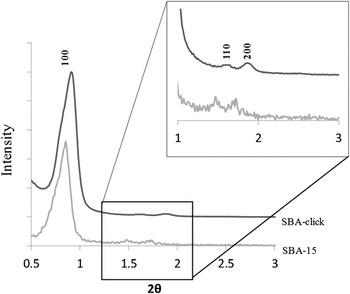
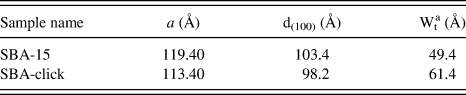
The low-angle x-ray diffraction (XRD) spectra of SBA-15 before and after click reaction are shown in Fig. 2. The as-synthesized SBA-15 sample exhibits a single strong peak in the XRD pattern followed by two additional peaks which are assigned to the (100), (110), and (200) reflections of a hexagonal lattice.Reference Zhao, Feng, Huo, Melosh, Fredrickson, Chmelka and Stucky29 After calcination and anchoring the organic species on its surface, the SBA-click sample displays the same reflections with a small peak shift to the high angles. This observation indicates that the hexagonal structure of the SBA-15 is maintained without any pore wall collapse during the four reaction steps. The small change of the lattice constant, a, can be due to the calcination. The larger wall thickness of the SBA-click sample is consistent with grafting the organic groups onto the pore walls within the porous network (Table I). It should be noted that the SBA-15 sample investigated by XRD was as-synthesized, containing the template and consequently showed less intense peaks with higher noise level.Reference Hamad, Alshebani, Pera-Titus, Wang, Torres, Albela, Bonneviot, Miachon and Dalmon30
X-ray diffraction pattern of SBA-15 before and after the click reaction.

Samples investigated by x-ray diffraction.
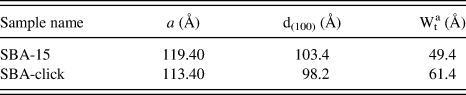
a Wall thickness = a – pore diameter. Pore diameter was obtained from BET data, see Table II.
B. Scanning electron microscopy
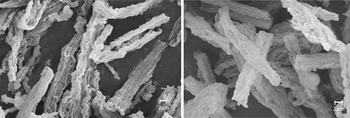
Figure 3 illustrates the scanning electron microscopic images of the initial SBA-15 sample and the click product at the end of four reaction steps. SBA-15 particles after the modification process have a similar morphology to the initial SBA-15. These images, in concert with XRD results, reveal that the structure is preserved.
Scanning electron microscopic images of SBA-15 (left) and SBA-click (right).

C. N2 adsorption–desorption analysis
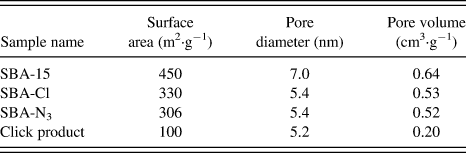
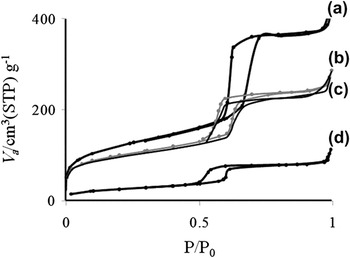
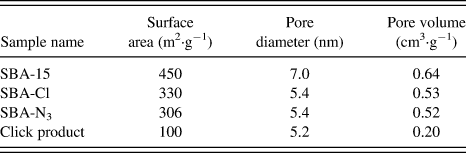
Figure 4 shows the nitrogen adsorption–desorption isotherms of the samples: SBA-15 to click product at 77 K. All of isotherms exhibit the hysteresis loop type IV, which is the characteristic of a mesoporous structure with accessible cylindrical pores. These results indicate that the mesostructure is preserved during the surface modification. These adsorption data help us calculate the apparent specific surface area S BET and the contribution of mesopores based on the BET and BJH methods, respectively. The textural parameters are listed in Table II. A considerable decrease in height of the capillary condensation step about the final product (Fig. 4, curve d) is observed with respect to decrease in pore volume and surface area. It can be concluded that functionalization takes place inside the channels.
The textural parameters of samples.
N2 adsorption isotherms at 77 K of (a) calcined SBA-15, (b) SBA-Cl, (c) SBA-N3, and (d) the click product.

D. FTIR measurements
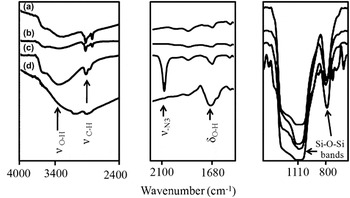
Figure 5 shows the FTIR spectra of functionalized SBA surfaces. All samples show absorbance peaks at 1110 and 800 cm−1. These peaks are typical of Si–O–Si bands that are associated with the silica networks. Spectrum a (Fig. 5) is related to SBA-Cl sample and displays the presence of alkyl chains, through weak peaks at 3020 and 2940 cm−1. The broad peak at 3300 cm−1 is related to –OH stretching of surface hydroxyl groups. Some of these surface silanolates were silylated in capped SBA-Cl sample (Fig. 5, spectrum b). High hydrophobicity of this sample is an evidence on the hydroxyl capping process, which is supported by decreasing of the –OH band intensity in spectrum b. A small peak at about 3740 cm−1 is related to terminal hydroxyls and shows that the capping process is incomplete. Some hydroxyl groups remain on the surface. Spectrum c shows an absorbance at 2100 cm−1, which is characteristic stretching vibration of organic azide and indicates that the azidopropyl group has been successfully incorporated. Regrowth of –OH peak in SBA-N3 can be due to nominal resonance charge on nitrogen atoms of azide group (–N−=N+=N−). The sharp peak at 2100 cm−1 related to azide group is removed in FTIR spectrum of SBA-click sample (Fig. 5, spectrum d). Also, this sample exhibits a large number of water molecules. The wide –OH stretching peak at 3200 cm−1 is larger than this peak in spectrum c, and vibrations at 1600–1700 cm−1 are due to vibrational modes δO–H in H2O molecules. Since the hydroxyl groups on the surface are capped before the reaction, this large number of H2O molecules cannot be the physically adsorbed but embedded onto the surface via ionic interaction with ionic liquid on the pore walls.
Comparative infrared spectra of (a) SBA-Cl, (b) capped SBA-Cl, (c) SBA-N3, and (d) SBA-click.

E. Elemental analysis and TGA measurements
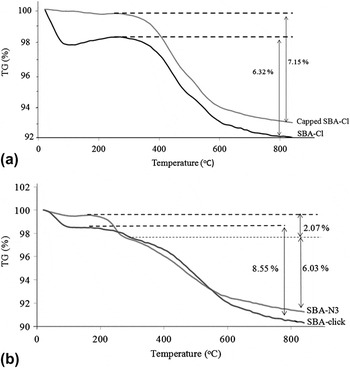
To estimate the amount of immobilized groups on the surface, elemental analysis and TGA were performed. All data are listed in Table III. Thermal analysis curves for samples are shown in Fig. 6. SBA-Cl loses weight between 20 and 90 °C. This event is associated with desorption of water,Reference Jaroniec, Kruk, Jaroniec and Sayari31 which signifies the presence of some free hydroxyl groups on the SBA-Cl surface. Between 90 and 260 °C, the curve is steady. Between 260 and 850 °C, there is a very slow, but continuous, weight loss. The weight loss between 260 and 800 °C is used for the chloropropyl determination. A minor weight loss (about 1%) takes place due to silanol cocondensation at high temperatures (>400 °C).Reference Zhuravlev32
Thermal gravimetric analysis of materials in four steps of reaction.

The elemental analysis results.

a Amount of chloropropyl (mmol/g)=1000 C%/3 × 100 WC.
b Obtained from difference in C% between SBA-Cl and capped SBA-Cl.
c The deviation from capped SBA-Cl C% was attributed to dimethylformamide (DMF) in SBA-N3 sample, so it was corrected to 3.48.
d This value was corrected to 1.34, because of the presence of DMF in this sample.
e Based on C/N molar ratio.
In Fig. 6(a), the TGA curve for the capped SBA-Cl is slightly different, as no weight loss is observed until 300 °C, demonstrating that most of the surface silanolates are capped and there are no physically adsorbed water molecules. The first weight loss at about 435 °C is attributed to the pyrolysis of the chloropropyl group and the next one is assigned to oxidation of the methyl groups. Difference between the mass loss of SBA-Cl and capped SBA-Cl is related to capping functions.
Figure 6(b) displays the TGA curves of SBA-N3 and SBA-click. Since conversion of chloride to azide was carried out in DMF and since this solvent is a high boiling point liquid, an appreciable amount is expected to remain in SBA-N3 sample. Thus, the rapid mass change in SBA-N3 observed between 170 and 300 °C can be associated to DMF loss. The second weight loss at 300–700 °C is related to detachment of azidopropyl chain and trimethyl groups. According to elemental analysis, chloride to azide conversion yield was calculated to be 47% from following formula:

where, W N is the atomic weight of nitrogen.
Based on the elemental analysis of SBA-click sample, the click reaction yield was determined to be about 90%:

Since ionic liquids are naturally hygroscopic materials, free water molecules within the pores observed in infrared spectrum of click product are evidence for the presence of ionic liquid inside the network.
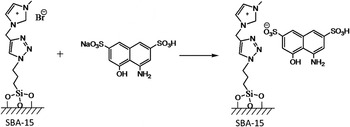
To demonstrate the utility of the ionic liquid, we used H-acid, a water-soluble environmental pollutant to adsorb on SBA-click surface. Figure 7 shows the ion exchange of bromide ion of SBA-click with H-acid in aqueous solution. SBA-click showed a high adsorption capacity for this negative species.
Ion exchange of SBA-click with H-acid.

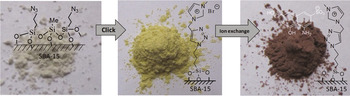
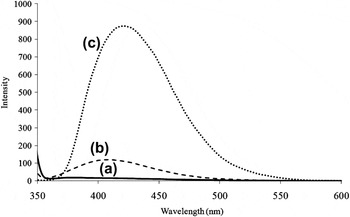
Figure 8 shows photographs of SBA-15 in three steps of the reaction. Discoloring of the sample from bright yellow to brown indicates adsorption of H-acid through imidazol rings on the surface. In view of the photoluminescence emission of H-acid in aqueous solutions, the fluorescence emission spectra of the click product and ion exchanged species with H-acid were recorded in H2O/EtOH solution. Maximum excitation wave length was selected at 337 nm (Fig. 9). Strong fluorescence quenching of H-acid by nitrogen atoms of imidazol and triazol rings illustrates immobilization of H-acid molecule on the surface.
Photographs of SBA-15 (left), SBA-click (middle), and SBA-click-H-acid (right).

The fluorescence emission spectra of (a) SBA-click (0.5 g/L), (b) SBA-click in H-acid (0.5 g/L in 50 ppm), and (c) H-acid (50 ppm) in H2O/EtOH, λ exc = 337 nm.

IV. CONCLUSION
Clickable nanoporous silica surface was processed in three steps: surface functionalization, –OH protection, and azide conversion (up to 47 wt%). 3-ethynyl-1-methylimidazole was synthesized and introduced to this protected clickable surface via click reaction (yield 90%). The results showed that the ionic system was fixed inside the channels without network collapse. As an additional evidence for the formation of an ionic coverage on the surface, the photoluminescence emission quenching of 5-amino-4-hydroxy-7-sulfonaphthalene-2-sulfonate anion in aqueous solutions was observed. SBA-click sample can be used effectively for anion removal from waste water.
ACKNOWLEDGMENT
The authors thank the University of Tehran for the support of this work.