Angina is a condition most commonly caused by coronary artery atherosclerosis with flow-limiting plaques that impede blood flow to the myocardium. Its prevalence in the United Kingdom is estimated to be approximately 700,000 men between 55 and 75 years of age and 400,000 women, with approximately 50,000 new cases per year in men and 40,000 in women (Reference Allender, Peto, Scarborough, Boxer and Rayner1). A recent report estimated that, in the year 2000, the cost of health care that could be directly attributed to angina was £669 million and the largest proportion of this cost was hospital admission, particularly in relation to revascularization procedures (Reference Stewart, Murphy, Walker, McGuire and McMurray24). The cost-effective management of angina in the United Kingdom, therefore, represents an important consideration. The use of enhanced external counterpulsation (EECP) as a treatment for angina is increasing steadily worldwide following reports of sustained benefit (Reference Arora, Chou and Jain3;Reference Lawson, Hui and Soroff15;Reference Lawson, Hui and Zheng16).
EECP is a noninvasive technique used in the treatment of angina to increase blood flow to the heart. Three pairs of pressure cuffs are wrapped around the patient's calves, lower thighs, and upper thighs and are sequentially inflated during diastole. All pressure is released at the onset of systole by simultaneously deflating the cuffs. Sequential compression results in an increase in aortic diastolic pressure, a major determinant of coronary blood flow that occurs predominantly during diastole. Improved diastolic coronary pressure and flow may improve the collateral circulation to ischemic territories, although other effects may contribute to the efficacy of EECP. Rapid deflation during systole reduces aortic pressure and, therefore, left ventricular afterload and consequently myocardial work (Reference Sinvhal, Gowda and Khan23). This may be of importance for patients with heart failure. An EECP treatment course conventionally consists of thirty-five 1-hour sessions over a period of 4 to 7 (can do two sessions per day) weeks (Reference Bonetti, Holmes, Lerman and Barsness5). To date, EECP has been used mainly in patients not suitable for coronary revascularization or in those who have chosen not to undergo revascularization (22;Reference Sinvhal, Gowda and Khan23). In the United Kingdom, the role of EECP has not yet been well defined and is only available in specialized centers (Reference Sinvhal, Gowda and Khan23). The primary goal from this noninvasive therapy is the symptomatic relief of angina symptoms. The sustained long-term maintenance of symptom relief establishes the efficacy of the intervention.
EECP results in upfront costs but the potential quality of life benefits through improved symptoms and long-term relief from symptoms may outweigh the costs when compared with not giving the therapy. There have been no previously published studies in relation to the cost-effectiveness of EECP for angina or heart failure. The National Institute for Health Research (NIHR) Health Technology Assessment (HTA) Program in the United Kingdom identified the use of EECP as an important topic for research to meet the needs of the UK National Health Service (NHS). Our aim was to develop a UK-specific cost-effectiveness model of EECP compared with no treatment as additional therapy to usual care for the treatment of chronic stable angina. The full report for the HTA can be found in McKenna et al. (2009) (Reference McKenna, McDaid and Suekarran17).
METHODS
Overview
A probabilistic decision analytic model was developed to assess the cost-effectiveness of EECP in the UK NHS. A systematic review was conducted to obtain effectiveness evidence from randomized control trials (RCTs) (Reference McKenna, McDaid and Suekarran17). The model provides a framework for the synthesis of evidence identified from the review and the elicitation of unknown parameters from experts. The model considers the potential long-term costs and benefits associated with the outcome of improvement in health-related quality of life (HRQoL) from EECP.
The model evaluates costs from the perspective of the National Health Service and Personal Social Services (NHS & PSS), expressed in UK £ sterling at a 2008 price base. Outcomes in the model were expressed in terms of quality-adjusted life-years (QALYs), with costs and benefits discounted at 3.5 percent per year (19).
Treatment Strategies and Population
The decision model evaluates the cost-effectiveness of EECP in adults with chronic stable angina. It evaluates a strategy of EECP treatment compared with no treatment on the assumption that angina patients would receive EECP treatment over and above standard current clinical practice care. This is consistent with the one RCT (MUST-EECP trial) assessing EECP in angina, which compares EECP treatment with sham-EECP (Reference Arora, Chou and Jain3). The base–case population in the model relates to the baseline characteristics of this trial population, under the assumption that this population is representative of angina patients typically presenting for EECP in the current clinical setting.
Model Structure
The decision model is structured to capture the HRQoL benefits and costs associated with the treatment strategies up to a period of 12 months, and to project the health related benefits beyond this 1-year period to a lifetime time horizon. Given that there is no evidence to suggest that EECP treatment compared with placebo has a differential impact on the risk of experiencing nonfatal-cardiovascular disease (CVD) events and death, it is assumed that the benefits of EECP are purely palliative. The model incorporates the risk of CVD events and death to keep track of the number of patients alive who could potentially benefit from QOL improvements, but because there is no differential impact on total costs and benefits between the treatment strategies due to CVD events, the estimate of cost-effectiveness is not affected by these events.
In the first year after EECP treatment, patients are assumed to achieve, on average, the HRQoL benefits reported in the 12-month follow-up of the MUST-EECP trial (Reference Arora, Chou and Jain4). A Markov state transition model (Reference Briggs, Claxton and Sculpher6) (Supplementary Figure 1, which is available at www.journals.cambridge.org/thc2010015) was developed based on the likelihood of sustaining HRQoL benefits over time. Three health states were defined as “Responders,” “Nonresponders,” and “Dead.” The “Responders” state represents patients who sustain HRQoL benefits from EECP. The “Nonresponders” state represents patients who lose initial HRQoL benefits from EECP. The “Dead” state incorporates death from cardiovascular causes and from other causes. Given that patients, on average, achieve the HRQoL benefits reported in the MUST-EECP trial at the end of the first year, patients in the second year either continue to sustain the 1-year HRQoL benefits and will move to the “Responders” state, or they will lose the benefits by falling back to baseline HRQoL and entering the “Nonresponders” state. Consideration was given to adding an additional state representing partial responders, that is, those patients who partially sustain HRQoL benefits, where their HRQoL is better than baseline but worse than 12 months after EECP. However, due to a lack of any evidence to populate this transition, or to determine the HRQoL of these patients, it was excluded from the model. In the third and subsequent years, responders to EECP in the previous year will either continue to sustain their HRQoL benefits or enter the “Nonresponders” state. Recovery of response in each year was possible if patients received repeat top-up procedures. All patients in the model face a risk of cardiovascular events, which eventually lead to death, and are deemed to be at a competing risk of a noncardiovascular death.
Model Inputs
Clinical Effectiveness. The systematic review identified only one RCT (the MUST-EECP trial) comparing EECP with an alternative treatment strategy (Reference Arora, Chou and Jain3;Reference Arora, Chou and Jain4). Full details of the systematic review undertaken and quality assessment of the identified studies are reported elsewhere (Reference McKenna, McDaid and Suekarran17). The one identified RCT on EECP was considered to be of good quality. A total of 139 participants were randomized: 72 to active-EECP and 67 to inactive-EECP. Of the participants in the active-EECP arm, thirteen withdrew during follow-up mainly due to adverse events, while only two withdrew from the inactive-EECP arm (Reference Arora, Chou and Jain3). All aspects of clinical effectiveness reported in this trial were considered for inclusion in the cost-effectiveness model including (i) exercise treadmill duration; (ii) time to ≥1 mm ST-segment depression; (iii) angina counts; (iv) nitroglycerin use; and (v) HRQoL. Despite additional searches, no evidence was available to link the four intermediate outcomes to final health outcomes in terms of QALYs. As a result, the primary outcome used in the model was improvement in HRQoL as reported in the trial itself. At 12 months after the end of treatment, the trial reports improvement in HRQoL from baseline assessed by the SF-36 instrument (Reference Arora, Chou and Jain4).
Health-Related Quality of Life. To estimate QALYs, it is necessary to quality-adjust the period of time the average patient is alive within the model using an appropriate HRQoL weight (utility). The trial reported summary measures of improvements in HRQoL from baseline to 12 months in the eight dimensions of the SF-36 in both the EECP and sham-EECP treatment arms (Reference Arora, Chou and Jain4). A recently developed algorithm was applied to predict a preference-based EQ-5D utility score using the summary scores of the eight SF-36 dimensions because patient level data were not available (Reference Ara and Brazier2). These utility values were used to estimate the incremental change in utility for EECP relative to no treatment over a 12-month period. To incorporate uncertainty in the estimate of the incremental change in utility in the absence of details of sampling uncertainty in the trial, a beta distribution was applied with a standard error equivalent to half the mean change in utility (Reference Briggs, Goeree, Blackhouse and O'Brien8). Table 1 reports the utility improvement for EECP relative to no treatment at 1-year. Baseline utility values were taken from age- and sex-dependent population norms for the general UK population and adjusted downward to reflect the presence of angina in this population (Reference Kind, Hardman and Macran14).
Utility Improvement for EECP Relative to No Treatment at 1 Year

EECP, enhanced external counterpulsation; SE, standard error assumed equivalent to half the mean change in utility.
Duration of HRQoL Benefits. Beyond 12 months, there is no trial evidence examining the degree to which improvement in HRQoL from EECP is sustained over time. In the absence of suitable trial estimates, a wider set of studies incorporating the experience of patients in the International EECP Patient Registry (IEPR) were examined. However, despite examining all published studies in EECP, the review did not identify a single source that could provide a generic measure of HRQoL beyond 12 months. To quantify the treatment duration in terms of sustaining HRQoL benefits, formal techniques were used to elicit the opinions of clincal experts. This involved asking clinical experts to report their beliefs about the duration of HRQoL benefits with some estimate of their uncertainty (Reference O'Hagan, Buck and Daneshkhah20). Experts were told to assume that patients have any additional repeat procedures (or top-up sessions) when they require them. An Excel-based exercise was designed to elicit the probability of sustaining benefits in subsequent years. One repetitive question was asked throughout the exercise; for example, in the second year: “In year 2, what proportion of patients would you expect to sustain the average HRQoL benefits observed at one year following end of treatment?”
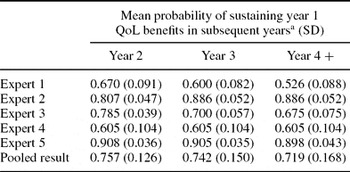
Five experts with experience and knowledge of EECP in the United Kingdom completed the exercise independently giving their own belief about the unknown quantities with estimates of uncertainty. The format chosen for each of the questions was a frequency chart (Reference van Noortwijk, Dekker, Cooke and Mazzuchi25). Experts were asked to place 20 crosses on the frequency chart to represent their current belief and uncertainty about that particular question. A distribution of uncertainty for the parameters was then derived. Full details of the elicitation exercise are reported elsewhere (Reference McKenna, McDaid and Suekarran17). Mean and standard deviations for the probability of sustaining HRQoL benefits in each subsequent year are shown in Table 2. The results from each expert were linearly pooled and a beta distribution applied to the values (Reference Cooke9). Each expert was given equal weight and the pooled result was assumed to be representative of the beliefs of relevant clinical experts.
Mean and SD of the Elicited Values for Each Expert Separately and Linearly Pooled Results Across Experts

aConditional on sustaining benefits in the previous year, and conditional on receiving top-up procedures as considered appropriate.
SD, standard deviation; QoL, quality of life.
Mortality. The model separates deaths into those caused by CVD events and other cause mortality, although no treatment effect from EECP in terms of mortality was modeled. The mortality associated with CVD events was informed by the risk equations applied in the EUROPA trial (Reference Briggs, Mihaylova and Sculpher7). The output was the number of deaths from CVD causes in each yearly cycle based on the likelihood of a first primary event of CVD death, nonfatal myocardial infarction (MI) or cardiac arrest, and the likelihood of subsequent CVD deaths from nonfatal primary events.
The age-dependent risk of other-cause mortality was based on standard UK age- and sex-specific mortality rates (11). These were adjusted to exclude those deaths recorded with an International Classification of Diseases code pertaining to cardiovascular disease (ICD-10 I20-I99). The treatments were assumed not to infer a differential mortality effect.
Resource Use and Unit Costs. Resource utilization and cost data were based on treatment received. Because no additional costs are incurred under a no-treatment strategy the only costs included in the model were those associated with EECP. The costs associated with EECP relate to the standard 35-hour treatment sessions and the need for repeat top-up procedures over time.
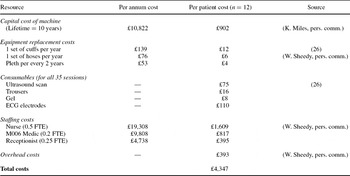
The cost of EECP per patient was based on the average number of patients per annum that a UK center can currently take and the cost of consumables. UK centers currently run at approximately 12 patients per annum (Ken Miles and Wayne Sheedy, personal communications, 2008) and is limited by referral rates. The capital cost of a new EECP machine (“AngioNew”) was taken to be £90,000 +VAT (including installation and training for three therapists for 3 days) (Ken Miles, personal communication, 2008). The machine is expected to have a useful life of approximately 10 years, which gives an equivalent annual cost of £10,822 (with an annuity factor for 10 years included at an interest rate of 3.5 percent per annum). Typical equipment replacement costs include 1 or 2 sets of cuffs per year, 1 set of hoses per year, and replacement of the plethysmograph every 2 years. The unit costs associated with each of these were informed by Vasogenics current price list (effective from April 2007). The consumables per patient for all thirty-five sessions are typically one pair of trousers, pre-assessment ultrasound scan, gel, and electrocardiography electrodes. Table 3 provides a breakdown of the total per patient cost for 35-hours of EECP treatment. Allowing for overheads and staffing costs, the total per patient cost was estimated to be £4,347 per treatment over a 35-hour course. Some patients may receive a repeat or top-up procedure involving fewer treatment sessions. The cost per session was obtained by dividing the total cost of treatment by thirty-five, giving a cost of £124 per session. The additional cost of repeat procedures was based on an average of 10 additional sessions.
Resource Use and Unit Cost Inputs Used in the Model

ECG, electrocardiography; FTE, full-time employment.
Repeat Procedures. A typical course of EECP involves a total of 35 hours of therapy. Some patients require (or request) a repeat or top-up procedure involving several additional sessions. These sessions are generally given to help sustain the long-term benefits of EECP. A search of the literature was undertaken to identify studies that could potentially inform the rate of repeat or top-up procedures. The search identified one study, based on the experience of patients in the IEPR, which examined the frequency and efficacy of repeat EECP for stable angina (Reference Michaels, Barsness and Soran18). Within 2 years of the initial course of EECP, the rate of repeat EECP was 18 percent (194/1078 patients), which occurred at a mean interval of 378 days after initial EECP. Assuming a fixed rate with respect to time, the 2-year probability was converted to a 2-year rate and used to generate an annual probability (Reference Briggs, Claxton and Sculpher6). This annual probability of repeats decreased exponentially over time. To incorporate uncertainty in the estimates of repeat procedures, a beta distribution was applied.
Analytical Methods. Probabilistic analyses were conducted using Monte Carlo simulation (repeated random sampling from the joint probability distribution of parameters). The results are presented in two ways. First, mean lifetime costs and QALYs of both treatment strategies are presented and their cost-effectiveness compared using an incremental cost-effectiveness ratios (ICER) (Reference Johannesson and Weinstein12). Second, decision uncertainty is presented as the probability that each strategy is considered the more cost-effective option for a given cost-effectiveness threshold. Two alternative thresholds are used, £20,000 and £30,000 per QALY gained, reflecting the range used by the National Institute for Health and Clinical Excellence (NICE) (Reference Devlin and Parkin10;19).
The following analyses are undertaken for an average starting age of 64 years and 92 percent of subjects male (based on the patient characteristics of the MUST-EECP trial) (Reference Arora, Chou and Jain4). First, separate analyses are undertaken by assuming that HRQoL benefits from EECP are sustained for different durations: (i) a worst case scenario is considered where HRQoL gains from EECP are only maintained in the first year after treatment, and lost in subsequent years; (ii) a best case scenario is considered where QoL benefits are assumed to last over a patient's lifetime; and (iii) a more realistic scenario is considered where the cost-effectiveness is examined in terms of the proportion of patients likely to sustain benefits over time. The third scenario based on the pooled consensus of experts forms the base–case analysis. In an alternative scenario, the empirical values from each expert are considered separately.
Second, the impact of the cost of EECP on cost-effectiveness is examined. The base–case assumes a total cost of £4,347 per patient as explained above. In an alternative scenario, the cost of EECP is increased/decreased to reflect the possibility of increased/decreased utilization (patient throughput) in some centers. Referral restrictions currently limit the throughput of patients undergoing EECP in NHS centers. Third, the rate of repeat EECP sessions is examined. The base–case assumes that the probability of repeat or top-up EECP sessions is 18 percent within 2 years of initial treatment. In an alternative scenario, this probability is varied from 10 percent to 30 percent.
RESULTS
Base–Case Analysis
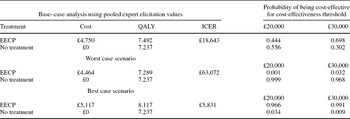
Table 4 presents the base–case results, together with the best and worst case scenario for the duration of HRQoL benefits. For the base–case analysis, the ICER associated with EECP is £18,643 per additional QALY. The probability that EECP is cost-effective at thresholds of £20,000 and £30,000 per QALY is 0.444 and 0.698, respectively.
Base–Case Estimates of Mean Lifetime Costs and QALYs, Together with Best and Worst Case Scenario for Duration of Quality of Life Benefits

QALYs, quality-adjusted life-years; ICER, incremental cost-effectiveness ratios; EECP, enhanced external counterpulsation.
For the worst case scenario, the ICER associated with EECP is £63,072. Therefore, it is highly unlikely that EECP could be considered cost-effective if the duration of benefits from treatment is assumed to last only 1 year. For the best case scenario, the ICER associated with EECP is £5,831. The probability that EECP is cost-effective with sustained lifetime QOL gains approaches 1 at a much lower value of the ICER than the base–case analysis. Hence, the cost-effectiveness of EECP is clearer the longer the QOL benefits are maintained.
Alternative Scenarios
Supplementary Table 1, which is available at www.journals.cambridge.org/thc2010015, presents the results for alternative scenarios. The empirical values for the probability of sustaining QOL benefits over time from each expert separately results in an ICER ranging from £10,664 to £28,158, indicating that the results are sensitive to the beliefs of experts. Hence, the cost-effectiveness of EECP is highly sensitive to the probability of sustaining QOL benefits over time. In the second scenario, where the costs of EECP are reduced, the cost-effectiveness results are improved by EECP. The ICER decreases to £14,354 when the costs are reduced by £1,000. Increasing the costs by £500 increases the ICER to £20,788 per QALY. If the costs are expected to be £3,000 more than the base–case estimate of £4,347 then it is unlikely that EECP can be considered cost-effective (as the ICER becomes greater than NICE's conventional upper limit of £30,000 per QALY). In the third scenario, where the probability of repeat EECP sessions is varied from 10 percent to 30 percent, an ICER of £18,021 to £19,413 is generated, indicating that the cost-effectiveness of EECP is quite robust to the likelihood of requiring additional treatment sessions.
DISCUSSION
To our knowledge, there have been no previously published studies examining the cost-effectiveness of EECP. The present study provides the first assessment of EECP in the UK NHS for the treatment of chronic stable angina. The results of the analysis demonstrate that the long-term maintenance of HRQoL benefits from EECP is central to the estimate of cost-effectiveness. If the benefits are maintained over the remaining lifetime of the patient, EECP is likely to be considered cost-effective based on the conventional cost-effectiveness thresholds used by NICE (£20,000 to £30,000 per additional QALY) (Reference Devlin and Parkin10). In contrast, if benefits are only maintained in the first year after treatment then EECP is unlikely to be considered cost-effective, with a resulting ICER well above the upper £30,000 threshold. The question of how long benefits are likely to be maintained in patients is a key consideration. The results based on pooled expert beliefs about durability of benefits suggest that the overall cost-effectiveness is finely balanced and difficult to determine without long-term RCT evidence on HRQoL gains from EECP. The sensitivity of the results to the beliefs of each expert separately supports this conclusion.
While the cost-effectiveness model attempts to quantify the potential HRQoL gains that could be achieved using EECP through symptomatic improvements, several limitations to the analysis should be noted. Clearly, the model output is dependent on the parameter inputs that are used. The HRQoL estimates applied in the model remain highly uncertain. First, a scoring algorithm was used to convert summary scores for the domains of SF-36 into EQ-5D utility values. Second, although there are several studies reporting on HRQoL of patients following EECP treatment, there are no studies that directly quantify the long-term impact of EECP using a generic, preference-based measure such as the EQ-5D (Reference Kind and Spilker13). In the absence of any long-term estimates for QOL, expert elicitation was used. Several separate scenarios demonstrated that the results were sensitive to the beliefs of the clinical experts. Therefore, the model results clearly demonstrate that the cost-effectiveness of EECP is extremely sensitive to the duration over which the benefits are likely to be maintained.
The decision model does not consider the impact of EECP treatment on other outcomes such as death or major adverse clinical events such as nonfatal MI, as no comparative studies of EECP address these end points. Consequently, no reliable estimates could be used to populate a long-term prognostic model of EECP for angina. The cost-effectiveness estimates for EECP can be considered conservative if EECP does, in fact, lead to a reduction in the risk of major clinical events over and above the reduction from standard care.
There is uncertainty regarding the need for repeat EECP treatment sessions. These repeat or top-up sessions have implications for costs and HRQoL, but there has been little consideration of this issue in the published research literature. It should also be recognized that the treatment costs of EECP itself remain uncertain. Referral restrictions currently limit the throughput of patients undergoing EECP in NHS centers. If the number of patients undergoing the therapy were to increase (perhaps following additional trial evidence), the cost per patient would fall yet further, mean cost-effectiveness improve, and the uncertainty in cost-effectiveness decline. For example, with one bed and an extended working day (three staff), it would be possible to treat seventy patients per year. Three staff could run two beds and get numbers up to over 100 per year and even 150 per year with extended hours. The costs used in the model are based on a reasonable approximation of the resource costs associated with the treatment sessions.
The decision model only considers the cost-effectiveness of EECP in patients with chronic stable angina, similar in severity level to the MUST-EECP trial. A large proportion of participants in this trial (approximately 77 percent) had Class I and II severity of the Canadian Cardiovascular Society (CCS) classification system. The generalizability of the findings to a broader range of patients who could potentially benefit from EECP should be viewed with due caution. Furthermore, the model is based on UK costs. While the results of the analysis are applicable to the United Kingdom, the generalizability of the findings to outside the UK is unclear. A societal perspective, that includes patient-borne costs, may increase the ICER associated with EECP.
In conclusion, the analysis suggests that the long-term maintenance of HRQoL benefits of EECP is central to the estimate of cost-effectiveness. The results from a single RCT do not provide firm evidence of the clinical or cost-effectiveness of EECP in stable angina. Although prospective cohort studies with long-term follow-up and assessing a generic measure of HRQoL may be informative if proper adjustment for selection bias can be made (Reference Polsky, Basu and Jones21), RCTs are primarily required to assess the relative effect of HRQoL from EECP in both stable angina and heart failure because the biases associated with other nonexperimental designs can be avoided.
SUPPLEMENTARY MATERIAL
Supplementary Figure 1
Supplementary Table 1
CONTACT INFORMATION
Claire McKenna, PhD (cm535@york.ac.uk), Research Fellow, Neil Hawkins, PhD (nsh2@york.ac.uk), Statistician, Karl Claxton, PhD (kpc1@york.ac.uk), Professor of Economics, Centre for Health Economics, University of York, Heslington, York YO10 5DD, United Kingdom
Catriona McDaid, PhD (cm36@york.ac.uk), Research Fellow, Sara Suekarran, MSc (sas506@york.ac.uk), Research Fellow, Kate Light, MSc (kl9@york.ac.uk), Information Specialist, Centre for Reviews and Dissemination, University of York, Heslington, York YO10 5DD, United Kingdom
Michael Chester, MD (michael.chester@rlbuht.nhs.uk), Professor of Rehabilitation and Preventive Health Education, Liverpool Hope University, The Cornerstone, Haigh Street, Liverpool L3 8QB, United Kingdom
John G. F. Cleland, MD (j.g.cleland@hull.ac.uk), Professor, Department of Cardiology, Castle Hill Hospital, Castle Road, Cottingham, Kingston Upon Hull HU16 5JQ, United Kingdom; Hull York Medical School, University of Hull, Hull, United Kingdom
Nerys Woolacott, PhD (nw11@york.ac.uk), Senior Research Fellow, Centre for Reviews and Dissemination, University of York, Heslington, York YO10 5DD, United Kingdom
Mark Sculpher, PhD (mjs23@york.ac.uk), Professor of Health Economics, Centre for Health Economics, University of York, Heslington, York YO10 5DD, United Kingdom