Introduction
Over the past decade, an extensive literature has amassed elucidating the natural classification of mental disorders. This research, examining the underlying covariance (or correlational) structure of psychopathology, focuses on understanding inter-individual differences and the latent variables underlying these differences. A seminal paper by Krueger et al. (Reference Krueger, Caspi, Moffitt and Silva1998) – partly inspired by Achenbach & Edelbrock (Reference Achenbach and Edelbrock1984) – suggested that relationships between disorders reflect two underlying dimensions – internalizing and externalizing – that are subject to genetic and environmental influences. This grouping of mental disorders, or meta-structure, has received robust support from community and clinical samples worldwide, demonstrating invariance across cultures (Krueger et al. Reference Krueger, Caspi, Moffitt and Silva1998, Reference Krueger, Chentsova-Dutton, Markon, Goldberg and Ormel2003; Vollebergh et al. Reference Vollebergh, Iedema, Bijl, de Graaf, Smit and Ormel2001; Slade & Watson, Reference Slade and Watson2006; Røysamb et al. Reference Røysamb, Kendler, Tambs, Orstavik, Neale, Aggen, Torgersen and Reichborn-Kjennerud2011), gender (Eaton et al. Reference Eaton, Keyes, Krueger, Balsis, Skodol, Markon, Grant and Hasin2012), ethnicity (Eaton et al. Reference Eaton, Keyes, Krueger, Noordhof, Skodol, Markon, Grant and Hasin2013), age (Eaton et al. Reference Eaton, Krueger and Oltmanns2011), and time (Krueger et al. Reference Krueger, Caspi, Moffitt and Silva1998; Vollebergh et al. Reference Vollebergh, Iedema, Bijl, de Graaf, Smit and Ormel2001; Measelle et al. Reference Measelle, Stice and Hogansen2006; Eaton et al. Reference Eaton, Krueger and Oltmanns2011). However, important gaps remain.
First, although the terms ‘internalizing’ and ‘externalizing’ originate from the youth literature (Achenbach & Edelbrock, Reference Achenbach and Edelbrock1984) much of the research into covariance structure has been confined to adults, with few studies comparing alternative models of adolescent psychopathology. Wittchen et al. (Reference Wittchen, Beesdo-Baum, Gloster, Höfler, Klotsche, Lieb, Beauducel, Bühner and Kessler2009) suggest that different underlying structures of co-morbidity may manifest at different developmental stages. For example, anxiety disorders typically present during childhood whereas depressive and substance use disorders emerge during adolescence or adulthood (Kessler et al. Reference Kessler, Chiu, Demler, Merikangas and Walters2005; Beesdo-Baum et al. Reference Beesdo-Baum, Knappe and Pine2009).
Second, research into covariance structure has been largely confined to common anxiety and depressive disorders. To capture the meta-structure of psychopathology and facilitate the emergence of nuanced factor structures and novel dimensions, it is necessary to take into account additional and severe types of mental illness, including psychotic symptoms. Psychotic symptoms are rarely included in research into covariance structure, partly due to their omission from most large-scale psychiatric surveys. Methodological issues notwithstanding, the absence of psychosis from the meta-structure is noteworthy due to the higher prevalence of psychotic symptoms in the community than previously assumed, high rates of co-morbidity and economic burden (Caspi et al. Reference Caspi, Houts, Belsky, Goldman-Mellor, Harrington, Israel, Meier, Ramrakha, Shalev, Poulton and Moffitt2014).
Third, research into covariance structure has largely used a diagnostic-level approach. Symptom-level analyses are warranted to unpack disorders and better capture the underlying structure of psychopathology (Markon, Reference Markon2010). It is well established that disorders in our leading psychiatric nosologies are based on arbitrary thresholds (Carragher et al. Reference Carragher, Krueger, Eaton and Slade2015) with considerable diagnostic overlap. This underscores the importance of building models of psychopathology structure from the bottom up. Finally, research into covariance structure has provided evidence of an overarching, general psychopathology factor (p factor) (Lahey et al. Reference Lahey, Applegate, Hakes, Zald, Hariri and Rathouz2012, Reference Lahey, Rathouz, Keenan, Stepp, Loeber and Hipwell2015; Tackett et al. Reference Tackett, Lahey, van Hulle, Waldman, Krueger and Rathouz2013; Blanco et al. Reference Blanco, Wall, He, Krueger, Olfson, Jin, Burstein and Merikangas2015; Noordhof et al. Reference Noordhof, Krueger, Ormel, Oldehinkel and Hartman2015). Similar to the g factor of general intelligence, the p factor reflects an underlying liability to experience all forms of psychopathology and emerged from observations that mental disorders and the underlying spectra are positively and substantially correlated. While a bifactor model (general factor and specific factors) has a long history in psychometrics and proven useful in intelligence and personality research, it has only recently been applied to psychopathology. Further research in different settings is warranted to establish whether the p factor observed in adult samples is present in adolescent samples.
These gaps have given rise to a nascent, developmental literature, most notably with the work of Caspi et al. (Reference Caspi, Houts, Belsky, Goldman-Mellor, Harrington, Israel, Meier, Ramrakha, Shalev, Poulton and Moffitt2014). These authors conducted confirmatory factor analyses (CFA) among adults at ages 18, 21, 26, 32, and 38 years. They found evidence for a bifactor model, comprising a general psychopathology factor and internalizing and externalizing specific factors. In this framework, individual symptoms are organized into distinct diagnoses. These diagnoses can be interpreted as representing a normally distributed general psychopathology dimension. Additionally, the residual variance of specific groups of diagnoses can be explained by internalizing and externalizing dimensions. The authors failed to find support for a distinct thought disorder factor. This may be due, partly, to a small number of thought disorder indicators, reducing capacity to adequately model this dimension, and a diagnostic-level approach. As Krueger & Markon (Reference Krueger and Markon2011) note, symptom-level analysis can help ‘unpack’ low-prevalence conditions and facilitate the emergence of new dimensions.
Extending Caspi et al.'s (2014) research, Laceulle et al. (Reference Laceulle, Vollebergh and Ormelin press) found support for general psychopathology, internalizing and externalizing factors using data from Dutch adolescents aged 11, 13, 16 and 19 years and their parents. They also failed to find a thought disorder factor, perhaps due to restricting psychotic assessment to one time-point. Further, utilizing a symptom-based approach and data from 23 477 adolescents at age 11 and 10 270 adolescents at 13.5 years, Patalay et al. (Reference Patalay, Fonagy, Deighton, Belsky, Vostanis and Wolpert2015) identified general psychopathology, internalizing and externalizing dimensions. They did not measure psychotic symptoms and so were unable to model a thought disorder factor.
Validation of the meta-structure
There is a relative paucity of research examining the external validity of the meta-structure, particularly in adolescents. Information about how factors are differentially related to external correlates could help identify important treatment targets. Caspi et al. (Reference Caspi, Houts, Belsky, Goldman-Mellor, Harrington, Israel, Meier, Ramrakha, Shalev, Poulton and Moffitt2014) highlighted the importance of gender, finding evidence that liability to general psychopathology, externalizing and internalizing are highly gendered styles in adults. Relatedly, personality has been associated with mental health and substance use disorders (Krank et al. Reference Krank, Stewart, O'Connor, Woicik, Wall and Conrod2011; Links & Eynan, Reference Links and Eynan2013). Accordingly, we examined the influence of sex and personality risk traits for adolescent substance use and mental health problems on the structure of adolescent psychopathology. To our knowledge, research into covariance structure has not examined these correlates among adolescents. External validity was examined using structural equation modeling (SEM), overcoming limitations associated with Patalay et al. (Reference Patalay, Fonagy, Deighton, Belsky, Vostanis and Wolpert2015) who utilized factor scores. Factor scores are numerical values which indicate an individual's relative location on a latent factor. They do not have the same distribution as true factors nor do they share the same relationships to other variables (Muthén, Reference Muthén2007).
The current study
Based on the above gaps and recent findings warranting further exploration, this study aimed to inform research on the structure of adolescent psychopathology. Our first goal was to evaluate the existence of internalizing, externalizing, thought disorder, and general psychopathology dimensions in a large sample of Australian adolescents. This involved testing alternative dimensional models using symptoms. Our second goal involved assessing the external validity of the best-fitting model. This is the first study of its kind in Australia and overcomes limitations with previous studies. Our study focuses on early adolescence, when many mental disorders emerge (Merikangas et al. Reference Merikangas, He, Burstein, Swanson, Avenevoli, Cui, Benjet, Georgiades and Swendsen2010).
Method
Participants and procedure
This study is part of a larger project, the CAP study, a cluster randomized control trial to prevent substance misuse and related harms in adolescents. The trial was conducted in 26Footnote 1 Footnote † secondary schools in Sydney and Melbourne, Australia. The research protocol (see Newton et al. Reference Newton, Teesson, Barrett, Slade and Conrod2012) and informed consent procedures were approved by the University of New South Wales Human Ethics Committee, Sydney Catholic Education Office, and New South Wales Department of Education and Communities. The trial is registered with the Australian and New Zealand Clinical Trials Registry (ACTRN 12612000026820). This study utilizes baseline data. Of the 2190 students who participated at baseline, 15 had missing data across all variables of interest. Accordingly, this study focuses on 2175 students [males = 57.4%, mean age = 13.3 (s.e. = 0.48) years].
Measures
The measures used to assess the past 6 months internalizing, externalizing and psychotic symptoms are described below and an item summary is provided in Supplementary Table S1. Our community-based sample of adolescents displayed a fairly limited range of severity. To reduce the number of sparse cells, improve statistical power and yield stable estimates, all Likert-type items were recoded into dichotomous variablesFootnote 2 .
As described below, internalizing and externalizing symptoms were partly assessed using the Strengths and Difficulties Questionnaire (SDQ; Goodman, Reference Goodman2001). The SDQ is a brief, 25-item questionnaire which assesses emotional and behavioral problems in children and adolescents. Selection of items to load onto the internalizing and externalizing dimensions was informed by recent analyses by the instrument's authors (Goodman et al. Reference Goodman, Lamping and Ploubidis2010). Based on documented problems with the reverse-coded SDQ items (van de Looij-Jansen et al. Reference van de Looij-Jansen, Goedhart, de Wilde and Treffers2011), we removed these items.
Internalizing symptoms
Internalizing was assessed using eight items from the SDQ emotional and peer scales, and 12 items from the depression and anxiety scales of the Brief Symptom Inventory (BSI; Derogatis, Reference Derogatis1993). The SDQ items were rated on a three-point scale (0 = not true, 1 = sometimes true, 2 = certainly true). The SDQ is one of the most commonly used instruments for screening psychopathology in children and adolescents. It has been widely validated in clinical practice, community and epidemiological settings across different countries (see Giannakopoulos et al. Reference Giannakopoulos, Dimitrakaki, Papadopoulou, Tzavara, Kolaitis, Ravens-Sieberer and Tountas2013). The BSI is a widely used, 53-item psychological distress scale, comprising nine symptom scales. It was rated on a five-point scale (0 = not at all, 1 = a little bit, 2 = moderately, 3 = quite a bit, 4 = often) and has high test–retest reliability and high validity (Derogatis & Melisaratos, Reference Derogatis and Melisaratos1983).
Externalizing symptoms
Externalizing was assessed using seven items from the SDQ behavioral and hyperactivity scales. Additionally, we used eight alcohol-related harm items from an abbreviated version of the Rutgers Alcohol Problem Index (RAPI; White & Labouvie, Reference White and Labouvie1989) based on the most frequently endorsed items by adolescents in previous work (Conrod et al. Reference Conrod, Castellanos and Mackie2008). Items were rated on a five-point scale (0 = never, 1 = 1–2 times, 2 = 3–4 times, 3 = 5–6 times, 4 = more than 6 times). The RAPI is one of the most commonly used measures of alcohol problems and demonstrates good psychometric properties (Neal et al. Reference Neal, Corbin and Fromme2006).
Psychotic symptoms
Nine questions assessed hallucinatory experiences and delusional beliefs (Laurens et al. Reference Laurens, Hobbs, Sunderland, Green and Mould2012) – including five items adapted from the psychosis section of the Diagnostic Interview Schedule for Children (Costello et al. Reference Costello, Edelbrock, Kalas, Kessler and Klaric1982) – using a three-point scale (0 = not true, 1 = sometimes true, 2 = certainly true). This measure has been validated using item response theory (Laurens et al. Reference Laurens, Hobbs, Sunderland, Green and Mould2012).
Statistical analysis
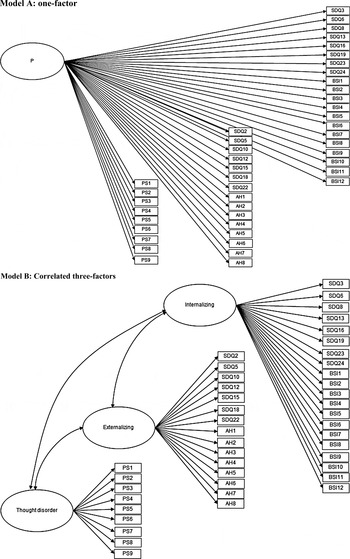
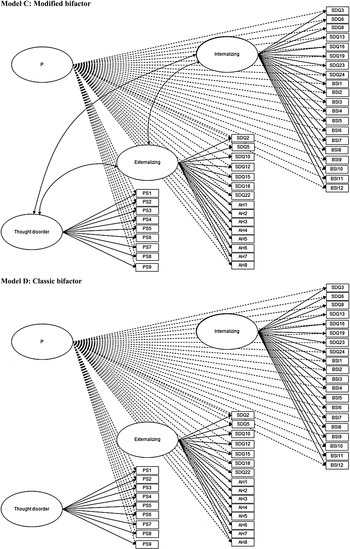
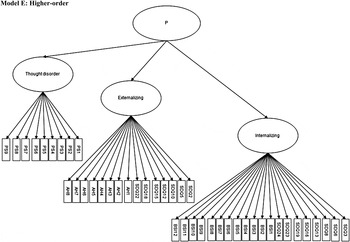
Analyses involved two steps. First, alternative dimensional models tested by Caspi et al. (Reference Caspi, Houts, Belsky, Goldman-Mellor, Harrington, Israel, Meier, Ramrakha, Shalev, Poulton and Moffitt2014), and replicated more recently by others, were estimated using CFA (see Fig. 1). Model A estimates a one-factor model whereby all symptoms are subsumed under a general psychopathology factor (Caspi et al. Reference Caspi, Houts, Belsky, Goldman-Mellor, Harrington, Israel, Meier, Ramrakha, Shalev, Poulton and Moffitt2014; Del Giudice, Reference Del Giudicein press; Laceulle et al. Reference Laceulle, Vollebergh and Ormelin press). Model B comprises three correlated factors (internalizing, externalizing, thought disorder) (Caspi et al. Reference Caspi, Houts, Belsky, Goldman-Mellor, Harrington, Israel, Meier, Ramrakha, Shalev, Poulton and Moffitt2014; Del Giudice, Reference Del Giudicein press; Laceulle et al. Reference Laceulle, Vollebergh and Ormelin press). The internalizing and externalizing factors have received robust support (Carragher et al. Reference Carragher, Krueger, Eaton and Slade2015). The addition of a thought disorder dimension reflects a recent observation (Markon, Reference Markon2010; Kotov et al. Reference Kotov, Ruggero, Krueger, Watson, Yuan and Zimmerman2011a , Reference Kotov, Chang, Fochtmann, Mojtabai, Carlson, Sedler and Bromet b ; Laurens et al. Reference Laurens, Hobbs, Sunderland, Green and Mould2012; Keyes et al. Reference Keyes, Eaton, Krueger, Skodol, Wall, Grant, Siever and Hasin2013; Wright et al. Reference Wright, Krueger, Hobbs, Markon, Eaton and Slade2013; Fleming et al. Reference Fleming, Shevlin, Murphy and Joseph2014). Model C tests a modified bifactor model (Lahey et al. Reference Lahey, Applegate, Hakes, Zald, Hariri and Rathouz2012, Reference Lahey, Rathouz, Keenan, Stepp, Loeber and Hipwell2015; Tackett et al. Reference Tackett, Lahey, van Hulle, Waldman, Krueger and Rathouz2013; Caspi et al. Reference Caspi, Houts, Belsky, Goldman-Mellor, Harrington, Israel, Meier, Ramrakha, Shalev, Poulton and Moffitt2014; Noordhof et al. Reference Noordhof, Krueger, Ormel, Oldehinkel and Hartman2015; Laceulle et al. Reference Laceulle, Vollebergh and Ormelin press; Patalay et al. Reference Patalay, Fonagy, Deighton, Belsky, Vostanis and Wolpert2015) with three correlated factors (internalizing, externalizing, thought disorder) and a general psychopathology factor. Extending Caspi et al. (Reference Caspi, Houts, Belsky, Goldman-Mellor, Harrington, Israel, Meier, Ramrakha, Shalev, Poulton and Moffitt2014), model D tests a classic bifactor model with three uncorrelated factors (internalizing, externalizing, thought disorder) and a general psychopathology factor. The general factor explains the correlation between all symptoms; the specific factors accounts for residual covariance among a subset of symptoms. The bifactor models differ from a simple structure first-order model with multiple factors [multiple common factors that are (un)correlated] or a second-order factor model (a first-order factor correlated with a higher-order factor). Model E estimates a higher-order model in which one overarching general factor explains three primary factors (internalizing, externalizing, thought disorder).
Model A (one-factor) and model B (correlated three-factors). For legend see model E.

Model C (modified bifactor) and model D (classic bifactor). For legend see model E.

Model E (higher-order). Alternative models of the structure of adolescent psychopathology. For clarity, dashed lines highlight paths from the general factor to individual symptoms (models C and D). PS, Psychotic symptoms derived from Laurens et al. (Reference Laurens, Hobbs, Sunderland, Green and Mould2012); SDQ, symptom items from the Strengths and Difficulties Questionnaire; AH, alcohol harm items derived from the Rutgers Alcohol Problems Index; BSI, Symptom items from the Brief Symptom Inventory; P, General psychopathology.

Second, we examined sex and personality risk factors for substance use and psychopathology in differences in psychopathological liabilities in the best-fitting model. Sex differences were evaluated using a multiple-indicators multiple-causes (MIMIC) model. Personality risk profiles were measured by the Substance Use Risk Profile Scale (SURPS; Woicik et al. Reference Woicik, Stewart, Pihl and Conrod2009). The SURPS measures personality risk for substance use and other behavioral problems according to four traits: anxiety sensitivity, negative thinking, impulsivity, and sensation seeking. Each profile was assessed using 4–7 items rated on a four-point scale (1 = strongly disagree, 2 = disagree, 3 = agree, 4 = strongly agree). Using CFA, differences in personality were investigated by simultaneously modeling the four SURPS dimensions and corresponding items (see Supplementary Table S2 for a description of the SURPS items and dimensions) with the best-fitting model.
Assessment of model fit
All models were estimated in Mplus v. 7.3, using robust weighted least squares (WLSMV) estimation, which is appropriate for dichotomous data. Analyses were adjusted for school-level clustering. Model fit was evaluated using the Root Mean Square Error of Approximation (RMSEA), Comparative Fit Index (CFI), and Tucker–Lewis Index (TLI). RMSEA values <0.05 indicate close model fit (Brown, Reference Brown2006). TLI and CFI values ⩾0.90 indicate acceptable fit and values ⩾0.95 imply very good fit (Brown, Reference Brown2006). Models were re-run with robust maximum likelihood estimation (MLR) to generate the Bayesian Information Criterion (BIC) and Akaike's Information Criterion (AIC). Lower AIC and BIC values are preferred. A 6- to 10-point BIC difference between models indicates strong support for the model with the lower BIC value and a difference >10 yields very strong support (Raftery, Reference Raftery1995). A single latent factor is supported by salient loadings ⩾0.40 (Brown, Reference Brown2006). Multicollinearity – indicating a lack of discriminant validity between two factors – is evidenced by factor intercorrelations ⩾0.80 (Brown, Reference Brown2006).
Results
The structure of adolescent psychopathology
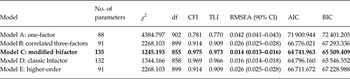
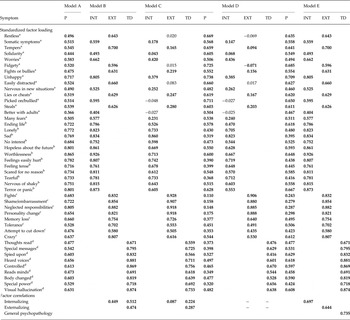
Goodness-of-fit indices are presented in Table 1, factor loadings and factor intercorrelations are presented in Table 2. Model A, a one-factor model, did not fit the data well (CFI and TLI < 0.90). Model B, a correlated three-factor model, provided a good fit to the data [CFI = 0.914, TLI = 0.909, RMSEA = 0.026 (90% CI 0.025–0.028)]. All factor loadings were positive, salient and significant (p < 0.001). The average factor loading for internalizing was 0.723, 0.714 for externalizing, and 0.794 for thought disorder. The factor intercorrelations were all significant (p < 0.001) and moderate in size (range 0.449–0.512), ruling out multicollinearity. Model C, a modified bifactor model, provided an excellent fit to the data [CFI = 0.975, TLI = 0.973, RMSEA = 0.014 (90% CI 0.013–0.016)]. The average factor loading for internalizing was 0.477, 0.473 for externalizing, 0.667 for thought disorder, and 0.480 for general psychopathology. The factor intercorrelations were all significant (p < 0.05) and moderate in size (range 0.087–0.287), ruling out multicollinearity. Model D, a classic bifactor model, provided excellent fit to the data, albeit the fit indices deteriorated marginally compared to model C [CFI = 0.969, TLI = 0.966, RMSEA = 0.016 (90% CI 0.014–0.018)]. The average factor loading for internalizing was 0.473, 0.410 for externalizing, 0.573 for thought disorder, and 0.528 for general psychopathology. No factor intercorrelations were specified for this model. Finally, model E, a higher-order model provided good fit to the data [CFI = 0.914, TLI = 0.909, RMSEA = 0.026 (90% CI 0.025–0.028)]. The average factor loading for internalizing was 0.723, 0.714 for externalizing and 0.794 for thought disorder. Factor intercorrelations were all sigznificant (p < 0.05) and moderate in size (range 0.644–0.735). The BIC for model C displayed a >10-point difference with other models, indicating it was the best-fitting model.
Fit indices for alternative dimensional models of the structure of psychopathology in Australian adolescents (n = 2175)

χ 2, Chi-square statistic; df, degree of freedom; CFI, comparative fit index; TLI, Tucker–Lewis index; RMSEA, root mean square error of approximation; CI, confidence interval; AIC, Akaike's Information Criterion; BIC, Bayesian Information Criterion.
Modified bifactor (model C) = specific factors are correlated. Classic bifactor (model D) specific factors are uncorrelated. Weighted least square means and variance adjusted (WLSMV) estimation was used to generate the number of parameters, χ 2 (df), CFI, TLI and RMSEA (90% CI). Robust maximum likelihood estimation (MLR) was used to generate the BIC and AIC. The best-fitting model is in boldface.
Standardized factor loadings and factor intercorrelations for Models A–E

INT, Internalizing; EXT, externalizing; TD, thought disorder; P, general psychopathology.
a Strengths and Difficulties Questionnaire items.
b Brief Symptom Inventory items.
c Alcohol harm items derived from the Rutgers Alcohol Problems Index.
d Psychotic symptoms derived from Laurens et al. (Reference Laurens, Hobbs, Sunderland, Green and Mould2012). Factor loadings and correlations with a p value ⩽0.05 are displayed in boldface. There are no factor correlations to estimate in the one-factor model (model A) or in the classic bifactor model (model D). Larger positive values reflect a stronger association of a symptom with that dimension; negative values indicate an inverse association with the dimension.
In the bifactor models (models C and D), a number of items loaded primarily on the general factor; others loaded primarily on a specific factor, indicating variability not captured by the general factor; and several transdiagnostic items loaded substantially on the general and specific factors. These patterns are consistent with the literature. However, theoretically, it could be argued that to be meaningful all items should be salient (⩾0.40) on the general factor. To investigate whether alternative models yield a better fit, and extending the work of Caspi et al. (Reference Caspi, Houts, Belsky, Goldman-Mellor, Harrington, Israel, Meier, Ramrakha, Shalev, Poulton and Moffitt2014), we conducted exploratory factor analysis (EFA) models specifying 1–4 factors. None of these models fit better than the modified bifactor model (BIC range for EFA models = 65638–72539; BIC value of model C = 65509). In summary, after testing a series of EFA and CFA models, a modified bifactor model provided a meaningful alternative to simple factor models, enabling simultaneous estimation of general and specific factors.
Sex differences in psychopathological liabilities
The latent factors in model C were subsequently regressed on sex (i.e. indirect effects only model) using MIMIC modelling. The modification indices did not support the inclusion of direct paths between individual symptoms and sex, providing evidence of gender invariance and permitting direct comparisons of factor means. This model provided an excellent fit to the data [CFI = 0.977, TLI = 0.975, RMSEA = 0.014 (90% CI 0.012–0.015)]. Females reported higher mean levels of latent internalizing than males (β = 0.307, p ⩽ 0.001), and males reported higher mean levels of externalizing than females (β = −0.139, p ⩽ 0.01). No significant sex differences were observed in thought disorder or general psychopathology.
Personality risk profile differences in psychopathological liabilities
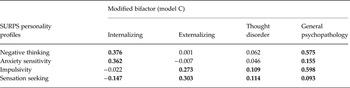
To examine differences in personality risk profiles for substance misuse and mental health problems, we estimated the latent structure of the SURPS simultaneously with model C using CFA. This model provided excellent fit to the data [CFI = 0.965, TLI = 0.962, RMSEA = 0.011 (90% CI 0.010–0.013)]. As Table 3 indicates, general psychopathology was characterized by high negative thinking, high impulsivity, high anxiety sensitivity and high sensation seeking. Adolescents who scored high on internalizing – over and above general psychopathology – were characterized by hopelessness, a risk factor for the development of depression (high negative thinking); a fear of anxiety-related sensations, driven by beliefs that such sensations have harmful consequences (high anxiety sensitivity); and, minimal desire for stimulation and novel experiences (low sensation seeking). Adolescents who scored high on externalizing – over and above general psychopathology – were characterized by difficulties in the regulation of behavioral responses (high impulsivity) and a desire for stimulation and novel experiences (high sensation seeking). Adolescents who scored high on thought disorder – over and above general psychopathology – were characterized, to a lesser extent, by difficulties in the regulation of behavioral responses (high impulsivity) and a desire for stimulation and novel experiences (high sensation seeking).
Standardized regression coefficients for the effects of four personality risk profiles on internalizing, externalizing, thought disorder and general psychopathology liabilities

SURPS, Substance Use Risk Profile Scale. Estimates with p value ⩽0.001 are displayed in boldface.
Discussion
This study contributes to a nascent literature examining the underlying structure of adolescent psychopathology (Caspi et al. Reference Caspi, Houts, Belsky, Goldman-Mellor, Harrington, Israel, Meier, Ramrakha, Shalev, Poulton and Moffitt2014; Patalay et al. Reference Patalay, Fonagy, Deighton, Belsky, Vostanis and Wolpert2015; Laceulle et al. Reference Laceulle, Vollebergh and Ormelin press). This study addresses shortcomings associated with previous adolescent research into covariance structure, by using a wide range of psychotic symptoms, SEM to examine external validity, and symptom-level analysis to facilitate identification of new factors. Our results demonstrated that adolescent psychopathology is well described by an internalizing liability to depression and anxiety; an externalizing liability to alcohol misuse; a thought disorder liability to psychotic symptoms; and, a general psychopathology factor, reflecting an underlying vulnerability to develop all forms of psychopathology.
Our findings align with research from New Zealand (Caspi et al. Reference Caspi, Houts, Belsky, Goldman-Mellor, Harrington, Israel, Meier, Ramrakha, Shalev, Poulton and Moffitt2014), the UK (Patalay et al. Reference Patalay, Fonagy, Deighton, Belsky, Vostanis and Wolpert2015) and The Netherlands (Laceulle et al. Reference Laceulle, Vollebergh and Ormelin press), identifying a general psychopathology factor and specific internalizing and externalizing factors. The observation of a general vulnerability to psychopathology factor spanning childhood (Tackett et al. Reference Tackett, Lahey, van Hulle, Waldman, Krueger and Rathouz2013; Lahey et al. Reference Lahey, Rathouz, Keenan, Stepp, Loeber and Hipwell2015), adolescence (Tackett et al. Reference Tackett, Lahey, van Hulle, Waldman, Krueger and Rathouz2013; Blanco et al. Reference Blanco, Wall, He, Krueger, Olfson, Jin, Burstein and Merikangas2015; Noordhof et al. Reference Noordhof, Krueger, Ormel, Oldehinkel and Hartman2015; Laceulle et al. Reference Laceulle, Vollebergh and Ormelin press; Patalay et al. Reference Patalay, Fonagy, Deighton, Belsky, Vostanis and Wolpert2015), and adulthood (Lahey et al. Reference Lahey, Applegate, Hakes, Zald, Hariri and Rathouz2012; Caspi et al. Reference Caspi, Houts, Belsky, Goldman-Mellor, Harrington, Israel, Meier, Ramrakha, Shalev, Poulton and Moffitt2014) lends support to a continuity of symptom presentation throughout the life-span. Consistent with the adult literature, the structure of adolescent psychopathology was gender invariant (Eaton et al. Reference Eaton, Keyes, Krueger, Balsis, Skodol, Markon, Grant and Hasin2012). Divergent from previous studies, however, we did not encounter problems estimating a specific thought disorder factor. This may have due to a greater number of thought disorder indicators and symptom-level analysis, which conferred greater capacity to model this dimension.
The substantive interpretation of the bifactor model is that the symptoms are correlated because they share a common general psychopathology trait and one independent source of common variation (e.g. a tendency to endorse internalizing symptoms). From an assessment perspective, the mean score on the p factor represents the general tendency to experience psychopathology and the mean score on, for example, the internalizing specific factor represents the specific internalizing tendency, not captured by the general factor. To corroborate the model's psychometric properties and support theoretical arguments regarding a bifactorial structure of adolescent psychopathology, we examined external validity of the specific factors and general factor in relation to gender and personality traits which are important correlates of a range of mental health and substance use disorders. The p factor demonstrated significant associations with all personality facets and the specific factors evidenced differential associations with various facets (see discussion below). In short, psychometric findings herein corroborate the value and the robustness of the bifactor structure of psychopathology and its substantive interpretation. Research, currently underway, will further contribute to our substantive understanding of the bifactor model by investigating whether it is stable from ages 13–17 years (i.e. longitudinal invariance).
Clinical and classification implications
From a clinical perspective, our findings suggest that separate assessment of general risk for psychopathology, and specific risk for internalizing, externalizing and thought disorder is warranted to provide detailed information about a patient's profile. It follows that treatment and/or prevention should be tailored according to general or specific risk profiles. Theoretically, a patient could have a high p score and not receive a diagnosis if they have low scores on the specific factors. This is possible given that the p factor and the primary factors are uncorrelated.
Relatedly, external validation analyses indicated that adolescent psychopathology is differentially associated with personality traits for substance misuse and mental health problems. Since treatments can have differential effects on substance use and mental health symptoms, our findings underscore the importance of prioritizing treatment targets for those with specific risk profiles. In line with available treatment options and practice, our findings reiterate that: (i) adolescents with internalizing symptoms may benefit most from treatments (either medical or psychotherapeutic) targeting negative thinking and anxiety sensitivity; (ii) adolescents with externalizing symptoms may benefit most from treatments targeting impulsivity and sensation seeking; and (iii) adolescents experiencing psychotic symptoms may benefit from treatments targeting impulsivity and sensation seeking. Given the strong links between internalizing, externalizing and psychotic symptoms through a general psychopathology factor, and affective and psychosis symptom overlap (Birchwood, Reference Birchwood2003), these findings suggest that adolescents with psychotic symptoms may also benefit from receiving cognitive therapy. Further validation studies, particularly using prospective research, are needed to confirm these relationships.
The observation of a general factor underlying psychopathology aligns with broader findings documenting a general genetic factor underlying neurodevelopmental symptoms (Pettersson et al. Reference Pettersson, Anckarsater, Gillberg and Lichtenstein2013). In a large representative sample of twins, Lahey et al. (Reference Lahey, Van Hulle, Singh, Waldman and Rathouz2011) found that a general bifactor model of genetic influences, on which the genetic component of every dimension of psychopathology loaded, explained the majority of genetic influences on youth internalizing and externalizing symptoms. Relatedly, Franić et al. (Reference Franić, Dolan, Borsboom, van Beijsterveldt and Boomsma2014) identified a common genetic basis for anxiety, depression, and withdrawal, with a different genetic structure for somatic complaints. Consistent with previous findings (e.g. Kendler et al. Reference Kendler, Heath, Martin and Eaves1987), the study by Franić et al. suggests the existence of differing additive genetic, common environmental and individual-unique environmental structures. Our study did not collect data on genetics or a broad range of environmental variables; thus we were unable to examine the presence of different structures and examine genetic influences on the factors in the bifactor model.
The findings have important implications for research on classification. Dialogue around the organization of mental disorders has often been framed in terms of lumping v. splitting. Lumpers emphasize similarities amongst categories and favor fewer diagnostic categories, whereas splitters highlight differences between conditions. Support for a bifactor model could be argued to bring the lumper and splitter factions together. That is, we found that one general dimension is needed to summarize a common liability to experience all types of psychopathology and specific factors, indicating some degree of heterogeneity, are warranted to capture individuals who manifest disorders along that single continuum in a distinct way (e.g. some individuals may be more inclined to developing internalizing). Caspi et al. (Reference Caspi, Houts, Belsky, Goldman-Mellor, Harrington, Israel, Meier, Ramrakha, Shalev, Poulton and Moffitt2014) suggest that the general factor may account for difficulties encountered in identifying unique causes, consequences, biomarkers and treatments for individual disorders. Our replication of a general factor underscores the importance and utility of transdiagnostic treatment and comprehensive prevention approaches which efficiently address multiple problems in a single framework.
Limitations and future directions
The results should be considered in light of some limitations. First, whilst our study included a range of mental health symptoms, our assessment of psychopathology was not exhaustive. Notably, youth-onset disorders, such as obsessive-compulsive disorder and autism, were not assessed. Researchers with more comprehensive psychiatric data may provide more detailed insight into the structure of adolescent psychopathology. Due to our restricted range of psychopathology we could not empirically test whether the internalizing spectrum bifurcates into distinct fear and distress sub-dimensions, as observed in some adolescent and adult studies (Kendler et al. Reference Kendler, Prescott, Myers and Neale2003; Krueger, Reference Krueger1999; Slade & Watson, Reference Slade and Watson2006; Blanco et al. Reference Blanco, Wall, He, Krueger, Olfson, Jin, Burstein and Merikangas2015). Similarly, we were unable to empirically evaluate whether the externalizing factor bifurcates into specific conduct disorder symptoms and substance misuse. Relatedly, our analysis of the externalizing spectrum focused on alcohol misuse symptoms due to low endorsement of drug misuse items. However, the subsequent waves of this study, which assess students up to age 16/17 years, offer an opportunity to examine substance misuse more broadly. Indeed, given that epidemiological studies indicate that the median age of onset for substance use disorder is 15 years, a longitudinal examination of the structure of psychopathology over time may reveal nuances in factor structure.
Second, this study is not based on a representative sample, therefore caution should be used when extrapolating findings beyond the study population. Third, our community-based sample displayed a limited range of severity; a more clinically severe sample may demonstrate a different factor structure. Fourth, similar to the majority of studies in this area, this study replies on self-report data, therefore it is important to investigate whether method effects impact structure. That is, do studies integrating multi-method and multiple informant (caregivers, teachers) data identify nuanced developmental differences in psychopathology structure? Limitations notwithstanding, this study has several important strengths, including a large sample size and comparison of a range of dimensional models. It provides the first investigation of the underlying structure of psychopathology in Australian adolescents and adds to a nascent literature examining the existence of novel thought disorder and general psychopathology dimensions.
Conclusions
In closing, the structure of psychopathology is much more than a semantic issue. How symptoms and disorders are classified has implications for assessment, prevention and treatment (Carragher et al. Reference Carragher, Krueger, Eaton and Slade2015). The meta-structure provides a succinct means of organizing disorders according to shared commonalities and supports the development of transdiagnostic treatment approaches, which offer an efficient means of addressing multiple problems in a single framework. Longitudinal invariance of adolescent psychopathology structure represents the next step in this burgeoning field.
Supplementary material
For supplementary material accompanying this paper visit http://dx.doi.org/10.1017/S0033291715002470.
Acknowledgements
This research was supported by grant funding (1004744) from the National Health and Medical Research Council, Australia. The authors wish to thank the team of interviewers, data management staff, and study participants.
Declaration of Interest
None.