Implications
The isomeric profile of intermediates of polyunsaturated fatty acid ruminal biohydrogenation (BH) is a major concern for the nutritional quality of milk fat for human health. An in vitro study was used to separate the effects of rumen microbiota adaptation from the effects of substrate on BH. It showed the importance of both factors to control the trans-10 shift. Combining high starch and high oil in the diet of donor cows, plus an addition of linoleic acid in the substrate clearly switched the BH pathway from trans-11 to trans-10. This knowledge will help further investigations on this shift, including studies on the microbiota.
Introduction
Conjugated linoleic acids (CLA) have a number of biological effects on animal models including anti-obesitic, anti-carcinogenic, antiatherogenic, anti-diabetagenic, immunomodulatory, apoptotic and osteosynthetic effects, and deserve interest as some of these properties have been evidenced in human subjects (Bhattacharya et al., Reference Bhattacharyaa, Banua, Rahmana, Causeyb and Fernandes2006; Benjamin and Spener, Reference Benjamin and Spener2009). Part of the effects of CLA are isomer-specific and some studies showed adverse effects of t10,c12-CLA (Bhattacharya et al., Reference Bhattacharyaa, Banua, Rahmana, Causeyb and Fernandes2006; Ip et al., Reference Ip, McGee, Masso-Welch, Ip, Meng, Ou and Shoemaker2007). Similarly, total trans fatty acids (FA), including monoenoic, can alter cardiovascular risk markers; however, the specificity of individual isomers remains an area of controversy, where some suggest a similar effect of all trans FA (Brouwer et al., Reference Brouwer, Wanders and Katan2010), whereas others assume natural trans FA, mainly of milk origin, are less deleterious as compared with industrial trans FA (Tardy et al., Reference Tardy, Morio, Chardigny and Malpuech-Brugère2011). Moreover, t10,c12-CLA decreases the mammary synthesis of de novo FA and induces milk fat depression in dairy cows (Shingfield and Griinari, Reference Shingfield and Griinari2007). In human foodstuffs, part of trans FA supply is from ruminant products, because they are formed during biohydrogenation (BH) of dietary unsaturated FA in the rumen (Enjalbert and Troegeler-Meynadier, Reference Enjalbert and Troegeler-Meynadier2009).
Wide variability in the ratio of trans-10/trans-11 isomers has been observed in milk fat (Shingfield et al., Reference Shingfield, Reynolds, Hervas, Griinari, Grandison and Beever2006). In most cases, trans-11 FA are the major isomers and the proportion of trans-10 isomers is very low (<1% of total FA), therefore any significant increase of trans-10 isomers to the detriment of trans-11 isomers can be considered as a shift. Dietary factors shifting from trans-11 to trans-10 BH pathway have been identified, that is, the proportion of concentrate (Griinari et al., Reference Griinari, Dwyer, McGuire, Bauman, Palmquist and Nurmela1998), the addition of oil (Roy et al., Reference Roy, Ferlay, Shingfield and Chilliard2006) or both (Loor et al., Reference Loor, Ueda, Ferlay, Chilliard and Doreau2004). Moreover, Roy et al. (Reference Roy, Ferlay, Shingfield and Chilliard2006) demonstrated strong time-dependent changes of the trans-10 to trans-11 isomers ratio when dairy cows received supplemental oil, suggesting that the adaptation of the ruminal microflora could be a modulator of the trans-10 shift. Nevertheless, the mechanism of action of these factors remains unknown.
The objectives of this study were to identify factors that affect the shift from trans-11 to trans-10 isomers, separating the effects of modifications of the microflora because of the diet adaptation of cows from the effects of the fermentative substrates. A short-term (5 h) batch in vitro system was used, factorially combining rumen fluids from cows adapted to four dietary combinations of starch and sunflower oil contents with four combinations of starch and linoleic acid (LA) levels in the incubation substrate.
Material and methods
In vitro incubations
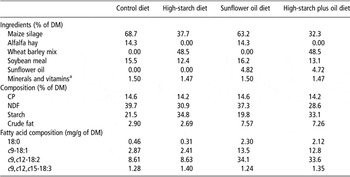
A total of four rumen-fistulated, non-lactating Holstein cows were assigned to a 4 × 4 Latin square design with four different diets during four periods. The control diet was a low-starch (21.5% on a dry matter (DM) basis) diet based on maize silage and soybean meal. In the high-starch diet, the starch content was increased to 34.8% using a mixture of ground wheat and barley. In the oil diet, 5% of the control diet was replaced with 5% of sunflower oil, and the high-starch plus oil diet was enriched with both wheat plus barley and sunflower oil. The composition of the diets is shown in Table 1. Each 4-week period consisted of 2 weeks with the control diet followed by 2 weeks with either control, high starch, oil or high-starch plus oil diet.
Ingredients and chemical composition of donor cow diets

DM = dry matter.
aContained (per kg of premix, DM basis) P: 40 g, Ca: 260 g, Mg: 50 g, Na: 20 g, Zn: 5 g, Mn: 4 g, Cu: 1 g, I: 40 mg, Co: 20 mg, Se: 20 mg, vitamin A: 450 000 IU, vitamin D3: 100 000 IU and vitamin E: 1500 IU.
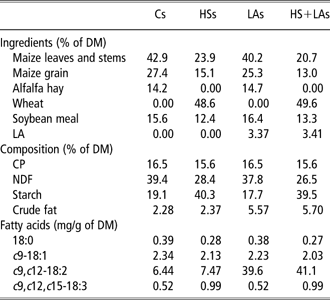
On day 27 of each period, 1 l of rumen fluid was collected from each cow before the morning meal, and strained through a metal sieve (1.6 mm mesh). The rumen fluids were transported quickly (30 min) to the laboratory in anaerobic conditions at 39°C. In the laboratory, the pH of the rumen fluids was measured and 100 ml of each sample was frozen. A total of four incubation substrates were used (2.7 g of DM per flask). They corresponded to the four diets, replacing maize silage with a mix of maize grain and maize leaves and stems, and sunflower oil by 99% pure LA (Sigma Co., St. Louis, MO, USA). The composition of substrates is given in Table 2. Each ruminal fluid was incubated with the four substrates.
Ingredients and chemical composition of the substrates of in vitro incubations
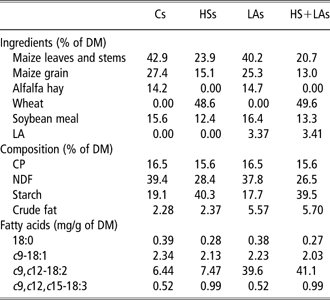
Cs = control substrate; HSs = high-starch substrate; LAs = linoleic acid substrate; HS+LAs = high-starch plus linoleic acid substrate; DM = dry matter; LA = linoleic acid.
A volume of 60 ml of each rumen fluid and 60 ml of a bicarbonate buffer solution (19.5 g/l of Na2HPO4⋅12H2O, 9.24 g/l of NaHCO3, 0.705 g/l of NaCl, 0.675 g/l of KCl, 0.108 g/l of CaCl2·2H2O and 0.180 g/l of MgSO4·7H2O) were placed into four 250-ml flasks containing the four different substrates. The buffer solution was pre-warmed to 39°C and saturated continuously with CO2. The pH of the solution was lowered to 6 with hydrochloric acid (6N) before being added to the 60 ml of rumen fluids. Next, the flasks were filled with CO2, closed with a rubber cap with a plastic tube leading into the water to vent fermentation gas without allowing the ingress of oxygen. This procedure may have changed the initial pH slightly, but pH was not checked again as incubation flasks were closed. Incubations were carried out at 39°C in a water-bath rotary shaker (Aquatron; Infors AG, 4103 Bottmingen, Germany). The flasks were stirred at 130 r.p.m. and kept safe from the light during incubation.
After 5 h, fermentations were stopped by placing the flasks in ice, and the pH was measured. The contents of the flasks were immediately frozen at −20°C. Samples of initial ruminal fluids and contents of the incubated flasks were freeze-dried (Virtis Freezemobile 25, Virtis, Gardiner, NY, USA), weighed, ground and homogenised in a ball mill (Dangoumau, Prolabo, Nogent-sur-Marne, France), and then stored at −20°C until analysis.
Chemical analysis
Chemical composition of feed was determined in accordance with the Association of Official Analytical Chemists (AOAC, 1998) procedures; NDF and ADF were determined according to the procedure of Van Soest et al. (Reference Van Soest, Robertson and Lewis1991).
The FA of rumen fluids, substrates and residues of incubation were extracted and methylated using the procedure of Park and Goins (Reference Park and Goins1994), except that the solution of 14% of boron trifluoride in methanol was replaced by a solution of methanolacetylchloride (10 : 1 v/v). Nonadecanoic acid (Sigma Co., St. Louis, MO, USA) was used as the internal standard at a dose of 0.8 mg.
FA methyl esters were quantified by gas chromatography (Agilent 6890N, equipped with a model 7683 auto injector, Network GC System, Palo Alto, CA, USA) using a fused silica capillary column (100 m × 0.25 mm ID, 0.20 μm film thickness; CPSil88, Varian, Middelburg, the Netherlands).
For analysis, the flame ionisation detector temperature was maintained at 260°C and the injector at 255°C; the split ratio was 1 : 50. Hydrogen was used as the carrier gas with a constant flow of 1 ml/min. The samples were injected in 1 μl of hexane. The initial temperature of the oven was 60°C, which was held for 2 min; it was then increased by 8°C/min to 150°C, held at 150°C for 12 min, further increased by 2°C/min to 175°C, held at 175°C for 20 min, increased by 5°C/min to 225°C, held at 225°C for 10 min, and finally increased by 10°C/min to 240°C and maintained at 240°C for 10 min. This temperature programme did not allow the separation of, c9,c12,c15-18:3 from 20:1 or of the t13,t14-18:1 from c9-18:1. Therefore, a second analysis was used to separate these coeluted FA. For this analysis, temperature of injection and detection were the same as in the first analysis. The split ratio was 1 : 75 and hydrogen was the carrier gas with a constant pressure of 150 kPa. The samples were injected in 1 μl of hexane. The initial oven temperature was 60°C, which was held for 3 min; it was then increased by 8°C/min to 190°C, held at 190°C for 13 min, further increased by 5°C/min to 225°C, held at 225°C for 10 min, and finally increased by 10°C/min to a temperature of 230°C, and maintained there for 10 min. Peaks were identified and quantified by comparison with commercial standards (Sigma Co., St. Louis, MO, USA) except 18:1 other than t9-18:1, t11-18:1 and c9-18:1, which were identified by the order of elution. The FA concentrations were expressed in mg per kg of DM.
Calculations
The balances of each FA were calculated as final (incubated flask)−initial (rumen fluid + substrate) percentages relative to total FA. Negative values represented FA disappearance and positive values FA accumulation.
The average rates (mg/l/h) and the efficiencies of LA isomerisation (v1 and E1, respectively), CLA reduction (v2 and E2, respectively) and trans-18:1 reduction (v3 and E3, respectively) for our 5 h incubations were calculated as previously described by Troegeler-Meynadier et al. (Reference Troegeler-Meynadier, Bret-Bennis and Enjalbert2006):

and

where 5 is the incubation time and [LA]b and [LA]e represent the concentrations of LA at the beginning and end of the 5-h incubation, respectively. E1 also represents the BH extent of LA:

and

where [CLA]b and [CLA]e represent the concentration of total CLA isomers measured at the beginning and end of the 5-h incubation, respectively:
![\[--><$$>\eqalignno{{\rm{v3}}\,{\rm{ = }}\,{\rm{([LA]b}}\,{\rm{ - }}\, {\rm{[LA]e}}\,{\rm{ + }}\,{\rm{[CLA]b}}\,{\rm{ - }}\,{\rm{[CLA]e}}\,\cr &\quad {\rm{ + }}\,{\rm{[}}trans{\rm{ \hbox{-} 18\!\!:\!\!1]b}}\,{\rm{ - }}\,{\rm{[}}trans{\rm{ \hbox{-} 18\!\!:\!\!1]e)/5}}\,\]} <$$><!--\]](https://static.cambridge.org/binary/version/id/urn:cambridge.org:id:binary:20160119061628585-0330:S1751731111001777_eqnU5.gif?pub-status=live)
and

where [trans-18:1]b and [trans-18:1]e represent the concentration of total trans-18:1 isomers measured at the beginning and end of the 5-h incubation period, respectively.
Statistical analysis
Data were analysed using the General Linear Model of SYSTAT (version 9, SPSS Inc., Chicago, IL, USA) and were reported as mean values with standard errors of the mean.
The pH, the total FA concentrations and the proportions of C18 FA in the rumen fluids were analysed using ANOVA according to the following model:

where μ is the mean, C, P, Sd and Ld are the effects of cow, period, high-starch v. low-starch diets and diets with sunflower oil v. diets without added oil, respectively, and ε is the residual error.
FA accumulation or disappearance, final pH, rates and efficiencies of BH reactions in vitro were analysed using ANOVA, according to the following model:

where Ss and Ls are the effects of high-starch v. low-starch in vitro substrates and in vitro substrates with LA v. substrates without LA, respectively. Differences were declared significant at P ⩽ 0.05.
Results
FA profiles of ruminal fluids from donor cows
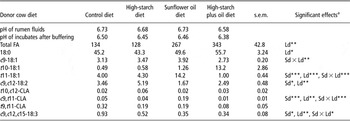
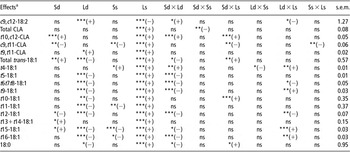
The FA composition of ruminal fluids was strongly affected by dietary starch level and oil supplementation. The ruminal fluids from cows receiving the high-starch diets supplemented with oil, contained numerically more trans-10 than trans-11 BH intermediates (Table 3). However, the effects of diet on t10,c12-CLA were not significant, and effects of dietary starch, dietary oil and their interaction only tended to be significant on t10-18:1 percentage (P = 0.078, P = 0.058 and P = 0.083, respectively).
Initial pH (before and after the addition of pH = 6 buffer solution), total FA amount (mg per flask) and C18 FA content (% of total FA) of the rumen fluids

FA = fatty acids.
*P < 0.05; **P < 0.01; ***P < 0.001.
aEffects: Sd = high-starch v. low-starch diets; Ld = diets with sunflower oil v. diets without added oil.
Effect of LA addition to the in vitro substrate
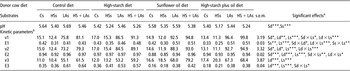
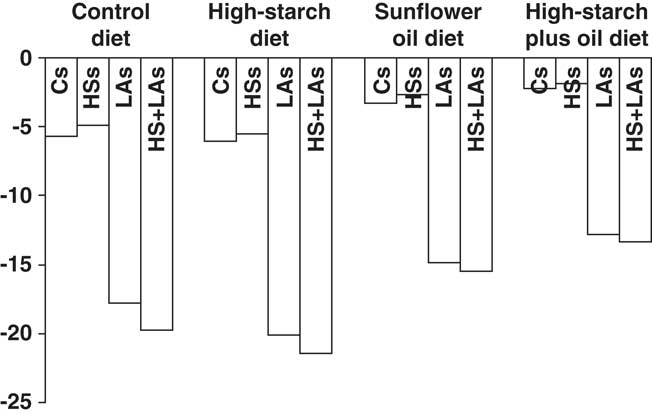
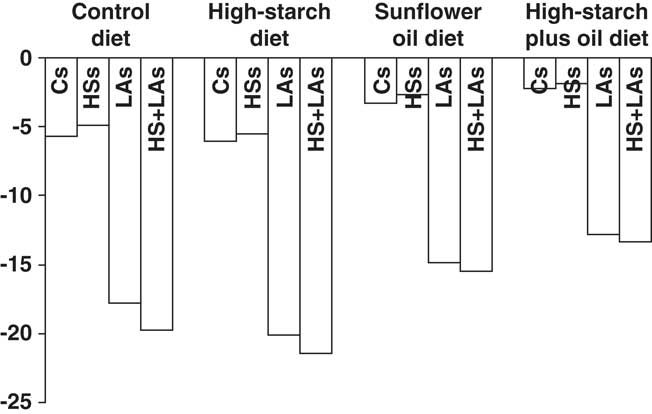
The addition of LA to the in vitro substrate caused an increase of rates and efficiencies throughout the BH chain (Table 4). The isomerisation was more efficient when LA was supplemented in the non-esterified form (48%, Table 4) as compared with the disappearance of LA, present in the cultures without LA addition (35%). Owing to a higher amount of LA in the incubation flasks, this efficiency increase was associated with a tremendous increase in the amount of LA disappearing per time unit (v1, 13.9 v. 89.8 mg/l/h) and of LA disappearance relative to total FA (17% v. 4%; Figure 1). In the same way, v2 was higher in the flasks with LA addition than in the flasks without LA; however, E2 was 92% without LA addition and 96% with LA addition (Table 4). For the final step leading to the formation of 18:0, v3 and E3 were also higher in cultures with LA compared with media without LA addition (64 v. 15 mg/l/h and 0.49 v. 0.27, respectively; Table 4).
Effect of donor cow diet and in vitro substrates on final pH and rates (mg/l/h) and efficiencies of the three reactions of LA BH during 5 h incubations

LA = linoleic acid; BH = biohydrogenation; Cs = control substrate; HSs = high-starch substrate; LAs = added linoleic acid substrate; HS+LAs = high-starch plus added linoleic acid substrate, CLA = conjugated linoleic acid.
*P < 0.05; **P < 0.01; ***P < 0.001.
aEffects: Sd = high-starch v. low-starch diets; Ld = diets with sunflower oil v. diets without added oil; Ss = high-starch v. low-starch substrates; Ls = substrates with LA v. substrates without LA added.
bv1 and E1 refer to the rate and efficiency of isomerisation of LA to CLA; v2 and E2 to those of the first reduction of CLA to trans-18:1; v3 and E3 to those of the second reduction of trans-18:1 to 18:0.
Effect of donor cow diet and in vitro substrates on the balance of c9,c12-18:2 (% of total fatty acids) after 5 h incubations (Cs = control substrate; HSs = high-starch substrate; LAs = added linoleic acid substrate; HS + LAs = high-starch plus added linoleic acid substrate).
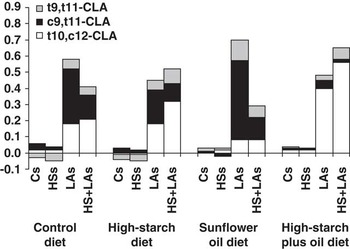
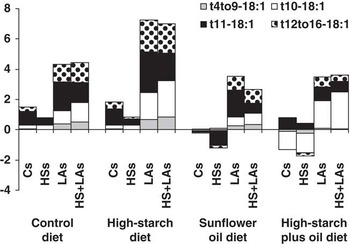
Regarding the different isomers (Figure 2), all the CLA balances were higher when pure LA was added to the cultures, with a marked effect on t10,c12-CLA whose accumulation was increased 25-fold. In the same way, addition of pure LA to incubation substrates led to a higher accumulation of all the trans-18:1 isomers (Figure 3).
Effect of donor cow diet and in vitro substrates on the balance of CLA isomers (% of total fatty acids) after 5 h incubations (Cs = control substrate; HSs = high-starch substrate; LAs = added linoleic acid substrate; HS + LAs = high-starch plus added linoleic acid substrate).

Effect of donor cow diet and in vitro substrates on the balance of trans-18:1 isomers (% of total fatty acids) after 5 h incubations (Cs = control substrate; HSs = high-starch substrate; LAs = added linoleic acid substrate; HS + LAs = high-starch plus added linoleic acid substrate).

Effect of starch addition to the in vitro substrate
The final pH was significantly lowered (P < 0.001) by the addition of starch to the substrate (Table 4). The addition of starch to the in vitro cultures had no effect on v1 and slightly decreased E1 from 44% to 39% (Table 4). The addition of starch had no effect on both reductions and on the accumulation of total CLA or total trans-18:1 (Table 5). Nevertheless, adding starch to incubations caused a decrease in the accumulation of c9,t11-CLA from 0.15% to 0.06% and of t11-18:1 from 1.23% to 0.61% (Figure 2), but had no effect on t10-18:1 isomers accumulation (Figure 3).
Effect of donor cow diet and in vitro substrates on the balances of FA (% of total FA) after 5 h incubations

FA = fatty acids; LA = linoleic acid.
*P < 0.05; **P < 0.01; ***P < 0.001.
ns, P > 0.05.
(+) increase.
(−) decrease.
aEffects: Sd = high-starch v. low-starch diets; Ld = diets with sunflower oil v. diets without added oil; Ss = high-starch v. low-starch substrates; Ls = substrates with LA v. substrates without LA added.
Effect of sunflower oil addition to the diet
When donor cows were fed sunflower oil, v1 slightly increased compared with that in flasks incubated from cows that did not receive oil (54 v. 49 mg/l/h; Table 4); however, the disappearance of LA significantly decreased from 13% to 8% (Figure 1). The v2 and v3 rates were slightly increased by the addition of sunflower oil to the diet, whereas E2 and E3 were slightly decreased (Table 4).
As reported in Table 5, the accumulation of total CLA in vitro did not change in response to the addition of oil to the diet except for t9,t11-CLA (P < 0.05), which slightly increased (Figure 2). The accumulation of total trans-18:1 decreased by 2.7 times (Figure 3) when cows received sunflower oil compared with others.
Effect of starch addition to the diet
The addition of starch to the diet affected the final pH of in vitro cultures (Table 4); pH was lower with rumen content from the high-starch diet cows than with rumen content from the low-starch diet cows (5.3 v. 5.5). The v1 and v2 slightly increased (Table 4) for the high-starch diets compared with the low-starch diets (P < 0.05). The E2 efficiency was also slightly increased (93% v. 95%); however, E1 was not affected (Table 4). The third reaction was not affected (Table 4). The addition of starch to the diets of donor cows affected neither the disappearance of LA nor the accumulation of total CLA, and slightly increased the accumulation of total trans-18:1 : +2.8% v. +2% when donor cows received low-starch diets (Figure 3). High-starch diets resulted in higher t10,c12-CLA, but lower c9,t11-CLA accumulation than low-starch diets (Figure 2). Regarding trans-18:1 isomers, the amount of starch in donor cow diets did not affect t10 or t11-18:1 accumulation (Table 5).
Effect of interactions
There were several interactions between the different factors either for the donor cow diets or the in vitro substrates. The main interactions were between starch and sunflower oil addition to the diet of cows, and between starch or oil addition to the diet of animals on the one hand and LA addition to the incubation substrate on the other.
Increasing dietary starch increased E1 when diets did not contain oil, but decreased E1 when they did. The addition of LA to the substrate more strongly increased E1 when the donor cows received oil (Table 4). As a result of this latter interaction (Ld × Ls), E1 was highest in cultures with added LA, and incubated with rumen fluid from cows receiving sunflower oil. The addition of starch to the substrate interacted with LA addition (Ss × Ls), resulting in lowest E1 values in high-starch cultures without added LA (Table 4).
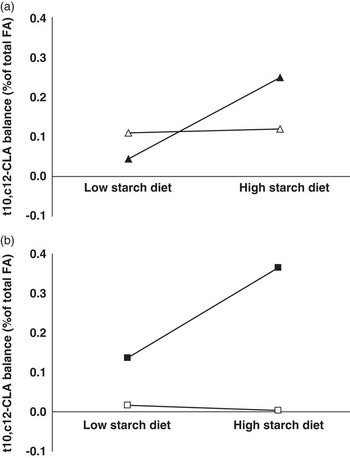
Interactions affected the CLA accumulation, but differently according to the isomers. High-starch diets or substrates resulted in a strong decrease of c9,t11-CLA accumulation in incubates with added LA, but had little effect on this balance in cultures without added LA, so that the highest balances were observed in LA-added cultures incubated with the rumen fluid of cows receiving low-starch diets (0.3% v. 0.1%; Figure 2). In contrast, dietary starch level interacted with the addition of sunflower oil to the diet (Sd × Ld) and LA in the substrate (Sd × Ls), increasing the accumulation of t10,c12-CLA only when the cows received sunflower oil or when LA was added to the substrate (Figure 4). This resulted in the highest t10,c12-CLA balances in cultures with rumen fluid from cows receiving high-starch diets with oil incubated with added LA.
Effect of the interaction between the amount of starch in the diet and the addition of sunflower oil (SFO) to the diet (a; Δ, without SFO; ▴, with SFO) or linoleic acid (LA) addition to the substrate (b; □, without LA; ▪, with LA) on the t10,c12-CLA accumulation (% of total fatty acids, FA).

The increase in v2 when LA was added to the substrate was greater when the diet of donor cows contained sunflower oil compared with diets without oil (Table 4). The same interaction affected E2, which was lowered by low-starch diets only when the culture substrate did not contain added LA (Table 4).
The increase in trans-18:1 balance with the addition of dietary starch was observed only when cows received the diets without added oil (Figure 3). This effect was observed on the accumulation of almost all the minor isomers except t13+t14-18:1, but not on t10 and t11-18:1. The second strong interaction for the trans-18:1 balance was noticed between dietary starch level and LA addition in cultures (Sd × Ls; Table 5); high-starch diets lowered this balance in cultures without LA, but increased it in cultures with LA (Figure 3). Among individual trans-18:1 isomers, this interaction (Sd × Ls) only affected t10-18:1 (Table 5). As a result of these two interactions, total trans-18:1 accumulation was the highest in cultures with rumen fluid from cows fed with high-starch diets without sunflower oil supplementation incubated with LA added to the substrate (Figure 3). The accumulation of t11-18:1 was not affected by interactions (Table 5).
For the final step, leading to the formation of 18:0, no significant interaction was observed for v3 (Table 4). Dietary starch level interacted with LA addition to the substrate (Sd × Ls) leading to the highest E3 with low-starch diets and LA in the substrate (Table 4). The interaction between dietary starch level and incubated LA (Sd × Ls) led to the highest 18:0 production in cultures with rumen fluid from cows fed with high-starch diets incubated with LA added to the in vitro substrate (Table 5).
Discussion
FA profile of ruminal fluids from donor cows
The wide range of proportions of trans-10 to trans-11 BH intermediates in the ruminal fluid from cows receiving the four different diets made it possible to investigate the in vitro effects of the modulation of ruminal activity by the diet of cows. More specifically, cows receiving the high-starch diet supplemented with oil exhibited a trans-10 shift, suggesting a different equilibrium between biohydrogenating bacteria. However, samples were taken just before the morning meal, that is, 15 h after the evening meal, which could fail to reveal all the possible effects of the experimental diets, so that we will not further discuss the compositions of ruminal fluids in this study.
Rates and efficiencies of BH reactions
The addition of LA to the substrate increased v1 and E1, leading to increases in LA disappearance and total CLA accumulation. Troegeler-Meynadier et al. (Reference Troegeler-Meynadier, Nicot, Bayourthe, Moncoulon and Enjalbert2003) showed that increasing LA concentrations (from 100 to 300 mg of LA in 160 ml flasks, carried by soybean oil), decreased the LA BH efficiency, but increased the amount of LA that disappeared, suggesting a limit of the capacity of isomerisation rather than an inhibition. In our case, 90 mg of LA were added to 120 ml cultures as free FA. This relatively small amount of LA could explain why no saturation of the isomerisation was observed; moreover no lipolysis was necessary before BH as pure LA was directly available for the enzyme.
Dietary starch level did not affect E1 and the lowest E1 (0.25) was observed in the cultures with high-starch substrate without LA addition, and when the rumen fluids were collected from cows fed with high starch plus sunflower oil. Table 4 shows that the lowest final pH (5.17) corresponded to this lowest E1. A linear relationship between these two parameters suggested that the E1 variations could be partly due to pH (r = 0.44; P < 0.01). Van Nevel and Demeyer (Reference Van Nevel and Demeyer1996), using an esterified source of FA, showed that the disappearance of LA liberated by lipolysis, was 80% when the pH was 5.5, but decreased to 60% at pH = 5.2.
The addition of LA to the substrate increased v2 and significantly increased E2, but only by 3%, suggesting that the increase in v2 could simply be the result of the rapid isomerisation because of the availability of the substrate, as LA was in the unesterified form in our experiment. The addition of LA to the substrate increased v3 and E3, leading to a greater accumulation of 18:0. It has already been reported that concentrations of LA exceeding 1.0 mg/ml of culture contents interfere with the second reduction, leading to the accumulation of trans-18:1 at the expense of 18:0 (Harfoot et al., Reference Harfoot, Noble and Moore1973). In our case, the amount of LA added to the substrate was 0.75 mg/ml so that no reduction of v3 was expected. The addition of sunflower oil to the diet of cows led to an increase of v3 as for v1 and v2, but to a decrease of E3. The v3 rate was increased by dietary oil because more trans-18:1 FA, which are the substrates of this reduction, were produced by the previous reactions. Nevertheless, this reaction was less efficient, which suggests a saturation of the second reduction.
Isomeric profile of CLA and trans-18:1
The accumulation of c9,t11-CLA was decreased when the starch level increased in the diet or the substrate. The accumulation of t11-18:1 was only significantly affected by starch in the substrate, but high dietary starch level also tended (P = 0.063) to decrease this accumulation. Indeed, it is well established that t11-18:1 is an intermediate of LA metabolism by isolates of Butyrivibrio fibrisolvens (Wallace et al., Reference Wallace, McKain, Shingfield and Devillard2007), and feeding high-grain diets to steers has been shown to cause a rapid decline of this bacteria (Klieve et al., Reference Klieve, Hennessy, Ouwerkerk, Forster, Mackie and Attwood2003). In our experiment, its growth and/or its activity could have decreased when the media was rich in starch. Moreover, when starch was added to the diet or the substrate, the pH was lowered. Although this precludes any definitive separation between the effects of starch and pH, an effect of pH is consistent with the observations of Troegeler-Meynadier et al. (Reference Troegeler-Meynadier, Nicot, Bayourthe, Moncoulon and Enjalbert2003), and might be related to a decrease in the activity of Δ12-isomerases produced by B. fibrisolvens, whose optimal pH is 7.0 to 7.2 (Kepler and Tove, Reference Kepler and Tove1967). Consequently, to boost the Δ12-isomerisation, a preliminary selection of a trans-11 BH microflora by a low-starch diet is necessary, and addition of LA in the culture, both acting as a BH substrate and increasing E1, optimises the trans-11 isomers balance.
The t10,c12-CLA is formed during LA BH and is usually at low concentrations in digesta and milk of cows (Offer et al., Reference Offer, Marsden and Phipps2001; Shingfield et al., Reference Shingfield, Ahvenjärvi, Toivonen, Ärölä, Nurmela, Huhtanen and Griinari2003). It can accumulate under certain dietary conditions, such as diets based on maize silage containing high-starch content and supplemented with oil (Loor et al., Reference Loor, Ueda, Ferlay, Chilliard and Doreau2004; Pottier et al., Reference Pottier, Focant, Debier, De Buysser, Goffe, Mignolet, Froidmont and Larondelle2006). Our results showed a significant positive effect of dietary starch level on t10,c12-CLA accumulation in vitro. Similarly, in the experiment of Piperova et al. (Reference Piperova, Sampugna, Teter, Kalscheur, Yurawecz, Ku, Morehouse and Erdman2002), increasing the level of concentrate in the diet increased t10,c12 CLA in the duodenum. Few bacterial species such as Propionibacterium acnes (Verhulst et al., Reference Verhulst, Janssen, Parmentier and Eyssen1987; Devillard et al., Reference Devillard, McIntosh, Newbold and Wallace2006) and/or Megasphaera elsdenii (Kim et al., Reference Kim, Liu, Rychlik and Russell2002) are known to synthesise t10,c12-CLA from LA, but the involvement of other bacteria is possible. The more probable hypothesis for explaining our observed increase of t10,c12-CLA when the dietary starch level was increased is a selection by the fermentative substrate and/or by a low ruminal pH, inducing a better growth and/or activity of bacteria producing trans-10 isomers, or a change of BH pathway from trans-11 to trans-10 isomers without change of biohydrogenating bacteria.
In cultures with added LA, the decrease in c9,t11-CLA balance caused by a high-starch level in the substrate was compensated by an increased t10,c12-CLA balance, therefore E1 was not affected, and similarly the decreased t11-18:1 balance was compensated by an increased t10-18:1 balance. These compensatory mechanisms with high LA substrates could be because of the toxicity of unsaturated FA for rumen bacteria (Maia et al., Reference Maia, Chaudhary, Bestwick, Richardson, McKain, Larson, Graham and Wallace2010), the ecosystem having to maintain its ability to BH even when the isomerisation through the trans-11 pathway is inhibited. This adaptation of the ecosystem was also probably encountered in the rumen of cows receiving the high-starch plus oil diet, as incubation of their ruminal fluids resulted in the highest t10,c12-CLA accumulation in vitro (Figures 2 and 4A), and the highest E1 (0.51) with LA addition. This diet also resulted in a high accumulation of trans-10 isomers in cultures with LA when a low-starch substrate was used, which means that the bacteria involved in trans-10 BH remained active, at least for a few hours, in a low-starch medium. On the contrary, without LA in the substrate, addition of starch to the substrate decreased, either directly or via a lowered pH, the accumulation of c9,t11-CLA; however, it only slightly increased the accumulation of t10,c12-CLA, resulting in a decreased E1, and suggesting that the low amount of unsaturated FA did not imply a compensation of the low trans-11 BH. Consequently, to boost the Δ9-isomerisation, a preliminary selection of a trans-10 BH microbiota by high-starch plus sunflower oil diet was necessary, with an addition of LA in the cultures as a substrate.
Conclusion
The shift from trans-11 to trans-10 FA after 5 h of in vitro incubation was related to both the diet of donor cow and the in vitro substrates. An increase in trans-10 isomers balance was not observed when the culture substrates did not contain added LA. High-starch diets resulted in an increase of trans-10 isomers balance in vitro. This increase was most important with high-starch plus sunflower oil diet, which also resulted in a drastic decrease of trans-11 isomers balance. This situation shows that the addition of an unsaturated oil to the diet caused an adaptation of the microorganisms in the rumen of cows in order to increase the ability of BH, by an increase in the number of competent bacteria and/or their activity. This adaptation resulted in an increase in trans-10 BH when conditions altered the efficiency of trans-11 BH. Further investigations on the microbial ecosystem with high-starch diets supplemented with unsaturated oil are necessary to understand the microbial modifications affecting the isomeric profile of BH intermediates.
Acknowledgements
The authors thank M.L. Chemit and the staff at the experimental station (UMR 1289 Tandem).