Introduction
This article deals with the gendered features of familialism in Turkey within a broader Mediterranean context that extends beyond southern Europe. It does so by exploring the link between the expansion of early childhood education and care (ECEC) and women’s labor market participation from a comparative perspective. The concept of “family resemblance” is utilized in the analysis following Gal’s (Reference Gal2010) suggestion of an extended family of Mediterranean welfare states. The notion of “family resemblance” suggests a versatile comparative approach that addresses both affinities and disparities concerning the institutional, social, and cultural dimensions within the realm of resembling regimes (Ferrera Reference Ferrera2016; Therborn Reference Therborn and Castles1993). Accordingly, transformations pertaining to the gender contract and preschool developments in Spain, Italy, Greece, and Israel are included as a shadow comparison to contextualize policy changes in Turkey.
Since the 1990s, social and political changes in Mediterranean Europe have laid the foundation for the transformation of familialist models. A major challenge that confronted familialist regimes was the rise in women’s labor market participation, which shifted traditional gender roles. This process is commonly referred to as the “gender revolution” in the literature (Hochschild and Machung Reference Hochschild and Machung1990). Another key aspect of the transformations in southern Europe was the expansion of ECEC services and the concomitant remarkable increase in ECEC enrolment rates. The existing body of literature provides evidence that the education policies aimed at the expansion of ECEC in southern Europe have had a positive impact on supporting women’s participation in the labor market (Arnlaug et al. Reference Arnlaug, Constanzo, Trifiletti, Gerhard, Knijn and Weckwert2005; Morgan Reference Morgan, Morel, Palier and Palme2012; OECD 2017).
Turkey missed the critical juncture of the 1990s’ transformative changes in the region, as evident in the low rates of female employment and below-the- Organisation for Economic Co-operation and Development (OECD)-average preschool enrolment. The persistently low rates of women’s labor market participation in Turkey, when compared to other countries in the region, have garnered attention in academic research. This phenomenon is often referred to as the “Turkish puzzle.” The salient gendered division of labor and culturally imposed gender roles in Turkey have been highlighted as major factors explaining the low levels of labor market participation of women (Karaalp-Orhan Reference Karaalp-Orhan2017). Such cultural explanations have been put forward to account for women’s low labor market participation in the Middle East and North Africa (MENA) region (Aybars and Tsarouhas Reference Aybars and Tsarouhas2010). Yet, women’s labor market participation is a complex phenomenon that is affected by several economic, social, and political factors, including the pace of industrialization, the labor market structure, care arrangements, cultural perceptions of gender roles, the position of political parties, and other immanent factors that shape the welfare model of a country (Bölükbaşı and Kutlu Reference Bölükbaşı and Kutlu2019; Buğra and Özkan 2012; İlkkaracan Reference İlkkaracan2012). In different contexts, women’s labor market participation trajectories have been shaped by a combination of diverse factors. Bölükbaşı and Kutlu (Reference Bölükbaşı and Kutlu2019) argue that in southern Europe, the combination of left-wing parties’ presence in government, the expansion of the service sector, and the rise in women’s tertiary education supported the increase in women’s labor market participation in the 1990s.
In Turkey, particularly the prevalence of informality in the labor market and women’s high representation in informal jobs in the sectors such as textile and food processing have shaped the terms of women’s labor market participation (Toksöz Reference Toksöz2016). There is also a prevalent perception that women’s employment is temporary (until they get married), and employment is often seen as a choice for single women rather than married ones. Young women with children are the most disadvantaged in accessing the labor market (Akkan and Serim Reference Akkan and Serim2018). A recent study demonstrates that while the labor market participation rate of women without children is 34 percent, it decreases to 24 percent for women who have a young child (Dedeoğlu et al. Reference Dedeoğlu, Adar and Sıralı2021). Until the early 2000s, the government demonstrated a lack of concern for women’s labor market participation and implicitly supported the gendered division of labor, thereby perpetuating the role of women as homemakers. Moreover, the absence of publicly funded ECEC services has contributed to the low levels of women’s labor market participation (Dedeoğlu et al. Reference Dedeoğlu, Adar and Sıralı2021). It was in the 2000s that ECEC started to expand; however, this expansion is primarily driven by market-based services (Atasü-Topçuoğlu Reference Atasü-Topcuoğlu2016).
There is a noticeable class divide between the relatively higher rates of labor market participation of women with university education and the low participation rates of the overall female population. Accordingly, the gendered implications of the change and continuity of the familialist regime in Turkey can be better understood by considering social class, with the level of education being a significant component of class differentials. Studies examining care arrangements have also provided insights into the class dimension of the gendered welfare regime in Turkey, highlighting the intersection of gender and class in determining the effects of the family-focused social policies on women from low socio-economic groups (Akkan Reference Akkan2018; Atasü-Topçuoğlu Reference Atasü-Topçuoğlu2022). In exploring the relationship between ECEC and women’s employment within a familialist context, it is crucial to address the intertwinement of class and gender.
In this framework, the article first provides an overview of the Mediterranean model with a focus on highlighting its familialist features that are prevalent across the region. Following this, the article explores the relationship between the transformations in women’s labor market participation, the gender equality framework and ECEC from a comparative perspective.
Mediterranean welfare context
The Mediterranean model has often been characterized as a corporatist social protection system with hierarchical and fragmented features alongside the inclusion of social assistance provisions of a clientelist nature (Ferrera Reference Ferrera1996; Gal Reference Gal2010; Gough Reference Gough1996; Leibfried Reference Leibfried, Ferge and Kolberg1992; Saraceno Reference Saraceno2002). The countries in southern Europe not only share the characteristics of this corporatist regime but also demonstrate a “family resemblance” in terms of the normative construction of the family within their respective societies (Anttonen and Sipila Reference Anttonen and Sipila1996; Bettio and Plantenga Reference Bettio and Plantenga2004; Da Roit Reference Da Roit2010; Ferrera Reference Ferrera1996; Leitner Reference Leitner2010; Naldini Reference Naldini2003; Saraceno and Keck Reference Saraceno and Keck2010). This is commonly referred to as familialism (Leitner Reference Leitner2010; Saraceno Reference Saraceno2016). Various studies highlight that Turkey shares the institutional characteristics associated with the familialist regime (Buğra Reference Buğra, Buğra and Özkan2012; Buğra and Keyder Reference Buğra and Keyder2006; Gal Reference Gal2010; Gough Reference Gough1996). It is important to note that, despite sharing commonalities in terms of welfare state development, Turkey has not attained the same level of economic development achieved by the southern European countries (Buğra and Özkan Reference Buğra and Özkan2012). This has consequences for labor market expansion and possibly public expenditures allocated to ECEC. Another significant factor that sets Turkey apart from southern Europe is the large number of workers in the informal sector. In the 2000s, while informality in the labor market decreased in Turkey, there was a simultaneous increase in women’s participation in informal jobs. The jobs created in the 2000s for women were mostly irregular jobs without any social security benefits (Atasü-Topçuoğlu Reference Atasü-Topçuoğlu2022).
Since the 1980s, the Europeanization process has led southern European welfare states to move closer to the continental model, and it is debated today whether we can consider a distinct Mediterranean welfare regime with its unique features (Leon and Migliavacca Reference Leon and Migliavacca2013). In the 1990s and early 2000s, Turkey demonstrated a degree of responsiveness to the process of Europeanization as a result of its prolonged European Union (EU) candidate status (Müftüler-Baç Reference Müftüler Baç2009). However, Turkey has emerged as more of an outlier in the region due to its backsliding in democratic politics (Arat Reference Arat2021). More recently, Turkey’s withdrawal from the İstanbul Convention (the Council of Europe Convention on Preventing and Combatting Violence against Women and Domestic Violence) in 2021 has resulted in a setback of gender rights in general.
Within its welfare regime, Turkey has implemented significant policy transformations since the 1990s. Reforms were put into effect with the objective of unifying the previously fragmented pensions, social security, and healthcare systems, resulting in a unified social security system and general health insurance (Buğra and Candaş Reference Buğra and Candaş2011; Yılmaz Reference Yılmaz2017). In the 2000s, work and family reconciliation policies, including flexible forms of work, were introduced to support women’s labor market participation (Akkan Reference Akkan2018). However, in a context where women participate in the informal sector, and their participation in the labor market is still seen as a secondary matter, the newly introduced policies have hardly functioned as work and family reconciliation mechanisms (Akkan and Serim Reference Akkan and Serim2018). It was also in the 2000s that the country introduced policy initiatives aiming at the expansion of market-based ECEC services.
What does this all mean for gender equality and class relations in Turkey within a broader Mediterranean context? In understanding the transformations in Turkey, we refer to institutionalized familialism (intergenerational care provided by women) as a salient feature of the Mediterranean model, which characterizes the social policies targeting women (Saraceno Reference Saraceno2010). The main characteristic of this model is the presence of “strictly and normatively controlled intergenerational relations” (Reher Reference Reher1998, 211), prescribed by family laws that assign to the family the responsibility for caring for descendants and ascendants (Knijn and Saraceno Reference Knijn and Saraceno2010; Saraceno Reference Saraceno, Kessler-Harris and Vaudagna2017). The Mediterranean model’s emphasis on family-based care has resulted in the development of a residual social policy area. The notion of family as the primary caregiver has established the normative basis for residualism. While the familialist discourses have justified such residual character of social policies (Leon and Pavolini Reference Leon and Pavolini2014; Valiente Reference Valiente, Scheiwe and Willekens2009), the low level of public support provided to families has created a paradox referred to as the “familialistic bias” (Da Roit Reference Da Roit2010; Naldini Reference Naldini2003). Regardless of the resemblances, the Mediterranean model is neither static nor homogeneous; throughout the 1990s and 2000s, southern welfare regimes have adapted their social policies in response to various factors, including the increase in women’s labor market participation and the influence of the EU regulations concerning childcare. The variations observed in Mediterranean welfare regimes offer valuable insights into understanding gendered aspects of familialism in Turkey.
Transformations in women’s labor force participation and the gender equality framework
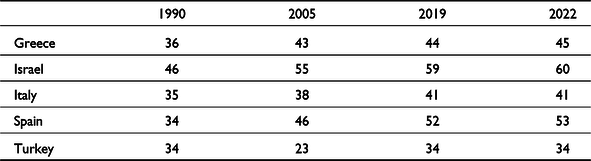
According to the latest figure (June 2022), the women’s labor force participation rate stands at 35.5 percent (TÜİK 2022). That is, only about one-third of women aged 15 years and above are participating in the (formal) labor market. This is the lowest rate, compared to southern European countries and Israel. The COVID-19 pandemic has further deteriorated women’s labor market participation in Turkey (Gürsel et al. Reference Gürsel, Uysal and Şahin2020).
When examining the historical trends in women’s labor market participation, it is notable that Spain, which had similar levels to Turkey in 1990, has made significant progress towards the rise of the female labor force over the past 25 years. By 2019, over half of Spanish women were employed. Jobs created in the 1990s, particularly in the service sector, were predominantly taken up by women, leading to a transformation in gender relations within Spanish society (Salido and Moreno Reference Salido, Moreno, Buğra and Özkan2012). Israel is also a noteworthy case where service jobs in the public sector were extended. As a result, there was a rapid increase in women’s labor force participation, reaching a level of 60 percent by 2019 (Stier and Yaish Reference Stier and Yaish2008).
In contrast to this Mediterranean trend, Turkey has witnessed a decrease in women’s labor market participation throughout the 1990s (see Table 1). In contrast to Spain, for instance, the dynamics of industrialization did not generate job opportunities for women in the manufacturing and service sectors in urban areas when the agricultural sector dissolved (Buğra and Özkan Reference Buğra and Özkan2012). Turkey has not followed a similar path of investing in service sectors or public services as a means to create jobs for women. One possible explanation could be attributed to the relatively lower proportion of highly skilled women in Turkey. Furthermore, in Turkey, women have encountered difficult conditions in gender-blind labor markets where the absence of family and work reconciliation policies exacerbated the situation (Buğra and Yakut-Çakar Reference Buğra and Yakut-Çakar2010).
Labor force participation rate (%) of women (15+ years) (International Labour Organization estimate)

Source: International Labour Organization (2023).
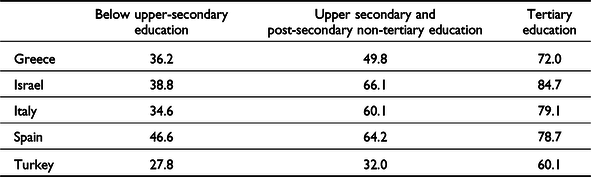
In all Mediterranean countries, women’s employment is determined by their higher educational levels, although to a lesser extent in Portugal (Salido and Moreno Reference Salido, Moreno, Buğra and Özkan2012). The employment rate of women (25–64 years) with tertiary education in Turkey stands at 60 percent, which is still below the levels observed in other Mediterranean countries (see Table 2). In Turkey the rate of women aged 25-34 years with tertiary education degree was 41.7 percent in 2021, which is lower than the OECD average of 53.7 percent (OECD 2023). However, considering that the rate of women aged 55-64 years with a tertiary education degree was only 8.4 percent (OECD 2023), it is evident that there has been a rapid increase in educational attainment within a single generation. Although tertiary education might be a necessary condition for accessing jobs, it is not sufficient on its own. Only two-thirds of university-educated women in Turkey are employed, which is the lowest rate in the Mediterranean region (see Table 2). While the number of women with a university degree is on the rise, there has also been a simultaneous increase in the proportion of young women with tertiary education who are among the long-term unemployed (Gürsel and Şahin Reference Gürsel and Şahin2020).
Employment rate (%) of women by educational attainment (25- to 64-year-olds), 2021

Source: OECD (2022b).
The gendered division of labor within households coupled with weak institutionalization of public childcare services can also be identified as one of the underlying causes of the low labor force participation of women in Turkey. The OECD estimates that women in the Mediterranean countries spend an average of over 4 hours per day on unpaid work. Men, in contrast, spend between 1.5 and 2.5 hours on these activities.Footnote 1 Women bear a disproportionately high burden of unpaid work in Turkey. Women spend 5 hours per day on unpaid work, whereas men spend around 1 hour per day.Footnote 2 The COVID-19 pandemic exacerbated this trend as families faced the loss of access to childcare services, education facilities, and intergenerational support (İlkkaracan and Memiş Reference İlkkaracan and Memiş2021).
Childcare services play a crucial role in alleviating the care burden on women and have a positive effect on women’s participation in paid work. A recent study has demonstrated that utilizing childcare services doubled the chances of women finding employment (Ekiz Gökmen Reference Ekiz Gökmen2022). Since the 1980s, the absence of policies that support public childcare has resulted in a predominant focus on promoting market-driven childcare services which are accessible to higher-income families (Akkan Reference Akkan2018; Dedeoğlu et al. Reference Dedeoğlu, Adar and Sıralı2021). Lower- and middle-income families face difficulties in affording childcare services or employing additional household help.
Developments in gender equality frameworks
The Europeanization process, characterized by the adaptation of EU standards through structural changes, played a significant role in shaping the transformations in gender politics in southern Europe (Featherstone and Kazamias Reference Featherstone and Kazamias2000). As early as the 1970s and 1980s, the EU introduced directives on equal pay for similar work, equal pension schemes, and equal treatment, which created more work opportunities, income security, pensions, and labor protection for women in many member states (Sainsbury Reference Sainsbury1999). In 1992, the EU took a significant step in adopting the “Recommendation on Childcare,” signaling its involvement in childcare policy. In 2002, the EU introduced specific targets for childcare commonly known as “the Barcelona targets” which were further supported by a policy framework outlined in the Commission’s 2008 document concerning implementation of the Barcelona objectives concerning childcare facilities for preschool-age children (European Commission 2013). Hence, the implementation of these targets is at the discretion of individual member states and depends on the governing political constellation.
In the region, throughout the 1980s and the 1990s, legislative changes laid the foundation for reforms in family law and equal opportunity (Gonzales et al. Reference Gonzales, Jurado, Naldini, Gonzales, Jurado and Naldini2000). Spain is a noteworthy case in this regard. In the democratization process in Spain throughout the 1980s, the introduction of anti-discrimination and gender equality legislation challenged the patriarchal character of the state (Leon and Migliavacca Reference Leon and Migliavacca2013). Over time, Spain has made progress towards adopting a more egalitarian approach to the gendered division of labor (Saraceno Reference Saraceno, Kessler-Harris and Vaudagna2017). In 2005, the reform in the Civil Code introduced an egalitarian understanding of the division of labor in the family. This reform mandated that spouses share domestic responsibilities as well as the care of ascendants and descendants (Naldini and Guerrero Reference Naldini and Guerrero2013). There is an ongoing discussion in the literature that suggests that the transformation of Spanish familialism has been more progressive compared to that of Italy (Knijn and Saraceno Reference Knijn and Saraceno2010; Saraceno Reference Saraceno2016). An argument is being made that Italy displays reluctance to implement changes in family law and welfare policies that could potentially result in a transformation of intergenerational and gender dependencies (Knijn and Saraceno Reference Knijn and Saraceno2010). A recent study highlights the growing impact of anti-gender movements on the gender regime change, which helps to explain the differences between Spain and Italy (Alonso et al. Reference Alonso, Ciccia and Lombardo2023). The striking comparison between Italy and Spain highlights how the varying degrees of reluctance or progressiveness in implementing reforms within the gender equality framework can result in distinct paths in the transformation of familialism. In Greece, EU membership had a significant impact on its gender equality framework. The adoption of gender equality measures into national law resulted in positive changes in the educational attainment of young women and their aspirations for employment (Karmessini Reference Karamessini, Buğra and Özkan2012).
In Israel, a series of legal and policy changes have contributed to the establishment of a robust gender equality framework and improvements in women’s status in society (Ajzenstadt and Gal Reference Ajzenstadt and Gal2001). Israel introduced changes in gender equality legislation in the 1990s. With these changes, the state recognized the economic contribution of women through unpaid care work, and an equal rights law adopted in 2000 accorded equal rights in all aspects of life, including education, employment, healthcare, housing, and social welfare (Ajzenstadt and Gal Reference Ajzenstadt and Gal2001). Transformations in Israel took place independently of the Europeanization process. However, if we consider Europeanization as a normative framework rather than a requirement for EU membership, gender equality developments in Israel demonstrate a similar Europeanization trend.
Following Turkey’s candidacy to the EU, legislation was Europeanized to a certain extent, and important steps towards gender equality were taken as part of its EU accession process (Dedeoğlu Reference Dedeoğlu2012). In 2001, revisions were made to the Civil Code, and in 2005 a new Penal Code was adopted. The amendments made to the Civil Code provided equal status for the husband and wife in the family unit and abolished the notion of the “head of the family,” which was present in previous legislation. It also introduced a new matrimonial property regime that, in the event of divorce, required equal distribution of property acquired during the marriage. While the changes opened the way for an equality framework, the process of European integration played a significant role in supporting the women’s movement in their efforts to advocate for democratic reforms (Dedeoğlu Reference Dedeoğlu2013). In 2003, a new Labor Code was adopted. The new code enforced equal treatment and anti-discrimination measures in the labor market and introduced the principle of “equal pay for equal work.” As part of the Europeanization process, progressive steps were taken in the first decade of the 2000s. In the last decade, Turkey’s gender equality framework has come under threat from the ideological instrumentalization of familialism, which is evident in the political discourses promoting conservative gender roles in society (Akkan Reference Akkan2021). The expanding body of literature on the gender regime change in Turkey demonstrates how neo-conservatism and neo-liberalism converge in ways that pose a threat to gender rights (Acar and Altunok Reference Acar and Altunok2013; Arat Reference Arat2021; Coşar and Özcan-Kerestecioğlu Reference Coşar and Özkan-Kerestecioğlu2017).
Transformations in early childhood education and care
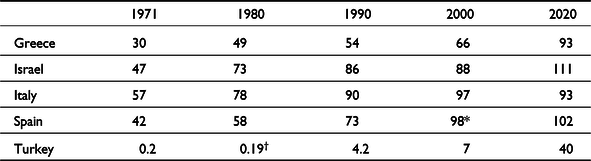
In the Mediterranean context, in conjunction with the transformations of the gender regime, there has been a significant expansion in preschool education services and a rise in enrolment rates since the 1980s. Italy and Israel experienced rapid increases in preschool enrolment in the 1980s (see Table 3). Similarly, Spain caught up with this trend in the 1990s (Arnlaug et al. Reference Arnlaug, Constanzo, Trifiletti, Gerhard, Knijn and Weckwert2005).
Gross enrolment rates (%) in pre-primary education, 1971–2020

Source: UNESCO Institute for Statistics (2023).
* For the year 2013.
† For the year 1981.
In Italy, already in the 1970s, over half of preschool children were enrolled in ECEC, followed in the 1980s by Israel and in the 1990s by Spain and Greece (Arnlaug et al. Reference Arnlaug, Constanzo, Trifiletti, Gerhard, Knijn and Weckwert2005; Ibanez and Leon Reference Ibanez, Leon and Leon2014; Leon and Pavolini Reference Leon and Pavolini2014; Rosenthal Reference Rosenthal, Melhuish and Petrogiannis2006). In both Israel and Italy, a majority of preschool children were enrolled in public or publicly subsidized preschool education in the 1980s, followed by Spain in the 1990s and Greece in the 2000s (Leon and Migliavacca Reference Leon and Migliavacca2013; Leon and Pavolini Reference Leon and Pavolini2014). In Italy, a law dating back to 1968 mandated the state’s responsibility for preschools. Before this law, preschools were run by charitable organizations and municipalities. In the early 1990s, preschool education was made universal and integrated into the education system in Italy (Hohnerlein Reference Hohnerlein, Scheiwe and Willekens2009; Ranci and Sabatinelli Reference Ranci, Sabatinelli and Leon2014). In Spain, with the Education Law of 1990, preschool education was also integrated into the formal education system and was no longer considered a social service for children of disadvantaged families, as had previously been the case (Naldini and Guerrero Reference Naldini and Guerrero2013). The developments mentioned above are strong evidence of social investment in Spain and Italy as they facilitated the expansion of high-quality services for children in the 3–5 years age group (Leon and Migliavacca Reference Leon and Migliavacca2013). In Israel, early childhood education has traditionally been regarded as a space to foster Hebrew culture among children of immigrant families from various parts of the world (Aram and Ziv Reference Aram and Ziv2018). In 1984, preschool education was made compulsory from the age of 3 years, but due to financial constraints, this provision was not implemented at the national level until 2014 (Rosenthal Reference Rosenthal, Melhuish and Petrogiannis2006). In Greece, on the other hand, high-quality preschool education was treated as a low-priority luxury, despite its inclusion on the political agenda since the 1990s (Petrogiannis Reference Petrogiannis, Melhuish and Petrogiannis2006).
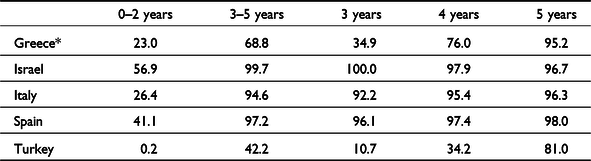
When we look at the recent preschool enrolment rates (see Table 4), both Turkey and Greece have the lowest levels of rates of enrolment among children under the age of 5 years. Israel, by contrast, has the highest enrolment rate for the 3–5 years age group, with Spain and Italy following closely behind.
Enrolment rates (%) in ECEC and primary education, 2020

Source: OECD (2022a).
* For the year 2019.
For children below the age of 3 years, Israel and Spain exhibit the highest enrolment rates, while Turkey has the lowest rate, which is nearly non-existent at only 0.2 percent. However, the picture for the 0–3 years age group in the Mediterranean region differs from that of the 3–5 years group. With the exception of Israel, the institutionalization of childcare services for children under the age of 3 years has been lacking, particularly in Greece and Italy. While there is a widely accepted assumption that maternal care is the ideal option for children aged 0–3 years, in many cases, family care is provided by grandparents or immigrant care workers in these countries (Leon and Pavolini Reference Leon and Pavolini2014; Luppi et al. Reference Luppi, Oomkens, Gal, Knijn and Naldini2018; Ranci and Sabatinelli Reference Ranci, Sabatinelli and Leon2014; Valiente Reference Valiente, Scheiwe and Willekens2009). For instance, in Greece, although steps have been taken since the 1990s to support working mothers, there has been a lack of development in childcare services targeting children under the age of 3 years, and grandparents and nannies continue to be the primary caregivers for this age group (Petrogiannis Reference Petrogiannis, Melhuish and Petrogiannis2006). In Israel, on the other hand, the state has made significant progress in supporting childcare facilities for children under the age of 3 years by providing subsidies aimed at increasing women’s labor market participation. However, over time ECEC in Israel has become financially inaccessible for lower-class families (Gal et al. Reference Gal, Ajzenstadt, Ben-Arieh, Holler and Zielinsky2021; Hasson and Buzaglo Reference Hasson and Buzaglo2019).
In the 1990s, and particularly in the 2000s, neo-liberal approaches facilitated the marketization of preschool education, enabling the entry of private enterprises into the ECEC sector in the region. Italy provides a striking example, where market-based childcare services rose from 7 percent in 1992 to 57 percent in 2012 (Ranci and Sabatinelli Reference Ranci, Sabatinelli and Leon2014). In Spain, the majority of childcare facilities for the 0–3 years age group are private or privately managed public entities (Ibanez and Leon Reference Ibanez, Leon and Leon2014). To date, marketization has shaped the progress of childcare in Mediterranean countries, where the demand for childcare exceeds the availability of facilities.
Developments in preschool education in Turkey
In Turkey, although the establishment of the first public preschool education institutions that serve children aged 4–7 years can be traced back to 1912–1913, preschool education did not receive significant attention on the political agenda until the 1960s (Akyüz 1996; Ecevit Reference Ecevit, Makal and Toksöz2012). The foremost priority for the state in the 1930s and 1940s was to educate its illiterate population (Akyüz 1996). From the 1950s onward, early childhood education began to attract interest in political circles (Batyra Reference Batyra2017), partly driven by the objective of enhancing women’s labor force participation (Ecevit Reference Ecevit, Makal and Toksöz2012). Between 1960 and 1990, preschool education was incorporated into the development plans recognizing it as an investment in sustainable and equitable development (Ağırdağ et al. Reference Ağırdağ, Yazıcı and Sierens2015). Over time the social investment-focused framework aimed at enhancing children’s education gradually disassociated ECEC from women’s employment (Ecevit Reference Ecevit, Makal and Toksöz2012). Irrespective of how ECEC was framed in Turkey, the availability of services remained limited and enrolment rates were remarkably low until the 1990s (Ağırdağ et al. Reference Ağırdağ, Yazıcı and Sierens2015).
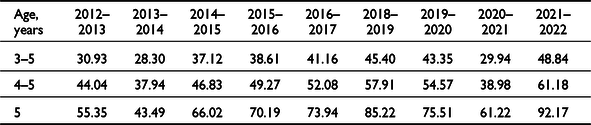
The historical trajectory of preschool education in Turkey reveals that it was a neglected policy area until the 2000s. Political attention given to ECEC remained a rhetorical issue with limited practical implications and progress in the policy framework. It was not until the 2000s that new initiatives were implemented to expand preschool education, yielding significant increases in the enrolment of children in ECEC programs. Since then, Turkey has taken significant steps in doubling the classroom capacity of preschools, leading to an almost threefold increase in the enrolment rate for children aged 3–5 years since 2005 (Göl-Güven Reference Göl-Güven2018). However, it is important to note that the main expansion of public preschool education took place in nursery classes for 5-year-old children (see Table 5), which is a relatively feasible target given that these classes could be set up within existing primary school facilities.
Gross enrolment rates (%) in pre-primary education in Turkey, 2012–2022

Source: Republic of Turkey Ministry of National Education (2023).
Beginning in 2008, policy initiatives were introduced to expand preschool education, with a particular focus on disadvantaged neighborhoods and underprivileged families. The 5-year development plans, including the 9th Plan (2009–2013) and 10th Plan (2014–2018), as well as the strategic plan of the National Ministry of Education (2015–2019) (MEB 2015) placed a high priority on the expansion of preschool education. One reason for the rising interest in ECEC is the “well documented” benefits associated with it (Göl-Güven Reference Göl-Güven2018). Public awareness regarding the benefits of preschool education was heightened through the efforts of non-governmental organizations (NGOs) focusing on preschool education, such as the Anne Çocuk Eğitim Vafkı (AÇEV). Their “Seven is Too Late” campaign mobilized parents and public resources to establish ECEC facilities, thereby playing a role in expanding preschool capacity within primary school settings (Hentschel et al. Reference Hentschel, Aran, Can, Ferreira, Gignoux and Uraz2010). Still, the main focus was on increasing the enrolment in nursery classes for 5-year-old children. The law that was passed in 2014 mandated that nurseries within primary schools admit 4-year-old as well as 3-year-old children (Batyra Reference Batyra2017). This was an important step for the expansion of preschool education for 3- to 5-year-old children. While the ministry has given priority to improving access to preschool education for low socio-economic groups, it has also provided support for the private sector to launch facilities through various incentives. NGOs have also been encouraged to take on responsibility in the expansion of preschool education (Toran Reference Toran, İnaz and Akkaymak2012).
The narrative surrounding the age group below 3 years pertains to childcare rather than education policy, and institutionalization of care facilities for that age group is almost non-existent in Turkey. The demand for formal childcare services catering to children up to the age of 3 years has been relatively low due to prevailing social norms that assign the role of primary caregivers to mothers (Göl-Güven Reference Göl-Güven2018; World Bank 2015). Women are involved in childcare at a rate of 94.4 percent, whereas men’s involvement stands at 2.3 percent (TÜİK 2023).
Preschool education in Turkey is not compulsory, which means that enrolment in a preschool institution, public or private, requires a fee. As a result, socio-economic status plays a crucial role in determining access to preschool education for children aged 3–5 years. Socio-economic inequalities in terms of access to preschool education are also exacerbated by the expansion of preschool education through market mechanisms. As of 2022, private companies provided 44 percent of the kindergarten facilities (MEB 2022). This figure excludes nursery classes for children aged 5 years, which are predominantly set up within primary school facilities. In the 2021–2022 school year, pre-primary education had the highest percentage of private education involvement compared to primary and secondary education (lower and upper) (MEB 2022). According to the OECD (2017), Turkey, along with Slovenia, the Slovak Republic, and the United States, exhibits one of the largest disparities in preschool education enrolment between economically advantaged and disadvantaged families. Access to preschool education is primarily determined by socio-economic status in Turkey (Ağırdağ et al. Reference Ağırdağ, Yazıcı and Sierens2015; World Bank 2015). The emergence of community-based programs in the 2000s has expanded the range of options available to low-socio-economic groups. These options include the pre-primary programs administered by the Presidency of Religious Affairs, municipalities, and various other associations. Approximately 14 percent of the students in pre-primary education are enrolled in these programs (MEB 2022). Community-based programs of this nature facilitate employment opportunities for low-income women within the informal sector (Dedeoğlu and Şahankaya Reference Dedeoğlu and Şahankaya Adar2022). Similar to other Mediterranean countries, the grandmothers’ involvement in childcare is also evident in Turkey. Recently, the ministries have introduced programs such as monthly cash payments to grandparents, aimed at supporting their caregiving role and encouraging women’s participation in the labor market (Can Reference Can2019).
To this end, two points can be made regarding Turkey. Firstly, the advancements made in the 2000s regarding ECEC primarily focused on expanding access for an older age group of 5-year-old children, and, more recently, 4 year olds. Secondly, the availability of childcare services for children in the age group of 0–3 years is limited and comes at a high cost, making it inaccessible for the majority of families. In contrast to other Mediterranean countries where the expansion of ECEC services has contributed to the increase of women’s labor market participation, in Turkey, the path-dependent weak institutionalization of ECEC can be identified as a contributing factor to the low level of women’s labor market participation. Turkey’s below-the-OECD average rate of women’s labor market participation, coupled with prolonged ECEC expansion, indicates a continued adherence to gendered familialism. Hence, the expansion of market-based childcare services in the 2000s has created opportunities for women from higher socio-economic groups to participate in the labor market. It is evident that the persistence of gendered familialism has implications for women from lower socio-economic classes.
Conclusion
Expanding upon the notion of “family resemblance” in the broader Mediterranean context, this article explores Turkey as a case of a familialist regime that has not experienced a significant shift in its gender regime, as evident in the low levels of women’s labor market participation. Given the transformations in the familialist gender regimes in the last two decades, it is intriguing to explore why Turkey has not undergone a similar trajectory. Although it is difficult to establish a causal relationship between the role of preschool education development and women’s employment, there is a consensus among scholars regarding the correlation: An increase in ECEC is often linked to a rise in women’s labor market participation. Two significant factors that also influence the relationship between preschool education and women’s labor market participation are the pace of industrialization and legal changes in family law towards gender equality. Legal changes aimed at promoting gender equality have been implemented in various Mediterranean countries, including Turkey, as part of a broader process of Europeanization. Furthermore, transformations in other Mediterranean countries demonstrate a notable correlation between the expansion of preschool education and the increased participation of women in the labor market.
Consequently, ECEC warrants closer examination to gain a better understanding of the gendered nature of familialism in Turkey. One prominent characteristic of this regime is the absence of adequate childcare facilities for children aged 0–3 years. Furthermore, the marketization of childcare in Turkey demonstrates that the gendered feature of familialism is primarily challenged by the process of marketization. As market-based childcare services benefit women in higher socio-economic groups, women from lower socio-economic groups experience the gendered nature of the familialist model to a great extent. This indicates that gender disparity persists within the framework of class differences. In understanding the change and continuity of the gendered familialist regime in Turkey, it is crucial to acknowledge the significance of class as a decisive factor in shaping the life chances of women.
Acknowledgements
We thank the reviewers for their insightful comments and the editors for their careful editing.
Competing interests
None.