Implications
Implementation of genetic improvement in village sheep flocks of smallholder farmers has so far been hindered by the absence of appropriate designs for village-based breeding programs. Assessment of farmers’ traditional breeding practices showed that genetic improvement cannot be achieved through individual efforts of smallholder farmers. The design presented here implies that smallholder farmers need to be organized in cooperative village breeding groups to implement effective genetic improvement programs. The observed appreciable improvement in sheep productivity is expected to contribute to improving the livelihoods of the smallholder farmers in the study villages and the experience can be replicated in other villages.
Introduction
The indigenous livestock breeds in developing regions have evolved largely through natural selection and are thus well adapted to their production environments. However, their productive performance is low as they are not effectively selected for increased productivity. Farmers’ traditional breeding practices are characterized by lack of genetic progress in productivity because diverse selection criteria, low selection intensity because of the small individual flock sizes, communal uncontrolled breeding practices and negative selection practices through sale of best performing animals (Kosgey and Okeyo, Reference Kosgey and Okeyo2007; Rege et al., Reference Rege, Marshall, Notenbaert, Ojango and Okeyo2011).
Designing and implementing effective breeding programs under smallholder livestock farming systems is challenging. Breeding schemes designed to suit low-input smallholder farming systems broadly include cooperative village (or community-based) breeding schemes (Sölkner et al., Reference Sölkner, Nakimbugwe and Valle-Zarrate1998; Wurzinger et al., Reference Wurzinger, Willam, Delgado, Nurnberg, Zarate, Stemmer, Ugarte and Soelkner2008; Gizaw et al., Reference Gizaw, Komen and van Arendonk2009), station-based centralized nucleus breeding schemes (Smith, Reference Smith1988; Kosgey, Reference Kosgey2004; Gizaw et al., Reference Gizaw, Lemma, Komen and van Arendonk2007) and a linked nucleus-village breeding scheme (Mueller and James, Reference Mueller and James1984; Gizaw et al., Reference Gizaw, Getachew, Haile and Dessie2011).
A pilot cooperative village-based breeding program was set up in 2009 in Ethiopia to improve the productivity of Menz sheep. The aim was to improve their economic values to their keepers, thus enhancing their competitiveness as a breed. The breeding program was set up based on a breeding scheme designed for Menz region (Gizaw et al., Reference Gizaw, Komen and van Arendonk2009; Gizaw et al., Reference Gizaw, Getachew, Haile and Dessie2011) and implemented in villages in Menz region. In this study, we evaluated the efficiency of selection for body weight in the Menz sheep cooperative village breeding program in terms of the selection differential and response to selection achieved in the cooperative village flocks.
Material and methods
Menz sheep breeding program
The Menz sheep breeding program was set up in 2009 in Dargegne village in the subalpine highlands of Ethiopia. The village is found in a community-based Guassa Ecosystem Conservation Area maintained by Afro-alpine Ecosystem Conservation Project (www.fzs.org). The area is subalpine with an altitude of about 3200 m above sea level. Temperature varies from −4 to +18°C and frost is common between October and November. The area is thus less suitable for cropping and farmers largely depend on sheep farming for their livelihoods. Sheep are the predominant species of livestock and account for 84.81% of the total population owned (Getachew et al., Reference Getachew, Haile, Tibbo, Sharma, Sölkner and Wurzinger2010). The breeding program aims to integrate genetic improvement and conservation of Menz sheep. The objective was to improve the genetic merits of Menz sheep in growth traits so as to increase their contributions to the livelihoods of their keepers and, by doing so, the competiveness and survival of Menz sheep breed.
Design of cooperative village breeding
The breeding program was set up and implemented on the basis of a conceptual framework described elsewhere by Gizaw et al. (Reference Gizaw, Komen and van Arendonk2009) and Gizaw et al. (Reference Gizaw, Getachew, Haile and Dessie2011). The key elements of the design were defining the organization of the breeding program, recording scheme, and selection and mating plans. The program was designed to benefit from the existing sheep production practices while ensuring that the existing bottlenecks, such as small household flock sizes and uncontrolled mating, were taking into account and overcome.
Organization
The program was organized as a cooperative breeding group. The breeding group was formed by villagers whose flocks share common grazing fields that are watered together. The flocks in the village can thus be considered one large interbreeding population, separate from other villages. The group consisted of 50 farmers with a total breeding flock of 1005 ewes. The breeding group was sub-divided into 17 ram groups, each comprising 2 to 4 farmers. The formation of the ram groups was based on mapped social structure (i.e. settlement, social connections) and grazing management of their flocks. By-laws were drafted to guide and govern the breeding group. The by-laws included regulations on membership and breeding activities including selection, use and management of breeding rams. The cooperative also serves the farmers to access better services (e.g. community-based health service and input delivery) and markets for their products.
Recording
One of the participating farmers in the project village was recruited and trained as an enumerator. His role was to coordinate the breeding program and collect pedigree and performance data from the participating village flocks. The enumerator made rounds of visits to the village households every morning to collect information. All animals in the village were uniquely identified using ear tags. Baseline data were collected before the start of the cooperative selection activity. The baseline information included parity of the village ewes using farmer-recall method; age of the ewes based on their dentition; and date and sex of lambs born, dam identity, birth weight and weights at 3 and 6 months of age of lambs sired by village rams before the cooperative selection activity started. Similar data were collected after the selection activity started.
Selection and mating
A one-tier breeding structure was adopted, that is, selection was implemented in the whole village sheep population. All 6-month-old ram lambs from all flocks in the project village were evaluated together as cohorts. The best young rams were to be selected on the basis of their 6-month weight corrected for nongenetic factors. These criteria were further subjected to farmers’ selection criteria, which have been defined earlier (Getachew et al., Reference Getachew, Haile, Tibbo, Sharma, Sölkner and Wurzinger2010; Gizaw et al., Reference Gizaw, Komen and van Arendonk2010). Farmers, however, put heavier weights on their own subjective morphometric type of criteria (i.e. pelvic width and body length) to select the rams. The selected rams were assigned to ram groups of two to four farmers following a family mating plan to avoid inbreeding (Croston and Pollott, Reference Croston and Pollott1994). The ram groups were organized in such a way that the rams would be used and managed communally. Mating was planned and restricted to within the ram groups. However, some matings could happen across the ram groups in communal grazing areas. Nevertheless, matings across ram groups would not affect the efficiency of selection as the rams in all the ram groups were the selected ones. All unselected rams and old breeding rams were culled at each round of selection. The culled rams were castrated, fattened and sold to establish a revolving fund that was then used to compensate or pay for the selected rams.
Jump-starting the village improvement program
The cooperative village sheep breeding program was linked to an improved elite nucleus Menz sheep flock. The nucleus flock was established in 1998 at Debre Birhan Agricultural Research Center. The flock was improved to an average estimated breeding value of 6.1 kg above the base population for 6-month body weight by 2008 (Gizaw et al., Reference Gizaw, Getachew, Haile and Dessie2011). The village sheep breeding was jump-started through a one-time provision of improved rams from the nucleus flock. After the initial provision of nucleus rams, the village program was thereafter run as a stand-alone program, subsequent replacement rams being selected from within the village flocks. Forty-five Menz rams with the highest breeding values from the central nucleus were provided to the village farmers in 2009. The farmers selected the best rams on the basis of their selection criteria for use in their flocks. Details of the selection process were given elsewhere by Gizaw et al. (Reference Gizaw, Getachew, Haile and Dessie2011).
Evaluation of selection efficiency
Trends in body weights were evaluated under two village breeding practices, that is, a traditional village sheep breeding practice and a cooperative village breeding program. For evaluating the traditional farmers’ breeding practice, body weight records of 1698 Menz lambs collected in a village flock monitoring study between 1997 and 2004 in a separate village in the Menz region (Sinamba village) were used. The purpose of this analysis was to provide an indication to body weight trends under traditional breeding practices, and not as a control group to compare with the results from the cooperative breeding village as the two data sets were collected at different periods of time.
The effectiveness of the cooperative breeding program was assessed on the basis of selection differentials and responses to the selection achieved. A total of 1416, 1166 and 1055 records of birth, 3-month and 6-month weights collected from 2009 to 2013 were analyzed to estimate responses to selection in the cooperative breeding program. The data were adjusted for age at weighing, sex, season of birth of the lamb and parity of the dam using the Generalized Linear Model (SAS 9.0, 2002). Body weight change because of selection was evaluated based on changes in the performance of lambs over generations. Lambs born in 2009 (before the selection commenced) from unselected village rams were taken as the base generation (first generation). The second generation constituted lambs born from improved rams supplied from the central nucleus. Lambs born from rams in subsequent selections within the cooperative village were considered the third and fourth generations (only birth weight was available for the fourth generation). Progress of selective breeding in each generation was estimated as a deviation of adjusted body weights from the first (base) generation.
Results
Traditional village breeding practices
The traditional village sheep breeding practices of the Menz farmers were monitored in Sinamba village between 1997 and 2004. The average flock size was 22.7, ranging from 4 to 64. Percentages of farmers keeping less than 10, 11 to 20, 21 to 30, 30 to 40 and above 40 sheep were 15.6, 37.5, 26.6, 10.9 and 9.4, respectively. Breeding ewes accounted for 49.3% of the flock. It was observed that farmers’ breeding practices varied depending on their breeding skills and socioeconomic needs. The common practice was random selection, with no clear and consistent selection criteria. Some farmers practiced selection of rams based on the animals’ appearance (horn, tail, color) and conformation (pelvic width, body length). However, selection intensities were expected to be low as selection of rams was conducted within the respective individual farmers’ small flocks.
The average mating ratio in the village was 9.04 ewes to 1 ram. This ratio indicated that farmers kept more rams than required for breeding. Thirty-five percent, 26.0% and 39.0% of the farmers kept two to six, one and no rams, respectively. The mating practices were uncontrolled and mating took place year round. All the flocks were grazed in the communal grazing lands together. Thus, both selected and unselected rams of the whole village were running with the flocks under communal village mating system. Breeding rams were commonly used for 2 to 3 years.
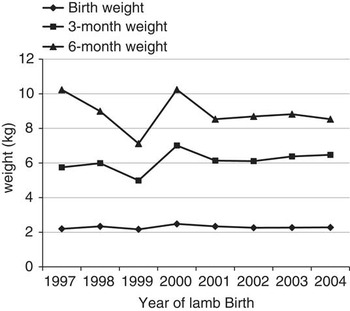
The analysis of body weight records from the monitoring study showed that there were minor changes in body weights over the years (Figure 1). Moreover, the changes in body weights were not consistent over the years. The trend in body weights calculated by regressing weight on year of birth showed that the annual increments in body weights at birth, 3 and 6 months of age were 0.004, 0.11 and −0.12 kg, respectively.
Body weight trends in the Menz sheep maintained under farmers’ traditional breeding practice at Sinamba village in Menz region, Ethiopia.

Cooperative village breeding scheme
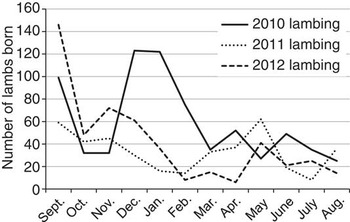
Analysis of lambing records collected between 2009 and 2013 in Dargegne cooperative breeding village showed that effectiveness of selective breeding in village flocks was found to be affected by lambing patterns (Figure 2). Lambing was spread throughout the year. The peak lambing season where the highest number of selection candidates would be available was generally in September. However, there was variation and a second peak lambing season could occur in December/January as was the case in 2010 (Figure 2). The numbers of male lambs that attained the selection age of 6 months after accounting for mortalities (i.e. the potential selection candidates) are presented in Table 1. The actual number of candidates available at selection time was lower than the potential candidates as some of the ram lambs had been sold. Thus, a higher than desired proportion (i.e. 5% to 10%) of the candidates had to be selected to meet the farmers’ requirements for breeding rams (Table 1). The selection differentials calculated as a deviation of the mean 6-month weight of the selected ram lambs from their contemporaries (Table 1) were 2.44 and 2.45 kg in 2010 and 2011 selections, respectively.
Distribution of lambing at Dargegn cooperative breeding village in Ethiopia, indicating the seasonality of the availability of selection candidates.

Number of male lambs expected to attain 6-month at selection season (potential candidates), actually available at selection (actual candidates), proportion selected and 6-month weight of selected candidates and their contemporaries

1 Rams selected in selection rounds 2010 and 2011 were sires of third- and fourth-generation lambs, respectively (see Figure 3). The second-generation lambs were sired by rams supplied from a central nucleus flock at Debre Birhan Research Centre.
Farmers tended to rely more on their own selection criteria than body weight information to select rams. Farmers’ selection criteria were elicited during each round of selection and included pelvic width, body length, color, tail and horn. Effectiveness of selection under village conditions using farmers’ selection criteria was calculated as the ratio between the actual selection differential achieved (Table 1) and the maximum possible selection differential that could have been achieved if selection was based on adjusted 6-month weight. The efficiencies for 2010 and 2011 selection rounds were 0.86 and 0.85, respectively.
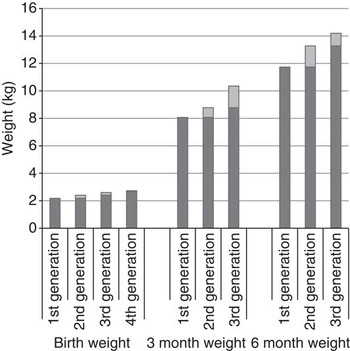
The least-square mean body weights adjusted for nongenetic factors showed increasing trend over generations for all traits studied (Figure 3). The differences among the mean weights over generations were statistically highly significant (P<0.01). The total genetic lifts in birth, 3-month and 6-month weights in the third generation (fourth generation for birth weight) were 0.49, 2.29 and 2.46 kg over the base generation. The genetic gain in 6-month weight of lambs sired by the central nucleus rams from Debre Birhan Research Center was 1.54 kg, whereas the gain achieved from selection in the village flock was 0.92 kg. Effectiveness of controlled mating was evaluated as the ratio between the genetic lift in 6-month weight in the third-generation lambs and half the selection differential (i.e. the rams’ transmitting ability) in the 2010 selection (see Table 1). The efficiency was found to be 0.75.
Least-squares mean body weights of three generations (four generations for birth weight) of lambs with the level of genetic lift (denoted by white color at the top end of each bar), resulting from selective breeding at Dargegn cooperative breeding village, Ethiopia.

Discussion
Selective breeding is an indigenous genetic improvement practice among the majority (90% to 96.3%) of the Menz sheep farmers (Gizaw et al., Reference Gizaw, Komen and van Arendonk2009; Getachew et al., Reference Getachew, Haile, Tibbo, Sharma, Sölkner and Wurzinger2010). The Menz farmers also have a clear breeding objective of increasing the market value of their sheep through selection for both appearance (color, horn) and body size/weight traits (Duguma et al., Reference Duguma, Mirkena, Haile, Okeyo, Tibbo, Rischkowsky, Soelkner and Wurzinger2011). However, analysis of farmers’ traditional breeding practices in the current study showed that there is stagnating or declining trends in body weights. This could be because of unintended negative selection by farmers, that is, removal of superior male rams from the breeding flocks through sales to fetch higher market prices rather than retaining them for breeding. Selection and mating practices of the Menz sheep farmers could also be ineffective because selection is carried out within individual farmers’ small flocks and 44.1% of the farmers practice uncontrolled breeding (Gizaw et al., Reference Gizaw, Komen and van Arendonk2009). Uncontrolled mating is a common practice in low-input smallholder sheep farming systems: for instance, 100% of Zulu sheep farmers surveyed in 11 rural communities of KwaZulu-Natal, South Africa, practiced uncontrolled mating (Mavule et al., Reference Mavule, Muchenje and Kunene2013a).
The absence of genetic progress under the traditional breeding practices in the current study seemingly supports the idea that genetic improvement in village flocks under low-input smallholder systems is infeasible. This has led to the adoption of central nucleus breeding scheme, where genetic improvement is carried out in nucleus flocks and disseminated to villages through provision of improved rams (e.g. Smith, Reference Smith1988; Gizaw et al., Reference Gizaw, Lemma, Komen and van Arendonk2007). However, results from the cooperative breeding village in the current study showed that genetic improvement in body weights could be feasible if appropriate breeding designs are adopted to overcome the constraints to implement effective village breeding programs, including small individual flock sizes and uncontrolled mating. Organizing farmers in a cooperative breeding group was the major element introduced to the traditional Menz farmers’ breeding practice. With the cooperative design, a higher selection intensity was possible that resulted in a higher selection differential than would have been possible through selection within individual farmers’ small flocks. The design also helped to avoid dilution of the genetic improvement efforts of cooperating farmers by unselected rams as the whole village flock participated in the selection program.
Published estimates of responses to selection for body weight in village breeding programs under low-input smallholder systems are rare in the literature. Our results indicate that a genetic progress of 0.92 kg per generation can be realized in 6-month weight. The annual genetic gain achieved in 6-month weight in the current study (0.61 kg per year, i.e. 0.92 kg divided by a generation interval of 1.5 years) is comparable to the genetic gain in 6-month weight (0.34 kg) in an experimental nucleus flock of Menz sheep (Gizaw et al., Reference Gizaw, Lemma, Komen and van Arendonk2007). Our results are also within the range of genetic gains estimated for yearling weight in simulation studies in Menz sheep (0.39 to 0.94 kg per year, Mirkena et al., Reference Mirkena, Duguma, Willam, Wurzinger, Haile, Rischkowsky, Okeyo, Tibbo and Solkner2012; 0.49 to 0.70 kg per year, Gizaw et al., Reference Gizaw, Komen and van Arendonk2009). However, the genetic gain in 3-month weight in the current study is much higher than annual genetic trend of 0.028 kg reported for village flocks of Djallonke sheep in a central nucleus breeding program in Cote d’Ivoire (Yapi-Gnaorè et al., Reference Yapi-Gnaorè, Rege, Oya and Nega1997). On the other hand, a genetic trend of 0.25 kg has been reported for 3-month weight of Norwegian sheep (Eikje, Reference Eikje1975). Controlled experimental selection studies on sheep have shown that genetic progress can be achieved for live weight traits. However, few studies have reported genetic trends under field conditions as an estimation of genetic trends under field conditions, in which national breeding programs must operate, are more difficult (Nicoll et al., Reference Nicoll, Bodin and Jonmundson1986). Response to selection in the current study was estimated as changes in phenotypic values adjusted for nongenetic factors. Application of a more accurate estimation of breeding values using unbiased estimators (i.e. BLUP breeding values) to estimate genetic progress is rather challenging under village conditions, as it requires accurate pedigree recording. Thus, a less accurate but reasonable estimation of breeding values may have to be adopted as was the case in the current study. However, studies on the feasibility of genetic selection on the basis of BLUP breeding values under village conditions may be needed.
A practicable design for village breeding needs to build upon and accommodate some of the farmers’ traditional practices and introduce improved practices in consultation with the community. For instance, the selection method in the Menz sheep cooperative breeding program was adopted from the villagers’ traditional practices (i.e. visual and tactile appraisal of body length, width and muscle/fat deposition in the dorsal region). Integration of farmers’ practices with our design did not adversely affect efficiency of the breeding program as can be seen from the genetic progress achieved in body weight. This can be explained by the high genetic (Janssens and Vandepitte, Reference Janssens and Vandepitte2004; Afolayan et al., Reference Afolayan, Pitchford, Deland and Mckiernan2007) and phenotypic (Mavule et al., Reference Mavule, Muchenje, Bezuidenhout and Kunene2013b) correlations between body weights and linear size traits in sheep. A significant correspondence between farmers’ and experts’ selection criteria for the Menz sheep has also been observed in an earlier study (Gizaw et al., Reference Gizaw, Getachew, Haile and Dessie2011).
Introducing optimal selection and mating strategies under village conditions is challenging. For instance, observation in the Menz sheep cooperative breeding village showed that lambing is distributed throughout the year. This indicates that selection seasons need to match with the peak lambing seasons to achieve higher selection intensity. Thus, selection needs to be arranged within 6 months of the peak lambing season when the maximum number of selection candidates would be available. Our observation has also shown that breeding rams are used for a prolonged period of up to 3 years. The majority (65.5%) of the farmers in Menz keep rams for breeding and for later fattening, and 61.8% own more than one ram while owning 14.9 breeding ewes on the average (Getachew et al., Reference Getachew, Haile, Tibbo, Sharma, Sölkner and Wurzinger2010). Yet, a ram service period of 2 years has been suggested as an optimal ram use for maximum genetic progress in Menz sheep (Mirkena et al., Reference Mirkena, Duguma, Willam, Wurzinger, Haile, Rischkowsky, Okeyo, Tibbo and Solkner2012). Improvements in the above traditional breeding practices are expected to improve genetic progress. However, the above arguments need to be seen from the farmers’ perspectives. For instance, open season breeding (Mahanjana and Cronje, Reference Mahanjana and Cronje2000; Mapiliyao et al., Reference Mapiliyao, Pepe, Chiruka, Marume and Muchenje2012) and keeping large number of rams have some advantages for farmers because it increases mating opportunities for their ewes. Year round lambing resulting from open season mating is also considered by farmers as a means to capital savings to meet immediate and year round cash needs. Thus, improvements in village breeding designs need to be evaluated in the context of farmers’ sheep production and marketing strategies, as smallholder farmers’ livestock production strategy is primarily risk aversion.
Conclusions
Assessment of farmers’ traditional breeding practices showed that genetic improvement cannot be achieved through individual efforts of smallholder farmers. Our results showed that village-based livestock genetic improvement under smallholder conditions could be feasible if appropriate designs are adopted. Commencing breeding programs with a supply of elite rams from central nucleus flocks would help jump-start village-based programs. The design presented here implies that smallholder farmers need to be organized in cooperative village breeding groups to implement effective genetic improvement programs.
Acknowledgments
The authors sincerely thank the farmers who spared their time and flocks for this work. Contributions of the staff at Debre Birhan Agricultural Research Centre are gratefully acknowledged. This paper is produced as part of the first author’s postdoctoral research funded by DAAD/ILRI. The project is financed by the Amhara Regional Agricultural Research Institute and the Ethiopian Institute of Agricultural Research.