I … decided to devote my life to the recovery and preservation of the Begram ivories, for the benefit of mankind. The idea is to create an international fund and to acquire them all, restore them, publish them and create a travelling exhibition before taking them back to Kabul once peace is restored. I knock at the door of the great American and English museums, and also at the Musée Guimet in Paris which possesses a few pieces of the original treasure. I contact the keenest collectors; the International Institute for Art Research (IFAR); I join a committee for the salvation of the Afghan heritage in Los Angeles. Finally, I appeal to UNESCO in Paris. Nothing is to be done. Everyone is enthusiastic and interested, but there is no public or private body willing to sponsor a clandestine market, enrich robbers and take part in an illegal operation. Footnote 4
INTRODUCTION
The destruction of archaeological sites and museums across Afghanistan over the past decades is well documented, but this article looks at how the recovery of one group of objects from the market offers an example of successful restitution and public benefit through exhibition and publication. Its focus is a group of 20 carved ivory and bone furniture overlays excavated at Begram in 1937 and 1939 and part of the collection of the National Museum of Afghanistan in Kabul from the point of division with the excavators in 1937 and 1946 up to the outbreak of civil war in 1992. These objects are generally known as the Begram ivories, although some are carved from bone. They date to the first or possibly early second century, judging by the associated finds and the weight of typological parallels from India, although both earlier and later dates have occasionally been suggested in the literature. Footnote 5 These pieces were stolen but identified and re-acquired by private means with the view that they would be returned to Kabul when conditions allowed.
This possibility was realized as a result of confidential discussions over several years during the preparations for an exhibition held at the British Museum in 2011 of objects borrowed from Kabul, entitled Afghanistan: Crossroads of the Ancient World. This opportunity allowed these highly delicate pieces to be newly conserved, scientifically analyzed, and placed on display for public benefit. This raised awareness not only of the scale of loss from the museum in Kabul but also that they could be returned safely and that a great deal of new information about their original appearance and artistic impact could be added through scientific analysis and using techniques not available in Kabul. An integral part of this process was close and regular dialogue between the key parties to build trust and ensure that they were all appraised and supportive of the process. In this case, it was clear that, despite the sensitive nature of the return of these objects, the results were fully justified and they represented a successful yet unusual example of collaboration between private individuals and international museums over the identification and restitution of famous objects long considered lost.
THE “BEGRAM IVORIES”: FROM EXCAVATION TO MUSEUM DISPLAY
French archaeologists excavating the site of Begram in northern Afghanistan made spectacular discoveries during two seasons in 1937 and 1939, when they uncovered huge numbers of objects at the heart of a building initially referred to as a palace. Footnote 6 These included Chinese lacquer bowls, Roman painted glass, bronzes, and other objects imported from Egypt as well as over a thousand carved ivory and bone plaques originally attached to wooden furniture. The range of motifs on the latter is extensive and varied. They include female and male figures, children, spirits, mythical beasts, architecture, hunting scenes (on foot and on horseback), wildlife (not only birds but also tigers, elephants, and lions), and geometric and vegetal designs (quatrefoils, palmettes, lotus flowers, and aśoka trees). They soon became known as the ”Begram ivories” and belong to a period when Afghanistan, Pakistan, and northern India were united under rulers of the Kushan dynasty. They are widely considered to be miniature masterpieces of Indian art and are one of the largest collections of excavated ivories from antiquity. They also represent one of the most significant archaeological discoveries in Afghanistan.
The finds were made in two separately walled up, but adjoining, rooms, designated Rooms 10 and 13. The first room was excavated between May and July 1937 and revealed large numbers of bronze, alabaster, glass, and ivory objects. Footnote 7 Most of the ivories were found in the northern part and along the eastern edge of the room. They included three spectacular ivory standing female figures, each representing a yakshī, or female guardian spirit, standing on a makara, a mythical composite beast (fig. 1). In addition, several ivory furniture legs and a large number of plaques originally attached to a row of 13 footstools were found in situ in a line along the eastern wall. The concentrations of finds were initially assigned group numbers, and the pieces were then individually catalogued—for example, Group 325 was later defined as Footstool V, comprising 64 different pieces. A total of 470 bone and ivory pieces were individually catalogued from this room. Footnote 8
Carved ivory figure of a yakshī, an Indian female guardian spirit, as displayed in the National Museum of Afghanistan in 1969 (photograph: Volkmar Thewalt).

Room 13 lies immediately north of Room 10 and was originally connected by a doorway that had been blocked in antiquity. It was discovered two years after Room 10 and excavated between 19 May and 23 August 1939. It not only yielded similar items but also contained several large panels of openwork inlays forming the backs of seven large pieces of furniture (Chairs 1–5, Chair 55, and Sofa 34), a collection of plaster molds and numerous crushed Chinese lacquer bowls. Footnote 9 A further 638 bone and ivory pieces were individually catalogued, giving a total of 1,108 individually catalogued pieces from both rooms. Footnote 10 The published plans, photographs, and descriptions show that the objects were deposited in groups, either directly on top of the benches or on the floors.
All of these objects were highly fragile as they had become highly desiccated and lost the wooden backings to which they had been fixed with tenons, metal pins, and clamps. Various attempts were made to conserve them in the field, including reconstituting their structure by pouring multiple layers of warm gelatine on to the individual pieces, attaching tissue paper to one side, allowing them to solidify, repeating the treatment on the back and then lifting them after the gelatine had set. The finds were divided between the National Museum of Afghanistan in Kabul and the Musée national des arts asiatiques–Guimet in Paris, and a selection from the first season was displayed in Kabul as early as August 1937, only a month after the excavations ceased. During the closing months of 1946, the finds from the second season were studied and further conserved in Kabul by Pierre Hamelin, and his observations enabled several important new reconstructions to be drawn of the large pieces of furniture. Footnote 11 The exported material arrived in Paris in January 1947, and in the final excavation reports, the allocation of individual pieces was indicated by the letters P and K, designating Paris and Kabul.
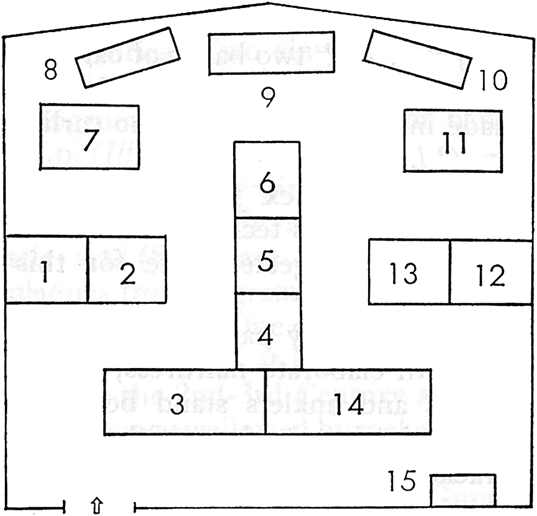
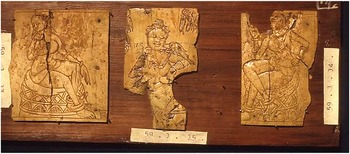
In 1957–58, the Begram and Islamic rooms in the Kabul museum were re-designed: this marked the first substantial effort to change the displays since the museum opened in 1931. The Begram room included a large selection of the ivories, including the most important pieces. Published plans and descriptions of these displays show that they filled as many as seven of the 15 showcases, and several of the objects discussed below were among them (fig. 2). During the 1960s, a series of travelling exhibitions focusing on antiquities—both pre-Islamic and Islamic—from the museum in Kabul were held in Europe, Japan, and America, and some of the pieces underwent further conservation at this period when white plaster of Paris was extensively used for backing and infills; others were coated with consolidants and lacquer (fig. 3). Following their return to Kabul, the ivories were brought back to the National Museum of Afghanistan where they remained on display until 1989 apart from a brief period of storage in 1979–80.
Plan of the Begram room in the National Museum of Afghanistan in 1974. The ivories were displayed in Cases 1, 3–6, 9, 11, and 14 (from Dupree, Dupree, and Motamedi Reference Dupree, Dupree and Motamedi1974, 37).

Ivory plaques belonging to Footstool 1 as they were displayed in the National Museum of Afghanistan in 1974. All were stolen during the civil war. The two plaques on the left are among the group discussed here and have been recovered, but the present whereabouts of the plaque on the right is unknown (photograph: J. Stephens).

THE KABUL MUSEUM DURING THE WAR YEARS
In April 1979, a year after a coup led by Nur Mohammed Taraki involving the assassination of President Daoud Khan and the installation of a Communist government, the contents of the National Museum of Afghanistan was moved for temporary storage in the deserted house of Minister Sardar Mohammed Naim Khan in the Wazir Akbar Khan district of Kabul. The museum building in Darulaman was then turned into an annex of the Ministry of Defense in the Darulaman Palace as the whole area became a military zone. However, in 1980, Soviet special forces entered the country, killed Taraki’s successor, Hafizullah Amin, and installed Babrak Kamal as the new head of state. As part of a program of normalization, the museum collections were returned to Darulaman in October 1980, the museum was re-opened, and it continued to operate throughout the next decade of Soviet occupation. Footnote 12
In February 1989, the last Soviet combat units withdrew from Afghanistan, and the government under Mohammed Najibullah Ahmadzai began defensive measures against the mujahideen. The government ordered the closure of the museum that autumn, and the collections were gradually divided between the Ministry of Information and Culture, the Central Bank vaults under the Presidential Palace, the underground stores below the museum, and a fourth location. Footnote 13 According to a report for the UN Educational, Scientific, and Cultural Organization (UNESCO) by its consultant, Andreá Bruno, the museum staff had already packed up half of the museum’s showcased exhibits by the following March. He noted
how [the] Museum staff is carrying on carefully and methodically the removal operation, checking the inventory, writing upon each package (made with tissue-paper, wadding, packing-paper and tape) the same catalogue number as it previously was written in the show[case]-window and filing the contents of each box. These boxes were countersigned by those responsible for the exhibition rooms (tawildar) who puts his seals on the zinc plated metal boxes locked with sealed padlocks. The box content is handwritten on the lids with indelible ink. These operations are usual in the Museum of Kabul, where at the end of the day exhibition rooms are sealed. Footnote 14
Items stored off-site included precious metal and a small selection of objects formerly on display. These included the Tillya Tepe grave goods, gold vessels from Tepe Fullol, and selected items from Ai Khanum and Begram, including the ivory furniture elements recently exhibited around the world as part of the latest travelling exhibition. Footnote 15
However, the Najibullah government soon fell, and on 29 April 1992, the mujahideen took Kabul. For the next two years, the city became the epicenter of a civil war, and since entry to the museum building was forbidden to museum staff, every time the area changed hands, it was ransacked by occupying forces. An estimated three quarters of the collection was either stolen or destroyed. Moreover, as it lay near the front line, it was badly damaged by rockets and artillery. On 12 May 1993, rocket attacks totally destroyed the roof and top floor, including a famous wall painting from Delbarjin, and many of the paper records were also burned. This occurred during fighting between Rabbani’s government troops and Hezb-e Wahdat, a group led by Abdul Ali Mazari, who took control of the Darulaman Valley in May that year. Footnote 16 Another source states that the museum was on a front line “between three rival factions, the Hezb-i-Wahdat, the Hezb-i-Islami and Ihehad-i-Islami.” Footnote 17 A ground floor storeroom containing complete pottery vessels was filled with debris, and a photograph taken in November that year, and credited to the UN agency for Humanitarian Assistance to Afghanistan, was published in The Art Newspaper in February 1994. Footnote 18 A British Broadcasting Corporation report dated 13 May reported this story and remarked that “Afghanistan may have buried its children, but should not be burying its culture.” Footnote 19 Ironically, a brave inspection of the museum by Najibullah Popal only a few days previously, on 5 May, found the storeroom seals to be intact, but subsequent visits on 21 May, in mid-September, and in November showed that destruction was followed by looting (fig. 4). Footnote 20 The late Carla Grissmann described it thus:
Since they had been cleaned for inventorying in July 1995, the storerooms had been pilfered yet again. The floors were littered with sherds and objects flung randomly in all directions The reconstructed ivory throne back from Begram had been demolished in order to remove the thirteen small carved panels, and splinters of the frame were found strewn over the floor. Countless fragments of smashed Greek plaster emblems were swept up from the Begram storeroom. Not a single object from the Begram storeroom remained intact. Footnote 21
The museum was a scene of destruction in 1994 (photograph: British Museum).

In September 1996, Taliban forces entered Kabul and executed president Najibullah. In 1997, Mullah Omar prohibited excavations and exports of cultural items but, a year later, is said to have “sent a letter to the governor of Ghor province, authorising anybody to excavate, as long as a quarter of the finds went to the authorities.” Footnote 22 One observer reported that in “1999 the Taliban put a ban on unauthorised excavations and the trading in antiquities, but the ban was scarcely enforced, and when I travelled through Afghanistan between March and October 2000, I found illegal excavations in full swing, sometimes quite openly.” Footnote 23
However, in July 1999, two decrees were issued, entitled “Concerning the Protection of Cultural Heritage” and “Concerning the Preservation of Historical Relics in Afghanistan.” Footnote 24 The first stated that “any excavation or trading in cultural heritage objects is strongly forbidden and will be punished in accordance with the law.” The second was more detailed and specific. Section 1 stated that the cultural heritage of the country covered “periods of several thousand years and concern culture, religion and beliefs also of civilisations of earlier periods up through the course of history” and “that this heritage must be protected and preserved.” Section 5 went on to specify that “current legislation deals with illicit trading in historic objects in order to prevent such activity, defining heavy penalties for breaking the law,” and section 6 stated that “the government regards the [Bamiyan] statues with serious respect and considers the position of their protection today to be the same as always The Taliban government states that Bamiyan shall not be destroyed but protected.” Footnote 25
In later years, the Taliban position hardened, and the Taliban Foreign Minister Mutawakkil stated: “We will not sell idolatrous images. It is un-Islamic. We must destroy them.” Footnote 26 The previous decrees were reversed on 26 February 2001, and the new Taliban minister of culture, Qudratullah Jamal Tahir, was witnessed smashing the famous statue of Kanishka in the National Museum of Afghanistan as part of a purge of all representations that extended from films to the Buddhas of Bamiyan. According to one source, he was accompanied by the minister of finance, Agha Jan Motassem, and a squad from the Ministry of Vice and Virtue known as the Amr bin Maroof. Footnote 27 Two of the museum staff, Mir Ghulam Navi and Mir Haider Mutaha, are quoted in another report as saying that “officials from the Taleban would regularly (and sometimes daily) since April arrive with hammers and smash sculptures which depicted human forms. The well-known headless statue of Kanishka in a flared robe and riding boots … took two hours to be destroyed,” and the Taliban “paid a last visit to the museum on 13 November as they were being ejected out of Kabul to further vandalise artefacts.” Footnote 28 By this stage, one dealer remarked that “[t]here is almost no art left above ground in Afghanistan to loot. What are coming out are small poor quality stucco pieces which can be slipped into a pocket. No respectable dealer or collector will touch anything from the Kabul Museum. These objects have no market value.” Footnote 29
THEFT OF MANY OF THE “BEGRAM IVORIES”
However, it is clear that a very large proportion of the Begram ivory collection had already been stolen from the museum. At least some of these had crossed into Pakistan by autumn 1994, when nine of them were seen in Peshawar, wrapped in pink toilet paper in a re-used shoe box, “held together by strips of Sellotape,” openly said to come from the Kabul museum and in one case dropped, resulting in it splitting into two. Footnote 30 More details on this incident are quoted in an article in The Art Newspaper in October that year, when it reported that one London dealer “was recently offered a group of second-century BC [sic] Indian ivories which are part of the Begram Treasure in the Kabul Museum, probably its greatest objects. He is currently looking for a group of sponsors who can acquire them and deposit them on loan to the British Museum or other institution until the Kabul Museum reopens.” Footnote 31 The scale of loss is suggested by the fact that one individual saw as many as 107 of the Begram ivories in a private collection in Peshawar in February 1996. Footnote 32 Another press story is quite explicit on how they were stolen:
[D]uring the fighting, they were stolen by the Hizbe Wahadat and the Hizbe Islami parties guided by expert Pakistani and Afghan dealers. These two opposition parties held the area around the museum after Kabul fell to the mujahideen. The ivories were flown to the northern city of Mazar-e-Sharif, into the hands of their ally, Uzbek warlord Gen. Rashid Dostum. From there they reached Peshawar and later Islamabad and Europe. Twelve statues were sold to a London dealer for $300,000. The dealer in turn sold the statues to a Japanese collector for $600,000. Several dozen ivories are still available in Islamabad. A Pakistani art historian who has seen and authenticated some of the statues says the asking price is $35,000 each. Footnote 33
Nancy Dupree cites a report in the Karachi-based Herald Magazine in September 1995, which quoted the late General Nasirullah Babar, then the federal interior minister in Pakistan, who boasted that he had purchased one piece for $100,000, “which he would return when the political situation in Afghanistan had stabilized” and that Prime Minister Benazir Bhutto intended to purchase others so that they could be “returned to the Afghans as a gift as soon as peace is established.” Footnote 34 The pledges have yet to be made good, despite an official request by Sayed Makhdum Rahin, minister of information and culture, reported in the Afghan state-run newspaper, Hewad, on 1 January 2006. This was followed by a counter-report in the newspaper Payam-e Mojahed on 4 January that General Babar regarded his collection as legally acquired and belonging to Pakistan. More details about these and other stolen or illicitly exported antiquities are reported in an interview with the late A.H. Dani, who was asked how many ivory pieces from the National Museum of Afghanistan in Kabul were smuggled into Pakistan via Mazar-i Sharif and the tribal areas:
In the first instance, I counted eight ivories. Naseerullah Babar, the ex-interior minister, called me up and brought the ivories to me. I showed him Dupree’s book [Guide to the Kabul Museum] and identified some of the pieces reproduced in it. More material kept flowing in, in bits and pieces: a big ivory lid was brought to my house by Naseerullah Babar. He managed to get approval from the Government of Pakistan (GOP) that such material should not leave the region and that funds for its purchase should be made available. As a result, the Government of Pakistan earmarked a sum of three crore rupees, an equivalent to nearly 30 million rupees. A meeting was held at the Ministry of Culture to fix the price of this lid. I also informed SPACH [the Society for the Preservation of Afghanistan’s Heritage] and asked its chairman, Pierre Lafrance, to contact UNESCO in Paris. SPACH agreed to contribute a nominal amount. The GOP approved the purchase, but unfortunately the price offered was Rs 500,000, whereas the price demanded was Rs 3,000,000. For a long time after that, the ivory lid remained in the tribal area. As for the other ivory pieces, they were sent across to London, and according to my information, about five or six of them were purchased by an Arab businessman. They should be in the safe custody of a bank in London now. Apart from the ivories, I also saw several other objects from Afghanistan: a Shiva figure in marble, inscriptions and sculptures. In fact, I saw many sculptures in Quetta at the house of a well-known Afghan leader who invited me to identify them. Some of these sculptures bore serial numbers from the Kabul Museum, while many others did not. According to him, he had more material in houses in Karachi and London. When the police raid due to charges of drug-peddling harboured against him was conducted, sculptures not drugs were found in abundance. Footnote 35
In an interview for a program entitled Kieta Kokuho – Senka no naka no Afghanistan [Missing National Treasures in Afghanistan], made by the Tokyo Video Center and aired by Nippon Hoso Kyokai, Japan’s national broadcasting organization, on 20 May 2001, General Babar went so far as to claim that all of his collection comes “from Pakistan in 1960.” The same program went on to interview the formerly London-based dealer in Asian art Alexander Götz, who admitted on it that he once saw the ivories from the Kabul museum, but
there were not any museums that wanted to purchase the ivory works even if it meant saving it. It was clear that those came from Kabul Museum. Currently, in England, it is very difficult to purchase such things. Therefore, these ivory works went to Japan. Japanese have different prospects toward such things. Footnote 36
RECOVERY AND RETURN OF SOME OF THE “BEGRAM IVORIES”
Despite this great loss of large numbers of objects from the National Museum of Afghanistan, there are some positive stories, and the following section dwells on how some of the Begram ivories have been identified on the black market by private individuals and bought back on behalf of a museum with no funds of its own and desperate to recover some of its prized pieces by any means possible.
In April 1997, two of the stolen ivories were identified on the black market in Peshawar and were bought on behalf of the Kabul museum by the newly formed Society for the Preservation of Afghanistan’s Heritage (SPACH) through the agreement of both parties, temporarily held in the so-called Afghan Museum in Exile in Bubendorf, Switzerland, and returned to the National Museum of Afghanistan in Kabul ten years later. Footnote 37 A second group of objects, including several originally belonging to Footstool IX, was acquired in London and, again through discussions with the national museum and SPACH, were deposited in the Musée Guimet, where they were temporarily exhibited in 2006 before future conservation and return to Kabul. Footnote 38
The most recent opportunity came during the planning for the British Museum exhibition of objects from the National Museum of Afghanistan’s collection, which had gone on tour abroad in 2006. This exhibition began with a formal proposal by the British Museum, which was delivered through the British Foreign and Commonwealth Office, represented by Her Majesty’s Embassy to Afghanistan in Kabul, to the Foreign Ministry. This letter was then forwarded by the Foreign Ministry to the Ministry of Culture and discussed by an exhibition committee composed of representatives of the Museum and Academy of Sciences. Once the agreement was reached in principle, the negotiations continued between the two museums and were facilitated by the British Embassy in Kabul. Although the core content of the travelling exhibition remained unchanged, the manner in which it was interpreted varied at different venues.
In the present case, it was decided to strengthen the narrative by highlighting the role of Afghanistan as a crossroads of culture and emphasizing the fragility of cultural heritage, particularly at times of conflict. The beginning and end of any exhibition are critical moments for the visitor, and special attention was paid to developing these areas. A Hellenistic Greek sculpture from Ai Khanum, which had been vandalized by the Taliban in the National Museum of Afghanistan was chosen as the gateway object at the opening of the exhibition. This display was followed by a short film, which showed key moments in the recent history of Afghanistan, and a series of interviews with a wide range of specialists of the area. The exhibition then continued with a display of the antiquities from the National Museum of Afghanistan. The final section of the exhibition provided the opportunity to emphasize positive developments in the rebuilding of Afghanistan’s cultural heritage. The key question was whether it could include more objects that had been previously stolen from the national museum but that had since been recovered.
The collection in question was the group of 20 pieces from Begram that are discussed in this article. These had been privately acquired by an individual living in London with the view that they would be presented to the National Museum in Afghanistan in Kabul when conditions allowed. This was an act of pure philanthropy and was not simply a case of tax sheltering, which obviously would not apply to a gift made by a UK tax payer to a museum in Kabul. The donor initiated discussions, and contact was facilitated by the British Museum with Omara Masoudi, then director of the National Museum of Afghanistan. He was delighted with this generous offer, and he strongly advocated for the opportunity to exhibit them as part of the exhibition at the British Museum prior to their return. Following further discussions involving Neil MacGregor, then director of the British Museum, and several members of the staff in the British Museum representing curatorial, scientific, conservation, exhibitions, and legal services, the objects were deposited in the British Museum in late 2010 on the mutual understanding that the British Museum would directly oversee their subsequent return to Kabul.
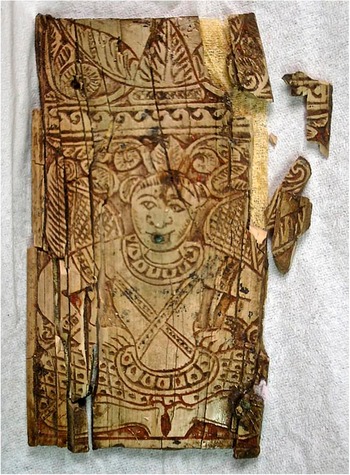
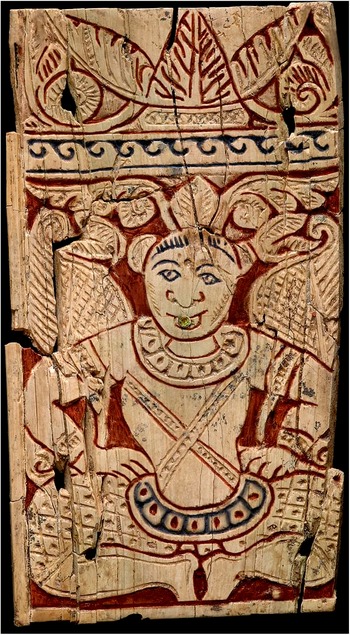
Our Afghan colleagues in Kabul appreciated that no previous scientific analyses had ever been undertaken on the ivories from Begram and supported our proposal that we use this opportunity to carry out a non-destructive scientific examination that would in turn facilitate further conservation that was made possible by additional support from the Bank of America’s Merrill Lynch Art Conservation Programme. The primary aim of the scientific examination was to assist the conservation process by establishing the composition of the often thick layers of restoration and conservation materials that had been built up on the objects over time, some of which had aged and altered and were causing damage (fig. 5). This is true of many other pieces from Begram, whether in Kabul or Paris, and there has been a tendency to add layers of consolidant onto earlier treatments, but without these affecting the underlying integrity of the object. While in the laboratories, the pieces were also imaged, the base materials identified, and remnant pigment layers investigated, allowing partial reconstruction of the original polychromy. The results are of major importance. They not only allow a much deeper appreciation of the quality of the holdings of the National Museum of Afghanistan but also provide the first scientific identifications of the pigments used and throw important new light on the extent of polychromy on Indian ivory and bone carving during this period (fig. 6).
A bone plaque representing a squatting tree spirit with a feathered crown, prior to recent conservation at the British Museum (photograph: British Museum).

The same plaque after conservation with digital colouring indicating areas of ancient pigment. Scientific analyses reveal the use of vermilion, indigo, an organic lake pigment (probably madder), and possibly other pigments (photograph: British Museum).

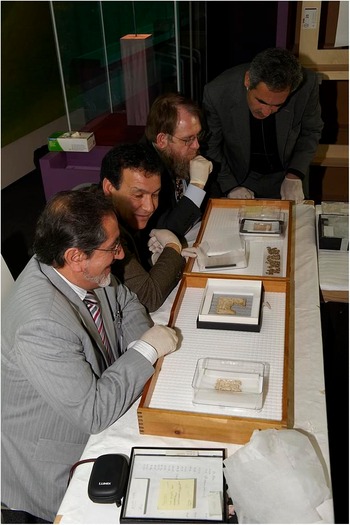
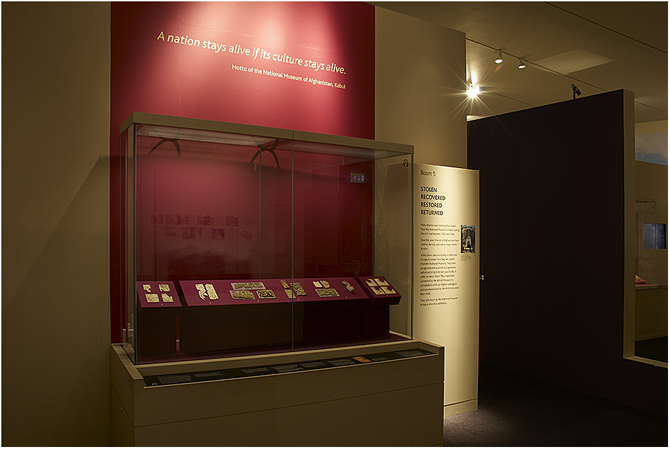
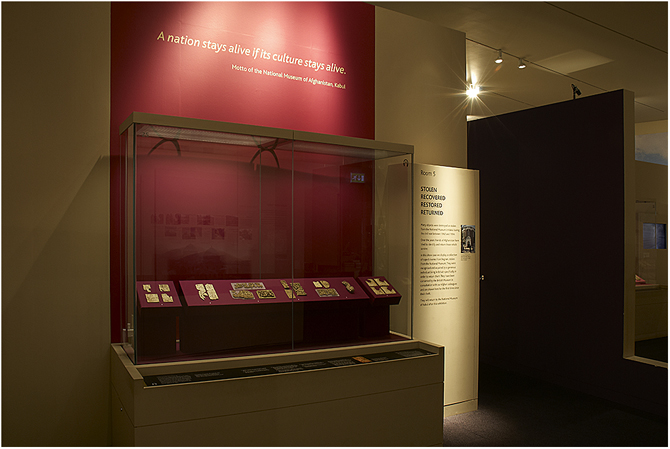
The scientific analyses and conservation were completed during the installation of the exhibition Afghanistan: Crossroads of the Ancient World, and these were the last objects to be installed. The unveiling of these pieces in the presence of loan couriers from Kabul, many of whom remembered them from the pre-civil war displays, was a moment of subdued emotion and triumph (figs. 7–8). The preliminary results of the treatments and analyses were presented to the public through labels and digital media in the special exhibition, a popular article, Footnote 39 and a special publication, Footnote 40 and these were followed by a refereed journal paper Footnote 41 and full publication as a refereed monograph. Footnote 42
Staff of the National Museum of Afghanistan and the British Museum condition check the restored ivories at the British Museum in March 2011 (photograph: British Museum).

Temporary display of the recently conserved ivories in the British Museum exhibition Afghanistan: Crossroads of the Ancient World (2011) (photograph: British Museum).
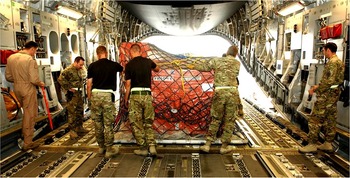
This story generated considerable and exclusively positive press and public interest during the exhibition in 2011. Footnote 43 During this time, many speculated about the future of these objects. Some suggested they should join the world tour, but in discussions with the National Museum of Afghanistan in Kabul, we agreed that the most appropriate gesture would be to restore them to public display in their own museum. In the summer of 2012, they were carefully condition photographed and packed by colleagues in the Department of the Middle East and flown to Kabul via Camp Bastion on military flights organized by the British armed forces (fig. 9). Footnote 44 These objects, together with other antiquities and publications, were immediately collected in person by Dr. Masoudi and some of his staff, unpacked, and displayed at a press preview at the National Museum of Afghanistan in Kabul on 5 August 2012. Footnote 45
Returning the ivories to Kabul (photograph: Ministry of Defence).

CONCLUSION
Cultural heritage, tangible or intangible, is a fragile commodity easily damaged or lost. The destructive effects of over 35 years of conflict in Afghanistan are evident across the country and affect the society and economy as well as archaeological sites and monuments, museums, and culture. However, to dwell on the loss and damage, however great, is to deny the positive stories, such as the successful concealment of some of the museum’s finest treasures, their continuing tour of the world as a special exhibition, the rebuilding of the National Museum of Afghanistan in Kabul, the re-opening of the museum in Herat, and the development of a new generation of Afghan museum curators and archaeologists. The identification and return of objects stolen from the museums in Afghanistan remains an international priority, but many have effectively disappeared through the market into private collections where they are untraceable and therefore beyond restitution. This article illustrates an extreme case of how one group of outstandingly beautiful and highly fragile pieces was re-acquired by private means and returned to Kabul through the British Museum where it had also been conserved, scientifically analyzed, and placed on temporary display. This was a highly successful case of collaboration between museums and private individuals over the identification and restitution of famous objects long considered lost. It is our firm hope that other objects stolen during the dark years of civil war will be returned in future to their proper home in the National Museum of Afghanistan in Kabul.
ACKNOWLEDGMENTS:
I would like to extend my deepest thanks to all concerned in the recovery, conservation, scientific research, and safe return of the pieces discussed in this article and to the editors, peer reviewers, and colleagues who commented on this article.