Introduction
The cancellarid genus Sveltia Jousseaume, Reference Jousseaume1887, is represented in most European and North African Neogene shallow-water marine assemblages. In Pliocene deposits, the most commonly reported species is Sveltia varicosa (Brocchi, Reference Brocchi1814), which was, until recently, considered a widely distributed and variable taxon in the Mediterranean Sea and adjacent Atlantic, along both European and northwestern African coasts (Chavan, Reference Chavan1940; Malatesta, Reference Malatesta1974; Fekih, Reference Fekih1975; Martinell, Reference Martinell1979; González-Delgado, Reference González-Delgado1992; Vera Peláez et al., Reference Vera-Peláez, Muñiz-Solís, Lozano Francisco, Martinell, Domènech and Guerra-Merchán1995; Silva, Reference Silva2001; Chirli, Reference Chirli2002; Landau et al., Reference Landau, Petit and Marquet2006, Reference Landau, Silva and Mayoral2011).
Brunetti (Reference Brunetti2016), in a follow-up paper to his review of the genus in the Pliocene of Italy (Brunetti et al., Reference Brunetti, Della Bella, Forli and Vecchi2011), re-examined the lower Pliocene specimens from the Atlantic Guadalquivir Basin of southwestern Spain assigned to S. varicosa and considered them to represent a new species; S. confusa Brunetti, Reference Brunetti2016. This spurred reassessment of the Sveltia material from the Atlantic Pliocene of the Mondego Basin, central-west Portugal, which, in the light of this recent taxonomic revision, represents yet another species of the genus. The results of this re-examination, together with a discussion of the Pliocene to present-day Atlanto-Mediterranean biogeographical evolution of the S. varicosa species group is presented herein.
Geological and paleoenvironmental setting
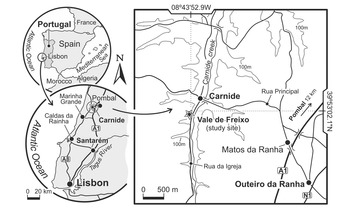
The Vale de Freixo site is located in west-central Portugal (Pombal region) with the geographical coordinates 39°53′02.1″N, 8°43′52.9″W (Fig. 1). The Miocene–Pliocene sedimentary sequence exposed at this locality is part of the Cenozoic Mondego Basin, the fossiliferous Pliocene sediments corresponding to the basal transgressive beds of the Carnide Sandstone Formation (Cachão, Reference Cachão1990; Diniz et al., Reference Diniz, Silva and Cachão2016). The calcareous nannofossil assemblage from these beds indicates placement in biozone CN12a of Okada and Bukry (Reference Okada and Bukry1980). Based on calcareous nannofossils and gastropod mollusks, these beds have been assigned to the uppermost Zanclean to lower Piacenzian (Cachão, Reference Cachão1990; Silva, Reference Silva2001; Diniz et al., Reference Diniz, Silva and Cachão2016). The molluscan fauna of Vale de Freixo, as well as all the known marine Pliocene Atlantic molluscan assemblages of the Mondego Basin, correlate to the Mediterranean Pliocene Molluscan Unit 1 (MPMU1) as defined by Monegatti and Raffi (Reference Monegatti and Raffi2001) for the Mediterranean Sea (Silva et al., Reference Silva, Landau, Domènech and Martinell2010). For more information on the general geological setting and the stratigraphy of the Vale de Freixo site and additional references see Silva et al. (Reference Silva, Landau, Domènech and Martinell2006, Reference Silva, Landau, Domènech and Martinell2010) and Diniz et al. (Reference Diniz, Silva and Cachão2016).
Geographical location of the study site: Vale de Freixo, Carnide, Pombal Municipality (west-central Portugal).

During the very end of the Zanclean and the beginning of the Piacenzian, the Caldas da Rainha-Marinha Grande-Pombal region of western Portugal corresponded, generally speaking, to a shallow marine environment of normal salinity with warm waters, and somehow was protected from the direct influence of open Atlantic Ocean (Nolf and Silva, Reference Nolf and Silva1997; Silva et al., Reference Silva, Landau, Domènech and Martinell2010). Based on the Pliocene molluscan assemblage, the mid Pliocene Sea Surface Temperatures (SST) along the western Iberian coast at that latitude (Portugal, 40°N) were subtropical, similar to those recorded today on the coasts of western Africa at the latitude of Cape Blanc (Morocco/Mauritania, 21°N; i.e., with maximum Mean Monthly SSTs of ~23.5°C in September and minimum MMSST of 19°C in January–March) (Silva et al., Reference Silva, Landau, Domènech and Martinell2010).
The fossil assemblage of Vale de Feixo suggests an infralittoral environment, <24 m deep, in which the gastropods were the most diverse group (Silva, Reference Silva2001, Reference Silva2002), followed by the bivalves (Dollfus and Cotter, Reference Dollfus and Cotter1909, for the Caldas da Rainha-Marinha Grande area; Pimentel, Reference Pimentel2018, for Vale de Freixo) and the polyplacophorans (Dell'Angelo and Silva, Reference Dell'Angelo and Silva2003). Other benthic invertebrate groups (i.e., bryozoans, Carvalho, Reference Carvalho1961; echinoids, Silva, Reference Silva2001; Pereira, Reference Pereira2010; and barnacles, Ferreira et al., Reference Ferreira, Pereira and Silva2019) were also well represented in the local ecosystem. Vertebrates are represented in the assemblage by bony fish otoliths and rare shark teeth (Nolf and Silva, Reference Nolf and Silva1997; Silva, Reference Silva2001). The gastropod fauna was part of the subtropical Pliocene French-Iberian Province of Silva and Landau (Reference Silva and Landau2007) and Landau et al. (Reference Landau, Silva, Van Dingenen and Ceulemans2020), including ~45 thermophilic genera, such as Xenophora Fischer von Waldheim, Reference Fischer von Waldheim1807, Cypraecassis Stutchbury, Reference Stutchbury1837, Distorsio Röding, Reference Röding1798, Bolinus Pusch, Reference Pusch1837, Cymbium Röding, Reference Röding1798, Marginella Lamarck, Reference Lamarck1799, Persicula Schumacher, Reference Schumacher1817, Granulina Jousseaume, Reference Jousseaume1888, Solatia Jousseaume, Reference Jousseaume1887, Conus s.l., Strioterebrum Sacco, Reference Sacco1891, and Sveltia, but lacking the typical tropical indicators common in coeval Mediterranean faunas (e.g., Persististrombus Kronenberg and Lee, Reference Kronenberg and Lee2007, and diversified Terebridae and Conidae, etc., after Monegatti and Raffi, Reference Monegatti and Raffi2001).
Material and methods
The examined material forms part of the collection of the Department of Geology of the Faculty of Sciences of the University of Lisbon, Portugal (C.M. da Silva, Vale de Freixo, Ph.D. collection), and the B. Landau collection, now incorporated in the Natural History Museum Vienna, Austria (NHMW).
Repositories and institutional abbreviations
NHMW coll. = Natural History Museum Vienna (Austria); GeoFCUL coll. = Department of Geology of the Faculty of Sciences of the University of Lisbon (Portugal), Carlos Marques da Silva, Vale de Freixo (VFX) Ph.D. Collection.
Systematic paleontology
Superfamily Cancellarioidea Forbes and Hanley, Reference Forbes and Hanley1851
Bouchet et al. (Reference Bouchet, Rocroi, Hausdorf, Kaim, Kano, Nützel, Parkhaev, Schrödl and Strong2017, p. 379) synonymized Cancellarioidea Forbes and Hanley, Reference Forbes and Hanley1851, with Volutoidea Rafinesque, Reference Rafinesque1815. However, the most recent molecular phylogeny of Fedosov et al. (Reference Fedosov, Caballer Gutierrez, Buge, Sorokin, Puillandre and Bouchet2019, fig. 2) suggests indeed that Cancellariidae are not nested with the rest of the Volutoidea, hence Cancellarioidea is a valid superfamily.
Family Cancellariidae Forbes and Hanley, Reference Forbes and Hanley1851
Subfamily Cancellariinae Forbes and Hanley, Reference Forbes and Hanley1851
Genus Sveltia Jousseaume, Reference Jousseaume1887
- Reference Jousseaume1887
Sveltia Jousseaume, p. 214.
Type species
Voluta varricosa Brocchi, Reference Brocchi1814 (currently accepted spelling varicosa) by original designation. Pliocene, Italy.
Sveltia sofiae new species
Figures 2.1–2.10, 3.1
- Reference Silva2001
Sveltia varricosa (Brocchi, Reference Brocchi1814) s.l.; Silva, p. 498, pl. 22, figs 17, 18.
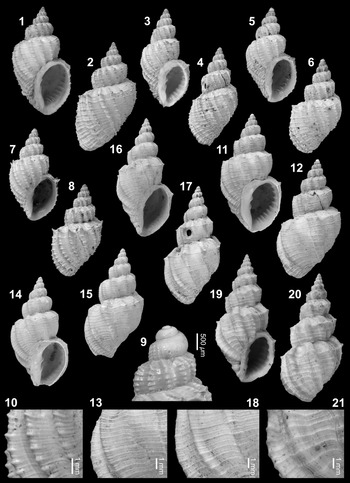
Gastropods of the Sveltia varicosa group from the Atlanto-Mediterranean Miocene and Pliocene. (1–10) Sveltia sofiae n. sp., Vale de Freixo, Portugal, Carnide Formation; (1, 2) (GeoFCUL VFX.03.130) paratype 3 in (1) apertural and (2) dorsal views, height 28 mm; (3, 4) (NHMW 2018/0331/0170) holotype in (3) apertural and (4) dorsal views, height 20.1 mm; (5, 6) (NHMW 2018/0331/0305) paratype 1 in (5) apertural and (6) dorsal views, height 16 mm; (7–10) (NHMW 2018/0331/0306) paratype 2 in (7) apertural and (8) dorsal views, (9) protoconch, and (10) detail of the sculpture, height 15.8 mm. (11–15) Sveltia confusa Brunetti, (11–13) (NHMW 2010/0054/0155) Lucena del Puerto, Huelva, Spain, Arenas de Huelva Formation, in (11) apertural and (12) dorsal views, and (13) detail of the sculpture, height 28 mm; (14, 15) (NHMW unnumbered) La Dixmérie, St-Julien-de-Concelles, Loire Atlantique, France, in (14) apertural and (15) dorsal views; height 20.4 mm. (16–18) (NHMW unnumbered) Sveltia varicosa (Brocchi), Poggio alla Staffa, Siena, Italy in (16) apertural and (17) dorsal views, and (18) detail of the sculpture; height 27 mm. (19–21) (NHMW1847/0058/0469) Sveltia dertovaricosa Sacco, Reference Sacco1894, Yaylasi, Akpinar, Turkey, Serravallian, middle Miocene in (19) apertural and (20) dorsal views, and (21) detail of the sculpture; height 32 mm.

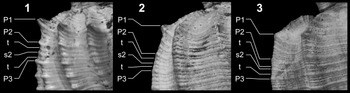
Comparison of spiral sculpture in Pliocene species of the Sveltia varicosa group from the Atlanto-Mediterranean Pliocene discussed herein. (1) Sveltia sofiae n. sp., paratype 2, Vale de Freixo, Portugal, Carnide Formation (NHMW 2018/0331/0306, same specimen as in Fig. 2.7–2.10); scale x2.1. (2) Sveltia confusa Brunetti, Lucena del Puerto, Huelva, Spain, Arenas de Huelva Formation (NHMW 2010/0054/0155, same specimen as in Fig. 2.11–2.13); scale x2.3. (3) Sveltia varicosa (Brocchi), Poggio alla Staffa, Siena, Italy (NHMW, same specimen as in Fig. 2.16–2.18); scale x2.4. Terminology after Landau et al. (Reference Landau, Merle, Ceulemans and Van Dingenen2019). P1 = primary shoulder cord, P2 = primary cord 2; P3 = primary cord 3; s2 = secondary cord between P2 and P3; t = tertiary cords.

Type specimens
Holotype NHMW 2018/0331/0170, height 20.1 mm, width 9.8 mm (Fig. 2.3, 2.4); paratype 1 NHMW 2018/0331/0305, height 16.0 mm, width 8.3 mm (Fig. 2.5, 2.6); paratype 2 NHMW 2018/0331/0306 (Fig. 2.7–2.10); paratype 3 GeoFCUL VFX.03.130, height 28.0 mm, width 15.1 mm (Fig. 2.1, 2.2); paratype 4 GeoFCUL VFX.03.131, height 17.0 mm, width 9.1 mm; paratype 5 GeoFCUL VFX.03.132, height 14.1 mm, width 7.8 mm; paratype 6 GeoFCUL VFX.03.133, height 12.0 mm, width 6.6 mm; paratype 7 GeoFCUL VFX.04.024, height 12.1 mm, width 6.6 mm. Carnide Sandstone Formation, basal fossiliferous gray sands, “Bed 3” in Gili et al. (Reference Gili, Silva and Martinell1995, text-fig. 2).
Diagnosis
Sveltia specimens of small to medium shell size for genus, multispiral protoconch, teleoconch with scalate spire, sculpture of 14–15 sharp, narrow ribs, fine spiral cords slightly spinous over ribs, subobsolete in interspaces between ribs.
Occurrence
Vale de Freixo site, near the village of Carnide, Pombal municipality, west-central Portugal. Pliocene northeastern Atlantic, western Iberian coasts; Mondego Basin (Portugal), uppermost Zanclean to lower Piacenzian (this paper).
Description
Shell of small to medium size and relatively fragile for genus, fusiform with an elevated scalate spire. Protoconch homeostrophic, multispiral, dome-shaped, consisting of three smooth convex whorls, with small smooth nucleus (height: 0.9–1.0 mm; diameter: 1.0–1.1 mm; diameter of nucleus: 0.10–0.14 mm). Transition to teleoconch abrupt, sharply delimited, marked by 2–3 prosocline ribs at end of protoconch and onset of spiral sculpture on teleoconch. Teleoconch consisting of up to 5.5 angular whorls with flattened to weakly convex, subsutural ramp, sharply angled at shoulder, convex below. Suture superficial, undulating. Axial sculpture of 13–15 sharp, narrow, prosocline ribs. Spiral sculpture of narrow, close-set spiral cords of primary to tertiary strength, strengthened over ribs, where primaries slightly spinous; cords weakened or subobsolete in interspaces between ribs. Shoulder cord further strengthened and more strongly spinous, delimiting subsutural ramp. Last whorl 70–72% of total height. Aperture, subtrigonal to ovate, 42–45% of total height. Outer lip not thickened, angled at shoulder, convex below, smooth to lirate within; anal canal hardly developed; siphonal canal short, open. Columella moderately excavated, bearing two oblique folds of equal strength. Columellar and parietal callus continuous, thickened, sharply delimited, closely adpressed and moderately expanded over medial side of venter in adult specimens, closing umbilicus. Siphonal fasciole weakly developed, poorly delimited, rounded.
Etymology
Named after Sofia Pereira, Portuguese Ordovician trilobite paleontologist at the Geosciences Centre of the University of Coimbra, Portugal.
Additional material
NHMW 2018/0331/0171 (nine subadults and juveniles), GeoFCUL VFX (eight unnumbered specimens), Vale de Freixo, Pombal, Portugal.
Dimensions
Measured on the 13 specimens of the GeoFCUL collection. Height: 28 mm (max.) to 4.5 mm (min.), average = 14.3 mm; diameter: 15 mm (max.) to 5.9 mm (min.), average = 8.7 mm; height of the last whorl: 21 mm (max.) to 7.7 mm (min.), average = 12 mm; height of the aperture: 15.5 (max.) to 5.4 mm (min.), average = 8.6 mm.
Variability
There is little intraspecific variability; in the largest specimen, the shoulder is a little more rounded. The sculpture is remarkably consistent.
Paleoecology
Epibenthic vagile gastropods living in coastal infralittoral subtropical marine environments (estimated maximum MMSST of ~23.5°C in September and minimum MMSST of 19°C in January–March; Silva et al., Reference Silva, Landau, Domènech and Martinell2010) of normal salinity and sandy substrates. Gastropods with multispiral protoconch suggesting planktotrophic larval development.
Remarks
The careful revision of numerous gastropod species known from the fossil record that were thought to correspond to coherent, widely distributed taxa, either geographically, stratigraphically, or both, has shown them to represent species groups rather than single variable biological entities (e.g., many of the naticid species in the Mediterranean Pliocene, see Pedriali and Robba, Reference Pedriali and Robba2005, Reference Pedriali and Robba2008; buccinids, see Brunetti and Della Bella, Reference Brunetti and Della Bella2014, Reference Brunetti and Della Bella2016; and other cancellarids, see Brunetti et al., Reference Brunetti, Forli and Vecchi2006, Reference Brunetti, Della Bella, Forli and Vecchi2008, Reference Brunetti, Bella, Forli and Vecchi2009, Reference Brunetti, Della Bella, Forli and Vecchi2011).
Difficulties surrounding the Sveltia varicosa species group have been repeatedly highlighted in the literature with contrasting conclusions, ranging from Bałuk (Reference Bałuk1997, p. 48) who considered it pointless to separate species or varieties from various Neogene European basins, to Landau et al. (Reference Landau, Petit and Marquet2006, p. 78) who recognized a Miocene to Pliocene trend for the shells to become larger, more angular, and to lose the abapical columellar fold. Those authors recognized several geographically or stratigraphically restricted taxa, such as S. dertovaricosa (Sacco, Reference Sacco1894) in the middle–upper Miocene Paratethys, Proto-Mediterranean Sea and adjacent Atlantic, S. burdigalensis Peyrot, Reference Peyrot1928, from the Atlantic Burdigalian lower Miocene of France, and S. lajonkaireana (Nyst, Reference Nyst1835) from the Pliocene North Sea Basin. The protoconch in all members of the Sveltia varicosa species group is multispiral, composed of three smooth convex whorls, with a small nucleus, and, therefore, not useful to discriminate the various species.
Silva (Reference Silva2001), in his work on the Pliocene Mondego Basin gastropod assemblage, already had expressed doubts about the conspecificity of the Portuguese specimens with “typical” Italian Pliocene S. varicosa by recording the species as Sveltia varricosa [sic] (Brocchi, Reference Brocchi1814) s.l. He pointed out that the Mondego specimens were less elongated, had a lower, more scalate spire with a shallower subsutural ramp, and were closer to the Pliocene Guadalquivir Basin specimens of southern Spain (now S. confusa) in shape. Differences in sculpture were also discussed. Sveltia varicosa has 8–10 rather broad, rounded axial ribs (Brocchi, Reference Brocchi1814; Rossi-Ronchetti, Reference Rossi-Ronchetti1955; Brunetti et al., Reference Brunetti, Della Bella, Forli and Vecchi2011, p. 94), whereas the larger Mondego Basin specimens have 14–15 ribs. The Guadalquivir Basin specimens have 10–11 axial ribs. Apart from the differences highlighted above by Silva (Reference Silva2001), the Mondego specimens are smaller and thinner shelled than either S. varicosa or S. confusa (maximum size: 51.8 mm S. varicosa; 34.6 mm S. confusa; 28.0 mm S. sofiae n. sp.) and differ in their spiral sculpture.
Brunetti (Reference Brunetti2016, p. 320) stated: “Compared to the very similar taxon, S. varicosa, the new species [S. confusa] has spiral sculpture composed of ribbon-like strings of identical thickness (…) while S. varicosa shows larger cords alternating with several others much thinner.” This is not accurate. All three species show shells with spiral cords of primary to tertiary strength. In S. varicosa, the primaries are markedly stronger than the secondaries, and the tertiaries are reduced to fine threads, and there are up to two tertiaries in each interspace between primaries and secondaries, making the distance between the primaries wider (Fig. 3.3). This spiral sculptural arrangement makes the primaries in this species more evident. In S. confusa, the primaries are also stronger, but the secondary and tertiary cords are of almost equal strength, giving the impression of more uniform spiral sculpture (Fig. 3.2). Moreover, the spirals are separated by narrower interspaces. In S. sofiae n. sp., the spirals are again well separated into those of primary to tertiary strength, slightly spiny where they overrun the ribs, and subobsolete in the interspaces between the ribs (Fig. 3.1). In S. sofiae n. sp., the number of ribs is greater than in the other two species. The Mondego Basin specimens represent, without doubt, a separate species, for which the taxon Sveltia sofiae n. sp. is herein erected.
Atlantic, Mediterranean, and Paratethyan specimens of this species group have been assigned to S. dertovaricosa Sacco, Reference Sacco1894 (Harzhauser and Landau, Reference Harzhauser and Landau2012; Landau et al., Reference Landau, Harzhauser, İslamoğlu and Silva2013). The holotype originates from the upper Miocene Tortonian of Stazzano, Italy (Ferrero-Mortara et al., Reference Ferrero Mortara, Montefameglio, Novelli, Opesso, Pavia and Tampieri1984, pl. 33, fig. 2; Brunetti et al., Reference Brunetti, Della Bella, Forli and Vecchi2011, figs. 4G, H). It has a regularly fusiform shell with a weak shoulder, two well-developed columellar folds, with a third subobsolete abapical one; and a lirate outer lip. Middle Miocene specimens from the Paratethys and eastern Proto-Mediterranean of Turkey (Fig. 2.19–2.21) are more strongly shouldered and, most importantly, have three well-developed columellar folds, and a lirate outer lip. Therefore, they may represent one or more distinct species. The specimens reported by Pereira da Costa (Reference Pereira da Costa1867) from the Tortonian of Portugal, under the name Cancellaria varicosa, conform to the shape of S. dertovaricosa, the abapical fold is either absent on extremely weak, but the outer lip is smooth, not lirate. We are unsure how important this feature is, because in other groups the presence/absence of lirae may vary intraspecifically. Therefore, we provisionally consider these specimens to represent S. dertovaricosa. Apart from the columellar folds, S. dertovaricosa further differs from S. sofiae n. sp. in being more fusiform, with a weaker shoulder.
Pereira da Costa described an additional member of the S. varicosa species group; Cancellaria adiçana [sic] (Pereira da Costa, Reference Pereira da Costa1867), from the Serravalian–Tortonian transition of Adiça (Almada), south of Lisbon, Portugal. We have not examined specimens of this species, but the shell described and figured by Pereira da Costa is fusiform, with no shoulder, the ribs are weak, the outer lip is smooth within, and it has two columellar folds. These specimens are most like S. dertovaricosa from Cacela in being fusiform, having two folds and a smooth outer lip, but the Cacela shells are shouldered with a small spine developed on the shoulder cord.
The genus is represented in the eastern Atlantic by the Pliocene to present-day species Sveltia lyrata (Brocchi, Reference Brocchi1814). The shell of S. lyrata differs from the S. varicosa species group discussed herein in having strongly angular whorls, a broad, steeply sloping subsutural ramp, and more or less well-developed spines placed roughly mid-whorl that are more strongly developed than in any of the species in the S. varicosa group (e.g., Verhecken, Reference Verhecken2007, p. 325, fig. 41).
Discussion
Chronostratigraphic distribution
Brunetti (Reference Brunetti2016, p. 323) reported that S. confusa has a chronostratigraphic distribution exclusive to the basal Zanclean and a wide geographical distribution, including the Mediterranean Sea (Estepona Basin, southern Spain and Monte Antico, Toscany, Italy) and the adjacent Atlantic (Guadalquivir Basin, southern Spain). In contrast, S. varicosa was particularly abundant in the Piacenzian (Pliocene), extending its distribution to the Gelasian (Pleistocene), and only referred to its occurrence in Italian assemblages. However, in the “Examined Material” section, Brunetti (Reference Brunetti2016, p. 320) clearly stated that S. varicosa occurs from the Zanclean to the Piacenzian (Italy) and into the Gelasian of Torrente Stirone (Italy).
It is not clear on what data Brunetti (Reference Brunetti2016, p. 323) based his chronostratigraphic assignment of the occurrences of S. confusa to the basal Zanclean. In the original formalization of the new species, Brunetti (Reference Brunetti2016, p. 320) did not mention the stratum typicum, stating simply, in the “Distribution,” that S. confusa occurs in the Zanclean sediments of the Guadalquivir and Estepona basins. In the chresonymy of S. confusa, specimens of the Guadalquivir Basin of González-Delgado (Reference González-Delgado1992) and Landau et al. (Reference Landau, Silva and Mayoral2011) are included. The Sveltia specimens figured in both these publications originate from the Huelva Sands Formation. Moreover, the type material of S. confusa originates from Lucena del Puerto, a typical Huelva Sands Formation locality (Landau et al., Reference Landau, Silva and Mayoral2011). Based on planktic foraminifers, this formation was assigned to the G. margaritae and G. puncticulata biozones (Sierro, Reference Sierro1985; Civis et al., Reference Civis, Sierro, González-Delgado, Flores, Andrés, Porta, Valle and Civis1987), corresponding to the lower Pliocene, but not to the basal Zanclean (biostratigraphy after Lirer et al., Reference Lirer, Foresi, Iaccarino, Salvatorini, Turco, Cosentino, Sierro and Caruso2019).
Similarly, the chronostratigraphic positioning of the Estepona Basin Pliocene sections does not corroborate a basal Zanclean age. According to Aguirre et al. (Reference Aguirre, Cachão, Domènech, Lozano-Francisco, Martinell, Mayoral, Santos, Vera-Peláez and Silva2005), the sections exposed in Parque Antena, Velerín, and Velerín-Carretera (Estepona) are assigned to the uppermost Zanclean, while the Velerín-Antena (Estepona) section is assigned to the lower half of the Piacenzian (upper Pliocene). Similarly, other authors assign the Estepona Formation sections to the upper Zanclean (Vera-Peláez et al., Reference Vera-Peláez, Muñiz-Solís, Lozano Francisco, Martinell, Domènech and Guerra-Merchán1995) to lower Piacenzian (Guerra Merchán et al., Reference Guerra-Merchán, Serrano and Ramallo2002; Janssen, Reference Janssen2004). As to the Monte Antico locality, the origin of the S. confusa Italian material examined by Brunetti (Reference Brunetti2016) was assigned by the author to the lower Pliocene, but not specifically the basal Zanclean. Finally, the fossil assemblage of the La Dixmérie deposits of northwestern France is assigned to Assemblage III of Van Dingenen et al. (Reference Van Dingenen, Ceulemans, Landau and Silva2015), which again is dated as Zanclean, but not basal (Landau et al., Reference Landau, Silva, Van Dingenen and Ceulemans2020).
The occurrences of S. confusa related to the Pliocene Mediterranean-West African Tropical Province of Silva and Landau (Reference Silva and Landau2007) (i.e., the Mediterranean region and Guadalquivir Basin reports) fit into the Zanclean to lower Piacenzian pre-3.0 cooling event, MPMU1 unit of Monegatti and Raffi (Reference Monegatti and Raffi2001). The French Assemblage III, representing the subtropical Pliocene French-Iberian Province, fits into the time frame of the MPMU1 in the Mediterranean region. Sveltia sofiae n. sp. occurs in the uppermost Zanclean to lower Piacenzian of the Portuguese Mondego Basin (this paper) and correlates to the Mediterranean MPMU1 (Silva, Reference Silva2001).
Geographical distribution
For this paper, dozens of Pliocene Sveltia specimens spanning the entire Huelva Sands Formation have been revised (“yellow” and “grey” sands, sensu Landau, Reference Landau1984 and Landau et al., Reference Landau, Silva and Mayoral2011), and all of them represent S. confusa (Fig. 2.11, 2.12). Likewise, a small collection of five poorly preserved Sveltia shells (NHMW) from the more northern Atlantic lower Pliocene locality of La Dixmérie (Nantes region, France, Assemblage III of Van Dingenen et al., Reference Van Dingenen, Ceulemans, Landau and Silva2015) was examined, all representing S. confusa (Fig. 2.14, 2.15).
Brunetti (Reference Brunetti2016) included the Pliocene specimens from the Estepona Basin, southern Mediterranean Spain, figured by Vera Peláez et al. (Reference Vera-Peláez, Muñiz-Solís, Lozano Francisco, Martinell, Domènech and Guerra-Merchán1995) as Sveltia varricosa [sic], in the chresonymy of S. confusa. These specimens are extremely uncommon in the Estepona deposits. A single Sveltia specimen from the Velerín Conglomerates (Estepona) was figured recently by Landau and Mulder (Reference Landau and Mulder2020, fig. 22), and it does indeed represent S. confusa.
For this work, the Italian records of Monte Antico given by Brunetti (Reference Brunetti2016) for S. confusa were reassessed. The assemblage was monographed in Brunetti (Reference Brunetti2014) and the specimen illustrated on page 62 identified as S. varicosa. This specimen was later included in the chresonymy of S. confusa by Brunetti (Reference Brunetti2016, p. 320). In our opinion, this specimen represents S. varicosa, not S. confusa. Although the spiral sculpture resembles that seen in S. confusa, the shoulder is far less acute than that seen in specimens of the species from Spain. In light of this revision, S. confusa has a geographical distribution restricted to the eastern Atlantic and the adjacent Mediterranean Alboran Sea. Conversely, we re-examined other Mediterranean records of S. varicosa (southern France, Fontannes, Reference Fontannes1880; Tunisia, Fekih, Reference Fekih1975; Catalonia, north-eastern Spain, Martinell, Reference Martinell1979), all of which represent that species: Sveltia varicosa is widespread in the Mediterranean region, east of the Alboran Sea.
Biogeography
Sveltia is a genus of thermophilic gastropods with a wide present-day distribution, including the tropical and temperate eastern and western Atlantic, and eastern Pacific (Verhecken, Reference Verhecken2007; Petit and Harasewych, Reference Petit and Harasewych2011). In the eastern Atlantic, the genus is represented by a single species, Sveltia lyrata (Brocchi, Reference Brocchi1814), occurring from shallow to relatively deep waters off Cape Blanc, Mauritania to South Africa, off Cape Town (Verhecken, Reference Verhecken2007).
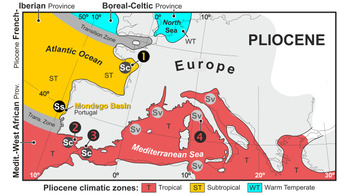
From a biogeographical point of view, as a result of the erection of S. confusa and S. sofiae n. sp., the Zanclean to early Piacenzian pre-3.0 Ma distribution (= MPMU1 time slice) of S. varicosa becomes restricted to the Mediterranean sector of the Mediterranean-West African Tropical Province (Fig. 4). Records of S. varicosa in the lower Pliocene Atlantic of Dar Bel Hamri (Morocco), although plausible, could not to be confirmed because no figures of specimens are given by either Chavan (Reference Chavan1940) or Lecointre (Reference Lecointre1952).
Geographic distribution of Sveltia sofiae n. sp. (Ss), S. confusa (Sc), and S. varicosa (Sv) in the pre-3.0 Ma Atlanto-Mediterranean Pliocene. 1 = Loire Basin, Ligerian Gulf; 2 = Guadalquivir Basin; 3 = Estepona Basin; 4 = Monte Antico, Tuscany. Pliocene biogeographic provinces after Silva and Landau (Reference Silva and Landau2007). Paleogeography adapted from Rögl (Reference Rögl1999), Silva (Reference Silva2001), and Popov et al. (Reference Popov, Shcherba, Ilyina, Nevesskaya, Paramonova, Khondkarian and Magyar2006).

On the other hand, the coeval S. confusa is a predominantly Atlantic Pliocene species, ranging from the northernmost subtropical Pliocene French-Iberian Province (from the Ligerian Subprovince, sensu Landau et al., Reference Landau, Silva, Van Dingenen and Ceulemans2020) to the northernmost Pliocene tropical Mediterranean-Moroccan Province (sensu Silva and Landau, Reference Silva and Landau2007). Its distribution crosses the Strait of Gibraltar, extending into the westernmost Mediterranean Sea only as far as the Alboran Sea. In the Mondego Basin, the S. varicosa species group is represented by S. sofiae n. sp. The Mondego assemblage, representing the southernmost part of the subtropical Pliocene French-Iberian Province, records a relatively cosmopolitan gastropod fauna with fewer than 10 endemic species (≤6%). This is, therefore, an interesting and relevant addition to the Mondego endemics.
Conclusions
Erection of Sveltia sofiae n. sp. from the Pliocene of the Mondego Basin (Portugal), in the wake of the reassessment of the Iberian Atlantic occurrences of Sveltia and the previous formalization of S. confusa, sheds new light on the biogeography of the Sveltia varicosa species group in the Pliocene of the northeastern Atlantic and the Mediterranean Sea. After this revision, a mosaic of species has emerged from what was previously seen as the broad Atlanto-Mediterranean range of a single widespread and very variable species.
As now understood, S. varicosa was a Mediterranean taxon, absent only in the westernmost Alboran Sea. Sveltia confusa had a mainly Atlantic distribution, from the northwestern French Pliocene Ligerian Gulf to the Gulf of Cadiz, at least, and straddling the Strait of Gibraltar into the Alboran Sea. Sveltia sofiae n. sp. was endemic to western Iberia, represented today only in the western Portuguese Mondego Basin.
Sveltia is a thermophilic genus. In the eastern Atlantic, since Pliocene times, as a result of sea surface temperature decrease, it underwent a southward range contraction along the western European and African coasts. Today, the genus is represented in the eastern Atlantic by a single species, Sveltia lyrata, occurring from Cape Blanc, Mauritania, south. This range contraction was coupled with the post mid-Piacenzian equatorward reduction of the Pliocene Mediterranean-West African tropical molluscan province (resulting in the present-day Mauritanian-Senegalese Province) and the consequent rise of the current Mediterranean-Moroccan subtropical province.
Acknowledgments
The authors would like to thank reviewers, M. Harzhauser (Naturhistorisches Museum Wien, Austria) and G. Vermeij (Department of Geology, University of California at Davis, USA), as well as the editor of JP, for their helpful and constructive comments and suggestions that greatly contributed to improving the final version of this work.