This article examines a Sino-Indonesian form of theatre, specifically the cloth glove puppet theatre of southern Fujian (Hokkien) origin known as budaixi (Pinyin), potehi (Hokkien pronunciation) or wayang potehi (in Indonesian). Using secondary scholarship, colonial and contemporary newspaper reports, and fieldwork, this article outlines the genre's emergence in Fujian, its arrival in the archipelago, and historical and contemporary practice there. This theatrical tradition develops from the historical maritime networks of southern coastal Chinese populations in Southeast Asia, contributing to and illustrating the complex meanings of Sino-Indonesian identity. Examples of contemporary potehi patronage constitute strategies used by Sino-Indonesians, in this case the mixed-culture non-Chinese-speaking communities of East Java, to perform an ethnic identity for the larger public, while the form's practitioners are now overwhelmingly non-Chinese. Since potehi is today consistently cast by its patrons, practitioners and scholars as a part of Indonesian heritage, the ways that it can be construed as a form of wayang (and thus, an Indonesian genre) are gaining emphasis. Deployment of the genre in scholarship and society advances an integrationist view of Sino-Indonesian ethnic identity.
Scholarship on Sino-Indonesian communities always navigates tensions of identity. Some privilege a Sinocentric view with overseas populations envisaged in relation to China; when the receiving country is the subject of study, diasporic connections or origins may be neglected in favour of an emphasis on its contribution to a core ‘native’ culture. Naturally, this tension can also be found in the scholarship on Overseas Chinese performing arts, with some stressing and some effacing of ‘Chineseness’. Mainland Chinese scholarship on budaixi has largely regarded Southeast Asian practice as unchangingly ‘Chinese’, while also being inclined to regard it as of marginal interest (and impractical to research) due to its position on the periphery and its linguistic otherness. Conversely, Indonesian and Western Indonesianist scholarship have been weak on the Chinese origins of this genre and the relations that should be traced with existing practices elsewhere (i.e. in Mainland China, Taiwan, Malaysia and Singapore).Footnote 1
This article seeks to respect Hokkien roots, Indonesian practice, and the position of this genre in a dynamic regional history while tracing the development and practice of the genre. Critical studies of Asian or transnational performance have absorbed from ethnic studies the idea of the ‘flexible indeterminacy and contestability of Chineseness … remade and reshaped in different conditions of diaspora’Footnote 2 acknowledging that ‘“Chineseness” as an ethnic marker is no longer a theoretical given but a malleable category which fluctuates according to its immediate environment’.Footnote 3 The existence of highly mixed assimilated communities and huge regional variation within Indonesia means that the terms of ‘Chineseness’ vary strongly by location and generation.Footnote 4 This article attempts to map the diasporic origin of the art and local context of this identity, taking the malleability and indeterminacy of ‘Chineseness’ in Indonesia as a theoretical starting point, and identifying a public performance of potehi as a way of shaping that local ‘Chineseness’. The existence of parallel traditions elsewhere in Southeast Asia, not to mention the genre's radically divergent development in mainland China and Taiwan, puts pressure on concepts of tradition and ethnic identity.
While the historical portion relies heavily on secondary scholarship and available newspaper reports of the era, the section dealing with the current practice of potehi is based on fieldwork with potehi troupes in October and December 2012 as well as in January and May 2013, observing performances at resident troupes in Surabaya, Gudo (Jombang) and Mojokerto; as well as performances of such troupes ‘away’ in Blitar and Yogyakarta. I interviewed and observed dalangs, patrons, musicians, employees, associates, local officials, and audience members, generally in unstructured or semi-structured conversation over the course of several days. The material gathered in this manner is reinforced wherever possible with local news reports and secondary scholarship.
Origins of budaixi in mainland China and transmission to the Indies
Wayang potehi can be directly traced to the southern Fujian (Hokkien) theatre practice of budaixi. Since Chinese immigration to Java originated largely from that area, it is unsurprising that a local puppet form arrived with them, along with other forms of xiqu (‘Chinese opera’),Footnote 5 and just as Hakka populations brought their marionette genre (known in Indonesian as wayang gantung) to Singkawang (West Kalimantan).
Budaixi and potehi both mean ‘cloth bag theatre’. Western scholarship on China (largely committed to Pinyin) has tended to use the former term, while non-Chinese-language scholarship focused on the Southeast Asian practices adopts the latter, often expanding to wayang potehi in Indonesia, originating in the late colonial practice of using the term wayang also for various forms of Chinese entertainment.
Some clarification vis-à-vis existing accounts of the name is in order. Early scholarship in Dutch variously translated the Chinese term as ‘linen bag theatre’ (Hazeu in 1897) and ‘play of the linen bag’ (Moens in 1949), proposing that the term came from a bag hanging beneath the stage (De Groot in Hazeu 1897), from a bag puppets were brought out of (Serrurier in 1896), or from a bag which the puppeteer would have worn during performance, with an opening at the top for the puppets (Moens); van Groenendael's summation of these interpretations of the terms of origin has been followed by Indonesian scholars, who, like the Dutch scholars, were not examining the terms from a Chinese-language perspective.Footnote 6 The three Chinese characters (cloth [bu/po/布]-pocket/bag [dai/te/袋]-theatre/show [xi/hi/戲]) for the genre are transparent, and the ordinary derivation of the name lies in the fact that bodies of the puppets are made of cloth, forming a kind of pocket for the puppeteer's hand. Western languages refer to this kind of puppetry as ‘glove’, (as opposed to rod puppets or marionettes), but the Chinese word means ‘cloth pocket’, and the name of the genre seems as self-explanatory to Chinese speakers as ‘glove puppet’ does to English speakers. Since van Groenendael also provides the doubtless correct explanation (that the pocket/bag refers to the body of the puppet), furnished by puppetry specialist Robin Ruizendaal, Indonesian sources today tend to provide the whole range of explanations; the confusion of the matter, however, can likely be traced to early Western speculation, and there is little reason to doubt the standard Chinese explanation.Footnote 7
In Chinese, budaixi is also known as zhangzhongxi (‘theatre of the palm of the hand’); older Sino-Indonesian puppeteers in Indonesia also used the term. Mu'ouxi is also sometimes used, though since this means ‘wooden puppet theatre’, it does not provide a distinction from marionette forms. Consequently, the three state-sponsored puppet troupes in southern Fujian today feature confusing terminology: the budaixi troupe in Zhangzhou is called the Mu'ou Jutuan (Wooden Puppet Troupe); but the Quanzhou Mu'ou Jutuan is a marionette troupe, while the budaixi troupe in Jinjiang is called Zhangzhong Mu'ou Jutuan (Palm-of-the-Hand Wooden Puppet Troupe).
The history of southern Fujian puppetry, including budaixi, presents considerable difficulties. As with many other folk arts, the scarcity of documentation limits historical certitude. Accounts of the Chinese origins of budaixi, especially those written in Indonesia, usually provide a vague, ancient heritage for the art, (i.e. ‘3,000 years’) based on English sources about puppetry in general. While there is evidence for the great antiquity of Chinese puppetry as a whole, specific evidence for southern Fujian puppetry only becomes very strong in the Song Dynasty, and the first conclusive reference to budaixi itself is found only in the nineteenth century.
Puppetry of some kind was popular in southern Fujian as early as the Song Dynasty, with records of troupes exceeding one hundred members. In 1192, while in Zhangzhou, the great neo-Confucian philosopher Zhu Xi appears to have forbidden puppetry out of concern for the morals of the local people, and his disciple Chen Chun (1159–1223) elaborated on the immoral aspects of theatre, explicitly including puppets. In nearby Putian, the numerous references to puppetry in the work of poet Liu Kezhuang (1187–1269) suggest elaborate puppetry performances, including full costumes, high stages, and full narratives.Footnote 8 Ming Dynasty records also usually mention puppets in terms of general censure of theatre as an unwholesome activity. Four Ming and Qing versions of the local nanxi script The lychee mirror all make reference to puppets — probably shadow puppets — being performed during the Lantern Festival, a practice corroborated by a record from 1612 which also notes paper puppets during that festival in Zhangzhou.Footnote 9
There is, however, little reason to assume that any of these forms of puppetry closely resembled budaixi; many clearly are not glove puppets, while others give no further information, and could possibly indicate marionettes, shadow puppets or glove puppets. Budaixi origin tales are recorded in Quanzhou, Zhangzhou and Taiwan, all of which date the genre from the Jiajing (1521–67) or Wanli (1572–1620) periods, while the export of budaixi from southern Fujian to Taiwan and Guangdong is often given as taking place during the late Ming Dynasty (i.e. early to mid-seventeenth century). Yet these accounts themselves never date earlier than the nineteenth century. The pleasure boats of Yangzhou (Yangzhou huafang lu) contains an account of a ‘shoulder-load’ jiandanxi glove puppet theatre in the late eighteenth-century,Footnote 10 but since Yangzhou is at a great distance, this at best suggests a precursor. The first regional evidence is the local gazetteer for Jinjiang in southern Fujian for the Jiaqing reign (1796–1820), which makes mention of budaixi by name; the first certain evidence of it on Taiwan is 1874.Footnote 11 Thus, the evidence for budaixi becomes stronger in the sixteenth century, but even that surmise must draw on evidence from accounts written three centuries later.
From the eighteenth century until at least the end of the nineteenth century, budaixi was transmitted to various places in Southeast Asia. Writing in 1981, Tan Sooi-Beng identifies three Chinese puppet forms existing in Malaysia, which were performed at that time ‘only in honour of deities and normally on what is referred to as his/her birthday’, and among which was a form of budaixi, which she writes as ‘po te hi’.Footnote 12 At the time of Tan's writing, this form of theatre was cheaper to hire than the two other forms (Hokkien marionettes and Chaozhou rod puppets). The physical puppets to which she refers came to Malaysia ‘eight or nine decades ago’, i.e., as in Indonesia, towards the end of the nineteenth century. There is also still a form of potehi performance in Singapore.Footnote 13 Moreover, as shall be seen below, potehi was also being performed in Sumatra in the late colonial period.
There is a historic and current tradition of potehi in mainland China, Taiwan, and in several parts of Southeast Asia, though it has seldom been discussed in these terms, and contact between wayang potehi practitioners and their counterparts elsewhere has been re-established only recently. The regional history of potehi still needs further work, but clearly the Qing Dynasty waves of Hokkien immigrants, which profoundly affected Southeast Asia, often arrived bearing glove puppets.
Potehi in eighteenth and nineteenth-century Dutch East Indies
As with the history of most theatre genres, it makes little sense to look for a single origin or arrival. Several troupes can independently trace their origins to China, so the best model is to assume repeated entries of Hokkien budaixi practices in various areas of the colonial Indies. As with the origins of budaixi in China, evidence frequently adduced to demonstrate the antiquity of potehi in the archipelago is actually inconclusive. A Middle Javanese text called Nawaruci mentions ‘awayang Cina’, and some have taken this as evidence of the presence of potehi on Java in the sixteenth or seventeenth centuries.Footnote 14 In the absence of further information, any kind of Chinese entertainment might be meant, not necessarily involving puppets.
The earliest good evidence for potehi performance in the Indies concerns the invitation of a Batavian potehi troupe in 1772 to Semarang. According to the author Liem Thian Joe (Lin Tianyou), the visit took place to celebrate the opening of new buildings of Tay Kak Sie temple in gang Lombok, with performances lasting two months.Footnote 15 Since the temple still hosts potehi, if the account is accurate it situates 240 years of potehi performance in the same location. Liem speaks also of ‘the first temple in Semarang’ (Sioe Hok Bio) being built in 1753, writing that for the opening ‘… there was a small celebration that evening. There was no wajang pow-tee-hee performance, because at that time Semarang had no pow-tee-hee troupe’.Footnote 16 The fact that Liem specially notes the absence of potehi shows to what extent it must have been an ordinary component of temple festivities in his time. Since Liem's history draws substantially on documents of the Semarang Kongkoan (Chinese Council) which he salvaged when it closed in 1931, the claim has some documentary credibility, even in the absence of the actual text.
It is clear that by the mid-nineteenth century, Batavia at least had both human xiqu and potehi events for major festivals. Most performers were invited from China, and permission had to be obtained for their three- to six-month sojourns; wayang wong was also being performed alongside the Chinese forms.Footnote 17 There is evidence of potehi performance, alongside other wayangs at Chinese and civic festivals, in various regions by the late nineteenth century. Van Groenendael cites a month-long performance in Kediri in 1869 to exorcise smallpox.Footnote 18 Chinese puppets — almost certainly potehi — were present at the quintessential Dutch Sinterklaas festival in Semarang in 1877 alongside the Dutch puppet Jan Klaassen.Footnote 19 In Ambarawa, near Semarang, wayang potehi is reported in 1899 alongside wayang orang, tandak and wayang kulit on the occasion of the Zhongyuan festival (called rebutan or cioko in Indonesia).Footnote 20 In April 1901, De Locomotief reported that potehi performances in Welahan were being offered, alongside music and gamelan performances for worshippers of ‘Siang Thee Kong’ (i.e. at Hian Thian Siang Tee Bio, est. 1840). In 1902, in Panolan near Blora, a Dutchman described a potehi performance in considerable detail for De Locomotief, comparing it not unfavourably to Jan Klaassen.Footnote 21 Such accounts continue throughout the first half of the twentieth century. Colonial articles repeatedly indicate that the audiences at markets and festivals are ethnically mixed; for instance, the 1899 article reports dozens of Javanese viewers coming early in the morning and staying until 5.30 p.m. Several of these colonial articles describes the art as ‘chineesche poppenkast’ (‘Chinese puppet-box’) which certainly implies the box-stage of potehi, and a close similarity with the earliest stages now known in Indonesia, such as the centenary example preserved in Gudo (Jombang).
Potehi in the late colonial period and in the early Republic (1900–1965)
Present-day dalang lineages mostly originate at the turn of the last century. Surabaya dalang Ki Mudjiono describes his teacher Gan Co Co as ‘third generation’, which suggests roughly a turn of the century arrival of the genre in Surabaya; potehi performances there are supposedly ‘as old as the temple’, which is tentatively dated to 1899.Footnote 22 Purwoseputro approximates their tradition to 1915–20, when Toni Harsono's grandfather arrived from Fujian.Footnote 23 The Kediri dalang Ki Bejo learnt the genre from Tang Ang Ang, the pupil of a dalang who arrived in Semarang in the 1880s.Footnote 24 We have further evidence of the popularity of potehi in Semarang in the second half of the nineteenth century from the biography of Oei Tiong Ham (Huang Zhonghan, 1866–1924), the famous sugar baron, who watched the puppets as a young man at Tay Kek Sie.Footnote 25 The puppet theatre there was prominent enough at the turn of the century to span a short-lived spin-off called Komedie Boneka Stamboel (Stamboel puppet theatre), which used potehi puppets but emulated the costumes, narratives and music of the Stamboel theatre. The venture failed in 1899, and the man behind it returned to his previous employ at the Komedie Stamboel.Footnote 26
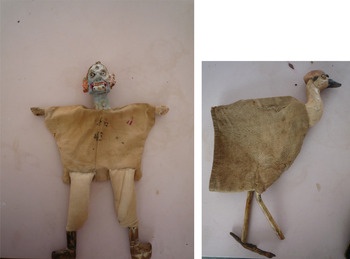
Potehi dolls originating from China, belonging to Hok Ho An. (Photo by author, courtesy of Hok Ho An)

Though potehi was thriving on Java by the mid-nineteenth century, and very likely before, the main surviving traditions can be traced to a later wave of Hokkien immigration in the second half of the nineteenth century and in the first half of the twentieth, enriching and spreading an existing Sino-Javanese practice. Wayang potehi remained popular through the later colonial period, and attracted the attention of several colonial-era Dutch-language researchers on Javanese theatre; some of them considered it probable that wayang golek derived directly from potehi.Footnote 27
In the first half of the twentieth century, potehi is recorded in a much broader geographical range than is now the case. The genre is attested in Sumatra, for instance, with records of Padang in the 1870sFootnote 28 and 1901,Footnote 29 in Medan in 1925Footnote 30 and 1933,Footnote 31 and in Solok (West Sumatra) in 1931.Footnote 32 It seems appropriate to posit widespread performances of potehi in the Hokkien communities of Sumatra and Java, narrowing geographically to East and Central Java over the second half of the twentieth century; today, the patronage of potehi troupes by affluent Chinese in East Java is again extending the range of performance, both geographically and in terms of venue type.
Though disrupted by war and revolution, potehi performance did not go into decline immediately after independence. Accounts from Surabaya report potehi performance in the Sukarno period occurring ‘as usual’.Footnote 33 A 1954 Dutch-language Jakarta newspaper advertises for Pehtjun (i.e. Duanwu) festivities in Tangerang, including potehi from Semarang alongside other entertainment. Along with other accounts of the mid-century, it suggests that a linguistic move slowly occurred from Malay/Indonesian to Hokkien; some troupes even alternated language performance by performance.Footnote 34 The 1954 narratives (Three Kingdoms, Xue Rengui, Qu Yuan and Investiture of the Gods) — are very much the same type of repertoire one sees today.Footnote 35 Since the performers came from Semarang, it may be that by this time potehi had already retreated from West Java and Jakarta. Thio Thiong Gie, who became a dalang in the early 1950s, estimates that there were in that period no more than ten dalangs in Indonesia, all of them in Central or East Java.Footnote 36 At the same time, additional stimulus may also still have been coming from China, since the Zhangzhou budaixi troupe (Zhangzhou mu'ou jutuan) toured eight cities in Indonesia in 1963.Footnote 37 This was likely the last of several pre-Orde Baru trips for Hokkien budaixi troupes.
Potehi under Orde Baru
To approach the question of potehi and Orde Baru (New Order), one can begin with a brief biography of the only dalang, who, to my knowledge, performed before, during and after the Suharto period.Footnote 38 This is Thio T(h)iong Gie (Zhang Zhongyi) (b. 1933), who has also used the Javanese name Teguh C(h)andra Irawan. Alongside two brothers in Tulungagung (Ki Santoso/Liem Giok Sam and Ki Kuwato/Liem Giok Bing), he is the only active dalang of Chinese ethnicity. Born in Demak, Thio moved with his family in 1942 to Semarang, after his father's store was looted during anti-Chinese riots. Since then, he has lived in the historic Chinese quarter; our 2013 interview was conducted around the corner from where Liem situates the 1772 potehi performance.
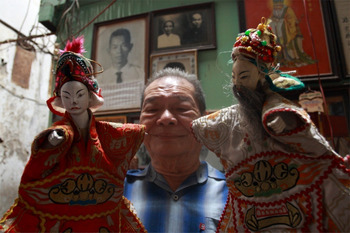
The dalang Thio Thiong Gie with two potehi puppets. (Photo courtesy of Wibowo Wibisono)

As a young man, Thio found a book, Prince Ciyun leaves the country, amidst some junk paper his father bought. Hearing Thio retell the narrative with such gusto, a friend of his father's suggested that he consider performing potehi. Thio was invited to perform Prince Ciyun at Cianjur, where he was contacted by a Blitar dalang called Tan Ang Ang (Chen Honghong), who gave him various books of Chinese stories. Thio proceeded to develop his career as dalang in Blitar, where he soon attracted large audiences of adults and children, particularly around festival time. Thio explains that he stepped in for Gudo performer Tok Hong Kie (father of Toni Harsono, of whom more below) in Blitar when he was unable to perform. ‘Within a week, I learnt to be a potehi dalang autodidactically’.Footnote 39 At the height of his career in the early sixties, Thio performed two or three engagements a year, usually around the temple holidays. Many of the engagements were of considerable length: on Mojokerto on one occasion he was engaged for four or five months, in Sukabumi for two months and seven days. The furthest away he ever performed was in Lampung and Palembang (both on Sumatra, at the time several days’ journey from Semarang).
Interestingly, Thio had also performed what he called ‘Hokkien Opera’, presumably related to forms such as gezaixi or gaojiaxi.Footnote 40 Consequently, according to his own account, his performances as potehi dalang adopted ‘traditional opera’ tonality. However, he also made use of a great variety of broad musical influences. For instance, he used the melody of ‘Siji ge’ (‘The Song of the Four Seasons’), a song adapted from a Suzhou folk song by He Lüting, one of China's most prominent twentieth-century composers. Thio, who watched a great many Chinese films in his youth, adapted the song with Indonesian lyrics for use in his potehi performances. Conversely, he also translated lyrics from Javanese songs for use as Hokkien potehi suluks.Footnote 41 When asked what qualities a dalang needed, he replied that one needs to be ‘crazy’ (gila), which, when asked to elaborate, he said meant that one needs to take on all sorts of influences. The fact that Thio could become a dalang without formal study, and that musical influences could be added at will, suggests that in the 1950s, the genre was loosely defined. This, in turn, suggests that at a performance and repertoire level divergence between potehi performance in China and in Indonesia was already substantial.Footnote 42 The adaptation of the genre in Indonesia, as well as its wide range of performance styles in mainland China and Taiwan, might suggest that the genre is particularly open to innovation.Footnote 43
Language was changing too: Thio's career bridges the shift from Hokkien to Indonesian, which he explains as necessary to maintain audience interest, although he also reports harassment from authorities to remove Hokkien suluks and lotus-flower imagery.Footnote 44 In his own performance, the change occurred when he was in his 40s and 50s, i.e. in the 1970s and 1980s. In Surabaya, at roughly the same time, the language shift was accomplished in one teacher–student relationship: ‘Gan Co-Co was an old Chinese man, he could only speak a few simple words of Indonesian. Because he saw that the young Mulyanto was enjoying the potehi show, so he brought him into the [back] stage and showed him how the performers manipulated the puppets’.Footnote 45 At the same time, new puppets were beginning to be made in Indonesia, especially in Tulungagung and Surabaya, supplementing those that had been brought from China. Thio dates the wider interest of pribumi Indonesians in potehi from that time, just as the genre was becoming linguistically, performatively and materially more independent from Chinese sources.
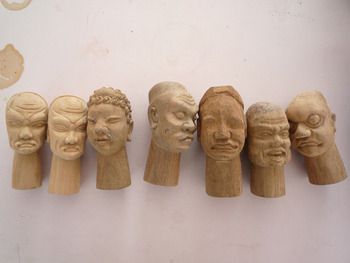
New potehi heads being carved in Gudo. (Photo by author, used by permission of Hok Ho An)

Thio has also been a part of the potehi revival of the Reformasi period, although Semarang has had neither the frequency of performance nor the level of patronage seen in Gudo and Mojokerto. In 2010, he was still travelling a great deal, performing that year in Jakarta, Solo and Sukabumi, sometimes for several weeks and in a group of up to twenty musicians, from Semarang and Surabaya. In the last few years he has performed less often, and for shorter periods — such as a three-day stint in Semarang after Chinese New Year and on the occasions of other important festivities, such as those honouring Zheng He and Guan Gong.
Thus, as Thio's career shows, potehi did not disappear during Orde Baru, despite the anti-Chinese climate and legislation. Other sources (scholarly, journalistic and interview) confirm that potehi remained widespread. Margaret J. Kartomi and her husband saw potehi in Malang in 1974,Footnote 46 and van Groenendael, conducting her research between September 1984 and June 1986, saw potehi at various sites, and described it as being then ‘very popular’ in East Java.Footnote 47 Dede Oetomo, writing on potehi in Pasuruan, reported that it had not been performed there for the ten years after the beginning of Orde Baru, while that at the time of his writing in 1987, scheduled performances were ‘cancelled periodically as a result of a wave of anti-Chinese feeling or a spell of rioting aimed at Chinese business’.Footnote 48 Research in Surabaya suggests that temple performance continued throughout Orde Baru ‘without interruption’,Footnote 49 though the dalang Sukar Mudjiono, who learned his art from a Hokkien speaker in that period, reports considerable difficulty getting permission to perform outside of Surabaya in the Orde Baru years. Footnote 50 John B. Kwee, writing in 1996, reports that the dalangs had to obtain permission to perform and were advised to refrain from insulting or political humour and ‘about ten minutes during the performance [had to be] allegorical in regard to the development program’.Footnote 51 Similar difficulties are reported regarding performances in Malang and Semarang.Footnote 52
Ki Bejo of Kediri thought that Orde Baru restrictions shifted the centre of Chinese performance from Central Java to East Java, where policy was less stringently enforced.Footnote 53 Audiences and performers in Gudo and Mojokerto also confirmed performances in the 1970s and 1980s; Ki Sesomo began performing as a musician in 1964, and became a dalang in 1968, arriving in Gudo specifically to perform potehi is 1971.Footnote 54 Respondents there told me that the ascension and birthday of the temple god Guangze Zunwang, with its biannual month-long puppet performances, was an even greater festival in Orde Baru years, since none of the other temples of East Java dedicated to that god could celebrate the festival, and hence all the devotees came to Gudo.
It seems appropriate to regard the effect of anti-Chinese measures as deleterious for the performance of potehi, but in practice these measures were unevenly applied, resulting in a move towards temple performance. Under Orde Baru religious policy, Taoist practice was subsumed into a definition of Buddhism rather than suppressed; hence Chinese temples (klenteng), as places of religious worship of a recognised religion, were permissible even when Chinese culture and language were formally banned.Footnote 55 The balance of evidence suggests strong suppression towards the beginning of Orde Baru, substantially but unevenly tolerated temple performance, and with performance frequency progressively growing towards the end of the period. During Orde Baru, the linguistic shift to Indonesian became all but complete (with Hokkien fragments retained for suluks as well as for interjections, wishes of good fortune, stock phrases, and ritual elements).
Sites of contemporary potehi performance
Potehi formed an organic part of the colonial Indies arts and entertainment world, frequently appearing alongside non-Chinese genres as well as in ethnic-specific temple venues. Since the identity of the Chinese in that period was not contested in national terms, there would have been little motivation or need to innovate or hybridise the art, particularly since Hokkien was broadly spoken and understood among the Chinese of Java. Most specifically Indonesian qualities of potehi, whether in form, infrastructure or intent, date from the second half of the twentieth century and are intimately bound up with the shifts in Chinese-Indonesian identity during that era, which are in turn largely determined by the Orde Baru suppression of Chinese cultural expression and the lifting of restrictions in the subsequent, present Reformasi era. The deployment of potehi as a positive and integrating expression of Sino-Indonesian identity is relatively new, permitted by the growing space available for public performance of Chinese culture. As such, it illustrates one available strategy for mixed-culture communities in present-day Indonesia.
To give an idea of the forms of contemporary potehi performance, I will first give a general overview of the state of its practice, and then focus on the two most active troupes and their patrons in order to examine the expressions and possible aims of contemporary potehi patronage.
Potehi today is predominantly performed in East Java, and, to a lesser extent Central Java; performances elsewhere consist of travelling troupes from these two regions. Potehi dalangs and patrons themselves, when asked, number the active dalangs at between nine and twelve, along with several dozen musicians. It is a loosely documented theatre, with no unified pedagogy or fixed texts, so no list will be exhaustive. There are always more troupes and more performance sites than typically listed in any one source; and potehi troupes all perform in both their home locales and away. As for ethnicity, Javanese dalangs now form the overwhelming majority of musicians and puppeteers, including all those of the younger generation.Footnote 56 Not surprisingly, several dalangs give an economic account of the profession — it is steady work, and better-paid and more agreeable than most jobs. It is nevertheless a very modest way of making a living, and the paucity of young Chinese dalangs is often explained by this circumstance. At present, potehi puppets are made in three places: Gudo, Surabaya and Tulungagung, while performance troupes are based in those three places as well as in Mojokerto and Semarang. Some other localities, such as Blitar, may have regular performances and even their own stage, but most often their performers are in fact members of the five above mentioned groups. The same is true of the frequent performances in Yogyakarta and Jakarta, as well as the more exceptional shows in Bandung, BaliFootnote 57 or Makassar.Footnote 58
Other sites can be adduced from secondary sources. Kuardhani mentions Pekalongan, Lasem, Rembang and Tuban as historic sites; along with Sunda Kelapa (now part of Jakarta); Kartomi mentions Malang,Footnote 59 Tuban, Kediri and Blitar; in the 1960s, Thio worked in Cianjur, Sukabumi and Mojokerto for some time; Oetomo writes about potehi in Pasuruan; and John Kwa cites Lamongan as still active. Media references from the last few years indicate shows in Welahan,Footnote 60 Bogor and Malang, generally for particular festivals. A German researcher reports encountering a troupe called ‘Yang Kwong Chop’ in Jakarta's Chinese district of Glodok, but I cannot otherwise find any reference to this group, which apparently was founded around 1920 by ‘Pek Liu Ki’.Footnote 61
Social, economic and religious organisation
Troupes are often intertwined by family, apprenticeship or institutional relationships. Blitar and Sidoarjo performances, for instance, are both Hok Ho An arrangements, while the Sidoarjo dalang, Ki Subur, hails from Surabaya and was a musician there before becoming a dalang.Footnote 62 There may be collaborative agreements as well: for four months in 2013 Mojokerto's assistant dalang Ki Kuwato (Chinese name Liem Giok Bing) was taking afternoon sessions in Tulungagung, while his brother Ki Santoso was taking the evening sessions; it was thus a mix of the Tulangagung and Mojokerto troupes, with sponsorship from Mojokerto-based Project Yensen.Footnote 63 Family connections and lineages are also significant: Surabaya dalang Ki Mudjiono is the nephew of the late Gudo dalang Ki Sesomo; Ki Subur's son is a potehi musician.Footnote 64
The temple remains the primary unit for most potehi troupe organisations, even as occasional venues multiply. As described, under Orde Baru cultural and religious policiesFootnote 65potehi venues were largely restricted to the temples, where potehi did and does indeed play a ritual role in Taoist belief.Footnote 66 Even though the temple association is no longer mandatory for the genre's existence — for instance, the Mojokerto troupe is centred around the patron's residenceFootnote 67 — the temple venue, as a centre of religion and a community gathering point, continues to provides the principal purpose for potehi performance. In temple performance, the ritual aspect is foregrounded. In Gudo, for instance, at the beginning of performances, a potehi will announce the date and occasion of the show (e.g. a god's birthday); he usually includes good wishes for the health and fortune of the sponsor's family and business.Footnote 68 The selection of plays typically occurs through a process of consultation with the temple gods through use of divination by means of crescent-shaped pieces of wood (poah poe). Ki Mudjiono, although a Muslim, describes particular rituals after performances, such as the burning of joss paper (kim c[h]ua) with characters on it after each performance. He is also quoted in a newspaper report as having learned from Gan Co Co that boiling potehi hairs could exorcise an evil spirit. Potehi musicians are furthermore required to accompany the arrival and departure of important visiting gods (i.e. statues from other temples) during festivals.
Troupes are almost entirely dependent on the support of their patrons and temples. These are Hok Ho An (Fu He An) in Gudo, and Project Yensen in Mojokerto. The cities lie approximately an hour's drive from each other, and the two patrons have gone through periods of cooperation and of rivalry. The systems of performances they sponsor and their aims for sponsorship are substantially different, and examination of their two models indicate two options available to individuals and communities for Sino-Indonesian self-representation to a larger society.
Hok Ho An is the hereditary troupe of the Harsono/Tok family, now represented by the local gold merchant Toni Harsono (Tok Hok Lay, b. 1969), the grandson of Tok Su Kwie and son of Tok Hong Kie, both potehi dalangs. From them he inherited traditional stages (one of which is from China), and puppets (thirty of which are from China). He also preserves the performance notes of his father, and the Malay/Indonesian-language Chinese novels, mostly from the 1930s through 1950s, on which his father drew. Harsono was only 13 when his father died, and so his interest in and knowledge of potehi was obtained to a great extent from friends of his father such as the dalang Ki Gunawan/Liem Sing Tjwan and the musician Tan Ping Han.Footnote 69 Harsono and an employee, the carver Supangat, a 48-year-old former furniture sculptor, who moved to Jombang in order to help make potehi according to Harsono's designs, are among the most prolific producers of potehi puppets (his own collection now numbers around two thousand), and of potehi stages. Seeking to spread potehi, Harsono has donated potehi puppets to the Quanzhou Museum, the US consulate in Surabaya, and several Western museums. His own collection of older puppets, many of them from China, has been exhibited in Yogyakarta and Surabaya.
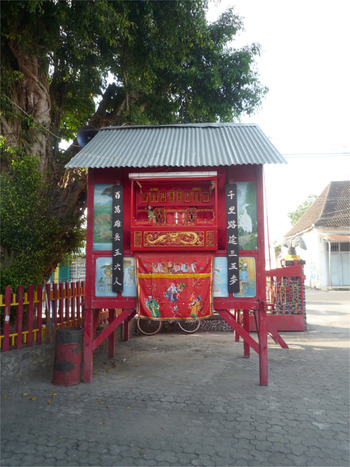
The potehi stage at Gudo (Courtesy of Hok Ho An)

The troupe is housed at the Hong San Kiong temple, where performances are generally held surrounding the festivals of the main temple god, Kong Tek Cun Ong (Guangze Zunwang). At these junctures, performances go on for thirty to forty-odd days, telling a different episode from the same narrative system twice a day. For instance, in October/November 2012, for the month following the god's ascendance to heaven, the performance being featured was Eighteen warlords oppose the king. At the same time, at Blitar's Poo An Kiong temple, other members of the troupe were performing two alternating Xue Rengui stories, in the afternoon and evening. In both places, performers and audiences were largely ethnic Javanese. In January/February 2013, the resident dalang Ki Sesomo played Xue Gang opposes the Tang over a total of forty-three days, having recently finished a shorter sequence about Lady Meng Jiang and the Great Wall, the latter being an adaptation he had put together himself from a translated book.Footnote 70 During the festival performances, Sesomo performed twice a day, one-and-a-half hours in the afternoon, and two-and-a-half hours in the evening. In Surabaya, during the Imlek celebrations, there are even three daily performances: at 9 a.m, 1 p.m., and 6 p.m.Footnote 71 As in colonial times, we find potehi in the context of wider celebrations and performance arts; in October 2012, for instance, wayang kulit performers came from Kediri to Gudo for performances on temple grounds, which were largely for a local Javanese audience. Similarly, in Mojokerto both ludruk and Javanese dance were incorporated into potehi events.
Because his patronage is temple-based and his family has a long history with potehi, there is a great deal of continuity in Harsono's approach. He is both the chairman of the temple and the employer of the puppet troupe. Other locals, many of them members of his family, or people in his circles, sign up to fund a particular performance in the long performance series. That funding is often related to thanks they wish to offer, or help they want to enlist from the temple deities. On many days there is no audience at all; the ritual purpose is central. It was repeatedly pointed out to me that such performances occur primarily to satisfy religious obligations or express requests from the deities, not to entertain audiences.
Symbolism, promotion and identity
Harsono and his associates are at pains to invoke symbolic patronage which can serve to show that prominent Indonesians support the development of potehi. For instance, pictures of Sri Susuhunan Pakubuwono XIII, the sultan of Surakarta, are featured in the puppet workshop area at the Gudo temple, as well as, potehi puppet in hand, in the published biography of Harsono. The sultan also wrote an introduction to that book, in which he compares potehi with the most emblematic of wayangs, writing that, ‘like wayang kulit Purwo Jawa, wayang potehi very much deserves to be protected, as a cultural heirloom of great value’, going on to praise Harsono for preserving the patrimony of his ancestors.Footnote 72
The renowned part-Chinese Yogyakarta dancer Didik Nini Thowok also writes a preface in the same book, in which he recalls watching potehi versions of Xue Rengui and Three Kingdoms stories with his grandfather in his native Central Java town of Temanggung, presumably in the early 1960s, since he was born in 1954.Footnote 73 Scholarship on his work notes that he was a fan of potehi from a young age, and ‘performed a home-made children's version of it for his Javanese and Chinese friends at his home — with dinner plates used for sound effects, and puppet heads carved by a friend’.Footnote 74 As a recognised giant in the Javanese arts with acknowledged Chinese heritage, Didik Nini Thowok can symbolise the same kind of relation of community to culture as potehi claims for it — local Chinese as a component of Javanese culture.
The memory of late president Gus Dur, who abolished anti-Chinese legislation, also has a symbolic place in potehi practice, though I am not aware of any connection to potehi during his lifetime. Upon his death, potehi was one of several arts included in performances to commemorate him,Footnote 75 and in Semarang Thio Thiong Gie led a prayer for Gus Dur at Tay Kak Sie, remarking that with him, Islam had been a force for reassuring minorities rather than oppressing them.Footnote 76 In Mojokerto performances, Gus Dur, Megawati, Jokowi, Ahok and other figures from Indonesian politics have been represented as potehi puppets. In a performance in December 2012, during a well-attended show in a Mojokerto-area village, the Gus Dur puppet appeared at a break in the Monkey King story and encouraged the young (non-Chinese) visitors to become potehi fans, highlighting the fact that as an Indonesian art it belonged to everyone present. Efforts to invoke political figures in puppet form to further the acceptance of potehi, and to encourage a positive view of Sino-Indonesian culture and community, may or may not be effective; but it would certainly seem to be the intent.
The symbolic patronage of the sultan or an association with the late president invokes prestige and legitimacy, just as the growing space for exhibitions of Sino-Indonesian culture has also brought potehi into more upscale venues, such as shopping malls and art galleries. Locations where potehi has recently been performed include Hotel Majapahit Surabaya,Footnote 77 Hotel Grand City Surabaya, Trans Studio Bandung, the Chinese Cultural Centre and a Javanese Protestant church (Gereja Pugeran) in Yogyakarta. On several occasions, there have been exhibits of puppets accompanying the performance.
If exhibits and performances are one manner of raising the profile of potehi, then publications and academics are another. By sponsoring publications and the travel of potehi scholars, patrons are helping to create a network of scholars and specialists on Chinese Indonesia. In all of these endeavours — exhibits, publications, performance promotion — the Indonesianness of the genre is highlighted: Hirwan Kuardhani's book is called Mengenal wayang potehi di Jawa (About wayang potehi in Java), Dwi Woro R. Mastuti's report ‘Wayang Cina di Jawa sebagai wujud akulturasi budaya dan perekat negara kesatuan Republik Indonesia’ (Chinese wayang in Java as a feature of cultural acculturation and adhesive for the national unity of the Republic of Indonesia), and Purwoseputro's Wayang potehi of Java.
Texts often take an overtly celebratory tone. Kuardhani writes that ‘[t]hrough performances of Chinese Peranakan Wayang potehi, other ethnicities such as the Javanese, Sundanese, Balinese and Minangkabau can interact with and understand the patron of the performance in terms of Chinese ethnicity’,Footnote 78 making the claim that potehi is ‘loaded with moral messages and guidance for noble behaviour’.Footnote 79 Purwoseputro writes that ‘Wayang Potehi is the uniting force that bond [sic] is in our childhood regardless of race and religion’,Footnote 80 and elsewhere that the Javanese ethnicity of most performers shows ‘that Wayang Potehi is no longer an art that is exclusive to the Chinese-Indonesian community, especially the Hokkien subgroup and followers of [Chinese religions], but belongs to the wider public’.Footnote 81 Indonesian scholars and patrons stress that potehi now has its own characteristics (usually with a focus on the language shift to Indonesian) which differentiates it from the ancestral genre, with affirmations that the ‘speciality of potehi in Java is a manifestation of the adaptive and assimilative attitude of the Chinese people who had already arrived in the region of Java hundreds of years ago’,Footnote 82 or that the genre is ‘no longer an exclusive Chinese art, but one imbued with Indonesian values’.Footnote 83
‘Roadshow Wayang Potehi’: A new performance model
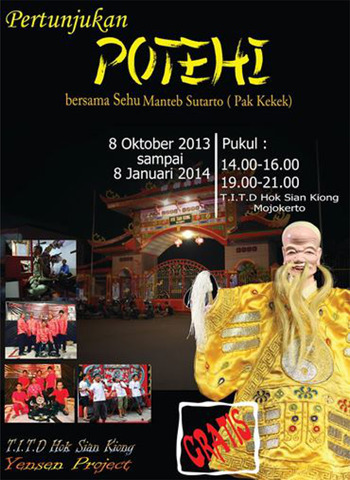
While also seeking to exhibit itself in prestige locales in Mojokerto, a different performance model has been developed there to bring potehi to a broader public. From 18 December 2012 to 25 January 2013, the Roadshow Wayang Potehi toured 18 villages of the city of Mojokerto, in East Java. The poster for the Roadshow features the dalang, Ki Manteb Sutarto (Pak Kekek) and is described as being sponsored by ‘the Yensen Project for the city of Mojokerto’, with performances consisting of the Journey to the west and Xue Rengui's campaign to the west.Footnote 84 Unlike the city, which has a prominent Sino-Indonesian community, these villages have no substantial ethnic Chinese presence. The project is led by Pak Yensen, a Mojokerto Hokkien plastics manufacturer who has watched potehi in Mojokerto's central klenteng since his childhood.Footnote 85 Staffer Herno, like most other ethnic Javanese, described the Roadshow as a first for Mojokerto, ‘maybe even for Indonesia’ and called the Project's mission an effort to ‘raise Indonesian culture. Wayang potehi is itself generally performed inside the Chinese temple. Maybe many people who are curious don't dare to enter the temple. So, in order to introduce the art of wayang potehi, we held a roadshow for all the villages in Mojokerto’.Footnote 86
Poster for series of wayang potehi and related performances. (Photo courtesy of Yensen Project)

The Roadshow, by bringing potehi into villages, and integrating it into a programme of Javanese festivities, was designed to demonstrate that there was no contradiction or distance between local pribumi culture and Sino-Indonesian culture (here separated from temple context and implicitly secular). Attendance was sweetened by the offer of five tricycles as ‘door prizes’ (though since these were performances on tarps at village crossroads, there were no doors.) Kuardhani has written that the Roadshow is ‘quite a tactical conservation measure’. Whether consciously or unconsciously, taking potehi out of the temple grounds recalls the pre-Orde Baru festival context, allowing people to realise that potehi is acculturated and ‘really a genre particular to the folk culture and art of Java’.Footnote 87
The project's potehi programme has only expanded since then. In April 2013, a school performance followed, advertised as a roadshow with a barongsay (i.e. lion dance) opening, and with Pak Kekek billed as ‘one of nine potehi dalangs in Indonesia’. From 2 August until 7 October 2013, Pak Kekek performed Xue Rengui's campaign to the west and Prince Ciyun flees his country twice a week at the Tridharma temple in Mojosari (belonging to Mojokerto), twice daily at 3 p.m. and 7 p.m. From 8 October 2013 to 8 January 2014, a new series of performances were scheduled, in the Mojokerto temple Hok Sian Kiong, twice daily at 2 p.m and 7 p.m also with Pak Kekek as dalang and Yensen Project's support.Footnote 88 The story was Emperor Tang Minghuang visits the Moon Palace.
Though potehi performance is the central element of Yensen Project's activities, it presents itself as an ecumenical group with various cultural projects. Many of these seek to promote the integration of Chinese culture into the concept of the Indonesian nation, and thus it produces DVDs of potehi performances, has established a barongsay group, recorded patriotic Indonesian-Chinese music (‘I am a daughter of Chinese, and my nation is Indonesia’ … Aku putri Tionghoa, dan bangsaku Indonesia), funded the roadshow, and acquired puppets, stages and accoutrements for the museum. On the Chinese place in Indonesian society, the group takes a strong discursive line, including such strategies as labelling its potehi DVDs and performances as ‘100 per cent Indonesian’.
It would be naive to think that the promotion of potehi arises from simple altruism or love of the art, particularly (with non-temple performances) when the ritual element is absent. Both Harsono and Yensen invest a great deal in their collections, stages, performance troupes and support of recordings and research, all of which contribute to the public representation of the genre and consequently of the community. It is probable that the troupes they support do not turn a profit (except perhaps in the karmic sense, since temple performances are meant to bring their sponsors good fortune). Given the close cooperation between the Roadshow and the city of Mojokerto, and the presence of dignitaries at the Roadshow performances, the dynamics of local politics are certainly sometimes in play. Even when expressed in less overt fashion, the extension of potehi performance and display beyond the temple consistently contains an element of ethnic self-representation. Potehi, with its potential to interest international academia and museums, can also lend new prestige to patrons. At the core, however, and always central in the sponsored scholarship, media reports, and their representations to me as a foreign researcher, is the effort to represent potehi as an Indonesian art, and therefore the local Chinese community as a component of local culture.
Within this effort is contained an old paradox of Chinese public performance in Indonesia — largesse in the service of a public festivity (with Chinese culture, as here, imbedded) can also read as ostentatious display. That is to say: presenting a village festival with Javanese arts, door prizes and potehi — visibly sponsored by a local Chinese businessman, and performed by the troupe he pays — may be meant to stimulate familiarity and liking for local Chinese culture, yet it may also reinforce existing cultural stereotypes. This paradox may be insoluble, and remains a dissonant element within the celebration of potehi and indeed of much public Chinese performance.
Conclusion
In his 1988 overview, Wayang, kebudayaan Indonesia dan Pancasila, Pandam Guritno established a typology of wayang, involving 28 distinct traditions from the islands of Java, Bali, Lombok and Sumatra, and performed in various regional languages such as Sundanese, Betawi, Palembang, Sasak, etc. This attitude — inclusive towards various pribumi forms, but drawing the line at genres of Chinese origin — is reasonably typical of the Indonesian conception of wayang and the pre-Reformasi reception of the potehi form, and points to the persistent reluctance to integrate the Sino-Indonesian element into conceptualisations of Indonesia culture, despite avowed pluralism regarding pribumi groups. Pandam Guritno's is only one of several typologies of wayang that ignores potehi.Footnote 89
This is understandable insofar as the term wayang has distinct uses. In Malay, wayang has historically been applied to various Chinese entertainments, including forms of xiqu and dance. For instance, a wayang tax in late nineteenth-century Batavia was defined as including potehi and Chinese opera alongside shadow puppets and wayang wong.Footnote 90 It remains also the term for Chinese street opera in Singapore. Although this broad usage has faded in Indonesia, the origin of the term wayang potehi lies in this Malay application of wayang.
Wayang's now more-familiar definition is narrower, and refers to a family of theatre forms, mostly (but not exclusively) performed by puppets; mostly performed in Javanese, Balinese and Sundanese; and which fulfil a ritual purpose. These wayang genres draw on a variety of narratives, most prominently Indian epics like Ramayana and Mahabharata, but also indigenous narratives such as those surrounding Panji, Airlangga or Siliwangi, religious narratives of Muslim or Christian origin, as well as Arabic narratives surrounding Amir Hamzah.Footnote 91
Given the internal diversity of the concept of wayang and the renegotiations of Chinese identity in the Reformasi era, it is not surprising to find a growing practice of inclusion of wayang potehi in the category of wayang, not only in the efforts of patrons or scholars, but also, for instance, in the display of wayang potehi puppets (as well as reproductions of wayang kulit Cina-Jawa, a Sino-Javanese wayang kulit genre) in the Wayang Museum in Jakarta. It has also been included in the family of wayang genres by the television show World of Wayang Footnote 92 and in 2010 was among the first projects of the Indonesian branch of UNIMA (Union Internationale de la Marionette).Footnote 93 Like core forms of wayang, wayang potehi is performed in an Indonesian language and fulfils a ritual purpose. Its narrative sources are unique within wayang, but the term already accommodates a vast range of material. While there is no need to seek an exact equivalence between potehi and forms of wayang such as wayang kulit, wayang golek, etc. which are connected to Javanese, Balinese and Sundanese systems of belief, there seems ample reason to expect continuing recognition of the form as a special wayang genre, representative of Sino-Javanese culture, particularly as patrons such as Yensen or Harsono devote resources to the popularisation of the form. The positioning of potehi as a ‘100 per cent Indonesian’ art form is thus judicious as well as strategic, i.e. to present the culture of the Chinese minority as an integral element of a Javanese and Indonesian whole.
From the perspective of Chinese performance studies, wayang potehi is a peripheral phenomenon — perhaps even a limit case. A theatre with little or no singing, not performed in any Chinese language, using scripts that are derived from the dalang's own reading of novels in translation, bears little resemblance to anything known in China. Nevertheless, it would be disingenuous to disclaim its roots in coastal China, which furnish the material and narrative framework for the genre, both of which changed less substantially in Indonesia than in the Chinese-speaking world, preserving aspects of southern Fujian puppetry which are lost elsewhere (see Appendix). It also provides the socioeconomic and often religious context for performance, and has retained the practice of sitting rather than standing behind the stage, no longer found in mainland China or Taiwan. There can thus be no tidy separation of its Chinese and Indonesian elements.
In my view, it is appropriate to acknowledge potehi as being a member of two traditions, wayang and xiqu — a special, challenging case for both systems — and at variance with neither. The liminal status of the genre points to the insufficiency of regarding a diasporic community from either perspective i.e. from Sinocentric or Indonesia-centric perspectives alone. In order to fully respect the subject, there can be no centre but the community itself; for a hybrid cultural identity is not an incomplete way of being one thing or another. To be valorised it must be recognised on its own terms. Its language, performers and performance context make it a hybrid genre and a local product, and emblematic of the wide-ranging exchange between Chinese and indigenous performance forms in the Indies and elsewhere in Southeast Asia. In contemporary practice, it is used to perform an ethnic identity and an integrationist position.
Chinese-Indonesian identity is studied more than any other ethnic question in the archipelago. Already in the Sukarno era, integration versus assimilation into the Indonesian polity was a burning issue for Chinese communities. The actions and statements of the Chinese patrons of potehi approximate the point of view of someone like Eddie Lembong, the head of INTI (Perhimpunan Indonesia Tionghoa), one of the principal Sino-Indonesian organisations: ‘The Chinese Indonesians are no longer forced to be assimilated; they are able to retain their ethnic culture and identity, but are expected to integrate into a larger Indonesian society’.Footnote 94 Yet one possible result of the Reformasi era ‘emancipation of Chinese in Indonesian civil society’ is ‘a consolidation of the long-standing assumption that ethnic identity — in this case, Chinese identity — is a given, a natural essence that resides in the bodies of Chinese Indonesians’. This has led to ‘an essentialised version of Chinese cultural identity — a version, for example, that is characterised by speaking Mandarin and knowing about “authentic” Chinese culture’,Footnote 95 thus obscuring the long history of mixed culture and race from which cultural products such as potehi derive. The promotion of a specifically Indonesian variety of performance, which emphasises its connection to Java and does not stress the origins of the theatre in China, proposes a patriotism grounded in local history and culture rather than ethnic identity drawing on ideas of ethnic essentialism.
In that sense, it is the vehicle of puppetry which is unique, not the stance; the patronage of potehi can be seen as one tendency in the stream of Sino-Indonesian dialogue, fundamentally proposing patriotism and identification in exchange for security and acceptance. The progressive space available to Sino-Indonesian culture during the Reformasi era has permitted the claim (implicit in integration without assimilation) that their cultural expression has a place at the heart of a complex Indonesian nation, while the regional specificity (whether Hokkien or Javanese) and the existence of other potehi forms in Singapore and Malaysia is elided. This streamlined vision of potehi, a symbol of Chinese–Indonesian harmony across religious and racial divides, and a perfect medium to pronounce this claim in malls, villages, temples, art galleries and publications, is a reminder that ethnicity, like any form of identity, is performed, negotiated, projected and decoded — whether by politicians, celebrities, or puppets.
Appendix: Comparison of puppets
Descriptions of material aspects of the performance, including stage and orchestra, are available in English in Ardian Purwoseputro's 2014 Wayang potehi of Java, translated by Hermanto Lim. Most hanzi correspondences for temples, performers, plays, instruments and important characters can be found in this book.Footnote 96
Since, however, no comparison of material aspects of budaixi in China with potehi on Java is available, it may be useful to translate these comments by a Quanzhou budaixi aficionado, Wang Xiaobo, to whom I gave potehi puppets (donated by Hok Ho An) for examination: he concluded that at a material level, the puppets closely resemble each other, with the following differences:
1. Whereas Quanzhou puppets are made of camphorwood, Gudo ones are made from waru (sea hibiscus) or mahogany.
2. Quanzhou puppet bears are now predominantly made of yak hair or silk, while Gudo puppets (like traditional Quanzhou puppets) use human hair.
3. For the headdresses, Quanzhou puppets use the traditional embossed painting and gilding method (lifen tiejin) while the Gudo puppets use the newer Zhangzhou (or a similar) method of using cardboard, silk and beads.
4. Quanzhou puppets use Panjin-style hand embroidery, while Gudo now uses computer embroidery.
5. The inner bag of Gudo puppets is the same length in front and at the back, whereas for Quanzhou puppets it is shorter at the back than in front, which makes it easier to get the puppet on one's hand.
6. The inner bag for Quanzhou puppets has an L form where the arms meet the torso, which makes the waist and the hands of the puppets more clearly delineated. The Gudo puppets have an inner bag which is almost square-shaped.
7. Almost all of the Gudo puppets have two strings to fix the headdress to head. This is still seen in Zhangzhou rural puppets. The Gudo puppets have two head-nails at the temple, to fix the strings. Quanzhou budaixi puppets no longer have head-nails, although Quanzhou marionettes have head-nails which are part of the suspension system.
8. Quanzhou puppets have a hole in the hand-stick for the auxiliary rod, use of which allows the puppets to do complex motions such as pouring liquids, fanning themselves, or shooting arrows. Gudo puppets have no such fine motions, no rod, and no hole in the hand-stick for the rod.Footnote 97