Introduction
Resuscitative endovascular balloon occlusion of the aorta (REBOA) is a percutaneous transfemoral balloon technique used for resuscitation and temporary hemostasis of bleeding patients; REBOA is used as a minimally invasive alternative to emergency department (ED) thoracotomy with aortic cross-clamp to temporize non-compressible torso hemorrhage and to obtain proximal control in both traumatic and non-traumatic causes of hemorrhage below the diaphragm. Zone 1 REBOA (inflated in distal thoracic aorta) is considered first choice for patients under cardiac arrest. In fact, REBOA is primarily a resuscitative tool providing augmented coronary and cerebral perfusion, and temporization of hemorrhage is a secondary benefit. Reference Brenner, Moore and Teeter1
During cardiopulmonary resuscitation (CPR) of non-traumatic and non-hemorrhagic cardiac arrests, central aortic pressure, carotid flow, and brain oxygenation are related to the rate of return of spontaneous circulation (ROSC); Reference Gray and Dieudonne2 thus, they have, eventually, an impact on neurological outcome. Reference Dogan, Beskow, Calais, Hörer, Axelsson and Nilsson3
In this way, REBOA could be an endovascular resuscitating device that helps provide cardiac and cerebral perfusion in patients suffering from non-traumatic cardiac arrest that require time to reach a cardiac catheter lab or an extracorporeal membrane oxygenation (ECMO) center.
Case Report
Before the publication of this case report, written consensus was acquired of the relatives of the patient involved in the case presented.
In January 2019, an Emergency Medical System was tasked to a man suffering sudden chest pain and shortness of breath. The first responder team examination revealed a patient that was in severe respiratory distress, and a after a few minutes, fell under cardiac arrest.
Cardiopulmonary resuscitation (CPR) was immediately started by paramedics, an automated external defibrillator (AED) was applied, and a DC shock was delivered on a ventricular fibrillation; CPR was then continued.
Meanwhile (three minutes after the cardiac arrest), an Advanced Cardiac Life Support (ACLS) team arrived at the scene, the AED was replaced with a Lifepak 15 Monitor Defibrillator (Physio-Control Inc.; Redmond, Washington USA), and that revealed an asystolic arrest.
The ACLS team then continued with humeral intraosseous access, epinephrine administration, and orotracheal intubation until a ROSC was obtained after 3mg of epinephrine, then the patient was carried to the ED. On the way to the hospital, a pulseless electrical activity (PEA) appeared; CPR was then started once again and another milligram of epinephrine was administered. Upon ED arrival, 22 minutes after the initial cardiac arrest, the patient was still under cardiac arrest with on-going CPR, end tidal CO2 was 11mmHg, and PEA alternated with asystole phases on the monitor.
Then, ACLS was handed over to the ED personnel that continued with administration of epinephrine boluses every five minutes; meanwhile, a cardiac echoscopy was performed and non-cardiac, potentially reversible causes of cardiac arrest were excluded.
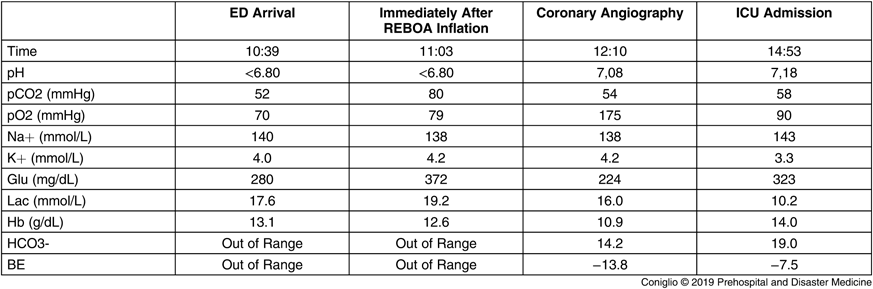
Arterial and venous femoral lines were inserted under ultrasound guidance; the first arterial blood gas analysis (ABG) showed a pH <6.8 and severe lactic acidosis (Table 1).
Arterial Blood Gases

Abbreviations: ED, emergency department; ICU, intensive care unit.
A continuous infusion of adrenaline up to 0.15mcg/Kg/min and sodium bicarbonate 8.4% were started; hemodynamics showed various transient ROSCs, followed by new episodes of cardiac arrest with non-shockable rhythms.
In considering that the patient was extremely unstable with refractory cardiac arrest and just transient phases of spontaneous low-flow state, despite a prolonged resuscitation and intravenous inotropic support, an attempt of REBOA Zone 1 positioning was performed; the arterial femoral access previously placed was substituted with a Seldinger wire with an 8F introducer, and a REBOA catheter (8F 80cm PTS Sizing Balloon Catheter; NuMED Canada Inc.; Cornwall, Canada) was placed in the aortic Zone 1 during CPR. The correct positioning was confirmed by ultrasound assessment with a subcostal longitudinal and transverse view of balloon passing just above the celiac artery.
After REBOA inflation (with 8ml of 0.9% saline) during CPR, end tidal CO2 (EtCO2, waveform) increased promptly from 8mmHg up to 20mmHg, hemodynamics became more stable, and subsequently a persistent ROSC was achieved. This allowed staff to carry the patient to the catheter lab in order to perform an emergent coronary angiography after one hour and 41 minutes from the onset of cardiac arrest.
Before coronary angiography, REBOA was first repositioned under fluoroscopic vision, more proximally in Zone 1. Reference Dogan, Beskow, Calais, Hörer, Axelsson and Nilsson3
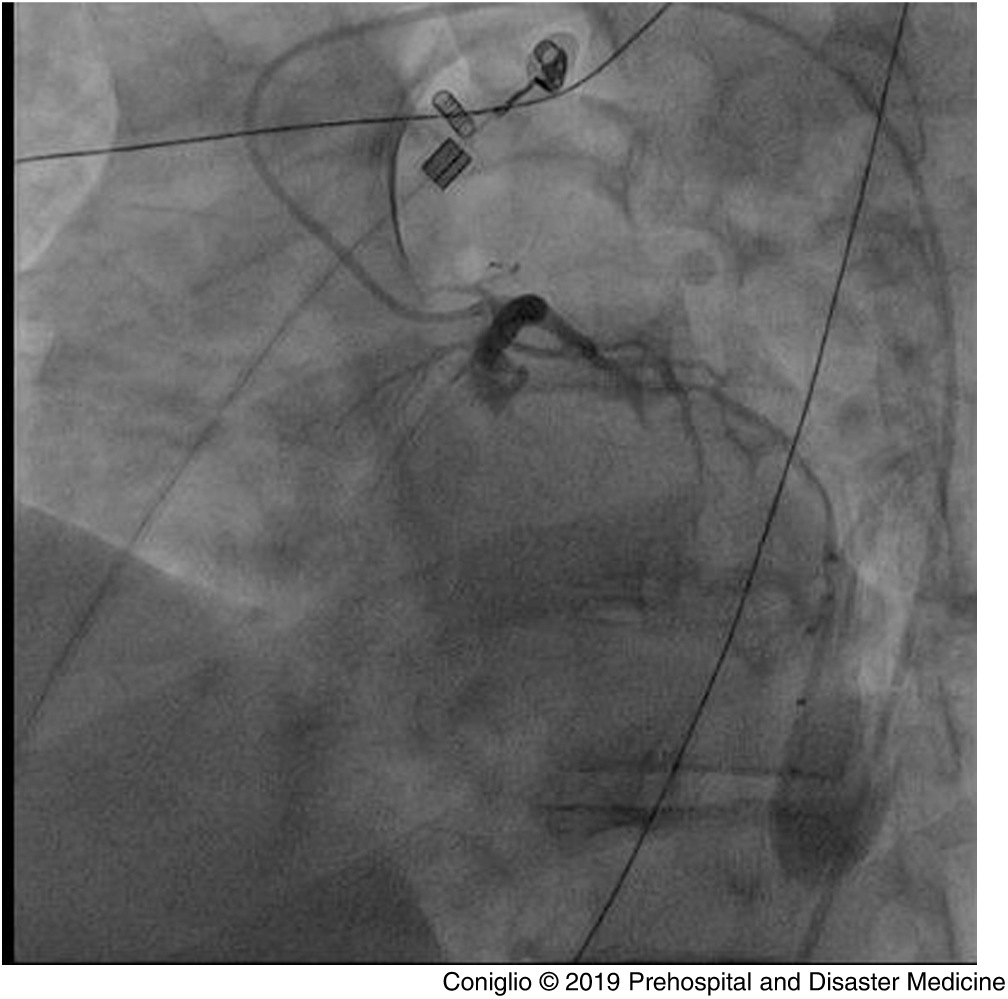
Coronary angiography revealed a 100% occlusion of the medium segment of the anterior interventricular artery, which was treated with percutaneous transluminal coronary angioplasty, and a drug eluting stent was then positioned. Figure 1 shows a coronary angiography picture with on-site REBOA, and the balloon is visible on the right side.
Coronary Angiography with On-Site REBOA.

At the end of the procedure, REBOA was replaced with an intra-aortic balloon pump (IABP) with a 1:1 ratio and the patient was subsequently transferred to the intensive care unit (ICU).
On ICU arrival, the patient was under sedation, pupils were mediomidriatic, and photomotor reflex was absent; hemodynamics was supported by both epinephrine 0.15mcg/Kg/min and norepinephrine 0.06mcg/Kg/min, and the ABG revealed a progressive decrease of lactate concentration (Table 1).
Furthermore, the patient developed a post-cardiac arrest coagulopathy and started to bleed from vascular accesses insertion sites, then requiring plasma, fibrinogen, and tranexamic acid administration that were made on thromboelastometry guidance (ROTEM Delta; Werfen Company; USA).
Isovolemic renal replacement therapy was necessary for refractory acidosis and electrolyte imbalance, even if spontaneous diuresis was maintained after an initial lowering upon ICU admission.
On the first day after cardiac arrest, despite hemodynamics, kidney and metabolic condition becoming better; the withdrawing of sedation allowed the patient to show bilateral mydriasis and no tracheal reflex. A cerebral angio-CT scan was then necessary to demonstrate lack of intracranial flow, and thus, to start brain death assessment as prescribed by law.
The patient’s relatives granted their consent to organ donation and, at the end of the brain death assessment procedure, the cadaveric donor was carried to the operating room in order to explant kidneys, liver, and tissues (cardiac valves, skin, bones, vascular segments, and corneas); then, the harvested organs were successfully transplanted.
Discussion
Despite usage of REBOA expanding in the trauma field and evidence growing about its effects on mortality in major hemorrhages, Reference Manzano-Nunez, Orlas and Herrera-Escobar4 its effectiveness in non-traumatic cardiac arrest is still little explored. Literature data report Reference Deakin and Barron5,Reference Aslanger, Golcuk and Oflaz6 only two cases involving in-hospital patients whose hemodynamics deteriorated to cardiac arrest and underwent aortic occlusion; authors were unable to find previous reports of REBOA usage in out-of-hospital refractory cardiac arrest.
In the reported case, the patient was extremely unstable despite ACLS, and spontaneous circulation was not maintainable, likely because of both metabolic and ischemic cardiac factors. In fact, if on one side cardiac output immediately after prolonged cardiac arrest is undoubtedly reduced, on another side, the severe metabolic compromise which was documented at hospital arrival did not allow adequate systemic vascular resistances and reduced the response to aminic support.
The REBOA insertion in Zone 1, by diverting circulating volume to the upper body, could have fostered coronary perfusion, therefore granting a persistent spontaneous circulation that allowed staff to carry the patient to cardiac angiography. Reference Daley, Morrison, Sather and Hile7
The two major alternative techniques to REBOA that should be discussed in this case are Extracorporeal Cardiac Life Support (ECLS) and direct coronary angiography with on-going CPR.
Extracorporeal Cardiac Life Support consists in veno-arterial ECMO placed during CPR, allowing an immediate support to cardiac and pulmonary functions. A recent meta analysis Reference Ouweneel, Schotborgh and Limpens8 demonstrated that in cardiac arrest, the use of ECLS was associated with an increased survival rate, as well as an increase in favorable neurological outcome, while in the setting of cardiogenic shock, there was an increased survival with ECLS compared with IABP.
Thus, ECLS would probably have been the best choice in this case, but unfortunately, it requires clinical expertise and appropriate materials that are often not available in the ED, as in this case.
On the other side, direct coronary angiography with on-going CPR using a chest compression device would have permitted an access to definitive treatment in less times, but at the cost of a prolonged coronary and cerebral low-flow that, even in case of successful procedure, could not grant a certain ROSC. The ED in this report doesn’t yet have chest compression systems immediately available at the resuscitation bay.
The REBOA positioning at the ED required seven minutes, and authors strongly believe that in this case, pre-procedural stabilization could have fostered the outcome in terms of survival. Moreover, the variable balloon inflation allows to modify the aortic flow distal to the balloon site (partial REBOA), therefore granting a minimal perfusion to splanchnic organs and lower limbs once the hemodynamic stability is restored, thus reducing ischemia-reperfusion injury. Reference Johnson, Neff and Williams9
Conclusion
In this case, the usage of an aortic occlusion technique, such as REBOA, in a case of refractory cardiac arrest allowed a stable ROSC that eventually allowed the patient to access definitive treatment.
In addition to the increase in ROSC frequency, REBOA may be used to optimize cerebral and coronary blood flow during conventional CPR as a bridge to ECMO. In fact, the REBOA technique is more widely available than ECLS, and its positioning and management are easier and do not require specific technology; reasons that make REBOA a suitable second choice in refractory cardiac arrest where ECLS is not available.
Thus, REBOA in cardiac arrest seems to be a promising therapeutic intervention to be investigated in humans, as a primary intervention to achieve ROSC or as a bridge to more definitive and interventional therapies, despite the fact that the optimal use of REBOA during cardiac arrest in human must be further explored in randomized studies.
Author Contributions
Carlo Coniglio and Piergiorgio Cavallo concepted and designed the work; Lorenzo Gamberini, Marco Tartaglione, and Valentina Chiarini wrote the article; and Cristian Lupi and Giovanni Gordini reviewed the work.
Conflicts of interest/funding
The Authors received no funding for this research. The Authors have nothing to disclose.