1. Introduction
The article offers a new perspective on the interaction of international investment law with other fields of international law based on a survey of the use of conflict clauses in 1,050 investment treaties, including recent mega-regional initiatives. The use and content of conflict clauses serve as an indicator of state priorities in terms of the fields of the broader international law matrix with which international investment law should be co-ordinated. Treaty drafting is the main avenue through which states influence the investment treaty regime and conflict clauses are the most effective tool from a legal point of view at their disposal for regulating the relations between their different international commitments.
The article inserts itself in the bourgeoning literature on flexibilities in investment treaties, providing a first systematic account of conflict clauses. In so doing, it allows for a refined comparative understanding of the importance that states ascribe to different international disciplines and, to a certain extent, the policy goals behind them. A largely asymmetrical approach to economic and non-economic disciplines transpires from the survey. Conflict clauses abound in investment treaties and their number is on the rise, but they reveal a significantly deeper engagement within international economic law (IEL) than with any other field of international law. Barely any of the surveyed clauses pertain to non-economic disciplines, such as environment, cultural heritage, labour or human rights, the relations with which are predominantly relinquished to soft language or general exceptions. Even when present, conflict clauses on non-IEL disciplines fall behind their IEL counterparts in qualitative terms. Drafting practices of conflict clauses further suggest that these trends are not likely to change. They may even intensify in years to come.
This asymmetry at the detriment of non-IEL disciplines has important implications for human and peoples’ rights. A lack of treaty wording pertaining to human rights may comfort investment tribunals’ current approach to potential conflicts between the two fields, often characterized by a reluctance to engage with human rights considerations. Against the backdrop of the Sustainable Development Goals (SDGs) and the United Nations 2030 Agenda for Sustainable Development, the observed asymmetrical approach raises the additional question of the legal effectiveness of the changes that states introduce in pursuit of these goals. The SDGs go beyond human rights but it is widely accepted that their achievement is intertwined with the effective protection and realization of an array of such rights.Footnote 1 Thus, lesser engagement with disciplines geared towards the achievement of the SDGs in investment treaties, such as labour or environmental protection, can have trickle-down effects for human rights as well.
The picture of stark asymmetry in favour of IEL disciplines that the survey paints may also be seen as laying partial support for the view that stakeholders ‘should be more concerned about states not changing their treaties when change is needed than about investment lawyers overreacting to developments in arbitration’.Footnote 2 It, thus, invites further research into the reasons behind the difference of engagement with different international law disciplines and the adequacy of the current approach to achieve the stated goals of reform of the investment regime.
The article moves in five sections: Section 2 introduces the relevance of treaty language in addressing normative conflict in international investment law; Section 3 offers a concise definition and typology of conflict clauses in investment treaties; Sections 4 and 5 then show how the prevalence and content of conflict clauses create an asymmetry between IEL and non-IEL disciplines in relation to investment standards; finally, Section 6 situates the structural disadvantage created by conflict clauses for non-IEL disciplines in the broader context of investment treaty flexibilities.
2. The relevance of conflict clauses in investment treaties
International investment law is undergoing a period of unprecedented attention in public opinion and states’ treaty-making practices, partly related to the perception that the current framework does not offer sufficient policy space to states to pursue regulations in the public interest. Given the number of arbitral cases in which a challenged measure is related to a non-investment international discipline,Footnote 3 it is unsurprising that the better co-ordination of investment standards of protection with the rest of international law is continuously identified at policy level as one of the necessary reform measures.Footnote 4 Policy studies have documented the reference to fields regulated by some international law disciplines in investment treaties, especially the environment.Footnote 5 More recently, as part of its Reform Package for the International Investment Regime, the UN Conference on Trade and Development (UNCTAD) called on states to insert clearer treaty language for the co-ordination of the investment regime with the rest of international law, listing carve-outs and exceptions, references to other international policy regimes or interpretative guidance clauses as options for doing so.Footnote 6
Co-ordination among the different fields of international law is an important aspect of gearing international economic disciplines towards the achievement of the UN 2030 Agenda, with important human rights implications. One aspect of this co-ordination comes in the form of using economic disciplines as tools to incentivize respect for other international disciplines, such as human rights, labour rights,Footnote 7 and environmental protection. This co-ordination effort is pursued, inter alia, through chapters on labour and sustainable development in free trade agreements (FTAs) and the strengthening of the enforcement mechanisms pertaining to these disciplines.
On the reverse side of this mutual reinforcement, an equally salient question on which the article focuses is how to manage the normative conflicts that arise across different fields of international law and how to limit their negative effects on the implementation of already agreed upon international norms. Normative conflicts in international law have the potential of hindering the working of the international legal system more than in domestic settings. International law is institutionally decentralized; sets of norms are related to institutions of their own and there are few mechanisms requiring inter-institutional co-ordination.Footnote 8 For regimes benefiting from strong enforcement mechanisms, such as investment law, this setting renders the regulation of conflictual relations with other international disciplines particularly salient.Footnote 9 Indeed, investment disciplines can overshadow international disciplines, the disregard of which carries lower litigation and liability risks that typically protect non-economic values. Therefore, while there is no reason to exaggerate the negative effects normative conflicts entail,Footnote 10 there is good reason to study them and take them into account when drafting international law instruments.
In line with the prevailing view in literature,Footnote 11 for the purposes of the article and the underlying empirical study, normative conflict is understood to mean: ‘[the relation between] two norms, one of which may be permissive, if in obeying or applying one norm, the other one is necessarily or possibly violated’.Footnote 12 Put differently, a normative conflict exists whenever two obligations cannot be performed simultaneously or whenever an obligation and a permission contradict each other (i.e., what is permitted under one normFootnote 13 is prohibited under the other).
While international adjudicative practice and doctrinal positions on normative conflictFootnote 14 include at least three different conceptions of that concept,Footnote 15 the medio sensu definition described above is preferred for several reasons. A definition that includes both relations between two obligations and relations between a permission and an obligation, rather than the narrower view that includes just those between two obligations,Footnote 16 is in line with general legal theory.Footnote 17 Both phenomena have similar characteristicsFootnote 18 and, if unaddressed, have the same negative effects on the rule of law in the system in which they occur.Footnote 19 As a result, relying on a definition that addresses only one of these phenomena would be under-inclusive.Footnote 20
At the same time, the third and broader conception of normative conflict (sometimes termed functional conflict)Footnote 21 which includes treaties or norms that pursue conflicting goalsFootnote 22 would also be inappropriate. To take into account the underlying goals behind different norms provides important contextual information, however the described phenomenon, by itself, does not lead to a conflict of legal nature.Footnote 23 The phenomenon pertains rather to the axiological and institutional characteristics of international law.Footnote 24 As advocates of functional conflict point out themselves, it is a phenomenon linked more to the approaches of different decision-makers than to the norms themselves.Footnote 25 Put differently, within juridical terrain, functional conflicts raise questions about the objectivity of decision-makers rather than about the conflict of norms of conduct.Footnote 26 As a result, their inclusion within a definition of normative conflict would be misguided. Thus, inter-institutional co-ordination is touched upon below, but only to complement the core survey of clauses that regulate the conflictual relations between substantive norms.Footnote 27
There are two complementary reasons why treaty language is an important tool to use in regulating normative conflicts across different fields of international law. First, while investment arbitrators have the power to resolve normative conflicts, the current adjudicative practice casts doubt on the capacity of investment tribunals (and a possible standing investment court) to develop a principled approach to normative conflicts with fields beyond investment law without treaty guidance. Indeed, in institutionally decentralized settings, such as international law, there is a certain pull of the norms that an adjudicator (or another decision-maker) considers their own and which they often see as taking priority over other norms,Footnote 28 as well as towards norms from fields that are socio-culturally closer to the adjudicator’s own discipline.Footnote 29 This tendency is further facilitated in international law due to the indeterminacy of the framework on normative conflict resolutionFootnote 30 and avoidanceFootnote 31 currently in existence.
A growing body of literature shows convincingly that investment tribunals (and international adjudicators more generally) pay only limited, and often instrumental, attention to disciplines from fields beyond their own.Footnote 32 Recent studies on the practice of investment arbitral tribunals and the World Trade Organization (WTO) Appellate Body show this type of reluctance in both. For instance, investment tribunals have afforded rather limited normative value to human rightsFootnote 33 or environmentalFootnote 34 considerations and put them in a structurally disadvantageous position compared to the rights of investors when these conflict.Footnote 35 Even the conception of normative conflict that investment tribunals adopt seems to expand to accommodate non-investment considerations the closer the particular discipline is to the underlying goals of the investment regime.Footnote 36 The WTO Appellate Body has also been more open to instruments created in the WTO framework than outside of it, even when such disciplines come from the field of trade law.Footnote 37 With respect to both adjudicators, it is telling that outside of their respective field’s case law, the decisions they cite the most are those of the International Court of Justice (ICJ), the Permanent Court of International Justice (PCIJ), and (state-to-state) arbitral tribunals. In addition, cases are cited overwhelmingly for propositions pertaining to general international law (such as rules on interpretation),Footnote 38 which serve to ground the respective adjudicators’ reasoning. Finally, it is worth noting that when authors suggest that international courts and tribunals apply international norms beyond those of their own field, they refer either to general international law and the case law of the ICJ/PCIJFootnote 39 or to cases in which the respective disciplines reinforce each other.Footnote 40
A brief and non-exhaustive survey of tribunals’ approach to the conflictual relation between international human rights law and investment protection serves to illustrate this point. When confronted with arguments limiting investor protection based on human or peoples’ rights, investment tribunals have often avoided addressing the putative conflict, through several techniques.Footnote 41 One way of doing so is to cast human rights norms as being outside the scope of applicable law, even in the face of broad applicable law provisions, as did the tribunal in Von Pezold v. Zimbabwe when it refused to admit an amicus submission, considering that it fell outside of the scope of the dispute.Footnote 42 Similarly, in SAUR v. Argentina, the tribunal considered that Argentina’s human rights and investment obligations operated ‘at different levels’.Footnote 43 This framing allowed the tribunal to engage only superficially with the interaction between human and investor rights. Another tool for doing so is to use a narrow definition of normative conflict, as did the tribunal in Suez v. Argentina. As a result, the tribunal simply considered that Argentina is ‘subject to both international obligations, i.e. human rights and treaty obligation, and must respect both of them equally’.Footnote 44 In Houben v. Burundi, to the author’s knowledge the only case in which civil and political rights of local residents were at stake, the tribunal also framed the factual issue before it in a way that allowed it to only consider the full protection and security investment standard as applicable.Footnote 45
Second, regulating foreseeable normative conflicts ex ante in treaties, rather than delegating their resolution to arbitral tribunals ex post at the time of a dispute, offers the added benefit of enhanced predictability. Independently of the outcome of a dispute, investment liability and litigation risks can have consequences on states’ choices to regulate.Footnote 46 The impact of litigation risk also suggests that low- and middle-income countries may be more likely to err on the side of caution in order to avoid expenses,Footnote 47 potentially hampering the implementation of non-investment disciplines that directly or indirectly bear on human rights. This likelihood is further enhanced when the outcome of the dispute is difficult to predict, as in cases that involve a normative conflict.
In the context of the relations between human rights and investment law, this uncertainty is just as important. Economic and social rights and the aspects of Indigenous peoples’ rights most commonly at stake do not fall squarely within the category of recognized jus cogens norms, which would have granted them clear priority over investment standards. Even in the Houben case, the relevant right was the right to privacy, which also falls outside of the scope of jus cogens. This uncertainty is further complicated by the diversity of the field of human rights itself, inter alia, at regional level.Footnote 48 In the context of conflict resolution, this diversity can lead to problematic questions of membership to specific instruments and the contours of particular rights. The tribunal’s discussion in South American Silver v. Bolivia on the relevance of several instruments pertaining to Indigenous peoples’ rights as ‘relevant rules’ for the purposes of systemic integration under Article 31(3)(c) of the Vienna Convention on the Law of Treaties (VCLT) provides an illustration of this type of complication.Footnote 49
Against this backdrop, an important body of knowledge has gradually developed on the use and effectiveness of general exceptions in investment treatiesFootnote 50 and on other references to human rights and sustainable development-related policies, such as labour, corporate social responsibility or the environment.Footnote 51 By providing an account of conflict clauses in investment treaties, the article offers a complementary perspective adding to this body of knowledge in two respects. First, a systematic account of conflict clauses allows painting a fuller picture of the flexibilities in investment treaties. Second, given the difference in stringency, comparing the use of conflict clauses to that of other types of provisions offers a refined perspective on the priority that states assign to different international disciplines and, as the following sections will show, sometimes also to the policy goals that these disciplines stand for.
3. Definition and typology of conflict clauses in investment treaties
Treaty drafting is the way in which states can and do influence the investment treaty regime. Conflict clauses more specifically constitute important indicators of what states do in order to co-ordinate the scope of application of investment disciplines with that of other fields of international law. The conducted survey of investment treaties shows that conflict clauses are common. Before delving into their asymmetrical use with respect to subject matter, which is the focus of the article, it seems opportune to offer a definition of conflict clauses (Section 3.1) and a typology of the surveyed clauses along their other main functional characteristics (Section 3.2), in order to situate clearly the discussion to follow.
3.1 Conflict clauses defined
Conflict clauses are among the most effective legal tools at states’ disposal for delineating the scope of application of investment disciplines vis-à-vis other norms. Indeed, conflict clauses are provisions ‘intended to regulate the relation between the provisions of the treaty and those of another treaty or of any other treaty relating to the matters with which the treaty deals’.Footnote 52 In more practical terms, conflict clauses provide priority rules which determine which among two conflicting norms would prevail. Namely, they regulate situations in which two obligationsFootnote 53 which purport to apply to the same facts cannot be complied with simultaneously or situations in which a permission and an obligation contradict each other.
In the more complex reality of international law today, a fuller picture of co-ordination management of international disciplines includes two additional types of provisions, related to, but distinct from conflict clauses. They are the provisions that regulate the effects of institutional output of different international bodiesFootnote 54 and those that regulate the relations between the provisions of different parts of the same treaty, as for example in broad economic treaties with investment provisions (TIPs).Footnote 55 The article analyses both types where relevant, albeit in categories distinct from the core conflict clauses described above.Footnote 56
In addition, it is important to note that while exceptions are not the focus of the article, certain exceptions in investment treaties form part of the analysis, only to the extent they constitute de facto conflict clauses. Indeed, certain exceptions expressly link the measures exempted from liability under investment disciplines to an international norm. Under such exceptions, when both norms purport to regulate the same facts, the investment discipline’s scope of application is circumscribed in order to cede priority to the other international norm and to the extent that other norm is applicable. As a result, these exceptions contain an embedded priority rule between the investment discipline and that other international norm. This characterizes them simultaneously as conflict clauses, as several examples below show in more detail (see Section 3.2).
3.2 A functional typology of conflict clauses in investment treaties
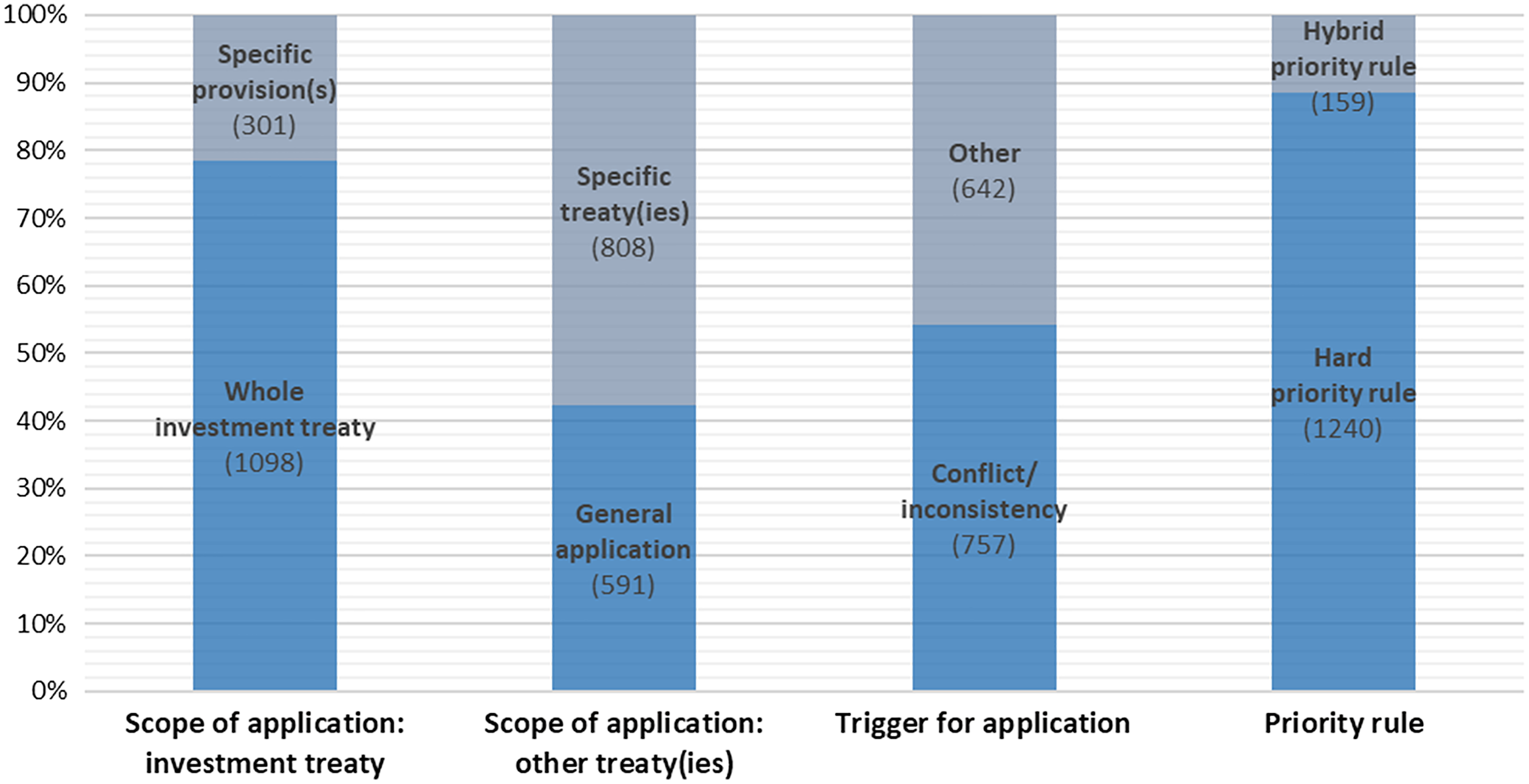
The conducted survey of investment treaties showed that conflict clauses abound in number and display an important variety regarding their subject matter, their intended scope, the conditions triggering their application and the type of priority rule that they establish (see Figure 1 for the respective share of conflict clauses of each type). Importantly for the discussion in subsequent sections, the prevalence of IEL over non-IEL disciplines in conflict clauses remains robust across all types of clauses described in this section.Footnote 57
Share of conflict clauses per functional type.
Note: The figure represents the percentage and number of conflict clauses in each functional type, out of a total of 1,399 conflict clauses identified in the 1,050 surveyed investment treaties.

Regarding their scope of application, the surveyed conflict clauses can be broadly divided into those that regulate the investment treaty as a wholeFootnote 58 and those that pertain to a specific standard of protection.Footnote 59 Conflict clauses that cover the investment treaty as a whole sometimes also aim at regulating its relations with all other international disciplines in general.Footnote 60 This is the most common approach in bilateral investment treaties (BITs), with the use of non-derogation clauses.Footnote 61 By contrast, conflict clauses in TIPs most often regulate the treaty’s relations with a specific treaty, as for instance in clauses that refer to a list of multilateral environmental agreements (MEAs),Footnote 62 or with treaties from a specific other international discipline, such as international taxationFootnote 63 or intellectual property law.Footnote 64
Conflict clauses that apply to specific standard(s) of protection are often even more precise and regulate the relations of that standard with a particular rule from another field of international law. Examples in point are the exclusion of compulsory licenses and other intellectual property rights modifications in accordance with the Trade-Related Aspects of Intellectual Property Rights (TRIPS) Agreement from the application of expropriation provisionsFootnote 65 or the temporary safeguard measures (TSM) exception to free transfer of funds, conditioned upon their compliance with the Articles of Agreement of the International Monetary Fund (IMF).Footnote 66
Conflict clauses also vary with respect to the trigger for their application, i.e., the conditions under which the priority rule they put in place operates. Clauses that apply to the whole treaty often depend on the existence of an ‘inconsistency’ or ‘conflict’ for their application. By way of example, tax conventions and MEAs alike can prevail over investment disciplines ‘to the extent of the inconsistency’. At the same time, 45 per cent of surveyed clauses establish priority rules which are not subject to the identification of a normative conflict in the formal sense. As detailed above, certain conflict clauses are embedded in an exception, but retain their character as conflict clauses due to the fact that they de facto determine which of two international disciplines takes precedence when both purport to regulate the same factual scenario.Footnote 67 The TRIPS compulsory license exception from expropriation and the TSM exception to the free transfer of funds standard mentioned in the previous paragraph provide two illustrations. Indeed, in the way the provisions function, it is sufficient for a compulsory license to comply with the requirements of TRIPS for it to no longer be subject to compensation for expropriation. This more pragmatic trigger for the application of specific conflict clauses is a welcome development in view of the uncertainty that surrounds the concept of normative conflict in international law and in investment arbitration.Footnote 68 It suggests that effective co-ordination of international disciplines need not be hampered by this uncertainty.
Finally, the types of priority rules that conflict clauses establish differ. They can be divided into ‘hard’ priority rules and ‘conditional’ or ‘hybrid’ priority rules. Under hard priority rules, compliance with the respective prevailing discipline is enough to render the other discipline inoperative. If a particular measure falls in the scope of application of the discipline that takes priority, the other discipline simply ceases to apply to it. In case of inconsistency, tax convention disciplines displace investment ones; measures taken for the maintenance of international peace and security in accordance with the UN Charter are not subject to investment disciplines; all provisions from non-investment chapters prevail over those in the investment chapter in TIPs.
Conversely, conditional or hybrid priority rules set additional conditions which must be fulfilled for one discipline to take priority over the other. They share some characteristics with general exceptions in that they provide an exemption from liability regarding measures implementing an international discipline, but only to the extent that the measure fulfils a set of additional requirements. An example in point is Article 104 of the North American Free Trade Agreement (NAFTA), providing for the priority of obligations derived from a closed list of environmental agreements over those imposed by NAFTA, but only when the obligations are implemented through the least restrictive measures available to the state invoking the clause.
4. The numerical prevalence of IEL-related conflict clauses and its implications
The survey revealed that the overwhelming majority of conflict clauses in investment treaties pertain to economic disciplines (Section 4.1). In addition, two broader trends in the overall profile of conflict clauses across different types of investment treaties further exacerbate the ensuing asymmetrical engagement (Section 4.2).
4.1 Ceding priority to other IEL disciplines first and foremost
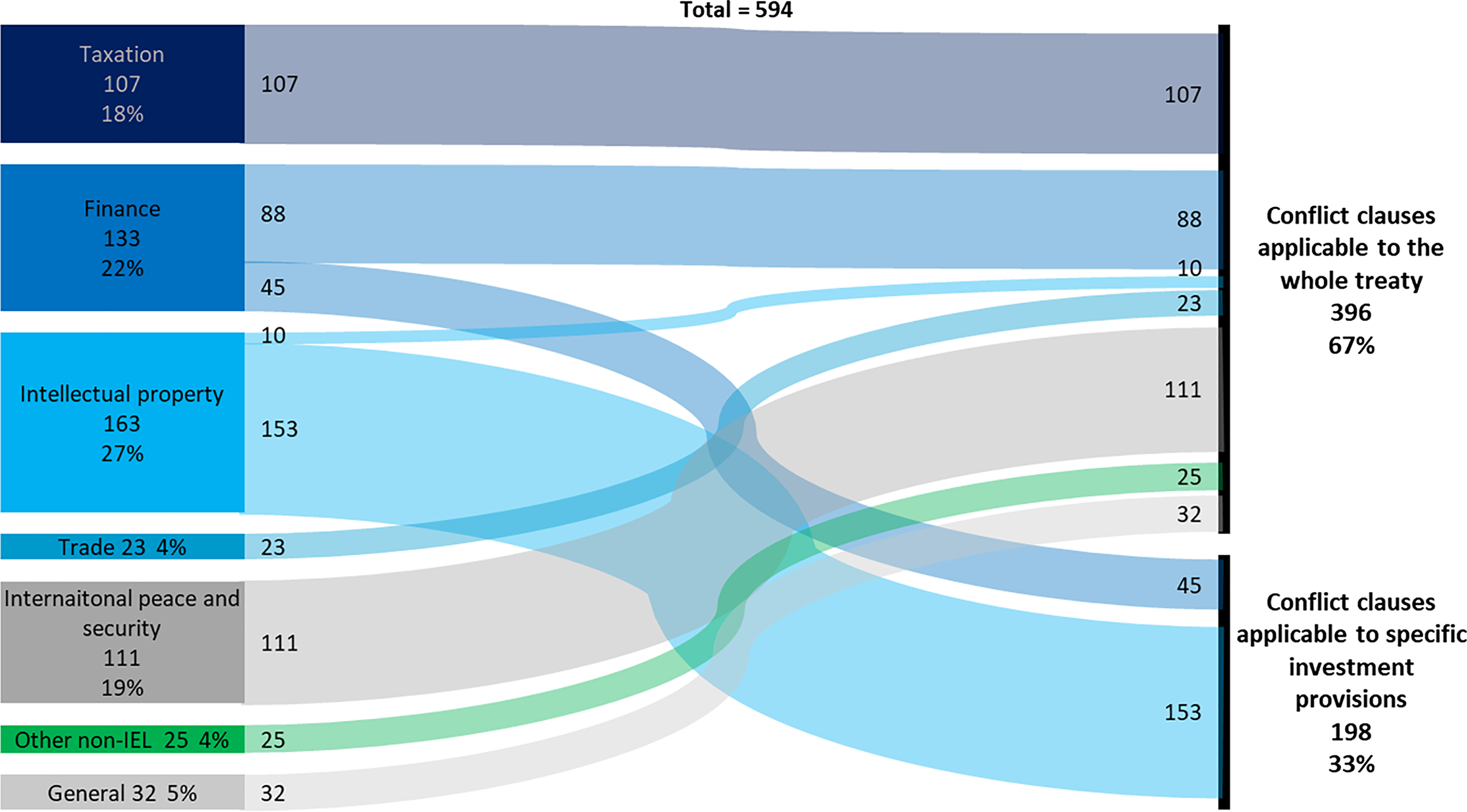
The most common conflict clauses in TIPs and in BITs pertain to the co-ordination of investment standards of protection with the rest of IEL. IEL disciplines are the ones that conflict clauses most commonly designate to take priority over investment standards of protection as well. Indeed, the overwhelming majority of surveyed conflict clauses pertain to: (i) taxation (referring to double taxation treaties, tax conventions or international standards related to tax evasion and avoidance); (ii) international financial law (with reference to the Articles of Agreement of the IMF); (iii) intellectual property law (with reference to the TRIPS AgreementFootnote 69 or conventions under the auspices of the World Intellectual Property Organization); and, albeit more rarely, (iv) international trade law (referring to the WTO Agreement, the General Agreement on Tariffs and Trade, the General Agreement on Trade in Services (GATS) or other preferential trade agreements (PTAs)). Over 60 per cent of TIPs contain conflict clauses on taxation, on international financial law and on intellectual property (See Figure 2); close to 50 per cent of recent BITs include at least one of the three as well.Footnote 70
Scope of application of conflict clauses in TIPs per discipline.
Note: The figure represents the scope of application of conflict clauses per discipline they pertain to out of a total of 594 conflict clauses identified in TIPs and based on a sample of 137 TIPs for which text was available.

By contrast, conflict clauses which regulate investment standards’ relations to international human (or peoples’) rights, environmental or cultural heritage disciplines are rare. None of the surveyed BITs contains such a conflict clause and there are only 24 such clauses applicable to investment disciplines in TIPs.Footnote 71 Among them, only two types of clauses refer to international human rights. The first is the human rights clarification to the international peace and security clause in the Comprehensive Economic and Trade Agreement (CETA).Footnote 72 The second is New Zealand’s exception for the Treaty of Waitangi which has a bearing on the Māori people’s rights.Footnote 73 The prevailing practice with respect to non-economic disciplines is to use provisions which stop short of constituting conflict clauses or to regulate the matter from the perspective of each state’s individual regulatory space, irrespective of the existence of international instruments on the subject matter.Footnote 74
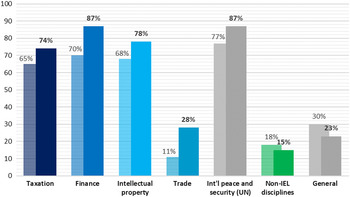
Furthermore, the evolution of the use of conflict clauses over time suggests that this asymmetry between the approach to IEL and non-IEL instruments is only deepening. The comparison of drafting practices in investment treaties signed since 2013, compared to treaties signed at a prior date, suggests as much.Footnote 75 Two trends are revealing – the growing use of the most common IEL-related conflict clauses, and the converse decline in the use of conflict clauses which pertain to non-IEL disciplines. The inclusion of conflict clauses on all IEL disciplines has grown by between 9 and 20 per cent in recent TIPs. At the same time, the number of conflict clauses on non-IEL disciplines has decreased from 18 per cent in earlier TIPs to only 15 per cent in recent ones (See Figure 3).
Share of TIPs per discipline of the conflict clauses they contain.
Note: The figure represents the percentage of TIPs that contain at least one conflict clause pertaining to each discipline, based on a sample of 91 earlier TIPs (1970–2012) and 46 recent TIPs (2013–2018) for which text was available. The front column on the graph corresponds to recent TIPs.

The conflict clause pertaining to states’ obligations to maintain international peace and security is the only surveyed provision which could temper the ensuing IEL-centrism. In addition to its common presence in recent BITs, it is also the most common conflict clause in TIPs. However, two complementary characteristics of the international peace and security conflict clause suggest that its inclusion is of limited relevance compared to other conflict clauses.
As a start, states’ international obligations to maintain international peace and security, at least to the extent they are derived from the UN Charter, enjoy priority over investment standards even in the absence of an express provision to that effect. Article 103 of the UN Charter, together with its confirmation in Article 30(1) VCLT, provide that obligations of UN member states under the Charter prevail over their obligations under any other international agreement.Footnote 76 With few exceptions,Footnote 77 international peace and security conflict clauses do not go beyond the priority rule as described above. As a result, in its current form, this particular conflict clause is little more than redundant.
The potential use of the international peace and security clause for human rights obligations as a defence in the context of investment proceedings is also unlikely. Indeed, while one could consider, as explicitly provided for in CETA, that human rights violations may be a threat to international peace and security, this framing is outward looking. It is typically meant to serve as a basis for suspending concessions in the case of human rights violations by the other contracting party, rendering it more readily relevant for trade than for investment disciplines.Footnote 78
4.2 Factors that enhance the numerical asymmetry in favour of IEL disciplines
In addition to the number of IEL-related conflict clauses themselves, clauses that regulate the place of investment disciplines in TIPs (Section 4.2.1) and the difference in profile between BITs and TIPs (Section 4.2.2) further enhance the asymmetry in favour of economic disciplines.
4.2.1 The subsidiarity of investment disciplines in TIPs
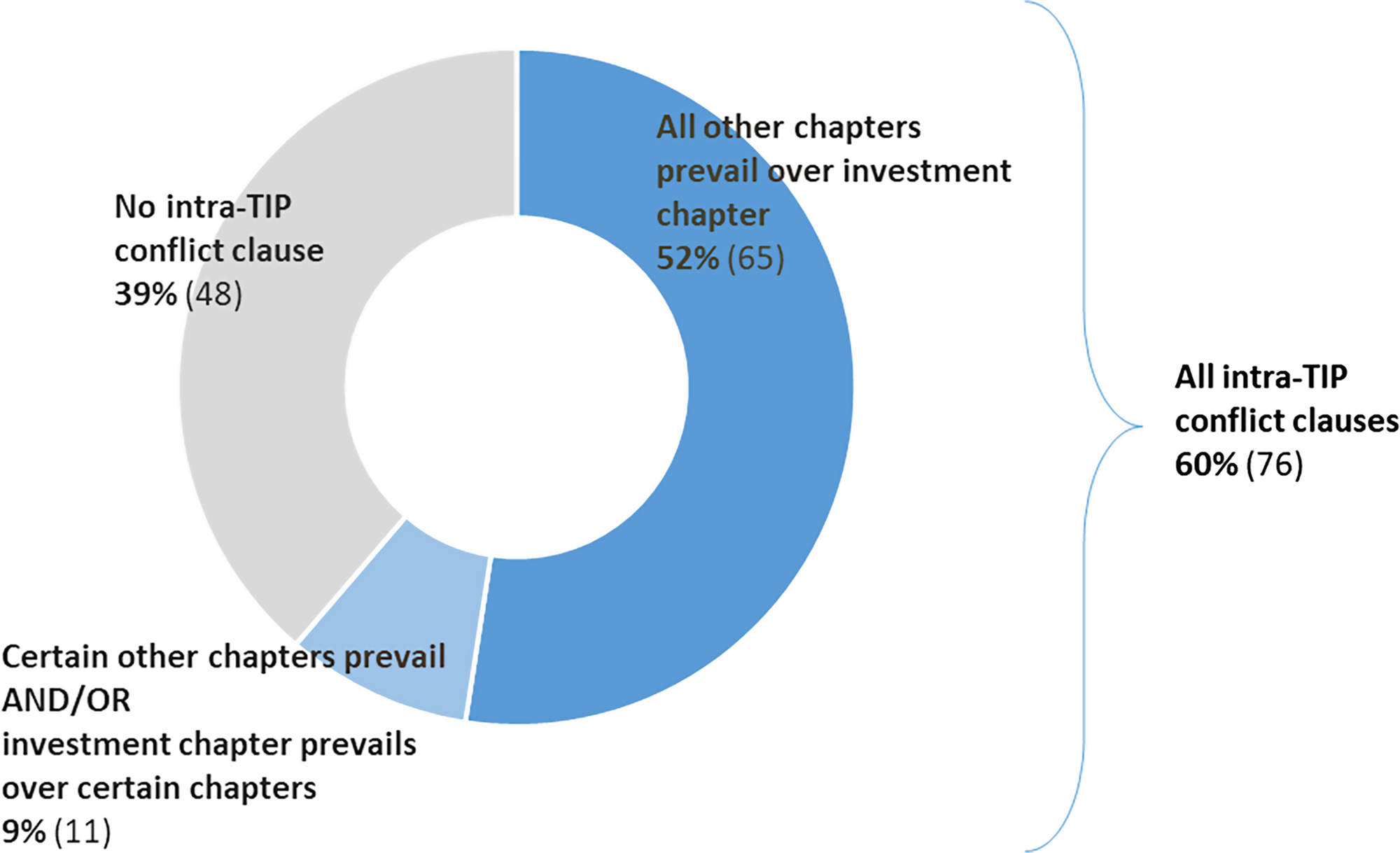
In the same TIP, investment disciplines overwhelmingly hold a subsidiary place (see Figure 4). Put differently, in case of inconsistency between provisions of the investment chapter and any other chapter of the TIP, the other chapter prevails to the extent of that inconsistency. This priority rule is present in over 60 per cent of all surveyed TIPs. Together with a complementary clarification that the investment disciplines do not apply to measures covered by certain other chapters,Footnote 79 this priority rule is the most common way of regulating the place of the investment chapter in TIPs. By contrast, TIP priority rules under which the investment chapter prevails are a small minority and are usually specific.Footnote 80
Share and type of intra-TIP conflict clauses pertaining to investment disciplines.
Note: The figure represents the per cent and number of the two types of intra-TIP conflict clauses present in 125 TIPs that include non-investment disciplines and for which text was available.

The subsidiary place of investment chapters in TIPs constitutes an additional factor that enhances the asymmetry between drafters’ approach to IEL and non-IEL disciplines. The TIP, which contains mainly IEL disciplines, receives priority, in contrast to the treatment of the rest of international law, as described above. Even in TIPs that contain chapters dedicated to labour or the environment, the subsidiarity of investment chapters remains a limited positive development for these non-IEL disciplines. Indeed, the non-IEL chapters typically contain language that may be seen as neutralizing the priority rules in the investment chapter, such as mutual supportiveness clauses.Footnote 81 This arrangement leads to what may be described as a battle of provisions – a drafting practice that is considered to ‘create[] more problems than it resolves’.Footnote 82
4.2.2 The uneven use of conflict clauses in BITs and TIPs
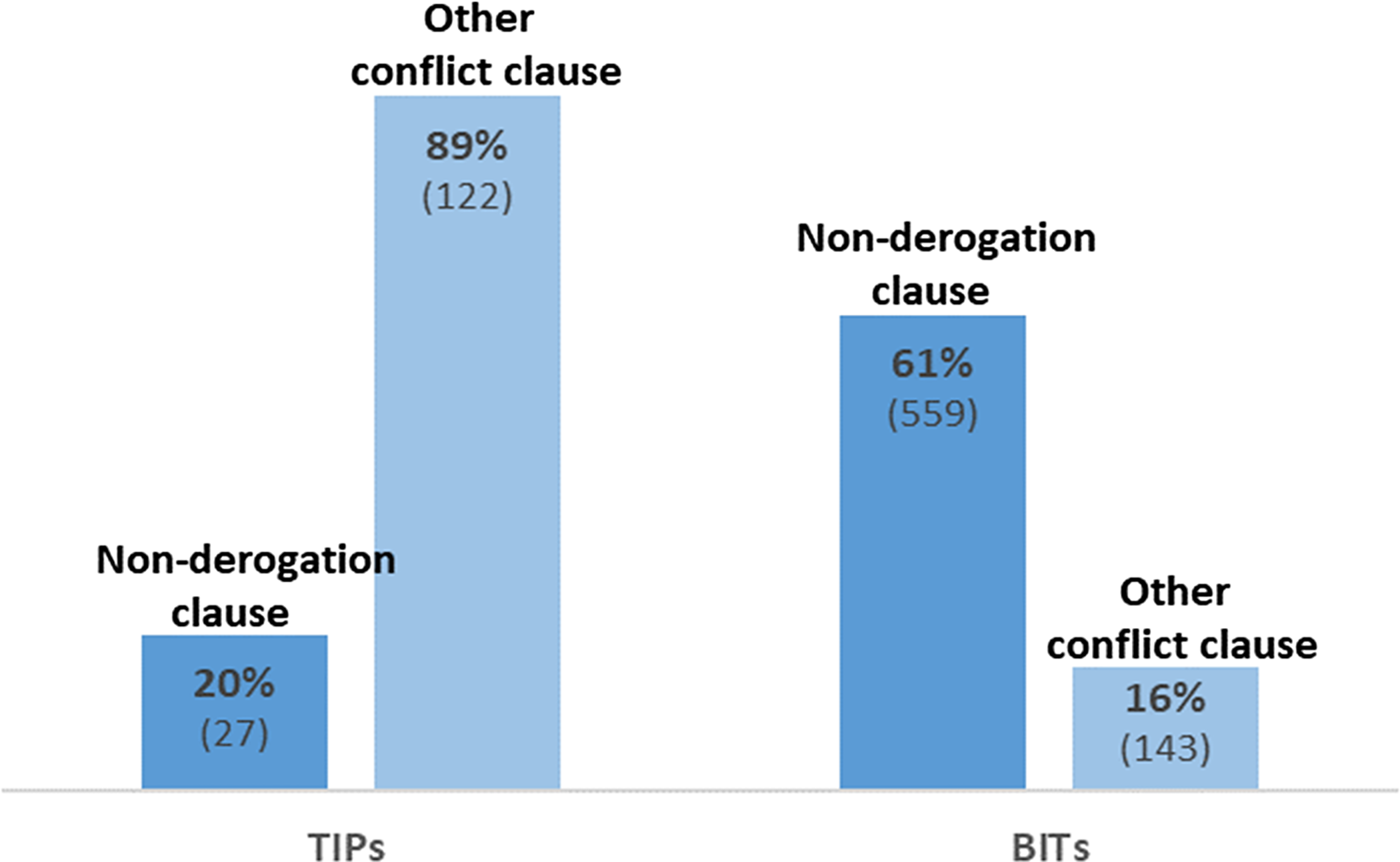
The reason behind focusing on the use of conflict clauses in TIPs throughout the article is a further asymmetry which places IEL disciplines at an advantage compared to non-IEL ones (Figure 5). Despite the fact that over 70 per cent of all surveyed investment treaties contain at least one conflict clause, the profiles of BITs and TIPs differ significantly with respect to the content of these clauses.
Types of conflict clauses per type of investment treaty.
Note: The figure represents the per cent and number of BITs and TIPs that contain a non-derogation or other type of conflict clause, based on a sample of 913 BITs and 137 TIPs for which text was available.

Where TIPs commonly cede priority to several other international law disciplines, suggesting an aim to effectively regulate the relations between them, conflict clauses in BITs are most often aimed at ensuring that investments would benefit from the most favourable treatment that different international instruments offer. On average, TIPs contain conflict clauses of the first type twice more often than BITs. To the contrary, by far the most common conflict clause in BITs is the ‘non-derogation’ or ‘more favourable treatment’ clauseFootnote 83 which is rather rare in TIPs.Footnote 84 In earlier surveyed BITs, only the practice of CanadaFootnote 85 and, to a certain extent, the United StatesFootnote 86 differ from the profile presented above. Also, while there are certain signs of convergence between BITs and TIPs in recent treaties, important differences persist (Figure 6).
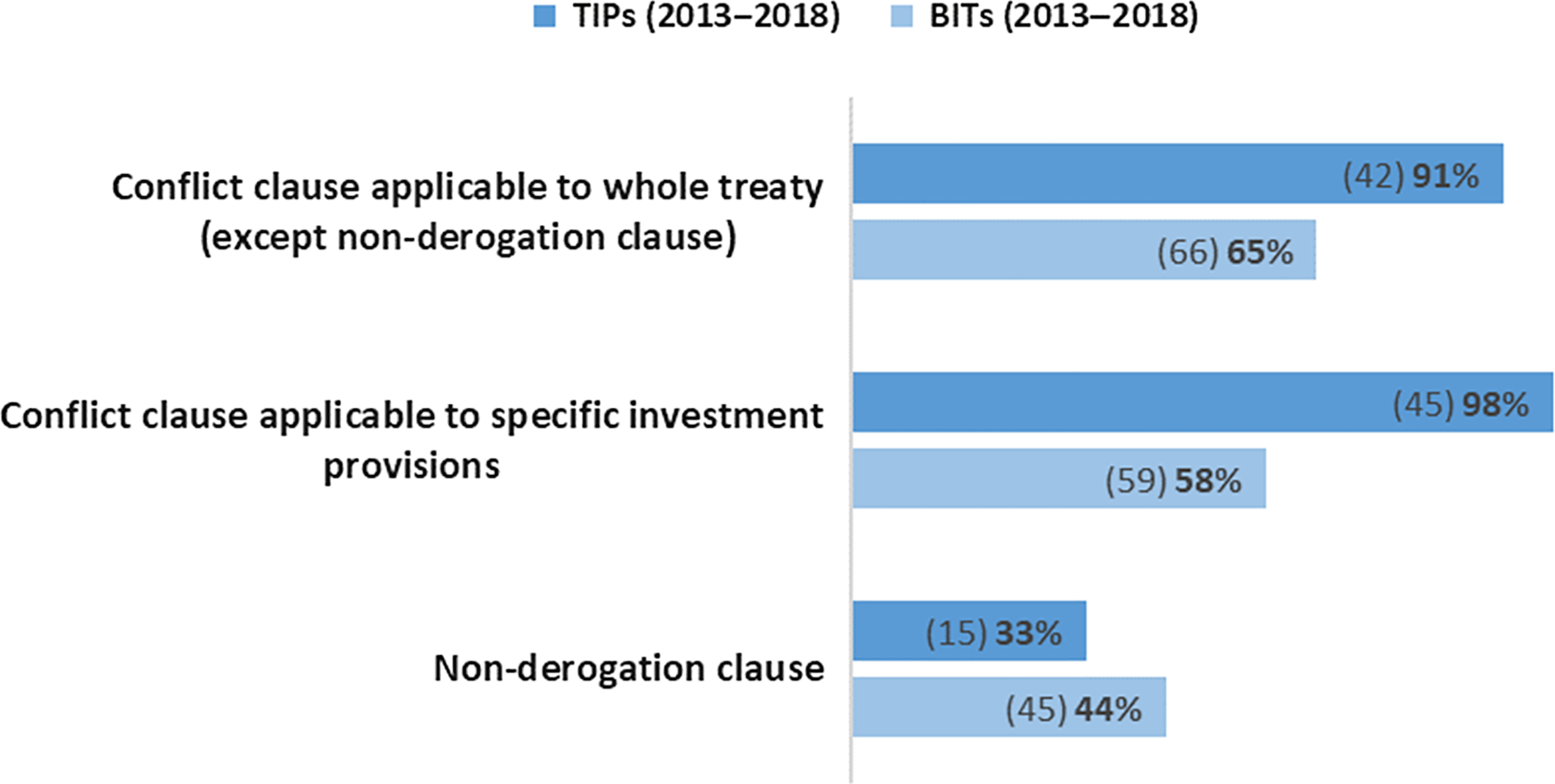
Types of conflict clauses present in recent investment treaties.
Note: The figure displays share of BITs and TIPs signed in 2013–2018 that contain each type of conflict clause, by per cent and number of treaties, using a sample of 102 BITs and 46 TIPs for which text was available.

The general profile of the two types of treaties is more similar among recent treaties. More than 60 per cent of both categories of treaties signed since 2013 contain at least one conflict clause applicable to the whole treaty. Also, in both types, the prevalence of non-derogation clauses is less than 50 per cent.Footnote 87 Despite this overall tendency, a closer look reveals important lingering asymmetries, which show that the drafters of TIPs continue to be more concerned with the treaties’ integration in the broader field of international law than those of BITs. With the exception of non-derogation clauses, TIPs contain conflict clauses that apply to the whole treaty and ones that apply to a specific standard of treatment more often than BITs. In practice, the gap is even more significant, as close to 80 per cent of recent TIPs contain more than one conflict clause while this is the case of only 33 per cent of recent BITs. Furthermore, among the clauses that apply to the whole treaty, the one most commonly present in BITs pertains to the maintenance of international peace and security.Footnote 88 As detailed above, this particular conflict clause is of limited import,Footnote 89 reducing further the number of BIT provisions which effectively regulate investment disciplines’ relations with other fields of international law.
This additional asymmetry is important as BITs remain the most common type of investment treaties both in terms of the number of instrumentsFootnote 90 and number of cases brought under them.Footnote 91 As a result, the rarer inclusion of conflict clauses in BITs and the prevalence of non-derogation clauses among them temper any strong claims of broad treaty reform aimed at the better co-ordination of investment disciplines with non-IEL disciplines.
In fact, when considering the relation between human rights and investment law, the prevalence of non-derogation clauses in BITs is revealing. According to the classic understanding of the effect of these provisions in other fields of international law,Footnote 92 non-derogation clauses serve to regulate similar (or homogenous) rights applicable to the same person.Footnote 93 Put differently, they resolve conflicts between norms that have similar underlying goals.Footnote 94 When applied to investment law, non-derogation clauses guarantee to investors the benefit of the more favourable among two potentially applicable provisions. As such, they can serve to comfort the current approach in arbitration under which human rights are more easily referred to when they support investor protection, while leaving conflictual relations with the rights of the host state’s population unaddressed. As a result, the inclusion of non-derogation clauses may arguably be detrimental to the approach that tribunals have towards human rights.
5. The qualitative superiority of IEL-related conflict clauses
In addition to the numerical prevalence of conflict clauses that regulate the relations of investment standards with the rest of IEL, the engagement with the field is also qualitatively different. While the majority of IEL-related clauses provide for a hard priority rule, non-IEL-related clauses are by and large hybrid provisions (Section 5.1). In addition, IEL-related clauses exhibit much more detail than their non-IEL counterparts, which are relatively short and generic (Section 5.2).Footnote 95 Finally, certain IEL-related clauses also contain an inter-institutional co-ordination aspect fully absent from non-IEL ones (Section 5.3). These three characteristics only exacerbate the asymmetry in approach to non-economic disciplines already instituted by the numerical prevalence of IEL-related clauses.
5.1 The asymmetry of preferring hybrid priority rules for non-IEL disciplines
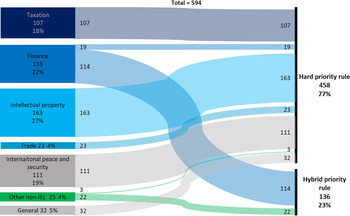
The type of priority rules that the surveyed conflict clauses establish also suggests that IEL comes first. The majority of IEL-related conflict clauses in TIPs provide for hard priority rules (Figure 7). Among IEL-related conflict clauses, the only type that consistently conditions its valid exercise upon the fulfilment of additional requirements is the TSM exception referring to the Articles of Agreement of the IMF in terms similar to those under Article XII GATS.
Type of priority rule of conflict clauses in TIPs per discipline.
Note: The figure represents the type of priority rule of conflict clauses per discipline they pertain to out of a total of 594 conflict clauses identified in TIPs and based on a sample of 137 TIPs for which text was available.

By contrast, except for clauses on the maintenance of international peace and security, most non-IEL conflict clauses provide for a hybrid priority rule. This is true as much with respect to the Treaty of Waitangi exception, as to clauses relating to international environmental norms. Environment-related conflict clauses include requirements, such as using the implementation measure ‘least inconsistent’ with the TIPFootnote 96 or expressly applying only to trade-related provisions of the respective MEAs.Footnote 97 The Treaty of Waitangi exception only exempts measures ‘necessary’ for the fulfilment of treaty obligations and only to the extent they do not result in discrimination and do not constitute a disguised restriction on investment.Footnote 98 There are only two non-IEL conflict clauses which grant unconditional priority to a human rights or environmental discipline and both are likely more relevant co-ordination tools for trade than for investment disciplines. They are the CETA international peace and security clause, discussed in Section 4.1, and a conflict clause related to cultural heritage law which grants priority to the UNESCO Convention on illicit trade in cultural property.Footnote 99
This qualitative difference reveals an additional asymmetry in the approach between IEL and non-IEL disciplines, suggesting a preference of ceding priority to IEL disciplines. In terms of structure, most non-IEL-related conflict clauses are closer to general exceptions than they are to most of their IEL-related counterparts. Being conditional in nature, they invite higher degree of scrutiny than IEL-related provisions.Footnote 100 In fact, several of the avoidance techniques that tribunals use in human rights-related cases would still be available to them under the majority of non-IEL conflict clauses in existence. By way of example, the conditionality of hybrid priority rules mandates tribunals to conduct a strict ex post review on whether the adopted state measures were indeed ‘necessary’ to comply with its non-IEL obligations, as happened in several of the Argentine cases.Footnote 101
5.2 The asymmetry in the level of detail reserved to IEL disciplines
IEL-related clauses commonly specify both the investment standards that they apply to and provisions or fact-scenarios of the other IEL instrument that prevail. By way of example, intellectual property-related conflict clauses are overwhelmingly standard-specific and often refer to the particular provisions of TRIPS and/or the intellectual property chapter of the TIP. Common formulations stipulate that expropriation does not require compensation in case of compulsory licenses, limitations and revocation of intellectual property rights in accordance with the TRIPS Agreement or that non-discrimination standards of protection do not apply to any measure that is an exception to the TRIPS Agreement, as provided under its Articles 3–5.Footnote 102 Similarly, TSM conflict clauses offer details on the types of investment they apply to.Footnote 103 By contrast, the most commonly encountered non-IEL clauses refer to an international treaty as a whole. At first view, this broad reference may suggest greater flexibility, i.e., all activities covered by the agreement lead to an exemption from liability under all investment standards. However, for the reasons detailed above regarding the conditional nature of priority rules that non-IEL-related clauses establish, such a conclusion would be misguided.
In addition, evolution over time suggests a deepening engagement with IEL in terms of detail. From this evolutionary perspective, non-economic disciplines are not catching up, rather they keep lagging behind, both in view of their rarer inclusion in recent TIPs and in view of their consistently generic character when included.
Tax-related conflict clauses provide the most revealing example of this trend of deepening engagement with economic disciplines. The basic priority rule in this field has been that tax conventions between the contracting parties prevail over the investment treaty to the extent of any inconsistency. Over time, the provisions have grown in sophistication. The inclusion of short provisions which simply grant priority to tax conventions have declined by 11 per cent in recent TIPs and account barely for a quarter of this type of conflict clauses. They have given way to ever more elaborate formulations. Detailed tax-related conflict clauses represent 70 per cent of this type of provision in recent TIPs, and 60 per cent of them overall. The practice of Canada is an example in point, showing clearly the evolution in complexity of tax-related conflict clauses in the country’s network of BITs.Footnote 104
Modern tax-related conflict clauses aim not only at co-ordinating the substantive provisions of tax conventions with those of investment treaties, but also at regulating the allocation of jurisdiction between investment and tax authorities.Footnote 105 Regarding substance, a series of detailed rules on each investment standard that applies to taxation follows a general conflict rule under which taxation-related conventions prevail over the investment treaty to the extent of any inconsistency.Footnote 106 Most recent TIPs contain also a special conflict rule (and procedure) applicable to expropriation. Expropriation is not subject to the general priority given to provisions pertaining to international taxation but takes their existence into account through a procedural co-ordination between investment tribunals and tax authorities.Footnote 107
Beyond this general trend, an even more detailed hard priority rule in favour of international tax law appears in a small number of TIPs in the form of a clarification on the meaning of expropriation, under which, inter alia, ‘a taxation measure that is consistent with internationally recognised tax policies, principles, and practices does not constitute an expropriation’.Footnote 108 The 2018 EU-Singapore IPA provides for a hard priority rule on taxation that goes even further. Under the provision, measures aimed at countering tax avoidance and evasion in accordance with a tax convention or domestic legislation are deemed not to constitute a breach of the investment treaty as a whole:
Nothing in this Agreement shall prevent the adoption or maintenance of any measure aimed at preventing the avoidance or evasion of taxes pursuant to the tax provisions of agreements to avoid double taxation or other tax arrangements or domestic fiscal legislation.Footnote 109
This clause is unique in that it extends the hard priority rule regarding tax avoidance or evasion to purely domestic measures in the same terms as it does to measures based on an international agreement. As such, it is in stark contrast to the approach to non-IEL disciplines in the same treaty, which are relinquished to a hybrid conflict clause.Footnote 110 Under the EU-Singapore IPA, the picture that emerges is one in which even domestic measures on taxation provide a better defence to an investment claim than international non-economic disciplines would.
The level of sophistication of the bulk of recent tax-related conflict clauses is unparalleled in any non-IEL conflict clause. This is particularly relevant since taxation and non-economic disciplines, such as human rights and environmental protection, have given rise to similar questions in international investment law. All three disciplines denote legitimate regulatory goals, domestically and internationally; all can lead to abuse in certain circumstances; and all have often given rise to similar difficulties in determining the appropriate threshold of liability.Footnote 111 Recent taxation-related conflict clauses seem to offer priority rules attuned to the inherent tension between the legitimate goals of taxation and the potential risks of abuse in taxation matters. As a result, one could have expected that lessons learned regarding taxation could serve as basis for the development of more granular priority rules for non-IEL disciplines too. Certainly, not all aspects of taxation-related clauses would be suitable for human rights disciplines, in view of the internal diversity of the field of human rights, both in terms of sources and regional differences. The fact remains that clauses pertaining to non-IEL disciplines that can be traced to broadly adhered to conventional sources and have featured prominently in investment disputes, such as international environmental law, have not evolved in the same way as tax-related ones either, raising questions as to the reasons behind this difference.
5.3 The asymmetry of reserving inter-institutional co-ordination to IEL authorities
A third aspect of the surveyed conflict clauses which reveals a preference for other IEL disciplines is the institutional co-ordination that some of them put in place, which is fully absent from non-IEL-related provisions (conflict clauses and other treaty references alike). There are a number of IEL institutions whose output either trumps investment standards of protection or binds decision-makers in proceedings under investment treaties. While clauses of this type are present in a small number of treaties, they deserve a spotlight shined on them. They suggest that negotiators possess the tools to create effective inter-institutional recognition and co-ordination. It is only the use of these tools that is uneven, again at the detriment of non-economic disciplines.
A first type of inter-institutional co-ordination provisions has the effect of exempting states from liability under the investment treaty when they are acting consistently with the decisions of international trade law bodies. A common example of this type of provision concerns trade law adjudicators. Certain investment treaties contain an exception under which actions taken to implement a decision by the Dispute Settlement Body of the WTO or of a PTA panel are deemed compatible with the respective investment treaty.Footnote 112 Again, with respect to trade disciplines, under certain conflict clauses, the WTO Ministerial Conference decisions to grant a waiver under Article IX(3) of the WTO Agreement are also deemed consistent with the investment treaty, showing trust not only to adjudicators, but also to the member states’ decision-making bodies of the Organization. These provisions commonly expressly state that measures falling within a waiver cannot give rise to an investment claim.Footnote 113
A second type of institutional co-ordination provisions renders certain determinations of another IEL authority binding on decision-makers under an investment treaty. Tax-related conflict clauses do so commonly by granting to the competent tax authorities the exclusive jurisdiction to decide upon the existence of an inconsistency between a tax convention and the investment treaty,Footnote 114 as well as to decide whether a particular measure constitutes a taxation measure in the context of an expropriation claim. Both decisions are binding on the investment treaty panel. Over time, certain states have complemented this allocation of jurisdiction with procedural rules on its practical co-ordination with investment proceedings.Footnote 115
Similarly, some TSM exceptions provide that in the context of consultations following the adoption of TSM measures by one party, the consulting parties ‘shall accept all findings of statistical and other facts presented by the [IMF] … and their conclusions shall be based on the assessment by the IMF of the balance-of-payments and the external financial situation of the Party concerned’.Footnote 116
Again, no similar trust or reference can be found regarding institutions and authorities outside of the broad field of IEL. In the rare instances where the output of non-IEL institutions is acknowledged in TIPs, this is done in relation to chapters on trade and sustainable development only.Footnote 117 It would thus be a matter of good will for investment decision-makers to take it into account, rather than an obligation. This is the case despite both the existence and significant body of work of several such institutionsFootnote 118 and the accumulated knowledge about the potential relevance of their work in the context of investment disputes.Footnote 119
6. The structural disadvantage that the asymmetrical approach to conflict clauses implies for non-IEL disciplines
The analysis above shows that both in numerical terms and in terms of their content, conflict clauses in investment treaties provide a more effective framework for the co-ordination of investment treaties with other IEL disciplines as compared to non-IEL ones. And while the quasi-absence of non-IEL disciplines from conflict clauses does not imply their overall absence from investment treaties, the ways in which non-IEL concerns are referred to in the treaties confirm their structural disadvantage.
Among the tools at states’ disposal aimed at influencing the relation of investment disciplines with other international law disciplines, conflict clauses that establish hard priority rules are among the strongest from a legal perspective. The choice to use this tool overwhelmingly for IEL disciplines, while using other tools for non-IEL ones, adds to the asymmetry between IEL and non-IEL disciplines and paints a picture of deeper concern on the part of negotiators for co-ordinating investment disciplines with the first than with the second. The characteristics of two categories of provisions through which the relations between investment disciplines and non-IEL disciplines are typically addressed in investment treaties and their disadvantages compared to conflict clauses serve to bring this asymmetry to light.
The first category of provisions to that effect are references to another international discipline in the investment treaty that reaffirms the normative value of that discipline or soft language that encourages adherence to it. Compared to the effect of conflict clauses, which regulate the normative interaction they pertain to, with these other provisions states do very little. Provisions which reaffirm the normative value of both international norms they refer toFootnote 120 (such as ‘mutual supportiveness’ clauses)Footnote 121 do not articulate priority rules. They exhibit the same circularity as interpretative principles such as systemic integration and thus relinquish the decision of which norm should take priority to adjudicators at the time of a dispute.Footnote 122 For practical purposes, under them, states delegate the decision-making power to the adjudicators in the same way as they would if the treaty were silent,Footnote 123 with the consequences that this delegation entails described in Section 2. A similar conclusion imposes itself with regards to other soft language provisions, such as the growing inclusion of corporate social responsibility clauses and labour or environment-related clauses in investment treaties. Indeed, there is an increasing recognition that they are of limited legal import.Footnote 124
In addition to soft law references to international disciplines, non-economic disciplines are also addressed in investment treaties through exceptions reserving policy space for state measures pursuing goals other than investment protection. These include most notably general exceptionsFootnote 125 and refinements to the scope of application of specific standards of protection.Footnote 126
From a theoretical point of view, it is important to note that these exceptions reserve policy space for unilateral state action. Under them, any international origin behind the exempted measure is ignored and therefore they do not have the same co-ordinating effect as conflict clauses. This approach entails an implied disadvantage for non-IEL disciplines in positioning their relation as one between an international (investment) standard and a domestic measure (aimed at a non-economic goal). As Viñuales points out, from this perspective, the domestic measure pursuing a non-economic goal has to comply with the international standard by virtue of being domestic, and thus by virtue of the presumption under Article 27 VCLT that domestic law cannot serve as an excuse for not performing treaty obligations.Footnote 127 By disregarding the international origin behind the domestic measure, this framing of the interaction creates a hierarchy in which non-IEL disciplines hold a lower position in relation to investment ones. A similar argumentative framework contributed to the tribunal’s conclusion in SAUR that Argentina’s human rights obligations and investment obligations operate at different levels. The tribunal reasoned that ensuring fundamental human rights to its citizens justified vesting police powers and special prerogatives in the state. It then analysed these prerogatives at the domestic level, dissociated from their affirmed international basis, and found that their exercise had to accommodate investors’ rights under the controlling BIT.Footnote 128
In practice, general exceptions in investment treaties partially temper this disadvantageous position. However, the asymmetry persists due to the fact that the exceptions that cover human rights and environmental disciplines provide for a higher standard of scrutiny of the measure than most priority rules typical for IEL-related conflict clauses. The structure of public policy exceptions requires a high threshold for exemption when the discipline relates to human rights and the environment. Many public policy exceptions require a ‘necessity’ nexus between the measure and the pursued objective for exemption, which allows for a rather invasive standard of review by arbitrators.Footnote 129 Essential security exceptions are again the main outlier among non-economic disciplines. They impose a looser nexus for exemption,Footnote 130 but their use for the protection of broader public policy objectives is also more tenuous.
Similarly, the clarifications to the scope of application of specific investment standards, while offering policy space to states, still use evaluative language,Footnote 131 which invites higher level of scrutiny than the one accorded to IEL disciplines in conflict clauses or sometimes even to domestic economic regulation. The approach taken regarding tax avoidance practices in several treaties provides a revealing example and finds no counterpart regarding non-economic considerations.Footnote 132
Regarding human rights norms more specifically, a final development in drafting is worth addressing, albeit it does not directly stem from treaty language. There is a rise of provisions pertaining to human rights in investment contracts, which is a welcomed development, as contractual arrangements allow for more detailed and context specific regulation than investment treaties can or arguably should.Footnote 133 While this is so, co-ordination through contractual provisions, as much as the other avenues through which non-IEL disciplines are addressed, suffers from a disadvantage in investment arbitration. Indeed, under the prevailing (albeit criticized) approach by arbitral tribunals, investment treaty terms trump and in practice have the effect of modifying the relevant contractual commitments.Footnote 134 As a result, the regulation of conflictual relations between investment and human rights norms through contract is less likely to have an impact to tribunals’ approach.
7. Conclusion
The article provides an account of conflict clauses in investment treaties, using these clauses as indicators of states’ activity aimed at co-ordinating investment disciplines with the rest of international law. It shows that these provisions are used extensively in investment treaties, but both in numbers and in content, they exhibit important asymmetries favouring IEL over non-IEL disciplines. Indeed, conflict clauses on IEL are much more common, more detailed and establish clearer priority rules than similar provisions on any other field of international law.
On a policy level, these asymmetries suggest that a shift in analytical perspective may be desirable. Instead of comparing the soft law language investment treaties use for non-IEL disciplines to the lack of any reference to such disciplines in earlier treaties, it seems desirable to compare it to the more effective language these treaties already employ regarding IEL disciplines. In so doing, one would focus on the quality of provisions referencing non-IEL disciplines in investment treaties rather than on their quantity. Certainly, not all IEL-related provisions would be suited to non-IEL disciplines. However, one can reach this conclusion only as a result of the analysis of existing models and their transferability. By mapping the existing conflict clauses, the article begins to provide the tools for such an analysis.
Beyond these immediate considerations, the observed disparity of conflict clauses raises questions for further research regarding the dynamics that influence the type of engagement with different international disciplines. The article revealed that negotiators already have the toolkit to create effective links between international norms and institutions. One possible reading of their uneven willingness to use that kit could be grounded on the qualitative difference between the IEL and non-IEL disciplines. The asymmetry can also lend initial support to hypotheses related to strategic fragmentation actions on the part of (certain) states or to hypotheses based on the social environment of investment negotiators and the resulting difference in their affinity to different fields of international law.
Annex I: Survey design
To consider the extent to which conflict clauses have the potential to regulate the relations of international investment law with other fields of international law, the article relies on a large-scale qualitative survey of investment treaties. The survey gathers information from a selection of 1,050 investment treaties, signed between 1957 and 2018. It examines the presence, coverage, and content (i.e., the type of established priority rule) of conflict clauses applicable to substantive investment provisions, coding for 60 variables.
The definition of ‘conflict clause’ adopted for the purposes of the survey is a functional one. It follows closely the understanding of the drafters of the VCLT. It emphasizes the need for a conflict clause to regulate the relation between the disciplines it applies to.Footnote 135 Two consequences flow from this definition.
In order to regulate relations between the two potentially applicable disciplines, a conflict clause must indicate which of them should be given priority. Otherwise, it falls short of affecting the conflictual relationship between the disciplines.Footnote 136 Clauses in which the normative value of both international disciplines is simply reaffirmed, or clauses reserving policy space for domestic regulations pursuing goals other than investment protection, do not fit in this definition and therefore are not documented in the study.
Conversely, adopting a functional definition of conflict clauses means that the study surveys all clauses which do regulate the relations between investment disciplines and other international disciplines, independently of their formal title.
In terms of scope, the survey includes clauses which apply to the relations both of the investment treaty as a wholeFootnote 137 and of specific investment standards of protection with other international disciplines. It surveys for general clauses which create priority rules on the place of the investment treaty or standard vis-à-vis all other international norms,Footnote 138 as much as special ones that do so for a specific treaty or type of treaties.Footnote 139 For TIPs, it also documents in a separate category the clauses which establish priority rules between the investment chapter and other chapters of the same treaty.
In terms of wording, the study surveys not only classically-worded conflict clauses referring to the term ‘inconsistency’ or ‘conflict’,Footnote 140 but also carve-outs or exceptions that establish priority rules between investment standards of protection and other international disciplines.Footnote 141
The surveyed treaties can be divided into three categories which overlap partially and were selected through purposive sampling based on their particular relevance for the international investment regime.Footnote 142 First, the selection includes 137 TIPs which contain substantive investment protection provisions. This category constitutes a near-exhaustion of the population of this type of treatiesFootnote 143 and comprises such mega-regional initiatives as the 2018 CPTPP or the 2016 CETA.Footnote 144
Second, the selection encompasses all investment treaties signed between 2013 and 2018. This category includes treaties which already fall in the previous category but is complemented by all BITs signed between 2013 and 2018. The inclusion of this second category of treaties is meant to capture shifts in recent treaty practice.Footnote 145
Finally, the selection includes the full investment treaty networks of nine states – Canada, China, France, Germany, India, the Netherlands, Switzerland, the United Kingdom, and the United States. These states are chosen on the basis of three aspects of their treaty practice that render them particularly relevant for the survey.
First, the group is made up of states exhibiting high level of coherence in their investment treaty networks,Footnote 146 i.e., they are the ‘rule-makers’Footnote 147 of the investment treaty universe.Footnote 148 In this way, the selection neutralizes to a reasonable extent the factor of bargaining power which can constitute an alternative explanation of the incoherence in the treaty practice of countries, including with regard to conflict clauses.
Second, the group includes the five states that are most often home states to claimants in investment disputes,Footnote 149 which ensures the study’s practical relevance for investment dispute settlement. The focus on home states results from the fact that the concentration of disputes per state is significantly higher on the side of the home state of the claimant than on that of the respondent state. As an illustration, the first five home states account for over 500 of the known 1,023 investor-state treaty-based disputes, while the first five host states only for half of that number (242 disputes). The treaty network of a country which is often home state to the claimant is thus more likely to be used as basis for an investment claim than the network of a country which is often the respondent. For instance, it is notable that the number of Venezuelan BITs used in investment disputes is 13 in total, while that of French BITs is 26 for the same number of disputes (52) for both countries (respectively 51 as home state of the claimant for France and 51 as respondent state for Venezuela). Similarly, two of Argentina’s BITs (with Spain and the United States) account for over half (32) of the 62 investment disputes in which the state is respondent.Footnote 150
Finally, taken together, the nine selected states include the five states with the widest investment agreements networks,Footnote 151 and four of the states with longest tradition in concluding investment treaties,Footnote 152 which allows for a meaningful account of the changes of policy towards conflict clauses over time in these states’ respective negotiating practices.