I. INTRODUCTION
Self-assembling of discotic molecules into columnar phases offers a unique opportunity of developing potential one-dimensional charge carrier systems. Among the huge variety of mesogenic species, liquid-crystalline (LC) phthalocyanines (Pcs) are of significant interest as organic semiconductors for electronic devices,Reference McKeown1–Reference Eichhorn, Bruce and Wöhrle6 mainly due to their high thermal and chemical stability. Particular attention has been already paid to lead(II) phthalocyanines (PbPcs) because of their promising structural, electrical, and optical properties.Reference Ambily, Xavier and Menon7–Reference Snow and Jarvis13 It is well known that the substitution at the peripheral and nonperipheral positions of Pc ring can significantly alter the structure and optical properties of Pc species.Reference Ford, Sumner, Zhu, Chang, Um, Choi, Heiney and Maliszewskyj14–Reference Hanack, Beck and Lehmann20 For example, alkoxy-substituted PbPc complexes were used to obtain the optical limiting materials with broad protective wavelength and high optical transmission as well as quick response.Reference Duan, Xia, Liu, Wang, Toshifumi and Toyoji21
It is well known that the properties of LC Pcs depend on the type and position of substituents in macrocycle. Despite many examples of PbPcs described in literature such investigations were not carried out for PbPcs. Moreover, although many mesomorphic PbPcs have been reported so far,Reference McKeown1, Reference Piechocki, Boulou and Simon11, Reference Ford, Sumner, Zhu, Chang, Um, Choi, Heiney and Maliszewskyj14, Reference Hanack, Beck and Lehmann20, Reference Basova, Gürek, Atilla, Hassan and Ahsen22–Reference Atilla, Gürek, Basova, Kiselev, Hassan, Sheludyakova and Ahsen26 only a few of them deal with film investigation.Reference Basova, Gürek, Atilla, Hassan and Ahsen22, Reference Atilla, Gürek, Basova, Kiselev, Hassan, Sheludyakova and Ahsen26
The first mesomorphic PbPc with eight substituents in peripheral positions (PbPcR8, R = –CH2OCnH2n+1; n = 8, 12) was synthesized in 1987.Reference Piechocki, Boulou and Simon11, Reference Hanack, Beck and Lehmann20 Several other PbPc derivatives [PbPcR8, R = –OC12H25, –CH2SCH(CH2O(CH2)11CH3)2, –SCH(CH2O(CH2)11CH3)2] have also been synthesized and studied afterward.Reference Basova, Gürek, Atilla, Hassan and Ahsen22, Reference Hanack, Gül, Hirsch, Braja, Subramanian and Witke24, Reference Atilla, Gürek, Basova, Kiselev, Hassan, Sheludyakova and Ahsen26 Our previous studyReference Atilla, Gürek, Basova, Kiselev, Hassan, Sheludyakova and Ahsen26 addressed the synthesis and characterization of octahexadecylthio- and tetrahexadecylthio-substituted PbPcs. The formation of the columnar hexagonal (Colh) mesophase of those compounds over a wide temperature range was confirmed by x-ray phase analysis. The strong dependence of the crystal-to-mesophase and the mesophase-to-isotropic phase transition temperatures on the number of alkyl chains were found for these Pcs.Reference Atilla, Gürek, Basova, Kiselev, Hassan, Sheludyakova and Ahsen26 The type of mesophase and the transition temperature were also dependent on the length of alkyl chains and the nature of connecting link between the side chains and aromatic core.Reference Engel, Bassoul, Bosio, Lehmann, Hanack and Simon25, Reference Masurel, Sirlin and Simon27–Reference Suda, Shigehara, Yamada, Matsuda, Okada and Masaki29 It is also remarkable that the clearing point of tetra-substituted Pcs is lower than that of octa-substituted Pcs due to the fact that tetra-substituted Pcs are a mixture of four isomers.Reference Atilla, Gürek, Basova, Kiselev, Hassan, Sheludyakova and Ahsen26
The nature of a linking heteroatom has also a noticeable influence on the spectral properties of Pc derivatives. For example, metallophthalocyanine (MPc) complexes containing sulfur linkages are known to absorb light at higher wavelengths (>700 nm)Reference Ozoemena and Nyokong30, Reference Gürek, Durmuş and Ahsen31 than other MPc derivatives. This makes such compounds good candidates for applications in optoelectronics, near-IR devices, and photodynamic therapy.
PbPcs with substituents in nonperipheral positions have been described in literatureReference Burnham, Cook, Gerrard, Heeney and Hughes12, Reference Bian, Li, Dou, Cheng, Li, Ma, Ng, Kobayashi and Jiang17; however, PbPc with substituents in nonperipheral positions exhibiting mesomorphic properties have not been investigated so far. For example, synthesis, structure, and electrochemistry of Pb[Pc(α-OR)4] with R = 3-pentyl, 2,4-dimethyl-3-pentyl, and 2-naphthyl were studied in Ref. Reference Bian, Li, Dou, Cheng, Li, Ma, Ng, Kobayashi and Jiang17. Molecular orbital energy gaps, atomic charges, and the ultraviolet–visible (UV–vis) electronic absorption spectra of two lead complexes of Pcs tetrasubstituted at the nonperipheral positions (PbPc(α-OC2H5)4 and PbPc(α-OC5H11)4) were studied using density functional theory (DFT) calculations.Reference Zhang, Zhang, Liu, Bian and Jiang32 Lead 1,4,8,11,15,18,22,25-octakis(hexylsulfanyl)phthalocyanine has been characterized by x-ray crystallography.Reference Burnham, Cook, Gerrard, Heeney and Hughes12
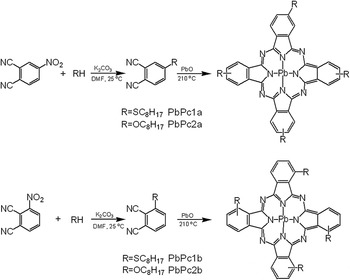
This study is aimed at the comparative analysis of mesogenic and spectral properties of peripherally and nonperipherally tetraoctylthio (PbPc(SR)4)- and tetraoctyloxy (PbPc(OR)4)-substituted PbPcs (Scheme 1). The mesogenic properties of these new materials were studied by differential scanning calorimetry (DSC), polarized optical microscopy (POM), and x-ray diffraction (XRD) techniques. The preparation of thin films of the title species and study of their structure by the UV–vis and IR spectroscopies are also reported.
II. EXPERIMENTAL SECTION
A. Materials
4-(n-Octylthio) phthalonitrile and 4-(n-octyloxy) phthalonitrile were prepared according to the reported procedures.Reference del Rey, Keller, Torres, Rojo, Agullo-Lopez, Nonell, Mart, Brasselet, Ledoux and Zyss33, Reference Berneth, Bruder, Hagen, Hassenrueck, Kostromine, Krueger, Meyer-Friedrichsen, Stawitz, Oser and Falkner34 All other reagents and solvents of reagent-grade quality were obtained from commercial suppliers and were dried using standard procedures.Reference Perin and Armarego35
B. Measurements
Elemental analysis was performed with a Thermo Finnigan Flash 1112 instrument (ThermoFisher Scientific, Waltham, MA). IR spectra of the species and reflection–absorption IR spectroscopy (RAIRS) (the incident angle of 80° was used) of the thin films were recorded by a Vertex 80 FT-IR spectrometer (Bruker Optics, Ettlingen, Germany). UV–vis spectra were recorded with the Shimadzu UV–vis-3101PC (Kyoto, Japan) and Shimadzu 2001 UV spectrophotometers (Kyoto, Japan) using 1-cm path length cuvettes at room temperature. Matrix-assisted laser desorption/ionization time-of-flight mass spectrometry (MALDI-TOF-MS) measurements were performed on a Bruker Daltonics micrOTOF (Bremen, Germany). Positive ion and linear mode MALDI-TOF-MS spectra of the compounds were obtained without matrix using 50 shots of a nitrogen laser. 1H and 13C nuclear magnetic resonance (NMR) spectra were recorded in CDCl3 solutions on a Varian 500 MHz spectrometer (Palo Alto, CA). The phase transition behavior of the species was observed by POM (Leitz Wetzler Orthoplan-pol; Leitz Wetzler, Wetzler, Germany) equipped with a hot stage (Linkam TMS 93) and a temperature controller (Linkam LNP). Transition temperatures were determined using a Mettler Toledo Star Thermal Analysis System/DSC 822 (Columbus, OH) at the scan rate of 10 °C min−1. DSC system was calibrated with 3- to 4-mg indium samples under nitrogen atmosphere. XRD measurements for thin film characterization were performed using automatic diffractometer DRON-UM1 (Cu Kα-radiation, Ni-filter, scintillation detector with amplitude discrimination, Soller slits with aperture of 1.5° on primary and reflected beams) in the region of 2θ from 5° to 60° with a scanning step of 0.03°. XRD measurements for the LC investigations were performed using a Bruker Advanced D8 (Cu Kα-radiation) diffractometer (Bruker AXS, Karlsruhe, Germany). All measurements were carried out under ambient conditions.
C. Synthesis and characterization
1. 2(3),9(10),16(17),23(24)-Tetrakis(octylthio)phthalocyaninato Lead(II) (PbPc1a)
A round-bottomed flask was degassed and flame-dried under dry argon. The flask was charged under argon with 4-(n-octylthio) phthalonitrile (0.500 g, 1.84 mmol) and anhydrous PbO (0.205 g, 0.92 mmol). The mixture was heated to 210 °C with stirring under argon atmosphere for 5 h without solvent (Scheme 1). The reaction mixture was then dissolved in dichloromethane, centrifuged, and the precipitate including inorganic impurities was removed. The solvent was evaporated, and the crude product was passed through a Bio Beads column (Bio Rad Laboratories, Berkeley, CA) using CH2Cl2 as an eluent for eliminating organic impurities. This purification step was repeated two times. The next purification stage was performed by preparative thin layer chromatography [silica gel; eluent CH2Cl2/n-hexane, 20:1 (v/v)]. Yield: 0.255 g (43%). UV–vis (THF): λmax nm (log ε) 370 (4.45), 403 (4.41), 649 (4.25), 721 (4.98). 1H NMR (500 MHz, CDCl3, Fig. S1 in Supporting Information): δ = 0.90 (t, 12H, CH3), 1.34–1.62 (m, 32H, CH2), 1.63 (m, 8H, CH2), 1.92 (m, 8H, CH2), 3.32 (t, 8H, SCH2), 7.92 (d, 4H, CHar), 8.95 (m, 8H, CHar). 13C NMR (125 MHz, CDCl3, Fig. S2 in Supporting Information): δ 14.17–14.11 (CH3), 22.85–22.67 (CH2), 29.07–29.34 (CH2), 31.92 (CH2), 33.41 (SCH2), 33.60 (SCH2), 120.86–120.48 (CarH), 122.56–122.71 (CarH) 128.58–128.78 (CarH), 134.06–134.36 (Car), 137.77–138.01 (Car–S), 140.57–141.01 (C=N), 152.08–154.00 (C=N). MS (MALDI–TOF, Fig. S9 in Supporting Information), m/z (%): 1296.9 [M]+ (100). C64H80N8PbS4 calcd: C, 59.28; H 6.22; N 8.64%, found: C, 59.14; H, 6.72; N, 8.59%.
Synthesis route of peripherally and nonperipherally tetrakis(octylthio)- and tetrakis(octyloxy)-substituted lead(II) phthalocyanines.

2. 2(3),9(10),16(17),23(24)-Tetrakis(octyloxy)phthalocyaninato Lead(II) (PbPc2a)
PbPc2a was prepared and purified by the same procedure described for PbPc1a (Scheme 1) from 4-(n-octyloxy) phthalonitrile (0.350 g, 1.37 mmol) and anhydrous PbO (0.153 g, 0.68 mmol). Yield: 0.100 g (24%). UV–vis (THF): λmax nm (log ε) 360 (4.50), 385 (4.49), 639 (4.27), 707 (4.94). 1H NMR (500 MHz, CDCl3, Fig. S3 in Supporting Information): δ = 0.96 (t, 12H, CH3), 1.39–1.65 (m, 32H, CH2), 1.66 (m, 8H, CH2), 2.03 (m, 8H, CH2), 4.44 (m, 8H, OCH2), 7.63 (t, 4H, CHar), 8.54 (d, 4H, CHar), 9.09 (m, 4H, CHar). 13C NMR (125 MHz, CDCl3, Fig. S4 in Supporting Information): δ 13.16–13.06 (CH3), 21.75–21.73 (CH2), 25.27 (CH2), 28.14–28.56 (CH2), 30.93 (CH2), 68.05–67.91 (OCH2), 104.13–104.77 (CarH), 117.44–118.20 (CarH), 122.69–123.29 (Car), 129.38–129.85 (Car), 138.39–138.98 (Car–O), 150.44–154.07 (C=N), 160.25–160.85 (C=N). MS (MALDI-TOF), m/z (%):1232.7 [M]+ (100). C64H80N8PbO4 calcd: 62.37; H 6.54; N 9.09%, found: C, 62.67; H, 6.48; N, 8.98%.
3. 1(4),8(11),15(18),22(25)-Tetrakis(octylthio)phthalocyaninato Lead(II) (PbPc1b)
PbPc1b was prepared and purified by the same procedure described for PbPc1a (Scheme 1) from 3-(n-octylthio) phthalonitrile (0.500 g, 1.84 mmol) and anhydrous PbO (0.205 g, 0.92 mmol). Yield: 0.330 g (56%). UV–vis (THF): λmax nm (log ε) 337 (4.63), 462 (4.22), 667 (4.45), 743 (5.21). 1H NMR (500 MHz, CDCl3, Fig. S5 in Supporting Information): δ = 0.96 (m, 12H, CH3), 1.38–1.77 (m, 48H, CH2), 3.11 (m, 8H, SCH2), 7.65 (m, 4H, CHar), 8.49 (m, 8H, CHar). 13C NMR (125 MHz, CDCl3, Fig. S6 in Supporting Information): δ 14.19–14.22 (CH3), 22.78 (CH2), 28.59–28.86 (CH2), 29.42–29.83 (CH2), 30.96– 31.17 (CH2), 31.60–31.69 (CH2), 31.97–31.99 (SCH2), 118.70–119.16 (CarH), 124.13–124.76 (CarH), 128.89–129.27 (CarH), 131.31–132.90 (CarH), 136.52–136.83 (Car), 137.66–138.76 (Car–S), 152.83–154.34 (C=N). MS (MALDI-TOF), m/z (%):1296.4 [M]+ (100). C64H80N8PbS4 calcd: C, 59.28; H 6.22; N 8.64%, found: C, 59.55; H, 6.19; N, 8.60%.
4. 1(4),8(11),15(18),22(25)- Tetrakis(octyloxy)phthalocyaninato Lead(II) (PbPc2b)
PbPc2b was prepared and purified by the same procedure described for PbPc1a (Scheme 1) from 3-(n-octyloxy) phthalonitrile (0.500 g, 1.95 mmol) and anhydrous PbO (0.218 g, 0.97 mmol). Yield: 0.200 g (33%). UV–vis (THF): λmax nm (log ε) 326 (4.61), 430 (4.22), 659 (4.43), 733 (5.20). 1H NMR (500 MHz, CDCl3, Fig. S7 in Supporting Information): δ = 0.92 (m, 12H, CH3), 1.28–2.43 (broad, 48H, CH2), 4.63 (m, 8H, OCH2), 7.55 (m, 4H, CHar), 7.96 (m, 4H, CHar), 8.77 (m, 4H, CHar). 13C NMR (125 MHz, CDCl3, Fig. S8 in Supporting Information): δ 14.10–14.22 (CH3), 22.68–22.83 (CH2), 25.86–25.98 (CH2), 26.70–26.85 (CH2), 29.04–30.20 (CH2), 31.83–32.17 (CH2), 69.36–69.46 (OCH2), 70.16–70.30 (OCH2), 112.85–113.09 (Car), 114.33–114.59 (Car) 115.62–116.11 (CarH), 124.77–125.35 (CarH), 130.38–130.96 (CarH), 140.36–140.84 (Car–O), 153.15–154.06 (C=N), 155.75–156.77 (C=N). MS (MALDI-TOF), m/z (%): 1232.5 [M]+ (100). C64H80N8PbO4 calcd: C, 62.37; H 6.54; N 9.09%, found: C, 61.92; H, 6.58; N, 8.37%.
D. Quantum chemical calculations
The IR spectra of PbPc1 and PbPc2 species were calculated at the B3LYP/LANL2DZ level of theory.Reference Becke36, Reference Hay and Wadt37 The geometries were fully optimized and each stationary point was fully characterized as a true minimum by the vibrational analysis. An ultrafine integration grid was used for numerical solving of the Kohn–Sham equations. The Raman intensities were not calculated because of resonant nature of the Raman bands excited in visible spectral range. All calculations were performed using Gaussian 03 suite of programs.Reference Frisch, Trucks, Schlegel, Scuseria, Robb, Cheeseman, Montgomery, Vreven, Kudin, Burant, Millam, Iyengar, Tomasi, Barone, Mennucci, Cossi, Scalmani, Rega, Petersson, Nakatsuji, Hada, Ehara, Toyota, Fukuda, Hasegawa, Ishida, Nakajima, Honda, Kitao, Nakai, Klene, Li, Knox, Hratchian, Cross, Bakken, Adamo, Jaramillo, Gomperts, Stratmann, Yazyev, Austin, Cammi, Pomelli, Ochterski, Ayala, Morokuma, Voth, Salvador, Dannenberg, Zakrzewski, Dapprich, Daniels, Strain, Farkas, Malick, Rabuck, Raghavachari, Foresman, Ortiz, Cui, Baboul, Clifford, Cioslowski, Stefanov, Liu, Liashenko, Piskorz, Komaromi, Martin, Fox, Keith, Al-Laham, Peng, Nanayakkara, Challacombe, Gill, Johnson, Chen, Wong, Gonzalez and Pople38
E. Preparation of thin films
Small volumes of solutions of PbPc1 and PbPc2 in THF (5 × 10⁻³ g/cm3) were dispensed by a glass pipette onto an ultrasonically cleaned substrate held on a photoresist spinner. The substrate was rotated for 60 s at a speed of 2000 rpm. The solvent was evaporated upon rotation, and thin films of the species were prepared. The substrates were varied according to the experimental requirements. The thickness of deposited films was measured by ellipsometry. Spectroscopic ellipsometric measurements were performed on films deposited on silicon substrates using a Woolam M-2000V™ rotating analyzer spectroscopic ellipsometer (Lincoln, NE) in the spectral range of 400–800 nm. The thickness of the films studied was about 60–80 nm.
III. RESULTS AND DISCUSSION
A. Synthesis
The usual synthetic pathway to obtain PbPc is heating PbO or Pb(OAc)2 with respective phthalonitrile derivatives without solventReference Snow and Jarvis13–Reference van der Pol, Neeleman, Zwikker, Nolte, Drenth, Aerts, Visser and Picken16, Reference Dinçer, Çerlek, Gül and Koçak18 or in n-pentanol.Reference Bian, Li, Dou, Cheng, Li, Ma, Ng, Kobayashi and Jiang17 Another route is the addition of anhydrous lead(II) acetate to a solution of Li2Pc or H2Pc in anhydrous alcohol.Reference Bian, Li, Dou, Cheng, Li, Ma, Ng, Kobayashi and Jiang17 PbPc can also be obtained by a microwave method.Reference Achar, Kumar and Lokesh19, Reference Duan, Xia, Liu, Wang, Toshifumi and Toyoji21 In this work, the cyclotetramerization of the phthalonitrile compounds was carried out in the presence of the dried PbO without any solvent (Scheme 1). By the use of this technique, PbPcs were already synthesized with a high yield comparable to the one of the earlier reported microwave procedure.Reference Basova, Gürek, Atilla, Hassan and Ahsen22 Generally, PbPcs are not stable due to the large size of the central lead atom. The Pcs can easily lose the Pb atom and transform into the corresponding metal-free analogues. To overcome this problem, the crude product was first passed through a Bio Beads column for eliminating organic impurities and then the PbPcs were purified by preparative thin layer chromatography as quickly as possible.
In this study, the synthesized peripherally (PbPc1a and PbPc2a) and nonperipherally (PbPc1b and PbPc2b) tetrasubstituted PbPcs have been obtained as an isomer mixture (Scheme 1), and no attempt was made to separate these isomers.
B. Spectroscopic characterization
PbPc1 and PbPc2 derivatives have a nonplanar “shuttle-cock” structure similar to unsubstituted PbPc.Reference Ukei39, Reference Iyechika, Yakushi, Ikemoto and Kuroda40 Small divalent metal ions (Cu, Ni, Zn, Mg, etc.) form planar Pc complexes, whereas larger metal ions (Pb, Sn, etc.) form nonplanar complexes suggesting that these larger ions lie outside the molecular plane of the Pc framework. The introduction of bulky alkyl substituents to Pc ring leads to a further distortion of the Pc macrocycle. This moiety becomes bent, and the molecular symmetry of PbPc1 and PbPc2 reduces to C4. The alkyl chains in both molecules are arranged parallel to isoindole unit planes.
As mentioned before, each of the four species PbPc1a–PbPc2b is actually a mixture of four isomers with different positions of alkyl chains. However, all of them showed very similar spectral properties. Therefore, only the IR spectra of one isomer for each compound with substituents in 2,9,16,23-positions of Pc ring were calculated. The geometries of PbPc1 and PbPc2 optimized at the B3LYP/LANL2DZ level are available in Supporting Information. The calculated bond lengths of PbPc molecules are close to the averaged experimental values of PbPc analoguesReference Burnham, Cook, Gerrard, Heeney and Hughes12, Reference Bian, Li, Dou, Cheng, Li, Ma, Ng, Kobayashi and Jiang17 and to the computed values for tetrakis(n-hexadecylthio)- and octakis(n-hexadecylthio)-substituted lead(II) Pc.Reference Atilla, Gürek, Basova, Kiselev, Hassan, Sheludyakova and Ahsen26
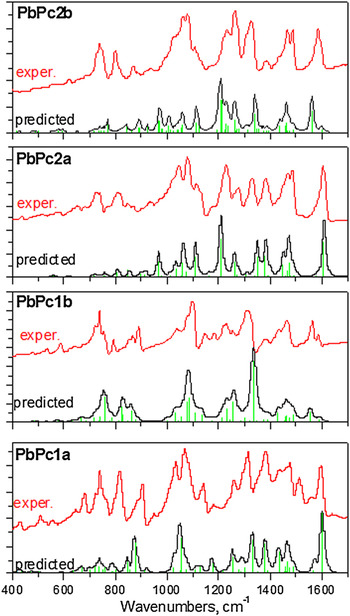
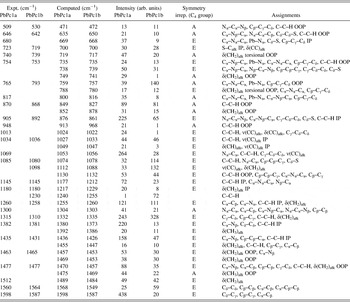
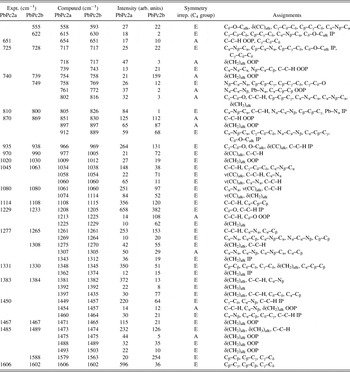
The experimental and DFT calculated IR spectra of PbPc1 and PbPc2 are presented in Fig. 1. Both A and E modes are active in the IR spectra. The assignment of experimental bands was primarily based on calculated vibrational frequencies and IR intensities. The comparison of the experimental and theoretical most intensive IR bands and their assignments are presented in Tables I and II. The vibrational frequencies were scaled by an empirically derived factor of 0.970. The root mean square difference between the calculated and experimental IR frequencies is 20 cm−1.
Experimental and theoretical (B3LYP/LANL2DZ) infrared (IR) spectra of PbPc1 and PbPc2 complexes.

Experimental and calculated (B3LYP) infrared (IR) spectra of PbPc1.

Experimental and calculated (B3LYP) IR spectra of PbPc2.

The vibrational modes in the spectra of PbPc1 and PbPc2 (Fig. 1) are complicated due to the presence of octylthio and octyloxy groups. Very intensive peaks corresponding to Cph–O stretching coupled with C–C–H in-plane bending vibrations appear at 1229 and 1233 cm−1 in the IR spectra of the octyloxy-substituted derivatives PbPc2a and PbPc2b, respectively (Fig. 1, Table I). The bands corresponding to Cph–S stretching vibration in the spectra of octylthio-substituted Pcs are much weaker and are shifted to lower wave numbers (1080–1085 cm−1, Fig. 1, Table I). The stretching C=C vibrations of benzene ring observed at 1606 and 1602 cm−1 for PbPc2a and PbPc2b, respectively, are shifted to lower energies in the case of PbPc1a and PbPc1b due to the greater electron donating behavior of SR groups compared to OR derivatives. The main difference between the spectra of Pcs with substituents in peripheral and nonperipheral positions is intensity of the modes involving Cph–H bending vibrations.
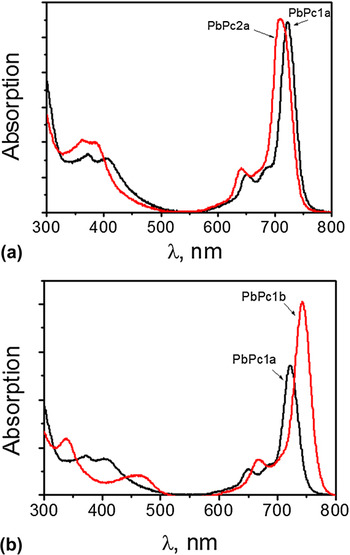
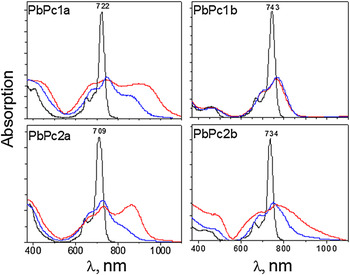
The electronic absorption spectra of PbPcs in THF (1 × 10⁻⁵ M) are presented in Fig. 2. Similarly to other Pc derivatives, PbPc complexes have two intensive bands in the UV–vis spectra: the Soret band (B-band) and the Q-band. The Q-band absorption has been assigned to a π–π* transition from the highest occupied molecular orbital (HOMO) of a1u symmetry to the lowest unoccupied molecular orbital (LUMO) of eg symmetry. The Q-bands of the nonperipherally tetrasubstituted complexes (PbPc1b and PbPc2b) are redshifted in comparison with their peripherally tetrasubstituted (PbPc1a and PbPc2a) analogues by 22 and 26 nm, respectively. The observed bathochromic shift is typical of Pcs with substituents in nonperipheral positions.Reference Mack and Stillman41, Reference Konami, Hatano and Tajiri42 The B-bands are broad due to the overlap of the B1 and B2 bands in the 330- to 370-nm region. The redshift of ∼10 nm is observed in the spectra of SR-substituted derivatives (PbPc1a and PbPc1b) compared to OR-substituted derivatives (PbPc2a and PbPc2b) due to the greater electron donating nature of SR groups in comparison with OR groups. Furthermore, the presence of Pb2+ ion leads to additional shift to longer wavelengths in comparison with planar Pc analogues.Reference Weber, Guillon and Skoulios23
Electronic absorption spectra of (a) PbPc1a and PbPc2a, (b) PbPc1a and PbPc1b complexes in tetrahydrofuran (THF) (C = 1 × 10⁻⁵ M).

C. Mesogenic properties
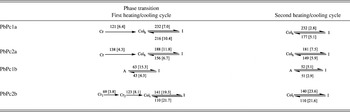
The phase transition temperatures and thermal stability of the PbPc1 and PbPc2 complexes were determined using DSC and thermal gravimetric analysis (TGA). TGA measurements with a heating rate of 10 °C/min showed that the decomposition of PbPc1 and PbPc2 starts at around 250–280 °C. The DSC measurements were performed on the virgin materials with a heating rate of 10 °C/min. Phase transition temperatures and the corresponding enthalpy changes of the species are summarized in Table III. The DSC curves of the first heating cycle of PbPc1a and PbPc2a exhibit two significant peaks corresponding to phase transition from crystal to liquid crystal and liquid crystal to isotropic liquid, respectively. However, the transition from the liquid crystal to crystal phase in the cooling step and the transition from the crystal to liquid crystal phase in the following heating steps were not observed indicating that the compounds are LC at the studied temperature range (see Table III and Figs. S10, S11 in Supporting Information). PbPc1b does not form a mesophase and melts at 63 °C (Fig. S12 in Supporting Information). PbPc2b has two crystalline polymorphs Cr1 and Cr2 (Table III) formed at 69 and 123 °C, respectively (Fig. S13 in Supporting Information). A clearing point was observed at 142 °C in the first heating step. The transition from the liquid crystal to crystal phase was not observed in the cooling step similarly to the case of PbPc1a and PbPc2a.
Phase transition temperatures (°C) and enthalpy changes ΔH (in parentheses, kJ/mol) of PbPc1 and PbPc2 complexes obtained by differential scanning calorimetry (heating and cooling rates were 10 °C/min).

Phase nomenclature: Colh, discotic hexagonal columnar; Colt, discotic tetragonal columnar; I, isotropic phase; Cr, Cr1, and Cr2, crystal phases; and A, amorphous phase.
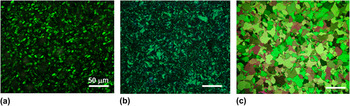
The mesophases were identified by POM observations and XRD measurements at room temperature. Figure 3 shows the photomicrographs of the mesophases of PbPc1a, PbPc2a, and PbPc2b between two glass slides. The birefringence textures were observed in a very slowly cooling process from the isotropic phase temperature to room temperature.
Optical texture of (a) PbPc1a, (b)PbPc2a, and (c) PbPc2b complexes at room temperature.

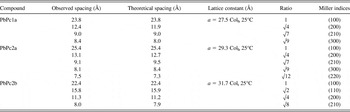
The x-ray data of PbPc complexes are summarized in Table IV. Powder diffraction patterns of PbPc complexes PbPc1a and PbPc2a exhibit peaks with spacings in the ratio of 1:√4:√7:√9:√12 and 1:√4:√7:√9:√12, respectively (Fig. S14 in Supporting Information). Therefore, they can be identified as Colh mesophases. The PbPc2b shows four peaks, the spacings of which are in the ratio of 1:√2:√4:√8 (Fig. S14 in Supporting Information). These results suggest a two-dimensional (2D) tetragonal lattice with disk-like molecules stacked in columns in the tetragonal arrangement for PbPc2b.Reference Ohta, Hatsusaka, Sugibayashi, Ariyoshi, Ban, Maeda, Naito, Nishizawa, van de Craats and Warman43 The absence of LC texture and peaks in the XRD pattern confirms the amorphous structure of the PbPc1b (Fig. S14 in Supporting Information).
X-ray diffraction data of PbPc1a, PbPc2a, and PbPc2b.

The melting points of alkylthio-substituted derivatives are generally lower in comparison with those of their oxygen analogues although the clearing point of PbPc1a is much higher than in the case of PbPc2a. The clearing point of nonperipherally substituted PbPc2b is approximately 50 °C lower than that of peripherally substituted PbPc2a. Large ions like Pb2+ lie outside the macrocycle plane and sterically destabilize the cofacial columnar structure. This leads to a noticeable reduction of both transition temperatures from crystal to liquid crystal and from liquid crystal to isotropic phase in comparison with the case of Pcs with smaller metal ions.Reference Weber, Guillon and Skoulios23
D. Thin film studies
The spin-coating methodReference Cook, Mayes and Poynter44 is a simple and convenient procedure for preparing films of the Pcs, which can be heated to form mesophases. Spun films of PbPc1 and PbPc2 derivatives were heated to a temperature of 10–20 °C above the isotropic transition temperature (Table III) and then cooled down to the room temperature at the rate of 5 °C/min for comparison with as-deposited layers.
Figure 4 shows the absorption spectra of the spun films of PbPc1 and PbPc2 at room temperature immediately after deposition and after thermal treatment. The structure of Q-band of the film is more complex than the Q-band observed in the solution phase where nonaggregated Pcs yield a single strong band assigned to the doubly degenerate transition a1u–eg. In the solid state, the spectra of PbPc films are broadened due to exciton coupling effects. These effects also lead to shifts in the band positions.Reference Cook, Clark and Hester45
UV–vis absorption spectra of PbPc1a, PbPc2a, PbPc1b, and PbPc2b: in THF (black lines); as-deposited films on glass slides (blue lines) at room temperature; and films after thermal treatment (red lines).

A single optical absorption band corresponding to the HOMO–LUMO π–π* transition splits into Qx and Qy components due to a reduction of molecular symmetry in the crystalline environment.Reference Mizuguchi and Karfunkel46 Note that the distance between these bands correlates with the extent of distortion. As a consequence, the position and intensity of the Q-band in the visible region are very sensitive to the specific molecular packing.
Two peaks at 683 and 748 nm and a shoulder at 860 nm were observed in the spectrum of the as-deposited PbPc1a film (Fig. 4, blue line). A steady transformation of the films after heating to the temperature of isotropic liquid and then cooling down to a room temperature resulted in an increase of the intensity of the longer wavelength band at 920 nm (Fig. 4, red line). The significant split of Q-band might be an indication of a lower lattice contraction along the molecular stack. Spectra with a split Q-band are similar to those for triclinic phase of the unsubstituted PbPcReference Miyamoto, Nichogi, Taomoto, Nambu and Murakami47 and for the crystalline phase II of TiOPc and VOPc.Reference Mizuguchi and Karfunkel46, Reference Coppede, Toccoli, Pallaoro, Siviero, Walzer, Castriota, Cazzanelli and Iannotta48 The XRD data obtained for the same PbPc1a film before and after thermal treatment are presented (Fig. S15 in the Supporting Information). The as-deposited film was amorphous, whereas the x-ray pattern of the film after thermal treatment had a distinct peak at 25.8 Å indicating ordered alignment.
Similar UV–vis spectra were also observed for PbPc2a films. The band at 850–870 nm was not observed in the electronic absorption spectrum of the as-deposited PbPc2a film (Fig. 4, blue line). However, its intensity increased after a thermal treatment (Fig. 4, red line). According to x-ray phase analysis, the as-deposited PbPc2a film is amorphous as in the case of PbPc1a film (Fig. S15). The x-ray patterns of PbPc2a films after thermal treatment (Fig. S15) have two peaks at 26.7 and 21.5 Å. The hkl indexation appears to be characteristic of a rectangular columnar phase (Colr). Similar columnar phase with a rectangular 2D symmetry was observed in the case of vanadyl Pcs substituted with eight alkoxy chains in the peripheral positions which are also characterized by dipole moment along the molecular small axis.Reference Sleven, Cardinaels, Binnemans, Guillon and Donnio49
The UV–vis spectra of PbPc1b and PbPc2b differ from those of peripherally substituted phthalocyanines PbPc1a and PbPc2a. The Q-band with a maximum at 763 nm and a shoulder at 700 nm were observed in the spectrum of PbPc1b (Fig. 4, blue line). This spectrum had not changed after thermal treatment of the film (Fig. 4, red line). XRD revealed that the PbPc1b films before and after thermal treatment were amorphous. The Q-band in the spectrum of PbPc2b film became broader after thermal treatment and its maximum shifted to a higher wavelength. These changes correspond to the appearance of the peak at 22.8 Å in addition to the peak at 21.4 Å observed in XRD pattern of as-deposited PbPc2b film. Similar to the previous case, the existence of these two peaks corresponding to different intercolumnar distances indicated the presence of two different phases in the film structure.
The IR spectroscopy was used to study the preferential orientation of molecules relative to the substrate surface. In a normal incidence transmission spectrum of a film deposited on an IR-transparent substrate such as KBr, the electric field vector interacts with transition moments parallel to the substrate surface.Reference Cook50, Reference Del Cano, Parra, Rodriguez-Mendez, Aroca and De Saja51 RAIRS exploits the perpendicular polarization of an electrical field at the nodal point on a reflecting surface plane.Reference Debe52 Therefore, the intensity of the vibrational modes with dynamic dipole components perpendicular to the surface will be enhanced, whereas those parallel to the surface will be suppressed as a consequence of the so-called “surface selection rule.”Reference Hayden53 Thus, the information on the molecular orientation can be extracted by comparing the standard transmission IR and RAIRS spectra of the film.
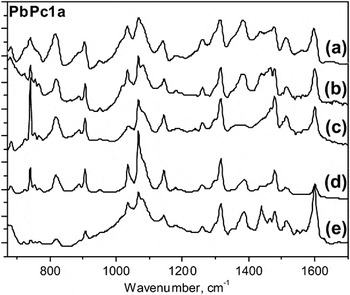
Pc thin films suit perfectly for IR analysis. The rigidity of the planar Pc macrocycle provides that the directions of out-of-plane and in-plane transition dipoles associated with the nucleus are all well defined. The IR spectra of the PbPc1a film (transmission on a KBr plate and RAIRS on a gold reflecting surface) are shown in Fig. 5. The transmission spectrum of the bulk (KBr pellet) was used as a reference. The IR spectra of PbPc1a are very complicated because of great number of the overlapping modes belonging to the Pc ring and substituents. Nevertheless, some bands can still be used for the study of the film orientation. In a KBr pellet, the Pc molecules are distributed randomly without any preferred orientation [Fig. 5(a)], and the relative intensities of in-plane and out-of-plane modes would simply reflect the extent of the change in dipole moment associated with a particular vibration. The spectra of the pellet and films of PbPc before heating are very similar [Figs. 5(b) and 5(d)], indicating the absence of the preferable orientation of the Pc molecules on the substrate surface.
Transmission IR spectra of PbPc1a in (a) KBr pellet, (b) as-deposited, and (c) thermal treated PbPc1a film on KBr substrate; reflection–absorption IR spectroscopy spectra of an (d) as-deposited and (e) thermal treated PbPc1a film on Au substrate.

The IR spectra of the PbPc1a film after heating are given in Figs. 5 (c) and 5(e). A significant difference in the spectra of the pellet and the PbPc1a film after annealing is especially pronounced for the A mode at 740 cm−1 (C–H out-of-plane deformations, Table I). This band becomes very prominent in the transmission spectrum of the film [Fig. 5(c)], whereas the intensities of the in-plane isoindole stretching modes (1383, 1435 cm−1, Table II) undergo a significant reduction.
In the RAIRS spectrum, the C–H out-of-plane modes are almost inactive, whereas the in-plane modes become quite prominent [Fig. 5(e)]. These findings (enhancement and suppression of the out-of-plane modes in an IR transmission spectrum and RAIRS, respectively) clearly correlate with an average preferential edge-on orientation of the Pc molecules in the PbPc1a film. We therefore infer that the new edge-on molecular orientation formed during the heating process remains largely unchanged in the cooled films of PbPc1a. Similar orientation of the molecules relative to the substrate surface was also observed for planar metal Pcs deposited on the surface of one substrate with an air interface.Reference Basova, Gürek and Ahsen54–Reference Basova, Durmuş, Gürek, Ahsen and Hassan56 This tendency was not observed for the films of PbPc2a, PbPc1b, and PbPc2b. The transmission and RAIRS spectra for PbPc2a, PbPc1b, and PbPc2b films are very similar. This fact suggests a small extent of anisotropy in the orientation of the molecules relative to the substrate surface.
Deposition of the films with controllable alignment is a very important task for the creation of electronic devices. In this work, we study the correlations between the Pcs molecular structure and structural features of their films. To obtain the ordered films, thermally induced self-organization ability of LC Pcs was used. As it was shown in previous publications, this technique can be successfully used for deposition of the ordered films of a number of Pcs having planar structure.Reference de Cupere, Tant, Viville, Lazzaroni, Osikowicz, Salaneck and Geerts55–Reference Sergeyev, Pisula and Geerts57 The Pb atom lies outside the Pc macrocycle plane. This leads to a sterical destabilization of the cofacial columnar structure and noticeable reduction of both crystal-to-mesophase and mesophase-to-isotropic transition temperatures. It was demonstrated that not all LC PbPcs can give well-organized films upon slow cooling from isotropic melt, and the behavior of tetrasubstituted PbPc on the substrate surface depends on the type and position (peripheral or nonperipheral) of substituents.
IV. CONCLUSION
In this work, the synthesis of new peripherally and nonperipherally tetrakisoctylthio- and tetrakisoctyloxy-substituted PbPcs has been described. The PbPcs were characterized using different spectroscopic techniques (NMR, UV–vis, FTIR, and mass spectrometry) and elemental analysis. Typical red spectral shift has been observed for Pcs with substituents at the nonperipheral positions. Additionally, a greater redshift has been observed for SR-substituted derivatives due to the stronger electron donating nature of SR groups compared to OR groups. The phase transition temperatures of the complexes have been determined by the POM and DSC experimental techniques. The formation of the Colh mesophase for peripherally substituted derivatives and the columnar tetragonal (Colt) mesophase for nonperipherally alkoxy substituted derivative over a wide temperature range has been confirmed by x-ray phase analysis. The Pb atom lies outside the Pc macrocycle plane. This leads to a sterical destabilization of the cofacial columnar structure and noticeable reduction of both crystal-to-mesophase and mesophase-to-isotropic transition temperatures. Furthermore, the clearing point of nonperipherally substituted derivatives was found to be lower than that of peripherally substituted derivatives.
Thermally induced molecular reorganization within spun PbPc films was studied by visible absorption spectroscopy and XRD. The IR spectroscopy was used to study the preferential orientation of molecules relative to the substrate surface. Quantum chemical (DFT) calculations were used for detailed assignment of the IR bands in the spectra of the PbPcs. It was shown that the films with an average preferential edge-on orientation of the Pc molecules on the substrate surface were obtained only in the case of PbPc1a, whereas the films of PbPc2a, PbPc1b, and PbPc2b were characterized by the absence of the preferable orientation of the Pc molecules on the substrate surface.
ACKNOWLEDGMENTS
This work was supported by bilateral project between The Scientific and Technological Research Council of Turkey (TUBITAK, Project number: 108M384) and the Russian Foundation of Basic Research (RFBR, Project number: 09-03-91219). Support for this work by the Siberian Supercomputer Center is gratefully acknowledged. V.G.K. also appreciates the Russian Federal Agency of Education (project NK-187P(6), Contract No. P1475) and SB RAS (Lavrentiev grant program) for the support of this work.