Introduction
Research has shown that abusive supervisor behavior toward subordinates is often witnessed by other individuals (Priesemuth & Schminke, Reference Priesemuth and Schminke2019). Abusive supervisor behavior (e.g., undermining, belittling, loud outbursts) has been associated with multiple negative outcomes, such as employee psychological distress, problem drinking, or family and supervisor-directed aggression (Hoobler & Brass, Reference Hoobler and Brass2006; Tepper, Reference Tepper2000; Tepper, Henle, Lambert, Giacalone, & Duffy, Reference Tepper, Henle, Lambert, Giacalone and Duffy2008). Further, such occurrences have been shown to trigger various responses in witnesses to abusive supervisor actions. To illustrate, some witnesses react by acting out in a deviant fashion, striking back at the perceived aggressor, or completely withdrawing from the situation (Greenbaum, Mawritz, Mayer, & Priesemuth, Reference Greenbaum, Mawritz, Mayer and Priesemuth2013; O'Reilly, Aquino, & Skarlicki, Reference O'Reilly, Aquino and Skarlicki2016; Skarlicki & Rupp, Reference Skarlicki and Rupp2010).
Studies show that racial stereotypes play a key role in individuals' actions toward other individuals. For example, Ayres and Siegelman (Reference Ayres and Siegelman1995) revealed that car dealers frequently accounted for the buyers' race when pricing their vehicles and offered significantly higher prices to Black shoppers as compared to White shoppers. In the same vein, Hernandez, Avery, Volpone, and Kaiser (Reference Hernandez, Avery, Volpone and Kaiser2019) found that managers expect Black job candidates to accept lower salaries as compared to similarly qualified White candidates.
Interestingly, despite the overwhelming evidence in the literature that race impacts individuals' actions (Adam & Shirako, Reference Adam and Shirako2013; Hernandez et al., Reference Hernandez, Avery, Volpone and Kaiser2019) no study to date has examined how race impacts individuals' reactions to abusive supervisor behavior. Priesemuth and Schminke (Reference Priesemuth and Schminke2019) have recently examined the impact of abusive supervision on coworkers' protective behavior; however, they did not account for potential differences in protective behavior reactions when the abusive supervisor and the abused employee belong to different racial groups. This is a significant limitation in the literature as abusive supervisor behavior can entail abusees belonging to different minority groups, such as African Americans (i.e., blacks). Without an understanding of the impact of race it is not possible to explain or predict observers' reactions (in terms of protective behavior) when witnessing situations of abusive supervision where the race of the abusive supervisor and abused employee differs.
In addition, extant literature on abusive behavior has primarily explored the phenomena from the employees' perspective (Mitchell & Ambrose, Reference Mitchell and Ambrose2007; Tepper, Reference Tepper2000) or from the employees' coworkers' perspective (Priesemuth & Schminke, Reference Priesemuth and Schminke2019). We complement this stream of research by examining abusive behavior from the perspective of stakeholders that are outsiders to the firm. We do so because abusive supervisor behavior can not only occur in the presence of other firm employees, but also in the presence of various external stakeholders. In spite of the plethora of negative consequences associated with abusive supervision (Avery, Volpone, & Holmes, Reference Avery, Volpone and Holmes2018; Harvey, Stoner, Hochwarter, & Kacmar, Reference Harvey, Stoner, Hochwarter and Kacmar2007; Thau & Mitchell, Reference Thau and Mitchell2010), little is known about how firm outsiders perceive abusive supervision and the factors that impact their decision to engage in protective behavior toward the abused employees, especially when the supervisor and the abused employee belong to different racial groups.
We conducted four different studies to examine differences in external observers' protective behavior (e.g., standing up for the victim, defending the employee) across the four possible abusive supervisor–abused employee racial combinations. The focus of these studies is on the two largest racial groups in the US: White Americans and African Americans (U.S. Census, 2021). In Study 1, we compared the level of protective behavior manifested by external observers witnessing a white supervisor abusing a black employee with the level of protective behavior expressed by external observers witnessing a white supervisor abusing a white employee. In Study 2, we compared the level of protective behavior conveyed by external observers witnessing a white supervisor abusing a black employee with the level of protective behavior manifested by external observers witnessing a black supervisor abusing a black employee. In Study 3, we compared the level of protective behavior expressed by external observers witnessing a black supervisor abusing a black employee with the level of protective behavior expressed by external observers witnessing a black supervisor abusing a white employee. Finally, in Study 4, we compared the level of protective behavior expressed by external observers witnessing a black supervisor abusing a white employee with the level of protective behavior manifested by external observers witnessing a white supervisor abusing a white employee.
Moreover, to shed further light on these differences, we also account for the moderating roles of racism, self-efficacy, and personal abusive supervision experience. We investigate these moderating effects for several reasons. First, racism has been shown to play a key role in shaping individuals' attitudes and behaviors toward others. For example, in the context of salary negotiations, Hernandez et al. (Reference Hernandez, Avery, Volpone and Kaiser2019) reveal that interviewer's racism moderates the relationship between a job seeker's race and the interviewer's expectations of the job seeker. Second, extant studies exploring individuals' reactions to abusive supervision reveal that observers' self-efficacy moderates the likelihood of engaging in protective behavior (Priesemuth & Schminke, Reference Priesemuth and Schminke2019). Third, there may be long-term effects for individuals who have experienced abuse (Alexander, Reference Alexander1993; Mitchell & Ambrose, Reference Mitchell and Ambrose2007), such as an increased willingness to engage in protective behavior when witnessing other individuals experiencing similar abuse. As such, there are theoretical reasons to believe that the observers' levels of racism, self-efficacy, and personal experience with abusive supervision influence their reactions to abusive behavior.
We draw on social categorization theory to guide the theoretical development. According to the theory, individuals classify people into groups based on various characteristics, such as race (Turner, Hogg, Oakes, Reicher, & Wetherell, Reference Turner, Hogg, Oakes, Reicher and Wetherell1987). Moreover, racial categorization is likely to influence how individuals perceive and behave toward individuals belonging to different groups (Bozkurt, Gligor, & Hollebeek, Reference Bozkurt, Gligor and Hollebeek2021a; Gligor, Reference Gligor2020; Gligor, Newman, & Kashmiri, Reference Gligor, Newman and Kashmiri2021a). Thus, social categorization theory provides a useful theoretical lens through which to unpack the relationships of interest.
Our findings allow us to put forth some unique theoretical implications. First, extant studies have investigated abusive supervision from the perspective of individuals internal to the firm (Mitchell & Ambrose, Reference Mitchell and Ambrose2007; Priesemuth & Schminke, Reference Priesemuth and Schminke2019). We augment this stream of literature by offering unique insights from the perspective of individuals external to the firm. Second, we build on the abusive supervision literature (e.g., Harvey et al., Reference Harvey, Stoner, Hochwarter and Kacmar2007; Thau & Mitchell, Reference Thau and Mitchell2010) by offering insights into the influence of race and racial difference on observers' willingness to engage in protective behavior. Third, we make some key contributions to the management literature investigating racial discrimination and abuse (Goldman, Gutek, Stein, & Lewis, Reference Goldman, Gutek, Stein and Lewis2006; James & Wooten, Reference James and Wooten2006). Past studies have explored these issues in various contexts, such as salary negotiations, contract negotiations, or supplier selection (Gligor, Reference Gligor2020; Hernandez et al., Reference Hernandez, Avery, Volpone and Kaiser2019). We build on this research by exploring the role of race in the context of abusive supervision. In the process, we connect the growing stream of research on abusive supervision with the literature addressing the complex role of race in management (Gligor, Novicevic, Feizabadi, & Stapleton, Reference Gligor, Novicevic, Feizabadi and Stapleton2021b; O'Reilly, Aquino, & Skarlicki, Reference O'Reilly, Aquino and Skarlicki2016).
The rest of the manuscript is structured as follows. First, we review the literature on abusive supervision. Next, we present the theoretical arguments for the study's hypotheses. We continue by presenting the methodology and findings for the four studies. Finally, we detail the study's theoretical and managerial contributions and outline relevant limitations and future research opportunities.
Theoretical development
Abusive supervision
The topic of abusive supervision has long been of interest to management scholars (Ashforth, Reference Ashforth1994; Tepper, Reference Tepper2000). Abusive supervision can be defined as the extent to which supervisors are perceived to have engaged in hostile verbal or non-verbal behavior (Tepper, Reference Tepper2000). Abusive managers arbitrarily and callously use their authority and power to mistreat employees (Ashforth, Reference Ashforth1997). Such managers conjure the image of tyrannical individuals who undermine and ridicule employees in the presence of other individuals (Tepper, Reference Tepper2000).
Some types of abusive supervision include aggressive eye contact, threat of job loss, or ridiculing or humiliating someone in front of others (Tepper, Reference Tepper2000). Typically, abusive behavior is considered a willful, intentional behavior. This type of behavior has been linked to several undesirable consequences, including subordinates' psychological distress, life and job dissatisfaction, workplace deviance, and turnover intentions (Aryee, Chen, Sun, & Debrah, Reference Aryee, Chen, Sun and Debrah2007; Harvey et al., Reference Harvey, Stoner, Hochwarter and Kacmar2007; Thau & Mitchell, Reference Thau and Mitchell2010).
A scant number of studies attempted to uncover the factors that lead to abusive supervision. For example, Hoobler and Brass (Reference Hoobler and Brass2006) argued that supervisors engage in abusive behavior when they perceived that their psychological contracts have been breached and they feel betrayed by organizations. Similarly, Aryee et al. (Reference Aryee, Chen, Sun and Debrah2007) proposed that the perception of injustice triggers supervisors to release their negative feelings toward other organizational members. Other authors, such as Tepper, Duffy, Henle, and Lambert (Reference Tepper, Duffy, Henle and Lambert2006) suggested that supervisors' depression leads to abusive supervision. These authors contended that depressed individuals manifest their anger toward others as an attempt to regain a sense of control (Allen & Greenberger, Reference Allen and Greenberger1980). More recently, Restubog, Scott, and Zagenczyk (Reference Restubog, Scott and Zagenczyk2011) indicated that the presence of aggressive norms in the workplace can also foster abusive supervisor behavior within organizations. Regardless of the trigger, abusive supervision behavior has multiple undesirable outcomes.
Supervisor abusive behavior has been shown to have negative consequences that extend beyond the abused employees' work place. Hoobler and Brass (Reference Hoobler and Brass2006) showed that when employees perceived their supervisor to be abusive, they were more inclined to display abusive behavior toward their family members. This is consistent with Mitchell and Ambrose's (Reference Mitchell and Ambrose2007) arguments who indicated that abused employees channel their aggression and frustration caused by abusive supervisors toward less powerful targets. Despite the negative implications associated with abusive supervision, little is known about how outsiders perceive abusive supervision and the factors that impact their decision to engage in protective behavior toward the abused employees.
Race and reactions to abusive supervision
Race can be described as a socially ascribed group membership as an element of perceived phenotype (Helms, Reference Helms2007; Johnson & Jackson Williams, Reference Johnson and Jackson Williams2015). Social categorization theory argues that individuals categorize themselves and others into in-groups and out-groups based on various characteristics (Turner et al., Reference Turner, Hogg, Oakes, Reicher and Wetherell1987). Individuals use various discernable traits to categorize themselves, such as gender, age, or race (Bozkurt, Gligor, & Hollebeek, Reference Bozkurt, Gligor and Hollebeek2021a; Ta, Esper, & Hofer, Reference Ta, Esper and Hofer2018). Interestingly, race is a more salient trait for categorization and social comparison (Richard, Murthi, & Ismail, Reference Richard, Murthi and Ismail2007). Therefore, it is plausible that, when witnessing an abuse, observers will mentally categorize the individuals involved in the incident according to their respective race. Because observers will associate the abuser and the abusee with a racial category, they are likely to ascribe to the abuser and the abuses the beliefs they have previously associated with their respective ethnic groups.
The United States has made significant progress in the area of racial discrimination since Du Bois famously stated that ‘the problem of the twentieth century is the problem of the color-line’ (Du Bois, Reference Du Bois1903). Needed legislation has granted voting rights to all races and has banned discrimination. While many minority executives have risen to the top of Fortune 500 companies, and the US has even had a black president, research indicates that racial discrimination continues to occur in society and work environments (Avery, Volpone, & Holmes, Reference Avery, Volpone and Holmes2018; Jones, Peddie, Gilrane, King, & Gray, Reference Jones, Peddie, Gilrane, King and Gray2016). Scholars, such as DiTomaso (Reference DiTomaso2013), point out that discrimination and racism as a practice did not completely cease to exist.
Historically, blacks have the subject of acts of abuse and discrimination more so than whites (Hall, Reference Hall2014; Seitles, Reference Seitles1998). To illustrate, Fox and Stallworth (Reference Fox and Stallworth2006) found that, about half of the black employees in their sample experienced racial bullying, while only an eight of the white respondents experienced such treatment. Rosette, Carton, Bowes-Sperry, and Hewlin (Reference Rosette, Carton, Bowes-Sperry and Hewlin2013) also found that, as compared to white employees, blacks were more likely to be the targets of racial slurs. Cunningham, Miner, and McDonald (Reference Cunningham, Miner and McDonald2013) found that white supervisors behaved in a more uncivil manner toward their non-white employees than black supervisors. Further, black supervisors did not appear to treat their subordinates differently based on their race.
Since colonial times, blacks have been the target of abuse (Washington, Reference Washington2006). Because of this history of abuse directed toward blacks, lawmakers, and the society as a whole, have exerted significant efforts to prevent the abuse of black individuals (Bonfield, Reference Bonfield1965; McDougall, Reference McDougall1996). Going back to White-American James Hinds who died trying to defend African-American civil rights (Blakemore, Reference Blakemore2018), individuals, irrespective of race, have been taking a firm stance against racial discrimination and abuse. Thus, considering the historical context of abuse directed toward blacks, it is plausible that individuals are more likely to exhibit protective behavior when they witness the abuse of a black employee then they would when they witness the abuse of a white employee, irrespective of the abuser's race. Because whites have a history of abusing blacks (Blakemore, Reference Blakemore2018), observers are also more likely to engage in protective behavior of a black employee when the abuser is a white supervisor than when the abuser is a black supervisor. However, because blacks do not have a history of abusing whites, when the subject of the abuse is a white employee, the race of the abusive supervisor should not impact observers' levels of protective behavior (i.e., no difference across black and white supervisors). Formally, we state these arguments as follows:
Hypothesis 1a: When the supervisor is White, observers display a higher level of protective behavior when the incident involves a Black employee than when the incident involves a White employee.
Hypothesis 1b: When the subject of the incident is Black, observers display a higher level of protective behavior when the incident involves a White supervisor than when the incident involves a Black supervisor.
Hypothesis 1c: When the supervisor is Black, observers display a higher level of protective behavior when the incident involves a Black employee than when the incident involves a White employee.
Hypothesis 1d: When the subject of the incident is White, observers' likelihood of engaging in protective behavior will not be different in incidents involving a Black supervisor than it would in a similar incident involving a White supervisor.
Research shows that racism might moderate the above hypotheses. Consistent with Schaffner, MacWilliams, and Nteta (Reference Schaffner, MacWilliams and Nteta2016), we operationalize racism as the extent to which individuals empathize with racism and acknowledge it. This conceptualization is opposite to the concept of color-blind racial attitudes (Bonilla-Silva, Reference Bonilla-Silva2006). Such ‘color-blind racial attitudes refers to the belief that race should not and does not matter’ (Neville, Lilly, Duran, Lee, & Browne, Reference Neville, Lilly, Duran, Lee and Browne2000: 60). In essence, individuals who hold such views do not recognize the existence of racism. Consistent with this conceptualization, it is plausible for racism to moderate the above relationships as follows:
Hypothesis 2a: When the supervisor is White, observers display a higher level of protective behavior when the incident involves a Black employee (vs. a White employee) at high levels of racism, but not at low levels of racism.
Hypothesis 2b: When the subject of the incident is Black, observers display a higher level of protective behavior when the incident involves a White supervisor (vs. a Black supervisor) at high levels of racism, but not at low levels of racism.
Hypothesis 2c: When the supervisor is Black, observers display a higher level of protective behavior when the incident involves a Black employee (vs. a White employee) at high levels of racism, but not at low levels of racism.
Hypothesis 2d: When the subject of the incident is White, observers do not display a higher or lower level of protective behavior when the incident involves a Black supervisor (vs. a White supervisor) neither at high levels of racism nor at low levels of racism.
One's self-efficacy has been argued to moderate the likelihood of engaging in protective behavior (Priesemuth & Schminke, Reference Priesemuth and Schminke2019). Self-efficacy can be defined as ‘beliefs in one's capabilities to mobilize the motivation, cognitive resources, and courses of action needed to meet given situational demands’ (Bandura & Wood, Reference Bandura and Wood1989: 408). The concept has been linked to various aspects of performance and has been considered to impact how individuals deal with conflict in the workplace (Lai & Chen, Reference Lai and Chen2012). In essence ‘the higher one's self-efficacy, the more likely one is to engage and persist in task-related behavior’ (Chen & Bliese, Reference Chen and Bliese2002: 549). Therefore, we expect one's self-efficacy to impact the hypotheses of interest as follows:
Hypothesis 3a: When the supervisor is White, observers display a higher level of protective behavior when the incident involves a Black employee (vs. a White employee) at high levels of self-efficacy, but not at low levels of self-efficacy.
Hypothesis 3b: When the subject of the incident is Black, observers display a higher level of protective behavior when the incident involves a White supervisor (vs. a Black supervisor) at high levels of self-efficacy, but not at low levels of self-efficacy.
Hypothesis 3c: When the supervisor is Black, observers display a higher level of protective behavior when the incident involves a Black employee (vs. a White employee) at high levels of self-efficacy, but not at low levels of self-efficacy.
Hypothesis 3d: When the subject of the incident is White, observers do not display a higher or lower level of protective behavior when the incident involves a Black supervisor (vs. a White supervisor) neither at high levels of self-efficacy nor at low levels of self-efficacy.
Research also shows that employees who are abused by their supervisors experience a loss of control (Mitchell & Ambrose, Reference Mitchell and Ambrose2007; Tepper, Duffy, Hoobler, & Ensley, Reference Tepper, Duffy, Hoobler and Ensley2004). While management research is silent on the temporal aspects of workplace-related abuse, psychology research indicates that the effects of various forms of abuse can have long-term consequences (Alexander, Reference Alexander1993; Martin, Rosen, Durand, Knudson, & Stretch, Reference Martin, Rosen, Durand, Knudson and Stretch2000). Thus, it is possible that individuals who have personally been abused by their supervisors might be less likely to engage in protective behavior when they witness similar abuse being experienced by other individuals because the loss of control they experienced during their own personal abuse might persist. Management research is silent on the possible long-term effects of abusive supervision. Thus, we empirically investigate this possibility in the context of the relationships of interest to this manuscript:
Hypothesis 4a: When the supervisor is White, observers display a higher level of protective behavior when the incident involves a Black employee (vs. a White employee) at low levels of personal abusive supervision experience, but not at high levels of personal abusive supervision experience.
Hypothesis 4b: When the subject of the incident is Black, observers display a higher level of protective behavior when the incident involves a White supervisor (vs. a Black supervisor) at low levels of personal abusive supervision experience, but not at high levels of personal abusive supervision experience.
Hypothesis 4c: When the supervisor is Black, observers display a higher level of protective behavior when the incident involves a Black employee (vs. a White employee) at low levels of personal abusive supervision experience, but not at high levels of personal abusive supervision experience.
Hypothesis 4d: When the subject of the incident is White, observers do not display a higher or lower level of protective behavior when the incident involves a Black supervisor (vs. a White supervisor) neither at high levels of personal abusive supervision experience nor at low levels of personal abusive supervision experience
Study 1
Pretest
We created a version of a fictitious construction company to design an abusive supervision experience. The use of a fictitious firm has the goal of investigating respondents' protective behavior intentions without biases from their previous attitudes toward the firm (Bozkurt, Reference Bozkurt2020; Bozkurt, Gligor, & Hollebeek, Reference Bozkurt, Gligor and Hollebeek2021a). For our manipulations, we obtained employees' and supervisors' pictures from Google images using a ‘labeled for reuse’ filter to ensure these pictures can be used publicly. We designed a dialog describing abusive supervision experience that takes place between a supervisor and an employee on a construction site (see Supplementary Appendix A for full manipulations). To check our manipulations' effectiveness, believability, and realism, we pretested our manipulations with a total of 99 undergraduate students (65 males and 30 females, M age = 22). In this pretest, we asked participants how realistic/believable the dialog (manipulation) they read is (1 = extremely unbelievable/unrealistic, 7 = extremely believable/realistic). A one-way ANOVA results showed that the means for the believability/realism of the white supervisor–black employee manipulation and the white supervisor–white employee manipulation were 5.06 and 5.18, respectively. These results provided evidence that the manipulations were viewed as being believable/realistic.
In this pretest, we tested whether participants accurately identified the race of the supervisors and employees used in the manipulations. For this purpose, we asked them the following questions: ‘What is the race of the supervisor in the above dialog?’ and ‘What is the race of the supervisor in the above dialog?’ Collectively, about 97% of respondents accurately identified the race of the supervisor, while about 91% of respondents accurately identified the race of the employee in the manipulations (all, p < .01), providing further evidence that our manipulations are realistic and believable.
Lastly, we tested whether participants perceived the interaction between the supervisor and the employee as abusive behavior. To gain such insight, we used an abusive supervision construct consisting of five items (e.g., the supervisor ridiculed the employee) (adapted from Mitchell & Ambrose, Reference Mitchell and Ambrose2007). This construct was measured using 7-point Likert-type scales, where 1 = strongly disagree and 7 = strongly agree. The Cronbach α for this construct was .81, indicating that it was a highly reliable construct (Churchill, Reference Churchill1979). A one-way ANOVA results revealed that respondents perceived both the white supervisor–black employee manipulation (M = 5.17) and the white supervisor–white employee manipulation (M = 4.94) as highly abusive.
Sample and procedure
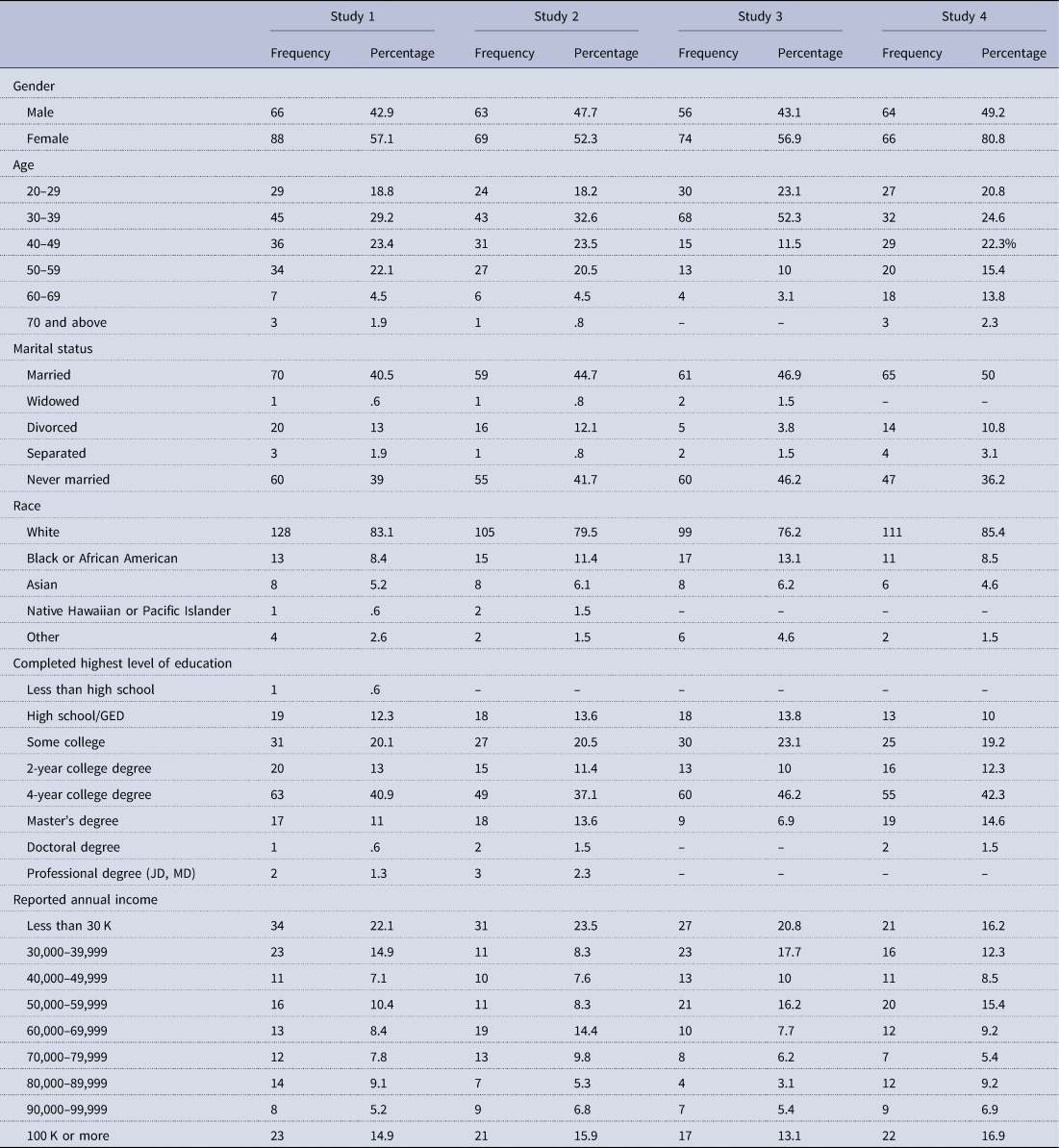
We adapted a scenario-based experiment, which has been successfully implemented in previous studies (e.g., Bozkurt & Gligor, Reference Bozkurt and Gligor2019; Ta, Esper, & Hofer, Reference Ta, Esper and Hofer2018), to stimulate an abusive supervision scenario. At the beginning of the survey, we informed participants that we want to know about their perceptions of an event, and instructed them to answer honestly and in one setting. We told them that their responses were anonymous and that we were only interested in their thoughts and opinions. To increase the quality of our data and eliminate careless respondents, we placed some attention-check questions throughout the survey administration. Those who failed to answer those questions correctly were not allowed to complete the survey. This method has been successfully used by previous studies (e.g., Bozkurt, Gligor, & Babin, Reference Bozkurt, Gligor and Babin2021b; Gligor & Bozkurt, Reference Gligor and Bozkurt2020). After implementing this approach, we ended up with a total of 154 adult subjects (66 males and 88 females, M age = 41.64) in this study. Regarding the demographics, 71.4% of the respondents were less than 50 years old, 83.1% were White, 60% were not currently married, 54% had at least a 4-year college degree, and 44.1% reported annual family household incomes no more than $50,000. Table 1 provides more details about participants' demographics.
Demographic properties

We used a 2 (abusive supervision conditions: white supervisor–black employee condition vs. white supervisor–white employee condition) factorial design. The participants were randomly assigned to one of the two conditions. In the white supervisor–black employee condition, participants read an abusive supervision incident that took place on a construction site between a white supervisor and a black employee. In the white supervisor–white employee condition, the participants read the same scenario but the parties involved were a white supervisor and a white employee (see Supplementary Appendix A for full manipulations).
Measures
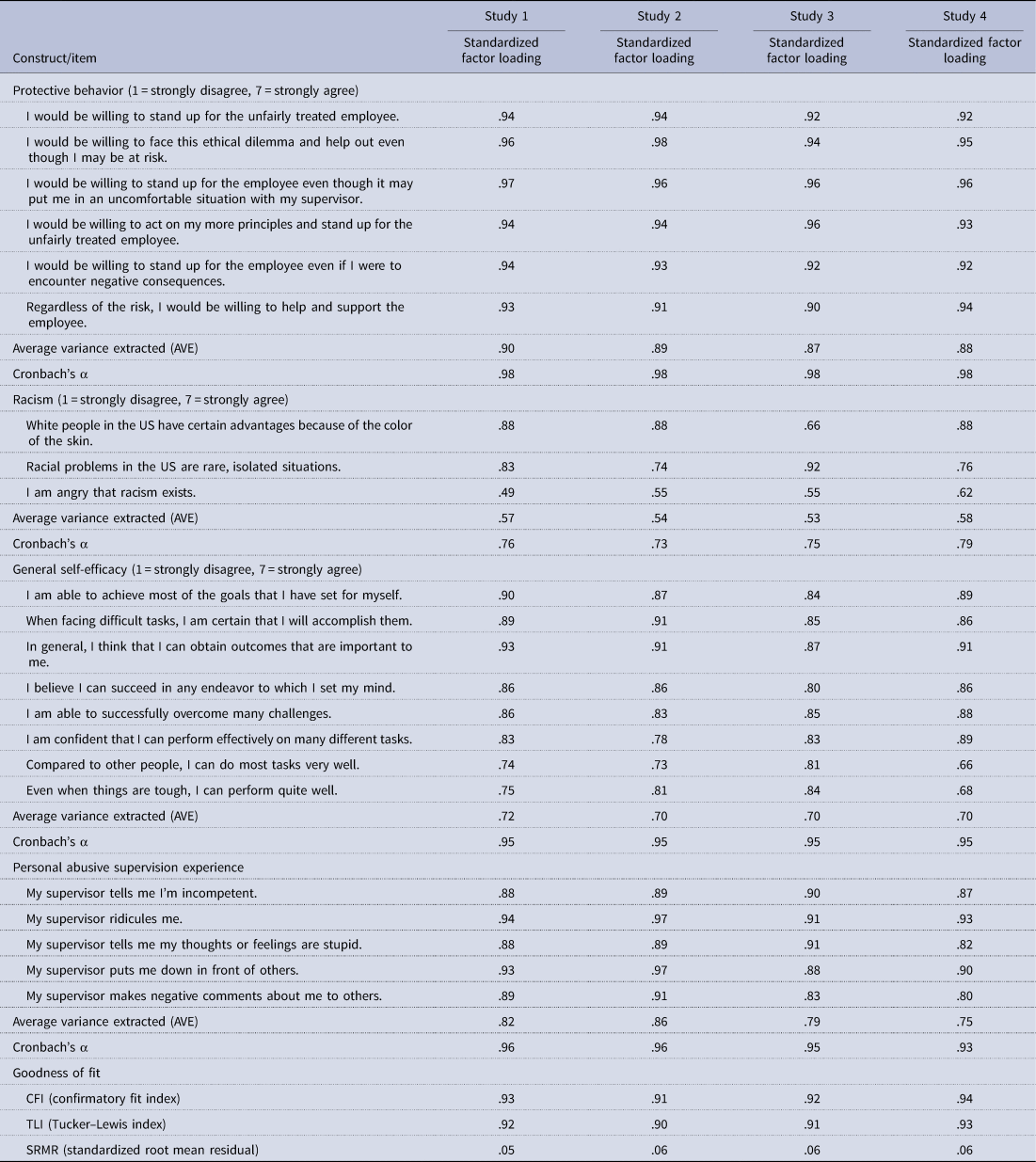
All variables were measured utilizing 7-point Likert-type scales, where 1 = strongly disagree, and 7 = strongly agree. Employee protective behavior was measured using six items (e.g., I would be willing to stand up for the unfairly treated employee) (adapted from Priesemuth, Reference Priesemuth2013). These items measure whether observers would protect the abused employee or stand up for him/her. Racism was measured using three items (e.g., racial problems in the US are rare, isolated situations) (adapted from Schaffner, MacWilliams, & Nteta, Reference Schaffner, MacWilliams and Nteta2016). These three items capture the extent to which observers acknowledge and emphasize with racism. The general self-efficacy construct was measured using eight items (e.g., I am able to successfully overcome many challenges) (adapted from Chen, Gully, & Eden, Reference Chen, Gully and Eden2001). These items assess the observers' amount of efficacy. The personal abusive experience construct was measured using five items (e.g., my supervisor tells me I'm incompetent) (adapted from Mitchell & Ambrose, Reference Mitchell and Ambrose2007; Tepper, Reference Tepper2000). All constructs had high levels of reliability (each construct's α was >.70) (Churchill, Reference Churchill1979) (see Table 2 for all items and construct reliabilities).
Confirmatory factor analysis, construct validity, and reliability assessment results

Manipulation-check result
To test whether both manipulations successfully worked as planned, we asked participants some manipulation-check questions. First, we asked them to indicate their thoughts about the following statement: ‘The supervisor and the employee engaged in a dialog you just read above belong to the same ethnic group’ with response options of ‘Yes’ or ‘No.’ In total, 92.9% of those who assigned to the white supervisor–black employee condition chose ‘No’ while 94.2% of those who assigned to the white supervisor–white employee condition chose ‘Yes.’ Also, we asked participants to indicate the race of the employee and the supervisor they saw in the manipulations. Collectively, more than 95% of respondents, regardless of the assigned condition, accurately indicated the race of supervisors whereas more than 98% of respondents, irrespective of the assigned condition, accurately indicated the race of the employees (all, p < .001), indicating the success of our manipulations.
The measurement model results
We ran confirmatory factor analysis (CFA hereafter) in Stata 15.1 to examine the psychometric properties of the multi-item latent constructs. The measurement model consisted of four latent constructs, which were protective behavior, racism, self-efficacy, and personal abusive behavior. Table 2 displays CFA results, including standardized factor loadings, average variance extracted (AVE hereafter), and Cronbach's α.
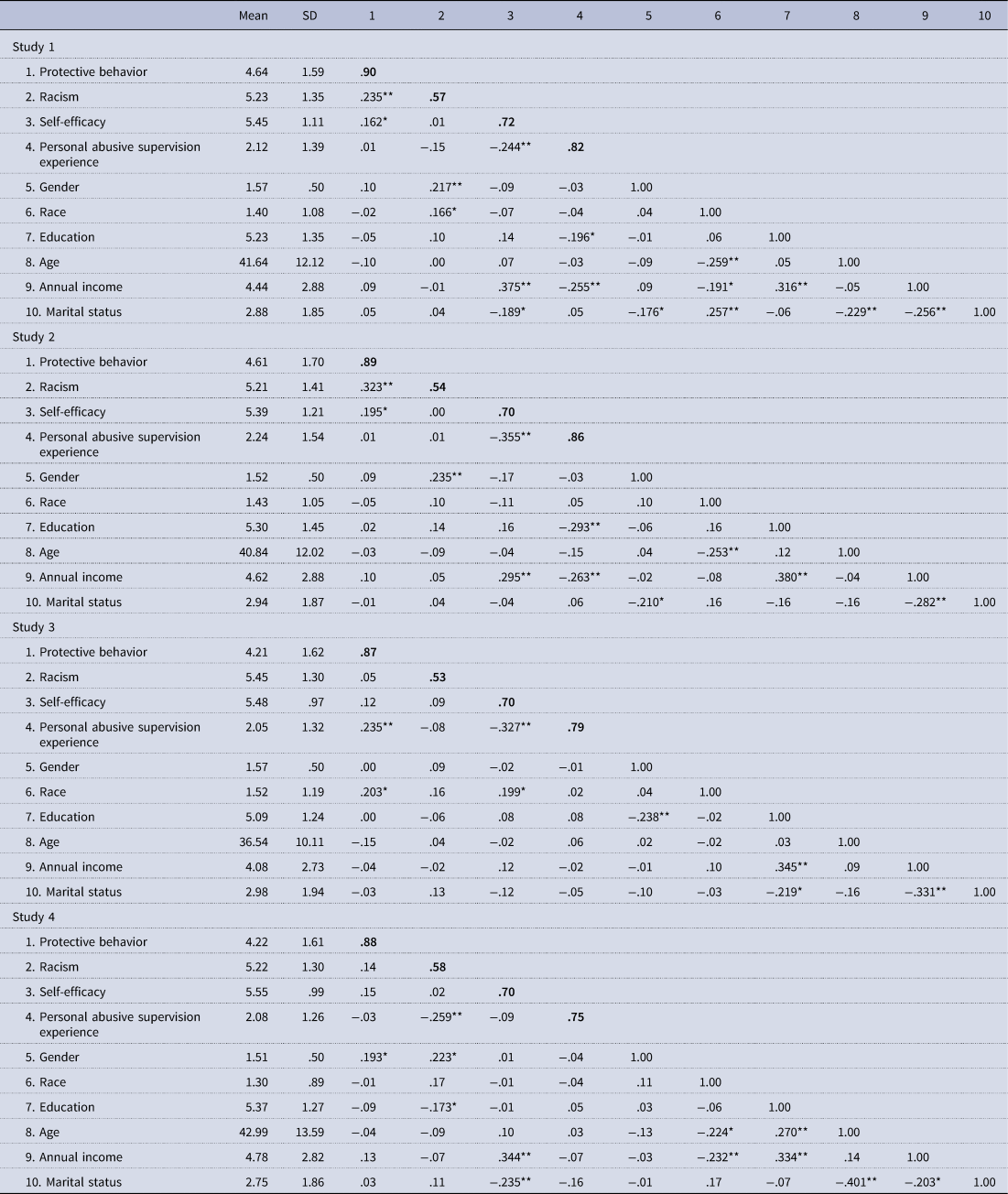
The CFA yielded a χ2 value of 485.155 (df = 203, p < .001), comparative fit indices of .927, Tucker–Lewis index of .917, and standardized root mean squared residual of .049. The z-value of each factor loading was significant (p < .001), and each standardized factor loading exceeded the acceptable threshold (>.5)Footnote 1 (Hair, Black, Babin, Anderson, & Tatham, Reference Hair, Black, Babin, Anderson and Tatham2013), providing evidence for convergent validity. The CFA results also showed that each construct's AVE surpassed the recommended threshold (>.5), ranging from .57 to .90, providing further evidence for convergent validity. We also tested whether a construct shared more variance itself than other constructs in the model. As can be seen in Table 3, each construct's AVE is greater than its respective squared inter-construct correlation, providing evidence of discriminant validity (Babin, James, Camp, Jones, & Parker, Reference Babin, James, Camp, Jones and Parker2019; Hair et al., Reference Hair, Black, Babin, Anderson and Tatham2013).
Correlation matrix and validity

Note. The diagonal values (values in bold) refer to the AVEs of each construct
*Correlation is significant at the .05 level (two-tailed); **correlation is significant at the .01 level (two-tailed).
Hypothesis testing results
Direct effect
We used a one-way ANOVA to test Hypothesis 1a. The results of one-way ANOVA showed that when the supervisor was White, observers displayed a higher level of protective behavior when the incident involved a black employee (M = 4.97) than when the incident involved a white employee (M = 4.37) (F(1, 152) = 5.66, p = .02), providing support for Hypothesis 1a.
The role of racism
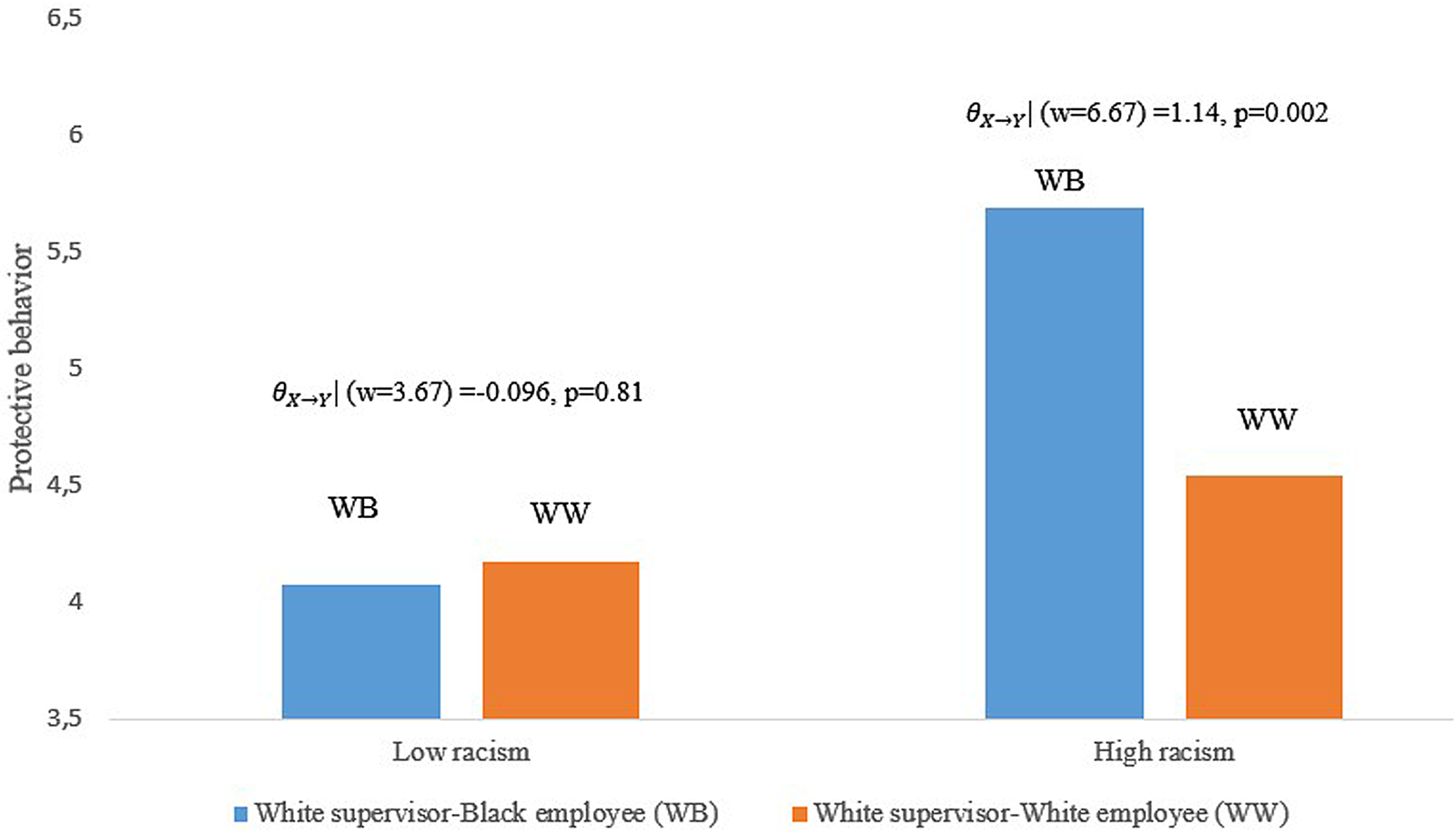
We used PROCESS (V3) Model 1, 5,000 bootstrap samples, and 95% confidence intervals to evaluate whether observers display a higher level of protective behavior when the incident involves a black employee (vs. a white employee) at high levels of racism, but not low levels of racism (Hayes, Reference Hayes2018). We added demographic variables (e.g., race, gender, age, income, education, and marital status) into the model as covariates to control for their effects. The results revealed a significant abusive supervision-conditions × racism interaction for protective behavior at the α = .05 significance level (b = .41, SE = .19, p = .03) (Hayes, Reference Hayes2018). However, this significant interaction term does not establish that observers display a higher level of protective behavior when the incident involves a black employee (vs. a white employee) for people high on racism but not for people low on racism, or vice versa (Bozkurt, Reference Bozkurt2021). To provide such insight, we probed the interaction term by employing the pick-a-point approach (also called spotlight analysis), which is deemed the most popular approach to probing the interaction term (Bauer & Curran, Reference Bauer and Curran2005; Darlington & Hayes, Reference Darlington and Hayes2016; Hayes, Reference Hayes2009; Rogosa, Reference Rogosa1980). In line with Hayes's (Reference Hayes2018) recommendation, we used the 16th and 84th percentiles of the distribution when operationalizing relatively low and relatively high levels of racism.
As can be seen in Figure 1, the pick-a-point approach revealed that when the supervisor was white, observers displayed a higher level of protective behavior when the incident involved a black employee (vs. a white employee) at high levels of racism (θx→y| [w = 6.67] = 1.14, SE = .36, p = .002)Footnote 2, but not at low levels of racism (θx→y| [w = 3.67] = −.096, SE = .40, p = .81), providing support for Hypothesis 2a.
(Study 1) The abusive supervision conditions × racism interaction for protective behavior.

The role of self-efficacy
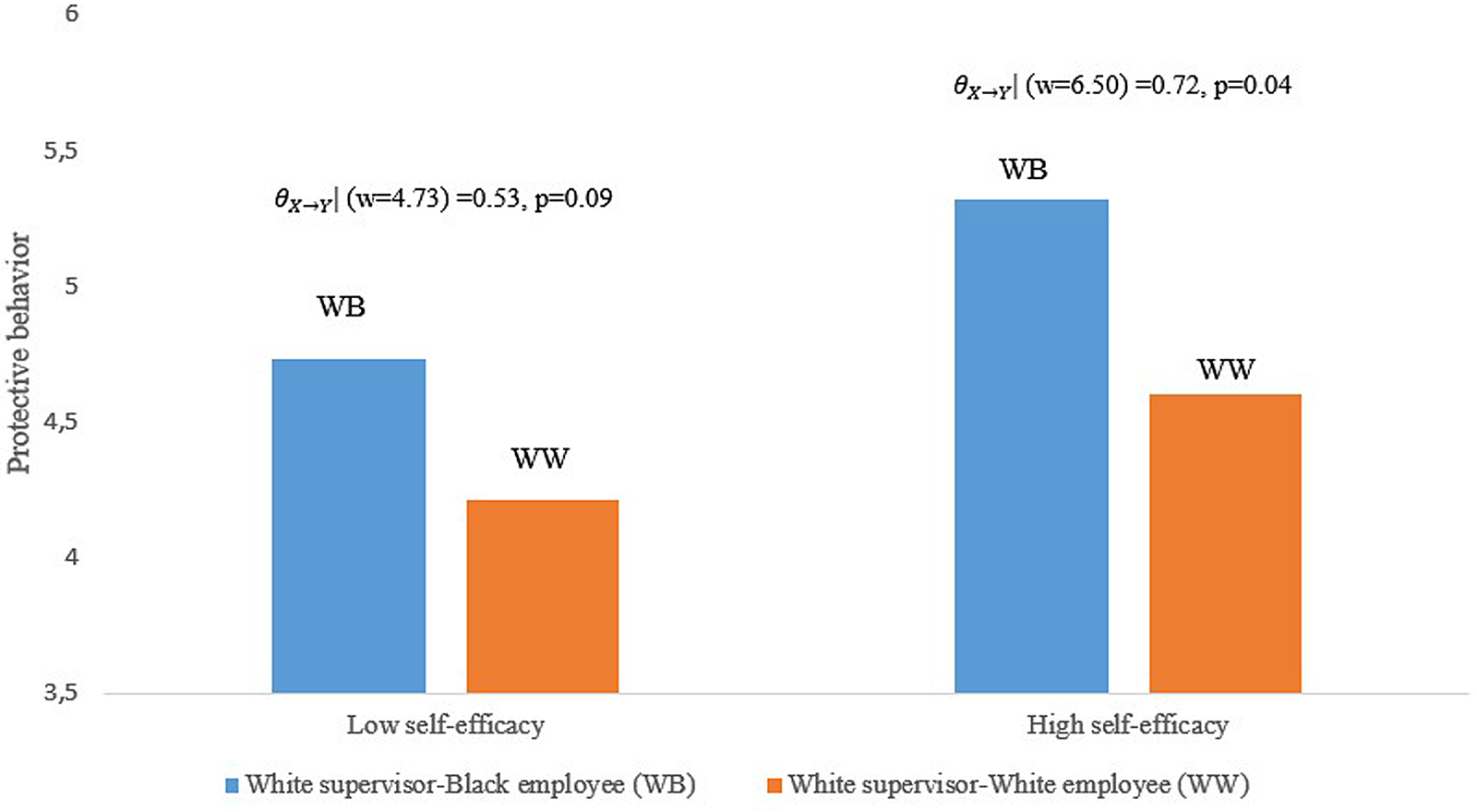
We used PROCESS (V3) Model 1, 5,000 bootstrap samples, and 95% confidence intervals to evaluate whether observers who are high on self-efficacy (but not low on self-efficacy) display a higher level of protective behavior when the incident involves a black employee (vs. a white employee) (Hayes, Reference Hayes2018). We added demographic variables (e.g., race, gender, age, income, education, and marital status) into the model as covariates to control for their effects. The results revealed that self-efficacy did not moderate the main effect at the α = .05 significance level (b = .11, SE = .23, p = .65). However, this insignificant moderation term does not establish that observers display a higher or lower level of protective behavior when the incident involves a black employee (vs. a white employee) at high levels of self-efficacy, but not at low levels of self-efficacy, or vice versa (Bozkurt, Reference Bozkurt2021; Bozkurt, Gligor, & Babin, Reference Bozkurt, Gligor and Babin2021b). To reveal such insight, we probed the interaction term using the pick-a-point approach with the 16th and 84th percentiles of the distribution (Hayes, Reference Hayes2018). As can be seen in Figure 2, when the supervisor was White, observers displayed a higher level of protective behavior when the incident involved a black employee (vs. a white employee) at high levels of self-efficacy (θx→y| [w = 6.50] = .72, SE = .35, p = .04), but not at low levels of self-efficacy (θx→y| [w = 4.72] = .53, SE = .31, p = .09) at the α = .05 significance level. Thus, Hypothesis 3a was supported.
(Study 1) The abusive supervision conditions × self-efficacy interaction for protective behavior.

The role of personal abusive supervision experience
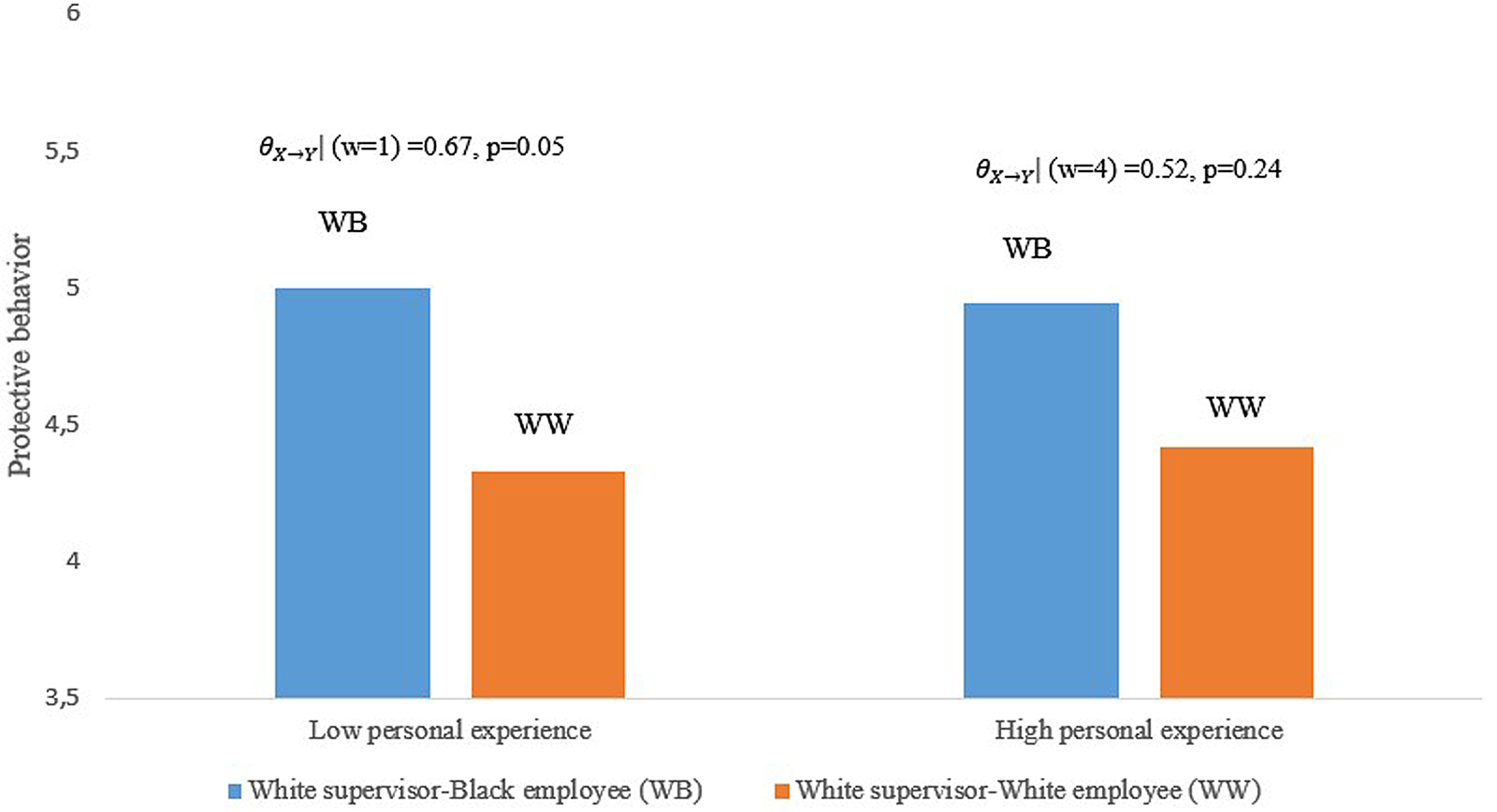
We used PROCESS (V3) Model 1, 5,000 bootstrap samples, and 95% confidence intervals to evaluate whether observers who have low levels of personal abusive supervision experience (but not high levels of personal abusive supervision experience) display a higher level of protective behavior when the incident involves a black employee (vs. a white employee) (Hayes, Reference Hayes2018). We added demographic variables (e.g., race, gender, age, income, education, and marital status) into the model as covariates to control for their effects. The results revealed an insignificant negative abusive supervision-conditions × personal abusive interaction for protective behavior at the α = .05 significance level (b = −.05, SE = .19, p = .80). Because of the aforementioned reason, we probed the interaction term by using the same approach. As demonstrated in Figure 3, when the supervisor was white, observers displayed a higher level of protective behavior when the incident involved a black employee (vs. a white employee) at low levels of personal abusive supervision experience (θx→y| [w = 1] = .67, SE = .34, p = .05), but not at high levels of personal abusive supervision experience (θx→y| [w = 4] = .52, SE = .44, p = .24). Thus, Hypothesis 4a was supported.
(Study 1) The abusive supervision conditions × personal abusive supervision experience interaction for protective behavior.

Study 2
Pretest
We used the same fictitious firm and abusive dialog as in Pretest 1. We only changed the images of the supervisors and employees (see Supplementary Appendix B for full manipulations). We implemented the same procedure to obtain public images for our manipulations. To check our manipulations' effectiveness, believability, and realism, we pretested our manipulations with a total of 101 undergraduate students (55 males and 45 females, M age = 21.43). We asked them the same questions as in Pretest 1. The one-way ANOVA results indicated that the means for the realism/believability of the white supervisor–black manipulation and the black supervisor–black manipulation were 5.35 and 5.03, respectively. Also, we tested whether respondents accurately identified the race of the supervisors and employees by asking the same questions as in Pretest 1. The results showed that, collectively, the majority of the respondents correctly identified the race of the supervisor (86%) as well as the race of the employee (86%) (all, p < .01). Lastly, we tested observers' perception of abusive supervision experience by using the same abusive supervision construct as in Pretest 1. The one-way ANOVA results showed that respondents viewed both the white supervisor–black employee (M = 5.11) and the black supervisor–black employee (M = 5.28) manipulations as highly abusive. All these results provided evidence that our manipulations were realistic and believable.
Method description
This study aims to investigate whether observers are more willing to stand up for an abused black employee (vs. white employee) when the incident involves a white supervisor than when the incident involves a black supervisor. Also, this study aims to explore under what circumstances observers display a higher level of protective behavior in response to the abusive supervision incident. In this regard, we conducted another scenario-based online experiment and followed the same procedure implemented in Study 1.
We used a 2 (abusive supervision conditions: white supervisor–black employee condition vs. black supervisor–black employee condition) factorial design. A total of 132 (63 males and 69 females, M age = 40.84) adult subjects, who were recruited from mTurk, participated in the experiment. Regarding the demographics, 74.3% of the participants were less than 50 years old, 79.5% were White, 55% were not currently married, 54.5% had at least a 4-year college degree, and 39.4% reported annual family household incomes no more than $50,000. Table 1 provides more details about participants' demographics.
Participants were randomly assigned to one of the two conditions. In the white supervisor–black employee condition, participants read an abusive supervision incident that took place on a construction site between a white supervisor and a black employee. In the black supervisor–black employee condition, participants read the same dialog, but occurring between a black supervisor and a black employee (see Supplementary Appendix B for full manipulations).
We used the same constructs as in Study 1 (Table 2). We ran a CFA to test constructs' validities. Tables 2 and 3 present CFA results, including standardized factor loadings, AVEs, constructs' reliability, and inter-construct correlations. All results indicated that constructs had high levels of convergent validity, discriminant validity, and reliability. For manipulation check, we asked the same questions as in Study 1. The majority of respondents, regardless of the assigned condition, accurately indicated the race of the employee or/and supervisor shown in the manipulations, indicating the success of our manipulations.
Hypothesis testing results
Direct effect
We used a one-way ANOVA to test Hypothesis 1b. The results of one-way ANOVA showed that when the subject of the incident was Black, observers displayed a higher level of protective behavior when the incident involved a white supervisor (M = 5.00) than when the incident involved a black supervisor (M = 4.21) (F(1, 131) = 7.55, p = .01), providing support for Hypothesis 1b.
The role of racism
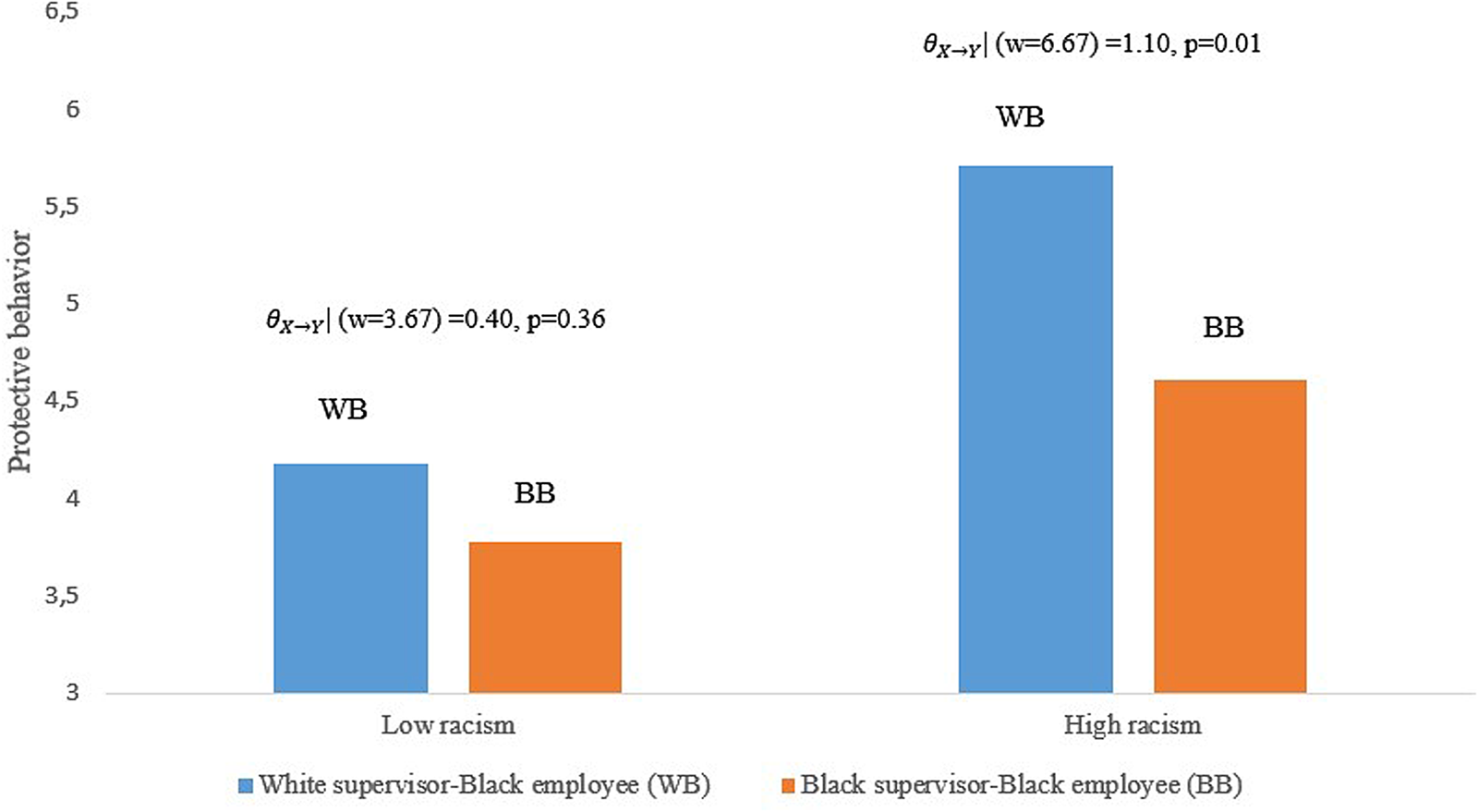
We used PROCESS (V3) Model 1, 5,000 bootstrap samples, and 95% confidence intervals to evaluate whether observers who are high on racism (but not low on racism) display a higher level of protective behavior or are more willing to stand up for an abused black employee when the incident involves a white supervisor (vs. a black supervisor) (Hayes, Reference Hayes2018). We added demographic variables (e.g., race, gender, age, income, education, and marital status) into the model as covariates to control for their effects. The results revealed that self-efficacy did not moderate the main effect at the α = .05 significance level (b = .23, SE = .21, p = .26). As indicated in Study 1, however, this insignificant interaction term does not establish that observers display higher or lower level of protective behavior for the abused black employee when the incident involves a white supervisor (vs. a black supervisor) at high levels of racism, but not at low levels of racism, or vice versa. To reveal such insight, as we did in Study 1, we probed the interaction term using the pick-a-point approach. As can be seen in Figure 4, when the subject of the incident was Black, observers displayed a higher level of protective behavior when the incident involved a white supervisor (vs. a black supervisor) at high levels of racism (θx→y| [w = 6.67] = 1.10, SE = .42, p = .01), but not at low levels of racism (θx→y| [w = 3.67] = .40, SE = .44, p = .36). Thus, Hypothesis 2b was supported.
(Study 2) The abusive supervision conditions × racism interaction for protective behavior.

The role of self-efficacy
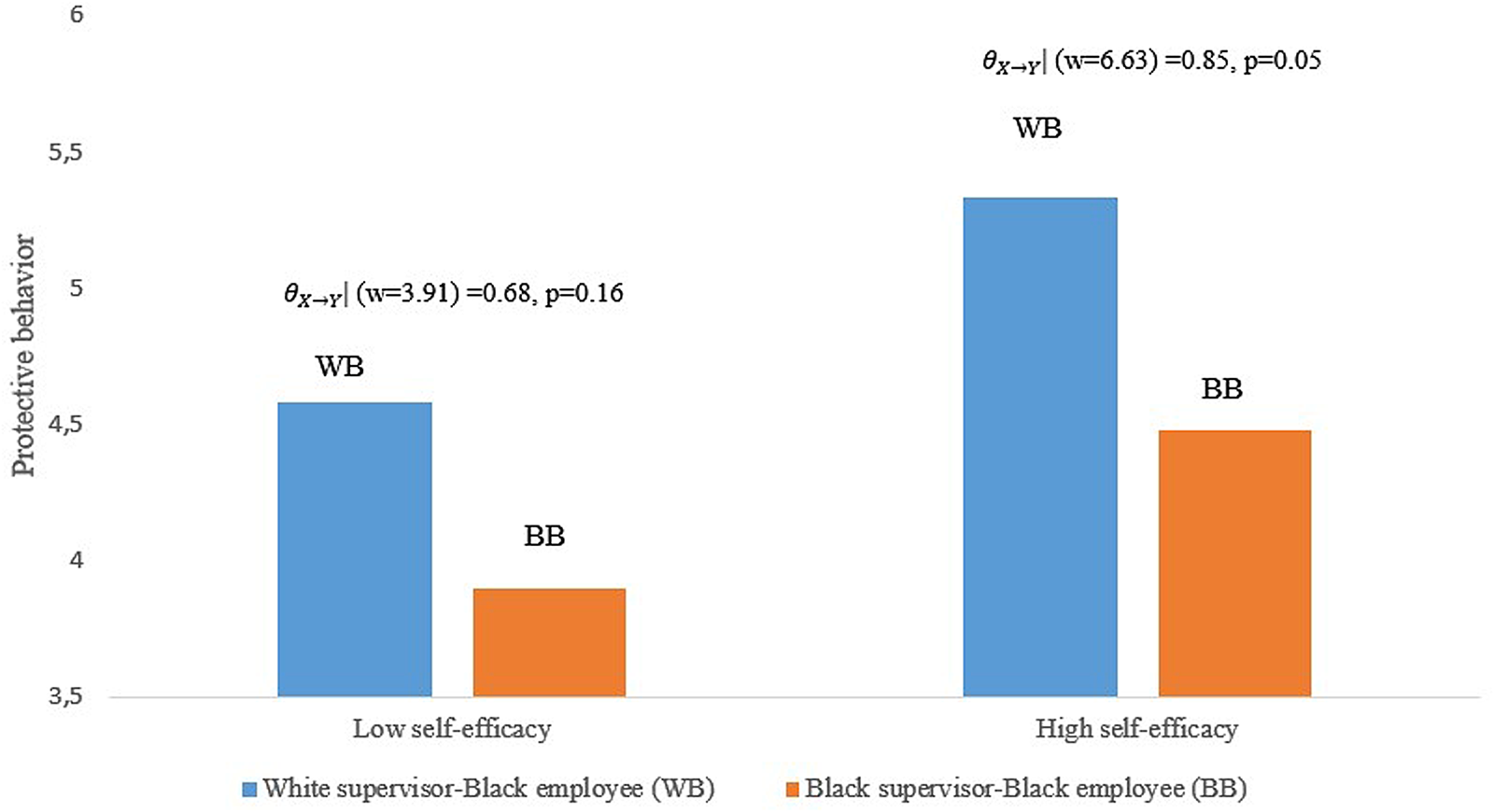
We used the same PROCESS analysis and controlled for the same demographic variables. The results revealed that self-efficacy did not moderate the main effect at the α = .05 significance level (b = .06, SE = .24, p = .80). However, we probed the interaction term and found that when the subject of the incident was a black employee, observers displayed a higher level of protective behavior when the incident involved a white supervisor than when the incident involved a black supervisor at high levels of self-efficacy (θx→y| [w = 6.63] = .85, SE = .43, p = .05), but not at low levels of self-efficacy (θx→y| [w = 3.91] = .68, SE = .48, p = .16) (Figure 5), providing support for Hypothesis 3b.
(Study 2) The abusive supervision conditions × self-efficacy interaction for protective behavior.

The role of personal abusive supervision experience
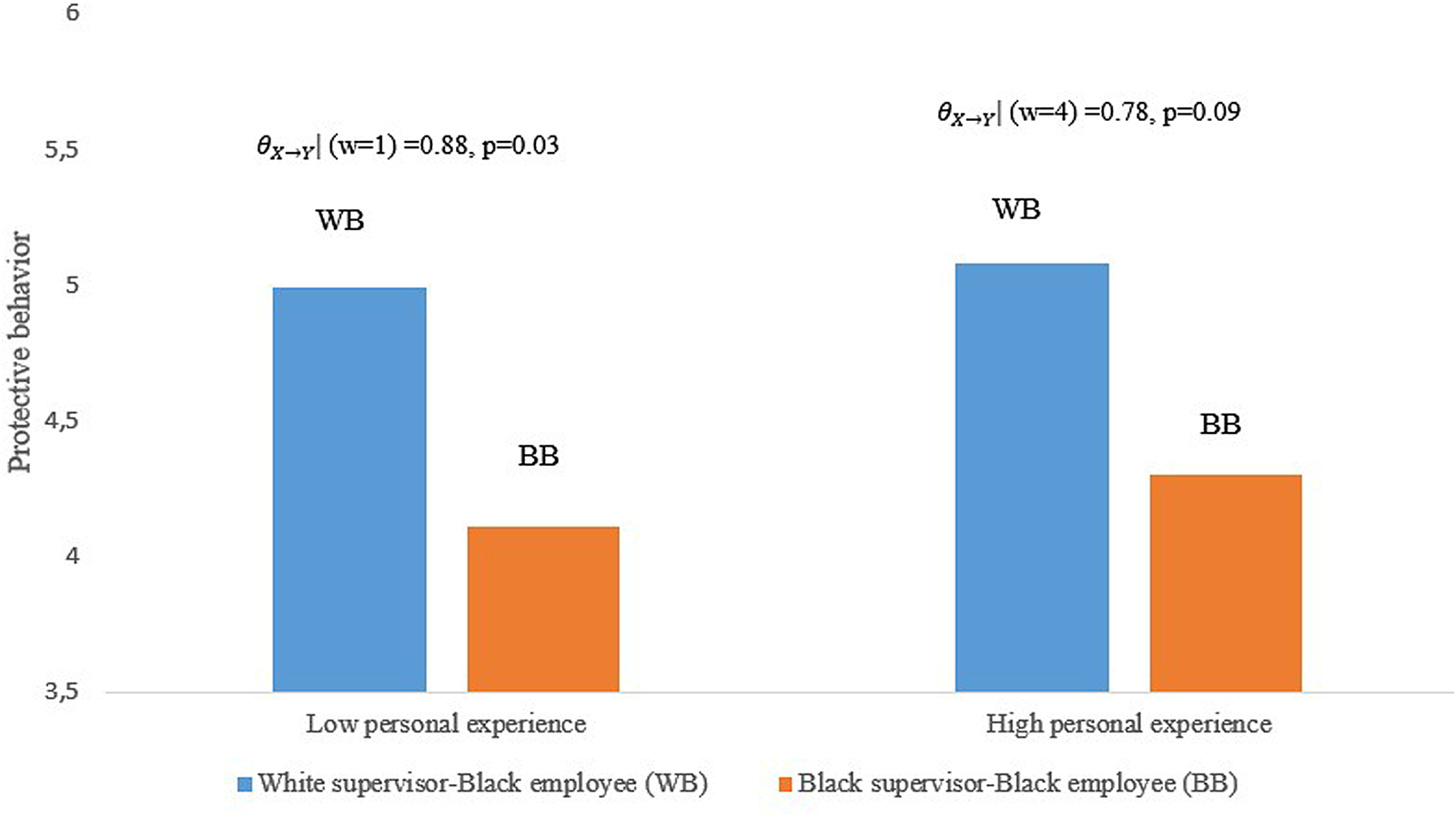
We used the same moderation analysis with the same control variables and found that there was an insignificant abusive supervision-conditions × personal abusive experience interaction for protective behavior (b = −.03, SE = .19, p = .86). However, as displayed in Figure 6, the pick-a-point approach results revealed that observers displayed a higher level of protective behavior for the abused black employee when the incident involved a white supervisor (vs. a black supervisor) at low levels of personal abusive supervision experience (θx→y| [w = 1] = .88, SE = .39, p = .03), but not at high levels of personal abusive supervision experience at the .05 significance level (θx→y| [w = 4] = .78, SE = .46, p = .09). Thus, Hypothesis 4b was supported.
(Study 2) The abusive supervision conditions × personal abusive supervision experience interaction for protective behavior.

Study 3
Pretest
In this pretest, we followed the same procedures as in Pretest 1 and Pretest 2. We only changed the images of the supervisor and employee (see Supplementary Appendix C for full manipulations). A total of 102 undergraduate students (47 males and 54 females, M age = 21.68) participated in this pretest in exchange for partial course credit. We asked them the same believability/realism and abusive supervision questions. The one-way ANOVAs results showed that the means for the believability/realism construct for the black supervisor–black employee manipulation and the black supervisor–white employee manipulation were 5.05 and 5.49, respectively. Also, we tested whether respondents accurately identified the race of the supervisors and employees by asking the same questions as in Pretest 1 and Pretest 2. The results showed that the majority of the respondents accurately identified the race of the supervisor (81%) and the race of the employee in the manipulations (85%). Lastly, the results showed that participants found both the black supervisor–black employee (M = 5.21) and the black supervisor–white employee (M = 5.25) manipulations abusive. These findings provided evidence that our manipulations were realistic and believable.
Method description
This study aims to explore whether observers display a higher level of protective behavior for an abused black employee (relative to a white employee) when the supervisor is black. Also, this study aims to explore under what conditions observers are more likely to stand up for an abused black employee (vs. a white employee) when the supervisor is black. In this regard, we conducted another scenario-based online experiment and followed the same procedure applied in Study 1 and Study 2.
We used a 2 (abusive supervision conditions: black supervisor–black employee condition vs. black supervisor–white employee condition) factorial design. A total of 130 (56 males and 74 females, M age = 36.54) adult subjects, who were recruited from mTurk, participated in the experiment. Regarding the demographics, 86.9% of the respondents were less than 50 years old, 76.2% were White, 47.1% were not currently married, 53.1% had at least a 4-year college degree, and 48.5% reported annual family household incomes no more than $50,000. Table 1 provides more details about participants' demographics.
Participants were randomly assigned to one of the two conditions. In the black supervisor–black employee condition, respondents read an abusive supervision incident that took place between a black supervisor and a black employee on a construction site. In the black supervisor–white employee condition, they read the same dialog, but the incident was presented as occurring between a black supervisor and a white employee (see Supplementary Appendix C for full manipulations).
We used the same constructs as in Study 1 and Study 2 studies (Table 2). We employed a CFA to test constructs' validities. Tables 2 and 3 demonstrate CFA results, including standardized factor loadings, AVEs, constructs' reliabilities, and inter-construct correlations. All results showed that constructs had high levels of convergent validity, discriminant validity, and reliability. For manipulation-check purposes, we asked respondents the same three questions as in the previous studies. The results showed that the majority of respondents, regardless of the assigned condition, correctly indicated the race of the employee or/and supervisor displayed in the manipulations, indicating the success of the manipulations.
Hypothesis testing results
Direct effect
We used a one-way ANOVA to test Hypothesis 1c. The results revealed that when the supervisor was black, observers displayed a higher level of protective behavior when the incident involved a black employee (M = 4.56) than when the incident involved a white employee (M = 3.85) (F(1, 128) = 6.58, p = .01), providing support for Hypothesis 1c.
The role of racism
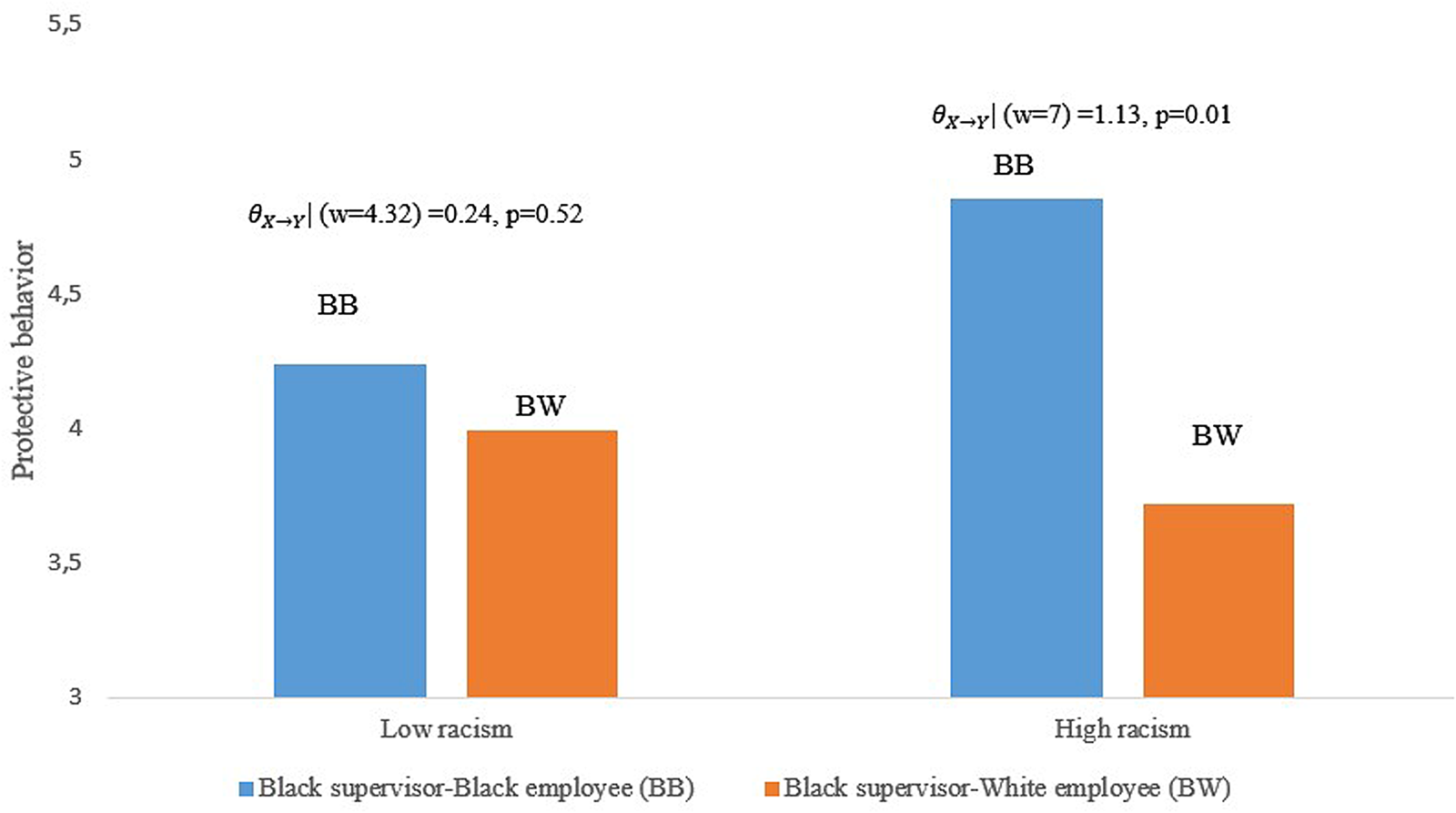
We used PROCESS (V3) Model 1, 5,000 bootstrap samples, and 95% confidence intervals to test Hypothesis 2c. We added demographic variables (e.g., race, gender, age, income, education, and marital status) into the model as covariates to control for their effects. The PROCESS results revealed an insignificant positive abusive supervision-conditions × racism interaction for protective behavior (b = .33, SE = .22, p = .14) (Hayes, Reference Hayes2018). Because of the aforementioned reason, however, we probed the interaction term by using the pick-a-point approach. As can be seen in Figure 7, when the supervisor was black, observers displayed a higher level of protective behavior when the incident involved a black employee than when the incident involved a white employee at high levels of racism (θx→y| [w = 7] = 1.13, SE = .44, p = .01), but not at low levels of racism (θx→y| [w = 4.32] = .24, SE = .38, p = .52). Thus, Hypothesis 2c was supported.
(Study 3) The abusive supervision conditions × racism interaction for protective behavior.

The role of self-efficacy
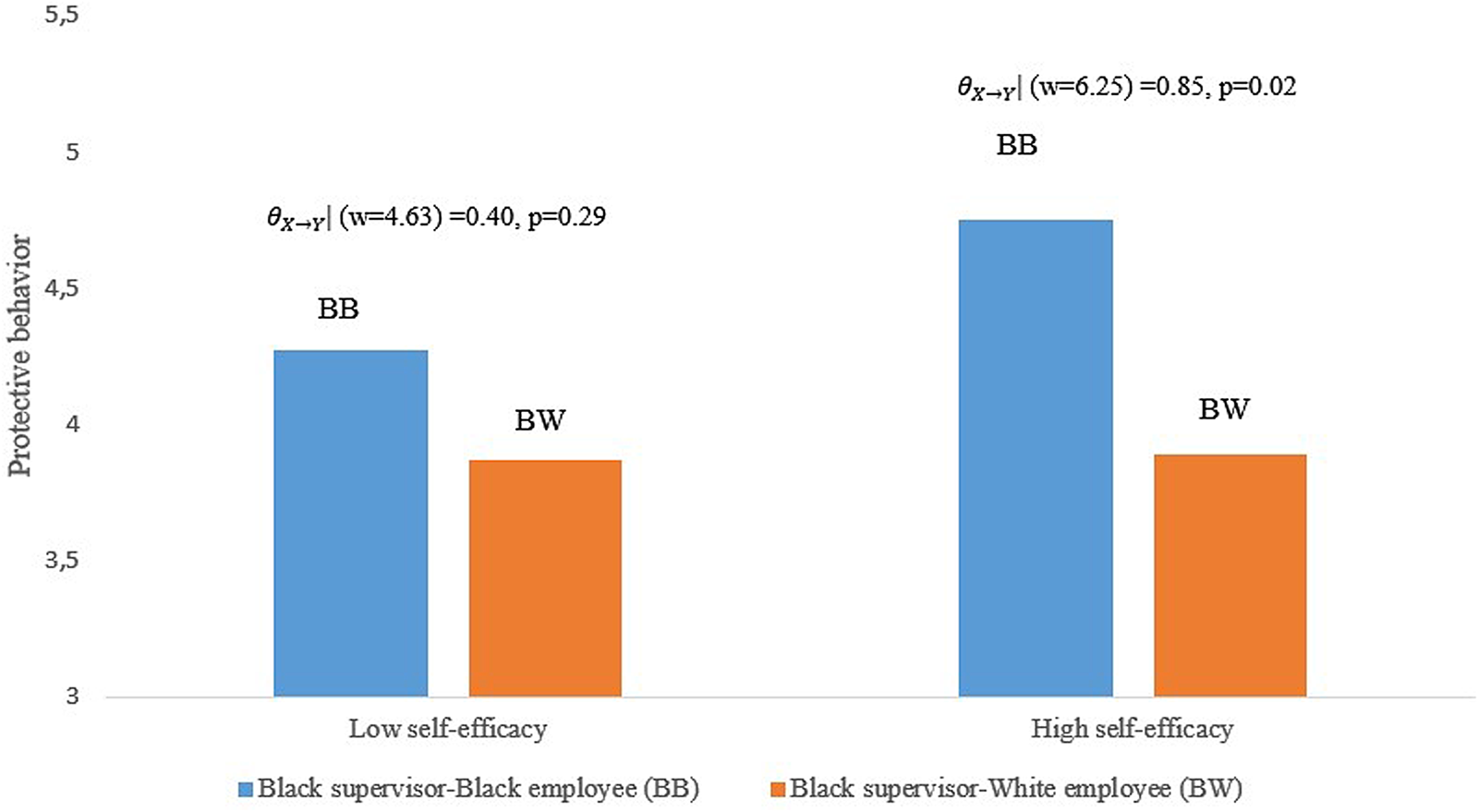
We utilized the same PROCESS analysis with the same control variables to test Hypothesis 3c. The results showed that self-efficacy did not moderate the main effect (b = .28, SE = .29, p = .34). However, we probed the interaction term and found that when the supervisor was black, observers were more willing to stand up for an abused black employee (relative to a white employee) at high levels of self-efficacy (θx→y| [w = 6.25] = .85, SE = .36, p = .02), but not at low levels of self-efficacy (θx→y| [w = 4.63] = .40, SE = .37, p = .29) (Figure 8), providing support for Hypothesis 3c.
(Study 3) The abusive supervision conditions × self-efficacy interaction for protective behavior.

The role of personal abusive supervision experience
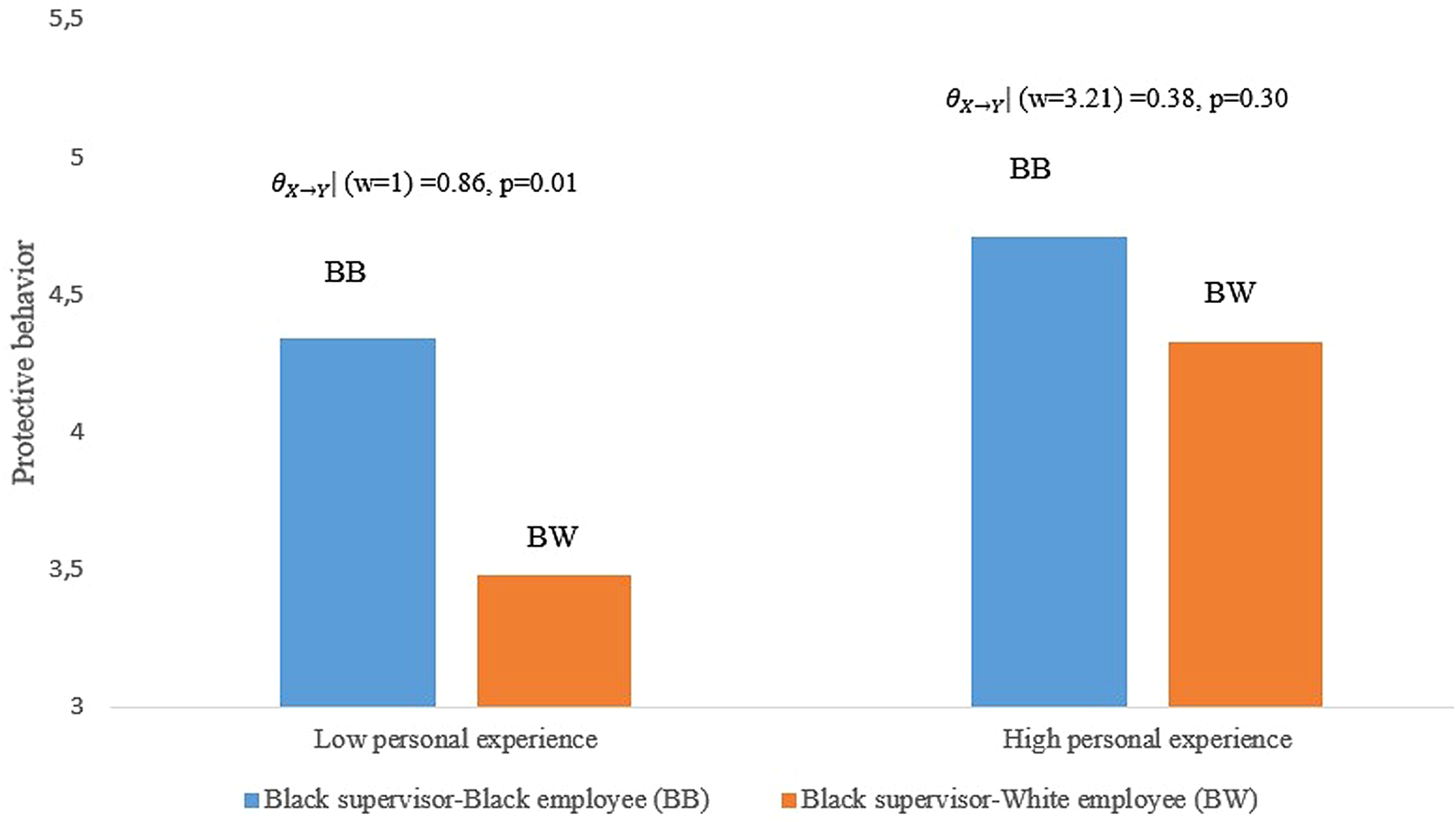
We used the same moderation analysis with the same control variables and found that there was an insignificant abusive supervision-conditions × personal abusive experience interaction for protective behavior (b = −.21, SE = .21, p = .30). However, as displayed in Figure 9, the pick-a-point approach results revealed that when the supervisor was Black, observers displayed a higher level of protective behavior when the incident involved a black employee (vs. a white employee) at low levels of personal abusive supervision experience (θx→y| [w = 1] = .86, SE = .35, p = .01), but not at high levels of personal abusive supervision experience (θx→y| [w = 3.21] = .38, SE = .36, p = .30). Thus, Hypothesis 4c was supported.
(Study 3) The abusive supervision conditions × personal abusive supervision experience interaction for protective behavior.

Study 4
Method description
This study aims to reveal that observers' likelihood of engaging in protective behavior for an abused white employee will not be different in incidents involving a black supervisor than it would in a similar incident involving a white supervisor. Also, this study aims to reveal that the moderators we examined in Study 1, Study 2, and Study 3 do not significantly affect the strength or direction of the proposed main effect. In other words, we argue that observers' levels of racism, self-efficacy, and personal abusive supervision experience do not significantly impact observers' likelihood of engaging in protective behavior for an abused white employee when the incident involves a black supervisor than when the incident involves a white supervisor. In this study, we used the manipulations pretested in the previous three studies (see Supplementary Appendix D for full manipulations).
We used a 2 (abusive supervision conditions: black supervisor–white employee condition vs. white supervisor–white employee condition) factorial design. A total of 130 (64 males and 66 females, M age = 42.99) adult subjects, who were recruited from mTurk, participated in the experiment. Regarding the demographics, 67.7% were less than 50 years old, 85.4% were White, half of respondents were not currently married, 58.5% had at least a 4-year college degree, and 37% reported annual family household incomes no more than $50,000. Table 1 provides more details about participants' demographics.
Participants were randomly assigned to one of the two conditions. In the black supervisor–white employee condition, participants read an abusive supervision incident that took place between a black supervisor and a white employee on a construction site. In the white supervisor–white employee condition, participants read the same dialog but occurring between a white supervisor and a white employee this time.
We used the same constructs as in the previous three studies (Table 2). We ran a CFA to test constructs' validities. Tables 2 and 3 present CFA results, including standardized factor loadings, AVEs, constructs' reliabilities, and inter-construct correlations. All results indicated that constructs had high levels of convergent validity, discriminant validity, and reliability. For manipulation check, we asked participants the same questions as in the previous three studies. The majority of participants, regardless of the assigned condition, accurately indicated the race of the employees or/and supervisors shown in the manipulations, indicating the success of our manipulations.
Hypothesis testing results
Direct effect
We used a one-way ANOVA to test Hypothesis 1d. The results of one-way ANOVA showed that when the subject of the incident was white, observers' likelihood of engaging in protective behavior was not statistically different when the incident involved a black supervisor (M = 4.01) than when the incident involved a white supervisor (M = 4.39) (F(1, 128) = 1.85, p = .18), providing support for Hypothesis 1d.
The role of racism
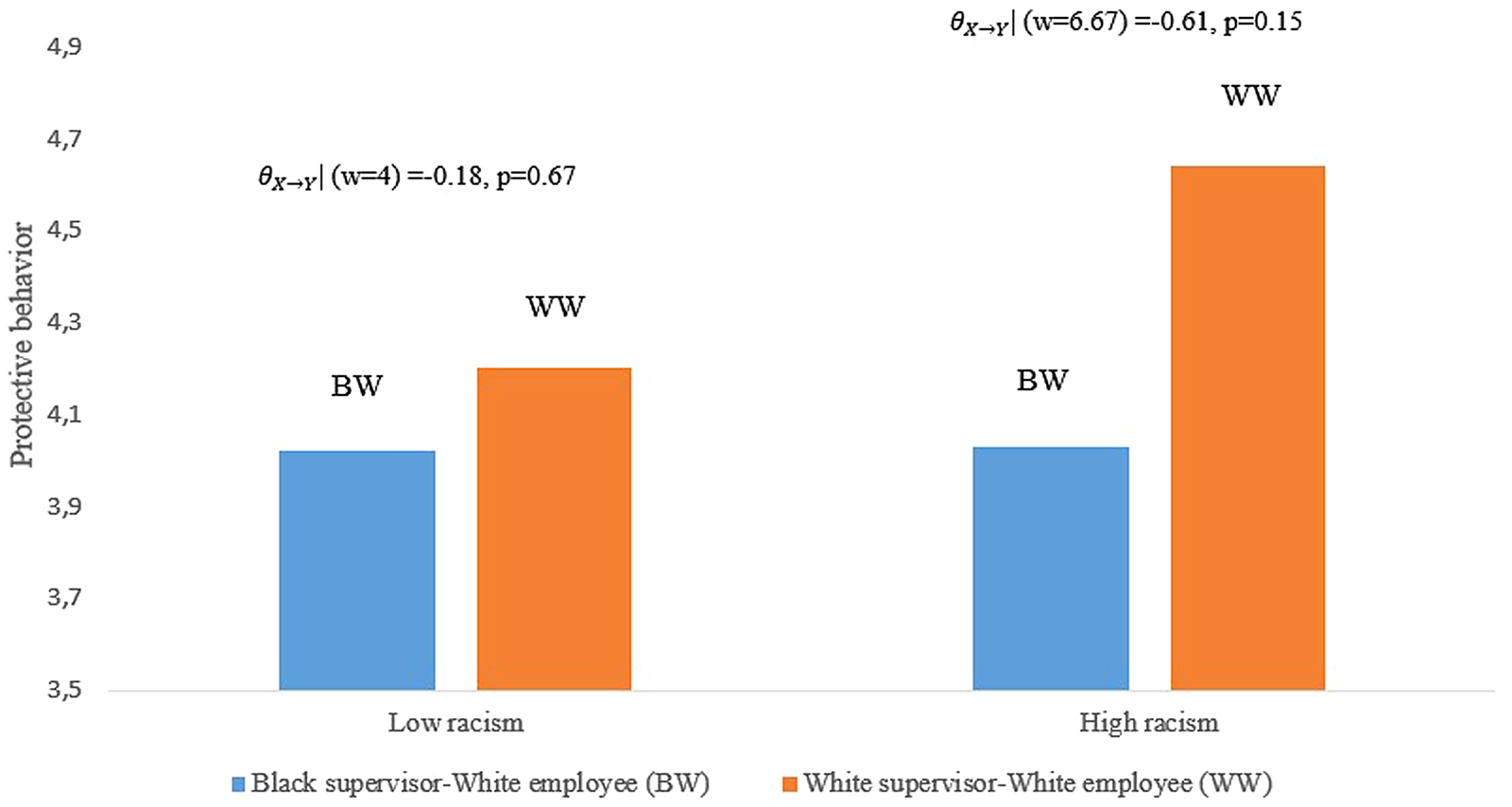
We used PROCESS (V3) Model 1, 5,000 bootstrap samples, and 95% confidence intervals to evaluate whether observers' likelihood of engaging in protective behavior for an abused white employee is not statistically affected by observers' levels of racism. We added demographic variables (e.g., race, gender, age, income, education, and marital status) into the model as covariates to control for their effects. The results revealed an insignificant abusive supervision-conditions × racism interaction for protective behavior (b = −.16, SE = .23, p = .49). We used the pick-a-point approach to probe the interaction term. The results showed that when the subject of the incident was a white employee, observers did not display a higher or lower level of protective behavior when the incident involved a black supervisor than when the incident involved a white supervisor regardless of observers' levels of racism. In other words, as can be seen in Figure 10, observers were not more or less willing to stand up for an abused white employee when the incident involved a black supervisor (vs. a white supervisor) neither at high levels of racism (θx→y| [w = 6.67] = −.61, SE = .43, p = .15), nor at low levels of racism (θx→y| [w = 4] = −.18, SE = .41, p = .67). Thus, Hypothesis 2d was supported.
(Study 4) The abusive supervision conditions × racism interaction for protective behavior.

The role of self-efficacy
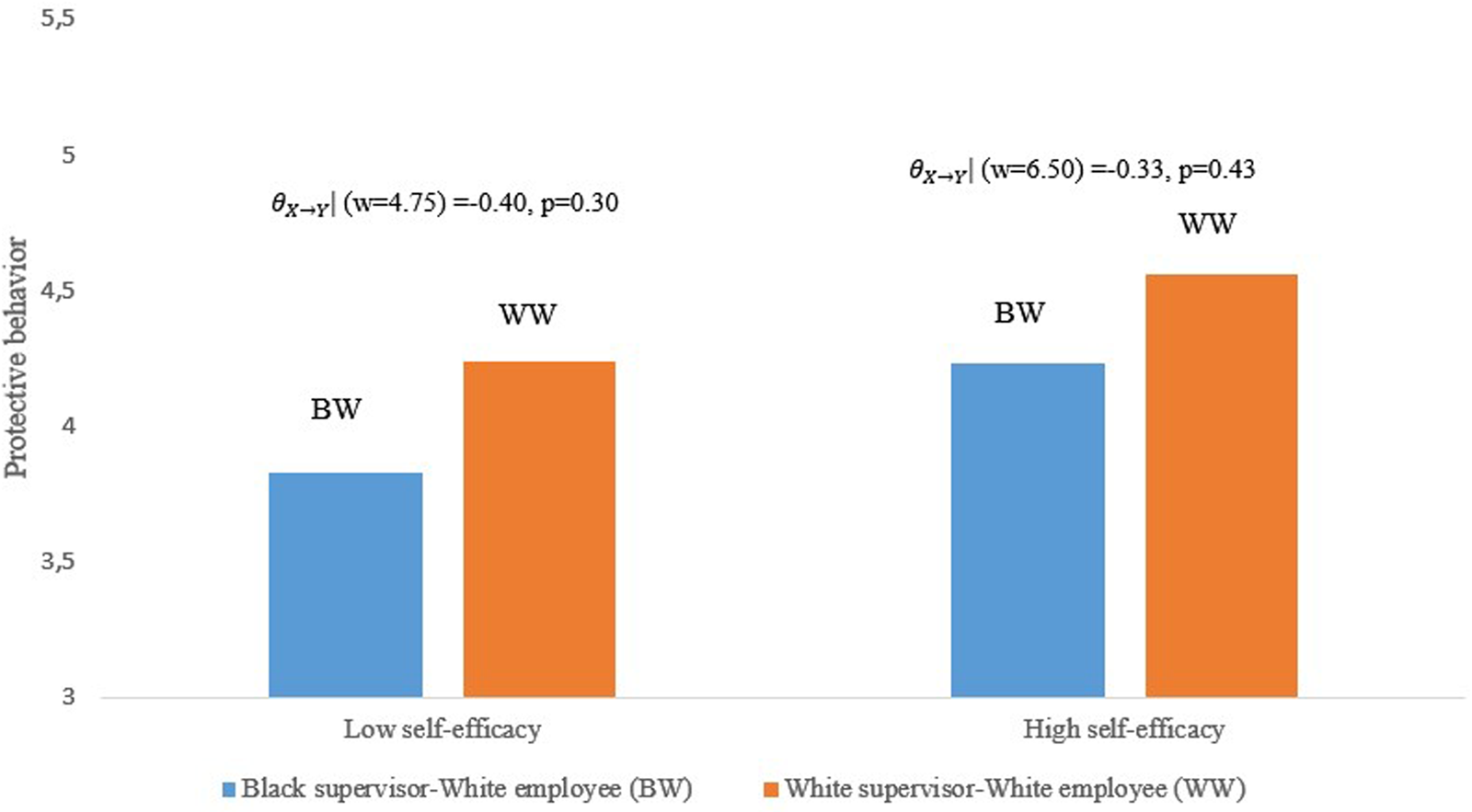
We used the same PROCESS analysis with the same control variables to test Hypothesis 3d. The results revealed an insignificant abusive supervision-conditions × self-efficacy interaction for protective behavior (b = .04, SE = .33, p = .89) (Hayes, Reference Hayes2018). We implemented the pick-a-point approach to probe the interaction term and found that when the subject of the incident was a white employee, observers did not display a higher or lower level of protective behavior when the incident involves a black supervisor than when the incident involves a white supervisor neither at high levels of self-efficacy (θx→y| [w = 6.50] = −.33, SE = .42, p = .43), nor at low levels of self-efficacy (θx→y| [w = 4.75] = −.40, SE = .39, p = .30) (Figure 11). Thus, Hypothesis 3d was supported.
(Study 4) The abusive supervision conditions × self-efficacy interaction for protective behavior.

The role of personal abusive supervision experience
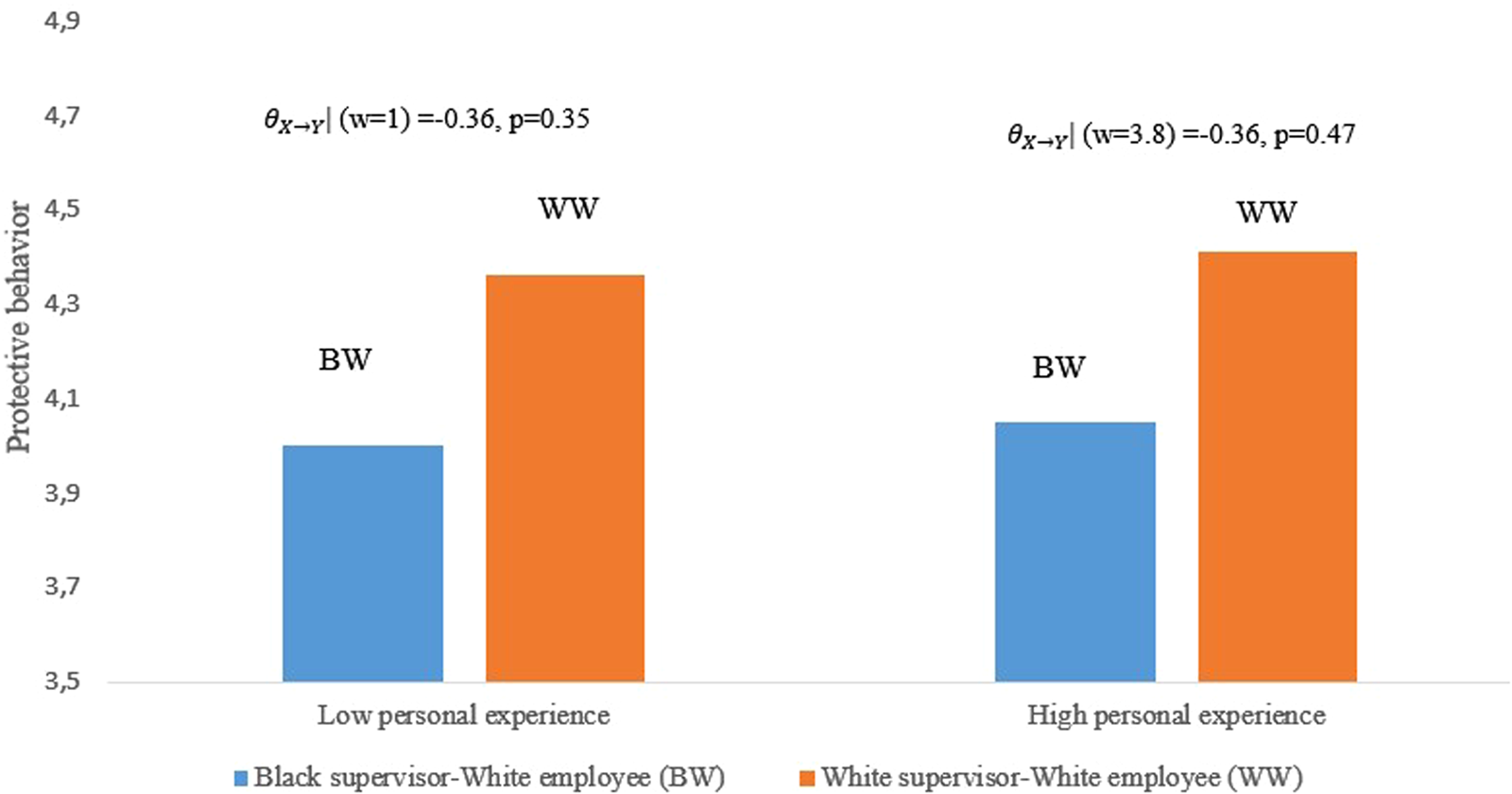
We used the same PROCESS analysis with the same control variables to test Hypothesis 4d. The results revealed an insignificant abusive supervision-conditions × personal abusive supervision experience interaction for protective behavior (b = .001, SE = .23, p = .998) (Hayes, Reference Hayes2018). We implemented the pick-a-point approach to probe the interaction term and found that when the subject of incident was a white employee, observers did not display a higher or lower level of protective behavior when the incident involved a black supervisor than when the incident involved a white supervisor neither at high levels of personal abusive supervision experience (θx→y| [w = 3.80] = −.36, SE = .49, p = .47), nor at low levels of personal abusive supervision experience (θx→y| [w = 1] = −.36, SE = .38, p = .35) (Figure 12). Thus, Hypothesis 4d was supported.
(Study 4) The abusive supervision conditions × personal abusive supervision experience interaction for protective behavior.

Discussion and implications
We conducted four studies to examine differences in external observers' protective behavior across the four possible supervisor–employee racial combinations. Our interesting findings allow us to derive some unique theoretical and managerial implications.
Theoretical contributions
Several studies have recently examined how individuals respond when they witness mistreatment of employees. We complement this literature in several ways. First, previous studies have explored the phenomena from the employees' perspective (Mitchell & Ambrose, Reference Mitchell and Ambrose2007; Tepper, Reference Tepper2000) or from the employees' coworkers' perspective (Priesemuth & Schminke, Reference Priesemuth and Schminke2019). That is, these studies examined employees' reactions and their coworkers' reactions to abusive supervisor. We complement this stream of research by investigating abusive supervisor behavior from the perspective of individuals who are outsiders to the firm. This is a noteworthy contribution as abusive supervisor behavior can not only occur in the presence of other firm employees, but also in the presence of various external stakeholders. As such, it is important to understand when outsiders are more likely to protect firms' employees from supervisor abuse.
Second, we shed some lights on the complex impact of race and racial difference on observers' willingness to engage in protective behavior. Our Study 1 findings revealed that external observers are more likely to protect a black employee that is being abused by a white supervisor than they are to protect a white employee abused by a white supervisor. Our Study 2 results showed that external observers are more likely to protect a black employee that is being abused by a white supervisor than they are to protect a black employee that is being abused by a black supervisor. In addition, our Study 3 findings uncovered that external observers are more likely to protect a black employee that is being abused by a black supervisor than they are to protect a white employee that is being abused by a black supervisor. Finally, our Study 4 results showed that when the abused employee is white, observers' willingness to protect the employee is not different whether the abuser is a black supervisor or a white supervisor. Combined, these findings indicate that the race of the abuser and the abusee directly impact external observers' levels of protective behavior. In essence, external observers are more likely to protect abused black employees than they are to protect abused white employees, irrespective of the abuser's race. This willingness to protect black employees is more salient when the abuser is a white supervisor (as compared to a black supervisor). However, when the abused employee is white, external observers do not react (in terms of protective behavior) to the race of the abusive supervisor.
Third, we further unpack the complex role of race in the relationship between supervisor abusive behavior and external observers' protective behavior by accounting for the role of racism. Our findings indicate that the strength of the relationships described above is amplified for external observers high on racism. Thus, we also complement the literature on racism (Bonilla-Silva, Reference Bonilla-Silva2006; Schaffner, MacWilliams, & Nteta, Reference Schaffner, MacWilliams and Nteta2016) by uncovering additional situations where racism plays a key role in individuals' reactions.
Fourth, our results also showed that the strength of the relationships described above is intensified for external observers high on self-efficacy. That is, external observers who display high levels of self-efficacy are more willing to protect black employees, than they are to protect white employees. Our findings also augment the literature examining the outcomes of self-efficacy (Chen & Bliese, Reference Chen and Bliese2002; Lai & Chen, Reference Lai and Chen2012) by revealing that self-efficacy also impacts external observers' willingness to protect black employees.
Fifth, our results also showed that the strength of the relationships described above is intensified for external observers who have not previously experienced supervisor-related abuse. These findings have noteworthy implications for the literature examining the temporal aspects of abuse. While extant psychology literature has primarily linked child abuse to long-term negative consequences (Dye, Reference Dye2018; Sousa, Mason, Herrenkohl, Prince, Herrenkohl, & Russo, Reference Sousa, Mason, Herrenkohl, Prince, Herrenkohl and Russo2018), our findings indicate that supervisor abuse can also have long-term consequences. Specifically, it makes individuals who experienced supervisor abuse in the past less likely to protect other abused employees, especially black employees. While this could be due to a prolonged loss of control employees might experience during abuse (Mitchell & Ambrose, Reference Mitchell and Ambrose2007), future research should shed further light on the causes of this phenomena.
Sixth, we make some noteworthy contributions to the management literature examining racial discrimination and abuse (Goldman et al., Reference Goldman, Gutek, Stein and Lewis2006; James & Wooten, Reference James and Wooten2006). The majority of studies in this stream of literature have focused on the challenges experienced by black managers, such as lower salaries (Hernandez et al., Reference Hernandez, Avery, Volpone and Kaiser2019) or interpersonal discrimination (Hebl, Ruggs, Martinez, Trump-Steele, & Nittrouer, Reference Hebl, Ruggs, Martinez, Trump-Steele, Nittrouer and Nelson2016). We complement this stream of research by revealing that blacks (as compared to whites) are more likely to be protected by external observers should they experience supervisor abuse. Our study is one of the few that identifies positive aspects pertaining to blacks' workplace experience.
Finally, we did not find that the race of the observer impacts observers' reactions. While this was not the focus of our study, it is an interesting finding that warrants further investigation. Our samples are representative of the racial composition of the US population (U.S. Census, 2021), containing a large percentage of white participants. Rather than speculating on the reasons why no differences were detected, it is important to acknowledge that our sample composition (i.e., white majority) might have limited our ability to detect significant differences between observers belonging to different ethnicities. As such, it would be interesting for future research to replicate our study with samples containing a higher percentage of Black participants.
Managerial contributions
Our findings also offer some important insights to managers and practitioners. First, we highlight to managers that abusive supervision can impact not only firm employees, but also outside stakeholders. That is, individuals who witness supervisors abusing employees react by engaging in protective behavior. Considering that individuals have such strong reactions to incidents of abusive supervision, it is likely that such incidents will also have a negative impact on the firm's reputation. External observers might associate the firm with such undesirable practices and the firm might lose potential customers. Future research ought to examine if external observers are less likely to continue to patronize firms where they witness acts of abusive supervision.
Second, our findings indicate that the race of the abused employee and the race of the abusive supervisor impact external observers' willingness to engage in protective behavior. Specifically, external observers are more likely to protect abused black employees than they are to protect abused white employees, irrespective of the abuser's race. This inclination to protect black employees is more salient when the abuser is a white supervisor (as compared to a black supervisor). However, when the abused employee is white, external observers do not react (in terms of protective behavior) to the race of the abusive supervisor. These findings render some managerial insights.
On the positive side, firms ought to know that external observers are likely to protect abused employees when the employee is black. On the negative side, firms should be aware that external observers are less likely to display protective behavior when the abused employee is white. As such, they should be aware that employees of different races might require customized monitoring to ensure no employee is left without defense when experiencing abuse in the workplace.
In addition, firms should be aware that observers are more sensitive to the abuse conducted by white supervisors (as compared to black supervisors) and therefore more likely to protect employees when the supervisor involved in the incident is white. Invariably, this implies that external observers are not as sensitive to black managers' abusive behavior, and therefore less likely to help employees (whether black or white) abused by black managers. Therefore, firms should be aware that supervisors of different races might require customized monitoring to ensure no employee is left without defense when experiencing abuse in the workplace.
Finally, firms should be aware that they cannot always rely on external observers to protect their own employees. Our results show that the racial effects described above occur for external observers who are high on racism, or on self-efficacy, or have never experienced abusive supervision. Ultimately, it is each firm's responsibility to ensure that no employee experiences supervisor abuse, irrespective of the employee's or the supervisor's race.
Limitations and future research
Our studies are not free of limitations
First, we collected experimental data. While this methodological approach allowed us to better infer causality and control aspects of the research design, our scenarios were fictitious. Future research should attempt to further test our hypotheses using a field study. Future research studies can also attempt to obtain workplace recordings as most workplaces are equipped with video surveillance to assess external observers' reactions to situations of abusive supervision. One limitation of this approach is that abusive supervisors might camouflage their behavior if aware of video surveillance.
Second, we explored racial differences by focusing on the two largest racial groups in the US: blacks and whites. Future research should explore similar effects by focusing on other races, such as Asians or American Indians. Workplaces are a melting pot of individuals belonging to different races. For example, it would be interesting to contrast external observers' reactions to different employee–supervisor combinations, such as black-Asian, or white-native Hawaiian.
Third, we tested our hypotheses in the US. Future studies ought to examine these racial differences in other countries as well. For example, while whites are a majority in the US, they are a minority in South Africa. As such, it would be interesting to replicate our study in a nation where blacks are a majority and whites are a minority.
Fourth, we controlled for the effect of the respondents' race on external observers' reactions, but the majority of the respondents in all studies were white. As such, it would be interesting for future studies to examine these effects with samples containing a higher number of minority participants.
Finally, we tested our hypothesis in one context (i.e., construction). Future research should replicate these studies in other contexts, such as retail, manufacturing, or hospitality. Such studies would help increase the generalizability of our findings.
Supplementary material
The supplementary material for this article can be found at https://doi.org/10.1017/jmo.2022.12