In their capacity as financial intermediaries and suppliers of risk management services, insurance companies have historically performed important functions in industrial economies such as risk diversification, risk transfer, and loss mitigation.Footnote 1 Relative to other financial institutions, economic historians have not performed much research about the development of insurance markets nor about the organizational forms of insurance companies. Insurance transfers the risk of unanticipated acute losses on productive assets to third party insurers that have comparative advantages in risk pooling. Insurance therefore mitigates the probability of corporate and private ruin and ensures that funds are available for managers to finance investment opportunities. By supplying essential financial services, the economic contributions of insurance are evident when viewed from a historical perspective, particularly its role in the development of the Industrial Revolution in the United Kingdom (UK) and the industrial breakthrough in Europe and North America.Footnote 2
Joint stock companies (owned by shareholders) and mutual forms of organization (owned by policyholders) have coexisted and competed against each other in insurance markets for a very long time. In Europe and North America, mutuals were the predominant form of insurance company in the eighteenth century. Stock forms of organization started to predominate from the mid-nineteenth century.Footnote 3 Despite the predominance of stock insurance companies, mutual forms of organization are still very much an important feature of contemporary insurance.Footnote 4
Scholars such as David Mayers and Clifford W. Smith and Bruce D. Smith and Michael J. Stutzer argue that mutual ownership structures survive and prosper in insurance markets alongside their stock counterparts because they have inherent economic advantages arising from the merging of the economic interests of customers and owners.Footnote 5 Specifically, mutual companies are able to effectively control for information asymmetries in insurance markets by restricting entry to the insurance pool to fairly homogeneous and predictable risk types. On the other hand, stock companies benefit from externalizing assumed risks across equity capital as well as policyholders’ funds and so they are better able than mutual companies to efficiently diversify and expand their business activities into broader lines of insurance. The different abilities of the two models of organizational form to manage capital costs and control information asymmetries has meant, however, that over time mutual and stock insurance companies have developed different strategies for managing risks.Footnote 6
The present study examines the issue of competing models of organizational form in Sweden's property fire insurance market between 1903 and 1939 by analyzing how differences in ownership structure influenced underwriting profitability.
We believe that the present study provides a good opportunity to examine competing models on the microstructure of insurance markets as there were different forms of organizational operating in the Swedish property fire insurance market during the period of our analysis.
By examining the stock organizational form of domestic and foreign companies and the mutual organizational form of nationwide and local firms, this study also highlights potential differences within ownership structure that could impact underwriting profitability, and thus the long-run viability of different types of organization. A micro-market analysis of the competitive advantages of different forms of insurance organization can also show the effectiveness of ownership structure in managing information asymmetry problems and controlling agency incentive conflicts arising from the separation of corporate ownership from control. We believe that a historical analysis of the competitive advantages of different organizational forms has the potential to uncover key mechanisms governing the development and function of insurance provision as well as the expansion of insurance markets.
The investigated period (1903 to 1939) was institutionally stable as far as insurance regulation is concerned. This helps us to mitigate complications arising from different institutional conditions arising in cross-country panels. The post-World War II period further witnessed more fundamental institutional changes in the Swedish insurance market following the passing of the 1948 Insurance Act. After 1948 firms attempting to enter Sweden's insurance market faced much greater difficulties than they had earlier. Existing firms were officially organized into insurance groups, reflecting the cartel-like industry structures that had emerged earlier in the twentieth century. As a consequence, entry of new companies was largely restricted. Changes in agriculture, with concentration in larger and more mechanized farms and a general depopulation of the countryside, also had adverse implications for the business model of small local fire insurers. Therefore, we believe that the years 1903 to 1939 represent a fairly stable period to conduct our analysis from both an institutional and market structure perspective.
COMPETING MODELS OF ORGANIZATIONAL FORM IN INSURANCE MARKETS
Academic research on the historical relation between organizational form and underwriting profitability in insurance markets draws heavily from the information asymmetry and agency theory literature.Footnote 7 For example, Smith and Stutzer postulate that as mutual insurance firms tend to admit fairly well-known and homogeneous risk types, they are able to effectively control adverse selection problems at the point of sale.Footnote 8 Therefore, mutual insurers are expected to predominate in local niche sectors of the domestic insurance market such as property fire insurance.Footnote 9 Mutual forms of organization, particularly small ones, have “club-like” characteristics and as such, they have advantages in managing moral hazard by reducing the likelihood of fraudulent or excessive claims.
This is because members of the mutual insurance pool were obligated to act responsibly once insurance has been taken out in order to avoid unnecessary depletion of accumulated reserves. Peer group pressure and the threat of social sanctions in the event of fraudulent and/or vexatious claims will further bind the collective interests of mutual members to control the moral hazard problem.Footnote 10 However, as mutual insurance pools became larger, the advantages in controlling for moral hazard may have been less obvious, as shown by Timothy W. Guinnane and Jochen Streb in their study of German health insurance.Footnote 11 These intrinsic features of mutual ownership structure thus help economize on monitoring and contractual enforcement costs and enable risks to be priced on an “actuarially fair” basis.Footnote 12 In turn, this quality enables mutual insurers to realize sustainable underwriting profitability and compete successfully in insurance markets alongside stock insurance firms. If this is the case, it implies that mutual fire insurers are likely to have higher underwriting profitability than stock fire insurers.
Due to the concentration of policyholders’ economic and social interests in the insurance pool, mutual forms of organization can further economize on the transaction costs associated with accumulating reserves by purchasing reinsurance. With social trust and obligations, the risk management strategy of local mutuals could rely less on reserve levels and the purchase of reinsurance and more on the goodwill of all policyholders to maintain premium levels and not exit the insurance pool after an acute fire loss. The mutuals therefore might have been better able to aid the local community in recovering after a period of widespread trauma.Footnote 13 This was particularly the case in Sweden where local community ties and socioeconomic obligations plus a historical legacy of local property fire support systems provided a form of social capital that reinforced the principle of mutuality and effectively substituted for financial capital such as reserves and reinsurance.Footnote 14 Additionally, the dependence of small mutual insurers on the trust and support of local communities meant that they tended not to expand beyond their geographically defined market. Accordingly, small mutual insurers tended to be characterized by decreasing returns to scale.
Lacking the benefits of close socioeconomic and geographical proximity enjoyed by small local mutual insurers, larger national mutual fire insurers tended to replace elements of social capital with financial capital in the form of reserves and reinsurance. Accumulating financial capital helped Swedish national mutual fire insurers to reduce the risk of dilution of the insurance pool after a severe loss event. It also enabled national mutual insurers to reward the “loyalty” of their policyholders by enabling them to participate in underwriting profits through annual and terminal policy bonuses and/or by cross-subsidizing premium rates with investment income. These financial attributes of the national mutual insurance structure allowed these companies to increase their share of domestic market premiums, diversify assumed risks through national expansion, and thus compete successfully with large stock insurance companies.Footnote 15 However, as with local mutual insurance firms, Swedish national mutual insurers needed a fairly risk-homogenous stock of insured property to avoid excessive risk exposure on the insurance pool.Footnote 16
Some scholars, however, argue that stock forms of insurance organization have inherent advantages over their mutual counterparts. For example, Mayers and Smith argue that stock insurers tend to operate in more complex and risk diverse lines of business and so grant their managers more discretion to make decisions with regard to the setting of underwriting prices, reserving, and reinsurance strategies.Footnote 17 Indeed, Hale Abdul Kader et al. find that reinsurance was a major driver of change and expansion of stock companies in the Swedish property fire insurance market in the interwar years.Footnote 18 In addition, the managers of stock insurers could be motivated to maximize shareholders’ economic interests and increase period underwriting profits as a result of attractive remuneration packages, incentive schemes, and the disciplinary effect of the market for corporate control.Footnote 19 Therefore, contrary to the predicted economic advantages of mutual forms of organization, it could be argued that stock insurers are likely to have higher underwriting profitability than mutual insurers.
Abdul Kader et al. report that in the Swedish property fire insurance sector in the interwar period, stock insurers ceded a relatively greater share of annual premiums to reinsurance companies and were less reliant on reserves and loans compared with mutual forms of organization.Footnote 20
By holding smaller reserves and loans and purchasing more reinsurance, stock insurance companies might have been less exposed to changes in interest rate fluctuations than their mutual counterparts. On the other hand, stock insurers were more exposed to fluctuations in equity markets, which increased their costs of capital and affected the ease with which they could raise external capital to fund their growth strategies. Due to the inherent difference in the capital structures and risk assessment strategies of mutual and stock forms of organization, the economic advantages of the two insurance models are also likely to be closely related to developments in the macroeconomy.Footnote 21 We examine these considerations further below.
Between 1903 and 1939 most foreign insurers operating in Sweden were joint stock companies. While foreign insurers may have had economic advantages, such as the ability to draw on a large pool of insurance expertise and greater risk diversification capacity, they probably faced more severe information asymmetries in operating in the Swedish property fire insurance market when compared with their domestic counterparts. Mayers and Smith predict that joint stock companies are mainly found in lines of insurance business involving a high degree of managerial discretion over underwriting terms, premium rates, investment policy, and so on.Footnote 22 Foreign stock insurers operating in Sweden's property fire insurance markets in the first four decades of the twentieth century tended to rely heavily on the decision-making discretion of local manager-agents which also meant that principal-agent problems could have been more pronounced in foreign fire insurers compared with Swedish fire insurance firms.Footnote 23 This implies that the underwriting profitability of joint stock foreign insurers was likely to be lower than that of their Swedish counterparts.
RESEARCH DESIGN
The analysis of the two competing models of organizational form focuses on their relative underwriting profitability in the Swedish property insurance markets between 1903 and 1939 and how that was linked to their risk and financial strategies, and state of the domestic macroeconomy. We therefore estimate an “underwriting profitability model” with a set of time-varying factors that describe the structure of each insurance firm. The firm-specific effects control for unobserved differences in risk profile and intercompany risk management expertise that are assumed to have varied randomly around the same mean for each insurer during the period of analysis. The time-specific effects capture changes in macroeconomic conditions that would have affected all firms in essentially the same way. To determine the most appropriate regression model to use, we follow William H. Greene and conducted two main diagnostic procedures—the Breusch-Pagan (BP) and Lagrange Multiplier (LM) tests—suggest the using of robust standard errors.Footnote 24 Second, the Hausman test between random-effects and fixed-effects specification was conducted and this favored the use of the random-effects model.Footnote 25 This can be expressed as

In the above model, Pit denotes the underwriting profit for insurance firm i at time t; Xit indicates the time-varying variables for each insurance firm; and Zit represents a vector of macroeconomic variables that only vary across time. Our model includes eight time-varying variables covering the key characteristics of the insurance firms in our data set.
Underwriting profitability (UP) is represented by annual net premiums (P) minus net claims (C) and overhead expenses (E) normalized by net premiums [(P–C–E)/P]. A high profit means that claims and overhead expenses were kept down and a low profit means that claims and expenses were high in relation to premiums.
Leverage is measured using the premium to surplus (P–S) ratio, which is defined as net annual premiums written divided by surplus (equity + reserves).Footnote 26 The predicted sign of the leverage coefficient is uncertain. A large ratio of potential liabilities to assets can confer economic advantages by binding managers to ensure free cash flows are maintained in order to meet the requirements of fixed claimants.Footnote 27 On the other hand, a high ratio might have kept the firms from pushing to write more business to avoid increasing insolvency risk.Footnote 28
Claims experience is represented by the ratio of claims incurred to the value of in-force fire insurance business underwritten, and is measured as the total value of annual incurred claims divided by the indemnity value of the stock of property insured. All else equal, we predict a negative relationship between the claims ratio and underwriting profitability.Footnote 29
Firm size is measured as the natural logarithm of annual total assets.Footnote 30 This approach alleviates the possible effects of extreme values in the data set confounding the empirical results. Anne Grøn suggests that large insurers are likely to realize capital cost advantages over small insurers as a result of economies of scale and their ability to diversify risks across a bigger insurance pool.Footnote 31 Therefore, other things being equal, large fire insurers are expected to have better underwriting profitability than local fire insurers.
Reinsurance activity is measured as the annual amount of reinsurance premiums ceded divided by gross annual premiums written. Reinsurance enables insurance firms to reduce underwriting and insolvency risks, increase coverage capacity.Footnote 32 Drawing from that result, one could expect a positive link between underwriting profitability and the level of reinsurance purchased by Swedish fire insurance firms. However, a positive relation may not be consistently found across all insurance markets.
Liquidity is measured as the annual amount of cash and cash equivalents divided by current liabilities. Generally, fire insurers with a better liquidity position can save on the transactions costs of reinsurance, better protect their capital position, and realize higher underwriting profits than cash constrained fire insurance firms.Footnote 33 Therefore, we predict that all else equal, high-liquidity fire insurers will tend to have better underwriting profitability and lower reinsurance than less liquid fire insurers.
Investment earnings are measured as the annual percentage yield on invested assets net of transaction costs and management fees.Footnote 34 Smith suggests that investment earnings can substitute for underwriting profitability and enable insurers to expand their underwriting capacity, enhance solvency, and concomitantly reduce the need for reinsurance.Footnote 35 As a consequence, other things being equal, Swedish fire insurers with high investment earnings are likely to have higher underwriting profitability due to lower leverage and fewer requirements to purchase reinsurance.
The bank loans variable is measured as the amount of bank loans to annual premium income. This gives an indication of how Swedish fire insurers used mainly short-term bank loans (of less than one year) to increase their underwriting capacity and raise profit margins.Footnote 36 This reasoning implies a positive relation between underwriting profitability and bank loans, all else equal.
The ex-post premium payment dummy variable takes the value 1 for years when negative underwriting profitability is reported and otherwise 0. It serves as a proxy for ex-post increases of premiums in the aftermath of abnormally large claims that led insurers to make additional calls on their policyholders in the event of increased risk of insolvency of the insurance pool.
In addition to firm-specific variables, we employ a set of macroeconomic variables to control for cross-temporal variations in the results. The annual interest rate (INT) is represented by the average annual long-term (five-year) government bond yield as fire insurers rarely held short-term bonds during the period of our analysis.Footnote 37 Real Gross Domestic Product (GDP) growth is taken as a measure of the annual growth of aggregated demand in the domestic economy. The annual rate of inflation is the average annual consumer price index. The stock price index is the Stockholm Stock Exchange General Index and it is used as a proxy for stock fire insurance companies’ stock prices and so only applies to this group of firms. Additionally, the exchange rate is used as a control variable for foreign fire insurance companies operating in Sweden during the period of our analysis. Exchange is measured as the Swedish currency in relation to the foreign currency (e.g., kronor per British pounds sterling).
Given inherent operational and financial performance differences between the competing models of insurance organizational form, we estimated equation 1 separately for each of the four organizational forms included in the analysis. The four models are tested both with firm-specific variables exclusively and firm-specific variables and macroeconomic variables together. In addition to the separate analysis of each organizational form, we have also tested for differences in the coefficients between the models. To test for differences in the coefficients for the time-varying variables within firms, we estimated the following model

In equation 2, Pit is underwriting profits, Xit represents the time-varying variables for each insurance firm, Org denotes a dummy variable for organizational form, and β2 is the coefficient estimate for the interaction with the organizational dummy, and so represents the difference in estimated coefficients between mutual and stock ownership. The interactive effect is estimated pairwise across the different types of organizational form (i.e., foreign/domestic, stock/mutual, and national/local). A t-test is applied to each variable-coefficient to test whether there is a significant difference between organizational forms. To fit the interactions in the model, we also normalized the variables to meet the requirement of integer variables and the maximum of interactions (N = 800) that could be accepted by the econometric software.
Our data set comprises an unbalanced panel of 5,070 firm/year observations for the 37 years from 1903 to 1939 and includes Swedish property fire insurance companies in four categories: local mutual fire support funds, nationwide fire insurance mutuals, nationwide stock fire insurance companies, and foreign companies. The sample includes the large national stock and mutual property fire insurers that together accounted for approximately 80 percent of the market between 1903 and 1939. The panel is unbalanced because firms entered and exited the Swedish property fire insurance market during the period of study. All financial and economic data for the Swedish property fire insurance market were obtained from the Swedish Official Statistics Series for Private Insurance.Footnote 38 This source publishes key annual financial statistics for Swedish insurance firms by line of business on premiums written, losses incurred, reinsurance premiums ceded, and investment earnings. Macroeconomic data on interest rates, inflation, stock returns, and foreign exchange rates were obtained from Daniel Waldenström and Rodney Edvinsson, Tor Jacobson, and Waldenström.Footnote 39 In addition, relevant national accounting data used in the study (e.g., GDP figures) were obtained from Olle Krantz and Lennart Schön.Footnote 40
COMPETING MODELS OF ORGANIZATIONAL FORMS IN THE SWEDISH INSURANCE MARKET
The early history of the Swedish insurance market is first mentioned in medieval archives and county laws. At that time, insurance was based on compulsory public fire support institutions funded through a local cooperative system of “deposit and call.” Members of the “fire pools” had obligations to provide aid and assist in the physical and financial reconstruction of buildings that were damaged by fire. Therefore, from the earliest times in Sweden, social obligations and trust worked alongside mutuality principles within an institutional local community-based structure of insurance.
In the late eighteenth and early nineteenth century, the concept of Swedish mutual insurance funds was extended and co-evolved alongside local mutual savings banks. Reporting to the government inspectorate became compulsory in 1889 but even after the passage of the national Insurance Act (1903), local mutual insurance organizations were less rigorously monitored than the larger insurance companies. Around 400 local, mainly rural-based mutual companies/funds existed during the period from 1903 to 1939, approximately half of which continue to survive in Sweden's insurance market today.Footnote 41 These mutual structures were typically situated in a single parish or in the countryside and they insured property owned by single households. Rural mutual companies did not tend to insure high-value/high-risk properties such as church estates, commercial offices, or industrial facilities. The market for industry fire risks that emerged in the wake of Sweden's industrialization from about the mid-nineteenth century was met not so much by mutual insurers, but rather by larger and more diversified domestic and foreign stock insurers that emerged in Sweden at the time.Footnote 42
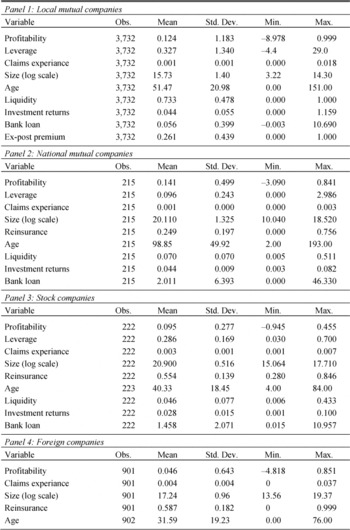
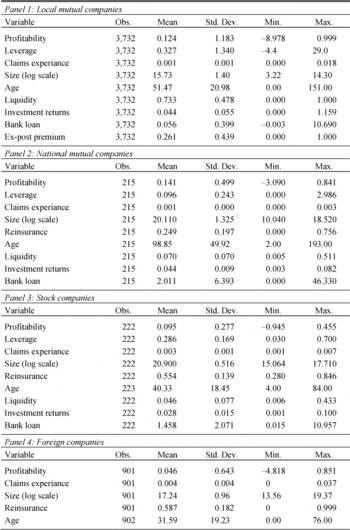
From the late nineteenth century to the immediate post-World War II period, the Swedish fire insurance market became clearly divided according to organizational form with mutual insurers writing mainly household property fire insurance and stock companies covering corporate property fire risks. An indication of this segmentation of Sweden's domestic fire insurance market is revealed from analyzing fire insurance companies’ claims experience. For example, Table 1 indicates that over our period of analysis claims experiences were statistically significantly lower in local mutual insurers compared with stock insurance companies (t-stat 24.2) and foreign companies (t-stat 37.7). Nationwide mutual companies, insuring residential buildings in rural and urban areas, were exposed to roughly equal claims experiences as local mutual insurers.
The results reported in Table 1 also suggest that over our period of analysis the average underwriting profitability of domestic fire insurers was on average roughly similar across organizational forms. A t-test across the domestic organizational forms shows that the differences in profitability are not statistically significant (t-stat < 1.2), although the profitability as a share of premiums ranges from 0.046 for foreign companies to 0.141 for national mutual companies. In turn, the standard deviations in underwriting profitability for local mutual companies of 1.183 and of 0.499 for national mutual companies were substantially higher than the 0.277 measure for stock companies.
Table 1 also shows that the local mutual fire insurers mainly kept their accumulated reserves as cash in banks. National mutual fire insurance firms held higher liquidity ratios of cash to liabilities of 7 percent than the 4.6 percent ratios held by stock companies, while local mutual insurers held liquidity ratios of 73 percent. To offset their lower liquidity ratios, the national mutuals and stock companies purchased significant amounts of reinsurance, an activity in which the local mutuals did not engage.
In the first four decades of the twentieth century, nationwide mutual insurance companies in Sweden were underwriting a fairly homogenous risk portfolio. The key segments were urban household properties (movables and real estate) and properties located in rural areas, such as churches as well as administrative buildings and agricultural facilities. Table 1 shows that the size distribution of insured risks for national mutual fire insurance firms operating in Sweden was fairly concentrated around the mean. The flat risk portfolio is mirrored in their observed claims experience where larger national mutual fire insurers had claims experience of 0.001 claims paid per premiums written that was three times lower than the 0.003 figure for domestic stock fire insurers (t-stat 20.3). Our dispersion measure also shows that national mutual fire insurers had more compressed risk portfolio than other forms of insurance organization as indicated by the standard deviation and minimum-maximum values of incurred claims.
DESCRIPTIVE STATISTICS BY ORGANIZATIONAL FORM
* denotes significance at the 5 percent level.
** denotes significance at the 1 percent level.
The companies used different methods for dealing with large shocks. Local mutual insurance pools mitigated the effects of volatile claims over time by imposing additional ex-post “premium calls” on their members. To alleviate the financial impact of such “premiums calls” on members of the mutual pool, bank loans could be raised to smooth-out claims payments. However, the threat of individual policyholders exiting the mutual insurance pool when faced with an additional premium call also mitigated a great deal by social obligations, trust, and the threat of public sanction from the local community.
In contrast, the larger national mutual and stock fire insurance companies were not in the same position to access and economize on proximate social capital. Ex-post premium calls would potentially have caused large-scale exits from the insurance pool. The likelihood of “insurance pool dilution” meant that the large fire insurers needed to compensate for their lack of social capital with financial capital, namely reserves and/or reinsurance. A small number of mutual fire insurers (such as the Städernas Allmänna Brandstodsbolag) had emerged in the late eighteenth and early nineteenth century. In the early days of operation, social and community-interest concerns were important, while the commercial motives grew stronger in late nineteenth and early twentieth century. The last decades of the nineteenth century also saw the entry of nationwide mutual companies such as Svenska Brand (1890) and Tor (1888). Due to slow growth, the market for mutual insurance was mainly dominated by the older organizations throughout the period that we investigated. The nationwide mutual relied heavily on accumulated reserves to manage their underwriting positions. At the turn of the twentieth century, however, this risk management strategy was modified as reinsurance became increasingly important as it became more available as a form of contingent capital that could be employed by fire insurers to mitigate the effects of adverse claims experience and volatile underwriting.Footnote 43 This enabled the larger fire insurers (both mutual and stock) to leverage new business opportunities (e.g., the industrial property fire insurance sector) and increase their market share. Compared with stock fire insurance companies, national mutual insurance firms mainly relied on accumulated reserves to manage underwriting risks. The national mutual insurers had in effect generally lower leverage levels (t-stat 9.5) and a less of a share of reinsurance coverage (t-stat 18.7) than stock companies.
The changing market structure for fire insurance in Sweden and the increasing role played by stock companies became evident from the late nineteenth century as a result of legislative and regulatory developments. For example, the Stock Corporation Act (1848), along with “nationalistic” public policy concern over an increasing foreign presence in the Swedish insurance market by companies such as Britain's Phoenix and Alliance and Germany's Magdeburg Fire Insurance Company helped to promote the establishment of a Stockholm-based composite (fire and life) national stock insurance carrier—Skandia—in 1855.Footnote 44 The primary purpose of this composite corporate structure was to channel savings from the life insurance lines to fire insurance since the life insurance funds were mainly invested in property mortgages, which in turn required insurance to protect the mortgage security from fire loss. However, over our period of analysis composite insurers such as Skandia and other national stock insurance carriers (e.g., the Malmö-based insurance company, Skåne) became overcapitalized relative to mutual forms of organization as mortality risks and the probability of severe losses from city fires diminished over time in accordance with improvements in life expectancy and advances in building design standards.Footnote 45
In the wake of the growing demand from industry for property fire insurance cover in the late nineteenth century, other non-composite stock companies such as Sverige (1879), Skåne (1884), Norrland (1890), and Victoria-Brand (1899) entered the Swedish property fire insurance market. In underwriting the fire risks of a rapidly expanding manufacturing sector, the underwriting portfolios of these large stock companies became more heterogeneous than those of the early mutual insurers. This increased level of risk diversity emerged not only as a result of the increased variety and complexity of the fire risks involved in industrial activities but also through the size distribution of industrial facilities which tended to be positively skewed. Typically, a few very large companies dominated in each main manufacturing sector of the Swedish economy at the time with a long tail of small enterprises.Footnote 46
By the early 1900s the skewed distribution of property values across Sweden meant that fire risk exposures in the underwriting portfolios of stock insurers become increasing concentrated such that a fire event in a large facility, like a large timber processing plant, could have disastrous financial consequences for the insurer. This called for a risk-sharing strategy which was accomplished though reinsurance and coordination of tariffs organized through the Swedish Fire Tariff Organization (Svenska Brandtarifföreningen).Footnote 47 This organization included both Swedish and foreign joint stock companies, and also a few large mutual organizations. The reason was that reinsurance could be purchased by members of the tariff cartel as common tariffs meant that information asymmetries between primary insurers and reinsurers could be more efficiently addressed. The mobilization of sectional business interests was also a key factor in formalizing praxis into legislation at the turn of the twentieth century. The Insurance Act (1903) further introduced more stringent licensing and solvency monitoring by the Swedish insurance industry regulator—the National Private Insurance Inspectorate—during the period of our analysis.Footnote 48
By meeting the demand from industry for indemnity against the risk of asset loss due to fire, stock insurers gained a strong position in the Swedish property fire insurance market. In 1903 stock companies underwrote roughly 70 percent of annual fire insurance premiums in the Swedish market, while national mutual insurers accounted for approximately 10 percent and local mutual insurers 12 percent of total annual premiums. The remainder was accounted for by foreign insurers. During the interwar period, however, stock insurers lost market share to about 61 percent of annual fire insurance premiums, while national and local mutual insurers increased their respective shares of the domestic market to 20 percent and 14 percent in the late 1930s.
Most of the foreign property fire insurance companies operating in Sweden in the years of the twentieth century up to World War II were British stock insurers, which accounting for about 60 percent of all premiums paid to foreign insurers. A substantial number of these foreign insurance companies were also members in the Swedish Fire Tariff Organization, which gave them access to the fire reinsurance market and fixed industry rates of premium. These foreign fire insurance companies seem to have written property fire risks at the high-risk end of the market, as indicated by their substantially higher claims experience reported in Table 1. For example, foreign stock insurers had 133 percent higher ratios of claims experiences to insurance written than did domestic stock insurers and the difference is statistically significant (t-stat 4.27). Table 1 also shows that on average, foreign companies tended to rely more on reinsurance than domestic companies (t-stat 85.7). Additionally, and consistent with our expectations, foreign fire insurers had significantly lower underwriting profitability than domestic fire insurers (t-stat 20.2).
Our results also suggest that foreign fire insurers tended to rely more on reinsurance than Swedish joint stock companies. This observation suggests foreign companies were operating in narrow but more unpredictable market segments than their Swedish competitors. For example, foreign fire insurance companies tended to underwrite property fire risks in the steam-powered sawmill industry, an industrial sector in which British and German investors owned a significant share of the capacity. Steam mills, and associated timber products, were also prone to accidental fire events. Therefore, for foreign fire insurers aggravated information asymmetries and principal-agent problems could have arisen not only as a result of geographical distance but also because more unpredictable types of risk require more managerial discretion over underwriting terms and premium rates.
UNDERWRITING PROFITABILITY AND RISK STRATEGIES
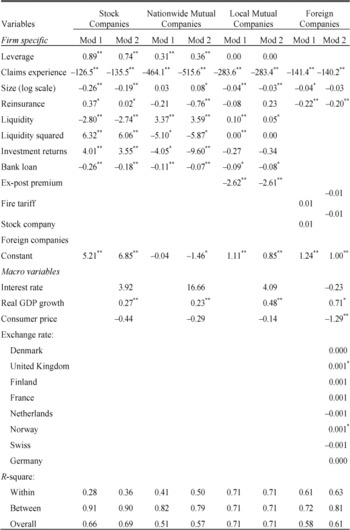
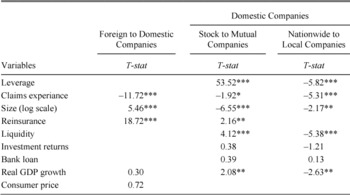
Comparisons of coefficients in Table 2 and the t-tests for the pairwise comparisons in Table 3 show how the profitability of insurers was influenced by different characteristics of the firm and how the firms operated differently. The coefficients for different types of firms tend to be statistically different from each other for all of the characteristics except investment returns and bank loans.
Locally based mutual fire insurance companies experienced volatile underwriting results over the period of study due to higher than expected claims. The coefficients in Table 2 show a negative and statistically significant relationship between claims and underwriting profits for all types of companies. The years when local mutual fire insurers relied on ex-post premiums were the years when underwriting profitability was severely depressed or even negative for a number of local companies. To survive after adverse fire events, ex-post premium calls were often necessary to avoid bankruptcy and maintain underwriting capacity due to the small reserves and the general lack of reinsurance cover held. As their policyholders had limited capacity to accommodate large fire claims and bear the burden of ex-post premiums, local mutual fire insurers became increasingly dependent on short-term bank loans to maintain sufficient levels of liquidity and solvency. Those bank loans had a negative and statistically significant relationship with on underwriting profitability for local mutual insurers, underwriting profitability declined in the aftermath of adverse fire losses. An alternative risk management strategy would have been to accumulate reserves and thereby internalize fluctuations in claims experiences.
MULTIVARIATE ANALYSIS OF UNDERWRITING PROFITABILITY BY ORGANIZATIONAL FORM

* denotes significance at the 5 percent level.
** denotes significance at the 1 percent level.
Sources:
Sveriges Officiella Statistik, Enskilda försäkringsanstalter, annually 1913–1939; and Försäkringsinspektionen, Försäkringsväsendet i riket, annually 1903–1912.
The coefficients and t-tests in Tables 2 and 3 show that the leverage position of companies did not significantly relate to the underwriting profitability of local mutual, but were positively associated with profitability in stock companies and nationwide mutuals. Local mutuals with higher liquidity experienced profitability, in contrast with the negative relationships for stock companies and nationwide mutuals. However, reserve levels are positively correlated with the liquidity and underwriting positions of fire insurance firms. This indicates that the demand for bank loans in cash constrained fire insurance firms was greater than in entities with higher levels of liquidity.
The coefficients in Table 2 show a small negative relation between size and underwriting profitability for local mutuals and a large and negative relationship for stock companies. The potential positive effects of economies of scale and efficient diversification of assumed risks across a larger insurance pool thus appear to be counteracted by associated difficulties in controlling the adverse selection and moral hazard problems. A lower potential to enhance social capital in larger insurance pools might be another reason for worsening underwriting profitability. In addition to the firm's specific characteristics, the profitability of local mutual fire insurers was to some extent related to general trends in the domestic economy. In fact, underwriting profitability was enhanced by higher national rates of real GDP growth for all firms.
Turning to the nationwide mutual insurers, Table 2 shows a significant negative relationship between underwriting profitability and claims experience. The coefficient for nationwide mutuals was substantially larger than for other forms of insurance organization. To adapt to changes in claims experience, the main risk management method used by national mutual fire insurers was to rely on internal reserves and investment returns to finance claims. An additional way to manage periodical increases in the reported level of incurred claims was to use short-term bank loans. The inverse relationship between bank loans and underwriting profitability indicates that loans tended to be taken out as a response to worse than expected claims experience, thereby relieving the pressure on internal reserves. Bank loans can also be seen as a means to manage liquidity constraints arising from weak underwriting profitability. Indeed, Swedish fire insurance firms with high-liquidity positions tended to have significantly stronger underwriting profitability than those that were cash constrained.
T-STATISTICS FOR TESTS OF DIFFERENCES IN COEFFICIENTS BETWEEN ORGANIZATIONAL FORMS FOR CORRELATES OF PROFITABILITY

* denotes significance at the 10 percent level.
** denotes significance at the 5 percent level.
*** denotes significance at the 1 percent level.
Sources:
Sveriges Officiella Statistik, Enskilda försäkringsanstalter, annually 1913–1939; and Försäkringsinspektionen, Försäkringsväsendet i riket, annually 1903–1912.
With regard to the stock fire insurance companies, the results in Tables 2 and 3 shows that the level of claims had a generally weaker negative effect on underwriting profitability than it did for other types of domestic insurers. The downward pressure on underwriting profitability resulting from higher than anticipated claims was mitigated by the large share of reinsurance which provided a contingent capital function in the event of severe fire losses. Table 2 indicates that the level of reinsurance had a statistically significant and positive relation with the underwriting profitability of stock insurers. In cases where the levels of reserves and reinsurance were limited, an additional measure used by stock as well as other Swedish fire insurers was to raise bank loans. In fact, we find a negative and significant relationship of bank loans with underwriting profitability, indicating that bank loans were employed to finance claims and maintain liquidity after adverse fire events.
In contrast to domestic stock companies, reinsurance had a negative effect on the underwriting profits of foreign insurance companies. This finding could indicate that foreign fire insurers were charged higher reinsurance premiums than their Swedish counterparts because they operated in riskier lines of business, like the forest industry, and/or faced relatively greater information asymmetry and agency problems due to the increased geographical distance of their business operations. This relation could also indicate a weak (underpricing) risk assessment by the underwriters of foreign fire insurance companies. Additionally, foreign companies reporting low or negative underwriting profitability could be suspected to be undercutting the tariffs. If the Swedish Fire Tariff Association suspected underpricing of premiums, such foreign companies were unable to purchase reinsurance companies under the terms of the cartel arrangement that existed at the time.
As operators in an “alien” market, foreign fire insurance companies were exposed to additional macroeconomic effects such as exchange rate fluctuations. To address such issues, we tested for the effect of foreign exchange rate movements on underwriting profits. While exchange rate fluctuations helped to improve underwriting profitability for British and Norwegian insurers, other foreign insurers’ underwriting results were largely unaffected by exchange rate fluctuations. When controlling for other external effects on the business of foreign fire insurers, profitability improved in times of market growth, while rising rates of inflation reduced underwriting profits. Foreign fire insurers also tended to be affected more by changes in the level of prices in the economy compared with domestic Swedish fire insurance companies. For example, our results for foreign fire insurers in Table 2 indicate a higher coefficient estimate of 0.71 for real GDP growth in the foreign company equation than the estimates ranging from 0.23 to 04.8 for the three types of domestic companies.
CONCLUSION
Between 1903 and 1939 the ownership structure in the Swedish property fire insurance market was divided between stock and mutual companies. The stock insurers kept a dominant position but their market share declined from 70 percent in 1903 to 61 percent by 1939. Both competing models of insurance organizational form survived and flourished because they specialized in different segments of the fire insurance market. The similarity of underwriting profitability and differences in strategy among domestic fire insurers indicate that the mutual and stock forms of organization had comparative advantages in different areas of business activity—for example, stock insurers generally operated best in national and mutual insurers functioned optimally in local markets. The different growth potential of these markets may be one reason for the growing market share of mutual insurers during the period of study.
Exposure to a high probability and magnitude of fire losses, particularly in manufacturing industries and the positively skewed real estate value distribution in the industrial sector of the Swedish economy in the early 1900s generated significantly higher claims as a share of insurance underwritten for stock insurers compared with their mutual insurance counterparts. To effectively risk-manage policyholders’ fixed claims on the insurance pool over time, stock insurers took on an intermediary role by ceding a substantial share of fire risks written to third party reinsurance companies, (particularly on commercial and industrial properties). In situations where adverse fire events substantively depressed underwriting profitability, short-term bank loans were often used to maintain solvency levels and manage liquidity. Stock fire insurers tended to hold relatively small reserves for internalizing the financial impact of admitted claims and instead they purchased reinsurance to help maximize corporate profits and increase value for shareholders. Stock companies also tended to maintain higher underwriting margins after controlling for firm-specific and macroeconomic effects.
In contrast, the risk management strategy of Swedish mutual fire insurers differed between local mutual fire insurers and larger mutual insurers that wrote business on a national scale. For local mutual fire insurers, the risk management strategy sought to externalize the impact of an adverse claims experience. Such mutual forms of organization relied heavily on the social obligations and the trust inherent in the local community as a means of “contractual enforcement” by demanding additional ex-post premium payments after acute fire loss events so as to avoid dilution of the insurance pool. In these circumstances, social capital essentially substituted for financial capital such as reinsurance and reserves. To help mitigate the financial burden placed on their policyholders, local mutual fire insurers would frequently use short-term bank loans to supplement ex-post premium payments from their policyholders and maintain statutory prescribed levels of solvency.
In the urban housing market, the principle of mutuality was modified to cope with the disparate policyholder membership of the insurance pool, and in many cases, private household fire risks were insured with national mutual fire insurance firms. Their risk management strategy sought to internalize the effect of fluctuating claims on the insurance pool. Unlike their local mutual counterparts, national mutual fire insurers could not rely on trust and social obligation to maintain the insurance pool after severe loss to the same degree. Instead, larger mutual fire insurance organizations had to accumulate and maintain reserves. National mutual fire insurers used accumulated reserves to cross-subsidize the underwriting function and thereby reducing premium rates for their policyholder-owners. By keeping large reserves and ceding extreme tail end fire risks to third party reinsurance companies, large national mutual fire insurance companies could help keep their “policyholders on board” and still grow their business in the expanding housing market in Sweden, particularly during the interwar years.
The results of our research therefore indicate that the evolving structure of insurance markets was related not only to institutional developments and changes in the macroeconomy, but also influenced by how different forms of organization used their particular comparative economic advantages to maintain underwriting profitability over time in different segments at the insurance market. This insight should help other scholars in examining the historical development of insurance markets as well as other organizational forms in other countries.