Introduction
Borderline personality disorder (BPD) is the most prevalent Axis II disorder in clinical settings (Skodol et al. Reference Skodol, Gunderson, McGlashan, Dyck, Stout, Bender, Grilo, Shea, Zanarini, Morey, Sanislow and Oldham2002). BPD patients have been described as receiving an ‘enormous amount of psychiatric treatment’ in the USA (Zanarini & Frankenburg, Reference Zanarini and Frankenburg2001), including more extensive out-patient, in-patient and pharmacological treatment, together with every type of psychosocial treatment compared to patients with depressive disorder (Bender et al. Reference Bender, Dolan, Skodol, Sanislow, Dyck, McGlashan, Shea, Zanarini, Oldham and Gunderson2001) and other personality disorders (Zanarini & Frankenburg, Reference Zanarini and Frankenburg2001; Zanarini et al. Reference Zanarini, Frankenburg, Vujanovic, Hennen, Reich and Silk2004). Such effects may be directly attributable to BPD psychopathology, or might be mediated by a co-morbid Axis I disorder, the prevalence of which is elevated among persons with BPD (Skodol et al. Reference Skodol, Oldham, Hyler, Stein, Hollander, Gallaher and Lopez1995, Reference Skodol, Stout, McGlashan, Grilo, Gunderson, Shea, Morey, Zanarini, Dyck and Oldham1999; Zimmerman & Mattia, Reference Zimmerman and Mattia1999). Co-morbid Axis I and other Axis II disorders are associated with poorer long-term outcome in BPD (Hull et al. Reference Hull, Yeomans, Clarkin, Li and Goodman1996; Goodman et al. Reference Goodman, Hull, Clarkin and Yeomans1998; Paris & Zweig-Frank, Reference Paris and Zweig-Frank2001; Zanarini et al. Reference Zanarini, Frankenburg, Vujanovic, Hennen, Reich and Silk2004). However, most information on BPD is derived from treatment-seeking samples and may therefore reflect selection bias (Bender & Skodol, Reference Bender and Skodol2003). Little is known about the effects of BPD on social functioning and service use in the general population. Epidemiological studies, using representative samples of BPD, are necessary to complete the description of the borderline spectrum in the general population and examine whether there are individuals with BPD who have not received treatment and who have different characteristics from participants in clinical samples. We estimated the prevalence of BPD using a self-report instrument, examined associations with demographic characteristics, co-occurring mental (Axis I) disorders, and treatment seeking from clinical and institutional services, among a representative sample of adults in Great Britain, conducted in 2000.
Method
Sample
The sample was drawn from those participating in the British National Survey of Psychiatric Morbidity, aged 16–74 years and living in private households in England, Wales or Scotland (Singleton et al. Reference Singleton, Bumpstead, O'Brien, Lee and Meltzer2001). This was a two-phase survey design. In phase I, participants completed computer-assisted interviews with Office for National Statistics interviewers, an interview lasting approximately 1½ hours. The Royal Mail's Small User Postcode Address File was used as the sampling frame for private households. Postcode sectors were stratified within each National Health Service (NHS) region on the basis of socio-economic profile. Initially, 438 postal sectors were selected with a probability proportional to size (i.e. the number of delivery points). Postal sectors contain on average 2550 of these. Within each of these sectors, 36 were selected, yielding a sample of 15 804 delivery points. These were visited to identify private households with at least one person aged 16–74 years. The Kish grid method (Kish, Reference Kish1965) was used to select systematically one person in each household.
A total of 8886 adults completed a first-phase interview, a response rate of 69.5%. Among non-respondents, 24% were refusals and 6.5% were non-contacts. However, weighting procedures applied through the analyses took into account the proportions of non-respondents according to age, sex and region to ensure a sample representative of the national population, compensating for sampling design and non-respondents in the standard error of the prevalence and controlling for the effects of selecting one individual per household.
Complete questionnaires were available for 8397 (94.5%) respondents.
Measurement of psychiatric morbidity
Personality disorder (PD) was measured according to DSM-IV Axis II criteria, using the screening questionnaire for the SCID-II (First et al. Reference First, Spitzer, Williams, Gibbon and Benjamin1997). Subjects gave ‘yes’ or ‘no’ responses to 116 questions on laptop computers. Apart from conduct disorder, all questions addressing the criteria of the 10 DSM-IV PDs referred to lifetime experiences. Ten categories of Axis II disorder were created from continuous data by imposing cut-off points that had been previously identified in another large, cross-sectional survey of prisoners (Singleton et al. Reference Singleton, Meltzer, Gatward, Coid and Deasy1998; Ullrich et al. Reference Ullrich, Deasy, Smith, Johnson, Clarke, Broughton and Coid2008). In that study the cross-instrument validity of the SCID-II screen and the SCID-II structured clinical interview was examined in a sample of 496 male and female prisoners. The SCID-II screen was adjusted on the basis of interview results. Diagnostic categories were compared before and after adjustment of the screen and the screen retained good internal consistency with improved discrimination between PDs and other clinical syndromes. In this study, categorical diagnoses derived with the prisoner algorithm were compared with the second-phase clinical interview data to test the accuracy of self-report in the household sample. The sensitivity and specificity of the SCID-II screen for PDs in this British household survey were: 0.79/0.93 for avoidant, 0.67/0.97 for dependent, 0.83/0.88 for obsessive–compulsive, 0.71/0.86 for paranoid, 1.00/0.93 for schizotypal, 1.00/0.83 for schizoid, –/1.00 for histrionic, –/1.00 for narcissistic, 0.62/0.94 for borderline, and 0.80/0.88 for antisocial PD. As the prevalence of histrionic and narcissistic PD was very low, it was not possible to calculate sensitivity for these two diagnoses.
The revised version of the Clinical Interview Schedule (CIS-R; Lewis et al. Reference Lewis, Pelosi, Araya and Dunn1992) was used to obtain the prevalence of common mental disorders in the past week (affective and anxiety disorders), using the ICD-10 classification (WHO, 1993), including generalized anxiety disorder, mixed anxiety and depression, depressive episodes, phobias, obsessive–compulsive disorder, and panic disorder. These six syndromes were combined into a single category of ‘any’ affective or anxiety disorder.
Participants screened positive for psychosis if any two of four criteria were present within the year before interview from the Psychosis Screening Questionnaire (Bebbington & Nayani, Reference Bebbington and Nayani1994). The principal instrument to assess alcohol misuse over the past year was the Alcohol Use Disorders Identification Test (AUDIT), which defines hazardous alcohol use (score of ⩾8) as an established pattern of drinking that brings risk of physical and psychological harm over the previous year (Babor et al. Reference Babor, Higgins-Biddle, Saunders and Monteiro1992). The Severity of Alcohol Dependence Questionnaire (SADQ; Stockwell et al. Reference Stockwell, Murphy and Hodgson1983) was included to measure alcohol dependence. A number of questions designed to measure drug use were included in the phase I interviews. Positive responses regarding a series of different substances (cannabis, amphetamines, cocaine, crack cocaine, ecstasy, tranquillizers, opiates and volatile substances) to any of five questions measuring drug dependence over the past year were combined to produce a single category of ‘any’ drug dependence (Singleton et al. Reference Singleton, Bumpstead, O'Brien, Lee and Meltzer2001).
A category of ‘no psychiatric disorder’ was applied to respondents who did not have PD, affective or anxiety disorder, drug or alcohol dependence, or possible psychosis.
Measures of service use
Participants were asked (i) if they had ever been a psychiatric in-patient; (ii) if they had consulted their general practitioner (GP), a psychiatrist, psychologist, social worker, community or other nurse, or attended a self-help group in the past year; and (iii) to report a series of social and behavioural problems at any time over their lifetime, including being in an institution or being taken into local authority care before 16 years, experiencing severe illness/assault, serious problems with friends or relatives, financial crisis, violence in their workplace, sexual abuse, homelessness, problems with the police/courts or whether they had assaulted or been in a fight with another person in the past 5 years.
Statistical analysis
When estimating the prevalence of psychiatric disorders in the population of Great Britain, weights were used to account for unequal selection of probabilities in the two-phase sample survey (Singleton et al. Reference Singleton, Bumpstead, O'Brien, Lee and Meltzer2001). Cross-tabulation was used to calculate prevalence of psychiatric disorders according to treatment seeking and psychiatric admission. χ2 tests were carried out to test differences in the prevalence of BPD between category levels of each demographic variable. Odds ratio (OR) estimates for BPD according to demographic factors were carried out using logistic regression analyses, adjusting for other demographic factors.
The likelihood of treatment seeking among the BPD group was compared with that of other persons in the sample. Further adjustment of the OR for confounding factors such as demographic characteristics, Axis I disorders, substance use problems, psychosis and other Axis II disorders (except BPD) was carried out using logistic regression analysis. The same measures of ORs and adjusted ORs (aORs) were also calculated for the risk of co-morbidity of Axis I disorders and social/behavioural problems among BPD in comparison to others.
ORs were calculated and adjusted for demographic factors as well as Axis II disorder, excluding BPD, to compare the prevalence of Axis I disorders and substance use problems between treatment-seeking and non-treatment-seeking participants with BPD.
All analyses were performed using SPSS version 14 (SPSS Inc., Chicago, IL, USA).
Results
Demography
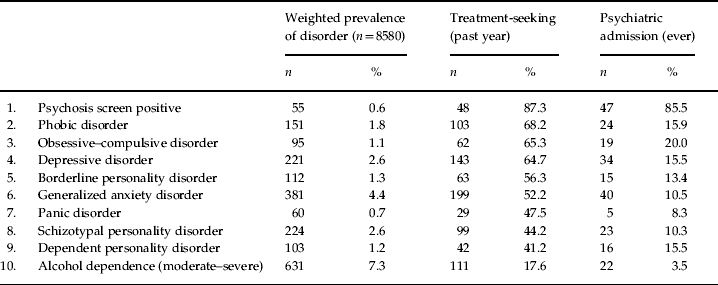
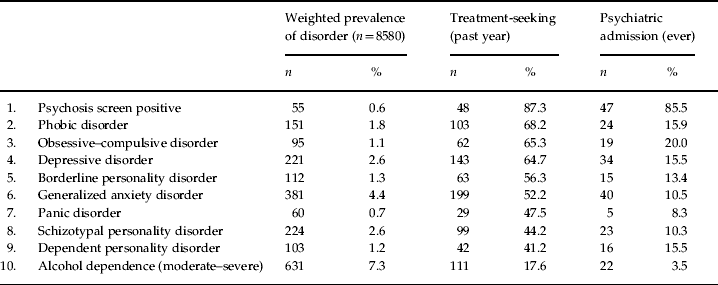
Weighted data from 8397 respondents included 113 (1.4%) who received a diagnosis of BPD following self-report using the SCID-II screen. The prevalence of BPD was 1.3% [95% confidence interval (CI) 1.1–1.6]. Table 1 ranks the 10 most prevalent Axis I and II disorders in the survey and the prevalence of participants who reported a consultation with a GP or mental health professional in the past 12 months for nervous or emotional problems, and those reporting admission to a psychiatric hospital over their lifetime. Participants who screened positive for psychosis were more likely to have both sought treatment and been admitted to hospital than participants with other disorders. Those with BPD were ranked fifth in reporting seeking treatment in the past 12 months, and sixth in reporting psychiatric admission. Participants with BPD were also more likely to report seeking treatment over the past 12 months than the other Axis II disorders. However, participants with dependent PD were somewhat more likely to report lifetime psychiatric hospital admission.
Prevalence of 10 psychiatric disorders ranked according to prevalence of those reporting treatment
At the time of interview, 35 (30.9%) participants with BPD reported receiving psychotropic medication, including 32 (28.3%) antidepressants and eight (7.2%) antipsychotics. Twelve (10.6%) reported that they were currently receiving individual or group psychotherapy or psychoanalysis, 11 (9.7%) counselling, two (1.8%) sex therapy, and only one cognitive therapy.
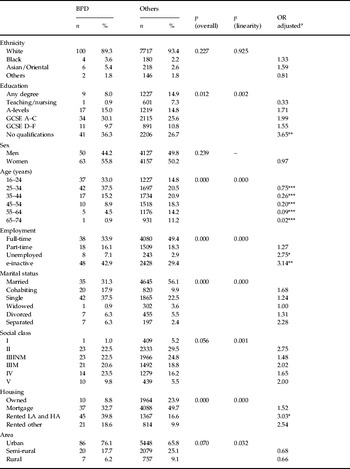
Table 2 demonstrates the demographic characteristics of BPD. There was no difference in prevalence according to gender or between different ethnic subgroups. BPD was significantly more common among those with no qualifications, unemployed or economically inactive persons and those living in rented accommodation (provided by government authority rather than privately rented). The distribution of BPD among different age bands in the population demonstrated a marked decline in observed prevalence with increasing age. Linear demographic trends also included the tendency for borderline patients to have fewer qualifications and to be less likely to live in rural and semi-rural than urban locations. They were less likely to be married and more likely to be separated from previous relationships. There was a linear association indicating increasing prevalence with lower social class.
Demographic characteristics of persons with BPD in the household population (weighted)

BPD, Borderline personality disorder; OR, odds ratio; LA, local authority; HA, housing association.
a Adjustment: other demographic characteristics.
* p<0.05, ** p<0.01, *** p<0.001.
Treatment-seeking behaviour and co-morbidity
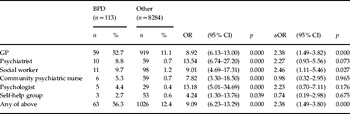
Table 3 demonstrates the treatment-seeking behaviour of participants with BPD compared to the rest of the household population. Over half of persons with BPD had seen a health-care professional, a social worker or their GP for nervous or emotional problems in the previous 12 months. When these figures were adjusted for demography and co-morbid Axis I and Axis II disorders, a diagnosis of BPD increased the likelihood of treatment seeking from any professional more than twofold compared to the rest of the population, and more than twofold from their GP and social worker. However, persons with BPD were no more likely to seek help from mental health professionals following adjustments.
Treatment seeking for nervous/emotional problems in the past 12 months (weighted prevalence)

GP, General practitioner; BPD, borderline personality disorder; OR, odds ratio; CI, confidence interval; aOR, adjusted OR [adjusted for no education, unemployment, age, rented housing, neurotic disorder, psychosis positive, drug dependence, alcohol, any PD (excluding BPD)].
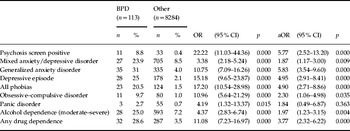
Table 4 demonstrates a high level of co-morbidity of BPD with Axis I disorders compared to the rest of the population. The odds of association decreased after controlling for demographic factors and other PDs. However, significant associations remained with screening positive for psychosis, generalized anxiety disorder, phobic disorder, depression, drug dependence, obsessive–compulsive disorder, alcohol dependence, and mixed anxiety/depressive disorder. The previous association with panic disorder was no longer significant following adjustments.
Co-morbidity of Axis I disorders in household population (weighted prevalence)

BPD, Borderline personality disorder; OR, odds ratio; CI, confidence interval; aOR, adjusted OR [adjusted for no education, unemployment, age, rented housing, and any PD (excluding BPD), neurotic (for psychosis), psychosis (for other categories)].
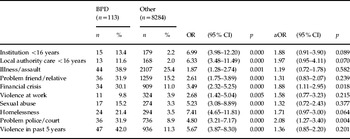
Table 5 demonstrates associations between BPD and a range of social and behavioural problems reported over the lifetime. However, following adjustments for demography and Axis I and Axis II co-morbidity, BPD was independently associated with a history of financial crises and reported problems with the police/courts.
Associations between social and behavioural problems reported over the lifetime (weighted prevalence)

BPD, Borderline personality disorder; OR, odds ratio; CI, confidence interval; aOR, adjusted OR [adjusted for no education, unemployment, age, rented housing, neurotic disorder, psychosis positive, drug dependence, alcohol, any PD (excluding BPD)].
Characteristics of treatment-seeking BPD
Of the 113 persons who received a diagnosis of BPD, 65 (57.5%) had consulted a GP, mental health professional or social worker in the past year for nervous or emotional problems. When compared to those who had not consulted a professional, they were significantly older (mean=33.8 years, s.d.=12.2 v. mean=28.1 years, s.d.=10.2, t=2.66, p=0.009); more were white (95.3% v. 79.6%) or of other ethnic origin (4.7% v. 0%), and fewer were black African or Caribbean origin (0% v. 8.2%) or Asian/Oriental ethnic origin (0% v. 12.2%, χ2=16.13, df=3, p=0.003); they were less likely to be employed full-time (22.6% v. 49.0%), part-time (14.5% v. 17.6%) or unemployed (4.8% v. 9.8%), but were more likely to be economically inactive (58.1% v. 23.5%, χ2=14.67, df=3, p=0.002); they were more likely to live in a home owned by themselves or a member of their family (12.7% v. 4.0%), were less likely to be purchasing a home with a mortgage or loan (27.0% v. 40.0%), more likely to be renting from a local authority (50.8% v. 26.0%), and less likely to be renting from other (primarily private) landlords (9.5% v. 30.0%, χ2=14.42, df=3, p=0.002). There were no significant differences between the two subgroups according to gender, educational qualifications, marital status, social class or characteristics of the area in which they lived.
To examine severity of BPD in the two subgroups, the prevalence of individual items and mean number of items were compared. There were no significant differences between persons with BPD who sought treatment and others in the prevalence of eight of the nine items or the mean number of items in each group (mean=7.6, s.d.=0.68 v. mean=7.5, s.d.=0.65). Only item 4, impulsivity, was reported more frequently among the treatment-seeking group (59, 93.7% v. 39, 79.6%, p=0.026). Further comparisons were made between the prevalence of other, co-morbid Axis II disorders, adjusting for demographic differences between the two subgroups, any anxiety or affective disorder, screening positive for psychosis, and other PDs (excluding the category under investigation). Avoidant PD was the only Axis II disorder to demonstrate a bivariate association with treatment seeking. This was no longer significant following adjustments.
The two subgroups were compared according to the social and behavioural problems previously demonstrated for the total sample in Table 5. Following adjustments for demography and co-morbid Axis I and Axis II disorders, no significant differences were observed between the two subgroups on any of these variables.
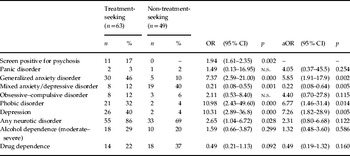
Table 6 compares co-morbid Axis I disorders among treatment-seeking and other participants with BPD. Only treatment-seeking participants with BPD screened positive for psychosis. Following adjustments for demographic differences and other co-morbid Axis II disorders, the treatment-seeking borderlines were significantly more likely to receive a co-morbid diagnosis of generalized anxiety disorder, phobic disorder and depression, but were less likely to receive a diagnosis of mixed anxiety/depressive disorder. Only treatment-seeking borderlines reported that they had ever been admitted to a psychiatric hospital (15.2%). The higher prevalence of reporting a lifetime suicide attempt (57% v. 29%) was no longer significant following adjustments.
Comparison of participants with borderline personality disorder (BPD) who sought treatment in the past 12 months (n=113)

OR, Odds ratio; CI, confidence interval; aOR, adjusted OR [adjusted for age, ethnicity, employment, any personality disorder (excluding BPD)]; n.s., not significant.
Discussion
The prevalence of BPD in this representative British household population was 1.3% (95% CI 1.1–1.6), and in accordance with a recent epidemiological US survey that reported a prevalence estimate of 1.4% (Lenzenweger et al. Reference Lenzenweger, Lane, Loranger and Kessler2007). The prevalence in that study rose slightly to 1.6% when a subsample were assessed using the structured clinical interview of the International Personality Disorder Examination (IPDE; Loranger, Reference Loranger1999) instead of the screening questionnaire.
Previous epidemiological research has shown that BPD is associated with impaired health status, greater utilization of mental health-care resources and psychotropic medication, and more functional impairment based on social, occupational and early adverse life-event measures when compared with respondents without this diagnosis (Connor et al. Reference Connor, Davidson, Hughes, Swartz, Blazer and George2002). However, our study demonstrated that many of the functional effects of BPD, together with their treatment-seeking behaviour, were mediated through the relationship between BPD and co-morbid Axis I disorders. Specific associations were identified between co-morbid psychotic, generalized anxiety, phobic and depressive disorders. Treatment seeking was not due to other co-morbid Axis II disorders. This has been observed in a recent survey where the associations between functional impairment and BPD but also with other Axis II personality disorders were largely accounted for by Axis I co-morbidity (Lenzenweger et al. Reference Lenzenweger, Lane, Loranger and Kessler2007). It has been suggested that the main public health significance of PDs lies in their effects on Axis I disorders rather than in their effects on functioning.
There was no convincing evidence that persons with BPD seeking treatment were suffering from a more severe form of BPD measured on the basis of their Axis II psychopathology. Furthermore, there was no indication that they had presented to services because they had experienced more traumatic events over their lifetime such as physical or sexual abuse. However, they were more likely to report financial difficulties, to have been homeless, and to have had problems with the police/courts. These results support previous findings of a study from Comtois et al. (Reference Comtois, Russo, Snowden, Srebnik, Ries and Roy-Byrne2003) who compared high and low use of public mental health services by persons with BPD. Although high-use BPD individuals were characterized by a higher prevalence of anxiety disorder, post-traumatic stress disorder, a history of para-suicide and poorer cognitive functioning, life stressors and global functioning did not differentiate between the two BPD groups.
After controlling for demographic differences and co-morbid Axis I disorders, the only health-care professional a participant with BPD was likely to consult was their GP or social worker. Consultations with professionals working in mental health services had resulted from co-morbid Axis I disorders, including substance dependence. These findings are consistent with research in primary care demonstrating that, although persons with PD accrue increased health service costs, this is mediated by an interaction between PD and common mental disorder (Rendu et al. Reference Rendu, Moran, Patel, Knapp and Mann2002).
Comparable with previous research (Comtois et al. Reference Comtois, Russo, Snowden, Srebnik, Ries and Roy-Byrne2003), persons with BPD in our household sample who sought help were no more likely to be women. Epidemiological studies in Australia (Jackson & Burgess, Reference Jackson and Burgess2004), Oslo (Torgersen et al. Reference Torgersen, Kringlen and Cramer2001), Great Britain (Coid et al. Reference Coid, Yang, Tyrer, Roberts and Ullrich2006) and the USA (Lenzenweger et al. Reference Lenzenweger, Lane, Loranger and Kessler2007) have demonstrated that the prevalence of BPD does not differ between the sexes. It is possible that previous misconceptions regarding gender differences have been due to sampling bias. Many previous studies have included highly selected treatment samples, often patients attending university hospitals.
These findings also reflect the characteristics of the UK NHS, funded by taxation rather than insurance contributions and where severe and enduring mental illness (primarily psychosis) is prioritized by the Department of Health. Depression is associated with higher health services costs than BPD in the UK (Chiesa et al. Reference Chiesa, Fonagy, Holmes, Drahorad and Harrison-Hall2002). Individuals with PD have not been prioritized by health-care professionals in the past in the UK (NIMHE, 2003). However, increasing media and public interest in the UK in the treatment of persons with PD and in their risk of violent offending, together with ongoing development of treatment guidelines, may result in an increasing number presenting to mental health services in the future.
‘High-functioning’ BPD
More than 40% of persons with BPD in the household population had had no contact with their GP or a mental health professional in the past 12 months, and none of this subgroup had ever been a psychiatric in-patient. Protective factors for other psychiatric disorders, such as higher social class, marital status (suggesting more stable relationships) and higher educational qualifications, did not differentiate this subgroup. However, they did seem to be functioning more effectively in the community because more than two-thirds were employed, many attempting to purchase their own homes or renting privately, instead of being housed in local authority accommodation. Although more were of Black and South Asian ethnicity, there is no evidence that persons of Black and South Asian ethnicity in the UK are more likely to be personality disordered (Coid et al. Reference Coid, Yang, Tyrer, Roberts and Ullrich2006). The tendency for minority subgroups with BPD to be less likely to use services has previously been observed among prisoners in England and Wales (Coid et al. Reference Coid, Petruckevitch, Bebbington, Brugha, Bhugra, Farrell, Lewis and Singleton2002) and is due to patient selection by mental health professionals and greater reluctance to seek help for problems due to PD from individuals within these minority groups.
Psychopathology among those people with BPD who were ‘high functioning’ was no less severe, although they were younger and less likely to meet criteria for co-morbid psychotic, affective or anxiety disorders. It is likely that the absence of co-morbid mental health problems was the important factor in determining their better social adjustment.
Treatment-seeking behaviour in this community sample did not seem to correspond to measures of prognosis such as ‘remitted’ and ‘active’ BPD, as indicated by the number of items falling below a threshold for the diagnosis (Frankenburg-Francis & Zanarini, Reference Frankenburg-Francis and Zanarini2006). The findings also did not correspond to treatment samples that have demonstrated that additional Axis II co-morbidity, particularly the anxious cluster, is associated with poorer prognosis in terms of remission (Zanarini et al. Reference Zanarini, Frankenburg, Vujanovic, Hennen, Reich and Silk2004, Reference Zanarini, Frankenburg, Hennen, Reich and Silk2006). However, this was a cross-sectional survey and the participants with BPD we have described as high functioning were only included if they fulfilled the required number of criteria for the BPD diagnosis. Individuals with good prognostic features, and those who had shown a decline in the number of their (previous) borderline items, may have been excluded. Furthermore, although younger age has been identified as a predictor of remission (Zanarini et al. Reference Zanarini, Frankenburg, Hennen, Reich and Silk2006), and characterized our high-functioning subgroup, it cannot be assumed that these younger individuals had a better long-term prognosis without further longitudinal study.
The findings did, however, correspond to the observation that poor functioning, measured by frequent hospitalization, is associated with psychotic symptoms (Hull et al. Reference Hull, Yeomans, Clarkin, Li and Goodman1996). However, this outcome was not associated with depressive disorder in this previous study.
Methodological limitations
The community-based design and large sample size allowed us to examine the associations between BPD and a series of associated mental disorders, social and behavioural problems and treatment-seeking behaviours without introducing the selection bias usually associated with treated samples. Furthermore, the sample size provided sufficient statistical power to test complex models and to control for confounding from demographics and co-morbidity. However, certain associations identified in the study must be viewed with caution in the light of certain limitations. First, the study was cross-sectional and we cannot address issues relating to the temporal sequence behind associations. Only longitudinal studies can inform about causes and consequences with respect to Axis I and Axis II psychopathology and treatment-seeking behaviour.
Second, Axis I and Axis II diagnoses were both derived from self-report questionnaires in the first phase of the survey. SCID-II was not developed to diagnose PD in the absence of a second-stage clinical interview. In addition, PD questionnaires are susceptible to reporting bias (Zimmerman, Reference Zimmerman1994), produce higher prevalence rates than interviews (Hunt & Gavin, Reference Hunt and Gavin1992), and mentally unwell participants may have been more likely to report personality pathology, leading to misclassification of PD status. Nevertheless, self-report questionnaires have been used in other community surveys of PD (Jackson & Burgess, Reference Jackson and Burgess2004) and our use of a brief questionnaire made it possible to obtain data in a large sample of participants. Furthermore, comparison of self-report and interview-derived diagnoses in the second phase of the survey indicated sufficient accuracy for the self-reported PDs. Nevertheless, these analyses could not be carried out for Axis I mental disorders. Furthermore, the time-span covered by these diagnoses differed (1 week before the interview for affective and anxiety disorders, 1 year before the interview for psychosis, alcohol- and drug-related disorders). This might affect the comparability of our results with other studies that used lifetime or present-state diagnoses but should not significantly impact on the comparison of BPD and the rest of the population, particularly because potential confounders (age and gender) were adjusted for throughout.
Third, there was no information on psychiatric status of non-respondents to conclude whether attrition resulted in biased estimates in the prevalence of self-reported PD. However, the second-phase sample was considerably smaller (Coid et al. Reference Coid, Yang, Tyrer, Roberts and Ullrich2006) and prevalence figures were too small to permit detailed statistical analyses.
Fourth, the category screening positive for psychosis was not specific to individual diagnostic categories of psychosis and the prevalence of these individuals was unexpectedly low. This variable was used as a screen in the first phase to identify participants for interview with diagnostic instruments for psychotic illness that were administrated by clinically trained raters in the second phase of the survey.
Separating BPD and the Axis I disorders
The study indicated that co-morbid Axis I disorders were acting independent of the level of severity of the underlying borderline psychopathology to determine social functioning and treatment-seeking behaviour. The apparent independence of Axis I conditions could have been an artefact of the study method, which did not allow further examination of the fluctuating nature of the functional impairments (Skodol et al. Reference Skodol, Pagano, Bender, Shea, Gunderson, Yen, Stout, Morey, Sanislow, Grilo, Zanarini and McGlashan2005) and relationship between BPD and the co-morbid disorders (Coid, Reference Coid1993). Complex and severe PDs such as BPD have been observed to have a negative impact on the outcome of most Axis I disorders (Tyrer & Mulder, Reference Tyrer and Mulder2006). However, the reverse association appears more complex, according to previous research. Although BPD patients with co-morbid mood disorders have been observed in certain studies to have a higher social and occupational functioning, freedom from residual symptoms and better improvement following treatment than BPD patients without co-morbid mood disorders (McGlashan, Reference McGlashan1983, Reference McGlashan1987; Pope et al. Reference Pope, Jonas, Hudson, Cohen and Gunderson1983), patients with co-morbid mood disorders more often have completed suicide at follow-up and make greater use of psychiatric treatment (McGlashan, Reference McGlashan1987). BPD patients with co-morbid mood disorders also demonstrate generally higher overall symptom levels and poorer treatment outcomes than patients with either mood disorders alone or only BPD. BPD patients with psychotic symptoms also experience higher rates of rehospitalization, higher symptom levels and poorer treatment outcomes than BPD without psychotic symptoms (Jonas & Pope, Reference Jonas and Pope1984; Kernberg, Reference Kernberg1984; Perry, Reference Perry1988; Links et al. Reference Links, Steiner and Mitton1989; O'Connell et al. Reference O'Connell, Cooper, Perry and Hoke1989; Stone, Reference Stone1990). However, it has been argued that BPD patients with narrowly defined psychotic symptoms, such as hallucinations and delusions, almost always have co-morbid mood disorders or substance misuse (Goodman et al. Reference Goodman, Hull, Clarkin and Yeomans1998). Fluctuating levels of psychotic symptoms are frequently reported by BPD patients.
Previous research has not resolved whether BPD is truly separate from the Axis I disorders and it is probable that it will be included as a clinical syndrome in the forthcoming DSM-V. It has been suggested that BPD is on the spectrum of affective disorders (Akiskal, Reference Akiskal1981; McGlashan, Reference McGlashan1983) or a specific variant of affective disorder (Coid, Reference Coid1993). However, it was beyond the scope of this study to examine whether it is a variant of either an affective or other Axis I disorder, predisposes individuals to Axis I disorders, or whether co-morbid Axis I disorders have common aetiological features with BPD (Gunderson & Phillips, Reference Gunderson and Phillips1991; Koenigsberg et al. Reference Koenigsberg, Anwunah, New, Mitropoulou, Schopick and Siever1999). Nevertheless, the study confirmed that BPD is highly co-morbid with other psychiatric disorders and that it is co-morbid Axis I and not Axis II psychopathology that ultimately determines the level of social functioning and treatment-seeking behaviour among borderlines in the general population. It questions whether greater emphasis should be placed on developing treatment interventions for co-morbid psychopathology and whether established interventions currently being used in the treatment of BPD exert their therapeutic effects primarily on their co-morbid Axis I symptoms.
Acknowledgements
This study was funded by the Department of Health.
Declaration of Interest
None.