





Breastfeeding is the natural and biologically normal way of feeding infants and young children, ensuring optimum growth and development(Reference Purkiewicz, Regin and Mumtaz1). Breastfeeding offers a range of health benefits for mothers and infants. Infants who are breastfed have a reduced risk of developing asthma, obesity, type 1 diabetes and sudden infant death syndrome. Significant health benefits for mothers include a reduced risk of developing breast and ovarian cancers, type 2 diabetes, hypertension(Reference Meek and Noble2) and cardiovascular disease(Reference Tschiderer, Seekircher and Kunutsor3). Breastfeeding is an environmentally sustainable practice with little or no waste, has a low carbon footprint and helps conserve natural resources(Reference Mohapatra and Samantaray4).
National and international recommendations from both the Health Service Executive, WHO and UNICEF state that infants should be exclusively breastfed (EBF) for the first six months of life, with continued breastfeeding to 2 years and beyond, along with complementary foods(5,6) . However, despite these recommendations, Ireland has one of the lowest breastfeeding rates worldwide. In 2022, only 44 % of infants in Ireland were EBF upon discharge from maternity services(7).
Women’s personal breastfeeding duration goals, whether those were met and their satisfaction with their own breastfeeding journey, has been minimally explored both in Ireland and elsewhere. A 2022 survey found that among over 5000 women who intended to breastfeed, just over 40 % planned to breastfeed for up to six months, 22 % aimed to breastfeed for up to one year, and 25 % did not have a specific breastfeeding goal(Reference O’Sullivan and Beatha8). The misalignment between women’s personal breastfeeding goals and the recommendations from public health bodies suggests that current metrics for determining breastfeeding success used by researchers and public health authorities may not always be appropriate. While it remains important to encourage higher prevalence of breastfeeding, it is arguably equally important to celebrate women’s individual achievements and support women in feeling positive about their breastfeeding journey.
Breastfeeding peer supporters have an important role to play in supporting mothers to work towards achieving their personal breastfeeding goals. Peer supporters are women with personal breastfeeding experience who offer practical support and emotional encouragement to other breastfeeding mothers(Reference Dennis9,Reference Yang, Liu and Cui10) . By sharing lived experiences and providing guidance, they help new mothers navigate challenges and gain confidence in their breastfeeding journey(Reference Dennis9,Reference Yang, Liu and Cui10) . Peer supporters may provide support through group settings or one-to-one interactions(Reference McCarthy, De Vries and Gallagher11). Evidence suggests that women value the approachability and non-judgmental, woman-centred approach of peer supporters, which helps to build maternal confidence, support emotional well-being and increase satisfaction with their breastfeeding journey(Reference Chang, Beake and Kam12). Unlike healthcare professionals, who are often constrained by clinical targets and time pressures(Reference Rossman, Engstrom and Meier13), peer supporters can provide flexible, individualised support that validates women’s personal breastfeeding goals rather than relying solely on breastfeeding rates or duration to define success.
Previous quantitative research has explored the effectiveness of peer support (PS) in improving breastfeeding outcomes, based on traditional metrics of success. A systematic review from 2017 found that community-based breastfeeding PS not only increased the duration of EBF, particularly for infants aged three to six months in low- and middle-income countries, but also encouraged mothers to initiate breastfeeding earlier and decreased pre-lacteal feeding(Reference Shakya, Kunieda and Koyama14). However, some trials did not find any significant benefit of PS on breastfeeding rates at time periods such as 10–14 d, 6 weeks or 6 months(Reference Jolly, Ingram and Freemantle15) and initiation rates for breastfeeding did not differ between the intervention group (IG) (69·0 %) and control group (CG) (68·1 %) in another trial(Reference MacArthur, Jolly and Ingram16).
In Ireland, previous research has primarily examined the effectiveness of breastfeeding support groups(Reference Quinn, Gallagher and De Vries17,Reference Nolan, Kennedy and O’Malley18) and support provided by healthcare professionals(Reference Lawlor, Prihodova and Byrne19,Reference O’Reilly, McNestry and McGuinness20) . To date, however, no published studies to our knowledge have explored the specific impact of one-to-one PS in the Irish context. There is currently limited understanding of how one-to-one PS is experienced by mothers or of the barriers and facilitators that influence its delivery, acceptability and perceived value. Exploring this form of support is important, as one-to-one PS may function as an additional and more individualised model of breastfeeding support alongside existing group-based and professional services. This is particularly important given evidence that, while women are encouraged to breastfeed during pregnancy, many experience limited postnatal breastfeeding support in practice(Reference O’Sullivan and Beatha8). Addressing this gap will contribute to a more comprehensive understanding of how PS can best be integrated into breastfeeding support pathways in Ireland.
The rationale for this review is to explore the impact of one-to-one PS on mothers’ personal breastfeeding goals, building on previous work in this area(Reference Gavine, Shinwell and Buchanan21,Reference Youens, Chisnell and Marks-Maran22) . By focusing specifically on mothers’ perspectives of receiving one-to-one breastfeeding PS from the outset, this review aims to provide a deeper understanding of the role peer supporters play in helping women work towards achieving their personal breastfeeding goals and how such support may influence satisfaction with their breastfeeding journey as opposed to focusing solely on targets imposed by public health bodies that define breastfeeding success in terms of breastfeeding rates or duration.
Methods
A scoping review methodology was chosen to comprehensively examine the extent of existing literature on this topic, identify gaps in the literature and provide recommendations for future research(Reference Tricco, Lillie and Zarin23,Reference Colquhoun, Levac and O’Brien24) . Given the variability in how PS is delivered, experienced and evaluated across different contexts, a scoping review allows for the inclusion of a diverse range of study designs and a broad exploration of key concepts(Reference Tricco, Lillie and Zarin23,Reference Rodger, Admani and Thomas25) .
The ‘PRISMA Extension for Scoping Reviews’ (PRISMA-ScR) was used to structure the reporting of this review, ensuring transparency, rigour and comprehensive documentation(Reference Tricco, Lillie and Zarin26). This tool provides a checklist of 20 essential reporting items and two optional items, aiding in systematically identifying, selecting and charting relevant literature while maintaining methodological clarity and consistency(Reference Tricco, Lillie and Zarin26).
In addition to PRISMA-ScR,(Reference Tricco, Lillie and Zarin26) this scoping review is guided by the framework of Arksey and O’Malley(Reference Arksey and O’Malley27). This approach includes five steps: defining the research question, identifying relevant studies, selecting studies, charting the data and analysing, summarising and reporting the findings(Reference Arksey and O’Malley27,Reference Levac, Colquhoun and O’brien28) .
Identifying the research question
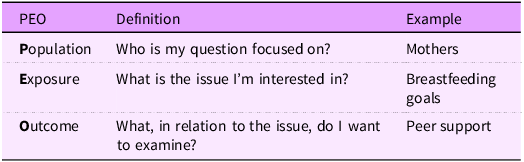
The research question was developed using the search strategy tool ‘PEO’(Reference Watson29). The PEO framework represents the population, exposure and outcomes of the research question, exhibited in Table 1. This review aimed to explore the research question: What impact does one-to-one peer breastfeeding support have on mothers’ personal breastfeeding goals?
PEO framework

Table 1. Long description
A table with three rows and three columns. The columns are labeled PEO, Definition, and Example. The rows are as follows: Row 1: PEO is Population, Definition is Who is my question focused on, and Example is Mothers. Row 2: PEO is Exposure, Definition is What is the issue I’m interested in, and Example is Breastfeeding goals. Row 3: PEO is Outcome, Definition is What, in relation to the issue, do I want to examine, and Example is Peer support.
Identification of relevant studies
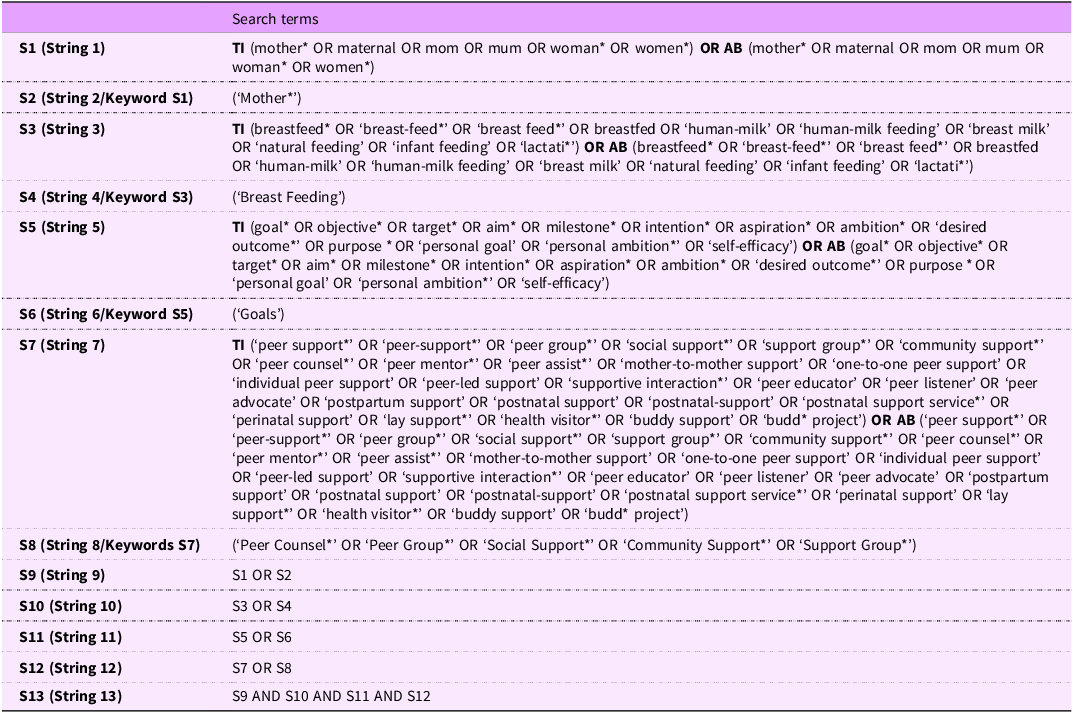
To obtain a greater variety of literature, a thorough search strategy was built based on the keywords generated from applying the PEO framework(Reference Arksey and O’Malley27,Reference Watson29) . A comprehensive computer-assisted database search was conducted using seven electronic databases (CINAHL, Academic Search Complete, MEDLINE, Scopus, PsycINFO, EMBASE and Cochrane Library). Searches were performed using the Title OR Abstract and Keyword options, with each search string searched individually and subsequently all four strings combined. The same search terms were inputted in all databases and are presented in Table 2. Search techniques included the use of an asterisk (*) as a truncation symbol, placed at the end of a word root to prompt the database to retrieve all possible variations of the term(Reference Munasinghe and Ranasinghe30). Boolean operators were also applied with ‘OR’ used to broaden the results and ‘AND’ to narrow the results(Reference Watson29). No limits (e.g. publication year or country) were applied to the search strategy, other than restricting studies to English-language publications.
Search strategy

Table 2. Long description
A table with 13 rows and 2 columns. The columns are labeled ’Search terms’ and ’S1 (String 1)’ to ’S13 (String 13)’. The table lists various search terms and their corresponding strings used in a literature review. Each row provides specific search terms and their combinations using Boolean operators and truncation symbols. The search terms cover topics related to mothers, breastfeeding, goals, and peer support. The strings are used to search titles, abstracts, and keywords in multiple databases.
Study selection
Results were exported to ‘Zotero’ and then uploaded to ‘Covidence’, a systematic review management tool, to facilitate and streamline the screening process. Following the removal of duplicates, the remaining papers were primarily screened based on their titles and abstracts by the lead author. Although standard practice for scoping and systematic reviews typically involves two independent reviewers at both the title and abstract and full-text screening stages, due to resource constraints and the defined scope of this project, a single-reviewer approach was employed for the initial title/abstract stage. Subsequently, a comprehensive full-text screening process was conducted by three authors (KT, ÁOC and EJOS). Furthermore, to ensure a comprehensive identification of relevant studies, reference list searching was performed. This involved screening the reference lists of papers included to identify additional sources that may have been overlooked in the database search. After examining these references, no additional studies met the inclusion criteria or were deemed suitable for inclusion in the review.
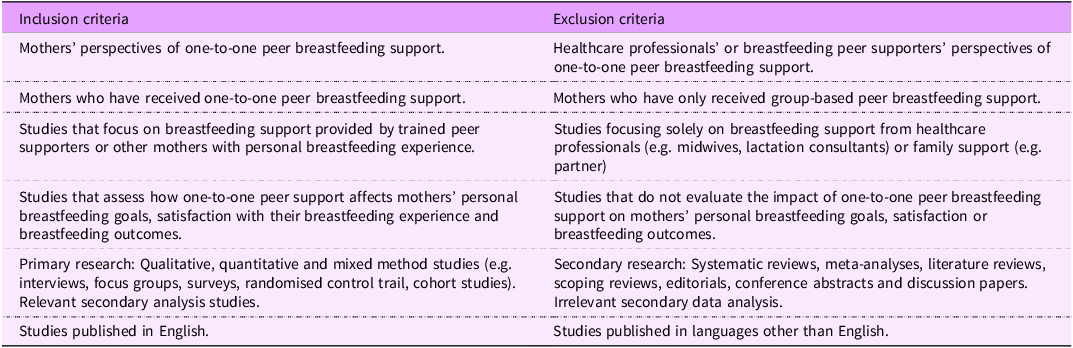
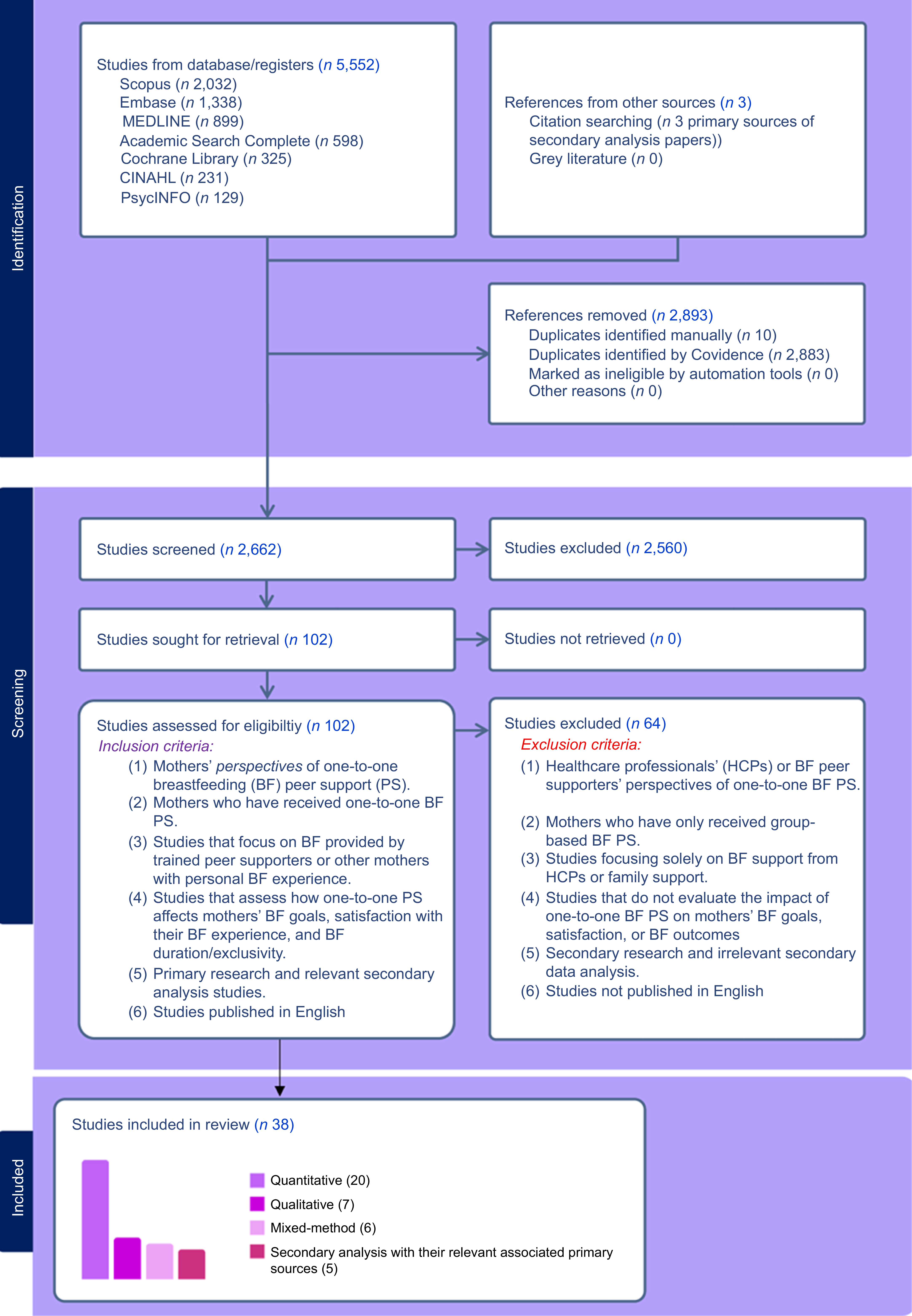
Papers were included if they described the mothers’ experience/perspective of one-to-one peer breastfeeding support. Papers were excluded if they focused on group breastfeeding support or support delivered solely by family members or healthcare professionals such as midwives, lactation consultants and general practitioners. The inclusion and exclusion criteria that guided this review are detailed in Table 3. During the full-text screening stage, the lead author initially assessed each paper independently. Papers with uncertain eligibility were further reviewed by a second and third reviewer, who initially assessed papers for inclusion independently and then met to discuss. A consensus was reached on the inclusion or exclusion of studies, with any disagreements resolved through discussion. To enhance the clarity of the review process, the review was documented using the PRISMA-ScR flow diagram (Figure 1)(Reference Arksey and O’Malley27). A diverse range of studies were chosen to be included, i.e. qualitative, quantitative, relevant secondary data analysis and mixed methods to capture both numerical and thematic insights.
Inclusion/exclusion criteria

Table 3. Long description
The table has two columns: Inclusion criteria and Exclusion criteria. It contains six rows of criteria each. Row 1: Mothers perspectives of one-to-one peer breastfeeding support. Healthcare professionals or breastfeeding peer supporters perspectives of one-to-one peer breastfeeding support. Row 2: Mothers who have received one-to-one peer breastfeeding support. Mothers who have only received group-based peer breastfeeding support. Row 3: Studies that focus on breastfeeding support provided by trained peer supporters or other mothers with personal breastfeeding experience. Studies focusing solely on breastfeeding support from healthcare professionals or family support. Row 4: Studies that assess how one-to-one peer support affects mothers personal breastfeeding goals, satisfaction with their breastfeeding experience and breastfeeding outcomes. Studies that do not evaluate the impact of one-to-one peer breastfeeding support on mothers personal breastfeeding goals, satisfaction or breastfeeding outcomes. Row 5: Primary research: Qualitative, quantitative and mixed method studies. Secondary research: Systematic reviews, meta-analyses, literature reviews, scoping reviews, editorials, conference abstracts and discussion papers. Relevant secondary data analysis. Irrelevant secondary data analysis. Row 6: Studies published in English. Studies published in languages other than English.
PRISMA flow diagram of search process(Reference Tricco, Lillie and Zarin26)

Charting the data
This component of the scoping review involved extracting/charting key items of information obtained from the papers reviewed(Reference Arksey and O’Malley27). Each included paper was analysed by two reviewers to minimise bias and ensure reliability and consistency of findings. Arksey and O’Malley’s(Reference Arksey and O’Malley27) process was utilised to extract the required data from each paper, including author, year, title, country, aim, methodology/study design, sample size, description of the interventions, summary of findings and considerations. Any questions about included/excluded data were resolved through discussions among the review team.
Collating, summarising and reporting the results
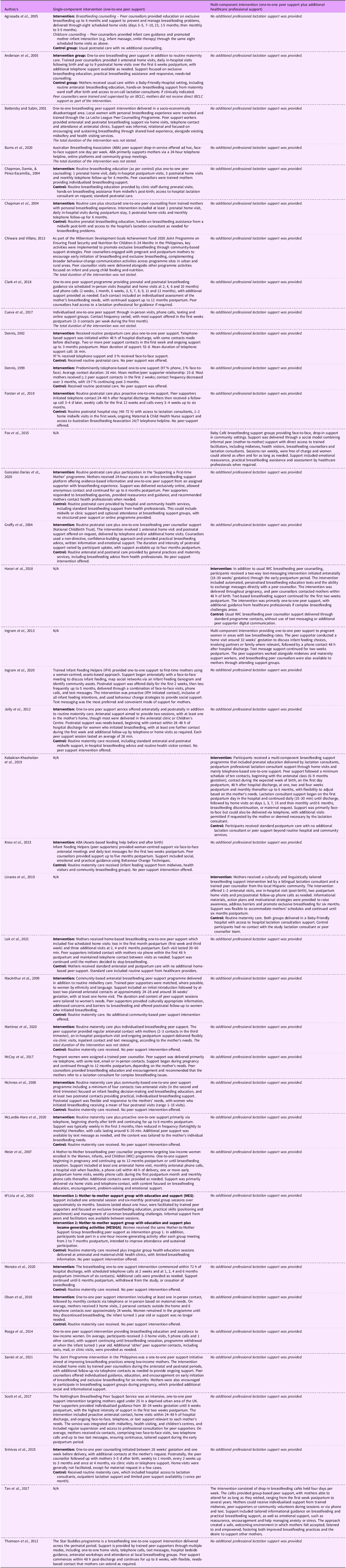
In accordance with the Joanna Briggs Institute Manual for Evidence Synthesis(Reference Aromataris, Lockwood and Porritt31) and PRISMA-ScR guidelines(Reference Tricco, Lillie and Zarin26), data from the included studies were collated and summarised using descriptive methods appropriate for scoping reviews. Quantitative data (e.g. intervention characteristics and breastfeeding outcomes) were summarised using frequency counts and proportions(Reference Aromataris, Lockwood and Porritt31). Qualitative data were analysed using descriptive content analysis(Reference Aromataris, Lockwood and Porritt31). Extracted findings and participant quotations were read repeatedly to familiarise reviewers with mothers’ experiences of one-to-one breastfeeding PS. Line-by-line coding identified key concepts, including personal breastfeeding goals, perseverance through challenges, the importance of encouragement, emotional reassurance and mother-centred support. These codes were grouped into meaningful categories reflecting the ways in which one-to-one PS influenced mothers’ personal breastfeeding goals, including how support helped mothers set, achieve or extend their personal goals, overcome challenges and build confidence on their breastfeeding journey. Tables and figures were used to present study characteristics (Table 4) and a description of interventions employed in the included studies (Table 5), providing a clear visual overview of the literature.
Data extraction table

Table 4. Long description
The table presents a structured summary of data extracted from studies on breastfeeding peer support. It includes columns for study characteristics, intervention details, and breastfeeding outcomes. Each row corresponds to a different study, with data filled in the respective columns. The table uses frequency counts and proportions to summarize quantitative data, while qualitative data is analyzed using descriptive content analysis. Key concepts identified include personal breastfeeding goals, perseverance through challenges, encouragement, emotional reassurance, and mother-centered support. These concepts are grouped into categories reflecting how one-to-one peer support influences mothers’ personal breastfeeding goals.
Description of interventions of included studies

Table 5. Long description
Panel A: A table listing the characteristics of included studies. The table includes columns for study author, year, country, study design, sample size, and key findings. Panel B: A table describing the interventions employed in the included studies. The table includes columns for intervention type, duration, setting, and key components. Panel C: A figure presenting a visual overview of the literature, likely including graphs or charts that summarize the data from the tables.
Findings
The search of the seven electronic databases and the addition of three primary source research papers generated 5555 results. After the removal of duplicates, 2662 remained and underwent title and abstract screening. At this stage, 2560 records were excluded because they did not meet the inclusion criteria, primarily because they were identified as irrelevant, did not address mothers’ experiences of one-to-one peer breastfeeding support or were review articles. The remaining 102 papers advanced to full-text review. Thirty-eight papers met the inclusion criteria, and justification for the excluded papers (n 64) is reported in the PRISMA flow diagram (Figure 1). The characteristics of the included papers, such as research methodology, year and country of publication, are detailed in Table 4.
Characteristics of the studies
The thirty-eight papers included in this review were published between 1999 and 2023, spanning across ten countries globally (Table 4). Of the thirty-eight papers, twenty were quantitative studies(Reference Jolly, Ingram and Freemantle15,Reference MacArthur, Jolly and Ingram16,Reference Forster, McLardie-Hore and McLachlan32–Reference Linares, Cartagena and Rayens49) , seven were qualitative studies(Reference Kabakian-Khasholian, Nimer and Ayash50–Reference Meier, Olson and Benton56) and six mixed methods(Reference Burns, Duursma and Triandafilidis57–Reference Cueva, Shimer and Kent62). An overview of the study designs employed in the included papers is provided in Table 4.
In this review, both the qualitative and quantitative findings from all mixed-methods studies were included. Three secondary analysis papers were also included, as they directly discussed one-to-one breastfeeding PS and addressed the research question(Reference Saniel, Pepito and Amit63–Reference Martinez, Strohbach and Hu65). Chiwara and Villate(Reference Chiwara and Villate66), a mixed-methods study in which only the quantitative findings were reported, served as the primary source for the quantitative study by Saniel et al. (Reference Saniel, Pepito and Amit63). Martinez et al. (Reference Martinez, Strohbach and Hu65), a quantitative study, was a secondary analysis of the ‘Navigating New Motherhood’ study(Reference Yee, Martinez and Nguyen67). Olson et al. (Reference Olson, Haider and Vangjel68), a quantitative study, was the primary source for the quantitative paper by Rozga et al. (Reference Rozga, Kerver and Olson64).
Description of interventions
The included studies (n 38) employed a wide range of one-to-one breastfeeding support interventions, delivered using a combination of methods such as face-to-face, telephone and digital communication, employing both structured and flexible formats. Table 5 provides a detailed description of the intervention characteristics across included studies.
Interventions were broadly categorised as single- or multi-component. Among the thirty-eight included studies, 82 % (n 31) evaluated single-component one-to-one PS interventions, in which trained peer counsellors/supporters delivered one-to-one breastfeeding support alongside routine maternity care, without the addition of structured professional lactation input. In these interventions, peer supporters primarily provided emotional reassurance, practical breastfeeding guidance and encouragement, drawing on shared lived experience(Reference Jolly, Ingram and Freemantle15,Reference Graffy, Taylor and Williams37,Reference McCoy, Geppert and Dech47,Reference Battersby and Sabin58) . The remaining 18 % (n 7) evaluated multi-component interventions, in which one-to-one support was integrated with additional professional lactation consultant care, midwifery or health visitor input, structured infant care education or community-based services offering direct access to healthcare professionals(Reference Agrasada, Gustafsson and Kylberg40,Reference Linares, Cartagena and Rayens49–Reference Fox, McMullen and Newburn51,Reference Tan, Rheeston and Douglas54,Reference Harari, Rosenthal and Bozzi60,Reference Ingram61) .
Across the thirty-eight included studies, the initiation of one-to-one support varied, with interventions commencing antenatally, postnatally or continuing throughout the perinatal period. Thirteen studies (34 %) initiated PS antenatally(Reference Jolly, Ingram and Freemantle15,Reference MacArthur, Jolly and Ingram16,Reference Scott, Pritchard and Szatkowski36–Reference M’liria, Kimiywe and Ochola38,Reference McInnes, Love and Stone41,Reference Chapman, Damio and Pérez-Escamilla43,Reference Ingram, Johnson and Clarke52,Reference Knox, Parker and Johnson53,Reference Thomson, Crossland and Dykes55,Reference Meier, Olson and Benton56,Reference Ingram61,Reference Martinez, Strohbach and Hu65) , typically beginning between 24 and 28 weeks(Reference MacArthur, Jolly and Ingram16) or around 30 weeks gestation(Reference Knox, Parker and Johnson53). These antenatal PS interactions were typically delivered through home visits or clinic-based meetings and focused on infant feeding decision-making and breastfeeding preparation(Reference MacArthur, Jolly and Ingram16,Reference Agrasada, Gustafsson and Kylberg40,Reference Chapman, Damio and Young44,Reference Anderson, Damio and Young45,Reference Srinivas, Benson and Worley48,Reference Ingram61) . Antenatal PS initiation was more frequently observed in interventions targeting first-time mothers or populations with historically low breastfeeding rates(Reference MacArthur, Jolly and Ingram16,Reference Agrasada, Gustafsson and Kylberg40,Reference Anderson, Damio and Young45,Reference Srinivas, Benson and Worley48,Reference Ingram61) . The majority of studies (66 %) initiated PS in the postnatal period, with first contact typically occurring within 24–72 h of hospital discharge, reflecting an emphasis on early breastfeeding support(Reference Forster, McLardie-Hore and McLachlan32,Reference Dennis34–Reference Scott, Pritchard and Szatkowski36) .
The duration of PS offered widely varied, with 29 % (n 11) offering short-term support (≤8 weeks postpartum)(Reference Jolly, Ingram and Freemantle15,Reference Forster, McLardie-Hore and McLachlan32,Reference Dennis34–Reference Scott, Pritchard and Szatkowski36,Reference Monoto, Hamzah and Alwi39,Reference Knox, Parker and Johnson53,Reference Thomson, Crossland and Dykes55,Reference Burns, Duursma and Triandafilidis57,Reference Harari, Rosenthal and Bozzi60,Reference Ingram61) , 47 % (n 18) provided longer-term support (≥6 months or until breastfeeding cessation)(Reference MacArthur, Jolly and Ingram16,Reference McLardie-Hore, McLachlan and Shafiei33,Reference Agrasada, Gustafsson and Kylberg40,Reference McInnes, Love and Stone41,Reference Chapman, Damio and Pérez-Escamilla43–Reference Kabakian-Khasholian, Nimer and Ayash50,Reference Meier, Olson and Benton56,Reference Lok, Chow and Shing59,Reference Saniel, Pepito and Amit63–Reference Martinez, Strohbach and Hu65,Reference Olson, Haider and Vangjel68) , and the remaining 24 % (n 9) did not clearly specify a fixed duration of support, instead reporting that contact frequency and continuation were determined by maternal needs(Reference Graffy, Taylor and Williams37,Reference Gonzalez-Darias, Diaz-Gomez and Rodriguez-Martin42,Reference Fox, McMullen and Newburn51,Reference Tan, Rheeston and Douglas54,Reference Meier, Olson and Benton56–Reference Battersby and Sabin58,Reference Cueva, Shimer and Kent62,Reference Chiwara and Villate66) .
Face-to-face support, usually via home visits, was reported in 68 % of studies (n 26), ranging from 1–9 visits, with some daily in the early postpartum period(Reference Jolly, Ingram and Freemantle15,Reference MacArthur, Jolly and Ingram16,Reference McLardie-Hore, McLachlan and Shafiei33,Reference Dennis35,Reference Graffy, Taylor and Williams37,Reference Monoto, Hamzah and Alwi39–Reference McInnes, Love and Stone41,Reference Chapman, Damio and Pérez-Escamilla43–Reference McCoy, Geppert and Dech47,Reference Fox, McMullen and Newburn51–Reference Knox, Parker and Johnson53,Reference Meier, Olson and Benton56–Reference Lok, Chow and Shing59,Reference Ingram61,Reference Cueva, Shimer and Kent62,Reference Rozga, Kerver and Olson64,Reference Martinez, Strohbach and Hu65,Reference Olson, Haider and Vangjel68) . Hospital-based support was included in 24 % of studies (n 9), providing bedside breastfeeding guidance(Reference Agrasada, Gustafsson and Kylberg40,Reference Gonzalez-Darias, Diaz-Gomez and Rodriguez-Martin42–Reference Clark, Baker and McGirr46,Reference Srinivas, Benson and Worley48,Reference Linares, Cartagena and Rayens49,Reference Martinez, Strohbach and Hu65) . Telephone support was reported in 71 % of studies (n 27), often frequent in the early postpartum period and reducing over time(Reference Jolly, Ingram and Freemantle15,Reference Forster, McLardie-Hore and McLachlan32–Reference Graffy, Taylor and Williams37,Reference Monoto, Hamzah and Alwi39,Reference Gonzalez-Darias, Diaz-Gomez and Rodriguez-Martin42–Reference Srinivas, Benson and Worley48,Reference Ingram, Johnson and Clarke52,Reference Knox, Parker and Johnson53,Reference Meier, Olson and Benton56,Reference Burns, Duursma and Triandafilidis57,Reference Lok, Chow and Shing59–Reference Martinez, Strohbach and Hu65,Reference Olson, Haider and Vangjel68) . Digital support, including text messaging and online platforms, was reported in 29 % of studies (n 11), facilitating proactive, timely support(Reference Jolly, Ingram and Freemantle15,Reference Gonzalez-Darias, Diaz-Gomez and Rodriguez-Martin42,Reference Clark, Baker and McGirr46,Reference Fox, McMullen and Newburn51–Reference Tan, Rheeston and Douglas54,Reference Meier, Olson and Benton56,Reference Lok, Chow and Shing59,Reference Harari, Rosenthal and Bozzi60,Reference Cueva, Shimer and Kent62) . Community-based PS support, such as drop-in cafés or peer-led clinics, were included in 16 % of studies (n 6), offering informal, flexible PS beyond the early postpartum period(Reference M’liria, Kimiywe and Ochola38,Reference Fox, McMullen and Newburn51,Reference Tan, Rheeston and Douglas54,Reference Burns, Duursma and Triandafilidis57,Reference Harari, Rosenthal and Bozzi60,Reference Ingram61) .
PS was individualised and proactive, with frequency, duration and mode of delivery adjusted to meet mothers’ evolving needs, particularly during the early postpartum period, highlighting the flexibility and adaptability of one-to-one PS interventions.
The findings are presented according to the primary a priori outcome (the impact of one-to-one PS on mothers’ personal breastfeeding goals) and two secondary outcomes that emerged from the data, namely the effect of one-to-one PS on traditional metrics of breastfeeding success and the impact of mother-centred breastfeeding PS on maternal emotional well-being.
Primary (a priori) outcome: Impact of one-to-one peer support on mothers’ personal breastfeeding goals
Twelve studies discussed the impact of PS on mothers’ personal breastfeeding goals, examining whether they were achieved or extended beyond their initial intentions(Reference McLardie-Hore, McLachlan and Shafiei33–Reference Dennis35,Reference Monoto, Hamzah and Alwi39,Reference Srinivas, Benson and Worley48,Reference Fox, McMullen and Newburn51,Reference Thomson, Crossland and Dykes55–Reference Battersby and Sabin58,Reference Harari, Rosenthal and Bozzi60,Reference Cueva, Shimer and Kent62) . Most mothers attending a drop-in PS service believed it helped them achieve their goals, with breastfeeding durations extending up to 21 months(Reference Burns, Duursma and Triandafilidis57). Similarly, another study reported that almost all mothers in the PS group met their personal breastfeeding goals compared to about three-quarters of the CG(Reference Harari, Rosenthal and Bozzi60). Another study emphasised that over three-quarters of mothers believed their peer counsellor helped them achieve their personal breastfeeding goals(Reference Monoto, Hamzah and Alwi39). An additional study demonstrated that women receiving breastfeeding PS were more likely to achieve their personal breastfeeding goal, but this difference did not achieve statistical significance(Reference Srinivas, Benson and Worley48).
Peer supporters not only helped women meet their initial goal but often encouraged mothers to extend their goals(Reference Cueva, Shimer and Kent62). One mother shared: ‘I gave myself a 6-week goal and with all your encouragement…I’m almost to 8 months!’ (Reference Cueva, Shimer and Kent62). Furthermore, many mothers believed their peer supporter was instrumental in helping them reach their personal breastfeeding goals(Reference Dennis34,Reference Dennis35) . Twenty mothers described how their peer supporter helped them to ‘persevere’(Reference Dennis34,Reference Dennis35) . The importance of ongoing PS was crucial as it enabled women to meet or even extend their personal breastfeeding goals: ‘I would like to thank the volunteer mother…I may have stopped breastfeeding in the initial phases when everything felt too hard and overwhelming (Reference McLardie-Hore, McLachlan and Shafiei33) .’
Many women discussed how their peer supporter inspired them to create new personal breastfeeding goals by increasing their confidence: ‘She helped me to feel proud and confident…achieving my goal of breastfeeding for 6–12 months’ (Reference McLardie-Hore, McLachlan and Shafiei33). Another study found most women initially aimed to breastfeed for 3 months, then set new goals during each PS interaction(Reference Meier, Olson and Benton56).
The ‘Star Buddies’ programme showed that consistent encouragement from peer supporters helped mothers extend their personal breastfeeding goals: ‘Just knowing that they would be calling next week spurred me on’ (Reference Thomson, Crossland and Dykes55). Similarly, another study highlighted that many mothers initially set short-term goals but continued breastfeeding much longer than expected due to PS: ‘I was looking at five weeks max…still breastfeeding at nine months’ (Reference Battersby and Sabin58).
These findings demonstrate the instrumental role one-to-one PS has in enabling mothers to achieve and often surpass their initial personal breastfeeding goals by offering reassurance, motivation, and practical guidance.
Secondary outcome 1: The effect of one-to-one peer support on traditional metrics of breastfeeding success
Although this review focuses on one-to-one peer breastfeeding support and its impact on women’s personal breastfeeding goals, the literature predominantly reports outcomes in terms of initiation, duration and exclusivity of breastfeeding. These measures remain the primary indicators used by national and international bodies to define breastfeeding success. Mapping these outcomes provides essential context for understanding how PS has influenced both global breastfeeding targets and mothers’ personal goals. It also highlights a gap in the literature. While breastfeeding rates are well-documented, women’s individual goals remain underexplored. This gap helps justify the focus of this scoping review.
Nineteen of the included studies(Reference Forster, McLardie-Hore and McLachlan32,Reference Dennis34–Reference Scott, Pritchard and Szatkowski36,Reference M’liria, Kimiywe and Ochola38–Reference Agrasada, Gustafsson and Kylberg40,Reference Gonzalez-Darias, Diaz-Gomez and Rodriguez-Martin42–Reference McCoy, Geppert and Dech47,Reference Linares, Cartagena and Rayens49,Reference Harari, Rosenthal and Bozzi60,Reference Saniel, Pepito and Amit63–Reference Martinez, Strohbach and Hu65,Reference Olson, Haider and Vangjel68) highlighted the positive effect of breastfeeding PS on increasing the initiation, duration and exclusivity of breastfeeding, with only eight papers reporting no significant differences in breastfeeding outcomes between the IG and CG(Reference Jolly, Ingram and Freemantle15,Reference MacArthur, Jolly and Ingram16,Reference Graffy, Taylor and Williams37,Reference McInnes, Love and Stone41,Reference Srinivas, Benson and Worley48,Reference Lok, Chow and Shing59,Reference Saniel, Pepito and Amit63,Reference Martinez, Strohbach and Hu65) .
Mothers who received one-to-one breastfeeding PS were generally more likely to initiate and sustain EBF for longer compared to those without such support(Reference Forster, McLardie-Hore and McLachlan32,Reference Dennis34,Reference Dennis35,Reference M’liria, Kimiywe and Ochola38–Reference Agrasada, Gustafsson and Kylberg40,Reference Gonzalez-Darias, Diaz-Gomez and Rodriguez-Martin42–Reference McCoy, Geppert and Dech47,Reference Linares, Cartagena and Rayens49,Reference Rozga, Kerver and Olson64,Reference Martinez, Strohbach and Hu65,Reference Olson, Haider and Vangjel68) . For instance, one study highlighted that women receiving PS were nearly three times more likely to EBF during their hospital stay(Reference Linares, Cartagena and Rayens49), while another found that mothers in the PS group were 15 times more likely to EBF compared to the CG throughout the study(Reference Anderson, Damio and Young45). Another study reported higher EBF rates at six months among the PS group: 46·7 % (PS) v. 32·1 % (CG)(Reference Monoto, Hamzah and Alwi39).
Furthermore, three studies highlighted significantly higher breastfeeding continuation rates among those who received PS at one, three and six months(Reference Forster, McLardie-Hore and McLachlan32,Reference Chapman, Damio and Pérez-Escamilla43,Reference Chapman, Damio and Young44) . At one month postpartum, 64·3 % of the PS group were breastfeeding v. 50·7 % of the CG(Reference Chapman, Damio and Young44). Similarly, another study demonstrated that mothers who received proactive telephone-based PS were more likely to breastfeed at six months: 75 % (PS) v. 69 % (CG)(Reference Forster, McLardie-Hore and McLachlan32). At three and six months postpartum, the EBF rates among the PS group were 57·3 % and 32·9 %, respectively, compared to 43·9 % and 29·9 % in the CG, respectively(Reference Chapman, Damio and Pérez-Escamilla43). Structured interventions, like the ‘Omega Smart Baby Project’(Reference Clark, Baker and McGirr46), demonstrated increased breastfeeding duration and strong maternal satisfaction with PS(Reference McLardie-Hore, McLachlan and Shafiei33–Reference Dennis35,Reference Graffy, Taylor and Williams37,Reference Monoto, Hamzah and Alwi39,Reference Agrasada, Gustafsson and Kylberg40,Reference Kabakian-Khasholian, Nimer and Ayash50,Reference Fox, McMullen and Newburn51,Reference Tan, Rheeston and Douglas54,Reference Meier, Olson and Benton56–Reference Harari, Rosenthal and Bozzi60,Reference Martinez, Strohbach and Hu65) . Structured PS models like the mother-to-mother support groups with education and support (MES) and those with added income-generating activities (MESIGA) boosted EBF rates, with MESIGA achieving 27 % EBF at six months v. 0 % (CG)(Reference M’liria, Kimiywe and Ochola38). Mothers in the MESIGA programme were more than twice as likely to maintain EBF to six months compared to women receiving routine postnatal support, emphasising the added value of structured, consistent peer interactions(Reference M’liria, Kimiywe and Ochola38). Another study observed higher EBF rates at three and six months among mothers receiving PS(Reference Gonzalez-Darias, Diaz-Gomez and Rodriguez-Martin42). An additional study reported increased breastfeeding initiation and continuation at two weeks following the introduction of the Nottingham ‘Breastfeeding Peer Support Service’(Reference Scott, Pritchard and Szatkowski36). Furthermore, another study highlighted that women receiving PS were more likely to initiate breastfeeding (P = 0·04)(Reference Martinez, Strohbach and Hu65).
Eight trials reported no statistically significant differences in breastfeeding outcomes between the IG and CG(Reference Jolly, Ingram and Freemantle15,Reference MacArthur, Jolly and Ingram16,Reference Graffy, Taylor and Williams37,Reference McInnes, Love and Stone41,Reference Srinivas, Benson and Worley48,Reference Lok, Chow and Shing59,Reference Saniel, Pepito and Amit63,Reference Martinez, Strohbach and Hu65) . One study found similar breastfeeding initiation rates: 69·0 % (IG) v. 68·1 % (CG)(Reference MacArthur, Jolly and Ingram16). Another trial reported breastfeeding initiation rates of 95 % (IG) and 96 % (CG), declining to 46 % and 42 %, respectively, by four months(Reference Graffy, Taylor and Williams37). There was no difference noted in the rate of any breastfeeding at 10–14 d between the IG and CG(Reference Jolly, Ingram and Freemantle15). In another trial, breastfeeding rates at six weeks were low in both groups, with no statistically significant difference noted (P = 0·07)(Reference McInnes, Love and Stone41). Although an additional study highlighted that PS was associated with increased odds of EBF, these findings were not statistically significant(Reference Saniel, Pepito and Amit63). A subsequent study found no significant differences in breastfeeding continuation at 6 weeks (P = 0·31) or 6 months postpartum (P = 0·54)(Reference Martinez, Strohbach and Hu65).
Overall, 50 % of the included studies (n 19) demonstrated that PS positively impacts breastfeeding outcomes(Reference Forster, McLardie-Hore and McLachlan32,Reference Dennis34–Reference Scott, Pritchard and Szatkowski36,Reference M’liria, Kimiywe and Ochola38–Reference Agrasada, Gustafsson and Kylberg40,Reference Gonzalez-Darias, Diaz-Gomez and Rodriguez-Martin42–Reference McCoy, Geppert and Dech47,Reference Linares, Cartagena and Rayens49,Reference Harari, Rosenthal and Bozzi60,Reference Saniel, Pepito and Amit63–Reference Martinez, Strohbach and Hu65,Reference Olson, Haider and Vangjel68) . Structured and proactive PS interventions were particularly effective in enhancing breastfeeding outcomes and maternal satisfaction with PS(Reference McLardie-Hore, McLachlan and Shafiei33–Reference Dennis35,Reference Graffy, Taylor and Williams37,Reference Monoto, Hamzah and Alwi39,Reference Agrasada, Gustafsson and Kylberg40,Reference Kabakian-Khasholian, Nimer and Ayash50,Reference Fox, McMullen and Newburn51,Reference Tan, Rheeston and Douglas54,Reference Meier, Olson and Benton56–Reference Harari, Rosenthal and Bozzi60,Reference Martinez, Strohbach and Hu65) . However, it is important to note that eight papers reported no significant differences in breastfeeding outcomes(Reference Jolly, Ingram and Freemantle15,Reference MacArthur, Jolly and Ingram16,Reference Graffy, Taylor and Williams37,Reference McInnes, Love and Stone41,Reference Srinivas, Benson and Worley48,Reference Lok, Chow and Shing59,Reference Saniel, Pepito and Amit63,Reference Martinez, Strohbach and Hu65) . Several reasons may explain this, including that only 70 % of women in one study received one antenatal PS visit(Reference McInnes, Love and Stone41), suggesting that low intervention uptake may have diluted its potential impact(Reference Graffy, Taylor and Williams37,Reference McInnes, Love and Stone41) . Many women did not receive the intended support, often due to reluctance to seek help or uncertainty about the support available(Reference Graffy, Taylor and Williams37).
Secondary outcome 2: The impact of mother-centred breastfeeding peer support on maternal emotional well-being
The impact of mother-centred breastfeeding PS on maternal emotional well-being was reported in 34 % of the included studies (n 13). This could suggest that support influenced mothers’ breastfeeding self-efficacy and motivation to continue breastfeeding and to progress towards achieving their personal breastfeeding goals(Reference McLardie-Hore, McLachlan and Shafiei33,Reference Dennis34,Reference Chapman, Damio and Pérez-Escamilla43,Reference Srinivas, Benson and Worley48,Reference Fox, McMullen and Newburn51–Reference Burns, Duursma and Triandafilidis57,Reference Lok, Chow and Shing59,Reference Ingram61) .
Mothers not only benefited from the practical and informational aspects of breastfeeding PS but also valued the emotional support(Reference McLardie-Hore, McLachlan and Shafiei33,Reference Dennis34,Reference Knox, Parker and Johnson53–Reference Burns, Duursma and Triandafilidis57,Reference Lok, Chow and Shing59) . Women appreciated feeling listened to and reassured: ‘I felt I was doing fine after talking to her’ (Reference Dennis34). Mothers found comfort in knowing that their peer supporter was available for breastfeeding assistance, especially for new mothers who didn’t have family or friends nearby(Reference Dennis34). Mothers appreciated the ‘mother-centred’ approach, where peer supporters consistently acknowledged their feelings. They actively listened, offered encouragement and praised mothers for their breastfeeding achievements. Additionally, they helped mothers navigate the challenges of parenthood and discussed the importance of self-care, nutrition and rest (Reference Knox, Parker and Johnson53).
Mothers appreciated the accessibility and responsiveness of peer supporters especially when professional services were not immediately available(Reference Lok, Chow and Shing59). The use of digital platforms, such as WhatsApp, alongside home visits, enhanced accessibility by enabling more frequent and flexible contact. Several participants expressed a preference for digital communication, highlighting its potential to support programme sustainability, and reduce costs especially when face-to-face contact is not feasible(Reference Lok, Chow and Shing59). Mothers valued how their peer supporter could relate to what they ‘were going through’ and could draw on their own experiences to provide support(Reference McLardie-Hore, McLachlan and Shafiei33). Peer supporters created a safe, non-judgmental space, with mothers describing them as ‘someone in your corner without an agenda’ (Reference McLardie-Hore, McLachlan and Shafiei33) and even ‘like a close aunt’ ‘friend or a mother model’ (Reference Meier, Olson and Benton56).
The ‘Baby Cafés’ also served as a source of emotional support, where mothers could share personal challenges and receive tailored advice based on their individual needs(Reference Tan, Rheeston and Douglas54). One mother disclosed: ‘You know if there is anything ever…wrong, it’s almost like that friend that you can confide in…she’ll jump in with advice…she’s just there to listen and to let me offload’ (Reference Tan, Rheeston and Douglas54).
Furthermore, another study highlighted how peer supporters fostered discussions on the women’s progress which instilled confidence and self-efficacy(Reference Thomson, Crossland and Dykes55). Women referred to their peer supporter as a ‘lifeline’, and ‘safety net’ with one mother stating: ‘It would have been the easiest thing in the world [to stop breastfeeding]…but when you’ve got that support there, it actually makes you stop and think twice…I can do this, they’ve done it, I can do it’ (Reference Thomson, Crossland and Dykes55). Additionally, several mothers emphasised that emotional support was crucial role in helping them feel reassured and less isolated, especially during vulnerable moments in early motherhood(Reference Burns, Duursma and Triandafilidis57). One first-time mother explained how emotional distress and difficulty with latching nearly led her to stop breastfeeding, but the empathy and guidance from the peer supporter helped her persevere: ‘…they also helped with my emotions as I was a first time mum… if it hadn’t been for her I may have stopped breastfeeding…’ (Reference Burns, Duursma and Triandafilidis57).
Several studies reported on breastfeeding self-efficacy(Reference Chapman, Damio and Pérez-Escamilla43,Reference Srinivas, Benson and Worley48,Reference Fox, McMullen and Newburn51,Reference Ingram, Johnson and Clarke52,Reference Thomson, Crossland and Dykes55,Reference Lok, Chow and Shing59) . One paper highlighted that many women, particularly those who had established careers before motherhood, felt unprepared for the unpredictability of breastfeeding(Reference Fox, McMullen and Newburn51). However, once mothers received breastfeeding PS, their sense of breastfeeding self-efficacy increased(Reference Fox, McMullen and Newburn51). Higher self-efficacy was observed among mothers with previous breastfeeding experience(Reference Ingram61). Additionally, a positive attitude towards breastfeeding was associated with higher initiation and continuation rates(Reference Srinivas, Benson and Worley48). Overall, one-to-one breastfeeding PS significantly enhanced maternal emotional well-being by offering mother-centred, non-judgmental, empathetic care that fostered confidence, motivation and reduced feelings of isolation.
Discussion
The findings from this review highlight that one-to-one PS have a positive impact on increasing rates of breastfeeding initiation, continuation and exclusivity, particularly in the early postpartum months(Reference Forster, McLardie-Hore and McLachlan32,Reference Dennis34–Reference Scott, Pritchard and Szatkowski36,Reference M’liria, Kimiywe and Ochola38–Reference Agrasada, Gustafsson and Kylberg40,Reference Gonzalez-Darias, Diaz-Gomez and Rodriguez-Martin42–Reference McCoy, Geppert and Dech47,Reference Linares, Cartagena and Rayens49,Reference Harari, Rosenthal and Bozzi60,Reference Saniel, Pepito and Amit63–Reference Martinez, Strohbach and Hu65,Reference Olson, Haider and Vangjel68) . Beyond breastfeeding outcomes, PS also offers critical emotional support(Reference McLardie-Hore, McLachlan and Shafiei33,Reference Dennis34,Reference Knox, Parker and Johnson53–Reference Burns, Duursma and Triandafilidis57,Reference Lok, Chow and Shing59) . Furthermore, twelve papers(Reference McLardie-Hore, McLachlan and Shafiei33–Reference Dennis35,Reference Monoto, Hamzah and Alwi39,Reference Srinivas, Benson and Worley48,Reference Fox, McMullen and Newburn51,Reference Thomson, Crossland and Dykes55–Reference Battersby and Sabin58,Reference Harari, Rosenthal and Bozzi60,Reference Cueva, Shimer and Kent62) explored how PS helped mothers achieve or even extend their personal breastfeeding goals, often surpassing their initial intentions. Six papers reported on breastfeeding self-efficacy and how PS can effectively strengthen women’s confidence to initiate and sustain breastfeeding(Reference Chapman, Damio and Pérez-Escamilla43,Reference Srinivas, Benson and Worley48,Reference Fox, McMullen and Newburn51,Reference Thomson, Crossland and Dykes55,Reference Lok, Chow and Shing59,Reference Ingram61) . The included studies (n 38) employed a wide range of one-to-one PS interventions, delivered using a combination of methods such as face-to-face, telephone and digital communication, employing both structured and flexible formats.
Several intervention studies demonstrated substantial differences between PS and CG. For example, mothers receiving PS were significantly more likely to initiate and sustain EBF(Reference Anderson, Damio and Young45,Reference Linares, Cartagena and Rayens49) . Regular contact with a peer supporter appeared critical for maintaining breastfeeding practices over time, as evidenced in studies reporting extended EBF rates among mothers who received ongoing PS(Reference Monoto, Hamzah and Alwi39,Reference Agrasada, Gustafsson and Kylberg40) . These findings are consistent with existing evidence from Cochrane reviews(Reference Gavine, Shinwell and Buchanan21), as well as national(5) and international guidance(69,Reference Arts, Taqi and Bégin70) which advocate for PS as a strategy to improve breastfeeding outcomes.
Community-based support is recognised as a vital component of the Baby-Friendly Hospital Initiative(71). PS within the community can enhance health literacy and help reduce health inequalities across all socio-economic groups(Reference Harris, Springett and Croot72). Structured models such as MES and MESIGA(Reference M’liria, Kimiywe and Ochola38) along with national programmes like the Nottingham Breastfeeding Peer Support Service(Reference Scott, Pritchard and Szatkowski36) provided further evidence that well-implemented PS interventions can effectively reach and positively impact diverse populations(Reference Scott, Pritchard and Szatkowski36,Reference M’liria, Kimiywe and Ochola38) .
In light of these findings, universal access to breastfeeding PS should be a public health priority. UNICEF and WHO have called for equal access to breastfeeding support, highlighting that when mothers receive the help they need to breastfeed, the benefits extend to all. Increasing global breastfeeding rates could save more than 820 000 children’s lives annually(Reference Victora, Bahl and Barros73). This review clearly demonstrates the positive impact PS has on increasing breastfeeding rates. Only 48 % of infants under six months of age worldwide are currently EBF(Reference Russell and Adhanom Ghebreyesus74). The Global Breastfeeding Collective has set ambitious targets for 2030, including 70 % EBF rates for infants under six months, 80 % breastfeeding continuation at one year and 60 % breastfeeding at two years(75). Achieving these targets will require scaling up accessible and sustainable PS interventions worldwide. PS is an important tool within existing healthcare and community services to improve breastfeeding rates globally. By offering emotional encouragement, practical guidance and a sense of community, PS helps mothers navigate challenges, normalise breastfeeding practices and prolong the duration of EBF(Reference McCarthy, De Vries and Gallagher11).
However, eight papers found no statistically significant differences in breastfeeding outcomes between the IG and CG, although participants in these studies still appreciated the support they received(Reference Jolly, Ingram and Freemantle15,Reference MacArthur, Jolly and Ingram16,Reference Graffy, Taylor and Williams37,Reference McInnes, Love and Stone41,Reference Srinivas, Benson and Worley48,Reference Lok, Chow and Shing59,Reference Saniel, Pepito and Amit63,Reference Martinez, Strohbach and Hu65) . This highlights that, even when breastfeeding outcomes are not significantly impacted, PS may provide perceived benefits that improve maternal satisfaction and confidence(Reference McLardie-Hore, McLachlan and Shafiei33–Reference Dennis35,Reference Monoto, Hamzah and Alwi39,Reference Agrasada, Gustafsson and Kylberg40,Reference Thomson, Crossland and Dykes55,Reference Burns, Duursma and Triandafilidis57,Reference Lok, Chow and Shing59,Reference Ingram61,Reference Martinez, Strohbach and Hu65) . This underscores the importance of considering maternal experience as a valuable outcome in its own right, beyond traditional success metrics that evaluate the rates of breastfeeding at various time points. PS has been shown to positively influence emotional well-being, confidence and a sense of empowerment among mothers, even in the absence of measurable changes in breastfeeding rates(Reference Schmied, Beake and Sheehan76). Such support often helps women feel heard, respected and less isolated in their feeding journey, which can be particularly meaningful in the transition into motherhood(Reference Dykes77,Reference Leeming, Marshall and Locke78) . Importantly, this reflects a shift towards a more mother-centred model of care, where success is aligned with mothers’ individual personal breastfeeding goals, rather than predetermined success metrics currently employed by public health bodies(Reference Leeming, Marshall and Locke78,Reference Renfrew, McCormick and Wade79) . Recognising these additional benefits is key to a more holistic understanding of the support women need on their breastfeeding journey.
Overall, these findings highlight that while the measurable impact of PS on breastfeeding rates can vary across settings and modes in which support is delivered, i.e. in-person, phone calls, texts, etc., its role in empowering mothers and promoting continued breastfeeding is consistently recognised. This underscores the importance of integrating one-to-one PS into maternity and public health services to complement routine postnatal care and address gaps in emotional and informational breastfeeding support.
Society has a crucial role to play in supporting women on their breastfeeding journey through ensuring community PS programmes are accessible to them, and adequate policies are in place to support mothers. Furthermore, access to breastfeeding PS should not depend on a mother’s geographic location. All women, regardless of where they live, whether in rural or urban areas, across the island of Ireland and worldwide, should have equal access to PS. The availability of such support must be viewed as a public health priority, not a postcode lottery. Ensuring universal access to PS can help bridge disparities in breastfeeding outcomes and empower mothers to achieve their personal breastfeeding goals. For instance, a recent study from the University of Missouri highlights the challenges faced by rural mothers in accessing breastfeeding support(Reference Weston, Anbari and Bloom80). Many first-time mothers in rural Missouri were initially motivated to breastfeed but discontinued within days or weeks due to limited access to breastfeeding support(Reference Weston, Anbari and Bloom80). The study found that rural mothers often felt uncertain about their milk supply, lacked knowledge on latching and pumping techniques, and encountered prevailing cultural norms that favoured formula feeding over breastfeeding(Reference Weston, Anbari and Bloom80). Similarly, Cueva et al. (Reference Cueva, Shimer and Kent62) highlighted how the frequency of interactions with peer supporters widely varied, with about 40 % of women at one site receiving only one visit from their peer supporter, whereas about half of mothers at another site received three or more visits(Reference Cueva, Shimer and Kent62). These inconsistencies reinforce the urgent need for targeted support systems in rural areas as well as urban areas, including telehealth and community-based programmes, to ensure all mothers receive the guidance they need, regardless of location. In addition, breastfeeding promotion in rural areas should be strengthened through culturally sensitive health education(Reference Duong, Binns and Lee81).
Currently in Ireland, the Health Service Executive website provides location-based guidance to help mothers access breastfeeding support services, including lactation consultants, breastfeeding clinics, maternity-based support, a live chat function in which you can access a lactation consultant online from 10.00 to 15.00 Monday to Friday and community-based support groups such as Friends of Breastfeeding, Cuidiú, and La Leche League, as well as groups facilitated by public health nurses(82). These services reflect growing efforts to make breastfeeding support more accessible, particularly in community settings. Furthermore, Sláintecare(83), a national healthcare reform initiative, seeks to improve healthcare accessibility and equity across Ireland. Its emphasis on delivering the right care in the right place at the right time and on shifting care into the community complements the goals of community-based breastfeeding support(Reference Russell and Adhanom Ghebreyesus74).
These reforms present a valuable opportunity to integrate and strengthen breastfeeding initiatives within routine maternal care(83). This review has many implications for practice and policy including the suggestion that healthcare services like the Health Service Executive consider incorporating structured, proactive, mother-centred one-to-one support programmes into routine perinatal care. It is crucial that all mothers have access to breastfeeding PS whether in the form of postnatal hospital support, home visits, phone calls, text messaging or other alternative methods of digital support.
Finally, breastfeeding PS services should be specifically tailored to meet the needs of diverse and vulnerable populations. Several studies included in this review highlighted that structured PS interventions were particularly effective among lower socio-economic groups(Reference M’liria, Kimiywe and Ochola38,Reference Chapman, Damio and Young44,Reference Clark, Baker and McGirr46,Reference Rozga, Kerver and Olson64,Reference Olson, Haider and Vangjel68) . For instance, data reported by Olson et al. (Reference Olson, Haider and Vangjel68), which was the primary source for Rozga et al. (Reference Rozga, Kerver and Olson64) and Clark et al. (Reference Clark, Baker and McGirr46) demonstrated that targeted PS improved breastfeeding initiation and duration rates in economically disadvantaged communities, where breastfeeding rates are often lower than national averages(Reference Clark, Baker and McGirr46,Reference Rozga, Kerver and Olson64,Reference Olson, Haider and Vangjel68) . Community-based breastfeeding programmes should continue to promote EBF and develop strategies to support working mothers, ensuring services are responsive to the practical challenges different groups face(Reference Thet, Aung and Diamond-Smith84). Tailoring services to the unique challenges faced by different groups is essential to achieving equitable breastfeeding outcomes and advancing public health goals.
Implications for future research
These findings highlight several priorities for future research. While the included studies provide evidence on the impact of one-to-one PS on breastfeeding outcomes and maternal experiences, there remains limited consistency in how interventions are designed, delivered and evaluated, particularly in relation to mothers’ personal breastfeeding goals and contextual differences across settings. A more standardised evaluation of one-to-one PS interventions is needed, particularly regarding the optimal timing, frequency, duration and mode of support. Future studies should place greater emphasis on mothers’ personal breastfeeding goals and maternal satisfaction as primary outcomes, rather than relying predominantly on breastfeeding duration and exclusivity rates as the determinant of breastfeeding ‘success’. Further research should also examine the effectiveness of digital and hybrid PS models, particularly for mothers in rural or underserved communities where access to in-person breastfeeding support may be limited. There is also a notable lack of Irish-based evidence on one-to-one peer breastfeeding support, highlighting the need for future research within the Irish context.
Strengths and limitations
The strengths of this review include its broad scope, spanning 25 years and incorporating studies from 10 countries, thereby capturing diverse global perspectives on one-to-one breastfeeding support. Guided by the framework of Arksey and O’Malley(Reference Arksey and O’Malley27), along with the Joanna Briggs Institute Manual for Evidence Synthesis(Reference Aromataris, Lockwood and Porritt31) and PRISMA-ScR guidelines(Reference Tricco, Lillie and Zarin26), this review systematically mapped the breadth of available evidence, generating key findings. By descriptively summarising a wide range of data, the review provides further insight into the positive impact of individualised breastfeeding PS in improving breastfeeding outcomes and maternal satisfaction. The inclusion of qualitative, quantitative, mixed method studies and relevant secondary data analyses aligns with the scoping review methodology, enriching the evidence base and offering a multifaceted perspective. However, this scoping review has limitations. In line with the scoping review methodology, it did not assess the quality of the included studies, which may affect the strength and reliability of the conclusions. Furthermore, the study selection process did not employ dual independent screening at the title and abstract stage, which may have increased the risk of missing relevant studies. However, multiple authors conducted full-text screening, and reference list searches were performed to mitigate this risk and reduce bias(Reference Stoll, Izadi and Fowler85). Restricting inclusion to English-language studies may have posed selection bias, potentially omitting relevant literature from non-English-speaking regions. This study focused on mothers’ perspectives on breastfeeding PS, which, while valuable, means the perspectives of relevant healthcare professionals and peer supporters are underrepresented. These limitations should be considered when interpreting the findings.
Conclusion
This scoping review highlights the significant and multifaceted impact of one-to-one breastfeeding PS on maternal and infant outcomes. Notably, PS played a vital role in supporting maternal emotional well-being, fostering resilience, and enabling mothers to set, achieve, and often extend their personal breastfeeding goals. In addition, the evidence demonstrates that PS can improve the initiation, continuation and exclusivity of breastfeeding across diverse populations and settings. Structured and proactive PS interventions, delivered through various modes including face-to-face, telephone and digital support, were particularly effective in enhancing breastfeeding outcomes and maternal satisfaction.
While not all studies reported statistically significant differences in breastfeeding rates, the perceived emotional and informational benefits of PS were unanimously valued by mothers. These findings highlight that PS extends beyond measurable clinical outcomes by offering essential individualised psychosocial support that strengthens maternal confidence and reduces feelings of isolation in the postpartum period.
As highlighted previously, this review identified key knowledge gaps. In particular, there remains limited research examining attainment of mothers’ personal breastfeeding goals as a primary outcome. There is also an insufficient understanding of which specific components of one-to-one PS interventions are most effective across different populations and settings. This scoping review further highlights the absence of Irish evidence on one-to-one peer breastfeeding support and establishes a structured foundation for future context-specific research. Future research should further examine the conditions under which breastfeeding PS is most effective, including the timing, frequency, and mode of delivery, as well as the contexts in which it is provided (i.e. home, hospital, or community settings).
Recognising breastfeeding PS as a public health priority is essential. Universal, equitable access must be ensured to provide all mothers with timely, compassionate and mother-centred breastfeeding PS. Scaling up accessible and sustainable PS programmes will be critical to achieving global breastfeeding targets and improving the health and well-being of mothers and infants worldwide.
Acknowledgements
SHE Research Centre, Department of Sport & Health Sciences, Faculty of Science and Health, Technological University of the Shannon (TUS) Midlands, Ireland. TUS RISE for funding this research project.
Financial support
This research project has been funded by TUS RISE. Project code: 008. TUS RISE is co-funded by the Government of Ireland and the European Union through the ERDF Southern, Eastern & Midland Regional Programme 2021–27. Funders had no role in study design, data collection and analysis, decision to publish or preparation of the manuscript.
Conflict of interest
There are no conflicts of interest.
Author contributions
K.T.: Conceptualisation-Lead, Data curation-Lead, Formal analysis-Equal, Methodology-Lead, Project administration-Equal, Resources-Lead, Software-Lead, Writing – original draft-Lead, Writing – review & editing-Equal; E.J.O’S.: Conceptualisation-Equal, Data curation-Equal, Formal analysis-Equal, Methodology-Equal, Project administration-Equal, Supervision-Equal, Writing – review & editing-Equal; Á.O’C.: Conceptualisation-Equal, Data curation-Equal, Formal analysis-Equal, Methodology-Equal, Project administration-Equal, Supervision-Equal, Writing – review & editing-Equal.
Ethics of human subject participation
No human or animal subjects were involved in this research. This review collected data from existing primary and relevant secondary analyses research; therefore, ethical approval was not required. Consent to participate was not required, as the analysis of the data is from previously published papers in which the individual’s data were anonymous.


 Open access

