When political scientists, politicians or journalists talk about politics, they almost invariably talk about the ‘left’ or the ‘right’. The terms ‘left’ and ‘right’ are not merely a vestigial homage to the seating arrangement in the French Assembly during the revolution, where supporters of the ancien régime were seated on the right and revolutionaries on the left, but signify distinct historical traditions and lifestyles. Left/right terminology serves as the chief method of describing the political preferences of candidates, practitioners, experts or the public at large. The poles of the left/right dimension pit a more progressive and redistributive view of the role of the state against a more conservative and market-oriented state outlook. Despite its prevalent use, recent evidence—especially from Western Europe—suggests that the structure of party competition has changed in recent decades, leading to the mobilization of culturally rooted issues relating to traditional lifestyles, rights of immigrants or Islam.Footnote 1
This study examines how the mobilization of these more culturally based policy issues affects how people identify with politics. Specifically, we explore how the political prominence of cultural issues affects voters’ left/right identification. We expect that when cultural issues become more important in political competition, voters will use this salient information to adjust their primary political identifications. Previous work on left/right identification indeed suggests that voters’ self-placements are influenced by the conflicts and debates they observe in the political system (Freire Reference Freire2006, Reference Freire2008; Adams, De Vries and Leitner Reference Adams, De Vries and Leitner2012; Adams, Green and Millazo Reference Adams, Green and Millazo2012). Given these prior findings, we investigate the extent to which the mobilization of a new policy issue (that is, a controversy previously not salient in party or electoral politics) affects voters’ left/right identification. We develop two expectations that we label the issue bundling and issue crowding out hypotheses.
In the case of issue bundling, a new policy issue emerges, either due to societal events or the activities of a political entrepreneur. If the issue remains high on the political agenda, parties will aim to integrate it into their existing ideological profile to ensure ideological consistency and minimize electoral risk (Riker Reference Riker1982; Carmines and Stimson Reference Carmines and Stimson1989; Hinich and Munger Reference Hinich and Munger1993; Meguid Reference Meguid2005). Since voters take cues from parties in order to reduce their informational costs (Hinich and Munger Reference Hinich and Munger1993; Zaller Reference Zaller1992), they will update their primal political identifications – that is, their left/right placements—accordingly.Footnote 2 This process of issue bundling implies that the issue basis of the left/right dimension will be (at least partially) redefined on the basis of the new controversy. Since voter preferences and identifications are, to a large extent, driven by factors that are momentarily made salient through party cues,Footnote 3 traditionally important issues for left/right identification, such as redistribution, become less important as a result of issue bundling. The new issue considerations at least partially crowd out existing determinants of left/right identification. These dual logics give rise to a change in the meaning of left/right ideology, such that voters’ left/right identifications come to be more rooted in anti-immigrant attitudes (issue bundling) and less so on their views on redistribution (issue crowding out).
We test these propositions by utilizing uniquely suited longitudinal data from the Netherlands between 1980 and 2006. During this time, Dutch political competition was characterized by a strong mobilization of cultural issues (Pellikaan, Van der Meer and de Lange Reference Pellikaan, Van der Meer and de Lange2003, Reference Pellikaan, Van der Meer and de Lange2007; Adams, De Vries and Leitner Reference Adams, De Vries and Leitner2012). This process originated in the early 1980s with the development of a small anti-immigrant party, the Centrum Democraten. From the late 1990s onwards, immigration remained high on the political agenda through the activities of right-wing populist leaders Pim Fortuyn and Geert Wilders. These changes in the Dutch issue agenda constitute perhaps one of the clearest examples of the rise in cultural issues in Western Europe and make the Netherlands a particularly suitable case for exposing the twin logics of issue bundling and issue crowding out.
Our analyses show that voters’ left/right self-placements in the Netherlands have become more strongly linked to anti-immigrant sentiment over time, while the opposite pattern emerges for attitudes towards redistribution. This is not to suggest that economic attitudes have become irrelevant; they remain important anchors for left/right identification, but within the time frame under investigation we witness a clear rise in the importance of cultural attitudes for public left/right ideological placements at the expense of economic attitudes. These findings support recent work suggesting that voters respond to elite conflict and events they observe in their political system (Ray Reference Ray2003; Steenbergen et al. Reference Steenbergen, Edwards and de Vries2007; Adams, De Vries and Leitner Reference Adams, De Vries and Leitner2012; Adams, De Vries and Leitner Reference Adams, De Vries and Leitner2012).
The remainder of this study is organized as follows. In the next section we briefly review the literature on left/right identification in Western Europe. We then present our theoretical expectations regarding the mechanisms underlying the dynamics of voters’ left/right identification, namely issue bundling and issue crowding out. After outlining the data, method and operationalizations, we present the empirical results. We conclude by drawing several general lessons from our analysis, and outline some implications for our understanding of stability and change in left/right ideology and the dynamics of public opinion.
Left/Right Identification in Western Europe
Political positions and preferences are frequently expressed in left/right terms. Indeed, left/right identification is often the only dimension used to capture voters’ preferences.Footnote 4 Building on the seminal work of Inglehart and Klingemann (Reference Inglehart and Klingemann1976), left/right identification entails three major components: social, value and partisan.Footnote 5 The social component relates to the idea that social structure—chiefly occupation, religion and spatial location—determines one's left/right identification. The value component singles out the importance of voters’ attitudes toward the major value conflicts in Western Europe—such as the role of the state in the economy and public life, traditional lifestyles or individual choice—in shaping voters’ left/right self-placements.Footnote 6 Finally, the partisan component suggests that left/right placements mirror voters’ overall partisan loyalties.Footnote 7
While recent work by Freire (Reference Freire2006, Reference Freire2008) highlights the continued importance of social factors in explaining individual left/right orientations, most authors underline the prominent role of value or issue conflicts that are mobilized by political parties in shaping voters’ left/right attitudes (Huber Reference Huber1989; Kitschelt and Hellemans Reference Kitschelt and Hellemans1990; Stimson, Thiébaut and Tiberj Reference Stimson, Thiébaut and Tiberj2012; Knutsen Reference Knutsen1998; Lachat Reference Lachat2008). In their influential work on the relationship between ‘new politics’ issues (that is, environment, public order or lifestyle issues) and citizens’ left/right attitudes, Kitschelt and Hellemans (Reference Kitschelt and Hellemans1990, 230–2) demonstrate how Green parties’ mobilization of ‘new politics’ issues altered the content of what it meant to be ‘left’ or ‘right’. In conjunction, work by Huber (Reference Huber1989) suggests that the conflicts and debates citizens observe in the political system heavily influence their left/right self-placements. Freire (Reference Freire2006, Reference Freire2008) also demonstrates that cross-country variation in the degree to which left/right ideology resonates with voters is best accounted for by considering party activities. In systems with a high clarity of party positions (that is, highly ideologically polarized systems) voters’ political attitudes are most strongly anchored by left/right ideology.Footnote 8
The use of left/right terminology to conceptualize voters’ preferences is widespread, even though existing scholarly work suggests that its meaning varies substantially across countries and over time. This variation is mainly a factor of the rise of new value conflicts and the role of political parties. Notwithstanding, we currently lack a clear conceptual framework that explains the relationship between changes in the political agenda and the dynamics of voters’ left/right identifications. By developing the logics of issue bundling and issue crowding out and applying them to the Dutch context between 1980 and 2006, this study attempts to fill this lacuna. In the next section we spell out both logics.
The Logics of Issue Bundling and Issue Crowding Out
Scholars of political competition stress different ways in which new issues may appear on the political agenda. These approaches can be broadly summarized as either sociological or strategic.Footnote 9 The sociological approach is concerned chiefly with the substantive character of divisions in society and the likelihood that individuals with particular social characteristics will support one or another political party. It starts from the Lipset-Rokkan premise that major conflicts are rooted in the historical experience of a society and that these have an inter-generational effect on citizens’ values and preferences (Lipset and Rokkan Reference Lipset and Rokkan1967). Voters have more or less durable social characteristics—above all, class, gender, education and occupational status—that lead them to identify with certain political parties and not with others. The work by Kriesi and colleagues (Reference Kriesi, Grande, Lachat, Dolezal, Bornschier and Frey2006, Reference Kriesi, Grande, Lachat, Dolezal, Bornschier and Frey2008) falls within this sociological tradition, and argues that societal conflicts over globalization, such as growing international market integration and migration flows, have led to the mobilization of socio-cultural issues, such as immigration and European integration, within political competition. New issues arise within the sociological approach, chiefly on the basis of large-scale societal changes that ultimately find political expression through party mobilization.
The strategic approach is based on the Schattschneiderian assumption that politics is a competitive struggle among political parties about which political issues dominate the political agenda (Schattschneider Reference Schattschneider1960). In this top-down perspective, parties are not vessels that carry societal divisions, but organizations that actively structure and determine the content of societal conflict. As a result, the substantive character of political competition will vary from election to election as new issues are identified and mobilized by one party or another.Footnote 10 Political parties politicize a previously non-salient event, policy issue or societal conflict and attempt to gear up public attention over this controversy. Within this view, strategic political entrepreneurs utilized the influx of immigrant workers and their families, mainly from North Africa and the former Yugoslavia, and events related to immigration within Western Europe to reap electoral gains.Footnote 11
Therefore sociological approaches mainly focus on societal bottom-up processes, while strategic approaches stress political entrepreneurship. In this study we shall not adjudicate on the separate merits of these approaches. Clearly, we should like to determine to what extent—and under which conditions—these approaches stand up to empirical scrutiny, but data constraints limit us in this regard. For now, we acknowledge that parties choose an issue to politicize that resonates with people's interests and daily lives and attempt to draw public attention to this controversy (De Vries and Marks Reference De Vries and Marks2012). Both approaches then speak directly to how voter identification with politics might follow from the mobilization of a new policy issue such as immigration. Consequently, we hypothesize that party mobilization of the immigration issue has led voters’ left/right orientations to become more rooted in attitudes towards immigrants and less so in attitudes towards redistribution, which formed the traditional anchors of left/right ideology.
To capture these dynamics in left/right identification we develop two logics: issue bundling and issue crowding out. When a new policy issue emerges, it initially creates a political disequilibrium. That is to say, it creates an unstable situation ‘in which large numbers of politicians and voters are initially out of line with the new constellation and under pressure (but of quite different sorts for politicians and voters) to resolve the inconsistency’ (Stimson, Thiébaut and Tiberj Reference Stimson, Thiébaut and Tiberj2012, 296).Footnote 12 When the issue has political longevity by remaining high on the political agenda (thereby introducing lasting conflict), parties and voters will both need to resolve their ideological inconsistencies. Politicians and voters will aim to solve these discrepancies by updating their current ideological positions or by sorting out their previous alignments. As for political parties, they can no longer dismiss the newly salient issue and will thus have a tendency to integrate the new issue into their existing ideological profile to ensure ideological consistency and minimize electoral risk (Riker Reference Riker1982; Carmines and Stimson Reference Carmines and Stimson1989; Hinich and Munger Reference Hinich and Munger1993).Footnote 13 As a result, the issue becomes more and more associated with the existing profiles of parties, and potential inconsistencies and tensions between the two are gradually weeded out.
In addition, politics is sufficiently complex that citizens need to find shortcuts in the form of attitudinal cues.Footnote 14 Some of these cues take the form of personal predispositions, while actors involved in politics offer others. Voters as bounded rational citizens (Simon Reference Simon1985) rely on the actions and information delivered by parties as cognitive cues that help form their opinions (Feldman and Conover Reference Feldman and Conover1983; Popkin Reference Popkin1991; Zaller Reference Zaller1992; Hinich and Munger Reference Hinich and Munger1993). As a consequence, parties are geared towards ideological consistency, which has electoral advantages such as lowering the costs of informing voters during election cycles (Hinich and Munger Reference Hinich and Munger1993). At the same time, ideological consistency also benefits voters, as it lowers their information costs. As time progresses, we expect inconsistent patterns to give way to more consistent ones based on parties’ existing ideological profiles more often than the reverse. Voters subsequently sort their primary political identifications (their left/right self-placements) in accordance with the newly salient issue.
The assumption that voters change their policy attitudes in response to changes in party positioning is largely in line with current research from the European context, which finds strong evidence for top-down effects (Ray Reference Ray2003; Steenbergen et al. Reference Steenbergen, Edwards and de Vries2007; Adams, De Vries and Leitner Reference Adams, De Vries and Leitner2012; Adam, Green and Millazo Reference Adams, Green and Millazo2012). In the case of the UK for example, Adams, Green and Milazzo (Reference Adams, Green and Millazo2012) demonstrate that British voters responded to the convergence of left/right positions among the two biggest parties, Conservatives and Labour, by also middling their ideological stances. Even more importantly for our purposes, a recent study by Adams, De Vries and Leitner (Reference Adams, De Vries and Leitner2012) of the Dutch case shows that as major parties converged on the left/right, abortion and nuclear energy dimensions, voters adjusted their issue positions accordingly. These findings suggest that voters are highly responsive to the changes they observe in the political environment.
We label the process in which new policy issues become more and more integrated into the left/right dimension over time issue bundling. The left/right dimension in Western Europe thus has a strong integrative capacity for absorbing new issues into this ideological conflict and adopting ever-changing substantive meanings, depending on the immediate political context.Footnote 15 As a newly salient policy issue is bundled into the left/right dimension, it redefines what it means to be on the ‘left’ or the ‘right’. As a by-product, other issues have to at least partially make way. When a new issue emerges on the political agenda, other issues will be given less attention and space in popular discourse. We know from existing work that voter preferences are more strongly driven by factors that are momentarily made salient (Zaller Reference Zaller1992; Steenbergen et al. Reference Steenbergen, Edwards and de Vries2007). Indeed, voters form opinions ‘off the top of the head’ on the basis of whatever ideas are immediately accessible in memory’ (Zaller Reference Zaller1992, 38). Current research also suggests that voters have trouble processing and storing large amounts of information, especially since they are poorly informed about politics overall (Chaiken, Liberman and Eagly Reference Chaiken, Liberman and Eagly1989; Fiske and Taylor Reference Fiske and Taylor1984; Delli Carpini and Keeter Reference Delli Carpini and Keeter1996). These limits of attention and information-processing constraints imply that ‘the issue agenda [has] a zero-sum dynamic’ at least to some extent (Singer Reference Singer2011, 287). When new issue considerations are made salient in political discourse, issues that were previously important for voters’ left/right identification are partially crowded out. Consequently, we argue that issue bundling is likely to be accompanied by a process of issue crowding out, whereby traditionally more prominent issues for left/right identification (such as state intervention in the economy) become less important for voters’ left/right identification. Note that we do not want to imply that traditional issues become obsolete for understanding left/right identification. Rather, we assume that left/right identification is a dynamic process in which issue bundling and issue crowding out constantly create contemporaneous equilibriums of what it means to be on the ‘left’ or ‘right’. As soon as new societal conflicts emerge or existing issues regain salience, the content of left/right identification will likely adapt to absorb these changes. In the recent case of the financial crisis, for example, traditional left/right concerns about state intervention in the economy could very well have regained importance at the expense of other issues.
One might argue that issue bundling does not necessarily imply issue crowding out. Newly salient issues might simply map onto older issue clusters that together determine left/right identification. While theoretically plausible, recent empirical scholarship has argued that mass attitudes on economic and cultural issues form an orthogonal dimensional structure (Van der Brug and Van Spanje Reference Van der Brug and van Spanje2009). Our argument implies that the left-right axis derives its substantive meaning from these orthogonal dimensions by sometimes focusing on economic issues at the expense of cultural issues and vice versa. Given the orthogonal nature of these dimensions, issue bundling is therefore likely to be accompanied by issue crowding out.
On the basis of these dual logics, we expect that the left/right identifications of Dutch voters in the period under investigation (1980–2006) became more rooted in attitudes towards immigrants (issue bundling) and less based on their views about the economy (issue crowding out). These expectations are formalized as follows:
Hypothesis 1 (Issue Bundling): The association between voters’ anti-immigrant attitudes and their left/right self-identification becomes stronger over time, all else being equal.
Hypothesis 2 (Issue Crowding Out): The association between voters’ attitudes towards redistribution and their left/right self-identification becomes weaker over time, all else being equal.
Data and measurement
To test these hypotheses, we use particularly suitable longitudinal data: the ‘Cultural Changes 1980–2006’ (Culturele Veranderingen) survey conducted by the Dutch Social and Cultural Planning Office. The Cultural Changes survey is a (mostly) biennial survey containing 23 national samples of the Dutch population (Becker et al. Reference Becker, Janssen, Engelen and Wouters2010). Because not all survey years contained information on economic and cultural attitudes, we constructed a pooled sample of 17 survey years from 1980–2006, which contains 29,384 respondents of at least 18 years of age. Each sample contains around 2,000 respondents. While the sampling frame does not distinguish between natives and immigrants, the survey was only administered in the Dutch language. According to Becker (Reference Becker1993), the samples hardly contain ethnic minorities and can thus be seen as a sample of the native Dutch population. With regard to the variable measuring anti-immigrant attitudes, we can therefore be confident that it captures ethnic discrimination. To the extent that ethnic minorities are included in our sample, we likely underestimate our main findings, in that immigrants are less likely to express anti-immigrant sentiment.
The Netherlands constitutes a particularly interesting case for our purposes. During the 26 years under investigation, the Dutch landscape has undergone major changes characterized by a strong mobilization of anti-immigrant sentiment (Pellikaan, Van der Meer and De Lange Reference Pellikaan, Van der Meer and de Lange2003, Reference Pellikaan, Van der Meer and de Lange2007; Westerwaal and Torenvlied 2010; Adams, De Vries and Leitner Reference Adams, De Vries and Leitner2012). The mobilization of anti-immigrant attitudes originated in the early 1980s with the development of a small extreme right party (Centrum Democraten), and to this day anti-immigration remains one of the chief issues in party competition and voting behavior, especially due to the activities of the right-wing populist leader Geert Wilders (Van der Pas, De Vries and Van der Brug Reference Van der Pas, De Vries and van der Brug2013). This changing nature of the issue agenda in Dutch politics is perhaps one of the clearest examples of the rise of cultural issues within Western Europe.
Dependent Variable
The dependent variable consists of the respondents’ self-placement on a 5-point left-right scale. The survey item reads: ‘To what extent do you consider yourself left or right? (very much left, moderate left, neither left nor right, moderate right, very much right). The item corresponds to traditional questionnaire items on ideological self-placement, even though in most European surveys the item contains 10 or 11 categories, while the American National Election Studies version consists of seven categories.Footnote 16
Independent Variables
The variable we use to measure cultural mobilization is a construct developed by Coenders and his colleagues (Coenders et al. Reference Coenders, Lubbers, Scheepers and Verkuyten2008; Coenders Reference Coenders1988), initially labeled ‘support for ethnic discrimination’. Note that throughout this study we refer to this concept as anti-immigrant attitudes or sentiment. The concept is similar to other work on attitudes towards immigrants.Footnote 17 The scale (Cronbach's alpha = 0.79; Loevinger's H = 0.72) consists of three items: respondents are presented with a fictional situation in which two persons or families—an ethnically Dutch and a foreigner—compete for a job, a house or a job promotion. The items are formulated as follows: We would like to know from you who, in a period of housing scarcity, should be given a home that becomes available?’ The second item reads: ‘assume there are two employees that are different in one aspect, but equal on everything else. If one of them is up for promotion, who should this be?’ The third item: ‘If one of the employees has to be fired, because the company is doing badly, who should that be?’
The scale consists of the number of occasions that the respondent favors native Dutch. One could argue that since these items refer to material resources, they contain an economic component as well. However, the choice that the respondents make is exclusively based on ethnicity. Furthermore, the resources do not concern the respondent, but refer to a hypothetical situation of two different ethnic groups. We are therefore confident that the scale captures ethnic discrimination, rather than competition over resources.Footnote 18
We gauge economic attitudes using a construct of three items that cover preferences for economic redistribution (Cronbach's alpha = 0.76; Loevinger's H = 0.80).Footnote 19 The first items reads: ‘Do you think that in our country the differences between incomes are too big? Or about right? Or too small?’ The second item asks: ‘Do you think the differences between high and low incomes should become: much bigger, a little bit bigger, little bit smaller, much smaller.’ The third item reads: ‘There are people who own much and people who own little. Do you think these differences should become much larger, a little bit larger, stay as they are, a little bit smaller, much smaller?’ The scale is simply the summed score of these three items, in which high values coincide with a low preference for redistribution. These items capture agreement with the existence of income inequality rather than the means to cope with inequality. However, this does not suggest that we are dealing with a valence issue about a societal consensus that income inequality is altogether undesirable. Rather, people disagree about the extent to which economic inequality can be tolerated, as borne out by the sizeable dispersion in this index.
Control Variables
We draw upon existing studies on the determinants of left/right self-placement for our control variables, which include gender, age, educational attainment, religious denomination, church attendance, being married, union membership, employment status and being a student.Footnote 20 We include the latter three variables as proxies for labor market position. Unfortunately, the survey did not contain suitable items for income and social class.
Empirical Strategy and Results
In order to examine the issue bundling and issue crowding out expectations we postulated in the theoretical section, we examine the effect of anti-immigrant and redistributive attitudes on citizens’ left/right placements in the Netherlands between 1980 and 2006. We do so by first estimating a regression predicting left/right self-placement for each survey year and plotting the slope coefficients of support for redistributive and anti-immigrant attitudes over time. Figures 1a and 1b depict these coefficients for our 17 surveys with an added linear fit line (for all coefficients, p < 0.05). In both figures, we clearly see an increase and decrease for the coefficients for anti-immigrant sentiment and economic redistribution, respectively, over time, indicating that these regression slopes vary across surveys.
Bivariate regression coefficients per survey year of (a) redistributive attitudes and (b) anti-immigrant attitudes on left/right self-placement (with linear fits)

In addition to the variation in the value of the coefficients over time, we also inspected the change in explained variance (change in R-squared) when adding attitudes towards immigrants and redistributive attitudes to the model. For each survey year, we calculated the adjusted R-squared (Ra2) for a model that contains all our individual-level predictors. We then estimated the same model, leaving out attitudes towards immigrants, and again calculated the Ra2. Subsequently, we calculated the contribution to the explained variance when adding our anti-immigrant variable to the model.Footnote 21 The same procedure was applied to redistributive attitudes. Figure 2 plots the contribution to the explained variance by adding economic and cultural attitudes for each survey year, with an added linear fit line. For example, in Figure 2a, the Ra2 increases by about 47 percent in 1980 (from Ra2 = 0.17 to Ra2 = 0.25) when economic attitudes are added to the model. However, there is no clear over-time pattern in the explained variance of redistributive attitudes. In contrast, adding anti-immigrant attitudes to our model increases the Ra2 by an ever-higher percentage as time goes by (Figure 2b). That is to say, as time passes, anti-immigrant attitudes are better able to explain variance in left/right identification of voters in the Netherlands, indicating that cultural attitudes became more important during the study period. Whereas adding our anti-immigrant variable to the model in 1980 raises Ra2 by 1.3 per cent, in 2006 Ra2 increases by 15 percent.
Contribution to explained variance in left/right self-placement per survey year when adding (a) redistributive attitudes and (b) anti-immigrant attitudes (with linear fits)
These findings present a first empirical examination of our issue bundling and issue crowding out expectations. In line with Hypothesis 1 (issue bundling), we find that anti-immigrant attitudes have become more strongly linked to left/right self-placements over time, and explain ever more variance in these placements. At the same time, the effect of redistributive attitudes on left/right identification has decreased over time. However, we find only partial evidence for Hypothesis 2 (issue crowding out) as the explanatory power of redistributive attitudes on left/right placements; the explained variance remains quite stable. This finding indicates that economic perceptions remain an important factor in understanding left/right self-identification.
Next we present a more thorough inspection of how anti-immigrant and redistributive attitudes help us predict left/right self-placements. In the previous analysis, we estimated regressions per year. Given that the slopes of these two attitudes vary significantly across surveys (p < 0.001), we proceed with estimating random intercept and random slope models with cross-level interactions between time and the two attitudinal variables. Using ordinary least squares or ordered logit to estimate the models yields similar findings, both with and without additional procedures to account for clustering per survey.Footnote 22
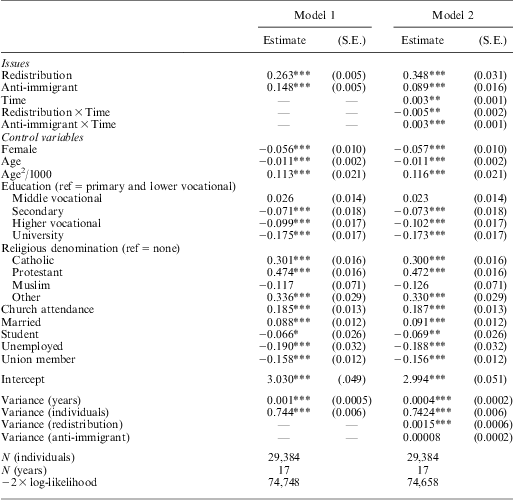
Table 1 presents the results of these random intercept and random slope models. Model 1 contains the direct effects of redistributive attitudes and anti-immigrant sentiment on left/right identification. In Model 2, we add cross-level interactions between redistribution and time and anti-immigrant attitudes and time. Before moving onto the main findings, we note that women, the higher educated, students, union members and the unemployed are more likely to designate themselves as leftwing, while Christians, churchgoers and married respondents are more likely to place themselves on the political right.
Determinants of Left/Right Identification in the Netherlands (1980–2006)
***p < 0.001, **p < 0.01, *p < 0.05 (two-tailed tests of statistical significance).
Note: ‘Redistribution’ and ‘Anti-Immigrant’ are standardized for the ease of presentation.
Source: SCP Culturele Veranderingen, 1980–2006.
Model 1 shows that both attitudinal variables have a sizeable effect on left/right identification. Those opposed to economic equality and ethnic heterogeneity are much more likely to place themselves on the ‘right’ than those favouring redistribution and cultural equality. However, for the time period as a whole, left/right ideology has a much stronger basis in economic than cultural attitudes. That is to say, a typical one standard deviation shift in redistributive attitudes results in a rightward shift of 0.26 points on the left/right scale. In contrast, a one standard deviation shift in anti-immigrant sentiment corresponds to a rightward shift of 0.15 points.
Still, the main contention of this study is that these effects will not be constant over time. The first interaction term in Model 2 indicates that the effect of redistribution on left/right ideology decreases as time goes by. In contrast, the coefficient for anti-immigrant sentiment increases in size over time. To interpret and visualize these interaction models, we follow the procedure suggested by Brambor, Clark and Golder (Reference Brambor, Clark and Golder2006). The downward sloping line in Figure 3a shows that the marginal effect of redistribution on left/right self-placement decreases over time. In line with Hypothesis 2 (issue crowding out), citizens have far weaker associations between left/right and economic issues now than two decades ago. In addition, Figure 3b shows that the marginal effect of anti-immigrant attitudes on left/right identification increases. As Hypothesis 1 (issue bundling) states, anti-immigrant attitudes are a far stronger predictor of one's left/right self-placement now than in the early 1980s. Given that both issue attitudes have been standardized in the models on which Figures 3a and 3b are based, the marginal effects on both y-axes can be directly compared. As such, Figure 3 highlights that, in terms of magnitude, the effect of these issues on left/right identification has almost equalized in the late 2000s.
The marginal effects of (a) redistributive attitudes (b) and anti-immigrant attitudes on left/right self-placement (with 95% confidence intervals)
Overall, our results show that while economic attitudes overshadowed cultural attitudes in determining the left-right identification of the Dutch population in the early 1980s, this difference has all but disappeared. These results lend credence to the idea that voters solve inconsistencies rising from the mobilization of previously non-salient issues (in this case immigration) by redefining their left/right identification. At the same time, this reinterpretation of left/right identification partially crowds out traditional redistributive attitudes associated with left/right.
Conclusion
Political scientists often describe party competition, political behavior or public preferences in left/right terms. Nevertheless, previous studies of the determinants of left/right identification focus on cross-national variations in the impact of attitudes.Footnote 23 This study explores changes in the foundation of people's left/right self-placements over time. Utilizing longitudinal data (1980–2006) from the Dutch context, where major changes occurred in terms of party competition in recent decades, this study provides evidence of a dynamic issue basis for voters’ left/right identification. As Dutch politics becomes more and more characterized by the mobilization of cultural issues relating to immigration, the left/right identification of Dutch voters has become more rooted in public attitudes towards immigrants. At the same time, the link between economic issues and left/right identification has weakened.
We explain this evolution in mass attitudes in terms of ‘issue bundling’ and ‘issue crowding out’. The logic of issue bundling can be understood as constituting a pressure for parties and voters to link new policy issues to their existing positions on the left/right dimension in order to guarantee ideological consistency and reduce information costs. Issue crowding out means that as a new policy issue becomes integrated into the left/right dimension, other issues that were more prominent for left/right identification, such as economic attitudes pertaining to income inequality, will become less important. Our results provide strong evidence of the multifaceted and dynamic nature of the meaning of left/right among the mass public. The dominant economic approach to left/right is clearly untenable, at least as far as the Netherlands is concerned.Footnote 24 This is not to suggest that economic attitudes are no longer relevant for understanding left/right politics, but rather that they became less important anchors of voters’ left/right positions in the Netherlands during the study period.
These results are important, as they suggest that the mobilization of cultural issues has affected how voters identify with politics. While our analysis has focused on the Netherlands, we might certainly encounter similar dynamics in voters’ left/right identification in other European countries where issues relating to immigration have become similarly politicized, such as Belgium, Denmark or Switzerland.Footnote 25 Furthermore, the results presented in this study have important implications for parties and their strategies. When the basis of voters’ ideological identification is essentially dynamic in nature and responds to changes in the political agenda, there is room for manipulation, which provides opportunities for new parties or political entrepreneurs. In addition, as time progresses and the electorate comes to terms with the new issue and adjusts its ideological identification accordingly, the traditional issue basis of left/right identification is altered, at least for a period of time. This redefinition of the ‘left’ or the ‘right’ may have significant implications for parties’ electoral fortunes.
Naturally, this study also has limitations and leaves several related topics untouched. First, although we provide evidence of a change in the relationship between anti-immigrant sentiment and redistributive attitudes on the one hand, and voters’ left/right self-placements on the other, endogeneity concerns remain.Footnote 26 Secondly, in future work it may prove important to explicitly test the effects of a changing political issue agenda on voters’ left/right identification. While using a generic time variable proved suitable to chart broad changes over time, using a substantive contextual variable will be an important next step towards further developing a theory concerning the dynamics of the issue basis of left/right ideology. Finally, an important avenue for further research concerns the ramifications and behavioral implications of the changing issue basis of voters’ left/right identification. Could these dynamics perhaps account for changes in the voter base of traditional left- or right-wing parties like the Social Democrats or Christian Democrats? While important caveats and questions remain, this study provides new insights into the dynamics of voters’ left/right identification. Most importantly, it shows that the issue basis of left/right identification is fundamentally dynamic in nature.