Introduction
Patient satisfaction is a key indicator of the quality of care (Miglietta et al., Reference Miglietta, Belessiotis-Richards, Ruggeri and Priebe2018), and is an important outcome of care in its own right. Numerous studies have shown initial satisfaction with care to be a reliable predictor of clinical outcomes following discharge for both voluntary and involuntary patients (Smith et al., Reference Smith, Roche, O'Loughlin, Brennan, Madigan, Lyne, Feeney and O'Donoghue2014). For example, initial satisfaction with inpatient care was the only variable shown to predict positive outcomes following involuntary hospitalisation. This included the overall duration of admission (Wykes et al., Reference Wykes, Csipke, Williams, Koeser, Nash, Rose, Craig and McCrone2018) and readmission to hospital within 1 year (Priebe et al., Reference Priebe, Katsakou, Yeeles, Amos, Morriss, Wang and Wykes2011b; van der Post et al., Reference van der Post, Peen, Visch, Mulder, Beekman and Dekker2014). Furthermore, for patients who are admitted involuntarily, those who are more satisfied with the admission within the initial few days are more likely to see the involuntary admission as necessary following discharge (Priebe et al., Reference Priebe, Katsakou, Amos, Leese, Morriss, Rose, Wykes and Yeeles2009; O'Donoghue et al., Reference O'Donoghue, Lyne, Hill, O'Rourke, Daly, Larkin, Feeney and O'Callaghan2011). Finally, across a range of studies conducted in different mental health settings, satisfaction with services has been linked to increased adherence to medication and treatment regimens (Wykes et al., Reference Wykes, Csipke, Williams, Koeser, Nash, Rose, Craig and McCrone2018), a reduced number of unmet needs (Reininghaus and Priebe, Reference Reininghaus and Priebe2012), better quality of life (Ruggeri et al., Reference Ruggeri, Nose, Bonetto, Cristofalo, Lasalvia, Salvi, Stefani, Malchiodi and Tansella2005) and a reduction in psychotic symptoms up to 3 years later (Vermeulen et al., Reference Vermeulen, Schirmbeck, van Tricht and de Haan2018).
A recent review of factors associated with satisfaction with inpatient care assessed a number of key patient characteristics across different studies and within different countries (Woodward et al., Reference Woodward, Berry and Bucci2017). Within the review, factors relating to satisfaction were classified as either patient-related or service-related. The only consistent patient-related factor across the studies that was linked to higher satisfaction was voluntary admission. Although a range of other factors such as age, gender, marital status and socioeconomic status had been investigated, results varied and proved to be inconclusive. Additionally, many of the studies included in the review were qualitative in nature, included only a small sample of individuals and were methodologically poor. Within the quantitative studies, sample sizes ranged from 25 to 433, with a mean of 182 participants. Therefore, they may have lacked statistical power to detect a significant association, with the reduced sample sizes potentially limiting the number of factors tested within the analyses (Woodward et al., Reference Woodward, Berry and Bucci2017).
Another key limitation across the current evidence base is that the majority of studies have only focused on an individual country, with inconsistent findings reported across studies conducted within different countries (Woodward et al., Reference Woodward, Berry and Bucci2017). Where studies have included patients recruited from multiple countries, the sample size within each country and/or hospital has been relatively small, with studies lacking statistical power to assess for interactions between patient characteristics and country (Krupchanka et al., Reference Krupchanka, Khalifeh, Abdulmalik, Ardila-Gomez, Armiya'u, Banjac, Baranov, Bezborodovs, Brecic, Cavajda, de Girolamo, Denisenko, Dickens, Dujmovic, Ergovic Novotny, Fedotov, Fernandez, Frankova, Gasparovic, Giurgi-Oncu, Grahovac, James, Jomli, Kekin, Knez, Lanfredi, Lassman, Mehta, Nacef, Nawka, Nemirovsky, Ola, Oshodi, Ouali, Peharda, Razic Pavicic, Rojnic Kuzman, Roventa, Shamenov, Smirnova, Smoljanic, Spikina, Thornicroft, Tomicevic, Vidovic, Williams, Yakovleva, Zhabenko, Zhilyaeva, Zivkovic, Thornicroft and Sartorius2017). At present, the evidence is insufficient to determine whether certain patient factors linked to satisfaction may differ across countries with different mental health systems, or whether the same factors are consistent across different countries. Understanding whether there are general patient-level characteristics that are linked to satisfaction, or whether satisfaction is determined by country specific factors will help services to make use of the available research on patient satisfaction when planning, delivering and evaluating mental health care. This is particularly the case where research is increasingly becoming international with the underlying assumption that similar processes and factors may apply across different countries thus allowing for cross-country generalisation of the results. Knowing whether there are country-specific or more general factors across countries that are associated with satisfaction, will enable researchers and clinicians alike to develop analytic procedures to evaluate and compare their satisfaction data.
To address this question, the current study utilised data from five European countries (Belgium, Germany, Italy, Poland, the UK), which have different traditions and organisations of mental health service delivery. Unlike previous studies, which have included a maximum of 701 patients, we aimed to recruit at least 1000 patients per country and assess satisfaction within the first few days of admission. Such a large sample size enables a range of factors, their association with initial satisfaction with care, and whether these associations are similar or different across countries to be tested. Furthermore, given the large number of hospitals and patients included from different countries, it is unlikely that the results will be influenced by a specific service or setting dominating the results.
Aims
The current study aims to overcome limitations in the existing evidence base and assess (a) which patient characteristics are associated with initial satisfaction with inpatient mental health care, (b) whether there are differences in patient satisfaction across five European countries and (c) whether associations between patient characteristics and satisfaction scores are similar or different across countries.
Methods
Study design and participants
The current study was a cross sectional study conducted in inpatient units across five different European countries (Belgium, Germany, Italy, Poland and the UK). Within each country, hospitals were purposively selected to include a range of rural, urban or semi-urban locations. In total 57 hospitals were included in the study.
Participants were included in the study if they met the following inclusion criteria: (i) 18 years of age or older; (ii) International Classification of Disease-10 (ICD-10) diagnosis of psychotic disorder (F20–29), affective disorder (F30–39) or anxiety/somatoform disorder (F40–49), (iii) hospitalised in a general adult psychiatric inpatient unit; (iv) sufficient command of the language of the host country to provide written informed consent and understand the questions in the research interviews and (v) capacity to provide informed consent. Individuals with a diagnosis of organic brain disorders and severe cognitive impairment too severe to enable completion of the study assessments were excluded.
Measures
Outcome variable
The primary outcome of interest was initial satisfaction with inpatient care as measured on the Client Assessment of Treatment Scale (CAT) (Priebe and Gruyters, Reference Priebe and Gruyters1995). The CAT is a seven-item measure, in which participants rate their satisfaction with different elements of their inpatient care. Items measured on the CAT include: ‘Do you believe you are receiving the right treatment/care for you?’, ‘Does your therapist/case manager/key-worker understand you and is he/she engaged in your treatment?’, ‘Are relations with other staff members pleasant for you?’, ‘Do you believe you are receiving the right medication for you?’, ‘Do you believe the other elements of treatment/care here are right for you?’, ‘Do you feel respected and regarded well?’, and ‘Has treatment/care here been helpful for you?’. For each item, the person rates their response on an 11-point Likert scale ranging from 0 (not at all) to 10 (entirely). The CAT has been used extensively in psychiatric research, and has been validated for use with psychiatric inpatients and across different countries (Miglietta et al., Reference Miglietta, Belessiotis-Richards, Ruggeri and Priebe2018).
Patient characteristics
Patient characteristics tested within the analysis were selected based on the available evidence highlighted in an existing review (Woodward et al., Reference Woodward, Berry and Bucci2017) and cross-country study of satisfaction (Krupchanka et al., Reference Krupchanka, Khalifeh, Abdulmalik, Ardila-Gomez, Armiya'u, Banjac, Baranov, Bezborodovs, Brecic, Cavajda, de Girolamo, Denisenko, Dickens, Dujmovic, Ergovic Novotny, Fedotov, Fernandez, Frankova, Gasparovic, Giurgi-Oncu, Grahovac, James, Jomli, Kekin, Knez, Lanfredi, Lassman, Mehta, Nacef, Nawka, Nemirovsky, Ola, Oshodi, Ouali, Peharda, Razic Pavicic, Rojnic Kuzman, Roventa, Shamenov, Smirnova, Smoljanic, Spikina, Thornicroft, Tomicevic, Vidovic, Williams, Yakovleva, Zhabenko, Zhilyaeva, Zivkovic, Thornicroft and Sartorius2017). The following variables were included age, gender, marital status, migrant status, education, homelessness, living alone, employment, diagnosis of psychotic disorder, affective disorder, anxiety/somatoform disorder, comorbid diagnosis of substance misuse, comorbid diagnosis of personality disorder, symptom severity as measured on the Clinical Global Impression (CGI) severity scale (Guy, Reference Guy1976), first admission v. repeat admission, and legal status of the admission. To measure social isolation, patients were asked to record whether (a) they had met a friend in the previous week and (b) they had anyone they would call a close friend.
Procedure
Patients consecutively admitted to adult psychiatric wards within 57 hospitals between 1 October 2014 and 31 December 2015 were screened to determine eligibility for the study. All eligible patients were initially approached by a researcher within 48 h of admission. The researcher provided information about the study and obtained written informed consent prior to completing the questionnaire containing the study measures. Where an individual lacked capacity to provide informed consent, they were re-approached at a later stage in their admission, when they were able to provide informed consent. The number of days between admission and completing the questionnaire was recorded on the study database. The questionnaire was completed in a face-to-face interview with the researcher, and included data on socio-demographic characteristics, social situation and satisfaction with inpatient care as measured by the CAT. Additional information relating to psychiatric diagnoses (according to ICD-10) at admission and at discharge, severity of illness (as measured on the CGI) and details of the admission including length of stay and formal status were obtained from medical records (where available) or from the treating clinician.
Ethical approval
Ethical approval was obtained in all five participating countries. Belgium: Comité d'Ethique hospitalo-facultaire des Cliniques St-Luc Brussels; Germany: Ethical Board, Technische Universität Dresden; Italy: Comitati Etici per la sperimentazione clinica (CESC) delle provincie di Verona, Rovigo, Vicenza, Treviso, Padova; Poland: Komisja Bioetyczna przy Instytucie Psychiatrii i Neurologii w Warszawie; and the UK: National Research Ethics Committee North East – Newcastle & North Tyneside (ref: 14/NE/1017).
Statistical analysis
The statistical analyses were conducted using STATA version 14.0. The mean score per item and standard deviation were calculated for satisfaction scores as measured by the CAT. Where individuals had missing data for two items or less, the mean of the remaining items was used to replace the missing items. Where more than two items were missing, the person was excluded from the analysis. For all other patient variables, including socio-demographic variables and details of the admission, mean and standard deviations or frequencies were calculated as appropriate.
Although the CAT is an ordinal measure, given the large sample size linear regression was seen as most appropriate for the analysis (Fagerland, Reference Fagerland2012). Initially, mixed effect linear regression models using a random intercept for hospital was conducted to test the association between individual patient-level characteristics and satisfaction. Where a variable had a univariable association with satisfaction that was significant at p ⩽ 0.1 level, it was included in the mixed effect multivariable regression model. The multivariable model was adjusted for hospital as a random factor and for country effects as a fixed factor. The estimated mean and standard deviation for satisfaction in each country was then calculated following adjustment for all significant predictors in the multivariable model.
Following the multivariable model, an interaction term between any variable showing a significant association in the multivariable model (p < 0.05) with satisfaction and country was fitted. This was to determine whether the association between different patient characteristics and either lower or high satisfaction scores was similar across the different countries, or whether different characteristics were associated with satisfaction scores for each country. This model adjusted for all other significant predictors and included a random intercept for hospital. An interaction was considered significant if it reached the p < 0.01 level, in order to control for multiple testing.
Results
Sample characteristics
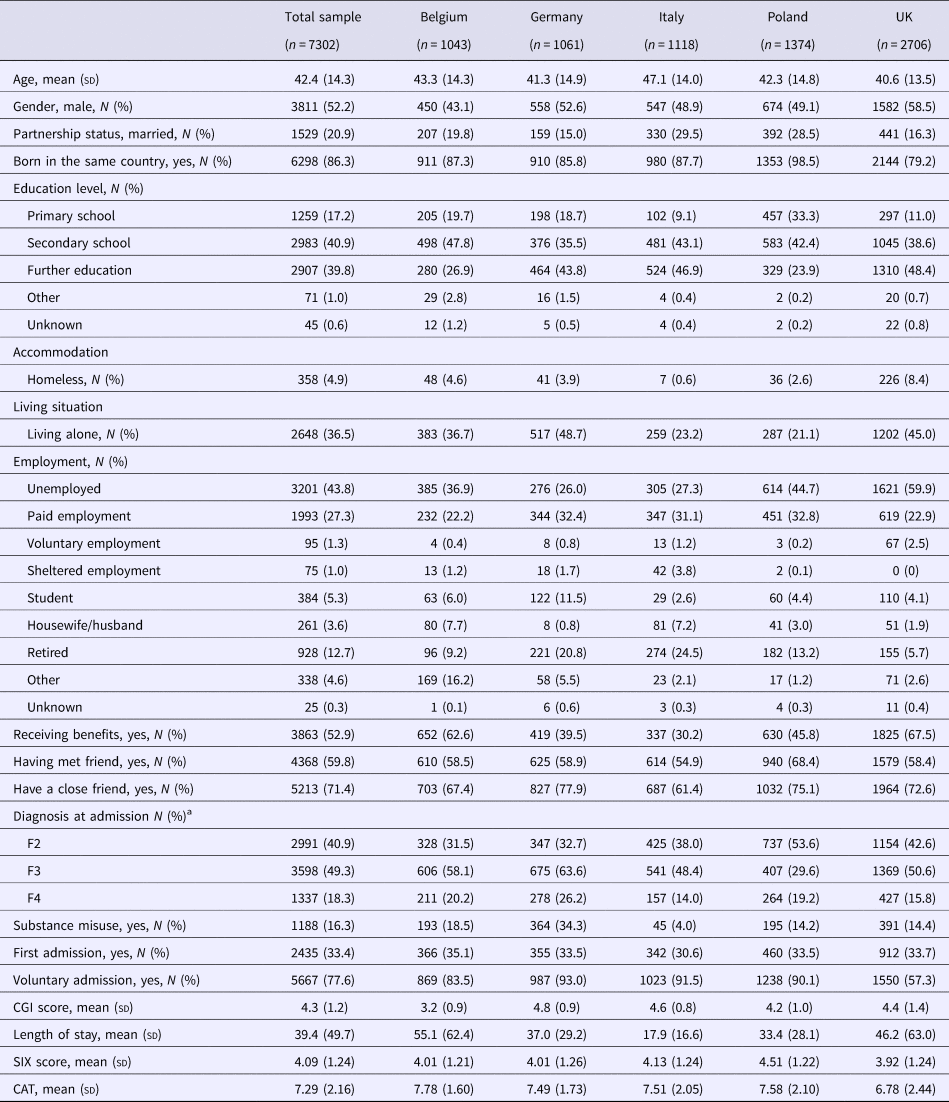
Overall, 13 869 eligible patients were approached to take part in the study. Of these, 7302 patients (53%) agreed to take part and were recruited 1043 in Belgium, 1061 in Germany, 1118 in Italy, 1374 in Poland and 2706 in the UK. The socio-demographic and clinical characteristics of the participants are shown in Table 1.
Socio-demographic and clinical characteristics of the sample

a Individuals could have multiple diagnoses hence the % adds up to >100.
Satisfaction with inpatient care
The unadjusted mean CAT for the total sample was 7.29 (sd = 2.16), with the following mean (sd) for each country: Belgium = 7.78 (1.60), Germany = 7.49 (1.73), Italy = 7.51 (2.05), Poland = 7.58 (2.11) and UK = 6.78 (2.44).
Patient characteristics associated with satisfaction with care
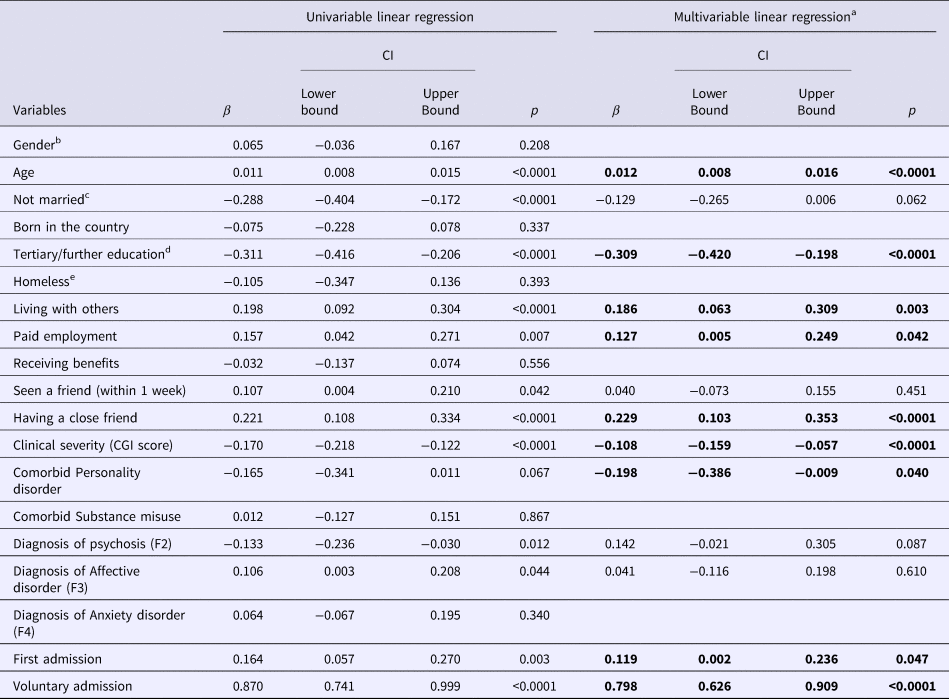
Of the 19 variables entered into the univariable regression, six did not show an association at the p < 0.1 level with satisfaction. These were gender, migrant status, homelessness, receiving benefits, co-morbid substance misuse at admission and anxiety disorder at admission. As a result, these variables were excluded from the multivariable model. This meant that 13 variables were entered in the multivariable mixed linear regression to test their association with satisfaction with care. The results of the multivariable regression analysis are shown in Table 2.
Mixed linear regression model testing associations of predictors with inpatient satisfaction

Bold indicates that the variable is significant at the p ≼ 0.05 level and hence retained within the final model.
a Adjusted for the effect of each country as a dichotomous variable and hospital as random intercept.
b Reference group = female.
c Reference group = married/co-habiting/civil partnership.
d Reference group = secondary education or less.
e Reference group = not homeless.
Out of the 13 variables tested in the multivariable model, there was a significant association with satisfaction with care for nine variables. As shown in Table 2, older age, living with others, paid employment, having a close friend and the current admission being a first admission were all associated with higher levels of satisfaction, whereas higher levels of education, increased symptom severity, having a comorbid diagnosis of personality disorder and involuntary admission were associated with lower levels of satisfaction.
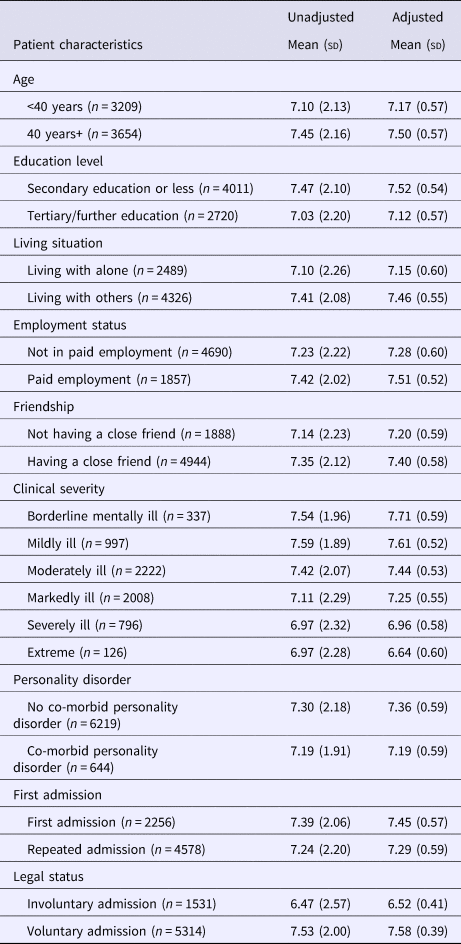
All significant variables were then entered into the final multivariable model along with country to produce adjusted mean satisfaction scores for each of the patient characteristics shown to be significant. As shown in Table 3, the differences between the groups tended to be small, with the mean satisfaction scores differing for most variables by up to 0.5 points, with the exception of clinical severity and legal status. The adjusted means for clinical severity as measured on the CGI, demonstrate a linear response, with patients with more severe illness rating their satisfaction as lower than those with less severe. Across the groups, there was a one point difference in satisfaction scores, with individuals rated as ‘Borderline mentally ill’ having a mean satisfaction score of 7.71 (sd = 0.39), compared to the most unwell (extremely mentally ill) who had a mean satisfaction score of 6.64 (sd = 0.60). Similarly, legal status of the admission also demonstrated a larger difference between the groups, with patients admitted involuntarily having a mean satisfaction score one point lower than those voluntarily admitted 6.52 (0.41) and 7.58 (0.39) respectively.
Satisfaction by patient characteristics

Country differences in satisfaction with care
There was a significant effect for country on satisfaction scores. Pairwise comparison tests indicated that all countries had significantly higher satisfaction levels compared to the UK (Belgium p < 0.001, Germany p = 0.036, Italy p = 0.019 and Poland p = 0.04). The means and standard deviations of satisfaction in each country were adjusted for the influence of all predictor variables that were significant in the multivariable model. Overall the adjusted mean satisfaction score for the whole sample was 7.34 (sd = 0.59). Adjusted means (sd) for each country were: Belgium = 7.84 (0.42), Germany = 7.5 (0.38), Italy = 7.57 (0.39), Poland 7.68 (0.37) and the UK 6.85 (0.52). After controlling for all patient characteristics shown to have a significant association with satisfaction, the effect of country continued to remain significant, with all countries having higher levels of satisfaction compared to the UK. Furthermore, within-country variation in satisfaction scores was small after adjustment for patient-level characteristics.
Interaction effects of patient characteristics and country
None of the variables included within the model were shown to have a significant interaction with country, thus the association between each patient characteristic and satisfaction scores did not significantly differ across countries.
Discussion
Main results
Across a large sample of psychiatric inpatients recruited from different hospitals and from different countries, the results indicate that a number of patient characteristics are independently associated with higher or lower satisfaction scores. Being older, living with others, having paid employment, having a close friend and the current admission being a first admission were all associated with higher levels of satisfaction. In contrast, higher levels of education, increased symptom severity, having a comorbid diagnosis of personality disorder and involuntary admission were all associated with lower levels of satisfaction. The associations of each patient characteristic with higher or lower satisfaction did not significantly vary across the different countries despite substantial differences in the mental health care system in terms of funding arrangements, bed numbers and clinical practices. Although there was no interaction between the impact of patient characteristics and satisfaction scores, country had an independent impact on satisfaction scores, with individuals from the UK significantly less satisfied compared to patients from all other countries. Within countries, variation in satisfaction scores was explained by differences in patient characteristics, when these characteristics were adjusted for within the analysis, within-country variation was small.
Strengths and limitations
The main strength of the current study was the large sample size of over 7000 patients, recruited from 57 hospitals across five European countries that vary in terms of service organisation, culture and tradition of mental health care. Within each country more than 1000 patients were included, with a consistent methodology used to approach and recruit patients. This large sample size allowed us to test a range of patient characteristics within a single multivariable model. Furthermore, the large sample allowed for interaction effects by country to be tested. Another strength was that satisfaction with care was assessed as early as possible during the inpatient admission. Within most previous studies, satisfaction has been assessed after 1 week or was assessed retrospectively following discharge from hospital. This may have led to sampling bias such that individuals admitted for only a short period of less than 1 week would not be included. Evidence also suggests that appraisals of satisfaction typically change following discharge, and that patient characteristics are linked to differing retrospective appraisals of care (Priebe et al., Reference Priebe, Katsakou, Amos, Leese, Morriss, Rose, Wykes and Yeeles2009; Katsakou et al., Reference Katsakou, Bowers, Amos, Morriss, Rose, Wykes and Priebe2010; O'Donoghue et al., Reference O'Donoghue, Lyne, Hill, O'Rourke, Daly, Larkin, Feeney and O'Callaghan2011). Furthermore, all researchers received training in the administration of the CAT and conducted face-to-face interviews with patients. The researchers were external to the clinical team and made clear to patients that their satisfaction ratings were confidential. This therefore reduced the possibility of any social desirability in the ratings, which may be the case when hospital staff members administer the measure to patients.
However, the study also has a number of limitations. Firstly, despite approaching all eligible patients admitted during a 15 month period, the opt-in rate was 53%. Although this raises the potential of bias within the sample, an opt-in rate of over 50% is consistent with the majority of studies in this area (Mindell et al., Reference Mindell, Giampaoli, Goesswald, Kamtsiuris, Mann, Mannisto, Morgan, Shelton, Verschuren and Tolonen2015). It is worth noting that associations tend to be more robust towards these types of bias then absolute scores. Secondly, the UK sample was larger than the samples included for the four other countries. This may have led to the UK results dominating the final model. To overcome this limitation results were adjusted for the impact of country, which was added as a fixed effect variable within the multivariable model. Thirdly, only a single measure of satisfaction was used – the CAT. This measure may not have addressed all areas of the patient experience. The choice of measure was influenced by the psychometric properties of the CAT, which have been established across countries and for this population group (Miglietta et al., Reference Miglietta, Belessiotis-Richards, Ruggeri and Priebe2018), and by the need to reduce demands on patients during the first few days of hospital admission. Finally, within the study, we focused on patient characteristics and did not assess other factors potentially associated with satisfaction such as perceived coercion, types of treatment received or the therapeutic relationship.
Comparison with the literature
Despite differences in methodology, including the time points at which satisfaction was measured; our findings are consistent with the existing literature regarding appraisals of inpatient care. Previous research including studies that have utilised the CAT, have highlighted the tendency for individuals to give positive ratings (Smith et al., Reference Smith, Roche, O'Loughlin, Brennan, Madigan, Lyne, Feeney and O'Donoghue2014). Within the current study, mean ratings were approximately 7 out of 10, suggesting patients were generally satisfied with the care received. Yet despite this overall positive appraisal, certain patient characteristics were linked to lower levels of satisfaction. It is noteworthy that many of the associations were small, with mean differences between categories rarely exceeding half a point. This may explain why previous studies with smaller samples have inconsistently shown an association between certain patient characteristics and satisfaction scores. However, consistent with previous research (Krupchanka et al., Reference Krupchanka, Khalifeh, Abdulmalik, Ardila-Gomez, Armiya'u, Banjac, Baranov, Bezborodovs, Brecic, Cavajda, de Girolamo, Denisenko, Dickens, Dujmovic, Ergovic Novotny, Fedotov, Fernandez, Frankova, Gasparovic, Giurgi-Oncu, Grahovac, James, Jomli, Kekin, Knez, Lanfredi, Lassman, Mehta, Nacef, Nawka, Nemirovsky, Ola, Oshodi, Ouali, Peharda, Razic Pavicic, Rojnic Kuzman, Roventa, Shamenov, Smirnova, Smoljanic, Spikina, Thornicroft, Tomicevic, Vidovic, Williams, Yakovleva, Zhabenko, Zhilyaeva, Zivkovic, Thornicroft and Sartorius2017; Woodward et al., Reference Woodward, Berry and Bucci2017), clinical severity and legal status of the admission were not only significant but had larger mean differences between the groups (over one point equating to a 15% difference in scores), with age and education level also having larger differences between groups. One possible interpretation of these results could relate to differences in expectations, with older individuals and people with lower levels of education having fewer or lower expectations about the services. Alternatively, these factors may be linked to general life satisfaction and wellbeing, rather than being specific to psychiatric services.
The results indicated that individuals in the UK are less satisfied with their psychiatric inpatient care compared to the other countries, a finding which may not solely reflect differences in services and/or patient expectations. Other population-based surveys conducted across Europe and beyond have indicated similar findings regarding satisfaction and wellbeing in general. For example, the European Values Study has previously indicated large cross-country variation in life satisfaction across European counties. Within the latest survey, individuals in the UK tended to score lower than most of the counties included in the analysis, apart from Italy who also had lower life satisfaction (http://www.europeanvaluesstudy.eu/page/life.html). Furthermore, this difference in satisfaction across countries also extends to happiness, where surveys of children highlight a tendency for individuals in the UK to score lower than other European countries (Rees et al., Reference Rees, Andresen and Bradshaw2016), and to specific types of satisfaction such as job satisfaction (NatCen, 2016).
Similar findings have also been reported in other multicentre studies conducted with both inpatients and patients receiving day hospital treatment. Within the EDEN study, individuals from five European countries (Czech Republic, Germany, Poland, Slovakia and the UK), received either inpatient treatment, or treatment in a day hospital. Measures of satisfaction, which were assessed within three days of the admission, highlighted country specific differences (Kallert et al., Reference Kallert, Glockner, Onchev, Raboch, Karastergiou, Solomon, Magliano, Dembinskas, Kiejna, Nawka, Torres-Gonzalez, Priebe and Kjellin2005). Likewise, the EUNOMIA study, which specifically focused on improving clinical practice for involuntary hospital admission, recruited patients from 11 European countries, including four of the five countries within the current study (Fiorillo et al., Reference Fiorillo, De Rosa, Del Vecchio, Jurjanz, Schnall, Onchev, Alexiev, Raboch, Kalisova, Mastrogianni, Georgiadou, Solomon, Dembinskas, Raskauskas, Nawka, Nawka, Kiejna, Hadrys, Torres-Gonzales, Mayoral, Bjorkdahl, Kjellin, Priebe, Maj and Kallert2011). As with the EDEN study, there was variation across countries in both the perceived levels of coercion and in treatment satisfaction, even after controlling for patient characteristics (Kallert et al., Reference Kallert, Katsakou, Adamowski, Dembinskas, Fiorillo, Kjellin, Mastrogianni, Nawka, Onchev, Raboch, Schutzwohl, Solomon, Torres-Gonzalez, Bremner and Priebe2011; Fiorillo et al., Reference Fiorillo, Giacco, De Rosa, Kallert, Katsakou, Onchev, Raboch, Mastrogianni, Del Vecchio, Luciano, Catapano, Dembinskas, Nawka, Kiejna, Torres-Gonzales, Kjellin, Maj and Priebe2012).
Implications for research and practice
The current study suggests that particular attention should be placed on improving the satisfaction of individuals who are admitted involuntarily, as this was the characteristic with the strongest association with satisfaction scores. Not only is there a moral imperative to provide the best possible care, especially when treatment is against the wishes of the patient, the consistent finding that initial satisfaction with care is the only positive predictor of outcomes following involuntary admission (Priebe et al., Reference Priebe, Barnicot, McCabe, Kiejna, Nawka, Raboch, Schutzwohl and Kallert2011a, Reference Priebe, Katsakou, Yeeles, Amos, Morriss, Wang and Wykes2011b; Richardson et al., Reference Richardson, Katsakou and Priebe2011) highlights the need for research to focus on this area. Consistently, a lack of procedural justice surrounding the admission and perceived coercion both factors common to the experience of involuntarily admitted patients, have been associated with lower levels of satisfaction (Katsakou et al., Reference Katsakou, Bowers, Amos, Morriss, Rose, Wykes and Priebe2010; Evans et al., Reference Evans, Rose, Flach, Csipke, Glossop, McCrone, Craig and Wykes2012; Smith et al., Reference Smith, Roche, O'Loughlin, Brennan, Madigan, Lyne, Feeney and O'Donoghue2014). In contrast, wards and services promoting involvement in decision making, increased activities and patient safety tended to have higher levels of patient satisfaction (Evans et al., Reference Evans, Rose, Flach, Csipke, Glossop, McCrone, Craig and Wykes2012). Recently, a range of approaches to improve patient satisfaction with inpatient care were combined in a single study. Across the trial, 8 different methods were applied, with each ward receiving training packages tailored to their needs. These methods included social and cognition training, cognitive behavioural therapy-based communication training for nurses, computerised cognitive remediation therapy, pharmacist-led medication education groups, hearing voices groups, emotional coping skills groups, problem solving skills, relaxation/sleep hygiene sessions and coping with stigma groups. The results indicated that although these practices led to increased satisfaction amongst involuntary admitted patients, they did not have an impact for patients admitted voluntarily (Wykes et al., Reference Wykes, Csipke, Williams, Koeser, Nash, Rose, Craig and McCrone2018).
The findings of the present study are promising for international research, as despite the substantial differences in the systems included within the study such as funding arrangements, bed numbers and practices within the hospitals, the same patient characteristics explain higher or lower satisfaction. This suggests some generalisable conclusions can be drawn across studies including those conducted in only one setting and those in multiple locations. This invariance of characteristics across the countries is in contrast with research highlighting the patient characteristics associated with length of stay. Within the same programme of research (i.e. the COFI study), we also explored the characteristics associated with increased length of stay with the results highlighting an interaction effect between most predictors (Dimitri et al., Reference Dimitri, Giacco, Bauer, Bird, Greenberg, Lasalvia, Lorant, Moskalewicz, Nicaise, Pfennig, Ruggeri, Welbel and Priebe2018). This suggests patient responses and experiences appear more consistent across countries than service practices.
Within this study, we were able to identify a consistent set of correlates for satisfaction in a large sample and valid for all countries. Identifying the patient characteristics associated with satisfaction allows for the development of a common analytical framework, which could be applied by any service, clinician or researcher wanting to compare and evaluate satisfaction levels. For instance, our results suggest that any comparison of satisfaction between services or countries should at the very least adjust for clinical severity (even with a brief measure such as the CGI), legal status, age and education level all of which could be easily obtained at the point of admission and are routinely collected on clinical information systems. Failing to control for these variables may result in spurious associations between services and satisfaction, which could rather be explained by differing patient characteristics.
Linked to the above, the study highlights how satisfaction can successfully be measured using a short scale i.e. the CAT, even within a few days of admission, and that this evaluation can occur for both voluntary and involuntary patients. Including a brief measure of initial satisfaction within routine elevations when the patient enters the ward, will help staff to identify individuals who are particularly dissatisfied. Assessing within this short timeframe maybe practically very important, as there is still time to target and improve satisfaction during the remainder of the admission. Satisfaction with inpatient care has been shown to improve later clinical outcomes (Priebe et al., Reference Priebe, Barnicot, McCabe, Kiejna, Nawka, Raboch, Schutzwohl and Kallert2011a; Richardson et al., Reference Richardson, Katsakou and Priebe2011; Vermeulen et al., Reference Vermeulen, Schirmbeck, van Tricht and de Haan2018), and is specifically linked to shorter admissions and fewer ward incidents and a decreased likelihood of compulsory readmission (Csipke et al., Reference Csipke, Williams, Rose, Koeser, McCrone, Wykes and Craig2016; Wykes et al., Reference Wykes, Csipke, Williams, Koeser, Nash, Rose, Craig and McCrone2018). Given the time pressure and the often-hectic nature of the admission, the CAT, which is an easy to administer seven-item measure, may offer one simple solution to capturing the initial subjective experience of care.
Conclusion
Patient satisfaction with care is increasingly recognised as an important process outcome indicating care quality and as an important outcome in its own right. A number of patient characteristics are associated with higher or lower satisfaction scores, independent of the country of admission. Severity of illness and involuntary admission were both associated with lower satisfaction scores with age and education level also having an impact. The finding that the same patient characteristics predict satisfaction regardless of country is encouraging for international research. This suggests that the same analytical frameworks may be applied to satisfaction data collected across countries or services. In particular, routine assessment conducted at admission should not only include a short measure of satisfaction, such as the CAT, but could capture legal status, clinical severity, age and education level as well. This will help services to adjust and properly compare their satisfaction scores, with those collected nationally and internationally. Having a better understanding of patient satisfaction will hopefully enable services to improve the quality of care provided as well as clinical outcomes for all patients.
Author ORCIDs
Victoria Bird, 0000-0002-2053-7679, Stefan Priebe, 0000-0001-9864-3394.
Acknowledgements
The views expressed in this publication are those of the authors and not necessarily those of the European Commission or Queen Mary University of London. The authors would like to gratefully acknowledge the wider COFI study group, the support of the funders, the 57 supporting services and to the 7302 participants who took part in the study.
Financial support
This study was funded by the European Commission 7th Framework Programme. Grant agreement number is 602645.
Conflict of interest
None.
Ethical standards
The authors assert that all procedures contributing to this work comply with the ethical standards of the relevant national and institutional committees on human experimentation and with the Helsinki Declaration of 1975, as revised in 2008.