INTRODUCTION
Kinematic evidence has the potential to contribute to an account of prosodic development and, more broadly, of interactivity in language processing. For this study, our aim was to assess whether children, both those with typical language and with specific language impairment (SLI), and adults implement distinct prosodic patterns within words that are embedded in different linguistic contexts. Two experimental analyses were planned. In the first, we used standard transcription measures to assess whether older children who are normally developing (ND) or have SLI produce the expected omission and segmental substitution errors in vulnerable prosodic environments. In the second analysis, we obtained direct articulatory kinematic measures to evaluate whether distinct prosodic patterns emerge in different grammatical and segmental contexts. Together, transcription and kinematic approaches can inform our understanding of the representation and interactivity of prosodic categories.
In metrical stress theory it is hypothesized that there are two basic rhythmic sequences, iambic (weak–strong) and trochaic (strong–weak; e.g. Hayes, Reference Hayes1995). Rhythmic sequences are organized into units of strong and adjacent weak syllables, termed ‘metrical feet’ (see Gerken & McGregor, Reference Gerken and McGregor1998, for a review). English allows trochaic metrical feet, which consist of a strong syllable followed by a weak syllable. Strong syllables also may stand alone. Iambic feet, defined as weak followed by strong syllables, are not considered well-formed in English. Therefore, weak syllables that precede strong are referred to as unfooted. Unfooted syllables are particularly vulnerable to error in children acquiring English (Gerken & McGregor, Reference Gerken and McGregor1998).
While most accounts rely on this binary distinction between iambs and trochees, it may be that additional subtypes of rhythmic sequences, or feet, can be identified as linguistic demands change over the course of development. Prosodic aspects of output may be influenced by other domains of linguistic processing, such as segmental, lexical, and morphological. For example, affixes “bearing weak stress” are particularly sensitive to prosodic demands (Hayes, Reference Hayes1995: 32). Segmental complexity (Gerken & Ohala, Reference Gerken, Ohala and Wheeldon2000; Zamuner & Gerken, Reference Zamuner, Gerken and Clark1998) and lexical frequency (Boyle & Gerken, Reference Boyle and Gerken1997) may also influence how weak syllables are instantiated. Because multiple dimensions of language, including lexical, morphosyntactic, and segmental components, are likely to develop more slowly in children with SLI, this population provides an ideal test case for investigating interactions across the prosodic hierarchy.
In the present study, we are interested in whether the prosodic organization of iambic and trochaic words is influenced by the language context in which they occur. We first replicate and extend earlier transcription-based findings to assess whether unfooted weak syllables are especially prone to production errors in older children, aged four to six years. Because these children are relatively accurate, perceptually based phonetic transcription may be limited in revealing whether an inventory of foot types can be identified that extend beyond the broad categories of iamb and trochee. With this limitation in mind, we then turn to an analysis of speech motor kinematics to index whether the rhythmic structure of movement patterning varies systematically when iambic and trochaic words are produced in different linguistic contexts. We ask whether additional systematic rhythmic distinctions can be made that include more nuanced subcategories than iambic and trochaic. For example, within the iambic foot structure, it may be that weak syllables associated with grammatical inflections are produced differently from weak syllables of content words. More fine-grained articulatory kinematic approaches have the potential to determine whether the broad categories of iamb and trochee are sufficient or whether additional rhythmic stress patterns can be identified.
Finally, again relying on kinematic evidence, we evaluate whether non-alternating stress sequences (i.e. weak–weak; WW) are produced with more movement variability than alternating (i.e. SW). The multiple levels of analysis should provide insights regarding the nature of the prosodic deficit in SLI and inform whether the existing binary iambic and trochaic distinction, suggested by perceptually based error analysis, should be extended to include additional prosodic subcategories.
Review of developmental account
Even infants mark stress, as indicated by increases in duration, intensity, and fundamental frequency in stressed compared with unstressed syllables (Davis, MacNeilage, Matyear & Powell, Reference Davis, MacNeilage, Matyear and Powell2000; Vihman, DePaolis & Davis, Reference Vihman, DePaolis and Davis1998). A trochaic bias is not revealed, since both iambic and trochaic sequences are produced with appropriate stress marking (Davis et al., Reference Davis, MacNeilage, Matyear and Powell2000). However, once toddlers begin to produce words, omission errors provide substantial evidence that trochaic sequences are less vulnerable to error than iambic.
In English, children's prosodic errors are often accounted for by the postulation of a trochaic production constraint, in which syllables are retained that can be parsed into binary feet which fit a trochaic template (Demuth, Reference Demuth2003; Echols, Reference Echols1993; Gerken, Reference Gerken1994; Reference Gerken1996). On this account, children are sensitive to the structure of the majority of English words and thus attempt to produce well-formed (i.e. S or SW) syllable sequences, omitting syllables that are inconsistent with this structure or are unfooted. For example, for young children an iambic word such as balloon is frequently produced as [lun], whereas a trochaic word such as baby is unlikely to include such a weak syllable omission error.
Omission errors occur variably. Investigators have attempted to understand the nature of this variability, hypothesizing that other linguistic factors may condition the likelihood that an omission error will occur. For example, Boyle and Gerken (Reference Boyle and Gerken1997) demonstrated that children are more likely to omit unfooted weak syllables from function words in unfamiliar than familiar contexts.
It is also important to consider that prosodic effects not only occur within a word, but also cross word boundaries and thus influence grammatical inflections. For example, children will form a trochaic foot across word boundaries, producing fewer omissions of the functor the in Tom pushed the bear compared to in Tom pushes the bear (Gerken, Reference Gerken1996). In the first case pushed the forms a trochaic foot, even though it crosses from a verb to the following noun phrase. The preference for a well-formed prosodic foot crosses word and phrase boundaries with prosodic constraints overriding syntactic ones. The same trochaic template may influence the production of content and of function words. Finally, it has been suggested that segmental factors may also interact with the frequency of prosodically conditioned errors (Gerken & Ohala, Reference Gerken, Ohala and Wheeldon2000; Zamuner & Gerken, Reference Zamuner, Gerken and Clark1998).
In sum, unstressed syllables in iambic feet are especially vulnerable. While it is established that multiple linguistic factors contribute to the likelihood of prosodically motivated errors, it remains unknown whether there are additional prosodic categories beyond those associated with iambs and trochees. It may be that the broad and binary categories of iamb and trochee are simply too coarse and that more refined subcategorization of prosodic foot structure may provide a stronger explanatory account of children's and adults speech production.
How does motor evidence change the problem space?
Iambic and trochaic prosodic forms have recognizable signatures that appear in the patterning of articulatory movement (Goffman, Reference Goffman1999; Reference Goffman2004). The use of kinematic evidence allows for a more detailed analysis of systematic and recognizable patterns that may emerge across distinct prosodic categories (Grigos & Patel, Reference Grigos and Patel2007). One possibility is that the only differentiable categories are iambs and trochees. Standard models of speech production, such as Levelt's (Levelt Reference Levelt1989; Levelt, Roelofs & Meyer, Reference Levelt, Roelofs and Meyer1999), propose discrete levels of processing for form encoding, which includes prosodification and syllabification, and for phonetic encoding. In this view, morphemic processing occurs prior to syllabification and the application of metrical structure. This is a hierarchical model, in which phonological structure is then fed into phonetic encoding and articulation. Articulation relies heavily on a mental syllabary, which is a catalog of highly frequent syllables (Cholin, Schiller & Levelt, Reference Cholin, Schiller and Levelt2004). Systematic changes in the structure of syllables that are conditioned by lexical, morphosyntactic, or segmental status would likely not be predicted by this account.
It is also possible that even highly frequent syllables vary systematically as a function of other language variables, such as lexical and morphosyntactic context. In this alternate view, there is thought to be interactivity among processing levels (Rapp & Goldrick, Reference Rapp and Goldrick2006). Empirical findings support a lexical–articulatory interaction. For example, Baese-Berk and Goldrick (Reference Baese-Berk and Goldrick2009) found that voice onset time (VOT) varied as a function of neighborhood density. McMillan, Corley, and Lickley (Reference McMillan, Corley and Lickley2009) asked participants to produce real word and nonword pairs. They observed increased substitution errors when word pairs included real word competitors. Further, more kinematic variability occurred in nonwords than in real words. These investigators argue that lexical and articulatory levels have more direct interaction than that proposed by discrete models. Direct recordings of articulatory movement change the problem space in that it becomes possible to examine how prosodic structure interacts with other aspects of language; there may be more reticulated prosodic subcategories than iambic and trochaic. We assess whether, as language demands change, distinct movement patterning is observed even within iambic and trochaic categories.
Patterning of prosodic templates
Syllable stress is defined as the “linguistic manifestation of rhythmic structure” (Hayes, Reference Hayes1995: 1). In the kinematic domain, correlates of stress are amplitude and duration. Fundamental frequency is an additional acoustic correlate. In speech, the most direct measure of rhythmicity is at the level of articulation (Goffman, Reference Goffman1999; Reference Goffman2004; MacNeilage & Davis, Reference MacNeilage and Davis2000), where oral movements are relatively small and short in weak compared to strong syllables (Goffman, Reference Goffman1999; Reference Goffman2004; Goffman, Heisler & Chakraborty, Reference Goffman, Heisler and Chakraborty2006).
Kinematic evidence may be used to assess the prosodic template. Our previous work has focused on bisyllabic nonce nouns, and has shown that the prosodic template is distinct for iambic and trochaic words (Goffman, Reference Goffman1999; Reference Goffman2004; Goffman et al., Reference Goffman, Heisler and Chakraborty2006; Goffman & Malin, Reference Goffman and Malin1999). Children and adults produce weak syllables in iambic content words differently from those that occur in trochaic content words. Specifically, weak syllables in iambs are produced with movements that are smaller and shorter than the strong syllable that follows. In contrast, for children, the highly frequent and early developing trochaic word is produced with movements that are similar in amplitude and duration for weak and strong syllables. Adults also show asymmetries between iambs and trochees, in that trochees are produced with strong and weak syllables that are relatively equal in weight (i.e. similar in amplitude and duration), whereas iambs increase quantitative contrasts between weak and strong syllables (Goffman, Reference Goffman1999; Goffman et al, Reference Goffman, Heisler and Chakraborty2006; Hayes, Reference Hayes1995; Prince, Reference Prince, Ziolkowski, Noske and Denton1990). Distinct rhythmic articulatory templates are observed for iambic and trochaic words, even when considering the weak syllable in isolation.
Very little is known about whether distinct prosodic templates are produced as a function of language context. In one study, again using nonce words (in order to control for segmental content), adults were observed to produce distinct articulatory movement templates in content versus function words (Goffman, Reference Goffman2004). Speakers were introduced to a character from another planet named Sam. They were told Sam's from outer space. He's not a boy. He's not a dog. He's a bab. They then produced the sentence Sam's a bab, which includes an article + noun construction. In another condition, the same speakers were told Sam has many funny toys. This toy's called an [ə'baeb]. In this condition, the same phonetic form now comprised a WS content word, and participants produced the phrase Sam's [ə'baeb]. Adults showed sensitivity to the morphosyntactic distinction, producing larger amplitude movements for the weak syllable in the article than the content word condition. Children, however, included the same articulatory rhythmic structure across the two morphosyntactic conditions, and produced similarly small movements in weak syllables associated with content and function words. Children invoked a single collapsed prosodic category for the production of iambs irrespective of grammatical context. In the present study, we assess whether the patterning of the spatial and temporal correlates of stress reveal prosodic templates beyond iambs and trochees within a lexical item.
Variability of prosodic sequences
Kinematic evidence may also reveal the ease with which a speaker produces a prosodic target. The ability to produce the same articulatory movement pattern on each rendition of a given target provides a measure of the stability of a motor representation. Variability is thought to register reorganization in learning and to be an index of flexibility, or plasticity (Thelen & Smith, Reference Thelen and Smith1994). There are multiple sources of variability. Often increased variability is an index of immaturity, with younger children producing more variable movements than older children and adults (e.g. Smith & Goffman, Reference Smith and Goffman1998; Smith & Zelaznik, Reference Smith and Zelaznik2004). Children with SLI show more variability than their age-matched peers (Goffman, Reference Goffman1999; Reference Goffman2004). Alternatively, decreased variability may reveal that a speaker has some covert awareness that expressing a particular distinction is important. It may be that iambic nouns require more precision than trochaic nouns. However, often unfooted syllables are free-standing grammatical morphemes, such as the article a in the sentence Spot's a dog. In the present study, we ask about shifts in movement variability in prosodic contrasts that extend across word boundaries.
Within-individual effects have been observed in articulatory variability. Children are more variable in their production of a phrase embedded in a longer and more complex sentence frame than when the same phrase is produced in isolation (Maner, Smith & Grayson, Reference Maner, Smith and Grayson2000). In addition, words are produced with more variability when they have no meaning than they are when a visual referent has been introduced in a learning task (Heisler, Goffman & Younger, Reference Heisler, Goffman and Younger2010). Thus, shifts in variability may reflect changes in the complexity of the learning task or environment.
With this background, it may be reasoned that a large degree of variability in the production of multiple renditions of an iambic or trochaic template reflects increased difficulty. Counter-intuitively, such speech motor patterning variability is higher in more frequently occurring trochaic words than in less frequent and later developing iambic words (Goffman, Reference Goffman1999; Goffman et al., Reference Goffman, Heisler and Chakraborty2006). One possible explanation is that, for English, due to the high frequency and early occurrence of trochaic nouns, children rely on a basic unmodulated rhythmic sequence for the production of these words. Iambs require that speakers invoke a more specified, precise movement pattern in order to mark their contrast to the default trochaic pattern. In other languages it is possible that such a default unmodulated rhythmic structure would apply to other prosodic structures (Demuth, Reference Demuth, Weissenborn and Hohle2001; Reference Demuth2003; Vihman et al., Reference Vihman, DePaolis and Davis1998). Children learning English produce trochaic nouns with movements that are relatively variable compared with iambic sequences. It is not known whether less canonical stress alternations that cross word boundaries (e.g. an article + content word that together form an iambic stress pattern) also show the increased precision that has been observed within an iambic word.
Hypotheses of the current study
The overarching goal of the present study is to assess whether the phonetic and articulatory components of prosodic structure vary as a function of higher-order phonological and morphosyntactic factors, thus revealing interactive processing. The specific hypotheses are:
(1) Older children will produce increased omission and segmental substitution errors in iambic words. These errors will be especially predominant in children with SLI.
(2) The articulatory patterning of prosodic templates will reveal differentiable subcategories that extend beyond the broad classes of iambic and trochaic stress patterns. Specifically, morphological and segmental factors will systematically influence the production of weak and strong syllables within the iambic and trochaic categories.
(3) Articulatory movement variability will decrease in alternating (footed; SWSW) compared with non-alternating (unfooted; SWWS) prosodic sequences that cross word boundaries.
METHODS AND RESULTS
General methods
Participants
Three groups of individuals participated in this study, including fourteen adults (ME = 20 years, SD = 1·5, range = 18–23), seventeen four-year-old children who were ND (ME = 4;7 (years;months), SD = 0;3, range = 4;1–4;11), and fourteen four- to six-year-old children diagnosed with SLI (ME = 5;2, SD = 0;7, range = 4;3–6;5). Because it was a goal of this study to investigate children with ND independently of those with SLI, this group was from a narrower age range, and included only four-year-olds. Different subgroups of participants were included across analyses, for reasons that will be explained in the context of each analysis.
The adults reported unremarkable developmental, medical, and speech, language, and hearing histories. Both groups of children, ND and SLI, showed non-verbal cognitive skills within the range of normal as measured by the Columbia Mental Maturity Scale (Burgemeister, Blum & Lorge, Reference Burgemeister, Blum and Lorge1972). In addition, all children demonstrated structural and functional oral motor skills within expected levels, as measured by the Clinical Assessment of Oropharyngeal Motor Development (Robbins & Klee, Reference Robbins and Klee1987). Auditory function was normal for all participants, as indicated by responses to pure tones presented bilaterally at 20 dB at 500 Hz, 1000 Hz, 2000 Hz, and 4000 Hz.
As required by the diagnostic category (Leonard, Reference Leonard1998), the children with SLI all demonstrated language skills at least one standard deviation below the mean on the Structured Photographic Expressive Language Test (Dawson & Stout, Reference Dawson and Stout2003) and/or the Reynell Developmental Language Scales-US edition (Reynell & Gruber, Reference Reynell and Gruber1990). The children who were ND all showed language skills within the normal range according to the Reynell Developmental Language Scales-US edition (Reynell & Gruber, Reference Reynell and Gruber1990).
Procedures and stimuli
Children and adults participated in one 20- to 30-minute experimental session. Children were seated in a wooden Rifton chair that was designed for individuals with cerebral palsy and includes an adjustable headrest and a play tray. Adults were seated on a stable wooden chair. For the kinematic recording, all speakers faced the Optotrak camera during data collection trials and were able to move naturally while speaking.
The target trochaic (i.e. baby) and iambic (i.e. baboon) words were embedded in two different sentence frames. These differed in several ways, most critically in that in one the target iambic or trochaic noun was preceded by a free-standing function word that was a vowel (Em's a ____). The other sentence frame included a content word + bound morpheme (Emma's ____) and a coda. The target sentences were:
(a) Em's a baby (SWSW, preceded by a free-standing function word and a final vowel); [VC.CV][CV.CV]. denotes syllabification and [] foot structure)
(b) Emma's baby (SWSW, preceded by a content word and a coda); [VC.CVC.][CV.CV]
(c) Em's a baboon (SWWS, free-standing function word, final vowel); [VC.CV.]CV.[CVC]
(d) Emma's baboon (SWWS, content word, coda); [VC.CVC.]CV.[CVC]
For recording lip and jaw kinematics, it is essential that the target productions include labial consonants. The use of real rather than nonce words leads to some trade-offs. The word baboon is less frequently occurring than the word baby. The stimuli were all modeled and, as will be apparent in the data analyses, these speakers produced baboon as an iamb. However, the reduced frequency of occurrence of the iambic compared with the trochaic target word needs to be accounted for in the interpretation of the results. Sentences were paired with a picture referent (e.g. a baboon wearing a diaper and holding a baby bottle, for Em's a baby) and were presented using PowerPoint. Utterances were presented randomly within a block with no more than three of the same sentence produced successively. Fifteen imitated productions of each sentence were elicited, with the first ten consecutive fluent sentences selected for analysis. Imitative paradigms are frequently used in studies assessing stress production in young children (Gerken, Reference Gerken1994; Reference Gerken1996; Schwartz & Goffman, Reference Schwartz and Goffman1995) and children are thought to integrate their own production patterns into imitations of prosodic contrasts. All of the experimental groups received the same input.
Excluded data
Sessions were observed on videotape and coded by two graduate students with experience transcribing child speech. Utterances that either judge coded as containing disfluencies (i.e. repetitions, prolongations, or long pauses) or, for kinematic analyses, extreme head movement (e.g. moving out of camera range) were excluded.
Descriptive analysis of transcribed error patterns
The purpose of this analysis was to verify that the target utterances would pattern as predicted in the standard transcription-based analysis. An increased number of omission and substitution errors were predicted in unfooted weak syllables, especially for children with SLI.
Participants
A subset of child participants were included in this verification of the standard transcription-based errors, including twelve children with SLI and twelve of their ND peers. All were randomly selected from the larger pool.
Data recording and transcription
For phonetic transcription, high quality audio-recordings of experimental sessions were collected using a Sony DAT recorder (DTC-59ES) and a Crown PZM-180 microphone. Using the DAT tapes, tokens were phonetically transcribed by two graduate student judges trained in the phonetic transcription of children's speech. Standard broad IPA procedures were used for the transcription of segments. Because the target syllables were phonetically identical across prosodic and syntactic conditions, only the [bV] syllables (i.e. [beI] for baby in the SWSW and [bə] for baboon in the SWWS sequences) were included. Three types of error analyses were completed, including standard measures (expressed in proportions) of: (1) weak syllable omissions; (2) consonant omissions (e.g. [ə] for [bə]); (3) consonant substitutions. Inter-judge reliability values were obtained for a randomly selected four children with SLI and one who was ND. Inter-judge agreement was minimally 95 percent for all five children.
Analyses
Because of the minimal errors, especially in the SWSW sequence, only descriptive results are included.
syllable omissions: In the canonical SWSW sequence, only one omission error occurred (in the production of a function word in the sentence Em's a baby by an ND four-year-old) across all twenty-four speakers. Syllables in this SWSW prosodic structure were not prone to omission and thus were not subjected to further analysis.
For the SWWS sequence, there were again few syllable omissions in the initial weak syllable (SWWS), which was associated with the content word Emma or the article a. Two children who were ND omitted these weak syllables. This small number of omissions was not surprising because this weak syllable could foot with the preceding strong syllable.
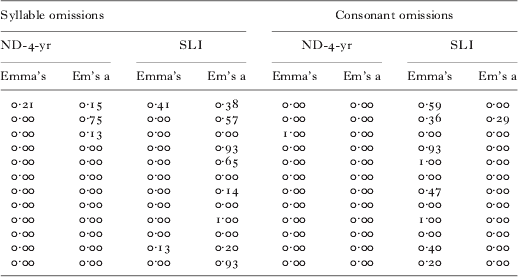
The second weak syllable in the sequence (SWWS), however, included numerous omission errors. These results are reported descriptively in Table 1. Due to the large number of zeros, statistical results are not reported. In the ND group, three of the twelve children variably omitted the initial weak syllable in the content word baboon. Eight of the twelve children with SLI showed similar omission errors. As shown in Table 1, there were more syllable omissions in the syllable [bə] in the frame Em's a baboon than in Emma's baboon, especially for children with SLI.
Individual data: Proportions of syllable and consonant omissions in SWWS sequences
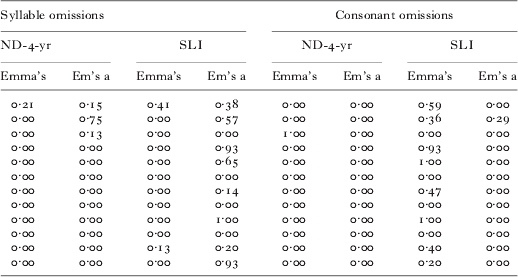
consonant omissions: Only the initial syllables in the words baby and baboon could be subjected to consonant omission analysis (e.g. the production of [bə] as [ə], with retention of the vowel to mark the syllable), since the preceding weak syllable contained a single vowel. There were no consonant omission errors for any child for the word baby in the SWSW sequence. However, there were consonant omission errors for the word baboon in the SWWS sequence. One child who was ND produced the syllable [bə] as [ə], and eight children with SLI showed this error pattern. As shown in Table 1, children with SLI produced more consonant omissions than those who were ND. In contrast to the analysis of syllable omissions, an increased number of consonant omission errors were observed in the frame Emma's baboon as opposed to Em's a baboon. Once again, the effect was observed in the children with SLI, but not their ND peers.
segmental errors: Only one child with SLI produced a segmental error for the word baby in the SWSW sequence. Three children who were ND and seven children with SLI produced other segmental substitution errors in their production of the syllable [bə] in the word baboon (e.g. [kəbun] and [dəbum] for baboon). Unlike omission errors, substitutions did not appear to pattern differently across linguistic contexts.
Summary of segmental analysis: It was expected that difficulties with weak initial (i.e. unfooted) syllables that have been observed in studies of younger children would also be present in these older children, particularly those diagnosed with SLI. This was indeed the case, with an increased number of omission errors occurring in the [bə] syllable in baboon compared with the [beI] syllable in baby. Other types of errors also were observed, including consonant omission and other weakening errors. Omission errors patterned differently across linguistic contexts. However, substitution errors were similarly distributed across contexts.
Kinematic analyses
The kinematic analysis was the primary focus of this study; from this analysis it could be determined whether children employ differentiable movement templates within iambic and trochaic categories and whether articulatory variability changes as a function of the complexity of the rhythmic alternation.
Participants
Because omissions did not occur in productions of the trochaic word baby, all fourteen adults, seventeen children who were ND, and fourteen children with SLI were included in the analyses of trochees. However, in the more critical iambic condition, because of the frequent occurrence of syllable omissions (especially for the children with SLI), the numbers were reduced for the child participants. In all, fourteen adults, thirteen children who were ND, and six who were SLI were included in the kinematic analyses of iambs.
Data recording and extraction
Kinematic data were collected using the Optotrak, a system designed for recording human movement (Northern Digital). The tracking error of the Optotrak is less than 0·1 mm. Small (6 mm in diameter), flat light emitting diodes (IREDs) were attached at midline, partially overlying the vermilion zone of the upper and lower lips (only lower lip/jaw movements will be reported here). To correct for head movement, a third IRED was placed on the forehead. Kinematic data were collected at a sampling rate of 250 samples/second. A synchronous acoustic signal, sampled at 16,000 Hz, was also obtained. Analyses were performed using the Matlab signal processing program (MathWorks, 1993). Lower lip motion was corrected for head movement using a three-dimensional subtraction technique, and displacement data were low-pass filtered (10 Hz cut-off) prior to computation of velocity (see Goffman, Reference Goffman1999; Goffman & Smith, Reference Goffman and Smith1999; Smith, Goffman, Zelaznik, Ying & McGillem, Reference Smith, Goffman, Zelaznik, Ying and McGillem1995). Video-recordings were obtained to code for extreme head movement and speech errors such as disfluencies.
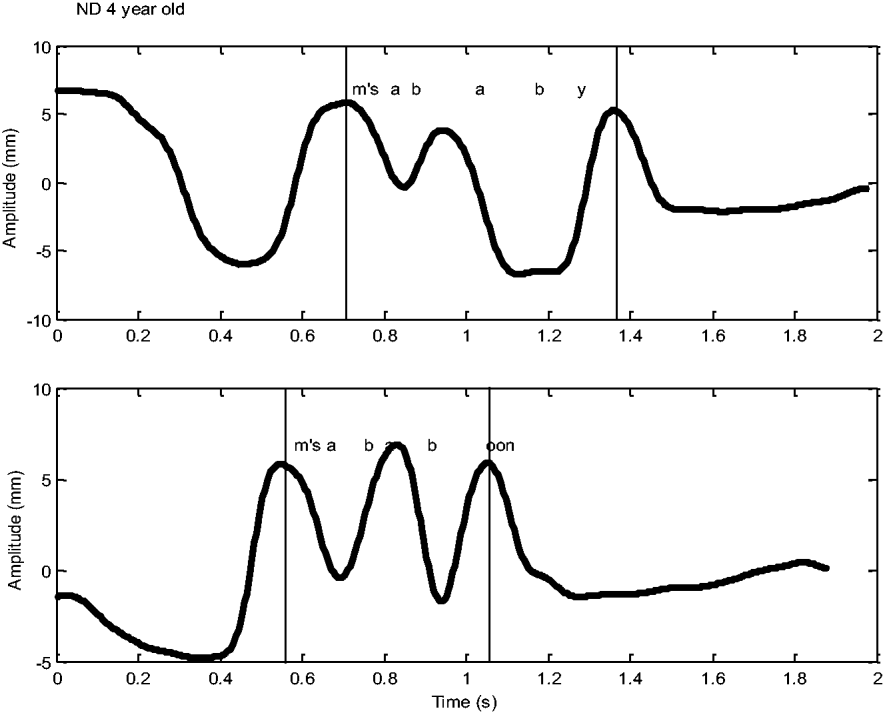
Kinematic records were collected in 45-second trials, during which children produced multiple sentences. The target utterances were selected because they included labial closure at the onset of the weak syllable/article (i.e. the [m] in Em's a or Emma's) and the onset and offset of the initial syllable in the following word (i.e. [bəb] in baboon and [beIb] in baby). As illustrated in Figure 1, movement onsets and offsets associated with lip closure were initially selected by visual inspection of the displacement record for local minima. An algorithm then determined the minimum value, corresponding to the experimenter-selected point. Selections of kinematic records were confirmed by playing back the synchronized acoustic signal.
Examples of extracted movement sequences from a four-year-old ND child producing the target sentences Em's a baby (top panel) and Em's a baboon (bottom panel). Movements were extracted, beginning with the lip closure for the [m] in Em's and ending with the second [b] in baboon or baby. The vertical lines show the WS or WW sequence used in the STI analysis.

Movement patterning
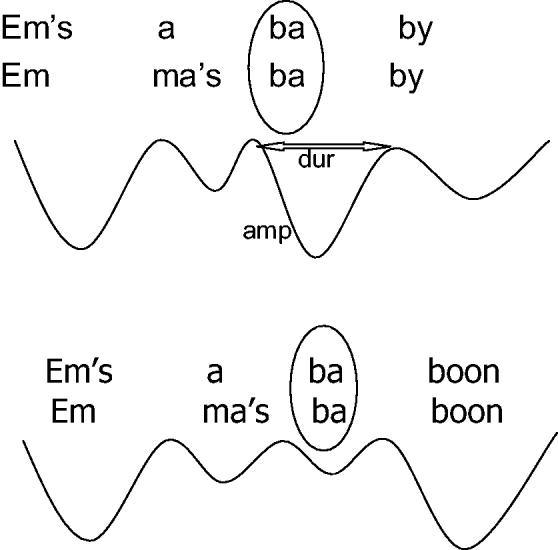
The rhythmic structure of individual syllables was assessed using point measures of movement amplitude and duration. Figure 2 shows how amplitude and duration measures of individual syllables were obtained from the initial syllables of the words baby and baboon. These amplitude and duration values could be compared across the two sentence frames Em's a ___ and Emma's ___ to assess the influence of linguistic context on the rhythmic structure of the initial syllables in iambic and trochaic words.
Illustration of the method for assessing the amplitude and duration of the syllable [bVb]. As an example, the [beIb] in baby could be compared across the two morphosyntactic contexts.
Movement variability
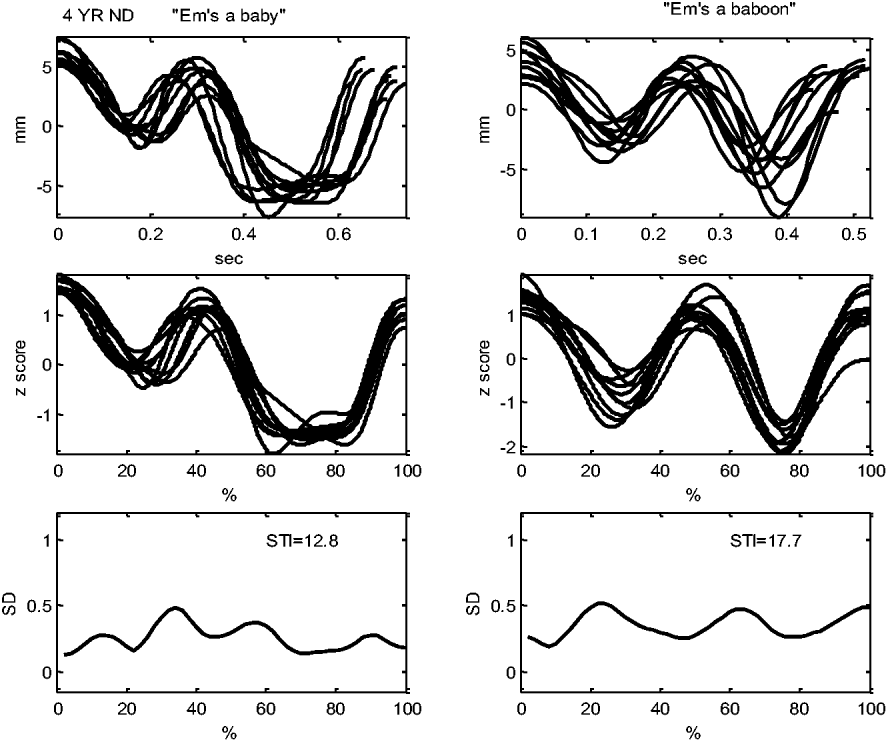
The spatiotemporal index (STI; Smith et al., Reference Smith, Goffman, Zelaznik, Ying and McGillem1995) was used to assess changes in variability across conditions and groups. As shown in Figure 3, the WS or WW sequence associated with the weak syllable that preceded the target word and the first syllable of baboon or baby was analyzed (e.g. in Em's a baby, a bab was extracted). The analytic purpose of the STI is to quantify the stability of underlying movement patterns when absolute differences in duration (e.g. rate) and amplitude (e.g. loudness) are eliminated. As illustrated in the middle panels of Figure 3, movement trajectories corresponding to the entire sequence were initially linearly amplitude- and time-normalized. Amplitude-normalization was accomplished by subtracting the mean and dividing by the standard deviation of each displacement record. For time-normalization, a spline function (MathWorks, 1993) was used to interpolate each displacement record onto a time base of 1000 points (for a detailed description of this analysis, see Smith et al., Reference Smith, Goffman, Zelaznik, Ying and McGillem1995; Smith, Johnson, McGillem & Goffman, Reference Smith, Johnson, McGillem and Goffman2000). Following normalization, as shown in the bottom panels of Figure 3, standard deviations were computed at 2 percent intervals across all of the time- and amplitude-normalized displacement records. The STI is the sum of these fifty standard deviations. A higher STI value indicates increased variability. Lower lip and jaw movement directly index the oscillatory frame used for the production of different syllable shapes (MacNeilage & Davis, Reference MacNeilage and Davis2000).
Example of the spatiotemporal index (STI) for a four-year-old ND child producing the sentences Em's a baby and Em's a baboon. These records were extracted as shown in Figure 1. For each set of plots, the top panels illustrate the original, non-normalized records, the middle panels the same records, now time- and amplitude-normalized, and the bottom panels the spatiotemporal index (STI).
Analysis
For all analyses, a mixed ANOVA was performed, with group (ADULT, ND, SLI) as the between-subjects factor. In the patterning analysis, the iambic (baboon) and trochaic (baby) words were analyzed separately. This was because opening movements associated with the initial weak [bəb] in baboon are inherently smaller and shorter than those associated with the initial strong [beIb] in baby. The within-subjects factor was linguistic context.
In the variability analysis, the between-subjects factor was again group (ND, SLI, ADULT). The within-subject comparisons were for the two medial syllables in the SWSW (i.e. well-formed alternation) vs. SWWS (i.e. poorly formed alternation containing an unfooted syllable) sequence and for linguistic context. For all analyses, post-hoc testing was completed using the Tukey HSD procedure, with a 0·05 significance level.
Results of kinematic analyses
Movement patterning
In this analysis it was asked whether children (ND or SLI) and adults produce more differentiated rhythmic structures within a given word than the binary iambic and trochaic categories.
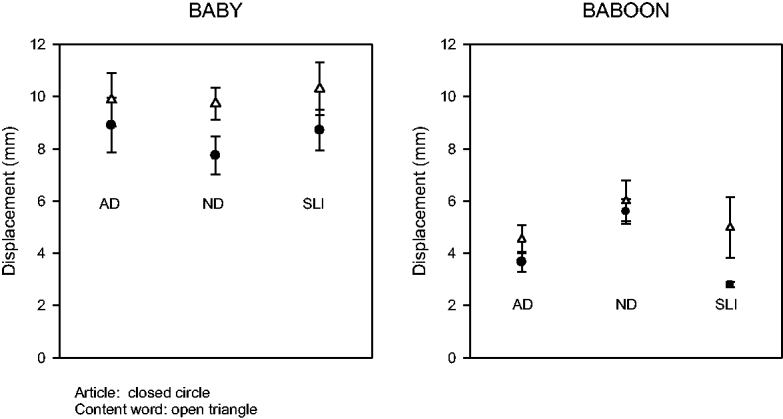
The amplitude and duration of movement associated with the initial syllable in baby (illustrated in Figure 2) provided a direct comparison of linguistic effects on prosodic structure, since these forms were phonetically identical across the two conditions. As shown in Figure 4, for amplitude, there was no effect of group (F(2, 40) = 0·09, p = 0·91). There was an influence of linguistic context (F(1, 40) = 22·11, p < 0·0001), with movement amplitudes in the Emma's baby context larger than those in the Em's a baby context. All three groups showed this effect, as indicated by no group*linguistic context interaction (F(2, 40) = 0·40, p = 0·67).
Amplitude (in mm) of lip/jaw movement associated with the opening for the [bVb] syllables in the words baby and baboon. Closed circles are used for syllables preceded by the phrase Em's a ____ and open triangles by the phrase Emma's _____. Error bars represent standard errors.
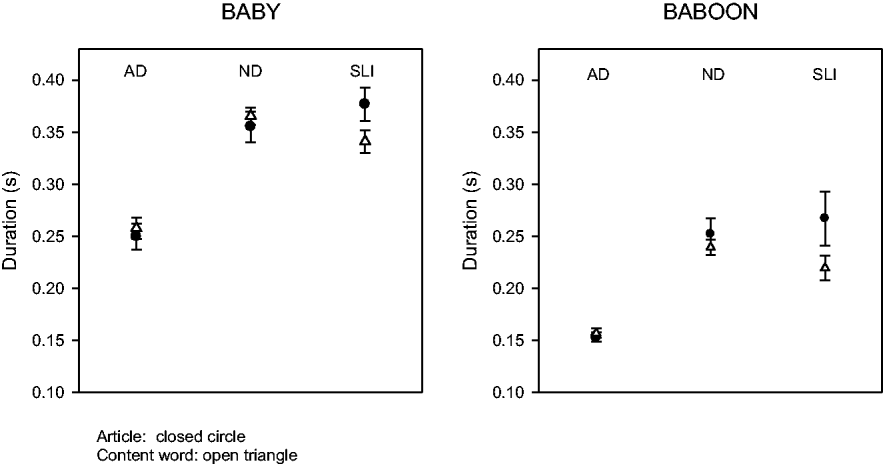
Duration for the syllable [beI] showed a group effect (F(2, 40) = 36·69, p < 0·0001) (see Figure 5). Post-hoc testing revealed that adults produced shorter movement durations than both groups of children. There were no effects of linguistic context (F(1, 40) = 0·21, p = 0·65) on syllable duration.
Duration (in s) of lip/jaw movement associated with the open–close for the [bVb] syllables in the words baby and baboon. Closed circles are used for syllables preceded by the phrase Em's a ____ and open triangles by the phrase Emma's _____. Error bars represent standard errors.
For the amplitude of the initial weak syllable in baboon in the sentences Em's a baboon and Emma's baboon, there was an effect of group (F(2, 30) = 5·06, p = 0·01). As illustrated in Figure 4, children who were ND produced larger amplitude movements in this syllable than their SLI peers or than adults. There was also an effect of linguistic context (F(1, 30) = 9·43, p = 0·005). Greater movement amplitudes for the syllable [bə] were observed in Emma's baboon than the Em's a baboon context. This was true for all three groups, as indicated by no group*linguistic context interaction (F(2, 30) = 0·88, p = 0·42).
As shown in Figure 5, durations of the initial weak syllable in baboon showed a group effect (F(2, 30) = 30·34, p < 0·0001). Adults produced shorter-duration movements compared with both groups of children. There was an effect of linguistic context (F(1, 30) = 4·97, p = 0·03) with the weak syllable [bə] in the phrase Emma's baboon produced with shorter duration movements than in Em's a baboon. There also was a group*linguistic context interaction (F(2, 30) = 3·37, p = 0·05).
Kinematic analysis of variability
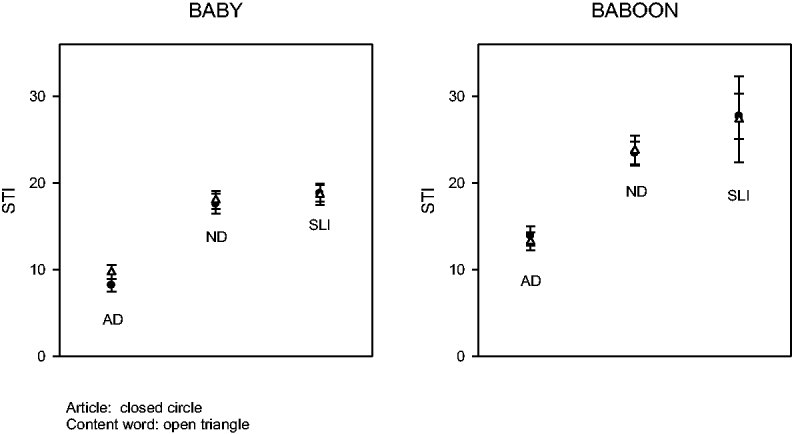
This analysis was extended beyond the word level, asking whether children (ND or SLI) or adults produce more variable movement sequences in alternating (SWSW) or non-alternating (SWWS) contexts. The focus of this analysis was the medial WS and WW components, all of which crossed word boundaries. As shown in Figure 6, there was a group effect for the STI (F(2, 30) = 37·77, p < 0·001). Post-hoc testing showed that adults differed from both groups of children, but children with SLI and ND were similar in their movement patterning variability. There also was an effect of prosodic context, with the SWSW sequence produced less variably than the SWWS sequence (F(1, 30) = 52·28, p < 0·001), with a trend toward a group*prosodic context interaction (F(2, 93) = 2·93, p = 0·07). There were no effects of context (F(1, 30) = 0·14, p = 0·71), and no group*context interactions (F(2, 30) = 0·04, p = 0·96). Both sentence frames (Em's a ____ and Emma's _____) were produced with similar degrees of movement patterning variability for all three groups of speakers.
STI values for SWSW and SWWS sequences. Closed circles are used for syllables preceded by a function word (e.g. Em's a baby) and open triangles by a weak syllable of a content word (e.g. Emma's baby). Error bars represent standard errors.
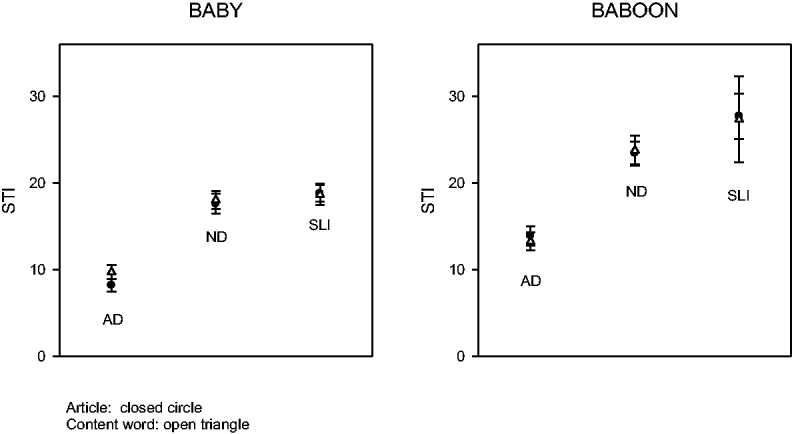
summary of kinematic results: Lexical items systematically varied in the amplitude of articulatory movements as a function of the sentence frame in which they were embedded. Duration measures showed the expected developmental effect, with adults producing shorter movements than children. Somewhat surprisingly, these slightly older children with SLI were similar to their younger ND peers in their organization of prosodic templates. For all three groups of speakers, the more problematic WW sequence was produced with more variable movement patterning than the alternating SW sequence.
DISCUSSION
In this study, we addressed three issues about the production of stress. First, we replicate prior findings based on children's overt error patterns, now including older children who are ND as well as those with SLI. We then turn to the central theme of this study, in which we use kinematic evidence to assess whether, at the word level, additional prosodic templates can be identified beyond the binary categories of iamb and trochee. Finally, we extend beyond the word, asking if well-formed rhythmic alternations (i.e. SW sequences) that cross word boundaries are produced with less variability than alternations that are poorly formed (i.e. WW sequences).
Children, especially those with language disorders, show difficulties with the production of unfooted weak syllables. It has been challenging to account for the variability in children's errors in these iambic structures. Transcription analysis, while essential, casts rather a wide net; sound and syllable omissions and substitutions may occur for a variety of reasons. Kinematic analysis allows a more fine-grained approach, providing insights into underlying factors that may influence production processes in young children. Many studies of children's stress production have relied on the productions of novel words (e.g. Gerken, Reference Gerken1996; Goffman, Reference Goffman1999; Schwartz & Goffman, Reference Schwartz and Goffman1995). While allowing for exquisite control of the stimuli, novel words are produced differently from familiar words (Heisler et al., Reference Heisler, Goffman and Younger2010; McMillan et al., Reference McMillan, Corley and Lickley2009). The use of natural as opposed to nonce stimuli on the one hand inherently includes confounds across prosodic, syntactic, lexical, and phonetic levels. On the other hand, more natural and systematic distinctions across prosodic categories can be identified. Because of the inherent infrequency of iambic nouns (Cutler & Carter, Reference Cutler and Carter1987) and the need to be restricted to labial consonants for the kinematic analysis, the words and phrases selected for this study (e.g. Emma's baboon) are probably unfamiliar to children. Thus, they contain the phonotactic characteristics of real words and phrases, but are likely similar to novel words in terms of children's lack of knowledge of them.
Replication and extension of previous findings: preference for trochaic feet
Overall, the transcription results replicate earlier findings and support both adherence to a prosodic template and weakening of syllables that lack perceptual salience. Further, there is some suggestion that syntactic and other phonological factors may influence the accuracy of prosodically weak unfooted syllables. Four- to six-year-old children, especially those with SLI, omit weak syllables that are unfooted. Similar to ND two-year-olds, these older children showed sensitivity to the prosodic hierarchy (Demuth, Reference Demuth, Morgan and Demuth1996; Reference Demuth, Weissenborn and Hohle2001; Gerken, Reference Gerken1994; Reference Gerken1996), as demonstrated by the omission of syllables that do not fit a preferred SW prosodic structure. In this study, the weak syllable [bə] in the word baboon was omitted, while the [beI] in baby was not. An equally weak CV sequence containing a function word ([zə]) was almost never omitted, presumably because it could foot with the preceding strong syllable (i.e. Em's a ___).
One primary question was whether the same prosodic template applied in different language environments. As expected, increased omission errors occurred in unfooted weak syllables. Less predictably, these errors patterned differently across the two sentence frames, with more omissions occurring when the word baboon was preceded by Em's a than by Emma's. These two frames differed in several ways, most notably in morphosyntactic and phonetic structure.
Other types of error were also observed in this vulnerable prosodic environment. Children omitted the initial consonant in the word baboon, producing [əbun] instead. This error type occurred more frequently in children with SLI than in ND four-year-olds. As with the full-blown syllable omissions, these patterned differently across the two sentence frames. More segmental omissions occurred in the Emma's than the Em's a frame. Segmental substitution errors were also observed, but these did not pattern across the two sentence frames.
Because this study incorporated real rather than novel words, it is not possible to sort out the specific linguistic factors that led to these differences in omission errors as a function of the sentence frame in which the iambic word was embedded. Perhaps the most likely explanation can be found in the segmental make-up of the surrounding sentence. In the target [eməzbəbun] (i.e. Emma's baboon), the error is more likely to take the form [eməzəbun]. A full omission would result in [eməzbun], which includes a CC sequence rather than the preferred alternating CV structure. It has previously been suggested that phonological factors may influence the patterning of syllable and consonant omission errors (Gerken & Ohala, Reference Gerken, Ohala and Wheeldon2000). The grammatical inflection [z], rather than the [b], was maintained, suggesting sensitivity to inclusion of the more meaningful and grammatically salient element. The relative weighting of prosodic and morphosyntactic variables cannot be explicitly determined in the present experiment. However, it seems that a complex model that incorporates multiple levels of language processing is needed to explain children's errors.
In addition to omission errors, as predicted by a perceptually based account of children's difficulties with weak syllables (Echols, Reference Echols1993; Snow, Reference Snow1998), there was also an increase in segmental errors in the least prominent unfooted syllables. A higher proportion of segmental substitution errors occurred in the weak syllable [bə] (i.e. [bəbun]) compared with the strong syllable [beI] (i.e. [beIbi]). Examples of such errors were [kəbun] for baboon as produced by a child who was ND and [dəbum] for baboon by a child with SLI. Prior studies have relied on spontaneous data and thus not controlled the context of segmental errors (e.g. Echols, Reference Echols1993; Snow, Reference Snow1998), or have incorporated consonants that are variable in the speech of young children (Schwartz & Goffman, Reference Schwartz and Goffman1995). In these studies, multiple factors may have contributed to children's segmental variability. In the present case we were certain that the segments in the weak syllable could be easily produced by all of the children, since both the SW and the WS words used in this study included one of the earliest developing consonants, the bilabial [b]. Variable production of the segments in the syllable [bə] could only be attributed to their occurrence in prosodically weak environments.
Patterning of movement templates
Similar to previous work suggesting interactivity across levels of speech production (e.g. Baese-Berk & Goldrick, Reference Baese-Berk and Goldrick2009; McMillan et al., Reference McMillan, Corley and Lickley2009), prosodic structure is not tied to an individual lexical item. Thus, the present data are consistent with an emerging body of literature showing that domains of language processing interact in more complex ways than predicted by modular models of speech production (e.g. Cholin et al., Reference Cholin, Schiller and Levelt2004; Levelt et al., Reference Levelt, Roelofs and Meyer1999). If there is indeed a catalog of highly frequent syllables available in a syllabary, these are not fixed entities, but are sensitive to other language demands and systematically vary based on these demands. The kinematic analyses of the patterning of rhythmic modulation revealed language effects. When the first syllable of an iamb (i.e. baboon) or a trochee (i.e. baby) was preceded by a content word (i.e. Emma) it was produced with larger amplitude movements than when it was preceded by an article (i.e. a). Thus, there were systematic differences in rhythmic structure that occurred as a function of language context. Because the present data were obtained from real rather than novel words embedded in a sentence frame (Goffman, Reference Goffman2004), it could not be ascertained whether morphosyntactic or phonological factors contributed to these systematic differences in the rhythmic template. All that is evident is that more reticulated distinctions occur than predicted by the binary iambic vs. trochaic categories.
To fully understand this result, it would be necessary to include a range of different sentence frames that vary in lexical, syntactic, and segmental structure. As they stand, however, these results provide articulatory evidence that systematic reorganization of the prosodic template occurred for all groups of speakers, as a function of some aspect of language context. These data support that the standard two-category division of iambs and trochees is not sufficient to account for these type-differentiated errors. There are additional systematic prosodic templates within these categories that are produced by child and adult speakers. The same lexical item is produced with distinct prosodic templates in different sentence frames.
Variability of prosodic sequences across word boundaries
Articulatory findings demonstrated that syllables that contain non-canonical weak–weak sequences are produced more poorly than those with strong–weak alternations. This was even the case for adult speakers. When there were no overt errors, weak unfooted syllables were produced with increased movement variability. For all three groups (adults, ND, and SLI), increased kinematic variability was observed in the more problematic WW component of the [SW]W[S] sequence (e.g. [Emma's] [baboon]), compared with the WS component of the well formed [SW][SW] sequence (e.g. [Emma's][baby]). Even for adults, the string containing two contiguous weak syllables, one unfooted, was more variable. In this case, increased variability is indicative of a relatively poorly implemented motor pattern that varies on each rendition. Other studies have shown similar within-subject increases in articulatory variability as a function of complexity. For five-year-old children, phrases embedded in longer and more complex sentences are produced with increased articulatory movement variability compared to shorter and less complex phrases (Maner et al., Reference Maner, Smith and Grayson2000). Similarly, in this study, the kinematic findings show that production variability is increased in unfooted syllables, even those that do not contain overt segmental errors.
Movement variability is complex. In prior studies about prosody we have found that early developing and frequently occurring trochaic nouns are actually produced with more variable movements than later developing and infrequently occurring iambic nouns (Goffman, Reference Goffman1999; Goffman & Malin, Reference Goffman and Malin1999). We argued that trochaic words may exploit an existing movement pattern and that speakers implicitly know that iambic words require increased precision. Such implicit knowledge is not relevant for difficult prosodic sequences that cross word boundaries. It is logical that the problematic sequence studied here actually showed an increase in variability.
The simplest view of variability is that it is an index of a less mature (Smith & Zelaznik, Reference Smith and Zelaznik2004) or an impaired (Huber, Stathopoulos, Ramig & Lancaster, Reference Huber, Stathopoulos, Ramig and Lancaster2003) system. Thelen and colleagues (e.g. Thelen & Smith, Reference Thelen and Smith1994) long ago suggested that variability should be viewed as a more complex construct and findings in the prosodic domain are consistent with this suggestion. In the present work, the more difficult weak–weak sequence was produced with more variability than a well-formed strong–weak alternation. In sum, within a lexical item, iambic forms are produced with increased precision (e.g. Goffman, Reference Goffman1999). Such precision is abandoned when more problematic prosodic sequences extend across word boundaries.
Differences across groups with implications for SLI
Children with SLI were included in this study because they have difficulties with many aspects of language production, including morphosyntactic, lexical, prosodic, and segmental domains (e.g. Leonard, Reference Leonard1998). In the present study, children with SLI differed from their ND peers primarily in the transcription analysis, producing an increased number of overt errors. While differences in movement duration, amplitude, and variability have been observed in other studies (e.g. Goffman, Reference Goffman1999; Reference Goffman2004), in the present findings the children with SLI were generally similar to their ND peers. Perhaps this was because, as a group, they were somewhat older. But, overall, these results suggest that, at the level of a single syllable or the organization of a two-syllable sequence that crosses word boundaries, children with SLI do not show particularly significant deficits. It may be that the production of novel words (i.e. new learning) or the organization of larger movement sequences reveals their deficit (Ullman & Pierpont, Reference Ullman and Pierpont2005).
What is especially striking in these findings is that adults and both groups of children represented identical prosodic categories. Even in the face of a less mature and more variable speech motor system, all three groups showed systematic differences in their organization of prosodic templates. All also showed reduced variability for well-formed compared with ill-formed cross-word rhythmic alternations. These findings together point to the idea that it is in the implementation not the representation that children differ from adults, at least in the production of these particular language structures.
CONCLUSIONS
The prosodic template account (e.g. Gerken, Reference Gerken1994; Reference Gerken1996) implies that there is a hierarchical structure in prosodic phonology, though the specific interactions of higher (e.g. morphological) and lower (e.g. segments, articulatory movement) levels of that hierarchy are not delineated. In the present case, we used speech motor and error analyses to assess components of this hierarchical structure. We found that two aspects of language influence rhythmic output in the speech motor domain. First, systematic subcategories of prosodic templates are observed that extend beyond the usually cited binary iambic and trochaic distinction. Second, unfooted syllables that occur across word boundaries are produced with relatively large movement variability, while those within words are produced with less variability.
The present results are consistent with an interactive view of language processing (Baese-Beck & Goldrick, Reference Baese-Berk and Goldrick2009; Rapp & Goldrick, Reference Rapp and Goldrick2006). Rather than importing a syllabary of highly frequent forms, the phonetic details of production are influenced by shifts in morphological and segmental processes. These findings contribute to a growing body of evidence (e.g. Baese-Beck & Goldrick, Reference Baese-Berk and Goldrick2009; Heisler et al., Reference Heisler, Goffman and Younger2010; McMillan et al., Reference McMillan, Corley and Lickley2009) demonstrating interactivity across phonetic and lexical, phonological, and morphological levels of language processing.