Introduction
Frailty is defined as a state of vulnerability due to poor resolution of homeostasis following distress, and is a consequence of a cumulative decline in multiple physiological systems over a lifespan (Clegg et al., Reference Clegg, Young, Iliffe, Rikkert and Rockwood2013). The physical phenotype (as a first operationalization of frailty by the Cardiovascular Health Study) is a monodimensional concept described by a cumulative decline in physical components, or in other words, less intrinsic physical capacity as reflected by low grip strength, slow walking speed, weight loss, exhaustion, and low activity. Different states of frailty can occur, ranging from nonfrail, prefrail, and frail individuals. Each state is typified by counting negative scores on the previously mentioned physical components using cutoff values (Morley et al., Reference Morley2013, Fried et al., Reference Fried2001). In the prefrail state, which is defined as a clinically silent process that predisposes individuals to frailty (Rasiah et al., Reference Rasiah2020), it is important to maintain or improve functional independence, as prefrailty is considered to be reversible (Travers et al., Reference Travers, Romero-Ortuno, Bailey and Cooney2019). There is a prominent substantially increasing mortality risk for nonfrail, prefrail, and frail older adults, with 21.4%, 45.6%, and 72.7%, respectively, showing that research to prevent frailty is needed (Ruiz-Grao et al., Reference Ruiz-Grao2020). In the prevention and treatment of frailty, a positive approach focuses on the plasticity and capacity for the improvement of older persons (Pickard et al., Reference Pickard2019). Such a “strength-based approach” to aging addressing older individuals’ strengths and abilities is needed (Minimol, Reference Minimol2016; van der Vorst et al., Reference van der Vorst2017), and fits well with the more positive view of the healthy aging concept of the World Health Organization (WHO), which is defined as the process of developing and maintaining the functional ability that enables well-being in older age (WHO, 2015). This is also in line with the view of the older persons themselves. Specifically, in a recent qualitative study on the perceptions of frailty, older individuals emphasized that a shift is needed from frailty toward independence, resilience, and autonomy in holding off frailty and maintaining the quality of life (Pan et al., Reference Pan, Bloomfield and Boyd2019).
It is important to maintain meaningful activities of daily living (ADLs) as they are benefactors for quality of life (Goldberg et al., Reference Goldberg, Brintnell and Goldberg2002), and prevent morbidity, such as dementia (Griep et al., Reference Griep2017) and even mortality (Haak et al., Reference Haak, Lofqvist, Ullen, Horstmann and Iwarsson2019). In an oldest-old sample, it was clearly shown that a higher frequency in leisure activities (including watching TV, playing cards, reading, keeping domestic animals or pets, gardening, and attending religious activities) was associated with a lower mortality risk (Li et al., Reference Li2020). Being engaged in meaningful activities enables people to do what they value and requires an adequate intrinsic capacity, ranging from physical performance to mental and cognitive skills (WHO, 2015). Therefore, continuing to perform activities on all levels from basic (b-) (Katz et al., Reference Katz, Ford, Moskowitz, Jackson and Jaffe1963) to instrumental (i-) (Lawton and Brody, Reference Lawton and Brody1969) and advanced (a-) (De Vriendt et al., Reference De Vriendt2012) activities of daily living (ADLs) might help to support healthy aging. The b-ADLs, such as washing yourself, getting dressed, etc, are basic activities to care for basic physiological and self-maintenance needs (Katz et al., Reference Katz, Ford, Moskowitz, Jackson and Jaffe1963), whereas i-ADLs (e.g., shopping) are more complex, require more high-level skills, and are needed to live independently (Lawton and Brody, Reference Lawton and Brody1969). Finally, the a-ADLs are the most difficult activities, unique and specific to each individual, influenced by cultural and motivational factors, such as hobbies, gardening, etc (De Vriendt et al., Reference De Vriendt2012). Consequently, each level requires more skills to perform the activities. Within the three levels of functioning, which were stratified according to difficulty and complexity, the a-ADLs thus require more advanced skills compared to i- and b-ADLs (Reuben and Solomon, Reference Reuben and Solomon1989). According to Zamudio-Rodriguez et al. (Reference Zamudio-Rodriguez2020), the hierarchical pattern of dependency and frailty starts from a robust, healthy stage, and is followed by either a “pure” frailty stage (no dependencies), or a stage of limitations in i-ADLs without frailty. Thirdly, a stage of limitations in i-ADLs with frailty follows, and finally a frailty stage with limitations in both i- and b-ADLs. The limitations in a-ADLs should also be considered in the context of this pattern.
Also, a person’s psychological resilience plays an important role in healthy aging. Psychological resilience is defined as the ability to adapt positively to changing life circumstances. It is a dynamic process evolving over time that specifically allows us to face difficulties by recovering an initial balance or bouncing back as an opportunity for growth (Sisto et al., Reference Sisto2019). Mendoza-Nunez and Vivaldo-Martinez (Reference Mendoza-Nunez and Vivaldo-Martinez2019), for example, suggested that psychological resilience strengthens and enhances human capacities during aging. Psychological resilience contributes to active participation of older adults and therefore for the maintenance of functioning and the prevention of health-related diseases. Furthermore, the intervention of Treichler et al. (Reference Treichler2020) showed that psychological resilience can increase at an older age and has the potential to enhance health and well-being. Psychological resilience is negatively associated with frailty (Kohler et al., Reference Kohler, Rametta, Poulter, Vogrin and Yates2020, Wong et al., Reference Wong2021). Improved psychological resilience might protect against frailty and vice versa, as corroborated in a sample of patients with cirrhosis (Wong et al., Reference Wong2021). Also, older individuals are more inclined to communicate about positive aspects such as their autonomy and psychological resilience, as opposed to their deficits. At the same time, the literature on resilience in older adults is still in a very early stage and the literature on prefrailty is nonexistent, thus requiring more in-depth investigation (Pan et al., Reference Pan, Bloomfield and Boyd2019).
The scarce evidence indicates that engagement in meaningful activities, functional independence, and psychological resilience are all important abilities in older age and show promise as factors that counteract (pre)frailty. The question remains of how they interact together. To date, the Chinese Longitudinal Healthy Longevity Survey showed that after 3 years of follow-up, a higher level of psychological resilience reduced the risk of limitation in b-ADLs in older adults aged 65 years and older (Yang and Wen, Reference Yang and Wen2015). Also, high resilience according to the Asset and Health Dynamics study was associated with the independence in i-ADLs in community-dwelling older individuals (Hardy et al., Reference Hardy, Concato and Gill2004). So far, studies are restricted to b- and i-ADLs and as of yet no research has been performed on the relationship of psychological resilience and a-ADLs in older age. There is a lack of knowledge of the extent to which psychological resilience can account for the relation between ADLs and frailty, particularly in a prefrail state, which is considered to be reversible (Travers et al., Reference Travers, Romero-Ortuno, Bailey and Cooney2019). Therefore, the aim of this study was to contribute to the understanding of prefrailty’s relationship with daily functioning by determining whether psychological resilience mediates the relation between daily functioning and the frailty status in prefrail and robust older individuals.
Methods
Study design and participants
Data of the “BrUssels sTudy on The Early pRedictors of FraiLtY” (BUTTERFLY) were analyzed. This is a study of the Gerontopole Brussels consortium directed by the Frailty in Ageing and Belgian Ageing studies research groups of the Vrije Universiteit Brussel (Belgium). The ethical committee of UZ Brussel (B.U.N. 143201421976) approved the study, and all participants provided informed consent. A sample of 494 community-dwelling octogenarians participated between February 2015 and June 2019, and 405 participants were eligible for this study. Older individuals aged 80 years and over were eligible when they were living independently in the community; able to walk; not having cognitive disabilities (i.e. unable to understand the test instructions and/or Mini–Mental State Examination (MMSE) <23/30 (Folstein et al., Reference Folstein, Folstein and Mchugh1975)); not recently diagnosed with cancer (within previous 6 months); not recently having undergone surgery, radiotherapy, and/or chemotherapy (within previous 6 months); and not frail according to three different frailty measurement tools: the Groningen Frailty Indicator <4/15 (Steverink et al., Reference Steverink, Slaets, Schuurmans and van Lis2001), the Rockwood Frailty Index <0.25/10 (Collerton et al., Reference Collerton2012), and/or the adapted version of the Fried Frailty Phenotype (FFP) <3/4 (exhaustion, weight loss, gait speed, and grip strength), as in Cao Dinh et al. (Reference Cao Dinh2019). For the FFP, exhaustion was first measured according to the original Fried phenotype assessing two questions from the Center for Epidemiological Studies–Depression (CES-D) Scale (Orme et al., Reference Orme, Reis and Herz1986) translated into Dutch or French: “How often in the last week did you feel this way?” (1) “I felt that everything I did was an effort” and (2) “I could not get going.” Participants could answer the questions with “rarely or none of the time” (0); “some or a little of the time” (1); “a moderate amount of time” (2); or “most of the time” (3). When participants obtained a score of 2 (a moderate amount of time) or 3 (most of the time) on either of the two questions, one point was granted for the criterion “exhaustion.” Second, weight loss was evaluated through the self-reported question: “In the last 6 months, have you lost more than 4.5 kg unintentionally?” which was answered by “yes” (1) or “no” (0). Next, the criterion “gait speed” was assessed using a sex and height stratified timing of a 4.5-m walking distance (Fried et al., Reference Fried2001). Participants were scored 1 point if their walking time exceeded or was equal to 7 s for men ≤173 cm and women ≤159 cm, and if their time exceeded or was equal to 6 s for men >173 cm and women >159 cm. Finally, grip strength was assessed using the Martin Vigorimeter (Sipers et al., Reference Sipers, Verdijk, Sipers, Schols and van Loon2016). The cutoff values were ≥71 kPa for men and ≥ 42 kPa for women. Participants who scored lower than the aforementioned values received 1 point. Based on the FFP, two groups were identified: a score of 0 indicated robustness and 1 or 2 signified prefrailty (Sirola et al., Reference Sirola, Pitkala, Tilvis, Miettinen and Strandberg2011).
Evaluation of resilience
Resilience was assessed with the Connor–Davidson Resilience Scale (CD-RISC) (Connor and Davidson, Reference Connor and Davidson2003), a self-report questionnaire of 25 statements. A 5-point Likert scale is scored where 0 stands for not true at all, 1 rarely true, 2 sometimes true, 3 often true, and 4 true nearly all of the time. The total score ranges from 0 to 100 with higher scores reflecting a higher degree of resilience.
Evaluation of daily functioning
The Brussels Integrated Activities of Daily Living Inventory (BIA) was used to evaluate daily functioning. The BIA consists of the b-, i-, (Cornelis et al., Reference Cornelis, Gorus, Beyer, Bautmans and De Vriendt2017) and shortened version of the a-ADL tool (De Vriendt et al., Reference De Vriendt, Mets, Petrovic and Gorus2015; De Vriendt et al., Reference De Vriendt2013). The following activities were evaluated: six for the b-ADLs to survive (bathing, dressing, transferring, continence, toileting, and feeding); nine at the level of i-ADLs to live independently (telephone use, using transportation, shopping, preparing food, housekeeping, doing laundry, caring for household objects, responsibility for own medications, and handling finance); and at the level of a-ADLs, personally and culturally related activities, 15 types of activities were used (sophisticated kitchen activities, household appliances and daily technology, high level gardening, cognitively stimulating activities or intellectual activities, craftwork and arts, complex economic activities or transactions, communicating by using sophisticated devices or techniques other than talking on the phone, sports, transportation by motorized vehicles, self-development/self-realization/self-educational activities, going on a holiday, caring for or assisting others, intimate relationships, caring for household objects, and semi-professional work; engagement in organized social life or leisure activities). Appendix A defines all ADL items. Firstly, each activity from b-, i-, and a-ADLs is reviewed for their relevance by asking the participants whether they performed the activity during the past 10 years. If this is not the case, that activity is not taken into account for further evaluation. Secondly, if the activity is relevant, the participants are asked how they perform the activity currently. Based on the narratives of the participants, the researcher assigns a score according to a 5-point scale ranging from 0 (no difficulty to perform) to 4 (unable to perform), to weigh the quality of the activity’s performance (WHO, 2001): 0 (no difficulty to perform an activity), 1 (mild problems in functioning, slower, less frequently), 2 (sometimes help is needed), 3 (continuous help is needed), and 4 (the person does not perform the activity anymore). Through this evaluation of daily functioning, a global Disability Index (DI) can be calculated for each ADL level (b-, i-, and a-ADL), expressed as percentages, where higher percentages indicate more disability.
Characteristics
Next to resilience and daily functioning, the following characteristics were examined: gender, age, education (<6, 6–9, 9–12, and >12 years), number of medications, living circumstances (living together, living alone), total score of the Geriatric Depression Scale (Yesavage and Sheikh, Reference Yesavage and Sheikh2008), and total Montreal Cognitive Assessment score (Nasreddine et al., Reference Nasreddine2005).
Statistics
Firstly, sample characteristics were analyzed using means with standard deviation (SD) for continuous variables and frequencies and percentages for categorical variables. Statistical differences between robust and prefrail participants were analyzed by the χ2 test for categorical and independent sample T-test for continuous variables in SPSS version 26.0. Effect sizes were calculated for percentages (Cohen’s h; small: ≥0.10; medium ≥0.30; and large ≥0.50) and means (Cohen’s d; small: d ≥0.30; medium ≥0.50; and large ≥0.80) (Cohen, Reference Cohen2009) between robust and prefrail groups.
Secondly, the extent to which resilience can account for relations between ADLs and frailty status was investigated (figure 1). In RStudio, missing data were handled by multivariate imputation with chained equations (Mice package). Point-biserial correlation (rpb) between the dichotomous independent variable, prefrailty/robustness, and the scores of limitations in ADLs and resilience as dependent variables were calculated as a measure of effect sizes (Rosnow and Rosenthal, Reference Rosnow and Rosenthal1996). Correlations between continuous variables (CD-RISC and limitations in ADLs) were calculated by Pearson correlations. The r effect sizes according to Cohen (Reference Cohen2009) were used for the interpretation (small: ≥0.10; medium ≥0.30; and large ≥0.50). Next, the PROCESS macro of Preacher and Hayes (Reference Preacher and Hayes2008) with a stepwise approach using multiple regression analysis was conducted. An accelerated–bias-corrected bootstrapping method with 5,000 estimates was used to investigate whether limitations in ADLs have an indirect effect on prefrailty/robustness through psychological resilience (figure 1). Confidence intervals were displayed for all effects indicating statistical significance when the interval did not include zero. Total effect of ADLs on prefrailty is represented through path C, which can be split up into direct (c’) and an indirect (c–c’) effect path.
Effect model. Note. The extent to which resilience can account for relations between ADLs and prefrailty status. ADLs = activities of daily living.

Results
Characteristics
The final sample consisted of 405 study participants after excluding participants with cognitive disabilities (n = 9), missing tests (n = 4), and frailty (n = 76). Of those, 214 participants (82.3 ± 2.1 years) were robust and 191 prefrail (83.8 ± 3.2 years). As shown in Table 1, significantly more men were present in the prefrail group compared to women. Prefrail participants were significantly older in comparison to the robust. No significant differences were found in the CD-RISC score and ADLs.
Characteristics

Note. SD = standard deviation; M = mean; CD-RISC = Connor-Davidson Resilience Scale; GDS = geriatric depression scale; MOCA = Montreal Cognitive Assessment; ADLs = activities of daily living; b-ADL-DI = limitations in basic ADLs; i-ADL-DI = limitations in instrumental ADLs; a-ADL-DI = limitations in advanced ADLs; χ2 for categorical variables and independent samples T test for continuous variables. + 2 missing values. °3 missing values. • 1 missing value. § 6 missing values. *: significant p-value <0.05.
Correlations
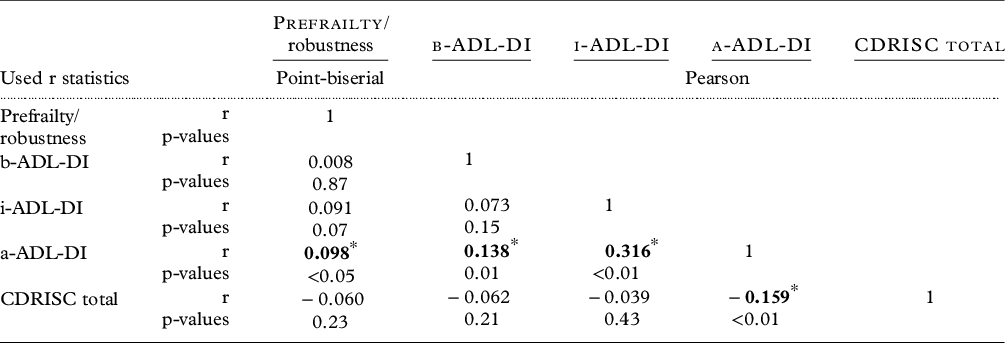
Correlations were conducted to determine the relationship between limitations in ADLs (b-, i-, and a), resilience (total score of 25 items), and one’s robust or prefrail state (Table 2). There was a significant positive correlation between a-ADL-DI and the state of the person (robust or prefrail) (rpb = 0.098; p<0.05), implying that higher limitations in a-ADLs were significantly correlated with a higher likelihood of being prefrail, though the effect size is limited (a small effect size of 0.098 for a-ADL-DI). For the total CD-RISC score, no significant correlation was found with frailty status but a significant negative correlation represented with a-ADL-DI (rpb = −0.16; p<0.01; small effect size). This indicates that higher scores of psychological resilience were correlated with a lower score in a-ADL-DI, or in other words, less limitations in a-ADLs.
Correlations between limitations in ADLs, resilience, and prefrailty/robustness state

Note. A significant positive correlation between a-ADL-DI and the state of the person (robust or prefrail) was found. ADLs = activities of daily living; b-ADL-DI = limitations in basic ADLs; i-ADL-DI = limitations in instrumental ADLs; a-ADL-DI = limitations in advanced ADLs; CD-RISC = Connor-Davidson Resilience Scale; r = correlation.
Process macros according to Hayes
Table 3 shows the direct and indirect effects of path C according to the process macros of Preacher and Hayes (Reference Preacher and Hayes2008) when controlling for age and gender. An effect is significant if the confidence interval does not include zero. No indirect effects (path c–c’) of resilience were found between limitations in ADLs and prefrailty/robustness. However, a significant direct effect (path c’) was found between a-ADL-DI and the prefrail/robust group when controlling for the total CD-RISC score. It was also investigated whether limitations in ADLs had an indirect effect on the relationship between resilience and prefrailty/robustness to no avail.
Process macros of path c’ and c-c’ with resilience

Note: When controlling for age and gender, a significant positive direct effect (path c’) between a-ADL-DI with the prefrail/robust group was found. R = resilience total score, n = 404. If the 95% confidence interval does not include zero, effects are significant and are highlighted in bold.
Discussion
This study aimed to examine the extent to which psychological resilience in older individuals accounts for the relation between limitations in ADLs and the robust and prefrailty status. Therefore, the potential effects of psychological resilience on the relationship between three types of limitations in ADLs (b-, i-, and a-ADLs), and prefrailty status was clarified using mediation analyses.
One significant direct effect of limitations in a-ADLs on robustness/prefrailty was found. More dependencies in a-ADLs represented a higher likelihood of prefrailty and vice versa. Psychological resilience had no (in)direct effect on the prefrailty state. How this fits into the existing literature on resilience is hampered by the fact that studies assessing resilience use different measures (Windle et al., Reference Windle, Bennett and Noyes2011), making comparability and generalizability difficult. However, our results clearly demonstrated a correlation between limitations in a-ADLs (such as hobbies, gardening, driving, reading, etc) and prefrailty/robustness, leading to a direct effect of the a-ADL-DI on prefrailty (though it should be remarked that the correlation coefficient of 0.10 is a small effect).
One of frailty’s negative health outcomes, next to hospitalization and early mortality (Ruiz-Grao et al., Reference Ruiz-Grao2020), is without doubt limitations in ADLs, although clearly depending on how ADLs are defined. Most studies only focus on b- and i-ADLs while our study also includes a-ADLs. Since in the studies the a-ADLs are mostly absent, it is undefined which level of ADLs (b-, i-, or a-ADLs) starts to be limited before, during, or after the occurrence of frailty. The higher the ADLs’ level, the more skills are required to perform the related activities (Reuben and Solomon, Reference Reuben and Solomon1989). Subsequently, it could be hypothesized that limitations in a-ADLs might be predictors, limitations in i-ADLs characteristics, and at last limitations in b-ADLs’ outcomes of frailty. These hypotheses are based on the hierarchical process of loss in ADLs, known as “the functional continuum,” where limitations start in i-ADLs (mostly transporting and shopping), and are followed by limitations in b-ADLs (e.g., eating) (Edjolo et al., Reference Edjolo, Proust-Lima, Delva, Dartigues and Peres2016; Barberger-Gateau et al., Reference Barberger-Gateau, Rainville, Letenneur and Dartigues2000). Two recent articles applied this model to frailty (Hoogendijk et al., Reference Hoogendijk2019; Zamudio-Rodriguez et al., Reference Zamudio-Rodriguez2020), describing the entire disablement process in frailty, though limited to b- and i-ADLs. Our results can extend the knowledge of this disablement process by introducing limitations in a-ADLs as red flags signifying vulnerability to early problems (e.g., prefrailty) as their performance requires complex skills. Research in other domains showed promising results. In early disease monitoring, incremental changes in function are already seen as a meaningful measure. For example, in Alzheimer’s disease, the more complex activities, such as managing paperwork, are specifically sensitive to the earliest cognitive changes (Dubbelman et al., Reference Dubbelman2020) and may be an indicator of cognitive decline when limited. Also, Wilkins et al. (Reference Wilkins2021) support this by showing that everyday preferences are important predictors for older adults with cognitive impairment. In particular, the social engagement preferences domain (regular contact with family, volunteering, meeting new people, outdoor tasks, exercise, etc.), or in other words several a-ADLs, were significantly rated in everyday living and are important for older individuals with Mild Cognitive Impairment (MCI). This could also be the case for frailty’s syndrome and must be further investigated as this might offer possibilities for prevention. However, it is important to mention that further research of the frail group is needed, given that both nonfrail groups with limitations in i-ADLs and frail groups have the same increased risk of mortality, as well as worse survival predictions compared to robust ones (Zamudio-Rodriguez et al., Reference Zamudio-Rodriguez2020). However, due to the cross-sectional design of this study, further verifications are needed, such as longitudinal analyses, to determine whether limitations in a-ADLs indeed represent red flags for early stages of the continuum.
Regarding the association between daily functioning and psychological resilience, other studies found that limitations in b-ADLs (e.g., toileting, dressing) and i-ADLs (e.g., shopping, cooking, using transportation) are associated with psychological resilience (Yang and Wen, Reference Yang and Wen2015; Hardy et al., Reference Hardy, Concato and Gill2004) in community-dwelling older individuals, indicating that high psychological resilience is related to more independence. In this study, a significant negative correlation between a-ADL-DI and the total resilience score occurred. Surprisingly, no correlations of b- and i-ADLs with resilience have emerged, which was unexpected. They should rather be negatively correlated in the same manner as the correlation found between the total CD-RISC score and limitations in a-ADLs. This could be explained by the range of limitations in ADLs, which was insufficient according to the International Classification of Functioning, Disability and Health (ICF) qualifiers (WHO, 2001). The whole sample scored “no dependency” on the b- and i-ADLs and “mild dependency” on a-ADLs.
Unexpectedly, no correlation or direct effect was found between the total CD-RISC score and a prefrail/robust status when controlled for age and gender. Prefrailty did not relate to lower resilience scores and vice versa in this study. This is opposite to Salem et al. (Reference Salem2014), who found an association using the Resilience Scale of Wagnild and Young (Reference Wagnild and Young1993) and frailty as a latent construct combining physical, psychological, and social domains. Also, similar to the study of Freitag and Schmidt (Reference Freitag and Schmidt2016), psychological resilience could be withheld as a protective factor for frailty in community-dwelling older individuals. However, most research regarding resilience focused on frailty, whereas we included prefrail participants. We argue that more studies are needed especially focusing on prefrailty, because the state has a lot of potential due to being a reversible state, and thus may be sensitive to preventive approaches (Travers et al., Reference Travers, Romero-Ortuno, Bailey and Cooney2019).
Moreover, psychological resilience had no indirect effect on the relation between limitations in ADLs and prefrailty. This indicates that psychological resilience does not play a mediating role. This was unexpected since, in previous studies, the associations with limitations in ADLs (Yang and Wen, Reference Yang and Wen2015; Hardy et al., Reference Hardy, Concato and Gill2004) and (pre)frailty (Kohler et al., Reference Kohler, Rametta, Poulter, Vogrin and Yates2020; Wong et al., Reference Wong2021) were found. Kohler et al. (Reference Kohler, Rametta, Poulter, Vogrin and Yates2020), for example, found an association in 65 year olds in geriatric rehabilitation using the Brief Resilience Scale (Smith et al., Reference Smith2008) and the Frailty Index from comprehensive geriatric assessments (Searle et al., Reference Searle, Mitnitski, Gahbauer, Gill and Rockwood2008). However, it is clear that it is difficult to compare our community-dwelling sample with a geriatric population and with different measurements for both resilience and frailty. Our operationalization of frailty is purely physical according to the FFP, and the aforementioned scale includes more domains.
Some remarks should be made concerning the way resilience was measured. Research on psychological resilience is still in its infancy, and the results can partly be explained by the lack of a golden standard on how to conceptualize psychological resilience. Two approaches are present in literature, namely a trait-oriented and an outcome/process-oriented approach (Chmitorz et al., Reference Chmitorz2018). We opted for the stable trait-oriented approach as this cross-sectional study only allows one measurement and focuses on determinants. A dynamic outcome approach, taking into account the stressfulness of an event (e.g., hospital admission, illness) or resilience as a process, might yield different results. Kohler et al. (Reference Kohler, Rametta, Poulter, Vogrin and Yates2020) already demonstrated the convenience of an outcome-based approach in the relation between frailty and psychological resilience using the Brief Resilience Scale, which takes into account one’s ability to recover from stress. However, evidence is still scarce as the explained variance of scales analyzing resilience as an outcome still lacks systematic clearance. On top of that, it is a challenge to find the exact moment when the stressor occurs and when the assessment should take place (Chmitorz et al., Reference Chmitorz2018). Also, due to the cross-sectional design of this study, findings must be carefully interpreted since causality cannot be established. Moreover, it should be noted that daily functioning was assessed via self-reports, which might give an overestimation of the scores. Informant-based or performance-based measures could be more reliable. However, in a previous study on ADLs in cognitive disorders, it was already showed that both report-based and performance-based measures have similar discriminatory power, but this needs to be further investigated in frailty (Cornelis et al., Reference Cornelis, Gorus, van Weverbergh, Beyer and De Vriendt2018). However, the study is unique in the sense that we included a large sample size of older individuals aged 80 years and over, the fastest growing population group. Most existing studies in older adults include persons 65 years old and over with only small samples of the oldest old (Mello et al., Reference Mello, Engstrom and Alves2014). Contrary to this article’s limitations, a key strength was the analysis of daily functioning, since all possible levels of ADLs were explored ranging from b-, i-, and especially a-ADLs.
To conclude, we hypothesized that psychological resilience might serve as a mediator to explain that limitations in ADLs significantly discriminate between the prefrail and the robust participants. This hypothesis could not be confirmed but we demonstrated that a better performance of a-ADLs is a directly influencing and correlated factor of robustness and prefrailty (however, this must be carefully interpreted due to the cross-sectional design and the limited effect size of the correlations). Loss in ADLs can serve as a “red flag” to detect (pre)frailty. This might indicate that the “disablement process” combining limitations in ADLs and stages of frailty can further be completed by including the most complex a-ADLs next to i- and b-ADLs. The hierarchical process of frailty and dependency starts from a healthy stage (a), and further develops into a mild stage (b) consisting of either: physical frailty (“pure” frailty) or a stage of limitations in i-ADLs without frailty. This is followed by a moderate stage (c) where frailty is combined with limitations in i-ADLs, and finally a severe stage (d) that incorporates frailty with limitations in both i- and b-ADLs (Zamudio-Rodriguez et al., Reference Zamudio-Rodriguez2020). Future research (but also interventions) should take into account the influence of ADLs, and in particular a-ADLs in the mild stage of the disablement process.
Conflict of interest
None.
Description of authors’ roles
Axelle Costenoble: Writing - Original Draft; Methodology; Formal analysis; Investigation; Visualization
Gina Rossi: Writing - Original Draft; Methodology; Formal analysis; Visualization; Supervision; Writing - Review & Editing
Veerle Knoop: Investigation; Writing - Review & Editing
Aziz Debain: Investigation; Writing - Review & Editing
Celeste Smeys: Investigation; Writing - Review & Editing
Ivan Bautmans: Conceptualization; Funding acquisition; Writing - Review & Editing; Project administration; Supervision
Dominique Verté: Conceptualization; Funding acquisition; supervision; Writing - Review & Editing
Patricia De Vriendt: Supervision; Conceptualization; Writing - Original Draft; Writing - Review & Editing; Formal analysis; Visualization
Ellen Gorus: Supervision; Conceptualization; Writing - Original Draft; Writing - Review & Editing; Formal analysis; Visualization
Gerontopole Brussels Study Group
Members of the Gerontopole Brussels Study group: Ivan Bautmans (FRIA, VUB) ivan.bautmans@vub.be; Dominque Verté (Belgian Ageing Studies BAST, VUB) dominique.verte@vub.be; Ingo Beyer (Geriatric Medicine department, UZ Brussel) ingo.beyer@uzbrussel.be; Mirko Petrovic (ReFrail, UGent) mirko.petrovic@ugent.be; Nico De Witte (Belgian Ageing Studies BAST, VUB) nico.de.witte@vub.be; Tinie Kardol (Leerstoel Bevordering Active Ageing, VUB) mjmkardol@hotmail.com; Gina Rossi (Psychology Department PSYC, VUB) Gina.Rossi@vub.be; Peter Clarys (Physical Activity and Nutrition PANU, VUB) pclarys@vub.be; Aldo Scafoglieri (Experimental Anatomy EXAN, VUB) aldo.scafoglieri@vub.be; Eric Cattrysse (Experimental Anatomy EXAN, VUB) ecattrys@vub.be; Paul de Hert (Fundamental Rights and Constitutionalism Research group FRC, VUB) paul.de.hert@vub.be; Bart Jansen (Department of Electronics and Informatics ETRO, VUB) bart.jansen@vub.be.
Acknowledgements
This study was partly funded by an “Interdisciplinary Research Program” (IRP) grant from the research council of the Vrije Universiteit Brussel. No sponsor’s role is present in this article. Due to IPR, the data are not made publicly available. Requests to access the data should be addressed to the Butterfly project PI prof Ivan Bautmans (ivan.bautmans@vub.be).