This article examines cultural governance in Taiwan and China as a process through which governments exercise control by managing the identities of local places and shaping cultures. On cultural governance, Foucault has shown how different narratives and appropriations of places where governmental and disciplinary regimes imbricate would involve power.Footnote 1 In Taiwan and China, I argue that cultural governance policies were used to objectify tradition and popularize cultural landscape in local places for economic development and identity politics. Place-making in both societies involves collective memory narratives, invention of tradition, heritage consumption and domestic tourism, and yet is driven by rather different modes of cultural governance. In China, rampant commercialization following economic reforms since 1978 brought forward the commodification of cultural specialities and heritage places. In Taiwan, local histories and memories have been revived since 1988 when ex-president Lee Teng Hui became president, with the objective of creating a unique Taiwanese identity to support the pro-independence movement. Cultural governance in Taiwan may therefore be characterized as cultural nationalism.Footnote 2 In the PRC, the pursuit of economic growth as an emblem of shared glory and as an important aspect of national identity could be viewed as economic nationalism.Footnote 3
With these drastic changes, while local government in China remains powerful and active after economic decentralization,Footnote 4 less government control has been seen in Taiwan since the rise of democracy in the late 1980s. In the context of cultural governance, I argue that the Chinese government has adopted a hands-off approach in constructing places and identities while the Taiwanese followed a much more hands-on approach. This article compares how the two modes of cultural governance in the PRC and Taiwan – state-sponsored market-driven cultural development and government-led local-centred cultural development respectively – have led to different dynamics among various actors and contributed to identity formation through place-making.
Since market reforms began in China, cultural governance has been used to support the collective pursuit of modernization and economic development through promoting cultural tourism. For example, Chinese cultural and national identity was cultivated through making the hometown of Confucius, Qufu 曲阜, a place of cultural heritage and promoting a public cult ceremony for tourism purposes.Footnote 5 Similarly, the national ideology of building a harmonious society is reflected in the recent establishment and promotion of a cultural (religious) festival at Wutaishan 五台山 in Shanxi province for tourists.Footnote 6
Ethnic and heritage places are also utilized by the government as regional cultural symbols for economic tourism and the formation of identities at the country, provincial and regional levels.Footnote 7 In Shenzhen, theme parks and tourist destinations such as Splendid China, China Folk Culture Villages and Window of the World reveal how the state sanctions traditional ethnic representations and displays multi-culturalism and nationscape while developing tourism and the local economy.Footnote 8 In Guizhou, the state plays a dominant role in standardizing and acknowledging the “authentic” heritage of ethnic minorities and identities, and granting new meanings to local histories, with the objective of advancing modernity and improving standards of living.Footnote 9
In Taiwan, the place-making process is not built around the local economy but directly reveals the nationalistic thesis and identity discourse under various regimes. Johnson has shown how “chronotopes” or “time-places” were products of cultural governance and, before the late 1980s, Chinese cultures were objectified through the operators of object classes, construction material, organized forgetting and hierarchical inclusion.Footnote 10 Allen shows how different regimes at pre-colonial, post-colonial and contemporary periods transform meanings of place and impose nationalistic ideologies within an urban park in Taipei. Memorial buildings in the Taiwan Park are corrective representations of changing nationalistic memories under various regimes. Statues of nationalistic icons (Chiang Kai-shek, Sun Yat-sen) were placed in the park as new memories for representing Chineseness, while those of colonial symbols (Governor General Kodoma, Hiro Tatsumi) were removed to imply forgetting.Footnote 11 More recently, sites of hot-springs and Shinto Shrines are re-discovered as a commemoration of the nostalgic remembrance of local history.Footnote 12
Other studies are based on individual communities in local places. Su examines how locals in three different communities in Tainan are motivated to participate in place-making and improve their environment.Footnote 13 Hong highlights that individuals are very much restrained by authorities from traditional networks while working in the community.Footnote 14 Luo shows that the locals in Wenshan took up the lead in community building at a later stage despite the fact that government played the dominant role initially.Footnote 15 Local women's active participation in the community building process, such as cleaning up the environment, cooking Baimi food and performing clog dances, has been argued as a process of self-empowerment.Footnote 16 Local cultural industries are often developed with the help of professionals from the government to showcase the uniqueness of local cultures.Footnote 17 Lu argues that community cultures in Baimi and Tanshui are built by various local groups to emphasize Taiwan's history and identity in the contexts of “nation-building” and globalization.Footnote 18
This article differs from this literature by comparing the implementation, the communal response and the effects of cultural governance in Taiwan and China. For both places, this involves analysing the web of interconnectedness between the government and individuals, the urban centre and rural periphery, and the local residents and domestic tourists. This multi-level connectedness follows recent research on state governance that highlights multi-layered communication, which involves interaction between a variety of actors who are participants with different interests and competing sets of beliefs.Footnote 19 Such interactive dialogue and co-operation may in fact empower individuals in societies.Footnote 20
In analysing the response of local residents to cultural governance in the two places, this article delineates how locals in Taiwan and China employ strategies and tactics to work with governmental and non-governmental organizations. Strategies are activities and narratives that locals engage in, driven by a government wanting to influence or regulate its people. These are also programmatic actions taken by individuals or institutions in accordance with programmes set up by the state. Tactics are not programmatic activities that blindly follow the government's instructions, but actions which reflect one's freedom and control over the environment and oneself. They are unpredictable behaviour responding to the environment and which sometimes may influence, or pervert, action from the authorities.Footnote 21 In Taiwan, I argue that the actions taken by locals in the process of creating local specialities and place-making are largely strategic, programmatic activities recommended and encouraged by the government's cultural policy, thus involving little individual initiative and creativity. Strategies include activities such as running museums, promoting local memories, and inventing cultural specialities through working closely with government and non-governmental organizations at different levels. In China, I demonstrate how residents instead employ tactics in place-making. Driven by the profit motive, local residents exercise more individual initiative and respond to cultural governance by reinventing themselves as entrepreneurs who sell local specialities.
The effects of cultural governance policies in the two places also offer a sharp contrast. The residents in Taiwan are drawn closer together in their joint participation of communal activities to promote local cultures, while communal relations in China are weakened as a result of the quest for individual gain.
This article takes the case of Baimi 白米 in Taiwan and Meijiawu 梅家坞 in the PRC to examine how different governance strategies are implemented for place-making in everyday life. Baimi and Meijiawu are selected because they share a common background as “ordinary” rural places but have been phenomenally transformed into popular places for domestic tourists over the last decade. Both are regarded by their respective governments as successful tourism sites with local specialities. Wooden clogs in Baimi have been regarded by ex-Minister Chen Chi-nan at the Council for Cultural Affairs as an ideal representative of local specialities and identity construction.Footnote 22 Meijiawu has also been identified by the China Tourism Bureau as one of the official “scenic sites” within the West Lake Region since 2002. As the local speciality, longjing 龙井 tea was identified as a national intangible cultural heritage in 2009.Footnote 23
Baimi is in Ilan 宜蘭, about 100 km from Taipei in north-eastern Taiwan. Since the opening of the Taipei–Ilan National Freeway in 2006, the journey from Taipei takes only about one hour by car under normal traffic conditions. Today, Baimi has become well-known among Taiwanese for its wooden clogs and many tourists visit every year, mostly in organized tours from schools, government organizations and communities.
Meijiawu is a Hangzhou village more than 500 years old located about 15 miles from the city centre of Hangzhou. It has around 153 hectares of tea farms and their annual produce forms a significant fraction of the total longjing output in Hangzhou. Since 2000, Meijiawu has become a famous site, known for its teahouses operated by villagers. It was officially named Meijiawu Tea Cultural Village in August 2003. It was also identified by the Tourism Bureau as one of the “eight commercial streets” within the West Lake Scenic District. Many domestic tourists from Hangzhou, Shanghai, Ningbo, Jinhua and Suzhou visit the village either by car or public bus.
Data in Meijiawu were collected in separate two-week visits in August 2005, July 2006 and April 2008. In-depth interviews were carried out with 60 informants including 50 local villagers, six village cadres and four government officials at the Tourism Bureau. In Taiwan, interviews were conducted in Taipei and Ilan during two-week visits in August 2005 and August 2006. Unstructured in-depth interviews were carried out with more than 48 informants, including voluntary cultural workers, tourists and community leaders in Ilan. Interviews were also conducted with four informants from non-government organizations (NGOs), the ex-Minister of Council for Cultural Affairs, Chen Chi-nan, and 18 government officials from different ministries in Ilan and Taipei.
Inventing Cultural Industry and Making a Local Place: Cultural Governance in Taiwan
This section examines how Baimi became a famous place through the cultural policy of the Taiwanese government. Cultural policy in Taiwan has historically been shaped and influenced by political developments. The superiority complex of the mainlanders who arrived in Taiwan in 1945 and their dominance in politics has led to a Taiwanese cultural policy based on re-sinicisation. Between 1945 and the mid-to-late 1980s, the Kuomintang (KMT) government pursued national solidarity in Taiwan through reinforcing the invention, promotion and nationalization of Chinese culture and tradition, while de-emphasizing Taiwan's local tradition and colonial culture.Footnote 24 Education in schools was one of the main channels of propagating this cultural policy, with the focus on promoting Chinese nationalism and suppressing local cultures. In addition, local township cultural centres were set up in 1982 with the mission of developing high arts, as well as assisting arts associations and art workers.Footnote 25
Meanwhile, a debate over Taiwanese identity arose in academia in the 1970s. This could be observed in the exchange between Chen and Li on the difference between Taiwan and Mainland China's identity and culture. Chen argued that a “nativization” process gradually took place among the early Chinese migrants to Taiwan as their culture and identity became increasingly differentiated from that in Mainland China.Footnote 26 In the late 1980s, a shift from the celebration of Sino-culture to the search for and creation of Taiwan's own unique cultural heritage occurred as a result of the independence movement.Footnote 27 In 1994, the first national conference on local historical societies was held and thereafter the non-governmental cultural workers worked more closely with the government, receiving its financial support to preserve various local Taiwanese cultures.Footnote 28 A gradual shift in cultural policy from “Sino-centric” education to “native-place education” (xiangtu jiaoyu 乡土教育) has therefore taken place in the last two decades. Not only are local cultures celebrated, but the colonial history of Taiwan and its description as “Illha Formosa” by the Portuguese in the 17th century has also been popularized nostalgically in public discourse.Footnote 29
In 1994, the Integrated Community Building Programme was launched by Chen Chi-nan 陳其南, vice-chairman of the Council of Cultural Affairs, signalling a significant change in the official cultural policy. Chen, as one of the informal advisors to Lee Teng Hui, has been keen to promote Taiwan's culture and to create a diverse Taiwanese culture.Footnote 30 Through different strategies – such as sanitizing the local living environment, enhancing ecological surroundings, improving the local landscape, holding local exhibitions, setting up museums, restoring architectural structures of historical significance, developing local specialities and giving assistance to the cultural industriesFootnote 31 – the community-building projects attract the public to gaze at and appreciate local cultures, thus boosting the new native place movement, encouraging residents to participate in remembering and consolidating local cultures in their own communities. Chen emphasized that this project was intended to promote participation, negotiation, communication and co-operation by local residents, professionals and administrators.Footnote 32 He contends that it is meant to enhance the sense of attachment to Taiwan.Footnote 33 In my interviews with him, he also highlighted that the Integrated Community Building Programme is a means to reinvent local cultures in response to globalization and to enhance cultural diversity in contemporary Taiwan.Footnote 34
In the following, this article will attempt to show how locals, via the Community Building Programme, have worked with government-related networks, organizations and tourists towards place-making and the construction of local specialities. The engagement of the project with the Baimi community began in a self-organized way in the early 1990s, when the residents fought against environment pollution generated by several big cement factories built during the Japanese colonial period. The Baimi Community Development Association (BCDA) could not significantly improve the environment at Baimi because it was powerless to rein in the cement factories and the government did not exert much legal pressure on the companies. BCDA then shifted its attention to community building by cleaning up the public space and also began exploring the possibility of developing a cultural speciality. Residents recalled that there was a famous factory during the Japanese occupation in Taiwan in the 1950s which made wooden clogs from locally collected wood. These clogs were widely worn until the 1970s, when plastic slippers became more common. BCDA decided to develop their local speciality – wooden clogs – through rekindling nostalgic memories from Japanese colonial times.Footnote 35
To facilitate the revival of wooden clogs, BCDA participates in the programmatic activities laid down in the Integrated Community Building Programme so that local residents get access to various kinds of resources, knowledge, skills and support from NGOs and government organizations.Footnote 36 Community leaders in BCDA are also able to tap into a wider network which enables them to have active and vertical communication lines with a number of government and NGOs, local residents and tourists. For instance, key members of the community, including Lin, went on field trips to Japan with Chen Chi-nan to learn about the creation and promotion of community specialities there, with subsidies from the Cultural and Environmental Foundation.Footnote 37 Lin and many others identified Chen Chi-nan as the “father of community building” and were grateful that he has guided Baimi's community building process through the past 20 years. BCDA also received funding from the Council for Cultural Affairs, the Ilan County Cultural Centre and the Yangshan Cultural Foundation to produce wooden clogs.Footnote 38 Since 1996, the Ministry of Economic Affairs helped to promote the scheme further through incorporating it into the small-middle business guidance project for four years. Professionals at the National Taiwan Craft Research Institute were also invited to offer expert advice to locals in designing their products. At the county level, the Ilan Cultural Bureau helped the community association to set up a course on business management and the marketing of wooden clogs.Footnote 39 This covers theories of production, management, retail store quality control and the management of community co-ops.Footnote 40 Meanwhile, a NGO known as the Community Empowerment Society, comprising volunteers who are professionals, teachers and intellectuals, helped to provide advice on community development to government officials in charge of cultural affairs at the national, county and township levels.Footnote 41 As one of the deliverables generated from the Integrated Community Building Programme, the Baimi Community Wooden Clogs Museum was established by the BCDA in 2006 for people to learn, applaud and consume wooden clogs as a local cultural heritage.Footnote 42
Today, several cultural workers and two craftsmen operate the museum, which is visited by tourists who can also go on to two souvenir shops nearby.Footnote 43 At the entrance to the museum, a wooden-clog craftsman can be seen doing his work while greeting visitors. A wide range of standardized activities planned by BCDA is offered to organized tour groups from colleges, schools and government organizations, such as a multimedia presentation of the history of Baimi village, a clog dance class, a clog making demonstration, a clog painting class, a clog museum tour and a Baimi banquet. Different types of clogs are displayed for sale at the souvenir shops, including miniature and giant ones, painted artistic ones and dancing ones, with beautifully painted flowers, trees, landscapes and even animal heads. These wooden clogs are to a large extent based on a reconstructed past jointly created by experts, intellectuals from government and NGOs, and local elites in the community. The modified styles and reinventions of the past reflect the remaking of “old” products to portray Baimi as the home of wooden clogs.
Not only are tourists able to gaze at and appreciate community specialities, they are also given opportunities to participate in making them before finally buying them as souvenirs. A tourist said to me: “I came to Baimi because of its reputation as a wooden clog village. In Baimi, I can see the master doing it on the spot and I can also do part of the design by myself. This is different from just buying a pair of wooden clogs from the shops in Taipei.” The participation and consumeristic experiences are important in shaping the tourists’ knowledge and cultural appreciation of community specialities.
According to the community workers, the clogs should not be perceived merely as commodities, but rather as handmade local artwork which carries the culture, history and communal spirit of the residents in Baimi. The process of “de-commoditizing” clogs is revealed in the way BCDA markets the wooden clog key chains to domestic tourists. Whenever a tourist chooses one of these, a gift exchange between the tourist and host is arranged. The chosen key chain is given to the Baimi community as a gift and is hung from a big plaque at the entrance to the museum. In return, the tourist receives a key chain similar in design, but that had been previously prayed for in a local temple. Such an arrangement separates wooden clogs from ordinary commodities and singularized them into objects with sentimental and historical value. Tourists I interviewed also praised the communal touch at Baimi. One informant added: “It is so thoughtful of them to have pre-arranged the key chains which were previously prayed for at the temple for us. It is also so nice to see my wooden clogs hanging here permanently in Baimi. I can still see them next time when I come.” This kind of exchange attaches sentimental and communal value to the wooden clogs.
Selling Nostalgia While Modernizing and Inventing a Spectacular Traditional Jiangnan Tea Village in China
Unlike the situation in Taiwan where government organizations play an important role in providing funding and knowledge support for place-making and cultural revival, the Chinese government's role in making Meijiawu into a “tea cultural village” is largely limited to the provision of infrastructure such as roads and the improvement of public facilities. The first important step taken by the government to modernize Meijiawu was in 2000, when a tunnel was built to link it to the city within 40 minutes’ driving time.Footnote 44 Today, public buses from the village to the city centre are available every 15 minutes. Secondly, village houses were renovated to look like old, nostalgic houses from Jiangnan 江南, under the leadership of the municipal government, as part of the reconstructed landscape of the West Lake Scenic district.Footnote 45 Since 2000, the Meijiawu village committee, made up of locals, has worked closely with the municipal government, the tourism bureau and professionals in an interactive way to draft the development plan. I was told that the village committee first prepared a detailed map of Meijiawu that covers around 3,000 square kilometres, and then invited professionals and scholars from the Zhejiang Province City Design College to draft a development plan for the village to become a tea cultural centre. The plan was subsequently discussed by the Hangzhou City Tourism Bureau and the Zhejiang Province City Design College.
In 2003 and 2004, the municipal government implemented the collective renovation of Meijiawu village, involving 154 households and 110 houses.Footnote 46 Based on a suggestion by the Tourism Bureau, the renovations were targeted only at the exterior of the villagers’ houses, and they were standardized to look like traditional village houses in the Lower Yangtze Delta, with black tiles and white walls, and a maximum of two-and-a-half storeys high. The two houses at the entrance of the main road were in fact designed, built and paid for by the Tourism Bureau as a model for the rest of the village houses.
The third thing the municipal government did was to improve the village's landscape by removing illegal construction sites and restoring them to greenery. Bridges were also built or refurbished, while new pipes and electrical and telecommunication wiring systems were installed. Green areas and parking spaces were added, together with a public toilet and rubbish collection depots.Footnote 47 In addition, sites such as the Zhou Enlai Memorial Hall and the entrance of a hiking route in the village were also renovated.
The most significant change was brought about by the locals who took the initiative to devise tactics to advance their own economic interests by capitalizing on the improved public transport system as well as the village's designated image as a tea cultural village. They seized opportunities provided by the new environment to set up teahouses and sell tea to domestic tourists. As recalled by the first villager who converted his house into a teahouseFootnote 48:
On the second day of May 2000, I was having dinner with my family outside the house beside the main road. Two men stopped their car and asked me whether there was any restaurant in the village. There were several cases like that afterwards and so I decided to start running a teahouse at home in co-operation with my neighbour to serve tea and meals. The net profit for the first month was around 1,500 yuan.
This case shows how a villager took the initiative to generate more income by starting a business, which is a drastic change from the era of social planning that preceded the market reforms. He explained: “One can serve 100 cups of tea with one catty of tea leaves. If the best tea sells for 500 yuan per catty while each cup of tea sells at 10 yuan, one gets 1,000 yuan for selling tea as drinks. The revenue per catty is double of that from selling tea leaves.”
Within a few months, a dozen fellow villagers followed. According to an informant, the income from running a teahouse in a good month was around 8,000 yuan when teahouses first emerged in 2000. This amounted to an entire year's average income at that time. By 2003, there were over 150 teahouses and competition had become fierce. Some villagers, who were uninterested in running teahouses or found it difficult to undertake the competition and business risk, instead chose to rent their houses to outsiders. The annual income from rental might vary from 20,000 to 80,000 yuan, depending on location. Indeed, these new opportunities brought by market reforms and improved infrastructure have significantly improved the standard of living of the villagers.
Today, the teahouses have become an important visual attraction as they are a representation of the old-style Jiangnan houses, with their black elongated eaves and white walls. Little balconies were built on the upper storey of the houses, slightly protruding and sheltered with a rather slip-shod canopy. Outside the windows, clouded in a thin spring mist, the terraced hill slopes sport little green stumps of tea shrubs, all neatly trimmed and placed. These village houses resemble pictures hanging in a museum, and serve as the principal visual memento for visitors. They are also an important part of the production of nostalgia, as well as the quest for the past as captured in an “authentic” rural village.
This government-led, nostalgic construction of village houses can also be seen as an expression of national pride, since traditional Chinese culture is now favourably evoked and commemorated. On the other hand, rural nostalgia is a newly aroused sentiment in response to the rapid modernization over the past 30 years since market reforms began. As a refuge for city-dwellers, rural nostalgia has become a special memory that captures things and people from the past. It reflects a lamentation over the loss of a golden past and leisurely lifestyle, and indicates dissatisfaction with the competitive, alienating and fragmented life in modern society. Such feelings often evoke images of the leisurely pace of traditional village life, especially among the newly affluent class who has benefited from the market reforms.
One of the most popular teahouses in Meijiawu is called Ligengtang 礼耕堂. This particular teahouse has appeared many times on television for its nostalgic look, and the manager, who is a villager, is very experienced in entertaining tourists, reporters and researchers. With a long beard hanging down to his chest and always wearing a traditional Chinese jacket, he acts like a nostalgic “walking advertisement,” which is an attraction to tourists. He also paid for a signboard advertisement along the main road.
Teahouses are sites for visitors to escape from hectic city life, and to immerse themselves in the simple, slow-paced lifestyle of the rural suburbs. One of the favourite pastimes at teahouses in Meijiawu is simply idling: drinking the famous homegrown longjing tea, eating melon seeds, playing chess, cards and mahjong, and chatting with friends. One of the most common statements many informants use is “we come to get some fresh air” (toutouqi 透透气). Toutouqi simply means to breathe but its implications are more complex. It suggests the air in the city is unbearable due to pollution while the air in a rural village like Meijiawu is fresh and breathable. Also, a sense of “breathlessness” is rooted in work pressure and the fast pace associated with city life. In contrast, the slow pace of life in the rural village is a relaxing and soothing change for city-dwellers.
Teahouses in Meijiawu also remind visitors of the personalized attention given to customers in the days of old. Chunquan teahouse is another popular one in Meijiawu. Although Chunquan herself, the owner, employs a couple of waitresses and a chef, she insists on going to the market on her own every morning to choose fresh food, as well as chatting with customers, taking orders and issuing bills. She stressed that she aimed to deliver a personalized service for quality assurance and believed that most customers would return. Customers are brought to the kitchen to view and select various kinds of fresh vegetables, fish and poultry before placing their orders. It is therefore really like home cooking where one has to first see what is available before deciding on what and how to cook. The bill is also quite flexible and managers may exercise their discretion to give discounts to regular customers. The other nostalgic attraction at Meijiawu is the “rural cuisine,” known as nongjiafan 农家饭, literally “village home rice.”
In addition, several signature dishes have been invented by villagers at the teahouses: free range chicken casserole, wild vegetables, wild fish and village homemade bean curd. Though the wild vegetables, fish and poultry are supposed to be grown or raised locally in the village, in reality they are just bought from the local market. However, some teahouses highlighted that their chicken casserole tasted better because it was stewed by a charcoal fire while their rice was more aromatic because it was cooked on wood. Charcoal and wood were materials used in cooking during the old days, and hence this cooking style causes visitors to remember with fondness the food they had in their younger days.
Nevertheless, the non-competitive, peaceful and nostalgic image of the tea restaurants is but an illusion in reality. While selling nostalgia to urban visitors, the actual operation of the teahouse business is driven by villagers who are purely out to secure the maximum economic gain for themselves. Competition is intense and most teahouses even employ workers to compete for customers at the car park or bus station. It is common to see conflicts because villagers are fighting over customers or are battling for car park spaces on behalf of their customers. Many villagers told me that they stopped talking to their neighbours because of the rivalries from business competition. Thus, communal ties have deteriorated and an individualistic orientation has surfaced.
In coping with the highly competitive business environment over the past few years, villagers are responsive enough to adopt new tactics for their own individual profit. In 2007, some villagers who live in the inner lanes of the village started to lease out two or three rooms in their houses to meet demand from tour groups. Business is very good during Chinese New Year because Meijiawu is only a 40-minute walk from the nationally famous Lingyin 灵隐 Buddhist temple, where many want to go as early as possible on the morning of a new year.
It is apparent that villagers are quick and innovative in responding to new opportunities that have arisen from improved transport, renovated houses and increased demand from domestic tourists. These tactics subsequently made an impact on shaping government policies. In particular, the duties of Meijiawu Management Committee, which was established in July 2003 under the management of the West Lake Scenic District, concentrate on promoting, managing and improving the tea village and especially the teahouses in the village. It maintains controls over teahouses by ensuring that they have a standardized outlook and proper drainage, and it also introduced a star-based ranking system that recognizes outstanding teahouses. As part of this, it monitors teahouses’ hygiene and prices. In addition, it organizes various activities to promote Meijiawu's tea village identity, and ultimately its tourism and economic development. It has focused more on the promotion of Meijiawu as a site for leisure tourism since 2006. That year, a rural gourmet competition was organized jointly with the television broadcasting authority and the municipal government. In 2007 there was a teahouse-ranking competition in which participants came from all over Hangzhou. In 2008 a rural teahouse association was set up, comprising teahouse owners in the West Lake District, with the aim of developing and promoting teahouses.
Memory Making and Transmission: Community Spirit and Narrating Local History in Taiwan
In contrast to the rise of individualistic, profit-seeking motives and the decline in interaction among villagers in Meijiawu, the emergence of a collective communal spirit is apparent in the place-making process in Baimi. This section investigates how Baimi's communal spirit and memories of local history are enhanced through the increased interconnectedness of locals with government organizations and tourists, as well as among themselves.
Local residents are mobilized to remember the past, transmit memories of local history and enhance the local place identity through interacting among themselves within BCDA. First, locals are encouraged to become community workers and to write about the histories of wooden clogs and community development in local publications, such as the quarterly publication Hsiang-ji-bao 響屐報 (literally “loud clogs newspaper”). Secondly, community workers in BCDA stir up the memories of the public by working closely with reporters from different media groups, such as television, travel sections of major newspapers, and “in-depth” guide books.Footnote 49 Thirdly, voluntary workers design and participate in clog dances and entertain domestic tourists.
These voluntary workers include male community leaders and intellectuals, who form the core leadership of BCDA and share the mission of community building and developing wooden clogs. They work closely with Chen Chi-nan and regularly solicit advice from him and from government organizations on the direction of development. At the operational level, it is predominantly housewives, young people and students who conduct activities because they have more free time whereas the men are mostly working full-time as breadwinners.
As part of the programmatic activities found in the Integrated Community Building Programme, most of the participants in the community largely follow the instructions of the leaders and stick to their assigned duties. Community workers who act as tour guides or clogs ambassadors have to attend courses to develop skills in guiding domestic visitors. Voluntary workers who are involved in artwork have to enrol in courses offered by government organizations to learn the skills for carving wooden clogs and painting leather straps.Footnote 50
Although voluntary workers joined the Integrated Community Building Programme for various reasons – as an extra-curricular activity, leisure, self-improvement opportunity or community service – many developed pride for Baimi after participating in these communal activities for an extended period. Many enthusiastically told me the story of how Baimi has been miraculously transformed from a highly polluted area into a well-known hometown of wooden clogs in Taiwan. Their participation grants them a sense of satisfaction as well as a growing sense of attachment to the local community. A woman shared with me her happiness after taking up the job of guiding tourists at the museum, and said how proud she felt about herself and her community. Another woman was delighted to be able to contribute through dancing and doing artwork for clogs. Chang also found that many women were happy to rediscover their own selves and value through participating in painting clogs.Footnote 51 Indeed, many mentioned that they were glad to have the opportunity to step out of the domestic sphere after their children had grown up, so as to develop their talent and potential while contributing to the community. Some emphasized that they had made more friends in the community through participation in these activities.
This process does not only empower the local residents, but also increases the interaction, dialogue and co-operation among them. The engaging experiences that the locals underwent in the process of reworking the public image of their community and creating cultural representations for themselves enhance the communal spirit and identity. A community's self-realization and attachment to a place is therefore nurtured through participating in developing local cultures.Footnote 52 A sense of pride towards the local speciality, a common consciousness and a common dream emerge as the residents’ attachment to their “homeland” becomes entrenched. This could be observed from the political and social statement that Lin proudly made through wearing wooden clogs for everyday use in Baimi, and even while in Taipei when meeting government officials there. This process promotes the rights and obligations of citizens, and emphasizes participation, respect and identity, which are key ingredients in the development of cultural citizenship, according to Stevenson.Footnote 53
Tea-Roasting as a Performance for Business: Memories and Economic Value of Tea in China
Whereas in Taiwan collective participation and communal identity have evidently been the goal that was realized in the process of promoting cultural heritage, individual economic interests are more prominently featured in the process of building Meijiawu into a tea heritage site. This section examines how memories of economic suffering in the past are recalled and tactics are utilized by villagers in reinterpreting the meanings of portraits displayed in the local museum, the Zhou Enlai Memorial Hall, to enhance the economic value of local tea and their own economic interests in the present.
During my fieldwork, memories of economic suffering were recalled through narrating the tough livelihood of the past. People had very little income during the collective period. They were deprived from consuming their own home-grown tea as tea was a prestigious tribute exclusively for national leaders. These memories of suffering caused by collectivization are found throughout China and are common national narratives and powerful signs of collective identity.Footnote 54
In addition, villagers repeatedly told me that Zhou Enlai, the first premier of the PRC, took particular interest in Meijiawu and visited it five times between 1953 and 1962. A memorial hall dedicated to Zhou Enlai, which was first built by village authorities in 1991, is presently an official site for “patriotic education.” Pictures were displayed in the hall to narrate the visits of Zhou and other international leaders to Meijiawu and to show how top leaders tried to improve village life through better tea growing and preparation skills. While supporting the official memory displayed at the museum, villagers provide reinterpretations tactfully as a response to new opportunities created by the teahouse business. Villagers now emphasize the historical identity of Meijiawu as a cultural tea village, the exceptional quality of Meijiawu's longjing, the prestigious artistic hand-based tea-roasting technique praised by leaders, and thus the legitimacy for the high price of their tea. Today, the performance of tea-roasting in public has become one of the most impressive marketing tactics found in the village. This performance reveals what Goffman has said about the presentation of images being part of the exchange and public consumption experience.Footnote 55
The roasting of tea publicly is a visual performance in theatrical terms, aimed at attracting the tourist gaze. Public tea-roasting reaffirms the status and identity of Meijiawu village as an authentic longjing production centre, where tea is prepared by genuine local villagers at the original hometown of longjing tea. It also highlights the long-revered hand-based roasting technique, which is a unique art in making tea.
While this public performance is a self-managed series of façades intended for tourists on the front stage, a totally different scene emerges backstage. First, the majority of the tea-collecting ladies and some of those who hand-roast the tea are actually not local villagers, despite what is advertised. Secondly, Meijiawu longjing is now not entirely hand-made. Since 2005, machines have been introduced into the roasting process. During my fieldtrip in April 2008 when villagers were busy with roasting tea leaves, a villager humorously recalled: “Everyone is roasting tea leaves by hand at the front of the house, while the machines are doing the same task at the back. Hand-made at the front, machine-made at the back.”Footnote 56 All farmers claimed that this is a “pragmatic” solution because machines speed up the process significantly so that they can make higher profits, even though the flavour may have worsened a little.
Such performance and marketing skills affect prices significantly because standardized quality control and benchmarking for tea does not yet exist. The price of tea thus varied from 700 to 2,600 yuan in 2008, based largely on non-quality factors such as the relative negotiation abilities of tea farmers and customers. Those who run tea restaurants along the main road often manage to sell their tea at a higher price because of higher customer traffic. Some villagers sent marketers to solicit business from tourists along the main road, hoping to direct them to their teahouses to show them their tea. Indeed, all villagers explore different tactics to maximize their individual profits and survive in this highly competitive market.
Conclusions
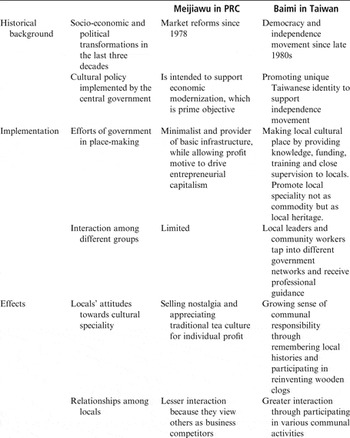
A key finding of this article is the contrast in the implementation of cultural governance in China and Taiwan (see Table 1). Contrary to what one would commonly expect, the Chinese government adopted a minimalist approach while the Taiwanese government was much more hands-on. The contrast in cultural governance practices is significant because it reflects deeper underlying differences in socio-political developments within Taiwan and the PRC. In China, the market reforms initiated by Deng Xiaoping in 1978 led to economic decentralization and the rise of individual-driven entrepreneurship. The cultural governance policy, based on the commodification of cultural specialities and revival of heritage places, is intended to support this central economic objective. In Taiwan, local histories and memories have been revived and remembered since 1988 when Lee Teng Hui took over the presidency. In order to support his pro-independence movement, cultural governance was reshaped to mould a local Taiwanese identity that is different from that of the mainland.
Comparison of Cultural Governance in PRC and Taiwan

The response of the respective villagers to the two cultural governance policies is also different. In China, the state's minimalist place-making efforts were met with tactical manipulations by the locals. These individuals are often engaged in clever, innovative and tricky tactics, which are what de Certeau called “bricolage.”Footnote 57 For instance, they reinterpret the meanings of displays put up by the village government at the memorial hall to enhance the value of their homegrown tea for their own economic interests. They therefore tend to act as individuals, driven by a profit motive, rather than as a community. On the other hand in Taiwan, the active involvement of different government ministries at the upper, middle and lower levels caused local villagers to engage instead in programmatic strategies, thus passively following the government's leadership as a community and demonstrating little individual initiative.
The difference in objectives also generated very different outcomes for the two cultural governance systems. In terms of economic impact, there is a sharp contrast. In China, the entrepreneurial dynamism generated higher income from the sale of tea leaves and from the teahouse business. On the other hand, the economic benefits in Taiwan were relatively inconsequential. This difference reflects the governments’ objectives: economic development was the central goal of the Chinese government, while the reshaping of Taiwanese identity was the overriding objective for the Taiwanese government.
The second difference is the impact on communal solidarity. In the case of Taiwan, the joint participation of villagers in transforming their hometown into a nationally famous place for wooden clogs has created a greater sense of belonging and communal pride. Their common objective of reviving their village's culture led them to work in unison, which has drawn them closer to one another. This process of communal participation and appreciation of their own unique past allows the villagers to rediscover their common identity and cultural heritage. In China, the profit motive generated economic competition between the villagers as they fought over customers, and this led to a deterioration in communal solidarity.