Introduction
Rhea pennata d'Orbigny (Aves: Rheidae), the lesser rhea (known locally as ‘choique’) is a large, flightless and endemic species which inhabits steppes and semi-deserts of Argentine Patagonia and southern Chile (Sales, Reference Sales2006; Barri et al., Reference Barri, Martella and Navarro2009). The lesser rhea is probably the dominant herbivore–omnivore component of the fauna of this region (Novaro et al., Reference Novaro, Funes and Walker2000). The control of parasitic diseases is one of the main concerns in captive breeding of this bird, as they can be responsible for losses in productivity (Chang Reissig & Robles, Reference Chang Reissig and Robles2001).
The identification and characterization of the nematode species affecting rheas is only possible by the examination of adult worms (Ederli & Oliveira, Reference Ederli and Oliveira2014). Most of the studies regarding the parasitic fauna of R. pennata are from specimens farmed in captivity (Chang Reissig et al., Reference Chang Reissig and Robles2001); the information on wild populations is still scarce. To date, most of the nematodes reported in this bird species were identified from eggs in faeces: Deletrocephalus dimidiatus Diesing, 1851 (Deletrocephalidae), Trichostrongylus sp. (Trichostrongylidae), Heterakis-like (Heterakidae), Capillariinae gen. et sp., Strongylidae gen. et sp. and Spirurida fam. gen. et sp. (Chang Reissig et al., Reference Chang Reissig, Olaechea and Robles2001; Martínez-Díaz et al., Reference Martínez-Díaz, Martella, Navarro and Ponce Gordo2013; Frixione et al., Reference Frixione, De Lamo and Olaechea2014). The exception is the work of Ewing et al. (Reference Ewing, Yonzon, Page, Brown and Davidson1995), who found D. dimidiatus after dissection of a bird.
In this study we describe a new species of Procyrnea from the proventriculus of R. pennata using light and scanning electron microscopy, and present a key for identification of the species of the genus.
Materials and methods
Three specimens of lesser rhea were found dead and were collected, dissected and examined for helminths: two chicks, one about 3 months old from Estancia San Pablo, Península Valdés (42°42′52.08″S, 64°12′0.48″W) on February 2014 and another about 5 months old from the intersection of roads 2 and 42 (42°32′26.75″S; 64°47′24.34″W) from the Protected Natural Area Península Valdés on March 2014; and one adult male from Dique Ameghino (43°40′25.94″S; 66°29′24.24″W); all from Chubut province, Argentina.
Nematodes collected from the proventriculus were fixed in 10% formalin and preserved and stored in 70% ethanol. They were later cleared in lactoglycerol for examination under a light microscope (Leica DM2500; Leica, Wetzler, Germany); drawings were made with the aid of a drawing tube. Measurements (range, followed by mean in parentheses) are given in micrometres (μm), unless otherwise stated (SpL/TBL = left spicule length (SpL) as a proportion of total body length (TBL) in percentage). Photographs of mounted specimens were taken with a Leica DFC280 camera with the software connected to the microscope. Specimens intended for study by scanning electron microscopy (SEM) were dehydrated in ethanol, dried by the critical point technique, coated with gold and examined in a Jeol 6360 LV microscope (Jeol, Tokyo, Japan). The specimens were deposited in the Parasitological Collection (CNP-Par) of the Instituto de Biología de Organismos Marinos (CCT CONICET-CENPAT), Puerto Madryn, Chubut, Argentina and the Helminthological Collection of the Museo de La Plata (MLP-He), La Plata, Buenos Aires province, Argentina.
The key to species was made by collecting all the original descriptions of the species of the genus Procyrnea and evaluating which ones are valid at present. We considered 60 valid species (including this new species). Only P. cameroni (Gupta & Kazim, 1978) was not included in the key because the original description could not be obtained.
Results
Procyrnea choique n. sp.
Description
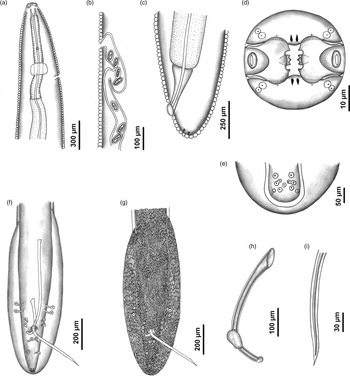
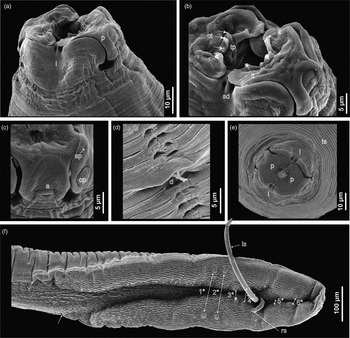
The appearance under light microscopy and SEM is shown in figs 1 and 2, respectively. Body small with distinct transverse striations (fig. 2e). Lip region continuous with body contour, lacking constriction. Lateral alae absent. Labial region consisting of two lateral pseudolabia, and dorsal and ventral labia (figs 1d and 2a, e). Pseudolabia wider distally than at base, narrower in the mid-region; amphids located near base of pseudolabia (figs 1d and 2c). Lining of the internal border of the pseudolabia thickened on the extremities, forming curved points. Internal middle part of each pseudolabium with a tongue-shaped projection, inserted more posteriorly, bearing three small teeth on its free margin (figs 1d and 2b). Dorsal and ventral labia consisting each of two submedian, rounded lobes and a less salient median process, keel-like, flanked by two small, slit-like depressions. Each labium bearing two double cephalic papillae, submedian, plus a pair of small pores on its anterior border (figs 1d and 2b, c). Buccal capsule slightly compressed laterally on the top. Oesophagus divided into short anterior muscular part and long posterior glandular part. Muscular oesophagus 2.4–3.0% (2.7%) of TBL in male and 2.2–2.6% (2.4%) of TBL in female; glandular oesophagus 32–36% (34%) of TBL in male and 11.4–39.6% (24.3%) of TBL in female. Nerve ring located between deirids and excretory pore. Deirids approximately bifid (fig. 2d).
Drawings of Procyrnea choique n. sp. (Nematoda: Habronematidae) in a lesser rhea from the Protected Natural Area Península Valdés, Argentina. Scale values are given beside each bar. (a) Anterior end of female, lateral view; (b) vulvar region of female, lateral view; (c) posterior end of female, details of anus and phasmids, lateral view; (d) anterior end of female, apical view; (e) posterior end of male, details of caudal sessile papillae and phasmids; (f) posterior end of male, details of caudal alae, internal and ventral view; (g) posterior end of male, details of caudal alae, ornamented cuticle, superficial and ventral view; (h) right spicule and gubernaculum, lateral view; (i) distal end of left spicule.

Scanning electron micrographs of Procyrnea choique n. sp. (Nematoda: Habronematidae) in a lesser rhea from the Protected Natural Area Península Valdés, Argentina. Scale values are given beside each bar. (a) Cephalic end of female, view of a labium and a pseudolabium, subapical view; (b) cephalic end of female, details of internal tongue-shaped projection with three sharp teeth (central teeth of pseudolabia) and two lateral teeth, subapical view; (c) detail of amphid in pseudolabium, lateral view; (d) detail of deirid, approximately bifid, median-lateral view; (e) cephalic end of male and transverse striations of cuticle, apical view; (f) posterior end of male, details of asymmetrical caudal alae (arrows), precloacal and postcloacal papillae and spicules, latero-ventral view. Abbreviations: a, amphid; cp, cephalic papilla; ct, central teeth; d, deirid; l, labium; ls, left spicule; lt, lateral teeth; p, pseudolabium; rs, right spicule; sd, slit-like depressions; sp, small pore; tp, tongue-shaped projection; ts, transverse striations. The numeration (e.g. 1°) indicates the pairs of papillae of the male (double arrows).

Male (n = 2)
Body length 8.25–9.85 mm. Maximum width 350–400. Buccal capsule 30–40 long and 25–30 wide. Muscular oesophagus 200–300 long and 40 wide; glandular oesophagus 2.64–3.56 mm long and 80–120 wide. Nerve ring, excretory pore and deirids 180–200, 250–290 and 140–180, respectively, from anterior end. Posterior end of body ventrally curved. Caudal alae well developed and asymmetrical, left ala 1150–1270 long, right ala 1090–1210 long (figs 1f, g and 2f). Caudal alae with longitudinal striations on ventral surface and transverse striations on dorsal surface. Tail with rounded tip, 260–320 long. Six pairs of symmetrically arranged pedunculate papillae: four pairs preanal and two pairs postanal (figs 1f, g and 2f). Median precloacal papilla not observed. Nine sessile papillae and phasmids located near tail tip, i.e. eight papillae arranged in pairs, of which the second and third pair contacting each other, one single papilla and pair of phasmids (fig. 1e). Spicules unequal and dissimilar. Left spicule 0.97–1.05 mm long, with pointed distal end (figs 1i and 2f). Right spicule 300–360 long, with curved and rounded tip, ending in a slight knob-like process (figs 1h and 2f). Ratio of right spicule–left spicule, 1:2.7–3.5. SpL/ TBL 9.85–12.73%. Gubernaculum gutter-shaped, ends rounded, with proximal end wider than distal one (fig. 1h), 60–80 long and 25–30 wide.
Female (n = 3)
Body length 13.4–17.8 mm (15.87 mm). Maximum width 400–600 (500). Buccal capsule 45–50 (47) long and 30–40 (37) wide. Muscular oesophagus 340–460 (387) long and 40–55 (47) wide; glandular oesophagus 1.87–5.30 mm (3.70 mm) long and 70–80 (75) wide. Nerve ring, excretory pore and deirids 250–330 (282), 350–550 (443) and 170–230 (195), respectively, from anterior end (fig. 1a). Didelphic. Vulva opening ventrally (fig. 1b), post-equatorial, 6.2–7.1 mm (6.70 mm) or 38.0–46.0% (42.3%) of TBL, from posterior end. Tail short and rounded, 80–100 (88) long (fig. 1c). Eggs ellipsoidal, thick shelled, embryonated (fig. 1b), 50.0–55.0 (51.7) long, 30.0–35.0 (31.7) wide.
Taxonomic summary
Type host
Rhea pennata d'Orbigny, 1834 (Aves: Rheiformes: Rheidae).
Type locality
Protected Natural Area Península Valdés (42°32′26.75″S; 64°47′24.34″W), Chubut province, Argentina.
Site of infection
Proventriculus.
Prevalence and intensity of infection
One out of three birds infected with two males and three females.
Type specimens
Holotype male, CNP-Par 144/1; allotype female, CNP-Par 144/2; paratype female, CNP-Par 144/3; paratype male and paratype female, MLP-He 7363 (mounted for SEM).
Etymology
The specific epithet refers to the host common name, ‘choique’; the aboriginal name in the Araucanian language.
Remarks
The genus Procyrnea was proposed by Chabaud (Reference Chabaud1958) initially as a subgenus of Cyrnea and later raised to the generic rank by Chabaud (Reference Chabaud, Anderson, Chabaud and Willmott1975). Chabaud (Reference Chabaud1958) proposed the name Procyrnea for those species having the lateral teeth inserted near the anterior border of the pseudolabia and the deirids located anteriorly to the nerve ring. Also, the specimens belonging to Procyrnea have cloacal papillae with the usual disposition of spirurid species, with four pairs of pedunculate preanal papillae, a single preanal papilla, two pairs of pedunculate postanal papillae and a terminal group composed of four pairs of sessile papillae and a pair of phasmids (Chabaud, Reference Chabaud1958). At present, 59 nominal species of Procyrnea have been described, all from avian hosts, most in Falconiformes and Strigiformes, and, to a much lesser degree, parasitizing Piciformes, Passeriformes, Tinamiformes and Rheiformes (e.g. Walton, Reference Walton1927; Maplestone, Reference Maplestone1932; Freitas & Lent, Reference Freitas and Lent1947; Ali, Reference Ali1961; Mawson, Reference Mawson1968; Gupta & Kumar, Reference Gupta and Kumar1980; Zhang, Reference Zhang1991; Pinto et al., Reference Pinto, Vicente and Noronha1996; Cheng & Ye, Reference Cheng and Ye2000; Zhang et al., Reference Zhang, Brooks and Causey2004, Reference Zhang, Dewi and Purwaningsih2009, Reference Zhang, Song and Zhang2011; Eduardo & Villa, Reference Eduardo and Villa2011).
Procyrnea choique n. sp. shares the lack of lateral alae with P. ficheuri (Seurat, 1916), P. murrayi (Ortlepp, 1934), P. excisiformis (Yamaguti, 1935), P. ameerae (Ali, 1961), P. ruschii (Freitas, 1967), P. dollfusi Mawson, 1968, P. aptera (Wang, 1976), P. haliasturi (Gupta & Kumar, 1980), P. ornata Cheng & Ye, 2000, P. brevicaudata Zhang, Brooks & Causey, 2004 and P. javaensis Zhang, Dewi & Purwaningsih, 2009. However, it differs from P. ficheuri, P. murrayi, P. excisiformis and P. dollfusi by having the left spicule with a pointed tip, instead of a barbed tip (single-barbed in P. murrayi and P. dollfusi, double-barbed in P. ficheuri and P. excisiformis), and by lacking the single preanal papilla. It differs from P. brevicaudata by the absence of lateral ridges on the left side of the body, from P. ameerae and P. ornata by having asymmetrical, instead of symmetrical, caudal alae and from P. haliasturi by having a postequatorial vulva. It also differs from P. aptera, P. ruschii and P. javaensis by having a shorter left spicule (≈1 mm vs. ≥1.2 mm) and a SpL/TBL of about 9–12% vs. 15–18%.
Other species of Procyrnea whose original descriptions are not clear with respect to the presence of lateral alae are P. aegotheles Johnston & Mawson, 1941, P. spiralis Mawson, 1968, P. anterovulvata Pinto, Vicente & Noronha, 1996, P. graculae Eduardo & Villa, 2011, P. uncinipenis (Molin, 1860) and P. waltoni (Freitas & Lent, 1947). In any case, these species can be differentiated from P. choique n. sp. Procyrnea aegotheles is characterized by having ten precloacal papillae (six on the left, four on the right) and a SpL/TBL ratio of 28%, whereas P. graculae is characterized by having pre- and postcloacal papillae strongly unpaired, the lack of a gubernaculum, and a female with a markedly pre-equatorial vulva. This latter character is shared with P. anterovulvata. Procyrnea spiralis has much shorter spicules (left spicule 215–290 μm, right spicule 70–75 μm) and a SpL/TBL ratio of 4.5–5.3% versus 9.8–12.7% in P. choique n. sp. Procyrnea uncinipenis and P. waltoni have both been described from the greater rhea, Rhea americana, and have been confused with each other several times (Freitas & Lent, Reference Freitas and Lent1947; Chabaud, Reference Chabaud1958). Both species were described as having denticulated pseudolabia. Paired lateral alae are apparently absent in P. uncinipenis, although specimens assigned to P. waltoni were referred to as having a single, short cervical ala on the left side (Walton, Reference Walton1927; Freitas & Lent, Reference Freitas and Lent1947). Another remarkable difference between P. waltoni and the new species is the spicule ratio, which in P. waltoni is about 1:8. Other differences between P. uncinipenis and the new species, besides the denticulation on the pseudolabia, lie in the body size (male size is 8.25–9.85 mm in P. choique n. sp. vs. 17.75–21.77 mm in P. uncinipenis), spicule size (SpL = 0.97–1.05 mm in P. choique n. sp. vs. 3–3.7 mm in P. uncinipenis), spicular ratio (1:3–4 in P. choique n. sp. vs. 1:5 in P. uncinipenis) and in the presence of the single preanal papilla (absent in P. choique n. sp. vs. present in P. uncinipenis) (Freitas & Lent, Reference Freitas and Lent1947).
Discussion
Our results extend the taxonomy of Procyrnea Chabaud, 1958 and comprise the first report of a habromatid nematode from R. pennata. Frixione et al. (Reference Frixione, De Lamo and Olaechea2014) did not find eggs of this nematode in the faeces of adults/sub-adults and chicks from the same study area. This is possibly due to the fact that eggs of Procyrnea and related genera are hard to find by standard techniques of faecal examination. Besides, ratites are relatively disease-resistant birds after the third month of age (Ederli & Oliveira, Reference Ederli and Oliveira2014). Habronematids are quite pathogenic in birds; being a possible cause of mortality in chicks. Despite parasitism being the major cause of the limited success in captive breeding of these birds, there are few studies concerning the parasites of rheas (Ederli & Oliveira, Reference Ederli and Oliveira2014).
The key presented below includes 60 species of Procyrnea Chabaud, 1958. The previous key of this genus was published in the 1960s by Ali (Reference Ali1961); therefore, the contribution of this key, which includes all the information collected from papers from 1819 to the present time, will be useful for future research, helping with the taxonomic identification of species of Procyrnea.
Acknowledgements
The authors thank Néstor J. Cazzaniga for his advice on the naming of the species, to the Wildlife Warden Squad (including Rafael Lorenzo) from the Protected Natural Area Península Valdés, to Julio Martello for collecting the birds, to Julia Rouaux for her help with the drawings, to Patricia Sarmiento (Servicio de Microscopía Electrónica de Barrido, FCNyM, UNLP, La Plata) for producing the SEM photographs, and to the Administration of the Protected Natural Area Península Valdés (AANPPV). The field work was conducted in a Protected Natural Area with permits from the Secretaría de Turismo y Áreas Protegidas of Chubut province.
Financial support
This work was supported by the Agencia Nacional de Promoción Científica y Tecnológica (PICT 2013-1702); International Barcode of Life (IBOL) 2013 and Universidad Nacional de la Patagonia San Juan Bosco (UNPSJB). E.B.’s doctoral fellowship was financed by Consejo Nacional de Investigaciones Científicas y Técnicas (CONICET) and Secretaría de Ciencia, Tecnología e Innovación Productiva del Gobierno de Chubut. M.C.D. and F.C. are members of CONICET.
Key to species of Procyrnea Chabaud, 1958
1 Body without lateral alae 2
1′ Body with one or two lateral alae 18
2 Left spicule with barbed tip 3
2′ Left spicules with pointed tip, without barbs 6
3 Left spicule with double barbed tip 4
3′ Left spicule with single barbed tip 5
4 Male 8.4 mm., left spicule 1.27 mm, right spicule 350 µm. Parasites of Ardeidae from Asia, Europe and Africa Procyrnea ficheuri (Seurat, 1916)
4′ Male 7.4–9.3 mm, left spicule 1–1.2 mm, right spicule 333–408 µm. Parasites of Strigidae from China and Japan Procyrnea excisiformis (Yamaguti, 1935)
5 Cuticle with coarse annulations giving a serrated appeareance to the body margins, precloacal papillae 4 pairs or more, left spicule 0.88–0.90 mm. Parasites of Tyto alba (Scopoli, 1769) (Tytonidae) from Africa Procyrnea murrayi (Ortlepp, 1934)
5′ Cuticle with fine annulations, precloacal papillae 4 pairs, left spicule 1.35 mm. Parasites of Strigidae from Australia Procyrnea dollfusi (Mawson, 1968)
6 Females with vulva pre-equatorial 7
6′ Females with vulva postequatorial 9
7 Vulva slightly pre-equatorial (c. 45% of TBL). Spicule ratio 1:3. Parasites of Accipitridae from India Procyrnea haliasturi (Gupta & Kumar, 1980)
7′ Vulva strongly pre-equatorial (c. 14–16% of TBL) 8
8 Spicule ratio 1:6.5. Parasites of Bucconidae from Brazil Procyrnea anterovulvata Pinto, Vicente & Noronha, 1996
8′ Spicule ratio 1:3–4. Parasites of Sturnidae from Philippines Procyrnea graculae Eduardo &Villa, 2011
9 Presence of two ridges longitudinal striated on the left side of the body, extending from level of deirid to posterior end of body. Parasites of Tinamidae from Costa Rica Procyrnea brevicaudata Zhang, Brooks & Causey, 2004
9′ Striated lateral ridges absent 10
10 Median precloacal papilla present 11
10′ Median precloacal papilla absent 12
11 Pseudolabia bearing small denticles. Male 17.75–21.77 mm long, left spicule 3–3.7 mm, spicule ratio 1:5. Parasites of Rheidae from Brazil Procyrnea uncinipenis (Molin, 1860)
11′ Pseudolabia lacking small denticles. Male 7.44–8.1 mm long, left spicule 1.35–1.63 mm, spicule ratio 1: 4. Parasites of Strigidae from Indonesia Procyrnea javaensis Zhang, Dewi & Purwaningsih, 2009
12 Caudal alae symmetrical 13
12′ Caudal alae asymmetrical 14
13 Male 4.5–5.3 mm long, left spicule 0.78–0.89 mm, SpL/TBL = 17%. Parasites of Falconidae from India Procyrnea ameerae (Ali, 1961)
13′ Male 8.61–8.84 mm long, left spicule 0.77–0.78 mm, SpL/TBL= 8.9%. Parasites of Leiothrichidae from China Procyrnea ornata (Cheng & Ye, 2000)
14 Males less than 6.0 mm long 15
14′ Males more than 6.0 mm long 16
15 Male 2.5 mm, left spicule 0.7 mm, SpL/TBL= 28%, spicule ratio 1:4. Parasites of Aegotheles cristatus (Shaw, 1790) (Aegothelidae) from Australia Procyrnea aegotheles (Johnston & Mawson, 1941)
15′ Male 4.7–5.4 mm., left spicule 0.22–0.29 mm, SpL/TBL= 4.68%. Parasites of Meliphagidae, Oriolidae and Campephagidae from Australia Procyrnea spiralis (Mawson, 1968)
16 Left spicule 1 mm long. Spicule ratio 1:3. Parasites of Rhea pennata d´Orbigny from Argentina Procyrnea choique n. sp.
16′ Left spicule >1 mm long 17
17 Left spicule 1.20 mm, spicule ratio 1:2.42. Parasites of Strigidae from China Procyrnea aptera (Wang, 1976)
17′ Left spicule 1.47–1.60 mm, spicule ratio 1:3.1–3.6. Parasites of Apodiformes (Trochilidae) from Brazil Procyrnea ruschii (Freitas, 1967)
18 Body with one lateral ala 19
18′ Body with two lateral alae 38
19 Left spicule with barbed tip 20
19′ Left spicules with pointed tip, without barbs 23
20 Left spicule with single barbed tip 21
20′ Left spicule with double barbed tip 22
21 Cuticle with coarse annulations giving a imbricated appeareance to the body margins, preanal papillae 4 pairs or more, median precloacal papilla present, left spicule 1.86–1.90 mm. Parasites of Accipitridae and Falconidae from Africa and Asia Procyrnea monoptera (Gendre, 1922)
21′ Cuticle with fine annulations, preanal papillae 4 pairs, median postcloacal papilla absent, left spicule 1.1 mm. Parasites of Strigidae from China Procyrnea sinica Zhang, Song & Zhang, 2011
22 Male 5.47–6.86 mm, left spicule 1.22–1.37 mm, right spicule 340–410 µm. Parasites of Accipitridae and Falconidae from Asia, Europe and South America (Chile) Procyrnea spinosa (Gendre, 1923)
22′ Male 7.2–11.1 mm, left spicule 1.4–2.5 mm, right spicule 400–430 µm. Parasites of Falconidae from Australia Procyrnea falco (Mawson, 1968)
23 Pseudolabia with small denticles. Male 20 mm long, left spicule 2.4–2.65 mm, spicule ratio 1:8. Parasites of Rhea americana (Linnaeus, 1758) (Rheidae) from Brazil Procyrnea waltoni (Freitas & Lent, 1947)
23′ Pseudolabia lacking small denticles 24
24 Male <10 mm 25
24′ Male ≥10 mm 31
25 Caudal alae symmetrical 26
25′ Caudal alae asymmetrical 29
26 Pseudolabia with teeth, median precloacal papilla absent, male 8.3 mm long. Parasites of Strigidae from India and China Procyrnea imbricata (Maplestone, 1930)
26′ Pseudolabia lacking teeth 27
27 Females with vulva pre-equatorial or slightly equatorial, male 6.6 mm long, spicule ratio 1:8. Parasites of Falconidae from Democratic Republic of Congo Procyrnea skrjabini (Vuylsteke, 1953)
27′ Females with vulva postequatorial 28
28 Lateral ala moderately wide, male 7–9 mm long. Parasites Ramphastos vitellinus Lichtenstein, 1823 (Rhamphastidae) from Brazil Procyrnea unilateralis (Molin, 1860)
28′ Lateral ala narrow, on the anterior fourth of the body, male 7.5–8.2 mm long. Parasites of Picidae and Ramphastidae from United States and Brazil Procyrnea pileata (Walton, 1927)
29 Left spicule ≤ 0.65 mm, SpL/TBL = 8.67%, asymmetrical and double papillae of caudal end of male. Parasites of Circus macrourus Gmelin, 1770 (Accipitridae) from India Procyrnea asymmetrica (Maplestone, 1932)
29′ Left spicule >0.65 mm 30
30 Pseudolabia with teeth, male 8–8.9 mm long, left spicule 0.99–1.21 mm, SpL/TBL = 12.38%. Parasites of Columbidae from India Procyrnea daleri (Ali, 1961)
30′ Pseudolabia lacking teeth, male 9 mm long, left spicule 1.78 mm, SpL/TBL = 19.56%. Parasites of Accipitridae from India Procyrnea magnilabiata (Maplestone, 1932)
31 Left spicule ≤1.5 mm long 32
31′ Left spicule >1.5 mm long 35
32 Four median precloacal papillae, SpL/TBL = 7.59%. Parasites of Centrocercus urophasianus (Bonaparte, 1827) (Phasianidae) from United States Procyrnea urophasiana (Wher, 1931)
32′ Fewer than 4 median precloacal papillae or absent 33
33 One median precloacal papilla, male 10.2–12.9 mm long. Parasites of Accipitridae from India Procyrnea singhi (Ali, 1961)
33′ Two median precloacal papillae 34
34 Caudal alae symmetrical, 6 caudal sessile papillae. Parasites of Falconidae from India Procyrnea suraiyae (Ali, 1961)
34′ Caudal alae asymmetrical, 8 caudal sessile papillae. Parasites of Strigidae from India Procyrnea vinodi (Gupta & Kumar, 1980)
35 Caudal alae symmetrical 36
35′ Caudal alae asymmetrical 37
36 Six sessile caudal papillae. Parasites of Accipitridae of genus Neophron from Asia and Africa Procyrnea tulostoma (Hemprich & Ehrenberg, 1866)
36′ Eight sessile caudal papillae. Parasites of Falconidae from India Procyrnea chabaudi (Ali, 1961)
37 Male 13.65 mm long, left spicule 1.81 mm long, spicule ratio 1:5. Parasites of Strigidae from India Procyrnea fotedari (Gupta & Kumar, 1980)
37′ Male 14.4–17.4 mm long, left spicule 1.81–2.15 mm long, spicule ratio 1:3. Parasites of Strigidae from India Procyrnea rauschi (Gupta & Kumar, 1980)
38 Lateral alae symmetrical 39
38′ Lateral alae asymmetrical 52
39 Left spicule with barbed tip 40
39′ Left spicules with pointed tip, without barbs 44
40 Left spicule with single barbed tip 41
40′ Left spicule with double barbed tip 42
41 Left spicule 2.1 mm, right spicule 0.45 mm, spicule ratio 1:5. Parasites of Falconidae of genus Falco from Asia (Siberia) and Africa Procyrnea seurati (Skrjabini, 1917)
41′ Left spicule 3.24 mm, right spicule 1.08 mm, spicule ratio 1:3. Parasites of Strix nebulosa Forster, 1772 (Strigidae) from United States Procyrnea longispiculata (Walton, 1927)
42 Pseudolabia with ≤3 teeth 43
42′ Pseudolabia with 3 teeth, male 10.24–12.42 mm long. Parasites of Trochilidae from Costa Rica Procyrnea mclennanae Zhang, Brooks & Causey, 2004
43 Caudal alae symmetrical, male 8.18–10.59 mm long. Parasites of Nestoridae from New Zealand Procyrnea kea Clark, 1978
43′ Caudal alae asymmetrical, male 7.21–10.69 mm long. Parasites of Accipitridae from Costa Rica Procyrnea mawsonae Zhang, Brooks & Causey, 2004
44 Median precloacal papillae absent, male 7.1 mm long; SpL/TBL 9%; spicule ratio 1:3. Parasites of families Accipitridae, Falconidae, Icteridae, Phasianidae, Tytonidae and Strigidae from Europe, Asia, Africa and South America (Brazil, Chile) Procyrnea leptoptera (Rudolphi, 1819)
44′ Median precloacal papillae present 45
45 One median precloacal papillae 46
45′ Two median precloacal paillae 49
46 Caudal alae symmetrical 47
46′ Caudal alae asymmetrical 48
47 Female with vulva pre-equatorial, 11 sessile caudal papillae, male 17.4–19.1 mm, spicule ratio 1:4. Parasites of Strigidae from Asia (Turkmenistán) Procyrnea zorillae (Seurat, 1919)
47′ Female with vulva postequatorial, 6 sessile caudal papillae, male <10 mm, spicule ratio 1:3. Parasites of Falconidae from Australia Procyrnea paraleptoptera (Johnston & Mawson, 1941)
48 Ten caudal sessile papillae, male 10–15 mm long, spicule ratio 1:5. Parasites of Picidae from United States and Brazil Procyrnea colaptes (Walton, 1927)
48′ Eight caudal sessile papillae, male 6.72–8.64 mm long, spicule ratio 1:3. Parasites of Accipitridae from China Procyrnea strialata (Zhang, 1991)
49 Pseudolabia with 3 teeth 50
49′ Pseudolabia without teeth, male 8.8 mm long, left spicule 1.7 mm, SpL/TBL 19.32%. Parasites of Acryllium vulturinum Hardwicke, 1834 (Numididae) from India Procyrnea diesingi (Maplestone, 1932)
50 Six caudal sessile papillae, male 6–9 mm long, 2 median precloacal papillae. Parasites of Picidae of genera Celeus and Colaptes from South America (Brazil) Procyrnea longistriata (Molin,1859)
50′ Eight caudal sessile papillae 51
51 Left spicule 1.2–1.6 mm long, spicule ratio 1:4. Parasites of Sturnidae from India Procyrnea hyderabadensis (Ali, 1961)
51′ Left spicule 1.43–1.82 mm long, spicule ratio 1:3. Parasites of Accipitridae from India Procyrnea hrishii (Agrawal, 1965)
52 Median precloacal papillae present 53
52′ Median precloacal papillae absent 57
53 Pseudolabia with 3 teeth 54
53′ Pseudolabia with 4 teeth, male 5.5–10.1 mm, left spicule 0.55–0.63 mm, right spicule 200–210 µm. Parasites of Falconidae, Accipitridae and Picidae from Asia, Australia, Europe and Brazil Procyrnea mansioni (Seurat, 1914)
54 Male ≤12 mm long 55
54′ Male >12 mm long, left spicule 6.3 mm, right spicule 600 µm. Parasites of Accipitridae from Africa Procyrnea dolichocolpos (Chabaud & Brygoo, 1958)
55 Caudal alae symmetrical, male 8.1–11.8. Parasites of Accipitridae from China Procyrnea beveridgei Zhang, Song & Zhang, 2011
55′ Caudal alae asymmetrical 56
56 Female with vulva pre-equatorial (33%), male 8–12 mm long. Parasites of Psittaculidae, Ardeidae and Odontophoridae from United States Procyrnea incerta (Smith, 1908)
56′ Female with vulva slightly pre-equatorial (49%), male 7.9–8 mm long. Parasites of Eupodotis afraoides (Smith, 1831) (Otididae) from Africa Procyrnea buckleyi (Bisseru, 1955)
57 Two pedunculate postcloacal papillae, left spicule 0.725–0.750 mm, right spicule 225–250 µm. Parasites of Buteo platypterus (Vieillot, 1823) (Accipitridae) from United States Procyrnea americana (Chandler, 1941)
57′ Four pedunculate postcloacal papillae 58
58 Twelve caudal sessile papillae, male 10.2–12.2 mm long. Parasites of Accipitridae from India Procyrnea magnipapillata (Ali, 1961)
58′ Eight caudal sessile papillae 59
59 Caudal alae symmetrical, male 9.1–9.9 mm long, left spicule 0.91–0.98 mm, right spicule 320–360 µm. Parasites of Accipitridae from India Procyrnea waheedae (Ali, 1961)
59′ Caudal alae asymmetrical, male 5.8–7.8 mm long, left spicule 0.87–1.00 mm, right spicule 320–370 µm. Parasites of Zosteropidae and Fringillidae from Hawaii Procyrnea longialatus Cid del Prado, Maggenti & van Riper, 1985
Conflict of interest
None.