Introduction
Background
Early support and treatment for people with mental health problems help prevent deterioration in their mental state (Thornicroft et al. Reference Thornicroft, Phelan, Strathdee, Knudsen and Thornicroft1996) and reduce the risk of relapse (Commander et al. Reference Commander, Dharan, Odell and Surtees1997) and compulsory admission to hospital (Turner, Reference Turner1996). This initial support and treatment are often shared between primary care and psychiatric out-patient clinics.
Attendance at clinics, however, can be poor. Every week in the UK each general practitioner makes at least four appointments for consultations that are not attended and 10–40% of people with mental health problems do not attend their initial out-patient appointment (McGlade et al. Reference McGlade, Bradley, Murphy and Lundy1988; Thompson, Reference Thompson2001). In addition to the adverse clinical consequences and the waste of resources, failure to attend often ensures that the burden of care falls back to primary care. Finally, attendance at out-patient appointments may be a key performance indicator used to measure quality of care (Healthcare Commission, 2005).
Reminders or prompts to encourage attendance at clinics are used in day-to-day practice by some clinicians. Examples of such strategies are telephone calls (Hershorn, Reference Hershorn1993), specific visits to the home (Phan, Reference Phan1995) or issuing a copy of the referral letter to the patient (Hamilton et al. Reference Hamilton, Round and Sharp1999). All such prompts may be embedded within complex care packages, especially for those with ongoing illness. Their value is, however, unclear (Smoller et al. Reference Smoller, McLean, Otto and Pollak1998) and there are no guidelines to describe when prompts should be deployed. A relevant Cochrane systematic review (Reda & Makhoul, Reference Reda and Makhoul2001) identified three trials. It was not clear whether prompting by telephone 1–2 days before the appointment improved attendance. Letters sent out a few days before the appointment, however, did increase attendance when compared with no prompts [two trials: n=200, relative risk (RR) missed appointment 0.6, 95% confidence interval (CI) 0.4–0.9, number needed to treat (NNT) 6, 95% CI 4–21]. There was a suggestion that an ‘orientation statement’ letter (a short paragraph, taking about 30 s to read, explaining how the programme of care worked, the fee system and providing gentle encouragement) was best (Reda & Makhoul, Reference Reda and Makhoul2001). There remained, however, insufficient power within the pooled trials to confidently establish the value of any of the prompts. Second, the research was conducted within a fee-based US mental health service setting during the 1980s and it was not clear if it was applicable elsewhere.
Aim
The aim of the study was to compare a simple timely postal ‘orientation statement’ with standard care to encourage attendance at a range of adult psychiatric out-patient services.
Methods
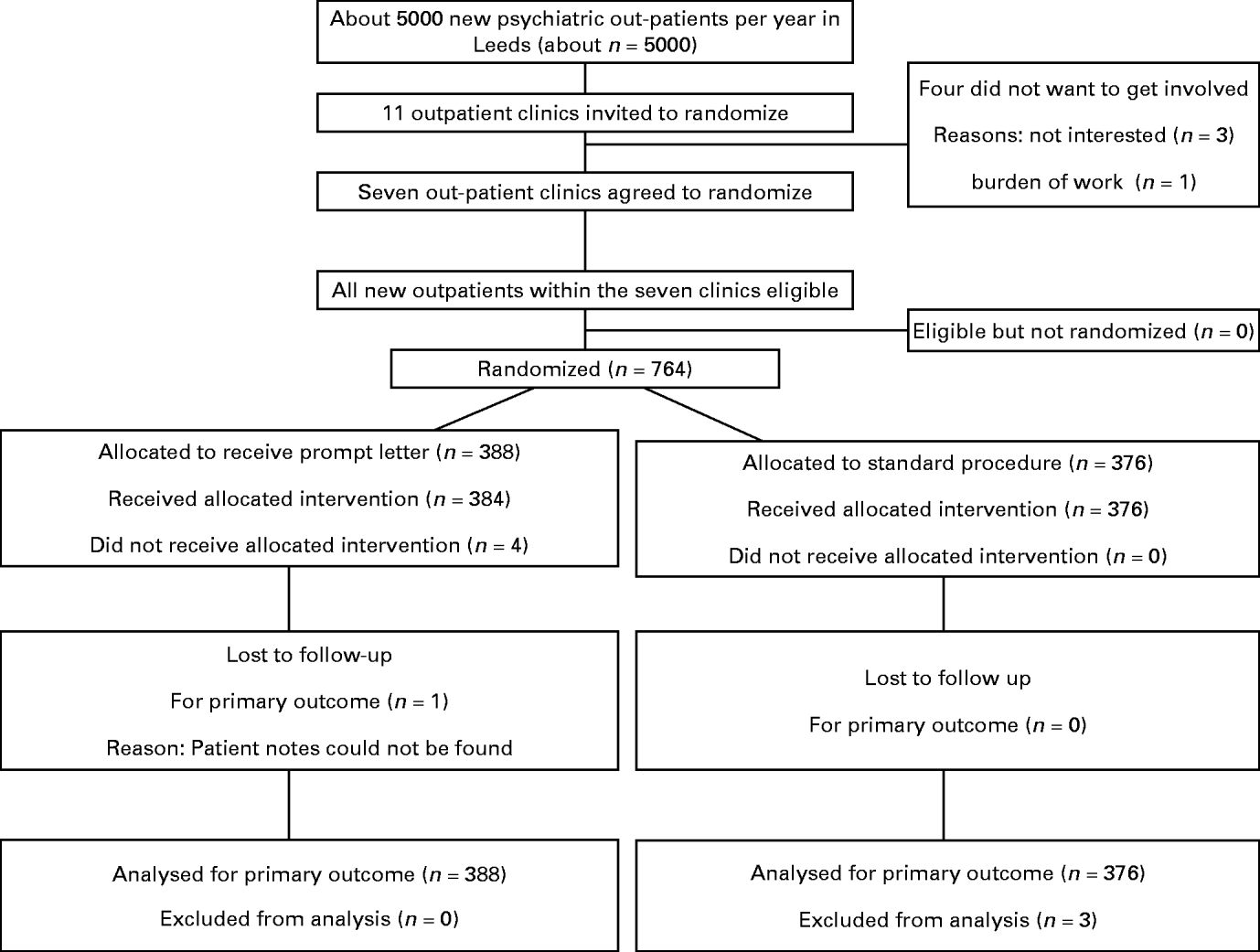
Seven clinics providing adult psychiatric services agreed to take part out of the 11 selected (see Fig. 1). Every person due to attend the seven study clinics for the first time was eligible (May 2003 to July 2004). Relevant demographic and contact data were extracted from the Patient Administration Systems (PAS) before the first appointment was due or were gained from the relevant clinic secretaries. Anonymized numbers corresponding to each person were then sent to one of the collaborators (C.E.A.) who generated allocation lists stratified by type of clinic using an online program (Dallal, Reference Dallal2003). With the exception of general adult clinics, with which the trial started, each allocation list employed blocks of even numbers of less than 10, also of random size. C.E.A.'s clinic for people of no fixed abode was one that was included within the general adult category but only four people were eligible (having an address). All linking of allocation lists to anonymized numbers and to patient details was undertaken by the trial co-ordinator (J.K.) who concealed the records and posted the prompt.
CONSORT diagram.

The intervention group received an individualized pro forma letter sent from the central administrative office 72 h prior to his or her scheduled first appointment. This ‘orientation’ letter was very short, taking 30 s to read (Appendix 1). It was written on headed paper, explained the time of appointment and gave the name of the doctor, a short description of the clinic and its routine, a map, and finally a request to bring medication and a friend or family member. Both the experimental and control groups received standard care, which is an appointment card for clinic within the following 13 weeks. About 47% of both arms were subject to a new form of standard care that involves ‘opt-in partial booking’. In this system psychiatric services send new out-patients a letter asking the person to confirm if they really wish to attend psychiatric out-patient services. If they decline or do not reply no routine appointment is made.
All outcomes were routinely collected and recorded by staff blind to group of allocation. The primary outcome was failure to attend the prearranged first out-patient appointment. Secondary outcomes were attendance rates stratified by the specific subspecialty of clinic, by partial booking service, and death and use of health service resources at 1 year. In order to determine a 5% difference in attendance rates, from a baseline non-attendance rate of 23% with 80% certainty 1200 patients were needed. The trial recruited for 1 year and ended because of constraints of time and finance rather than slowing of recruitment. Follow-up was until 1 year after each person's initial out-patient appointment and data were extracted from PAS or the person's psychiatric notes. We undertook no interim analyses and tests were two-tailed. Individual patient consent was not requested.
Results
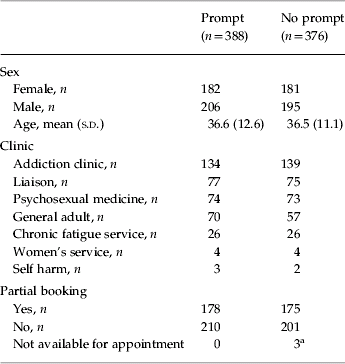
A total of 764 people were randomized. Potential confounders (age, sex, partial booking service) were evenly distributed across groups (Table 1). The imbalance between groups for the general adult clinic represents the play of chance (see Discussion), as this was the only clinic not blocked in numbers less than 10. We were able to acquire all but one record for the primary outcome (Table 2) and 755 (98.8%) people entered the secondary analyses (see Fig. 1).
Demographic data and target clinic by group of allocation

s.d., Standard deviation.
a Two people admitted to hospital at time of first appointment, one dead.
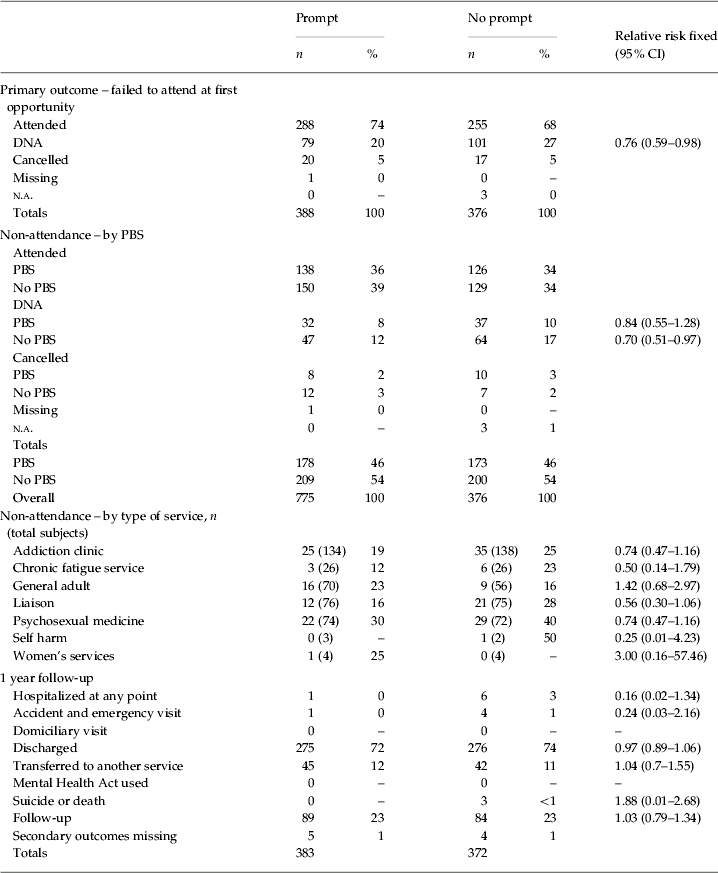
Results

CI, Confidence interval; DNA, did not attend; n.a., not applicable; PBS, partial booking service.
The orientation letter prompting people to attend arrived by standard first class postal services about 24–48 h before their appointment was due. We found that it statistically significantly reduced numbers of people failing to attend [n=761, absolute risk reduction (ARR) 7%, RR 0.76, 95% CI 0.59–0.98, NNT 16, 95% CI 10–187]. The ‘opt in’ partial booking reduced this effect (Table 2). Some sub-speciality clinics saw few new patients but all secondary analyses of non-attendance rates are consistent with the primary finding.
The initial prompt did not have any discernable effect for any secondary outcomes for which there were substantial numbers of events at 1-year follow-up. About 70% of people in both groups were discharged back to primary care, 10% were transferred to another service and 20% continued psychiatric out-patient follow-up. For other outcomes, where the event rate was low, at the end of a year, more people in the standard care group had, at some point, been admitted to psychiatric hospital, attended an accident and emergency department or had died (Table 2). None of these findings reaches conventional levels of statistical significance.
Discussion
All clinics were busy, but, because the pragmatic design did not increase the burden of work, and because of continuing goodwill within the service, most clinics we approached agreed to take part. The initial 11 clinics were chosen to reflect the busy, general services in Leeds and those that declined to take part may have been the particularly hectic out-patient departments. Applicability of results, as with any trial, is therefore open to interpretation. We do not think that participating clinics in the PROMPTS trial were so self-selected as to render results impossible to apply. The resulting seven reflect a range of general adult services but may not be generalizable. In 14 months we randomized 764 people attending these clinics for the first time (about 15% of all people attending psychiatric out-patient clinics for working-age adults for the first time in Leeds during that period). The clinics represent the broad range of local psychiatric out-patient services.
The study started within ‘general adult’ psychiatric out-patients. Anticipating more recruitment in this sub-specialty than occurred, we did not use small block randomization and the end of the trial we had randomized a total of 127 people from a balanced allocation list of 200. Our allocation to intervention groups within ‘general adult’ psychiatric out-patients was noted, as part of a post hoc analysis, to be imbalanced but, throughout the whole trial the sequence of allocation was fully concealed and strictly adhered to (see Protocol – available in the online version of the paper). We found the likely explanation was the play of chance as, according to the concealed allocation list, should another 30 been randomized from general adult psychiatry the groups of allocation would have balanced.
Routine data collection, even at 1 year, was excellent. Although a full record sometimes had to be pieced together from both PAS and clinical notes, all data were available for the vast majority of people. We found that punctual supply of routine data was not always a reality but, with tenacity, at least for this part of the UK's National Health Service (NHS), these routine data nearly always existed.
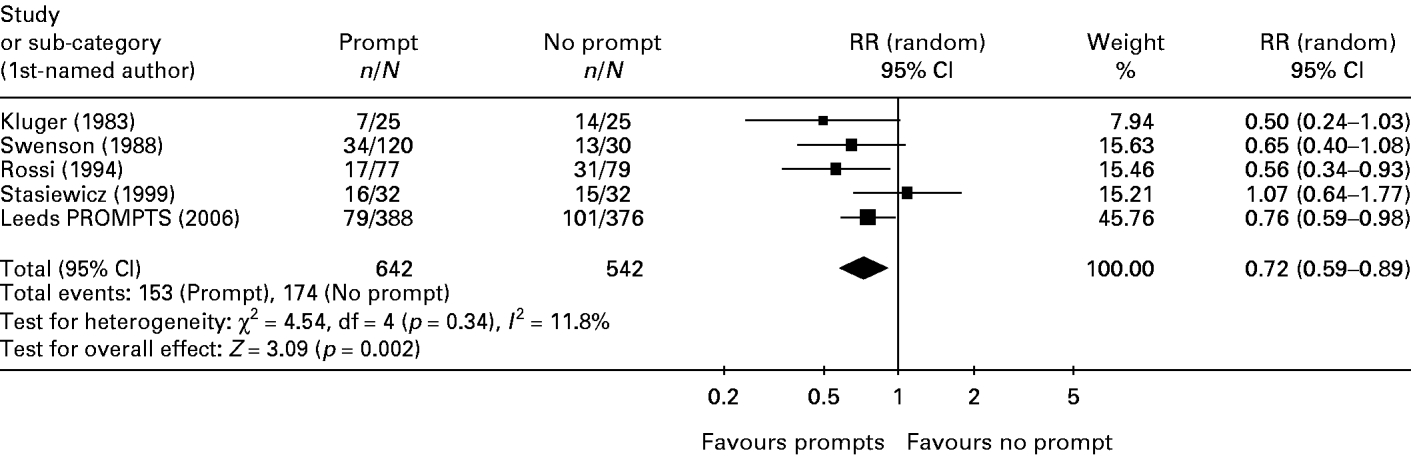
This pragmatic trial does suggest that gently prompting with a first psychiatric out-patient appointment by a timely encouraging letter significantly decreases non-attendance rates. Adding these data to the findings of all other relevant trials (Kluger & Karras, Reference Kluger and Karras1983; Swenson & Pekarik, Reference Swenson and Pekarik1988; Rossi, Reference Rossi1994; Stasiewicz & Stalker, Reference Stasiewicz and Stalker1999) shows our results to be consistent and to heavily weight the overall meta-analysis (Fig. 2).
Leeds PROMPTS in the context of all other known studies – outcome: did not attend appointment. RR, Relative risk; CI, confidence interval; df, degrees of freedom.

Although we are not aware of any randomized trials, data from within this study on the effects of partial booking suggest that it too has an effect on non-attendance. The orientation statement prompt aims to encourage attendance by making the process less intimidating. Partial booking, however, relies on the person wanting to ‘opt in’. The orientation statement prompt probably encourages those wavering about psychiatric attendance whereas partial booking may well not and, in this way, opportunities to help this vulnerable, avoidant group, and to share workload with primary care, are being lost.
This simple administrative procedure will increase the already heavy workload of psychiatric out-patient clinics. Even when appointments are missed clinicians do not, as a rule, waste their time. Patients are double-booked, dictation completed, telephone calls made and colleagues consulted. With current levels of staffing, increasing attendance may be more welcomed by managers, primary carers, and patients than those manning psychiatric clinics.
Even though this study is the largest of its type and has produced clear results, it could and should be replicated to confirm the strength of the effect in different settings. For this study, findings by clinic type are sub-group analyses – generating, not proving hypotheses. In the same way, replication should investigate whether simple prompts to attend psychiatric out-patient clinics do have longer-term effects on the risk of hospital admission, attendance at accident and emergency departments and self harm.
Acknowledgements
Without the Cochrane Review this trial would not have taken place. Simon Gilbody and David Thompson gave early encouragement and input to the design of the study. We would like to thank Drs Akagi, Cobb, Deacon, Dixon, Flannigan, Kumar, Narayan, Nehaul, Protheroe, Rowe, Trigwell, Whitton, Professor House and the Leeds Addiction Unit. For comments on drafts of this paper we would like to thank Gill Rizzello and Lelia Duley. This study was approved and monitored by the Local Research Ethics Committee of Leeds. The trial was funded by a grant from the NHS Priorities and Needs (50% R1B, 2 years). The Yorkshire Deanery supports the research time of specialist registrars in Leeds and without this A.P., I.K. and D.M. would not have been able to take part. The researchers were independent of funding.
Declaration of Interest
None.
Note
Supplementary information accompanies this paper on the Journal's website (http://journals.cambridge.org).
Appendix 1
Example of letter