On January 9, 2014, a chemical spill of approximately 10,000 gallons of 4-methylcyclohexanemethanol (MCHM) and propylene glycol phenyl ethers (PPH; ~7% by weight) contaminated the potable water supply of an estimated 300,000 West Virginia residents.Reference Thomasson, Scharman and Fechter-Leggett 1 , 2 The spill occurred in the Elk River, 1.5 miles upstream from the Kanawha County municipal water intake in Charleston, West Virginia. The governor declared a State of Emergency, and the local water company issued a “Do Not Use” water order, except for flushing toilets, for a 9-county area.
Environmental health emergencies involving contaminated water supplies can present unique challenges for hospital emergency preparedness, a key component of public health preparedness and response. 2 - 4 During such emergencies, decisions about resource allocation can affect hospitals’ provision of health care. Few published reports exist on lessons learned for hospital preparedness from disasters that compromise public water supplies.Reference Kamei, Kuno and Sato 5 - Reference Milsten 7
As part of a larger investigation into the Elk River chemical spill,Reference Thomasson, Scharman and Fechter-Leggett 1 , 2 officials from the West Virginia Bureau for Public Health (WVBPH), the Centers for Disease Control and Prevention (CDC), and the Agency for Toxic Substances and Disease Registry (ATSDR) surveyed hospitals in the affected area to understand the spill’s impact on hospital operations.
METHODS
We created 2 survey tools: a general hospital survey and an emergency department (ED)-specific survey. Surveys included applicable questions from the hospital survey in ATSDR’s Assessment of Chemical Exposures tool kit. 2 Additional questions were developed by using background information gathered from interviews with officials from 2 hospital systems affected by the “Do Not Use” order. In the general hospital survey, we inquired about whether the hospital received a “Do Not Use” order; if hospitals received this order, we asked additional questions regarding affected hospital services, additional supply needs (other than potable water), and lessons learned for hospital preparedness. The ED survey asked about spill-related changes in patient volume. Each survey required approximately 30 minutes to administer and included both closed- and open-ended questions.
We contacted the 10 hospitals in the affected area that were required to provide the WVBPH with daily updates on persons who visited their EDs and reported MCHM exposure. At each hospital, the infection control specialist identified appropriate survey respondents. For the ED survey, the respondent was the ED director, if available, or an ED physician or nurse. For the general survey, each hospital included an infection control specialist as a respondent. Depending on each hospital’s individual preference, additional hospital staff also provided responses for the survey; these additional staff included one or more of the following: quality improvement or quality assurance officer, risk manager, director of hospital disaster response, and hospital chief executive officer. Surveys were administered January 22-24, 2014, in person or by telephone interview, depending on the winter road conditions each day. We obtained informed consent before each survey.
We analyzed survey data by calculating descriptive statistics with the Microsoft Excel computer program (Microsoft Corp, Redmond, WA). Statistical significance was set at a P value <0.05. Because this investigation was not research, it was exempt from institutional review board review at both the WVBPH and CDC/ATSDR.
RESULTS
Our participation rate was 100% (10 out of 10 hospitals) for both the general hospital survey and the ED survey. Most hospitals (60%) were in urban areas with ≥50,000 residents; the remaining 40% were in urban clusters (2500-49,999 residents). Additionally, 70% of the hospitals were acute care hospitals (ie, >25 hospital beds); among these 7 hospitals, the median number of reported beds was 155 (range, 74-424). The remaining 3 hospitals reported 25 hospital beds each.
Hospital Impact
Survey respondents from 8 of 10 EDs (80%) reported an increased number of visits following the spill, with a maximum increase in the number of daily visits of 13% to 58% compared to the hospitals’ reported average daily visits during the 7 days prior to the spill (the range of average daily ED visits was 20-100). However, no EDs required additional staff to handle the increased patient volume.
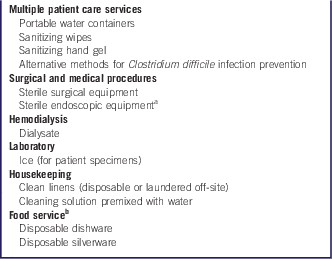
From the general hospital survey, we learned that 6 of 10 hospitals (60%) received a “Do Not Use” order (“affected hospitals”). Receipt of the “Do Not Use” order did not differ significantly according to whether hospitals were acute care hospitals (>25 hospital beds) or critical access hospitals (≤25 beds; P=0.5 by Fisher’s exact test). The 6 affected hospitals each required extra supplies in addition to water (Table 1). Multiple hospital services were affected. For example, nonemergency surgical and endoscopic procedures were unavailable at all 6 affected hospitals because equipment could not be sterilized. For emergency procedures, all 6 affected hospitals obtained equipment-sterilization services from area hospitals unaffected by the “Do Not Use” order. Affected hospitals identified alternative hemodialysis sites or potable water sources for patients requiring emergency hemodialysis. Survey responses indicated that housekeeping and food services (eg, for patients, patient visitors, or hospital staff) were also affected at 100% of hospitals that received the “Do Not Use” order. Because of potable water needs for hospital processing and cleaning, one hospital official noted this experience was a demonstration that emergency drinking water supply standards for household use (one gallon of drinking water per person per day) are not sufficient for hospitals.
Examples of Key Supplies Needed (in Addition to Drinking Water) by Hospital Services Among Hospitals Receiving a “Do Not Use” Water Order (n=6), West Virginia, January 2014

a For example, equipment for bronchoscopy, esophagogastroduodenoscopy, or colonoscopy.
b Patient meals and cafeteria services.
Among the 6 hospitals that received a “Do Not Use” order, infection control practices for Clostridium difficile (ie, handwashing) were also affected. Washing with soap and water has been found to be superior to alcohol-based sanitizing gel in reducing numbers of viable C. difficile spores,Reference Leffler and Lamont 8 so affected hospitals relied on contingency plans for C. difficile control. For example, several hospitals implemented a “buddy system” whereby one hospital staff member poured potable (bottled) water for another staff member for handwashing.
Administrators from 2 hospitals reported their preparedness planning for alternative potable water sources changed as a result of their experience with the spill. One hospital modified existing renovation plans to include a centralized water shut-off mechanism and a water-intake site where tanker trucks could deliver water. Another hospital intended to reestablish well water as a backup water supply.
DISCUSSION
This investigation’s results highlighted a variety of hospital services dependent on potable water. We found that the loss of potable water affected many aspects of day-to-day hospital operations and patient care (eg, surgery, endoscopy, hemodialysis, and infection control of C. difficile).
A compromised water supply can be caused by a variety of emergencies, such as water-main breaks, pathogen contamination, natural disasters, and manmade disasters (eg, chemical spills, radiation leaks, and bioterrorism). 3 , Reference Kamei, Kuno and Sato 5 Water is considered critical to hospital infrastructure. 4 , 9 , 10 For infection control, handwashing with water and soap has been shown to be superior to alcohol in reducing spore counts of C. difficile, a common health care-associated infection responsible for approximately 450,000 infections and 29,000 deaths annually in the United States.Reference Leffler and Lamont 8
Our report provides concrete lessons learned regarding hospital preparedness for a loss of potable water. Specifically, hospitals could enhance emergency preparedness plans for a compromise in water supply by specifying alternative sources of potable water sufficient for infection control of C. difficile, hemodialysis, surgical and endoscopic procedures, hospital processing and cleaning, food service, and drinking water. Our data complement existing guidance to help hospitals enhance emergency preparedness by having an emergency plan for continuing operations in the event of a compromise in water supply. 3 Our results could be useful to other aspects of the health care system such as long-term care facilities, which serve approximately 8 million persons in the United States annually. 11
This investigation had several limitations. Recall bias was possible. Survey responses could not be verified. Surveys were not designed to determine causality between the spill and subsequent increase in ED visits or to evaluate how the chemical spill affected patient outcomes or quality of life. Also, surveys did not ask survey respondents to quantify hospitals’ potable water needs, recall how hospital staff responded to prior water emergencies, specify alternative sources of water procured during the “Do Not Use” order, or describe survey respondents’ scope of duties during or after the chemical spill. Statistical power was limited by the investigation’s sample size. Medical facilities unaffiliated with hospitals (eg, independent hemodialysis centers, outpatient clinics, ambulatory surgery centers) were not surveyed; findings might not be generalizable to these facilities. Last, we did not conduct follow-up on how hospitals decontaminated their water distribution systems after the “Do Not Use” order was lifted.
CONCLUSIONS
In conclusion, we surveyed hospitals in the area affected by the Elk River chemical spill in Charleston, West Virginia, and found that the spill-related loss of potable water affected many aspects of patient care. Hospitals could enhance emergency preparedness plans by specifying alternative sources of potable water sufficient for infection control of C. difficile, hemodialysis, surgical and endoscopic procedures, and other hospital processing and cleaning needs (as well as drinking water).
Acknowledgments
Yolanda Sowards, Center for Threat Preparedness, West Virginia Bureau for Public Health; Suzanne Beavers, Air Pollution and Respiratory Health Branch, Division of Environmental Hazards and Health Effects, National Center for Environmental Health, CDC; Maureen Orr, Division of Toxicology and Human Health Sciences, Agency for Toxic Substances and Disease Registry; Erik Auf der Heide, Division of Toxicology and Human Health Sciences, Agency for Toxic Substances and Disease Registry.
Disclaimer
The findings and conclusions in this report are those of the authors and do not necessarily represent the views of the Centers for Disease Control and Prevention, the Agency for Toxic Substances and Disease Registry, or the West Virginia Bureau for Public Health.