Introduction
The use of gardens in urban backyards for the conservation of plant species can be a good strategy to maintain the variability of species of medicinal, ornamental or commercial interest, among others, besides instilling in urban residents the concepts on proper use and conservation of agrobiodiversity (Akinnifesi et al., Reference Akinnifesi, Sileshi, Ajayi, Akinnifesi, Moura, Linhares and Rodrigues2010).
Embrapa Cassava and Fruits has an Active Germplasm Bank (AGB) with over 700 pineapple accessions kept in the field and nearly 300 preserved in vitro, with security backups, constituting one of the largest pineapple germplasm collections in the world (Souza et al., Reference Souza, Souza, Costa, Costa, Santos-Serejo, Amorim and Ledo2012; Silva et al., Reference Silva, Ferreira, Ledo, Souza, Silva, Carvalho and Souza2016). Nevertheless, risks of losses exist both in the field and laboratory. In reaction to these problems, there is growing demand for new strategies for preservation of germplasm, ranging from cryopreservation (Souza et al., Reference Souza, Kaya, Jesus, Souza, Oliveira, Skogerboe, Matsumoto, Alves, Ledo and Jenderek2015) to conservation in urban gardens.
Few actions have been carried out to induce urban residents to plant and conserve in their backyards native species or those important to a region. Most such actions have occurred in European countries and USA, where efforts at participative conservation have obtained relevant results. These experiences demonstrate that domestic gardens are a potential reservoir of genes, of great importance to local agriculture. Furthermore, studies have sought to contemplate the management aspects that are preponderant in this type of preservation (USDA, 1998; Bailey et al., Reference Bailey, Eyzaguirre and Maggioni2009; RCS, 2009, Veteläinen et al., Reference Veteläinen, Negri and Maxted2009; Negri et al., Reference Negri, Fasoula, Heinonen, Musayev, Spataro, Veteläinen, Vögel, Maxted, Dulloo, Ford-Lloyd, Frese, Iriondo and Carvalho2012a,b; ECPGR, 2017). A study produced by the United Nations Human Settlements Program (UN-Habitat) in 2013 indicated that the urban share of the population in Latin America will reach 89% in 2050 (Alves and Marra, Reference Alves and Marra2009). This forecast reveals the need to educate urban residents about the benefits of protecting the agrobiodiversity of the species that surround and feed them, aiming to establish a model for participative preservation of natural resources (Carvalho et al., Reference Carvalho, Filho, Ritzinger and Carvalho2001).
However, there are no structured models for this type of program and the concept and format of this type of conservation need to be constructed considering the involvement of different actors, including city residents, research companies or agencies, universities and municipal officials. Validation of this new proposal is fundamental to guarantee the success of this conservation model, starting with good development and propagation of plants and ending with their maintenance in the selected gardens. The model's success depends not only on citizens’ understanding of the importance of the work but also their training to maintain the plants adequately.
Therefore, this paper describes the implementation of conservation cells in urban backyards, by recruiting urban dwellers as elements of the process and with the possibility of exploiting the use of conserved accessions. The paper discusses the different aspect that permeates this effort in 30 urban gardens in the municipality of Cabaceiras do Paraguaçú, Bahia, aiming to consolidate a complementary model for preservation and use of pineapple germplasm in partnership with urban residents.
Materials and methods
The study was conducted in Cabaceiras do Paraguaçú, located in the Recôncavo region of the state of Bahia, 160 Km from the capital (Salvador), with a population of 17,327 inhabitants according to the most recent census conducted by the Brazilian Institute of Geography and Statistics (IBGE, 2010). To establish the gardens, members of the staff of the Pineapple Germplasm Bank of Embrapa Cassava and Fruits, through a member of the community associated with our Research Institute, carried out an informal survey of city residents who already had a tradition of growing local species in their backyards, asking about their interest in taking part in the Pineapple Conservation Project. Those who expressed interest were invited to attend a meeting, including a visit to the facilities of the Germplasm Bank, where the project was explained. Then an initial questionnaire was applied to ascertain whether the prospective participants satisfied the basic requirements: ownership of an urban property; availability of a suitable area and water resources; and interest in the work and understanding of its importance. The result allowed selecting 30 guardians. Next another questionnaire was administered to learn the profiles of those selected and to contribute to the establishment of the model, by eliciting the following information: home and street infrastructure (electricity, piped or well water, paving); number of persons in the household; number of children per household; schooling level of the owner; work aspects (working hours, professional occupation, sector); and gender. In this evaluation, we also considered aspects related with the care of the gardens: a person who takes care of the yard; the level of yard care; and interest in participating and understanding of the Project.
Thirty accessions were selected from the Pineapple AGB, encompassing four botanical varieties of the genus Ananas (A. comosus (L.) Merr. var. ananassoides (Baker) Coppens & F.Leal, A. comosus (L.) Merr. var. bracteatus (Lindl.) Coppens & F.Leal, A. comosus var. comosus (L.) Merr., A. comosus (L.) Merr. var. erectifolius (L.B.Sm.) Coppens & F.Leal) and one Ananas sp. accession. The accessions were introduced in the gardens in two steps, with 15 being planted in August 2014 and the other 15 in January 2015, and with three different accessions of three plants in each garden, where each accession was repeated three times across the 30 gardens. The three repetitions were planted in separate backyards, to reduce the risk of total loss of the accession or all the plants in a yard.
Each guardian was responsible for three different accessions, for a total of nine plants in each garden. The experimental design was completely randomized, with nine plants, from three accessions and three different botanical varieties, for a total of 30 backyards. Within the preserved accessions, plants were chosen belonging to different botanical varieties or that were easily distinguishable, in case of loss of the identification tag of each plant by the guardian. The choice of accessions gave priority to those already characterized for various purposes, and that would attract the interest of the guardians due to their characteristics: local varieties resistant to fusariosis, accessions with ornamental potential or containing fibres with qualities needed for handicrafts, among other parameters.
Of the selected accessions, five belong to the variety Ananas comosus var. ananassoides (AGB-025, AGB-323, AGB-377, AGB-465, AGB-651); five to the variety A. comosus var. bracteatus (AGB-35, AGB-408, AGB-495, AGB-584, AGB-690); 17 to A. comosus var. comosus (AGB-001, AGB-016, AGB-137, AGB-139, AGB-159, AGB-194, AGB-298, AGB-341, AGB-344, AGB-397, AGB-413, AGB-432, AGB-556, AGB-673, AGB-758, AGB-759, AGB-772); two to A. comosus var. erectifolius (AGB-804, AGB-820); and one to Ananas sp. (AGB-507). With respect to the uses of each botanical variety, we can mention the ornamental potential of A. comosus var. ananassoides, A. comosus var. bracteatus and A. comosus var. erectifolius, since they stand out for the beauty of their stems with fruits or mini-fruits (Souza et al., Reference Souza, Cabral, Souza, Santos, Santos-Serejo and Ferreira2007, Reference Souza, Souza, Costa, Costa, Santos-Serejo, Amorim and Ledo2012). The variety A. comosus var. erectifolius, besides ornamental potential, stands out for its production of high-quality fibre with potential uses in a range of industrial segments and for handicrafts, as demonstrated by several articles (Sena Neto et al., Reference Sena Neto, Araujo, Barboza, Fonseca, Tonoli, Souza, Mattoso and Marconcini2015; Souza et al., Reference Souza, Ferreira, Souza, Sena Neto, Marconcini, Ledo and Souza2017). Finally, A. comosus var. comosus has edible fruits with good organoleptic properties that can be eaten fresh or processed into jellies and compotes.
The areas in the backyards for planting the garden were prepared under the guidance of the project's curator and were monitored by an agricultural technician, according to the technical recommendations for the culture (Reinhardt et al., Reference Reinhardt, Souza, Matos, Sanches, Cabral, Cunha and Souza1998). The guardians received a kit containing an illustrated manual to identify pests, diseases and nutritional deficiencies of pineapple plants (Matos et al., Reference Matos, Sanches and Souza2010), specific fertilizers and a technical circular describing the basic care for the plants, to make them as independent as possible. The plants were identified with tags affixed to small stakes next to the plants.
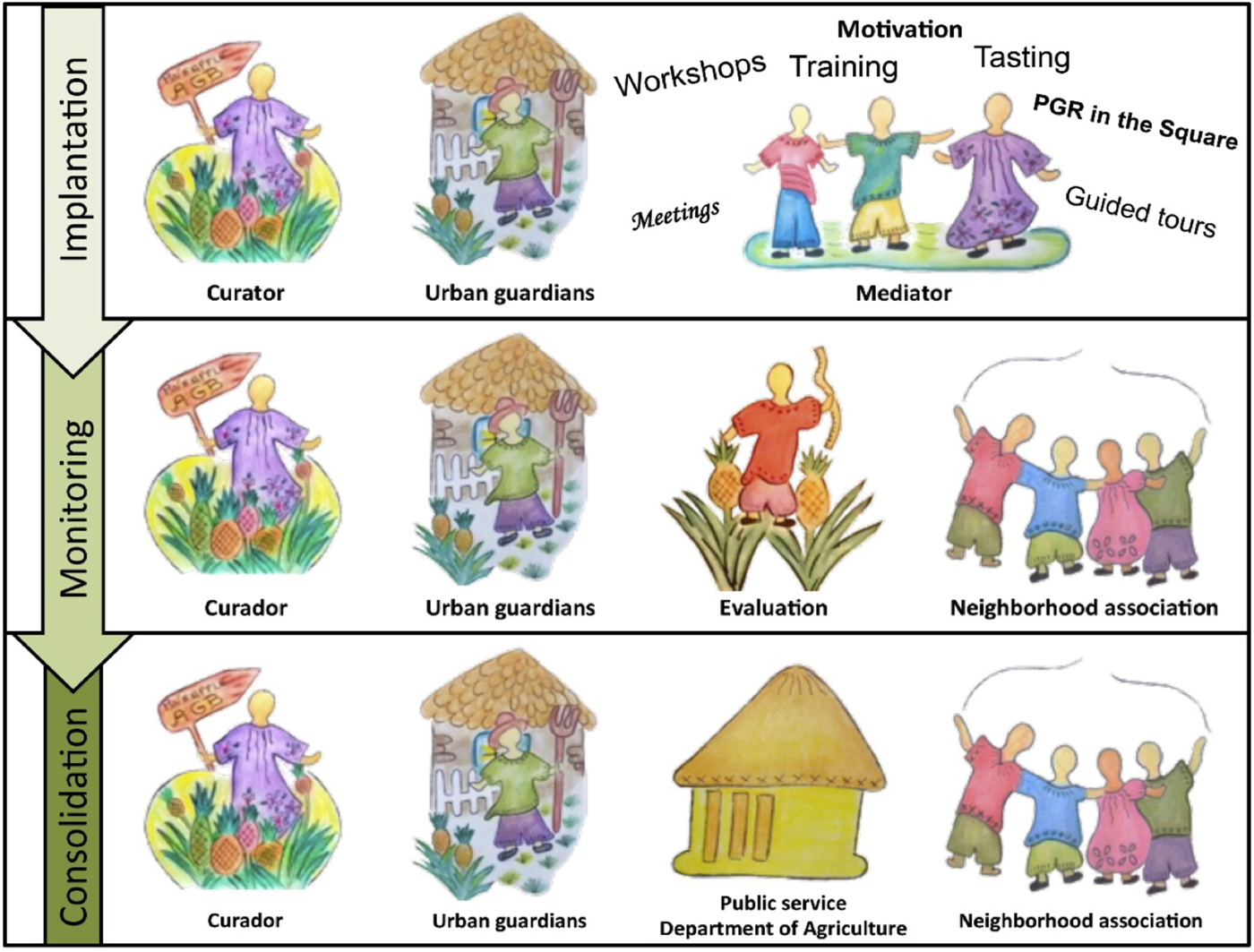
The work involved various actors, necessary for consolidation of this strategy, as depicted in Fig. 1. Besides the technical aspects, the project demanded motivational activities and the search for participants and partners among entities of the Cabaceiras do Paraguaçú municipal government and the Rural Association of Cabaceiras do Paraguaçú – Bahia (ARCACAP).
Actors involved in the different steps of implementation and consolidation of the urban conservation gardens. Illustrations: Fernanda Vidigal Duarte Souza.

The plants were monitored during two complete cycles. A full cycle ranges from the initial planting to the formation of the fruit, which takes approximately 18 months (accompanied with instructions on how to renew the cultivation). During the evaluations, we also tried to infer the level of satisfaction of the guardians and the care of the gardens, by applying a second questionnaire and engaging in informal conversations. All the evaluations were concluded in March 2017. Gardens were considered to be well tended when there was: regular weeding; watering at least three times a week; fertilization as necessary; and no loss of plants or accessions due to failure to follow the basic care recommendations.
The urban gardens were evaluated according to the following quantitative and qualitative descriptors: plant height (cm), length and width of leaf ‘D’ (cm), length of the peduncle (cm), length and diameter of the inflorescence (cm), length and diameter of the syncarp (cm), length and diameter of the crown (cm), shape of the syncarp, habit of the plant, spine presence and variegation.
The gardens were visited monthly to verify flowering and the general condition of the plants. The data were tabulated and compared with morphological characterization data obtained in the field of Embrapa Cassava and Fruits, where accessions of the Pineapple AGB are maintained, as reported by Souza et al. (Reference Souza, Souza, Costa, Costa, Santos-Serejo, Amorim and Ledo2012). The data were analysed by mixed principal component analysis with the PCAmixdata package of the R program (Chavent et al., Reference Chavent, Kuentz, Labenne, Liquet and Saracco2017). The significance of the cophenetic correlation was calculated by the Mantel test (10,000 permutations).
Results
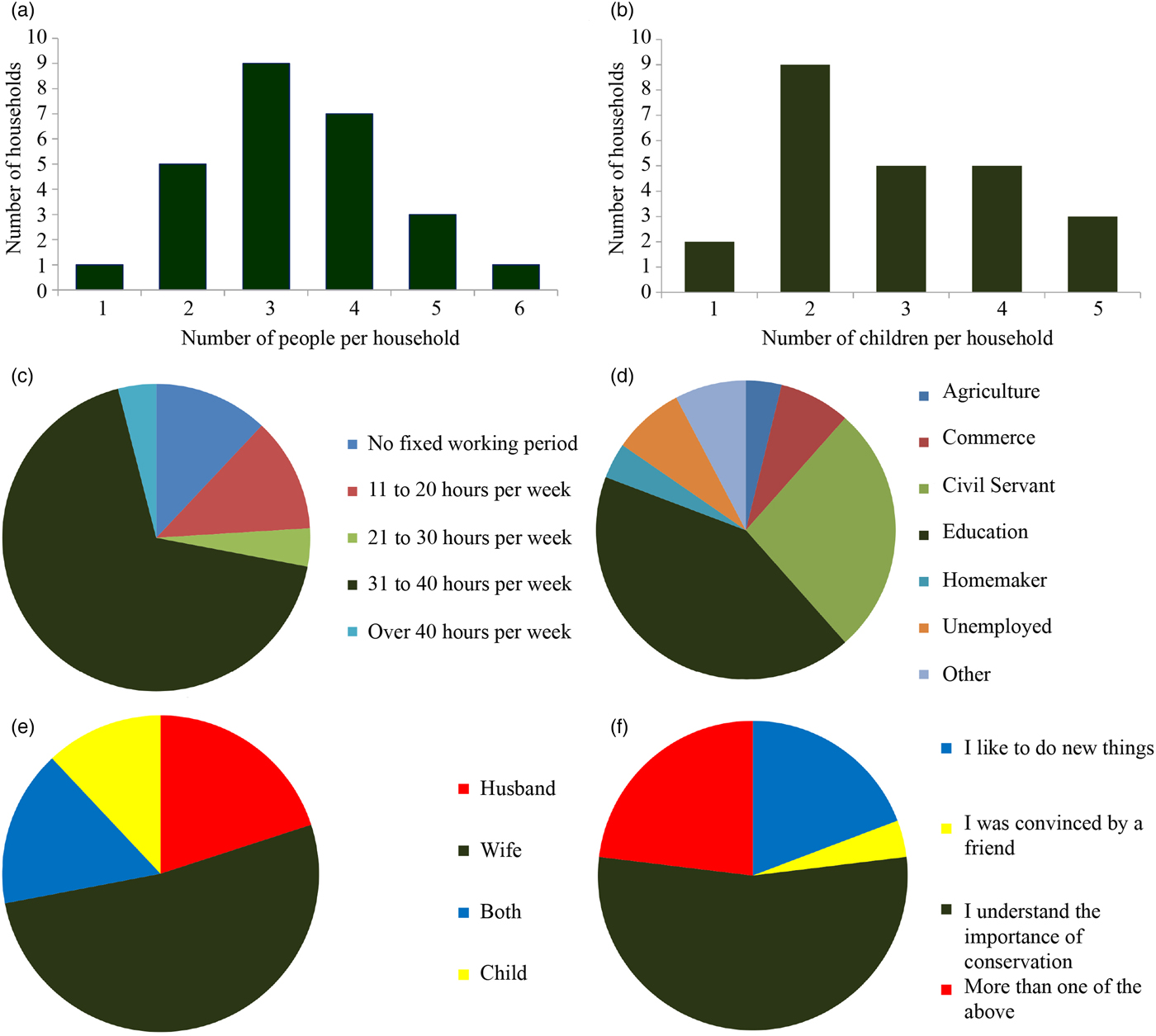
Based on the initial criteria established, of having adequate infrastructure (property ownership, availability of a suitable area and water resources), we selected 30 homeowners as guardians also due to their good understanding of the importance of the program. The results of the questionnaire given to evaluate their profiles showed that 100% of the homes had electricity and access to piped or well water; 75% of the streets were paved; the majority of households were small, varying from one to four people, with only one household having six members (Fig. 2(a)). The number of children per household varied from one to five, with the great majority having two children (Fig. 2(b)).
Graphs presenting the socioeconomic aspects of the owners of the homes with urban gardens; (a) number of people per household; (b) number of children per household; (c) working period of the homeowners; (d) occupation/profession of the homeowners; (e) participation of each member of the household in caring for the urban garden; (f) motivation for participation in the project to preserve pineapple germplasm in urban gardens.

With respect to occupational aspects, 75% of the guardians worked up to 40 h a week (Fig. 2(c)), and more than 50% worked as educators, 25% were civil servants and the other 25% were engaged in sectors like agriculture, commerce or ‘homemaker’, among others (Fig. 2(d)). With respect to gender, 95% were women, although the care of the accessions involved several people in most households in 15% of the cases, the gardens were tended by children, 20% by men and more than 50% by women (Fig. 2(e)). When asked about their interest in the project, 60% of the participants stated they understood the importance of conservation, 15% were motivated by liking to do new things and the remaining 25% were prompted by both reasons (Fig. 2(f)). With respect to the quality of the care for the gardens, 75% were very well-tended, 15% well-tended, 5% reasonably cared for and 5% were neglected.
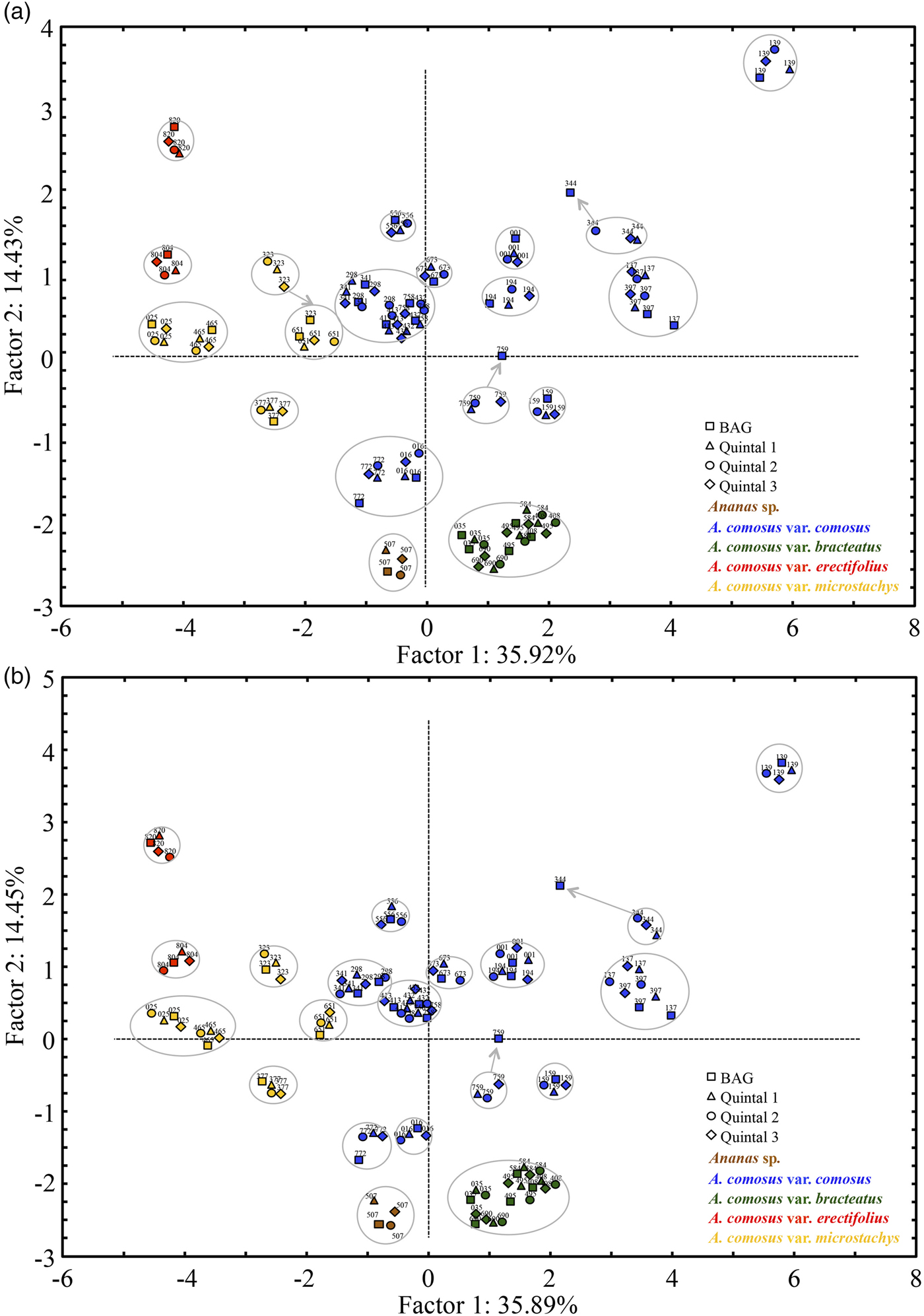
Regarding the morphological characterization, in both cycles, the qualitative and quantitative characteristics were considered, as represented by Fig. 3(a) and (b) and online Supplementary (Tables S1–S4). The significance of the correlation obtained by the Mantel tests was r = 0.87, demonstrating the similarity and stability between cycles 1 and 2.
Mixed principal component analysis of the quantitative and qualitative data of the accessions evaluated in the urban residential gardens and the facilities of the Pineapple Active Germplasm Bank. (a) Grouping of accessions characterized in the first growing cycle. (b) Grouping of accessions characterized in the second growing cycle.

As can be seen in Fig. 3(a), the same accessions, whether from the AGB or residential gardens, formed groups, with only a few exceptions. In the case of accessions AGB-323, AGB-344 and AGB-759, the values of variables such as height and length of leaf ‘D’ varied between the gardens and AGB, indicating the responsibility of these aspects for the results obtained. For accession AGB-323, the plant height values were greater than in the AGB, while for the length of leaf ‘D’, the residential garden plants had larger mean values than the plants kept at the AGB facilities. For AGB-344, the plants in the gardens were taller than those in the AGB. In turn, for accession AGB-759, the mean heights of the plant and length of leaf ‘D’ were greater in the plants of the AGB
With respect to the second cycle of assessments, all of them formed groups in function of the botanical variety, except for accession AGB-507, which was not grouped in any of the varieties, because it is an Ananas sp. Accessions of Ananas sp. are difficult to classify taxonomically in the genus because they have traits that are common to A. comosus var. ananassoides and A. comosus var. parguazensis, but without being classified in either of those varieties (Souza et al., Reference Souza, Souza, Costa, Costa, Santos-Serejo, Amorim and Ledo2012). In relation to the uniformity of the accessions, in the second cycle (Fig. 3(b)) only AGB-759 and AGB-344 (from the gardens) were distant regarding the length of leaf ‘D’.
Discussion
The profile of the guardians is relevant for the successful implementation of any participatory conservation program like this one. Therefore, the application of the questionnaires to learn details of their profile was an important step. It revealed that the people involved had a good level of schooling, understood the importance of germplasm and its conservation, had the interest and skills necessary for proper care of the plants and had residences with the minimum necessary infrastructure.
Besides providing knowledge about the profile of the guardians, this initial evaluation was fundamental to plan additional strategies and direct the actions necessary for more efficient conservation, considering some aspects observed.
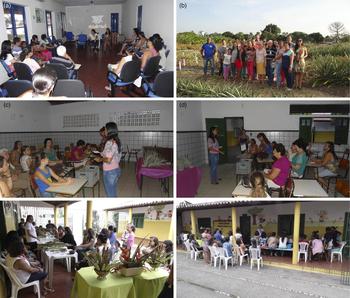
The project was implemented together with the homeowners, considering their opinion on the location of the accessions in the gardens, as well as how to plant them. Two meetings were held with the guardians in the implementation phase, as well as a visit by them to the facilities of the Pineapple AGB of Embrapa Cassava and Fruits (Fig. 4(a) and (b)), with the purpose of supplying them with the necessary information for good understanding and progress of the work.
Actions to motivate the urban pineapple guardians. (a) Meeting with the curator, mediator and urban guardians to present the culture and its potential. (b) Technical visit of the guardians to the facilities of the Pineapple Active Germplasm Bank of Embrapa Cassava and Fruits. (c) and (d) Event to test some accessions planted in the urban gardens. (e) and (f) Workshop on floral arrangements with ornamental pineapple varieties.

The developments of a project like this one can affect city's panorama with respect to quality of life and conservation of genetic resources that are important for the region's agrobiodiversity.
The morphological characterization carried out in the two cycles was mainly due to the need to see how the accessions were responding to the local edaphoclimatic conditions, including quantitative characteristics, since learning about these traits was one of the objectives of the program. This revealed that the accessions were homogeneous and stable compared with the accessions maintained at the AGB previously characterized by Souza et al. (Reference Souza, Souza, Costa, Costa, Santos-Serejo, Amorim and Ledo2012).
The losses of plants or accessions were minimal (15 plants, three of which were replaced) and were generally due to the fact that some plants did not develop well. This may have occurred due to the response of an accession to changes in environmental conditions since in the field of Embrapa Cassava and Fruits the accessions are irrigated, fertilized and monitored by technicians with specific training for the culture.
The plants that died at the start of forming the gardens were replaced, which occurred with one lot (three plants) of accession AGB-25 in one of the gardens. One month after planting, these plants showed symptoms of Pineapple Mealybug Wilt-associated Virus (PMWaV). In the case of accessions AGB-465 (2), AGB-584 (2) and AGB-820 (2), the plants showed symptoms of the virus during the flowering and fruiting period. The fruits did not develop adequately and the plants died at the end of the cycle. However, the monthly visit by the evaluator to the gardens enabled detection and replacement of the three plants of this accession with healthy ones, which also prevented the dissemination of the virus to the other accessions. In turn, the plants of accessions AGB-159 (3) and AGB-344 (3), in different gardens, were lost after flowering because, despite the guidance and monitoring, the guardians did not care for the plants properly curing the cycle.
Of the 30 gardens planted, only three no longer existed at the end of the second cycle, after the conclusion of the evaluations, because the guardians decided to remodel their homes, involving the construction of walls or paving of backyards, making it impossible to maintain the accessions. In a strategy of this nature, risks exist that cannot be ignored, such as the death of homeowners, sale or remodeling of the house, losses of some or even all the accessions in a given garden caused by inadequate care, pests or diseases, among other causes.
In this work, the losses of plants of some accessions were minimal and were overcome by the experimental design used or by replacement of dead plants. The experimental design, whereby each accession was distributed in three different gardens, prevented total loss of any one accession. Likewise, the regular monitoring by the technicians and curator allowed early identification of problems and their solution, considering the implementation of a permanent model. Some aspects are crucial, both to minimize the risks of losing accessions and laxity by the guardians, who need to be consistently committed to the program. In this respect, the long growing cycle of pineapple plants can be considered a negative feature. The development of a model for this conservation strategy should involve the government, which can act as a partner in the initiative by creating incentives for citizens to preserve biodiversity, to strengthen and maintain this practice with native plants and crops important to the region. In this pilot project, we formed working arrangements with the Municipal Secretariat of Agriculture and a farmer association, which were very important to promote the awareness and motivation of the guardians.
Some specific actions were taken to solidify the commitment and motivation of the guardians, such as workshops to demonstrate floral arrangements with ornamental pineapple plants (Fig. 4(e) and (f)), a pineapple tasting party, with appetizers made from local varieties (landraces) belonging to the collection of Embrapa, and distribution of seedlings of these varieties for larger-scale planting (Fig. 4(c) and (d)). Those strategies were highly relevant because they allowed a good understanding of the potential uses of the conserved accessions. Ornamental use, for example, was a novelty among the guardians and is now being better exploited. We also sought to establish a range of accessions in the home gardens to enable the guardians to experience the different uses and obtain extra income from their efforts. The city has a street market that attracts buyers and sellers from the region, giving the guardians a chance to sell products, including ornamental potted plants, fresh and processed fruits and handicrafts. Besides this, the partnership with the municipal government and local farmer associations, an ongoing step of the project, aims to supply seedlings in large quantity to the guardians who want to become small producers, providing a chance to earn extra income over the long run.
The results obtained allow concluding that a model for conservation in partnership with urban residents is workable, although certain adjustments will always need to be made. Two aspects that should be considered are the regular monitoring by the curator and the establishment of partnerships with local officials and associations. Therefore, work is now being done to identify new guardians and introduce new accessions, to continue and expand the program with new conservation cells. At the end of the project, a party was held with all the guardians, who received a certificate of recognition as ‘Urban Pineapple Guardian’ and a keepsake with the symbol of the project. In particular, most of the people involved in the project are motivated to expand cultivation of some accessions for commercial purposes, to increase household income. Finally, the success has attracted interest by other people in the community in the conservation of plant genetic resources, many of whom have expressed interest in joining the project.
Supplementary material
The supplementary material for this article can be found at https://doi.org/10.1017/S1479262118000114
Acknowledgements
The authors would like to thank the support from the Coordenação de Aperfeiçoamento de Pessoal de Nível Superior (CAPES/ Embrapa) for the scholarships granted.