Introduction
Pasture poultry was the traditional poultry farming system for a long time, but this practice began to be replaced during the 1960s due to low average costs (O'Bryan et al., Reference O'Bryan, Crandall, Davis, Kostandini, Gibson, Alali, Jaroni, Ricke and Marcy2014). Pasture poultry is an agricultural system that allows natural animal behavior and positive environmental outcomes. During the production, animals are not confined to restricted facilities, have more surrounding space, and stay outside during their growth.
In general, poultry processing is done on-farm with a traditional stationary plant or with a mobile processing unit (MPU). Alternatively, it can be processed off-farm, usually in the United States Department of Agriculture (USDA) inspected facility.
On-farm processing combined with the pasture poultry practice has been addressed as an eco-friendly alternative to ultra-efficient industrial meat production and as a good example of ‘moral economy’ (Follet, Reference Follet2009) involving only farmers and consumers. Some criticism of this practice has been made because free-range and organic meat products may have more negative environmental impacts than other meat products, since more methane is produced (Tidwell, Reference Tidwell2010). Pasture poultry growers face several other challenges. Potential buyers, on average, belong to a higher income class, but their number is limited by proximity to farms (Wolfe and Best, Reference Wolfe and Best2005). In many cases, the selling price for pasture poultry that is processed on-farm is lower than the selling price for poultry processed at USDA-inspected facilities. This reduces its value. In addition, in most cases the nearest off-farm processing facility is located several miles away, and small-scale farmers struggle to find a cost-effective way to process their birds due to transaction and search costs.
In this context, the MPU is a processing option that provides several advantages. It implies a lower environmental impact since the production can be realized in a small area, and it does not require a slaughtering facility. In addition, even if it does not pass through USDA inspection, it has to pass the state inspection. This should provide a higher selling price. Moreover, the MPU can easily reach a greater number of small farmers. However, little is known about the profitability of MPUs.
This study provides additional insights on the profitability and feasibility of MPUs. First, an analysis of the pasture poultry market in Arkansas, Georgia, and Louisiana is provided. Secondly, this study compares the economic feasibility of the MPU with two alternative processing technologies, on-farm processing with a stationary plant (traditional processing) and off-farm processing at a USDA-inspected facility. Thirdly, this paper assesses the economic feasibility of the MPU with respect to different scenarios, economies of scale, and financial costs.
The rest of this paper is divided into five sections. The section ‘Background and Literature Review’ introduces the methodology employed to assess the economic feasibility. The section ‘Methodology’ analyzes per-bird profit. The section ‘Budget Assessment’ compares the MPU budget with other processing options. The section ‘Income Feasibility of the MPU in Different Scenarios’ investigates the economies of scale, financial costs, and alternative uses of the MPU. ‘Conclusions’ are drawn in the last section.
Background and Literature Review
Georgia is the largest poultry producer in the USA (United States Department of Agriculture, 2014a). In 2013, 1,334,600 thousand birds were produced. Arkansas follows with 996,400 thousand birds (United States Department of Agriculture, 2014a) and Louisiana with 211,000 thousand birds (Louisiana Agricultural Center, 2011). In 2012, the number of poultry farms was 6340 in Georgia, 6089 in Arkansas, and 2733 in Louisiana (United States Department of Agriculture, 2014b). Regarding processing facilities in the USA, over 99% of the slaughter for any species is under federal inspection (United States Department of Agriculture, 2015). In the USA in 2012, approximately 300 plants slaughtered poultry under federal inspection. In 2012, there were 23, 32, and 4 poultry facilities in Georgia, Arkansas, and Louisiana, respectively (Watt Poultry Directory, 2012). The regulatory regime for poultry processing is different in each one of these three states (Niche Meat Processor Assistance Network, 2012).
Arkansas does not have a state poultry inspection program and accepts federal exemptions between 1000 and 20,000 processed birds per year. No license is required to process poultry. In addition, Arkansas follows the federal requirements sanitation system for the processing facility (Niche Meat Processor Assistance Network, 2012).
Similarly, Louisiana accepts federal exemption for poultry processing, but anyone interested in processing poultry under an exemption must obtain a letter from the Louisiana Department of Agriculture and Forestry acknowledging the exemption that falls under their operation. If the poultry facility is not exempted, Louisiana has a state poultry-inspection program, administered by the Louisiana Department of Agriculture and Forestry's Meat and Poultry Inspection Program, as authorized by the Louisiana Meat and Poultry Inspection Law. As with Arkansas, Louisiana follows the federal regulation in terms of sanitation.
In 2003, Georgia sought to establish its own poultry inspection program covering the processing and sale of poultry products within the state (Georgia Organics, 2011). As part of that process, Georgia deleted most of the federally-recognized exemptions from the inspection requirement. Apart from the exemption for processing less than 1000 birds per year, Georgia does not recognize the USDA exemption to process between 1000 and 20,000 birds per year, and it requires performing a state inspection. Despite this, Georgia has not established a state-run inspection program to date. Thus, the certain option for a farmer who processes between 1000 and 20,000 birds per year is to sell the products directly to customers on the farm (Georgia Organics, 2011).
Several recent studies have been conducted on the economic feasibility of the MPU. Ennis et al. (Reference Ennis, Jefferson-Moore and Bynum2008) studied the economic feasibility of MPUs with respect to different economies of scale and different financial scenarios. They found that financial feasibility depends on the cost of capital and the leverage ratio (total debt/total equity).
O'Bryan et al. (Reference O'Bryan, Crandall, Davis, Kostandini, Gibson, Alali, Jaroni, Ricke and Marcy2014) analyzed the MPU cost-effectiveness for small-scale farmers. They found that even the most expensive MPU is more profitable than other traditional on-farm options such as brick-and-mortar facilities.
From another point of view, Hilimire (Reference Hilimire2012) investigated pasture poultry profitability by interviewing California poultry producers. She found that the most common challenge for pasture poultry farmers was the predation of birds and higher cost of feed. However, 50% of farmers were cost-effective and 78% of them stated that additional profits came from the savings on fertilizer and pest management.
Wolfe and Best (Reference Wolfe and Best2005) focused on the economic feasibility of MPUs for large-scale production (20,000 birds per year). They found that increasing the number of processed birds drastically decreased the cost per bird. However, after accounting for all the costs, the per-bird profit was quite small (US$1.48 per bird.)
Van Loo et al. (Reference Van Loo, Alali, Welander, O'Bryan, Crandall and Ricke2013) conducted a survey of 82 poultry farmers in Georgia. They found that the percentage of farmers interested in on-farm processing was approximately equal to the percentage of farmers interested in off-farm processing (22 and 24%, respectively). The latter processing option scored better than the former, but the farmers interested in on-farm processing favored MPUs over a stationary processing plant. Thus, limited evidence suggests that the MPU is economically feasible, but its profitability may be low, especially when compared with the other processing options.
Methodology
To investigate the economic feasibility of MPUs we drew from two sources: a literature review and a survey from 29 farmers in Georgia, Louisiana, and Arkansas. An online survey was administered to more than 100 small poultry farmers in the three states. The online survey was sent to farmers through Southern Sustainable Agriculture Research and Education as well as through extension personnel at the University of Georgia and University of Arkansas. Because of this, we are unsure of the number of farmers reached by the survey. In addition, we did not have prior information on the characteristics of farmers reached, but, generally, they were small-scale farmers.
We compared the MPU option with the two main processing alternatives: on-farm processing with a stationary plant (traditional processing) and off-farm processing at a USDA-inspected facility. We did not compare the results with off-farm non-USDA inspected facilities for two reasons. First, from the survey, data were limited; only one respondent used a non-USDA inspected facility. Secondly, since the USDA inspected facility option allows, on average, a higher selling price, comparing this processing technology with the MPU alternative makes the budget assessment more appealing.
The analysis is focused on small-scale farmers because the MPU option is generally better suited for low production. For instance, from the survey the average number of processed birds per year was 944. In addition, costs, revenues, and profits were analyzed as per-bird values. The advantage of this approach is to make interpretation and comparison easier among different scenarios.
Budget Assessment
In order to assess the economic feasibility, we divided the budget in four parts: initial investment, production cost, processing cost, and revenue. In this study, the initial investment was the fixed cost required for the processing stage. The production cost was defined as the variable cost to acquire and raise birds; the processing cost corresponded to the variable expenses necessary to transform the raised chicken into product ready to be sold, and the revenue was the selling price per bird.
Initial investment
The initial investment was defined as the fixed cost necessary to process birds. Two alternative on-farm processing systems were considered in this study: MPUs and the stationary plant. In general, choice of which processing system choice was affected by scale. For small-scale production, if the number of processed birds per year is less than 20,000 units and if the product is sold inside the state borders, USDA inspection is not required in several states. In those cases, the farmer has the option to choose between two alternative systems: the traditional stationary on-farm plant and the MPU.
There are four ways to use a MPU: buy a new one, build a new one, buy a used one, or lease one. The price of buying a new unit is mainly affected by the technical characteristics of the unit. One distinction is between enclosed and open-air units. The main advantage of the enclosed unit is that it can operate during adverse weather conditions and it has a higher processing capacity. According to Cornerstone Farm Venture (2014), a farm venture active in this sector, the cost of a traditional enclosed MPU currently ranges around US$100,000. By contrast, the selling price for a new open-air unit is US$29,284 (O'Bryan et al., Reference O'Bryan, Crandall, Davis, Kostandini, Gibson, Alali, Jaroni, Ricke and Marcy2014). However, different solutions are available. A mini-poultry unit can be purchased for US$10,000, while a basic enclosed unit starts from US$45,000 (Cornerstone Farm Venture, 2014). The maximum processing capacity of an MPU is the same for a mini-poultry unit and for a basic unit (200–250 birds per hour under optimal labor and equipment conditions (Cornerstone Farm Venture, 2014)). However, a mini MPU is less equipped than a basic unit. For instance, it may contain the cones, the scalder, and the plucker, but usually requires equipping for the eviscerating table, the chill tanks, and the packing station. In addition, it is much smaller and makes labor conditions more complicated.
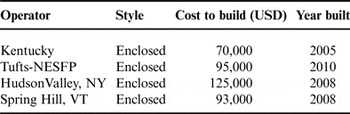
With regard to the cost of building an MPU, McDonald and Mills (Reference McDonald and Mills2012) indicated that fixed development cost (study case Montana) was US$46,000 for 3000 processed birds per year. This value comprises the truck expense of US$18,000, trailer expense of US$7000, equipment expense of US$20,000, and fabrication expense of US$1000. However, the building cost varies substantially (see Table 1).
MPU building cost—processing capacity 200 birds per hour.

Source: O'Bryan et al. (Reference O'Bryan, Crandall, Davis, Kostandini, Gibson, Alali, Jaroni, Ricke and Marcy2014).
Leasing a MPU can have some economic advantages. According to O'Bryan et al. (Reference O'Bryan, Crandall, Davis, Kostandini, Gibson, Alali, Jaroni, Ricke and Marcy2014) leasing appears to be the most cost-effective strategy, especially during the start-up stage if the farmer is not able to afford the expenditure to buy or build a new unit. In addition, although leasing a unit requires the interest payment, the risk of failing is lower because the lender bears responsibility for any deterioration and decrease of value. For instance, Spring Hill Poultry Processing agreed to lease-to-own a unit at a rate US$9300 per year; the cost to build/purchase a new unit was therefore recoupable in about 10 yrs (investment US$93,000). In contrast, the Cornerstone Farm Venture (2014) rented a mini MPU with a value of US$10,000 for US$85 per day. Other options consist of renting the unit on the basis of the number of processed birds. Kentucky Extension Service America's Research Based Learning Network (2013) reported renting an MPU for US$0.75 per bird.
Another competitive option, especially for small-scale farmers, can be buying a used MPU. In 2012 the Vermont Agency for Agriculture, Food, and Market sold an MPU for US$61,000; the original price in 2008 was US$93,000.
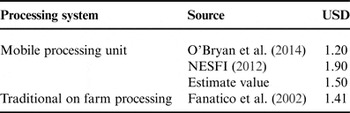
In general, the large price variability does not allow determining a priori which option is more profitable (New Entry Sustainable Farming Project, 2012). In the following analysis we assume an average initial investment of the MPU equal to US$75,000 for 10,000 processed birds per year and a 5 yr of lifespan for the unit. Notice that this corresponds to US$1.50 per bird. O'Bryan et al. (Reference O'Bryan, Crandall, Davis, Kostandini, Gibson, Alali, Jaroni, Ricke and Marcy2014) estimated the initial investment to be between US$0.50 and 2.25 per bird, with an average value equal to US$1.20, plus miscellaneous expenses like maintenance and customization. The New England Small Farm Institute (NESFI) (2012) reported a cost of US$1.90 per bird.
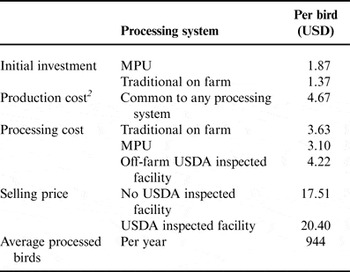
Our survey also provided values in the same range. The initial investment in an MPU was US$14,000 for an average processing capacity equal to 1500 birds per year. If we assume a 5 yr lifespan of a mobile unit, this is equal to US$1.87 per bird. Table 2 shows the average values from the survey answers.
Per bird initial investment cost.

Regarding the traditional on-farm processing option, Fanatico et al. (Reference Fanatico, Redhage, Schuck, Knoblauch, Green and Saylor2002) found the initial investment to be US$1407.63 for raising 999 birds per year, or US$1.41 per bird (in 2013 dollars). These costs include the following elements: brooder house, processing building, processing equipment, pens, composter, brooder waterer/feeder, brooder, and a dolly to move the pens.
The initial costs of the traditional processing option were also assessed in our survey. We asked farmers: ‘What was the initial facility and equipment investment for on-farm processing?’ The survey answers ranged from US$0.33 per bird to US$5.00 per bird, with an average fixed cost for a traditional on-farm processing plant of US$1.37 per bird. Five years were chosen as a benchmark of the average depreciation time of the both processing options (MPU and stationary plant). The per-bird value was calculated assuming that 5 yrs is the average useful economic life of any fixed plant and/or equipment as considered by many in the industry. Table 2 summarizes the per bird initial investment for the MPU and the traditional on farm processing option.
In general, the production stage also requires an initial investment. The initial investment related to the production stage comprises the fixed costs necessary to raise the birds: brooder houses, pens, baths, and fences. These costs are independent from processing costs and can be characterized by two aspects. First, they are common to any processing technique since each farm needs to be equipped for raising birds. Secondly, these costs are quite small and their depreciation rate is high. Consequently, they will be incorporated directly in the production cost.
Variable production costs to acquire and raise birds
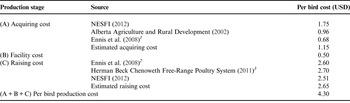
Production costs are variable expenses necessary to acquire and raise birds and they are common to any processing technology. The cost to acquire birds is the cost that the farmer has to pay to the supplier to buy chicks. The NESFI estimated the purchase price unvaccinated for chicks to be US$1.75 per bird. Ennis et al. (Reference Ennis, Jefferson-Moore and Bynum2008) estimated US$0.68 per bird (US$684.00 per 1000 birds), and the Alberta Agriculture and Rural Development (2002) considered an average price equal to US$0.96 per bird. In our analysis we consider the average purchase cost equal to be US$1.15 per bird as summarized in Table 3.
Literature review of the per bird production cost for pasture poultry.

1 Assumed 130 chicks.
2 Assumed 1000 chicks.
3 Assumed 240 chicks.
The published research provided a quite large range regarding the cost to raise birds. The NESFI evaluated feeding cost equal to US$0.13 per pound, expected weight loss equal to 70% of the gross weight, expected dressed weight equal to 4.5 pounds, and feed conversion ratio equal to three. This is equivalent to US$2.51 per bird.
The Herman Beck Chenoweth Free-Range Poultry System (2011) estimated the total cost to raise birds equal to US$648 per 240 birds (US$2.70 per bird). The raise cost involves brooding expenses, transfer expenses to move the chickens to the skid and from the skid to the farm, labor cost, and feed. In (Ennis et al., Reference Ennis, Jefferson-Moore and Bynum2008), the cost of feed was US$2520 per 999 birds (US$2.60 per bird). The authors considered a weight loss of 75% and a feed conversion ratio of 3.33. We estimated the per-bird cost to raise chickens, labor included, at US$2.65. Table 3 summarizes the estimates.
In addition, facility cost involves all the necessary expenses related to the production stage and that require a fixed, even if small, investment. These costs include brooder house, pens, production equipment, baths, brooder waterer/feeder, and fence. The total investment in these components is small, around US$500.00 for 1000 processed birds per year. Since the pasture operation is made three times per year (not during the winter, Ennis et al., Reference Ennis, Jefferson-Moore and Bynum2008), the depreciation rate of these small tools is quite high. Consequently, we considered the facility cost for the production stage equal to US$0.50 per bird. Notice that we did not consider the land cost. In general, the per-bird cost is small, especially in comparison with the entire life cycle of the unit. For instance, 1000 processed birds per year, a 3-month raising cycle, 0.25 square meter module per pasture chicken, and US$4250 per acre farm/ranch price (Land Watch Georgia, 2013) imply a land cost equal to US$0.19 per bird. Moreover, at the end of the investment cycle we assume that the land can be resold at the same value as the purchase price. Table 3 summarizes per-bird production cost that is US$4.30 from the literature review, comprising US$1.15 for the acquisition cost, US$2.65 for the raising cost, and US$0.50 for the facility cost.
Regarding the survey, 29 famers answered the following questions: ‘How many birds do you raise in a year?’, ‘How much is your total cost of production?’, ‘How much do you pay the hatchery per chick?’, ‘How much is the annual feed cost?’, and ‘How much are the annual expenses to raise all the birds acquired this year (labor, veterinary, breeding medicine, utilities, insurance, maintenance, and any other necessary expenses to raise birds)?’ The per-bird cost, including raising the chicks, ranged between US$1.00 and 6.67 and the average value was US$4.67 (Table 4).
Pasture poultry cost, selling price, and processed birds 1 .

1 Source: Farmer survey.
2 Cost for acquiring and raising birds.
Variable processing cost
The variable processing cost is the cost necessary to process the raised chickens into food products ready to be sold. This section is different for each processing alternative.
Regarding the MPU option, the maximum potential processing capacity is quite different from the real processing capacity for small-scale farmers. According to the Cornerstone Farm Venture (2014), a farm venture active in poultry processing machineries, the maximum processing capacity for a traditional MPU (US$100,000 purchase cost) is 200–250 birds per hour. The New Entry Sustainable Farming Project (2012) considers an optimistic processing capacity equal to 204 birds per hour and a more realistic processing capacity equal to 144 birds per hour. These values represent the potential maximum capacity of an MPU, but they cannot be considered a benchmark for small-scale farmers. In general, there are specific limitations to processing capacity. For instance, in Massachusetts the regulators set the daily legal maximum processing capacity at 400 broilers for the MPU (New Entry Sustainable Farming Project, 2012).
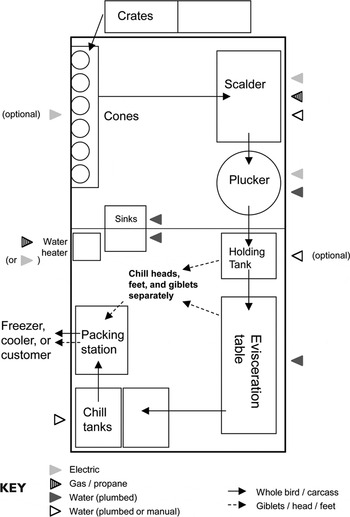
There are also technical limitations. Bottlenecks during processing are basically four (New Entry Sustainable Farming Project, 2012). One is due to the time employed by a scalder to prepare broilers for the plucking stage. The rotary scalder usually takes more than 1 min to complete this stage, whether it holds one broiler or four. A second potential block is the plucker, which limits the processing capacity to the number of birds it can pluck simultaneously. The eviscerating stage is the most labor intensive. It may take four or more workers to keep up with one efficient kill side operator. In addition, eviscerating requires specialized labor. Finally, once the broiler is processed, it must be frozen in order to be sold. It usually takes 1–4 h to lower the internal temperature of the product to below 40 °F. Figure 1 shows the processing flow for an enclosed MPU.
Process flow of the enclosed MPU. Source: New Entry Sustainable Farming Project (2012).

O'Bryan et al. (Reference O'Bryan, Crandall, Davis, Kostandini, Gibson, Alali, Jaroni, Ricke and Marcy2014) provided a more realistic analysis of the processing capacity of the MPU considering 200 birds per day. Similarly, the Kentucky Extension Service (Tiny Farm Blog, 2013) estimated 200–250 broilers per day. In our study we considered a processing capacity equal to 225 birds per day. We also assumed that four workers are necessary and that the hourly wage of an experienced worker is US$10.50. This corresponds to US$336 per day, or US$1.50 per bird. Notice this value is the same as in Ennis et al. (Reference Ennis, Jefferson-Moore and Bynum2008).
Miscellaneous costs of MPUs as estimated by NESPI included equipment listing, inside equipment, additional trailer modification, and an additional one-time operational cost of US$1.88 per bird. Ennis et al. (Reference Ennis, Jefferson-Moore and Bynum2008) estimated the miscellaneous cost equal to US$1.80 per bird. The Alberta Agriculture and Rural Development (2002) provided a similar estimate (US$1.85 per bird for processing cost, plus bagging cost). Therefore, from the literature review, a typical per-bird processing cost for the MPU alternative was equal to US$3.35: US$1.50 for the labor and 1.85 for miscellaneous expenses (Table 5).
Annual per bird income analysis of a traditional MPU.

1 USDA off-farm processing.
2 Non-USDA off-farm processing.
Number of processed birds per year = 10,000.
MPU cost = US$75,000.
Regarding the survey, two questions were asked concerning on-farm slaughtering: the total number of slaughtered birds per year and the total annual expenses for on-farm processing. The processing cost per-bird ranged between US$1.55 and 6.53. Table 4 shows that the average per bird processing cost of the MPU was US$3.10.
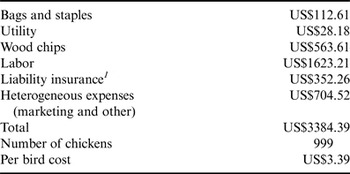
The second processing option analyzed in this study is the on-farm stationary plant. The estimate of per-bird processing cost was based on the data provided by Fanatico et al. (Reference Fanatico, Redhage, Schuck, Knoblauch, Green and Saylor2002). Processing expenses consisted of bags and staples, utilities, wood chips, labor, insurance, and marketing cost. We adjusted the values to reflect 2013 dollars. The estimated cost was US$3.39 per bird (Table 6). The survey provides values of the same order. The per-bird processing cost with a stationary plant ranged from US$1.73 to 4.29, with an average value of US$3.63.
On-farm stationary plan processing cost.

1 The liability insurance considers US$500,000 coverage for US$250 annual premium (2002 values Fanatico et al., Reference Fanatico, Redhage, Schuck, Knoblauch, Green and Saylor2002).
All the monetary values are adjusted for inflation (CPA 2002: 180, CPA 2013: 240; correction 1.33).
Notice that the MPU option demands less labor in the processing stage than with traditional on-farm technology. For the traditional on-farm processing alternative, our results indicated the per-bird labor cost was US$1.62 (Fanatico et al., Reference Fanatico, Redhage, Schuck, Knoblauch, Green and Saylor2002) and its incidence on the processing cost was equal to 48% (US$1.62/3.39). In contrast, Ennis et al. (Reference Ennis, Jefferson-Moore and Bynum2008) estimated the labor incidence in the processing stage of the MPU to be 44%.
Finally, the third processing option considered in this study was the use of an off-farm USDA inspected facility. The expense for this option basically is divided into two components: the fee to slaughter birds that the farmer pays the poultry facility owner and transportation cost. The Heckerman Beck Chenoweth poultry system adopted a fee cost of US$1.10 per bird, including the cost of bags. However, compared with the other sources, this value seems to be an underestimate. Tiny Farm Blog (2013) suggested a range between US$3.00 and 4.50 per bird. NESFI (2012) considered US$5.00 per bird for the slaughtering fee. Some of this variation in cost is likely due to differences in the number of birds processed. In this study we considered per bird cost for the fee equal to US$3.75 based on a facility that processes not more than 10,000 birds per year.
Eleven of the 29 surveyed farmers processed off-farm at the USDA inspected facility. Each responded to the following questions: ‘Total number of birds slaughtered per year?’ and ‘Transportation expenses?’ The per-bird transportation cost ranged from US$0.25 to 2.40 with an average of US$1.04. The survey does not provide any information about the distance traveled, but it can be estimated.
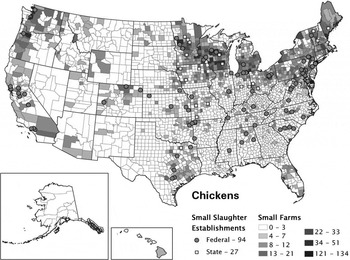
Figure 2 shows a map of poultry processing plants in the USA, and Table 7 presents details of the three surveyed states. The average market area of a poultry processing plant is assumed to be given by the total area of the state divided by the number of poultry facilities in that state. For instance, the total area of Arkansas is 53,179 square miles. There are 32 poultry plants in Arkansas, so the average market area of a poultry processing facility in Arkansas is 1662 square miles. For simplicity, we assume that each market area is a square and the poultry plant is located at the center. Table 7 shows that the poultry farms in each state number several thousand; thus, we assume that poultry farms are uniformly distributed within the market area of a poultry plant. The expected distance between a central fixed point (the poultry facility) and a random variable uniformly distributed in a square of side l is:
 $${\hskip9pt}\displaystyle{1 \over {l^2}} \int_0^l {\int_0^l {\sqrt {\left( {x - \displaystyle{l \over 2}} \right)^2 + \left( {y - \displaystyle{l \over 2}} \right)^2} {\rm d}x\,{\rm d}y}} = l \cdot {\rm constant}\; $$
Poultry slaughterhouse distribution by size. Source: USDA, Food Safety News (United States Department of Agriculture, 2010).

Off-farm processing. Farm–poultry slaughter plant distance.

1 Square root of the average area per plant multiplied by 0.3826.
where
 ${\rm constant} = \; (1/6)\left( {\sqrt 2 + {\rm ln}\left( {1 + \sqrt 2} \right)} \right) = 0.3826$
.
Table 7 shows that the average one-way distance from a poultry farm to a poultry facility is 16 miles in Arkansas, 19 miles in Georgia, and 44 miles in Louisiana. The average one-way distance for all three states is estimated as weighted average of these distances with weights given by the number of poultry farms in each state (Table 7). This corresponds to 22.25 miles. This estimate is reasonable when compared with the other recent studies. Beam et al. (Reference Beam, Thilmany, Pritchard, Garber, Van Metre and Olea-Popelka2015) estimated the average farm-slaughter facility for several cattle sectors in the USA. In the poultry industry, at the aggregate level the distance ranges from 2 to 250 miles with a median distance equal to 19 miles.
From the survey, the average number of transported birds was 226. Consequently, we assumed that 226 birds traveled 22.25 miles in each case to reach the poultry facility. In this way, the cost of the off-farm processing at the USDA-inspected facility was US$4.79 per bird, or US$3.75 for the processing fee plus US$1.04 for the transportation cost (Table 5).
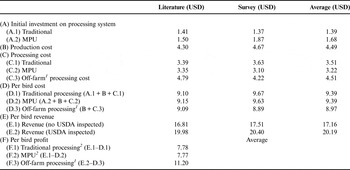
In conclusion, Table 5 summarizes the processing cost of the three options with respect to the literature review and the survey. On average, the off-farm USDA-inspected facility alternative had the highest per bird processing cost (US$4.51). The MPU had the lowest per bird processing cost (US$3.22), with the on-farm stationary plant presenting an intermediate solution (US$3.51).
Farm Selling Price
In this study farm selling price is defined as the price to sell the whole processed chicken, not deboned, and without shipping cost. The market exhibits price variability, but if the poultry is processed off-farm it is usually subjected to USDA-inspection. For instance, from the survey all 11 farmers who process their product off-farm did so at a USDA-inspected facility. In contrast, on-farm processed poultry is usually exempted from USDA-inspection. All 17 surveyed farmers who processed their products on-farm were USDA-exempt. This is particularly common for small-scale farmers.
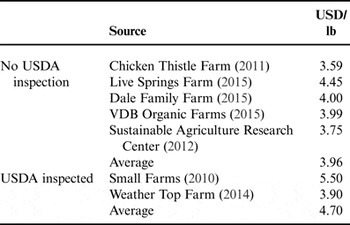
Price information from secondary sources is presented in Table 8. The average per pound selling price for USDA-inspected poultry is US$4.70, and the average selling price for the non-USDA inspected poultry is US$3.96 per pound. Assuming that a raised chicken ready to be sold weighs 4.25 pounds, per-bird prices are US$19.98 and 16.81 for USDA-inspected poultry and the non-USDA inspected poultry, respectively. From the survey, the average per pound selling price was US$4.80 and 4.11 for the USDA- and non-USDA-inspected facilities, respectively. This corresponds to US$20.40 and 17.51 per bird for the USDA- and non-USDA-facilities, respectively.
Selling price.

Income Analysis
Table 5 summarizes the per bird initial investment, production cost, processing cost, revenue, and profit from the published research and the survey answers.
We considered a typical scenario where the on-farm processing options, MPU and stationary plant, are usually non-USDA inspected, and the off-farm alternative is USDA-inspected. Since the selling price for the USDA-inspected facility poultry is usually higher than the selling price for the non-USDA inspected facility poultry, this has important consequences for the profitability of the three processing technologies.
The off-farm USDA-inspected facility had the highest return, while the traditional on-farm stationary plant and MPUs had, on average, the same profitability. The per-bird profit was US$11.20, 7.78, and 7.77 for the off-farm processing, the traditional on-farm stationary plant, and the MPU, respectively (Table 5).
This is due to price differences, rather than cost factors. Costs for the stationary on-farm plant or the MPU are 5% more expensive than the off-farm processing system but their selling price is 15% lower. However, the market shows huge price variability. For example, 53% of surveyed farmers who processed their product off-farm at a non-USDA inspected facility sold their broilers for a lower price than the average price of the USDA-inspected facility alternative, but for 47% the selling price was higher. In several cases this means the MPU and the traditional on-farm stationary plant may be more profitable than the off-farm processing option.
The profit analysis suggests that there are also differences in the cost composition. The average per-bird processing cost for the off-farm alternative is the highest (US$4.51), the MPU indicates the smallest value (US$3.22), and the on-farm stationary plant is in the middle (US$3.51). However, the off-farm processing option does not require any initial investment in the processing capacity while the estimated per bird initial investment is US$1.39 and 1.68 for the traditional on-farm processing alternative and for the MPU, respectively.
Income Feasibility of the MPU in Different Scenarios
This section is divided in three sub-sections. The first sub-section studies the effect of the economies of scale on MPU profitability. The second sub-section analyzes income feasibility with respect to a more intensive use of the excess processing capacity of the MPU. The last sub-section considers the impact of financial costs on profit.
Income feasibility and economies of scale
If the goal of the small farmer is to process not more than 1000 birds per year, investing in a basic MPU or in a mini MPU reduces the financial requirement considerably in the start-up stage. Thus, in this section we compare two processing capacities: a mini MPU and a traditional MPU. The initial investment in a mini MPU is assumed to be US$10,000 (Cornerstone Farm Venture, 2014) and 75,000 for a traditional MPU. We also assume that the useful economic life of the unit is 5 yrs for both of the processing scales that implies a per year fixed cost equal to US$15,000 and 2000 for a traditional MPU and a mini MPU, respectively.
The per-bird variable cost is assumed to be US$3.22 for a traditional MPU and US$4.85 for a mini MPU. The assumed gain of efficiency with a large operational scale corresponds to 50% and it is quite low, especially if we consider that the initial investment on a traditional MPU is more than seven times the corresponding investment on a mini MPU. As indicated previously, a mini MPU requires additional investment for an eviscerating table, chill tanks, and packing station. In addition, the small size makes the labor requirements more complicated. To keep the analysis simple, we also assume that the per-bird selling price and production cost is US$17.16 and 4.49, respectively for both scales.
The per bird profit is the difference between the price and the average (per bird) cost,
 $AC$
. Assume
 ${\rm \pi} _1 \; $
to be the per bird profit of a traditional MPU and
 ${\rm \pi} _2 \; $
the per bird profit of a mini MPU, Equations (1) and (2) express these relationships:
 $${\rm \pi} _1 = \; {\rm price} - AC_1 = {\rm US}\$ 17.16 - 7.71 - 15,000/b$$
 $${\rm \pi} _2 = \; {\rm price} - AC_2 = {\rm US}\$ 17.16 - 9.32 - 2000/b$$
where b is the number of processed birds per year.
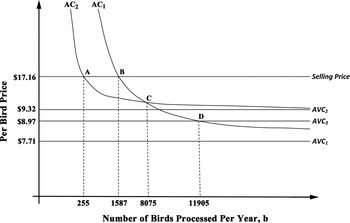
Figure 3 shows the relationship between the price and average cost curves. For only a few processed birds per year, the profitability of a mini MPU is greater than the profitability of a traditional MPU because the fixed cost is much higher for a traditional MPU. As the number of processed birds increases, the incidence of the initial investment approaches zero, and the average cost curves approach the average cost variable curves. Since the average variable cost of a large processing scale is smaller, for large processing volumes the profitability of a traditional MPU will exceed the profitability of a mini MPU. In other words, there will be a number of processed birds that makes the two operational scales equivalent in terms of profit. In Figure 3, the point C indicates
 ${\rm \pi} _1 = {\rm \pi} _2 \; $
that corresponds to 8075 processed birds per year.
Economies of scale of the MPU. Per bird selling price = US$17.16E; AVC = average variable cost (per bird cost) = per bird production cost + per bird processing cost; AVC
1 = average variable cost of a traditional MPU (US$75,000 initial investment); per bird production cost = US$4.49; per bird processing cost of a traditional MPU = US$3.22; AVC
1 = US$7.71 = US$4.49 + 3.22; AVC
2 = average variable cost of a mini MPU (US$10,000 initial investment); percent of higher processing cost of the mini MPU with respect to a traditional MPU = 50%; per bird processing cost of a mini
 ${\rm MPU}\, = \,{\rm US}\$ 4.83 = {\rm US}\$ 3.22 \times (1 + 50\% )$
; AVC
2 = US$4.49 + 4.83 = US$9.32; AVC
3 = average variable cost of off-farm USDA inspected facility = US$8.89 per bird; life cycle of a MPU unit = 5 yrs; CF
1 = Per year fixed cost of a traditional MPU = US$15,000 = US$75,000/5; CF
2 = per year fixed cost of a mini MPU = US$2000 = US$10,000/5; AC = average (per bird) cost = average variable cost + average fixed cost; number of processed birds per year = b; AC
1 = average cost of a traditional MPU = US$7.71 + $15,000/b; AC
2 = average cost of a mini MPU = US$9.32 + $2000/b; AC
3 = average cost of off-farm processing = US$8.89 = AVC
3; π1 = per bird profit of a traditional MPU = price
 $ - AC_1 = {\rm US}\$ 17.16 - 7.71 - 15,000/b$
; π2 = per bird profit of a mini
 ${\rm MPU} = {\rm price} - AC_2 = {\rm US}\$ 17.16 - 9.32 - 2000/b$
;
 ${\rm \pi} _2 = 0\; \,{\rm for}\,\; b = 255$
processed birds per year for a mini MPU (point A);
 ${\rm \pi} _1 = 0\; \,{\rm for}\,\; b = 1587$
processed birds per year for a traditional MPU (point B);
 ${\rm \pi} _1 = {\rm \pi} _2 \; {\rm for}\; \,b = 8075$
processed birds per year the two options have the same profit (point C); AC
1 = AC
3 (point D) at 11,905 processed birds per year the MPU and the off-farm USDA inspected system have the same average cost.

In general, the relationship that equates the profit of the two operational scales can be expressed as:
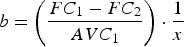 $${\hskip70pt}b = \left( {\displaystyle{{FC_1 - FC_2} \over {AVC_1}}} \right) \cdot \displaystyle{1 \over x}$$
where b is the number of processed birds per year, FC 1 is the annualized fixed cost of the large operational scale (initial investment divided by the number of years of life cycle), FC 2 is the fixed cost of the small operational, AVC 1 is the average processing cost of the large operational scale, and x is the percent increase of the average processing cost of the small operational scale.
The breakeven number of processed birds for the two investments depends crucially on the ability of the farmer to organize the processing flow of the two operational scales. For instance, if the average processing variable cost of a mini MPU is 100, 150, and 200% larger than the average processing variable cost of a traditional MPU, the previous analysis suggests that the investment on the large processing scale is more profitable after 4037, 2692, and 2019 birds processed per year, respectively.
For comparison, Figure 3 also shows that the breakeven point D between a traditional MPU and off-farm USDA inspected facility option corresponds to 11,905 birds processed per year. Below this threshold, a traditional MPU shows a lower average cost than an off-farm USDA inspected facility system.
It is not possible to address which operational scale is better. This depends on market conditions, the cost of different sized MPUs, hourly wage, equipment, as well as on how efficiently the processing stage is organized. However, the estimated number of processed birds that makes the two investments equivalent is quite low, and a small farmer may find it more profitable to invest in a traditional MPU than in a mini MPU, especially if he/she plans to employ the excess processing capacity. The next sub-section studies this aspect.
Income feasibility of MPUs with respect to the capacity excess
One aspect indicated by the income analysis is that the MPU is characterized by excess processing capacity. For instance, even for 30,000 processed birds per year, a traditional MPU with a processing capacity of 225 birds per day still has an excess capacity of 15,000 processed birds per year (assuming 200 working days per year (Ennis et al., Reference Ennis, Jefferson-Moore and Bynum2008)).
The dramatic increase in both small-scale farms (O'Bryan et al., Reference O'Bryan, Crandall, Davis, Kostandini, Gibson, Alali, Jaroni, Ricke and Marcy2014) and in processed poultry from those farms (Wolfe and Best, Reference Wolfe and Best2005) indicates good potential for using this excess capacity. Our survey results also showed considerable interest in MPU's. Apart from three farmers who already have an MPU, only one has no interest in using one. All of the remaining 25 farmers expressed positive interest in potentially utilizing an MPU. The number of the processed birds per year for the three farmers who already have an MPU is 1100, 1300, and 2000.
In addition, the processing demand is faced by a low processing supply. O'Bryan et al. (Reference O'Bryan, Crandall, Davis, Kostandini, Gibson, Alali, Jaroni, Ricke and Marcy2014) reported that the number of slaughterhouses declined by over 23% in the past 5 yrs. Figure 2 shows the US map for small-scale poultry producers and for small slaughterhouses. Thus, leasing the MPU to other farmers generates additional revenues that can make this option the most profitable.
Ownership of a shared MPU usually belongs to extension services (Kentucky Extension Service. America's Research Based Learning Network, 2013), food hubs, and non-profit organizations (Sustainable Agriculture Research Center, 2012). Charges for an MPU can be based on a per-day fee or a per-bird fee. Some services also require a limited subscription fee on the order of US$100. As previously, we assume that the purchasing cost of a brand new traditional MPU is US$75,000. The daily capacity is 225 birds and we assume that in a year there are 200 working days. Notice that we are considering less working days in a year since it is necessary to count for the time spent to raise the birds and that the poultry is processed only three times per year (not in the winter (Ennis et al., Reference Ennis, Jefferson-Moore and Bynum2008)).
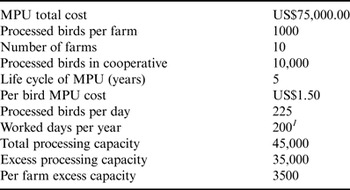
We also assume that there are ten farmers who buy an MPU. The farmers are organized in a cooperative or in a production partnership with equal shares of ownership of the MPU. Each farmer processes 1000 birds per year on his/her own farm so the total annual used processing capacity is 10,000 birds. One of the three farmers surveyed who already owned an MPU shared the property with other farmers in a cooperative.
The total capacity of the MPU is 45,000 processed birds per year (225 processed birds per day by 200 working days in a year). This implies an unused capacity equal to 35,000 birds per year. The details are listed in Table 9. After processing their chickens, the farmers outsource the MPU to other farmers who will be charged a per bird fee.
MPU excess capacity analysis.

1 The number of worked days per year considers the time necessary for raising the birds and the time spent to move the unit from one farm to another farm (Ennis et al., Reference Ennis, Jefferson-Moore and Bynum2008).
We are interested in comparing the total profit of the MPU alternative to the off-farm processing option. If
 ${\rm \pi} _{{\rm off}} $
is the per bird profit of the USDA inspected facility option,
 ${\rm \pi} _{{\rm mpu}} $
is the MPU processing profit, and
 ${\rm \pi} _{{\rm extra}} $
is the extra profit from renting the MPU to other farmers, the breakeven point is given by Equation (5):
 $${\hskip50pt\rm \pi} _{{\rm off}} = {\rm \pi} _{{\rm mpu}} + {\rm \pi} _{{\rm extra}} $$
The income analysis estimated
 ${\rm \pi} _{{\rm off}} $
equal to US$11.20 per bird and πon to US$7.77 per bird. The extra profit from renting the MPU is the product of the number of outsourced processed birds n and the per bird fee. Equation (6) expresses the per bird fee at which the two alternatives are equally profitable:
 $${\hskip50pt\rm fee} = \displaystyle{{1000 \cdot ({\rm US}\$ 11.20 - 7.77)} \over n}$$
Equation (6) implies that the larger the number of birds the farmer processes for his/her own farm, the larger the per-bird fee must be from renting the unit. For instance, if a farmer processes 1000 birds per year and the same number when renting the unit, the per-bird fee that equates the MPU option with the off-farm USDA inspected facility system is US$3.43. If the farmer processes 2000 birds on his/her farm and 1000 when renting the unit, the break-even fee will be US$6.86. For comparison, the NESFI evaluated the direct cost of MPU fee at US$5.00 per bird. According to McDonald and Mills (Reference McDonald and Mills2012), the average per-bird fee ranged between US$1.95 and 2.75.
Our breakeven analysis suggests that the MPU may be the most profitable processing technology if the farmers are able to employ its excess capacity. Table 9 indicates that the maximum excess capacity is 3500 processed birds per year per farmer. According to Equation (6), this means that charging a fee higher than US$0.98 per bird makes the MPU option more profitable than the off-farm USDA-inspected facility. Again, for comparison, Kentucky State University charges US$1.50 per bird for use of its MPU (Kentucky Extension Service. America's Research Based Learning Network, 2013).
The proposed break even analysis indicates that the MPU can be competitive with the off-farm USDA inspected facility option and probably reach a higher profit than the on-farm stationary plant processing system. The next sub-section investigates the impact of the financial requirement on the MPU profit.
Income feasibility of the MPU with respect to its financial cost
Financial cost affects MPU profitability with respect to processing scale and interest rate. We assume that the initial investment is US$10,000 and 75,000 on a mini MPU and on a traditional MPU, respectively. As previously, we assume that the selling price is US$17.16 per bird, the average variable cost is US$7.71 per-bird for a traditional MPU and US$9.32 per bird for a mini MPU.
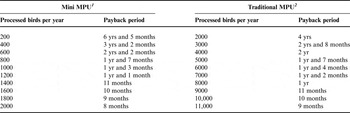
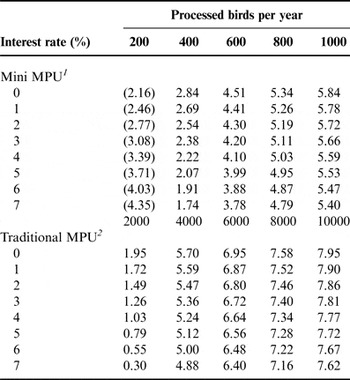
Table 10 shows the payback period of the two investments with respect to a different number of processed birds per year. If a mini MPU processes 200 birds per year, the payback period is 6 yrs and 5 months. For 1000 processed birds per year, the payback period is 1 yr and 3 months. A traditional MPU requires a longer payback period since the initial investment is higher. For 2000 processed birds per year the payback period is 4 yrs. After 8000 processed birds per year, the payback period is less than 1 year.
Payback period and MPU processing scale.

1 Initial investment on the mini MPU = US$10,000.
2 Initial investment on the traditional MPU = US$75,000.
Per bird selling price = US$17.16.
Per bird variable cost of the mini MPU = US$9.32.
Per bird variable cost of the traditional MPU = US$7.71.
Per bird profit without the initial investment = price-per bird variable cost.
Annual profit without the initial investment = per bird profit without the initial investment by number of processed birds per year.
Payback period = initial investment/annual profit without the initial investment.
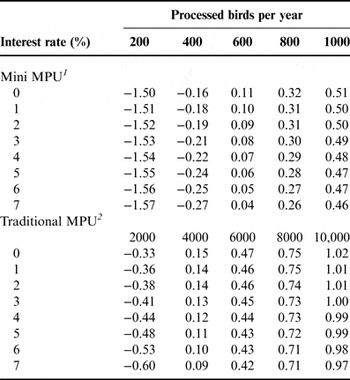
Table 11 indicates the per-bird profit of a mini MPU and a traditional MPU for different numbers of processed birds and different interest rates.
Financial cost and processing scale. Per bird profit.

1 Initial investment on the mini MPU = US$10,000.
2 Initial investment on the traditional MPU = US$75,000.
Per bird selling price = US$17.16.
Per bird variable cost of the mini MPU = US$9.32.
Per bird variable cost of the traditional MPU = US$7.71.
Loan duration = 5 yrs.
Number of payments = 5, each one at the end of the year.
Type of payment = equated monthly installment.
Annual financial payment (principal + interest) = initial investment
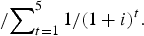 ${ /{\sum\nolimits_{t = 1}^5 {1/(1 + i)^t}.}} $
i = annual interest rate.
Annual profit without financial cost = (price − per bird variable cost) × number of processed birds per year.
Annual profit = annual profit without finance cost − annual finance payment.
Per bird profit = annual profit/number of processed birds per year.
Numbers in parenthesis indicate a negative profit.
We consider that the farmer has to borrow the capital necessary to buy the MPU. We assume that the length of the loan is same as the life cycle of the MPU (5 yrs), that each payment expires at the end of year, and that the annual payment is constant and covers the principal and interest (equated monthly installment). In particular the annual payment is given by Equation (7):
 $${\hskip10pt\rm annual\; financial\; payment} = \; {\rm \;} \displaystyle{{{\rm Initial\; Investment}} \over {\sum\nolimits_{t = 1}^5 {1/(1 + i)^t}}} $$
where i is the annual interest rate.
The per bird profit is the difference of annual profit and the annual financial payment divided by the number of processed birds. Table 11 indicates that if the number of processed birds per year is small, it may be difficult to attain economic feasibility. The mini MPU incurs a loss at any interest rate if the number of processed birds is 200. This is due to the annual profit of a mini MPU that is negative for less than 255 processed birds per year (point A in Figure 2). However, after 400 processed birds per year, a mini MPU reaches economic feasibility. In our survey, the average number of processed birds per year was 944 (Table 4).
A traditional MPU may incur a loss for 2000 processed birds per year if the interest rate is higher than 10%. Figure 2, point B, indicates that the profit of a traditional MPU is zero for 1585 processed birds per year. However, even in this case the range of economic feasibility is quite consistent. After 4000 processed birds per year, the profit is positive for an annual interest rate below 8%. These results hold equally well for a single farmer, or for a group of farmers who buy an MPU in partnership. For instance, one farmer who processes 2000 birds per year has the same per bird profit, financial cost, etc., as two farmers each processing 1000 birds per year.
Table 12 provides the financial analysis in terms of internal rate of return (IRR). The duration of the investment is again assumed to be equal to the economic life of the unit, that is, 5 yrs. Table 12 shows that the IRR of a mini MPU is positive above 600 processed birds per year. Similarly, a traditional MPU has a positive IRR for 4000 or more processed birds per year.
Internal rate of return (IRR) and processing scale.

1 Initial investment on the mini MPU = US$10,000.
2 Initial investment on the traditional MPU = US$75,000.
Per bird selling price = US$17.16.
Per bird variable cost of the mini MPU = US$9.32.
Per bird variable cost of the traditional MPU = US$7.71.
Loan duration = investment duration = 5 yrs.
Number of inflows = 5, each one at the end of the year.
Annual inflow = unit profit × processed birds.
Annual outflow (principal + interest) = initial investment/∑ t = 1 5 1/(1 + i) t .
i = annual interest rate.
Cash flow = CF = annual inflow − annual outflow.
 ${\rm Initial\; investment} = \; CF \cdot \sum\nolimits_{t = 1}^5 {1/(1 + {\rm IRR})^t} $
.
IRR = internal rate of return.
The estimated values are sensitive to the initial investment. A traditional MPU that processes 6000 birds per year with an initial investment equal to US$75,000 and 4% interest rate has an IRR equal to 0.44. In contrast, if the initial investment is US$50,000, the corresponding IRR is 0.86, while, if the initial investment is US$100,000 the IRR is 0.21.
Conclusions
The study analyzed the economic feasibility of MPUs with both a literature review and a survey of 29 pasture poultry farmers in Georgia, Louisiana, and Arkansas. The analysis indicated that the MPU profit is, on average, on the same scale as an on-farm-stationary plant processing system and lower than an off-farm USDA-inspected facility processing option. We found that the profit differences are due to the selling price of the birds more than the cost of owning and operating each system. The per bird profit is US$7.78 for the on-farm stationary plant, US$7.77 for the MPU, and US$11.20 for the off-farm USDA inspected facility.
Economies of scale play an important role in determining MPU profitability and therefore necessitate careful analysis by the farmer. A mini MPU requires a lower initial investment, and for a small number of processed birds, allows a higher profit than a traditional MPU. Results indicate that below 8705 processed birds per year, a mini MPU has a lower average cost than a traditional MPU.
The financial cost is high for a small number of processed birds per year, but for larger production levels its effect is limited. A mini MPU with an initial investment of US$10,000 has a negative profit if the annual processing capacity is smaller than 400 birds, and a negative internal rate of return for less than 600 birds. A traditional MPU with an initial investment of US$75,000 shows a positive profit and internal rate of return for more than 4000 processed birds per years. The financial analysis indicated that the results are substantially affected by the initial cost and the length of the investment.
Finally, this study showed that for small farmers the MPU is characterized by substantial excess processing capacity. Leasing an MPU therefore can make this option more competitive. Results indicate that ten farmers sharing the ownership of the MPU can earn a higher profit than the off-farm USDA inspected facility alternative if they charge a processing fee higher than US$3.43 per bird. This consideration is supported by an increasing demand for processing pasture poultry (Wolfe and Best, Reference Wolfe and Best2005; Van Loo et al., Reference Van Loo, Alali, Welander, O'Bryan, Crandall and Ricke2013; O'Bryan et al., Reference O'Bryan, Crandall, Davis, Kostandini, Gibson, Alali, Jaroni, Ricke and Marcy2014) and a relatively low supply for processing pasture poultry (United States Department of Agriculture, 2010). The MPU option could be the most effective in states Georgia where poultry production is large in relation to processing capacity. MPUs also show promise in states like Louisiana where limited poultry production is met by few poultry slaughter plants (Louisiana Agricultural Center, 2011; Watt Poultry Directory, 2012).
Acknowledgements
This review was funded by SARE grant LS11-245. We would like to thank SARE for facilitating the survey.