Case history
JW is a 66-year-old woman referred to outpatients with a two-year history of musical hallucinations. She has provided written informed consent to publication of this report. JW described the sudden onset of hearing unaccompanied male and female voices singing a series of familiar songs. The experience was heard in both ears, at normal volume, tempo and pitch. The songs included “Daisy, Daisy” and “I had a dream”, which she heard in their entirety, musical phrases from “I'm forever blowing bubbles” and a childhood variant of “Glory, glory, hallelujah; Teacher hit me with a ruler'. The hallucinations occurred as she lay down at night but while still awake and alert. They persisted if she got up during the night, but had usually stopped by morning. She initially thought the singing was coming from outside her house, but soon realised the phenomena were “inside her head”. She could not stop the hallucinations once started; however, she found that concentrating on word puzzles reduced their intensity enough for her to sleep. On rare occasions the hallucinations were also experienced during the day but always while she was in a quiet environment.
JW's past medical history included a number of relevant factors. At the age of 48 she had two subarachnoid hemorrhages, each requiring a left frontal craniotomy and clipping of anterior communicating artery aneurysms. She subsequently developed communicating hydrocephalus and a ventriculo-peritoneal shunt was inserted. She also developed absence seizures and was commenced on phenytoin 100mg od. A neuropsychological review at the time documented severe cognitive dysfunction. She was transferred to a neurorehabilitation unit and made excellent progress. Within three months she was independent with self care and fully orientated; however, she demonstrated impaired abstract reasoning, and moderate word-finding difficulties. She continued to improve and has been functioning independently ever since. She remained on phenytoin until the age of 63 when she stopped it of her own accord, a year prior to the onset of her hallucinations.
JW has a history of mild hearing impairment and recent audiography confirmed moderate bilateral high frequency hearing loss and mild left low frequency hearing loss. The date of onset of her hearing impairment is unclear, and she has declined the offer of hearing aids.
JW has a 40-year history of restless legs syndrome, with a strong family history of the condition. At the age of 64 her GP commenced pergolide 50mcg. This had no effect on her restless legs; however, after six months she began experiencing musical hallucinations. Pergolide was discontinued but the hallucinations persisted.
JW had two episodes of mild depression aged 33 and 54. She was treated with citalopram for one year after the second episode but had no further contact with mental health services. She had a history of significant alcohol intake, and drank 30–40 units per week for 20 years before her subarachnoid hemorrhages and 8 units per week subsequently. Her drinking was related to her occupation as a barmaid and pub landlady. She frequently sang in her pubs and at other events throughout her life. She denied having regularly sung any of the songs she heard as hallucinations, although recognizes them from childhood. Her family was musical, and her father regularly sang at home. Despite this the songs have no specific significance or emotive resonance.
On mental state examination JW presented with no evidence of affective or psychotic symptoms. Aside from the musical hallucinations described above, she denied ever experiencing auditory hallucinations in any other form, or hallucinations in other modalities. Her insight was good, as although she perceived the singing as coming from external space she realized this was not the case.
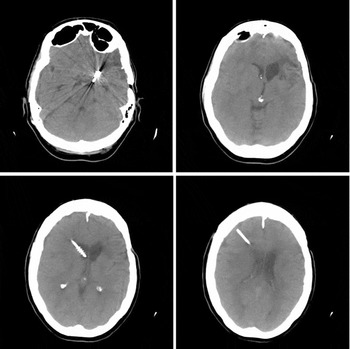
Investigations revealed normal blood indices. An EEG, during which she had a very brief musical hallucination and became drowsy, showed a normal rhythm and no epileptiform abnormalities. Computed tomography of the head (Figure 1) revealed evidence of a frontal temporal craniotomy, a left aneurysm clip, mature damage in the left inferior frontal and anterior temporal lobe, and a right intra-ventricular catheter, with no ventricular dilatation. Neuropsychological assessment revealed an IQ of 83, impaired prospective and short term memory, word finding difficulties and some executive deficits consistent with her neurosurgical history.
CT brain, axial slices demonstrating a left aneurysm clip, mature damage in left inferior frontal and anterior temporal lobes and right intra-ventricular catheter with no ventricular dilatation.

JW was commenced on lamotrigine 25mg, titrated to 50mg od, which was the highest dose she was able to tolerate due to sedative side effects. After several weeks on treatment the musical hallucinations reduced in volume and persistence. The repertoire also changed and reduced to one less familiar song, “In the midnight hour”, which is only heard faintly.
Discussion
Musical hallucinations are rare phenomena (Fukunishi et al., Reference Fukunishi, Horikawa and Onai1998). General risk factors are female sex and increasing age; however, there are a number of other reported associations, several of which are present in our case. Hearing impairment, specifically sensorineuronal deafness, is the most common association, reported in 39–67% of cases (Berrios, Reference Berrios1990; Keshavan et al., Reference Keshavan, David, Steingard and Lishman1992; Evers and Ellger, Reference Evers and Ellger2004). The postulated mechanism is of “perceptual release”, with reduced sensory input resulting in disinhibition of neuronal activity and emergence of memory traces, analogous to the visual hallucinations experienced in the Charles Bonnet syndrome. A PET study investigating musical hallucinations in deaf subjects found musical hallucinations to be associated with activity in brain areas required for normal musical perception despite the absence of sensory input. Spontaneous activity in a network of regions including posterior temporal lobes and inferior frontal lobes, but not in the primary auditory cortex was demonstrated during the hallucinations (Griffiths, Reference Griffiths2000). It has been argued that musical hallucinations are always due to an otological pathology (Gordon, Reference Gordon1997); however, associations with other neurological and psychiatric illness also exist.
Epilepsy has long been associated with musical hallucinations. The concept of “neuronal irritation”, with stimulation of the cortex giving rise to abnormal perceptual phenomena, is well recognized as an explanation for the emergence of perceptual symptoms in epilepsy (Penfield and Perot, Reference Penfield and Perot1963). In a recent case series of musical hallucinations, epilepsy was the main etiology in around 11% of cases (Evers and Ellger, Reference Evers and Ellger2004).
A wide range of structural lesions has been associated with musical hallucinations, including space occupying lesions, arterio-venous malformations (Keshavan et al., Reference Keshavan, David, Steingard and Lishman1992), and strokes (Berrios, Reference Berrios1990). Case series have found structural brain disease in 39% (Berrios, Reference Berrios1990) and 42% of cases (Evers and Ellger, Reference Evers and Ellger2004).
Musical hallucinations have also been associated with a variety of medications including, phenytoin (Evers and Ellger, Reference Evers and Ellger2004; Tomar and Cheung, Reference Tomar and Cheung2007). Dopamine agonists, and in particular pergolide, have also been reported to induce psychotic symptoms including auditory hallucinations (Ecker et al., Reference Ecker, Unrath, Kassubek and Sabolek2009).
Finally, musical hallucinations can occur in the context of psychiatric illness. A study of 128 psychiatric patients reported musical hallucinations in only 3.9% (Schakenraad et al., Reference Schakenraad, Teunisse and Olde Rikkert2006); however, it is likely that musical hallucinations are under-reported in the psychiatric population.
Treatment of musical hallucinations has been reported as largely unsatisfactory with a number of agents including antipsychotics, anticonvulsants, cholinesterase inhibitors and the use of hearing aids and external stimulation (Evers and Ellger, Reference Evers and Ellger2004; Sacks, Reference Sacks2007).
In the absence of clear evidence of the superior efficacy of any agent, we chose lamotrigine as it is a well-tolerated first-line anti-epileptic. To our knowledge this is the first report of low dose lamotrigine proving efficacious in the management of musical hallucinations.
JW has a number of these etiological factors, including structural brain damage to the temporal and frontal areas implicated in musical hallucinations, hearing impairment, partial seizures treated with phenytoin and use of a dopamine agonist. Our hypothesis is that, in this case, the brain injury resulting from the subarachnoid hemorrhages and subsequent procedures may have lowered her threshold for neuronal irritation and predisposed her to musical hallucinations. The onset of hearing impairment, discontinuation of phenytoin and commencement of pergolide, may all be partially responsible for allowing the perceptual release of her musical hallucinations. Despite these multiple etiological factors, the patient positively reports that treatment with lamotrigine has significantly reduced the intrusiveness of her symptoms, which continue to persist at night – “in the midnight hour”.
Conflict of interest
None.
Description of authors' roles
Dr. Huntley, Dr. Philpot and Miss Sandall were all responsible for the clinical management of JW. Dr. Huntley and Dr. Philpot wrote the initial draft of the case report and Miss Sandall provided further neuropsychological assessment and revision of the report.