Because of its mix of institutions and practices, the fundamental nature of the government of Canada is a problematic case for scholars. A reconsideration of the Canadian polity needs to be undertaken because of events over the past quarter century, such as the development of executive federalism; the repatriation of a revised Constitution from the supervision of the United Kingdom over the objections of Quebec; the rejection of the constitutional settlements in the Meech Lake Accord (1990) and the Charlottetown Accord (1992); increased attention to the claims of Aboriginal peoples; increased movements for relaxing party discipline in Parliament and for a more proportional electoral system; increased controversy over the use of judicial review in interpreting the Charter of Rights and Freedoms; and, above all, the ongoing problem of national unity, especially stemming from the Quebec separatist movement.
Arend Lijphart's (1999) classification scheme provides a powerful analytical tool for the study of Canada, as it has for other problematic cases such as India (Lijphart 1996) and, more recently, the United Kingdom (Flinders 2005). The classification scheme is based on two ideal types, consensus and majoritarian democracy. Democracies are classified using 10 variables divided into two dimensions—the first an executive-parties dimension, and the second a federal-unitary dimension. Executive-parties variables include the effective number of parties in a system, the level of executive dominance, the percentage of minimum winning one-party cabinets, the type of electoral system, and the degree of interest group pluralism. Federal-unitary measures consist of the degree of institutional centralization, the cameral structure and relative powers of the legislature, the level of constitutional rigidity, the strength of judicial review, and the level of central bank independence. These measures are then standardized to produce two dimensions.
An ideal consensus democracy (also called consociational or power-sharing democracy) has the following characteristics: (1) broad multiparty coalitions; (2) a balance of executive-legislative power; (3) a multiparty system; (4) proportional representation; (5) a corporatist interest group structure (6) federal, decentralized government; (7) balanced bicameralism in the legislature; (8) a rigid constitution changed only by extraordinary majorities; (9) strong judicial review; and (10) central bank independence. Switzerland and Belgium approximate the consensus ideal.
The majoritarian (or Westminster) ideal type features the following characteristics: (1) concentration of executive power in single-party majority cabinets; (2) executive dominance over the legislature; (3) a two-party system; (4) a majoritarian and disproportional electoral system; (5) a pluralist interest group structure; (6) unitary and centralized government; (7) concentration of legislative power in one house of the legislature; (8) a flexible constitution that can be easily amended; (9) parliamentary sovereignty; and (10) central banks dependent on executive decisions. While no country perfectly matches each dimension, Lijphart (1984; 1999) has analyzed how well different democracies fit these specific characteristics and dimensions as well as the overall ideal types. Until recently the United Kingdom and New Zealand were classic majoritarian systems.
Of course, countries can change their positions over time as institutions and practices change. Lijphart (1999) examines changes over a half century in 36 democracies, 1945–1996, and finds Canada to be in the least-populated quadrant, that of “majoritarian-federal” systems. Noting especially institutional attempts to deal with political expressions of ethnic-cultural divisions in the country, others have referred to Canada as “semi-consociational” (Cannon 1982; McRae 1997). With additional time and data from the same sources as Lijphart (1999), we provide a fresh evaluation of Canada.
1. Government Formation
Canada is part of the Westminster model on this characteristic since political practices favor single-party majority governments when possible. There are single-party minority governments when no party has a majority, on both the federal and provincial levels. Agreements with minority legislative parties to sustain the government in office on key votes are common. There is little inclination to form coalition governments, and there have been none on the central level since World War I. There have been several minority governments since World War II, but each has governed alone until the next election.1
Depending on when one considers a new government formed, there have been eight of 20 minority governments (by elections) or nine of 25 (by new prime minister or election).
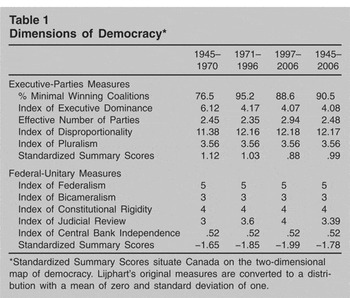
Dimensions of Democracy*

2. Executive Legislative Relations
On the second characteristic, few countries in the world have as much cabinet dominance over Parliament as Canada, especially on the central level. In Canada the average cabinet durability for 1945–1996 was 4.09, which is the third highest score of the non-presidential democracies examined (Lijphart 1999). For the period 1997 to 2006, there was a slight decline.
Independent parliamentary behavior through free votes, backbench rebellions, and the willingness of governments to accept defeats on legislation without interpreting such defeats as being negative votes of confidence are rare in Canada. Recommendations by political parties, and even a parliamentary select committee, that Canada adopt these practices have been rejected (Docherty 2005). Free votes, sometimes restricted to non-cabinet members, have taken place on only a few issues in the post-World War II period: flag redesign, capital punishment, abortion, and, most recently, homosexual rights (Smith and Tatalovich 2003). Backbench rebellions, such as abstaining or voting against the government by members of its own party, have been punished through various disciplinary procedures. Even the more populist Reform Party, which claimed to want to change many of these “iron discipline” practices and defer more to constituents, largely followed them once it achieved substantial membership in the House of Commons in the 1990s. Its successor party, the now-governing Conservatives, have continued to adapt to existing parliamentary conventions. Despite much rhetoric about allowing MPs more freedom, thus far reforms have been minimal (Docherty 2005). Having a monarch as de jure head of state can constitutionally reinforce executive dominance. The wide discretion of the executive in Canada to decide rules and regulations without specific legislative approval stems from the inheritance of the British Crown as well as broadly-based authorization for delegated legislation. The Conservative government in 2006 introduced a procedure of allowing nominees for the Supreme Court to appear before a parliamentary committee, but the appointment of judges is still entirely part of executive prerogative.
3. Effective Number of Parties
The nature of the party system in Canada is less firmly majoritarian. On both the central electoral level and legislative representation Canada has rarely been a two-party system. The leftist New Democrats and sometimes others, especially regionally-based parties who do well in a single-member plurality (SMP) electoral system, have had some representation. Since World War I, only two parties, the Liberals and the Conservatives, have formed governments, but the NDP has had influence on government policy, especially during periods of minority government. Nevertheless, according to the Laakso-Taagepera (1979) index of the “effective number” of parties in the legislature, the party system is still majoritarian (Lijphart 1999).
The data in Table 1 show a substantial change in the effective number of parties, up almost .5 in the most recent period, although this barely affects the overall average. This shift reflects the consistent performance of smaller parties in elections as well as the splintering of the Conservative party in the early 1990s and its reconstitution in 2003.
As part of the party system, Lijphart (1999) considers how many issue dimensions affect partisan competition. A Westminster system has fewer fundamental divisions than a consensus system. Lijphart (1999) argues that there are 1.5 issue dimensions in Canada, with the cultural-ethnic (regional) dimension being highly salient and the socioeconomic (class) cleavage being of medium salience. This is a fairly typical number of issues for a Westminster system. Regional policies often focus on the issue of Quebec's claims as the only majority Francophone province within the Confederation but also include other concerns in the growing Western provinces, especially Alberta and British Columbia, and the economically depressed Atlantic ones. In the 1990s, this issue led to the emergence of two new parties, the Bloc Quebecois and Reform. The problem of reconciling an issue dimension that could lead to the break-up of the country has bedeviled Canadian policymakers historically, especially since the rise of the Quiet Revolution in Quebec in the 1960s. This will be addressed further in the conclusion.
4. Electoral System
The fourth characteristic of the Westminster model, a single-member plurality electoral system, has been cited as contributing to national unity problems in Canada by underrepresenting minority opinions (Cairns 1968; Weaver 1997). Recently, the index of disproportionality between party votes and legislative seats has remained high, but minor parties did get some legislative seats from their mass support (see Table 1).
The presence of a plurality electoral system tends to reduce the number of legislative parties and generate single-party governments. This linchpin of the whole Westminster system is deeply rooted in Canada. The desirability of single-party government and the importance of the individual constituency member are so entrenched that proposed electoral system reforms usually limit the share of proportional representation seats (Weaver 1997; Milner 2004).
In recent years a vigorous movement for electoral reform has arisen through advocacy by Fair Vote Canada and espousal by the NDP. Although there are many complaints about the distorting effect of SMP on regional, ethnic, and women's representation, the principal motivating factor was continued legislative and executive dominance on the central level over four elections (1993, 1997, 2000, 2004) by the Liberals on the basis of a plurality vote and similar outcomes in some provinces. Thus far, electoral reformers have had more impact in getting the issue on provincial agendas than on the central level, where a majority vote in the House of Commons would be necessary to change the law or to allow a referendum (Studlar 2003; Milner 2004).
5. Interest Group System
Historically, Canada has a pluralist interest group system, another characteristic of a Westminster democracy. Siaroff's (1999) comparative measures of this dimension reflect this, with Canada at 3.56 as the most pluralist of 24 democracies.2
There is a difference in data between Siaroff's unpublished manuscript, which Lijphart (1999) cites, and his eventual article, although Canada remains the most pluralist.
6. Centralization of Authority3 The measures employed in the unitary-federal
dimension are worth analyzing despite minimal variation in the scores.
Three of the variables, the index of federalism, the index of
bicameralism, and the index of constitutional rigidity, are functions of
subjectively-determined scales and change only when there is major
structural reform in the polity.
The measures employed in the unitary-federal dimension are worth analyzing despite minimal variation in the scores. Three of the variables, the index of federalism, the index of bicameralism, and the index of constitutional rigidity, are functions of subjectively-determined scales and change only when there is major structural reform in the polity.
Canada does have a consociational feature in its federal structure. In the 20th century, Canadian federalism, now with 10 provinces and three territories, has become more decentralized fiscally and in policy authority due to initiatives from the provinces. Federalism also has acted as a support for Quebec's concerns (both those of secessionists and moderates) since the Francophone population largely is concentrated in that province.
Canadian federalism is executive-centered. The key element since the 1960s has been executive federalism, periodic meetings of provincial ministers, including the premiers (First Ministers Conferences), with their federal counterparts for negotiations about matters affecting both jurisdictions (Cannon 1982). In 2003, a Council of the Federation was established to provide a regular forum for premiers of the provinces and territories to coordinate strategy. The provinces usually have single-party majority governments through SMP; thus the premiers consider themselves representatives of their province's interests. Effective opposition to central executive proposals is more likely to come from the premiers, especially those from larger provinces such as Ontario, Quebec, British Columbia, and Alberta, than from opposition parties in the Commons.
Canada also affords a degree of autonomy to its Aboriginal peoples. The creation of Nunavut in 1999 and treaty negotiations in Yukon, the Northwest Territories, and British Columbia are attempts by the federal and provincial governments to guarantee rights for Canada's Aborigines (Russell 2004). Some native languages receive official recognition in the Northwest Territories and Nunavut.
7. Legislative Bicameralism
Canada is an example of asymmetric bicameralism. The relatively equal formal power of the two houses puts it above the overall mean for democracies. Lijphart (1999) argues this makes it a consensual characteristic. The Canadian Senate has only a tenuous connection to the federal principle, based on archaic ideas of regional representation. But all of the senators are lifetime patronage appointments by the prime minister. When government changes after a long period of one-party rule (1984, 2006), a period of tension can follow until Senate appointments fall into line. Although formally equal, the political resources of the Senate as an unrepresentative body are limited; thus in practice, Canada may tilt toward majoritarianism.
Senate reform has been on the political agenda since the early 1980s and was part of the Meech Lake and Charlottetown accords for constitutional change. But the defeat of these measures left this reform beleaguered, despite increased assertiveness by this unelected body in the 1990s and espousal of a Triple E (elected, equal, effective) Senate by the Reform and, later, Conservative parties (Russell 2004). Although hampered by its minority status, the current Conservative government has proposed an eight-year limit for senatorial terms and promises further reform involving the election of new senators.
8. Constitutional Rigidity
Since 1982, constitutional rigidity, requiring supermajorities for amendments, has been a strongly consensual feature of Canadian government. Constitutional amendments are governed by the 7/50 rule, requiring that seven of the provinces, containing at least 50% of the population of the provinces, approve them. The Constitutional Amendments Act (1996) imposes an additional hurdle of approval by each of five regions to pass, but this law could be repealed by a future Parliament (Russell 2004).
The 1982 Constitution attempted to reconcile parliamentary sovereignty with constitutional entrenchment and judicial review by the device of the notwithstanding clause, whereby a central or provincial parliament could override a decision of the Supreme Court for a five-year renewable period. Thus far only Quebec (several times, on French language preference laws) and Saskatchewan (once) have invoked it; the central government never has (Russell 2004). Thus over the years the written Constitution as interpreted by the Supreme Court has assumed the dominant position. Yet the notwithstanding clause is not dead, as indicated by the fact that the prospect of a Conservative government attempting to override court decisions on human rights, especial those of homosexuals, was an issue in both the 2004 and 2006 elections.
9. Judicial Review
Judicial review in Canada has evolved into a strongly consensual element after the repatriation of the Constitution in 1982 (Lijphart 1999). Table 1 shows that in recent years judicial review has become even stronger.
The advent of the Canadian Charter of Rights and Freedoms with the repatriation of the Canadian Constitution from the United Kingdom in 1982 has encouraged claims based upon individual and non-territorial group rights. An appreciable number of citizens now consider themselves to be “Charter Canadians” (Cairns 1991) possessing universal rights. These include women, Aboriginals, the disabled, the aged, and multicultural groups as well as linguistic minorities. The Charter was the first constitutional foundation in Canada for these rights, and the Supreme Court has been sympathetic (Manfredi 2001).
The Supreme Court response to the threat of secession in Quebec through an advisory opinion expressed concern for minority rights of dissident English-speakers and Aboriginals within the province as well as French-speakers elsewhere. But a clear majority on a clear question advocating secession in a referendum would mean that the central government is obligated to negotiate with the Quebec government (Russell 2004).
10. Central Bank Independence
The Central Bank in Canada remains highly independent, characteristic of a consensus system. Among the 36 democracies, there were only four with higher index figures for independence, and those were not by much. Recently there has been little change.
Conclusions
Of the 10 elements of democracy, Canada largely follows the Westminster model on six (concentration of executive power through one-party cabinets, executive dominance over the legislature, party system, asymmetric bicameralism, plurality elections, pluralist interest groups), and the consensus model on four (decentralization, rigid constitution, strong judicial review, central bank independence). Lijphart's (1999) assessment that Canada fits the majoritarian-federal category of countries seems fair.
Table 1 and Figure 1, however, indicate that over the past decade Canada has become somewhat less majoritarian on both dimensions. As Table 1 shows, there is less executive dominance, more effective parties, marginally fewer minimal winning coalitions, and more disproportional election results, along with a somewhat increased power of judicial review. Other data, especially the standardized scores for the two dimensions, show evidence of a longer-term trend.

Two Dimensional Conceptual Map of Democracy
According to Lijphart (1999), the severe ethnic-cultural cleavage within its social structure makes Canada a “plural” society, even though the number of issue dimensions has not changed from an earlier analysis when he characterized the society as “semi-plural” (Lijphart 1984). Thus he appears to be impressed with the persistence of regional divisions, especially concerning Quebec, that threaten the unity of the country.
When Canada has tried to incorporate consensual elements, it has had more success through custom and legislation than through constitutional change, except for the long struggle over the terms of the repatriation of the Constitution. The policies of bilingualism (federal services received in both French and English throughout the country) and multiculturalism, pursued since 1969, have now become generally accepted, even in formerly resistant parts of the West. They were even written into the Constitution in 1982. This puts pressure on the federal civil service to have more bilingual officials. New Brunswick and the three territories are the only other bilingual jurisdictions.
The Meech Lake and Charlottetown accords proposed constitutional measures that would guarantee Quebec special status as a “distinct society” within Canada, but they foundered on opposition from the populace in the rest of Canada. The Charlottetown Accord was also defeated within Quebec because it proposed too many other things to the rest of Canada, leaving everyone with objections (Johnston 1993).
Based on the Supreme Court reference, the Clarity Act (2000) specifies conditions for secession of a province. A federal resolution recognized Quebec as a distinct society. Conciliating Quebecers also was the declared goal of the federal programs in the sponsorship scandal leading to the fall of the Liberals from power.
Canada also has attempted informal consensus dimensions. These procedures include having regionally balanced cabinets (Bakvis 1991), even if the legislative representation on which the cabinet is based is often far from regionally balanced, and the Liberal party alternating leaders from Quebec and the ROC (Rest of Canada).
Although there is some questioning of several of the Westminster principles, there is little sign of a major reexamination of the continuing elements of this model. Since the 1960s, the national unity problem has overwhelmed the constitutional debate in Canada. Most of the political class is still weary of the mega constitutional debate over Quebec and the repatriation of the Constitution (Russell 2004).
Single-party rule in a majoritarian system, especially with one long-term dominant party such as the Liberals in Canada, reinforces the disinclination toward institutional change. The possibility of the Conservative party winning a majority government at the next election may represent a chance for change in some dimensions. But if the separatist Parti Quebecois wins the next provincial election, then Quebec may again raise fundamental issues concerning how Canada is governed.