Introduction
The concept of ‘organic product’ is fully understood by consumers, who directly associate it with more environmentally responsible production (Sánchez-Bravo et al., Reference Sánchez-Bravo, Chambers, Noguera-Artiaga, Sendra, Chambers and Carbonell-Barrachina2021), although most lack knowledge of the practices that can and cannot be used in the production processes of these products (Chryssochoidis, Reference Chryssochoidis2000). In general terms, consumers with a positive perception of organic products consider such products to be safer, healthier, tastier, more nutritious, and more sustainable and that they also promote the development of local communities (Rimal et al., Reference Rimal, Moon and Balasubramanian2005; Tsakiridou et al., Reference Tsakiridou, Boutsouki, Zotos and Mattas2008; Asif et al., Reference Asif, Xuhui, Nasiri and Ayyub2018; Kushwah et al., Reference Kushwah, Dhir, Sagar and Gupta2019; Rana and Paul, Reference Rana and Paul2020).
The sustained increase in the consumption of organic foods is a tangible trend but consumers' positive attitudes toward these producers are far from being decisive in their purchasing decisions in most countries (Aertsens et al., Reference Aertsens, Mondelaers, Verbeke, Buysse and Van Huylenbroeck2011; Ifoam, Reference Ifoam2020). It has been shown that, in certain circumstances, consumers' buying intentions do not always translate into actual purchases (Auger and Devinney, Reference Auger and Devinney2007). This misalignment between the positive perception of a product and its purchase has been labeled the intention-behavior gap. A number of studies have attempted to explain this mismatch by means of moderator variables, which might serve to explain these counter-intuitive relationships that seem to be especially significant in the case of organic foods (Grimmer and Miles, Reference Grimmer and Miles2017; Dorce et al., Reference Dorce, Da Silva, Mauad, De Faria Domingues and Borges2021). Among the factors that might constrain the acquisition of organic products, studies have identified factors such as skepticism toward certification boards (Hughner et al., Reference Hughner, Mcdonagh, Prothero, Shultz and Stanton2007) or the limited availability of such products (Rabadán et al., Reference Rabadán, Díaz, Brugarolas and Bernabéu2020). Of all the factors, the impact of the price has attracted the attention of the greatest number of studies (Krystallis et al., Reference Krystallis, Fotopoulos and Zotos2006; Batte et al., Reference Batte, Hooker, Haab and Beaverson2007; Hamm et al., Reference Hamm, Aschemann and Riefer2007; Rödiger and Hamm, Reference Rödiger and Hamm2015).
In a recent study conducted in Brazil, Dorce et al. (Reference Dorce, Da Silva, Mauad, De Faria Domingues and Borges2021) reported that the perceived price mediated the relationship between purchasing intention and behavior. In the case of most organic products, it is the price that discourages consumers from purchasing them (Van Loo et al., Reference Van Loo, Caputo, Nayga, Meullenet, Crandall and Ricke2010; Aertsens et al., Reference Aertsens, Mondelaers, Verbeke, Buysse and Van Huylenbroeck2011; Marian et al., Reference Marian, Chrysochou, Krystallis and Thøgersen2014), even among those that, in principle, exhibit more positive attitudes toward such products (Yadav and Pathak, Reference Yadav and Pathak2016). Organic products are generally viewed as being more expensive than their conventional counterparts, although, on occasions, the price of some organic products is lower than conventional products sold under specific marks (Hamm et al., Reference Hamm, Aschemann and Riefer2007). Nonetheless, counter to most evidence in the literature, Bunte et al. (Reference Bunte, Van Galen, Kuiper and Tacken2010) found that even in situations where the price of organic products was the same as that of conventional ones, there was no significant increase in the sales of the former.
A number of studies have presented contrasting findings on the elasticity of demand for organic products, with some studies reporting it to be inelastic (Monier et al., Reference Monier, Hassan, Nichle and Simioni2009) and others, elastic (Fourmouzi et al., Reference Fourmouzi, Genius and Midmore2012; Schröck, Reference Schröck2012), depending on the type of organic product under analysis. In a study conducted using data collected in the United States, Bezawada and Pauwels (Reference Bezawada and Pauwels2013) concluded that lower prices increased sales of organic products in the segment of consumers most willing to buy such products. Using a more innovative approach, Ngobo (Reference Ngobo2011), under a non-linear analysis, found that the relationship between the price and demand for organic products has an inverted U-shape. Accordingly, higher prices for organic products are, in fact, positive to a certain point, although, there is a maximum after which the higher prices act as a disincentive to consumption.
One of the approaches most widely used in studies is that of willingness to pay (WTP), a method used to assess the extent to which consumers are more willing to pay for an organic product compared to the same product in a conventionally produced version (Rödiger and Hamm, Reference Rödiger and Hamm2015). Trends show a considerable increase in WTP for organic food, which might be attributable to consumers' greater awareness of these healthier, more sustainable products (Tsakiridou et al., Reference Tsakiridou, Boutsouki, Zotos and Mattas2008; Aguirre González, Reference Aguirre González2009; Rana and Paul, Reference Rana and Paul2020). However, it should be noted that the greater health benefits attributed to organic production are not yet generally accepted by the scientific literature and should only be considered a consumer perception (Giampietri et al., Reference Giampietri, Bugin and Trestini2020). WTP is known to differ according to the category of product (Krystallis et al., Reference Krystallis, Fotopoulos and Zotos2006), consumers in different countries (Mueller et al., Reference Mueller, Remaud and Chabin2011) and even depending on different socioeconomic consumer segments in the same country (Batte et al., Reference Batte, Hooker, Haab and Beaverson2007; Ureña et al., Reference Ureña, Bernabéu and Olmeda2008).
The majority of studies coincide in identifying the typical profile of an organic product consumer as a woman with university studies and a medium to high income (Pearson et al., Reference Pearson, Henryks and Jones2011; Rodríguez-Bermúdez et al., Reference Rodríguez-Bermúdez, Miranda, Orjales, Ginzo-Villamayor, Al-Soufi and López-Alonso2020). If we turn to the level of consumption of organic products by country, the mean national income appears to be one of the attributes that could help explain the differences in organic food consumption in the European Union (EU). Per-person expenditure on organic products is greater in higher-income countries, such as Denmark, with 312 € per−1 capita, Sweden, 231 € per−1 capita; Luxembourg, 221 € per−1 capita and Austria, 205 € per−1 capita (Ifoam, Reference Ifoam2020). In contrast, in Spain, despite being the EU country with the largest land area dedicated to organic farming, the market share for organic products represents only 1.69% of mean consumer spending and the mean amount spent on organic food per consumer is 36 € per−1 capita (Ecological, 2018). Thus, it is a country with a large amount of organic food available, which is, however, not acquired by domestic consumers.
Regarding the consumer evaluation of the organic attribute, a significant number of studies have compared the importance that consumers attribute to the organic label in comparison with other food attributes, such as food origin. Different approaches have been used, reporting slightly different results. While some studies have directly stated that origin is more important for consumers than the organic attribute in products such as cheese (Bernabéu et al., Reference Bernabéu, Díaz and Olmeda2010), others have reported that consumers' WTP for the organic attribute was very similar to the WTP reported for the local production attribute (Chengyan and Cindy, Reference Chengyan and Cindy2009). Using a more complex approach, Costanigro et al. (Reference Costanigro, Kroll, Thilmany and Bunning2014) found that, in the apple market, local and organic attributes were partial substitutes, arguing that they both offer an alternative to a conventional production system. Also studying the substitution between local and organic claims, Gracia et al. (Reference Gracia, Barreiro-Hurlé and Galán2014) found that two different consumers segments existed. The first and larger segment of consumers valued origin over production system, while the second and smaller segment showed greater commitment to the production system.
Considering the above, the aim of this work is to analyze the relationship between the self-reported intention to purchase organic food, the WTP for such products and the importance that consumers attribute to the organic label. Moreover, with the aim of evaluating how the intention to purchase organic products translates into practical purchasing preferences, we study consumers' preferences when acquiring a specific product, including the attribute of production method (organic or conventional), together with other variables. Thus, we can examine how their initial attitude, positive or negative toward buying organic products, is mediated by other variables to be evaluated when about to buy.
Methodology
The data used for this study were collected by means of interviews about organic food consumption conducted with consumers aged 18 years or over. Consumers were surveyed in the Madrid Metropolitan Area (Spain), chosen as the primary center of consumption in the country and the national reference in organic food, as well as being an important business center and commercial showcase.
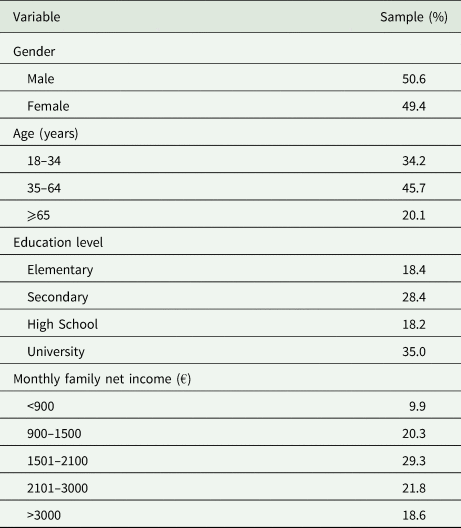
A total of 415 surveys were conducted in December 2017 and January 2018, in areas around the main shopping areas. To design the sample, we used population data for Madrid in 2016, provided by the Spanish National Statistics Institute (INE, 2017). Stratified random sampling was used, by gender and age (between 18 and 34 years, 35 and 64 years, and over 65), for a sampling error of less than 5% and a confidence interval of 95.5% (P = q = 0.5; k = 2). Table 1 shows the socioeconomic characteristics of the sample. Before starting the fieldwork, a preliminary questionnaire was administered to 25 food consumers to ensure the questions had been properly designed and were easily understandable.
Socio-economic characteristics of the sample of participants in the consumer panel (%)

Following an initial analysis of the data and drawing on the work by Bernabéu and Tendero (Reference Bernabéu and Tendero2005), it was decided to analyze the differences between the consumers for each of the variables under study, considering the intention of purchasing organic foods. We segmented the consumers into three groups according to their self-reported intention to buy organic products. The consumers were classified according to their answers to the question: Do you currently intend to buy organic products? The first group comprised consumers that reported a clear intention to buy organic foods (answering yes, or probably yes), with the segment being labeled ‘Consumers interested in buying organic food’ (CIBOF). This segment accounted for 60.2% of the overall sample. The second segment was formed by consumers with no clear intention to buy organic foods (answering no or probably not), with the group being given the name of ‘Consumers not interested in buying organic food’ (CNIBOF), and accounting for 21.0% of the sample. The intermediate segment was made up of consumers whose intention was neither positive nor negative (answering I don't know). This group was identified as the segment of ‘undecided’ consumers, accounting for 18.8% of the sample.
Using analysis of variance, for each of the groups and using their responses to a number of statements, we examined consumers' attitudes toward protecting the environment, their lifestyle, their attitude during the purchasing process and their WTP for different types of organic foods.
The methodological approach of this study can be divided in two different parts, linked on the basis of consumer segmentation and using consumer self-reported attitudes toward organic foods. In the first part of the study, the relationship between self-reported attitudes toward organic food and the WTP for this certified food is analyzed, including reference to different food categories. In the second part of the study, we focus on a specific product, tomato, and evaluate how pro-organic consumers value the organic label when they have to consider the organic label together with other attributes (price, type and origin). Using this approach, we assess whether a higher WTP reported for organic products in general is also translated into higher importance attributed to the organic certification label when buying a specific product.
Determining the maximum WTP for organic foods
Logistic regression was used to determine the maximum WTP. Based on logistic regression, the Contingent Valuation Method (CVM) consists simply in asking a group of individuals how much they would be prepared to pay for a specified good, or, following Bishop and Heberlein (Reference Bishop and Heberlein1979), asking consumers whether they would buy a certain good at a specific price. The 1980s saw a rapid growth in interest in the CVM, with Hanemann (Reference Hanemann1984) being the author that established the theoretical foundations for its subsequent application.
To calculate the difference in price between organic and conventional food products, consumers respond to a series of questions on their WTP. Following Gil et al. (Reference Gil, Soler, Díez, Sánchez, Sanjuán, Ben Kaabia and Gracia2000b), we opted for a mixed format, with both binary and open-ended questions. The aim of the first question was to ascertain whether the respondent was willing to pay a specific premium (10, 20 or 30% above the price of the conventional product), randomly establishing three proportional groups for each of the price increments. Depending on whether the answer to this question was positive or negative, consumers were asked another question. In the first case, they were asked how much more they would be prepared to pay, and in the second case, they were asked the maximum premium they would be willing to pay.
In accordance with Hanemann (Reference Hanemann1984), the maximum willingness to pay (MWP) is calculated by means of the following logarithm:

where P i is a dichotomous variable that takes the value of one if the consumer is willing to pay the premium and zero if not, A i refers to the initial prices offered to the consumers (10, 20 and 30%), a and b are the parameters to be estimated and u i is the error term. Based on the previous logarithm, the mean WTP is calculated as follows:

Finally, it was verified that the variables do not follow a normal distribution. Nonetheless, the Snedecor F statistic was sufficiently robust to apply the analysis of variance to contrast differences between scaled variables and differences in the maximum WTP (Canavos, Reference Canavos1998). However, first, the homogeneity of variances was contrasted using the Levene test.
Determining consumer preferences for organic foods
The conjoint analysis method (Green and Rao, Reference Green and Rao1971) has emerged as a useful technique to evaluate consumer preferences toward the different attributes of a food product, determining the relative importance (RI) of each of the product's attributes in consumers' buying decisions.
To determine the RI of the attributes and to verify the stability of consumers' self-reported attitudes toward organic products with respect to buying a specific food, we evaluated the consumers' preferences toward tomatoes. The aim of this point was to evaluate the RI of ‘organic production’ compared to other attributes of tomatoes, such as price or origin, with the consumer being asked to evaluate the importance of all the attributes in conjunction. Tomatoes were chosen as they are a food product that is familiar to consumers and which can easily be found in the market in both conventional and organic versions.
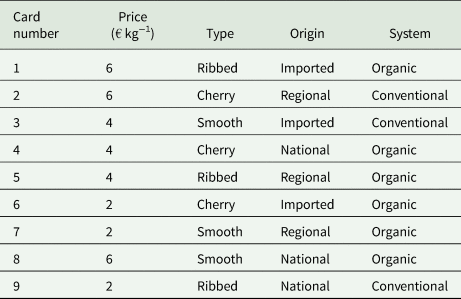
The tomato attributes to be evaluated were selected by means of interviews with experts and a preliminary questionnaire intended to identify the most representative attributes in a consumer's tomato purchasing process. Accordingly, the most representative attributes considered by consumers when buying tomatoes are as follows: price (6, 4 and 2 € kg−1), type (smooth, ribbed and cherry), origin (regional, national and imported) and production system (organic and conventional).
These four attributes and their eleven levels gave rise to 54 profiles, which is a high number of stimuli for a consumer to be shown. Hence, we used an orthogonal design which allowed us to reduce the combinations to nine cards (SPSS, 2013). The choice of an orthogonal design rather than presenting all the combinations reduces the obtainable information to only the main effects of attributes, eliminating interactions. It has, however, the advantage of only offering nine products to each respondent, and this advantage was deemed to outweigh the drawback mentioned (Braña et al., Reference Braña, Ferraces and Válera1995).
Once the cards had been designed, they were presented to the respondents, who were asked to express their preferences and assign a rating between 1 and 10, with one being the least preferred product and 10 the most preferred. The aim of this method is to identify and quantify the consumers' attitudes in order to determine what they actually prefer, as well as establishing the characteristics with the greatest impact on overall preferences as regards the product (Table 2).
Hypothetical tomato cards shown to those surveyed

The specification of the joint analysis model is based on the hypothesis that the respondents' preferences, or their overall evaluation of the products included in the survey, are obtained from the individual scores for each attribute, such that the sum of these scores generates the total evaluation (Steekamp, Reference Steekamp1987). We used an additive model as it explains, in almost all cases, a very large percentage (between 80 and 90%) of the variation in individuals' preferences (Hair et al., Reference Hair, Anderson, Tatham and Black1999). It is formulated by the following equation:

where β 1i, β 2j, β 3k y β 4l are the coefficients associated with levels i (i = 1, 2, 3); j (j = 1, 2, 3), k (k = 1, 2, 3), and l (l = 1, 2) of the attributes of price (1), type (2), origin (3) and system (4), respectively, where D 1i, D 2j, D 3k and D 4l are the fictitious variables for each attribute, considering the levels of each attribute to be categorical.
Additionally, given that one of the aims of the present study was to identify the differences in the preference structures in the purchase of organic food products across the three groups of consumers (CIBOF, undecided, and CNIBOF), the conjoint analysis model had to take into account this division in the market. To this end, we also included belonging to the different groups as fictitious variables. Thus, the model was defined as follows:

where:
E = Each respondent's evaluation of each of the hypothetical tomatoes.
P2€ = Tomato price, 2 € kg−1.
P$€ = Tomato price, 4 € kg−1.
LIS = Fictitious variable for smooth tomato.
ACO = Fictitious variable for ribbed tomato.
CLM = Fictitious variable for tomato from the consumer's region.
RESP = Fictitious variable for tomato from the rest of Spain.
ECO = Fictitious variable for organic tomato.
CIBOF = Fictitious variable for consumers that have the intention to buy organic foods.
CNIBOF = = Fictitious variable for consumers that do not have the intention to buy organic foods.
_ = Indicates interaction between variables.
ɛ = Random disturbance.
The results for the partial utilities of each profile, the total utility of each profile, as well as the goodness of fit, were estimated using the Conjoint module included in the SPSS (2013) software package.
The result allowed us to estimate the partial utilities of each of the attributes and the total utility of each profile (Hair et al., Reference Hair, Anderson, Tatham and Black2007). The RI of attributes is calculated in the following manner: First, for each attribute, determine the highest and lowest utility values for the attribute. The difference between the highest and lowest utility values is the attribute utility range. Next, take the sum of the ranges over all attributes (Halbrendt et al., Reference Halbrendt, Wirth and Vaughn1991). The RI of an attribute (n) is defined as:

Results and discussion
Effect of concern for the environment and lifestyle
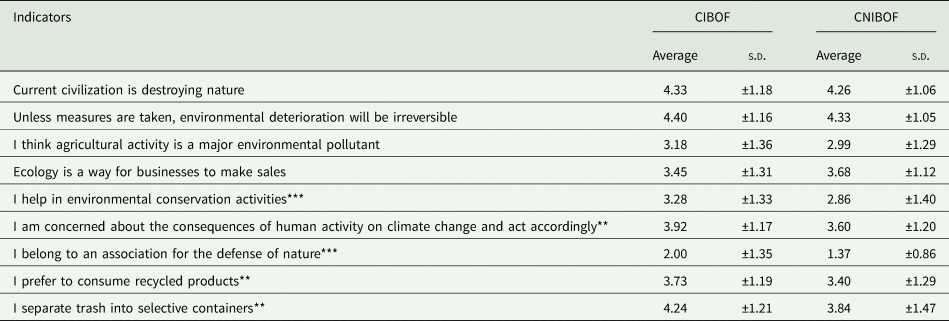
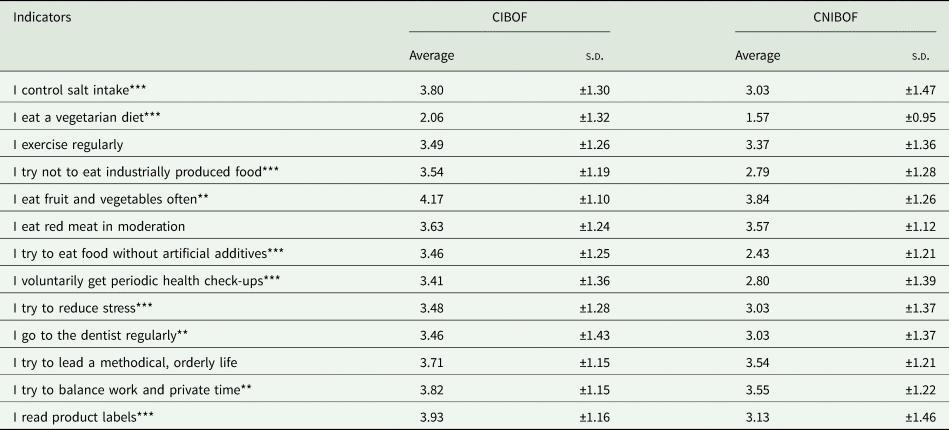
Concern for health and the environment have been identified as two of the most important factors determining consumers' intention to buy organic products (Kapuge, Reference Kapuge2016; Asif et al., Reference Asif, Xuhui, Nasiri and Ayyub2018). Table 3 show the attitudes toward the environment for the different consumer groups, according to their intention to buy organic products, while Table 4 shows their attitudes toward indicators from a study on healthier lifestyles.
Consumer attitudes toward the environment

CIBOF, consumers interested in buying organic food; CNIBOF, consumers not interested in buying organic food Numbers are the means of consumer responses to statements, ranging from 1 (strongly disagree) to 5 (strongly agree).
*** and **indicate the existence of significant differences for a maximum error level of 1 and 5%, respectively.
Descriptive statistical indicators for consumer lifestyle

CIBOF, consumers interested in buying organic food; CNIBOF, consumers not interested in buying organic food Numbers are the means of consumer responses to statements, ranging from 1 (strongly disagree) to 5 (strongly agree).
*** and ** indicate the existence of significant differences for a maximum error level of 1 and 5%, respectively.
Concern for the environment is one of the leading drivers of increased consumption of organic products (Thøgersen et al., Reference Thøgersen, Jørgensen and Sandager2012), due to the growing awareness of environmental problems (Paul and Rana, Reference Paul and Rana2012) and the notion that food can help meet present and future environmental challenges (Ghali-Zinoubi and Toukabri, Reference Ghali-Zinoubi and Toukabri2019). Our results show that the consumers with the most favorable attitudes toward organic products are also those that most collaborate in environmental conservation activities and those that most frequently belong to nature protection associations (P < 0.01). They are also those most concerned about the impact of human activity on climate change and those that most tend to recycle and acquire recycled products (P < 0.05). However, there are no significant differences compared to the CNIBOF group in other factors related to concern for environmental degradation.
In comparison to the work by Ureña et al. (Reference Ureña, Bernabéu and Olmeda2008), also conducted on Spanish consumers with a comparable sample, we find that the mean scores on the indicators of consumers' attitudes toward the environment are maintained or have increased, suggesting that the population's environmental awareness has clearly grown in recent years (Paul and Rana, Reference Paul and Rana2012; Grunert et al., Reference Grunert, Hieke and Wills2014). While this greater awareness is higher among consumers in the CIBOF group, it can be said to generalized across the entire population.
The differences between the consumers in the CIBOF and CNIBOF groups as regards lifestyle habits are significant (Table 4). Those in the CIBOF group control their salt intake more, are more likely to be vegetarians, try to avoid eating industrially produced food, have periodical health checks, try to reduce their stress levels and read quality labels (P < 0.01). They also eat more fruit and vegetables, go regularly to the dentist and try to balance their work and private lives (P < 0.05) to a greater degree than their counterparts in the CNIBOF group. Thus, although the true health benefits of consuming organic products are still a question under discussion (Bourn and Prescott, Reference Bourn and Prescott2002), studies on consumers continue to suggest that greater concern for one's health is directly related to a greater interest in buying organic products (Kapuge, Reference Kapuge2016; Asif et al., Reference Asif, Xuhui, Nasiri and Ayyub2018; Ghali-Zinoubi and Toukabri, Reference Ghali-Zinoubi and Toukabri2019).
Consumer WTP for organic food
As evidenced in previous studies, the WTP of consumers with a more positive self-reported attitude toward organic food products (CIBOF) is higher than that of those without positive attitudes (Gil et al., Reference Gil, Gracia and Sánchez2000a; Ureña et al., Reference Ureña, Bernabéu and Olmeda2008; Bean and Sharp, Reference Bean and Sharp2011; Lund et al., Reference Lund, Andersen and O'doherty Jensen2013) (Table 5). Levels of WTP for organic products vary greatly across countries, ranging from 10 to more than 80% (Aryal et al., Reference Aryal, Chaudhary, Pandit and Sharma2009; Tranter et al., Reference Tranter, Bennett, Costa, Cowan, Holt, Jones, Miele, Sottomayor and Vestergaard2009; Akgüngör et al., Reference Akgüngör, Miran and Abay2010; Sriwaranun et al., Reference Sriwaranun, Gan, Lee and Cohen2015), with mean values of 31.9% in Europe, 25.5% in North America, 31.8% in Asia and 17.2% in Oceania (Li and Kallas, Reference Li and Kallas2021). In Spain, Rodríguez-Bermúdez et al. (Reference Rodríguez-Bermúdez, Miranda, Orjales, Ginzo-Villamayor, Al-Soufi and López-Alonso2020) recently determined that WTP for organic products is between 10 and 30%, depending on the product, with this being below the mean values observed in other European countries (Li and Kallas, Reference Li and Kallas2021). It should also be considered that the use of WTP has some limitations (Rödiger and Hamm, Reference Rödiger and Hamm2015) and previous studies have found that the actual WTP of organic food buyers is higher in reality than that obtained in surveys using questions related to WTP (Rödiger et al., Reference Rödiger, Plaßmann and Hamm2016).
Consumer WTP for organic food (% of premium compared with conventional food)

CIBOF, consumers interested in buying organic food; CNIBOF, consumers not interested in buying organic food.
*** indicates the existence of significant differences for a maximum error level of 1%.
The specific product selected in the different studies on WTP is crucial, since consumers' responses change according to the reference used to identify greater WTP (Krystallis et al., Reference Krystallis, Fotopoulos and Zotos2006; Aryal et al., Reference Aryal, Chaudhary, Pandit and Sharma2009). Our results suggest that among CIBOFs the WTP for different types of organic foods ranges between 15.2 and 20.1%, being significantly higher than that reported by CNIBOFs for most products. Previous studies have reported that consumers of organic products showed lower price sensitivity (Schäufele and Hamm, Reference Schäufele and Hamm2018). This greater WTP is exhibited for cereals and legumes (20.1%) and for vegetables and tubers (19.5%), with the lowest reported rates being for eggs (15.6%) and red meat (15.2%). These findings coincide with those obtained in previous studies that suggest the greatest WTP is found for less processed products, such as fruit and vegetables (Marchesini et al., Reference Marchesini, Hasimu and Regazzi2007), being lower for eggs and meat (Gil et al., Reference Gil, Gracia and Sánchez2000a; Krystallis et al., Reference Krystallis, Fotopoulos and Zotos2006). It is worth noting, however, that although there are significant differences between the two groups, the WTP in both segments is relatively low. This shows that price continues to be a substantial limiting factor in the acquisition of organic products, even among the more involved consumers.
Organic production vs the other attributes
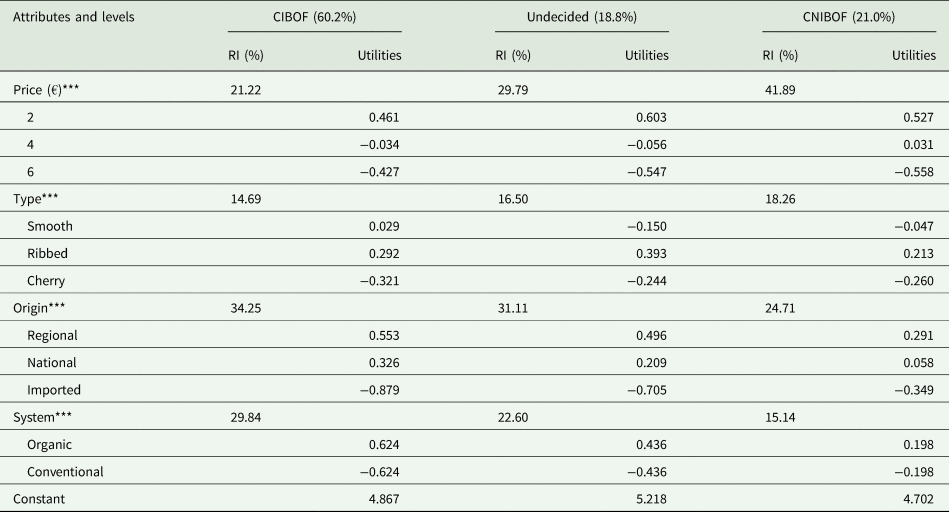
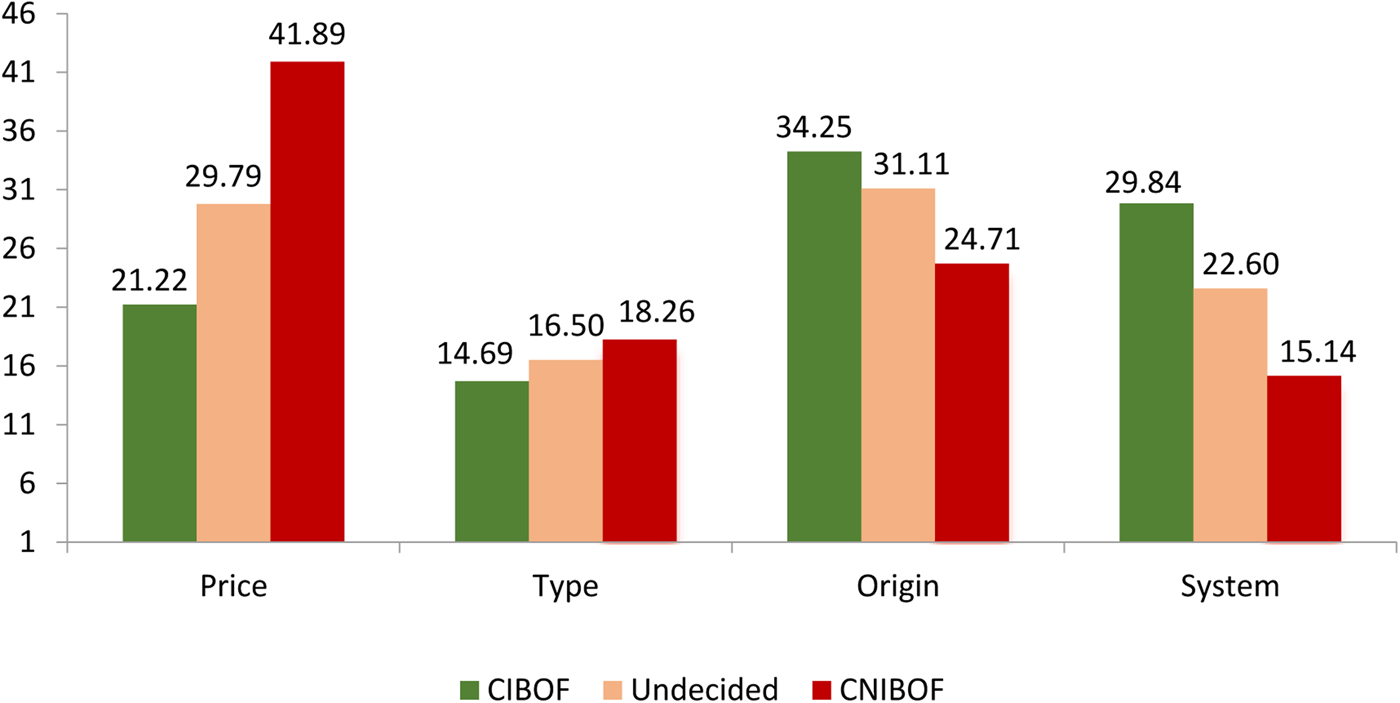
When the importance attributed to organic production is compared to the importance attached to the other attributes affecting the decision to purchase a specific product, we find significant differences between our consumer segments (Table 6). When buying tomatoes, the CIBOFs primarily value quality attributes (origin and production system), while the CNIBOFs essentially base their decision on price. The production system (organic or conventional) is the factor least valued by consumers uninterested in buying organic food. This consumer segment shows a highly price-dependent purchasing decision. The high prices typically associated with organic products might be behind this price-dependent segment's scant interest in organic production (Aguirre González, Reference Aguirre González2009; Bryła, Reference Bryła2016; Kushwah et al., Reference Kushwah, Dhir, Sagar and Gupta2019). In an extensive review of the literature, Kushwah et al. (Reference Kushwah, Dhir, Sagar and Gupta2019) established that high prices were a leading cause of consumers' resistance to acquiring organic products. Our study finds that this is only true in the case of the non-involved consumers.
Relative importance (RI) of attributes (%) and utilities of levels of tomato consumers

CIBOF, consumers interested in buying organic food; CNIBOF, consumers not interested in buying organic food.
*** Indicates significant differences with a maximum error of 1%.
Pearson's R and Kendall's Tau for significant correlations (P < 0.001) between observed and estimated preferences.
It should be noted that, even for consumers more interested in acquiring organic products, origin continues to affect the purchasing decision more than the production system (Fig. 1). Similar results were reported by Hempel and Hamm (Reference Hempel and Hamm2016), who found that German consumers preferred locally produced food to organic food. Our results contrast with those reported by Gracia et al. (Reference Gracia, Barreiro-Hurlé and Galán2014) for the Spanish egg market, as these authors found a small segment of consumers that valued the production system over the origin. However, these differences can be linked, among other factors, to the product analyzed, as higher consumer responsiveness to egg production methods may be expected due to animal welfare considerations.
Relative importance of tomato attributues (%) for the three consumer segments.

The use of origin as a guarantee of product quality has already been reported for numerous foods, including meat and other fruits (Bernabéu et al., Reference Bernabéu, Rabadán, El Orche and Díaz2018; Schnettler et al., Reference Schnettler, Ruiz, Sepúlveda and Sepúlveda2008; Skuras and Vakrou, Reference Skuras and Vakrou2002; Rabadán et al., Reference Rabadán, Martinez-Carrasco, Brugarolas and Bernabéu2021). According to the study by Gracia et al. (Reference Gracia, De Magistris and Nayga2012), food production in closer proximity to consumers is now interpreted as production that is more sustainable, of higher quality (fresher and healthier) and as promoting economic and social justice. Thus, to most intents and purposes, the origin factor could be at least a partial substitute of the organic production label (Kapuge, Reference Kapuge2016; Asif et al., Reference Asif, Xuhui, Nasiri and Ayyub2018; Kushwah et al., Reference Kushwah, Dhir, Sagar and Gupta2019). This idea is similar to that proposed by Costanigro et al. (Reference Costanigro, Kroll, Thilmany and Bunning2014) who reported that the organic label and the origin were partial substitutes. Developing this idea and also considering our results, combined use of both attributes would be advisable in the marketing of organic foods.
Conclusions
Our results show that the consumers with the most interest in organic products are also those that most value this quality label when buying, compared to the other attributes. However, among these consumers with a greater interest in buying organic food, the origin is more valued than the production system when acquiring a product. Similar results have been reported in works in which consumers are not segmented, but our findings reveal the limitations of organic labels in encouraging purchasing by themselves even among highly involved consumers. Pro-organic consumers require further information about their food, and the origin attribute seems crucial to them. As a result, a combined reference to the origin and organic label could be advisable in the promotion of organic food. The current highly informed consumer demands increasing amounts of information about where and how their food has been produced and the food sector should be able to satisfy these demands.
This opens up a debate on the usefulness of these differentiated quality labels, where organic production appears to be less important than a reference to local production as a guarantee of more sustainable, healthier, higher quality products that represent fairer trade. In the current scenario of growth in short distribution channels in the agri-food sector, this is a crucial topic deserving greater in-depth study.
This study evidences that the WTP for organic foods in Spain is highly limited in comparison to that observed in most European countries in previous studies (Li and Kallas, Reference Li and Kallas2021). Future studies should analyze the reasons for this finding so as to establish strategies designed to bring Spanish rates of WTP into line with the general trends in other European nations. A priori, the lower mean income in Spain, compared to that in central and northern European countries, could be viewed as one of the main causes of this lower WTP.
This study is not without its limitations. The first is that it was developed in Madrid and nearby towns, while the results are extrapolated to the whole country. The second is related to the use of gender and age for the stratified sampling. Arguably, the use of education and income would have been more appropriate as attitudes toward organic products rely more on these variables. The third is one of the classic weaknesses of marketing studies in that the work analyses consumers' intentions to buy and not their actual purchases, with there always being a possibility of intentions not fully matching final purchasing actions.
Future studies should examine the specific reasons reported by consumers for acquiring organic foods and whether these are really different from those mentioned when buying local products. Thus, it would be possible to determine whether these quality factors might coexist, or, in contrast, are being used as proxies for quality to obtain similar information.