Introduction
The tapeworm Caryophyllaeus laticeps (Pallas) is a well known intestinal parasite of cyprinid fish (Bykhovskaya-Pavlovskaya et al., Reference Bykhovskaya-Pavlovskaya, Gusev, Dubinina, Izyumova, Smirnova, Sokolovskaya, Shtein, Shulman and Epshtein1964; Mackiewicz, Reference Mackiewicz1972; Schäperclaus, Reference Schäperclaus1990; Hoole et al., Reference Hoole, Bucke, Burgess and Wellby2001).The bream Abramis brama (L.) and white bream Blicca bjoekma (L.) are cited by Amlacher (Reference Amlacher1992) as its major hosts, but C. laticeps has also been found to occur in the majority of cyprinids, including the nase Chondrostoma nasus (L.) with varying prevalences depending on the fish species (Macko et al., Reference Macko, Ryšavy, Špakulova and Kralova1993). The first study on the population biology of the Caryophyllidae was published by Wunder (Reference Wunder1939) on carp Cyprinus carpio L. from fish ponds in Silesia. Further studies of wild fish populations have been carried out by Kennedy (Reference Kennedy1968, Reference Kennedy1969, Reference Kennedy1971), Anderson (Reference Anderson1974), Pojmanska (Reference Pojmanska1984), Evlanov & Kolokolnikova (1991) and Aydogu et al. (Reference Aydogu, Kostadinova and Fernandez2003), among others. Within the fish host, C. laticeps has been found to occupy the entire intestine showing varying preferences, e.g. in the middle and posterior regions of the alimentary tract in bream (Pojmanska & Choloniewski, Reference Pojmanska and Choloniewski1991) and in the proximal region in carp (Wunder, Reference Wunder1939).
The life cycle of C. laticeps involves cyprinid fish as definitive hosts with oligochaetes of the genus Limnodrilus and Tubifex as intermediate hosts (Kulakovskaya, Reference Kulakovskaya1962, Reference Bykhovskaya-Pavlovskaya, Gusev, Dubinina, Izyumova, Smirnova, Sokolovskaya, Shtein, Shulman and Epshtein1964). These tubificids live mainly in slow-flowing or standing waters with muddy or sandy grounds (Engelhardt, Reference Engelhardt1996). Chondrostoma nasus belongs to the group of rheophilic fish, which spend their entire life cycle in and along the banks of rivers (Schiemer, Reference Schiemer1988). Chondrostoma nasus is a highly specialized feeder, initially feeding mainly on zooplankton in early ontogeny, and then almost exclusively on algae, which are abraded from the surface of rocks and stones (Reckendorfer et al., Reference Reckendorfer, Keckeis, Tiitu, Winkler, Zornig and Schiemer2001). A small number of benthic invertebrates are additionally ingested. Due to this specialized feeding behaviour, C. nasus is found in rivers with gravel and rocky grounds, mostly in the grayling and barbel zones (Gerstmeier & Roming, Reference Gerstmeier and Roming2003). The special diet and the preferred habitat of C. nasus seem to be the main reasons for the relative scarcity of the helminth community in nase, which has been reported by Lawrynowicz (Reference Lawrynowicz1968).
From parasitological examinations of C. nasus in seven different sites in Austria, C. laticeps was recorded for the first time in this host in Austrian waters. In addition to this finding, the aim of the present study is to further our understanding of the effects of anthropogenic intervention in river morphology on the transmission of C. laticeps in the nase.
Materials and methods
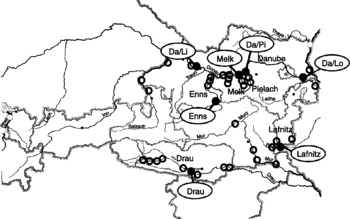
The study areas (fig. 1) represent the most frequent sites of occurrence of C. nasus in central, south, and eastern Austria (Tabernig, Reference Tabernig2003). The most important nase populated river is the Danube, one of the largest river systems in Europe. The Austrian segment of the Danube is approximately 350 km long (Schiemer & Spindler, Reference Schiemer and Spindler1989). Therefore the following sites were chosen along the Danube: Danube-Lobau, Danube-Pielach, Melk River and Danube-Linz. Furthermore, a part of the Enns River, an important tributary to the Danube, was selected as a separate site, approximately 80 km south of the Danube-Linz site. Southern and eastern Austrian sites were the Drau River at Rosegg and the Lafnitz River near the Hungarian border, both also parts of the Danube basin, with their connections to the Danube far east in Hungary and Serbia, respectively.
Chondrostoma nasus in Austria. ○, Sites of occurrence after Tabernig (Reference Tabernig2003); ●, sites for collection from April 2003 to November 2006: Da/Lo, Danube-Lobau; Da/Pi, Danube-Pielach; Melk; Da/Li, Danube-Linz; Enns; Drau; Lafnitz.

The Danube-Lobau site is located within The Donau Auen National Park east of Vienna, the largest natural riparian wetlands in Central Europe, which remain, to a high degree, ecologically intact (National Park Donau Auen, 2007).
The Danube-Pielach site is situated approximately 80 km west of Vienna within the estuary of the Pielach River. The Pielach River itself is one of the few rivers in Lower Austria that has almost been left in its natural state throughout its course, showing only minor anthropogenic alterations. The ultimate 2.5 km of the river and its estuary have been described as the most important region for the natural maintenance of the nase population in the Danube (Jungwirth et al., 2001). At this location, a total of 1250 nase specimens were observed during the 1997 spawning season (Melcher, Reference Melcher1999). The Danube-Lobau and the Danube-Pielach sites are situated within the only two free-flowing stretches of the Danube in Austria (Kovacek-Mann, Reference Kovacek-Mann1992; Humpesch, Reference Humpesch and Kinzelbach1994).
The Melk River, which flows into the Danube approximately 1 km upstream of the Pielach, was selected as a separate study site. Fish populations in the Melk had been isolated from the Danube by a 4 m high dam that blocked migration into and from the Danube for several decades, until a fish ladder was built in spring 2003. During the spring and summer of 2003, when fish for this survey were taken from the Melk, the upstream migration of fish was recorded and no significant migration of nase from the Danube was observed (Jirsa, Reference Jirsa2004; Zitek et al., Reference Zitek, Schmutz and Jungwirth2004). The Danube-Linz site is located approximately 170 km upstream from Vienna, between Wilhering and Linz, where a part of the stream flows through a heavily industrialized landscape. The Enns site is the dammed 13.1 km stretch of the Enns River between the Weyr and Großraming hydroelectric power plants in Upper Austria (Ennskraft, Reference Ennskraft2007). An important tributary is the Neustiftbach, which is used as the spawning ground by C. nasus enabling a self-sustaining population in this area. It is also the source of spawn of this species used by the fish breeding plant of the Federal Agency of Water Management in Kreuzenstein (N. Schotzko, personal communication).
Fish from the Drau River were caught at a 6.5 km segment of the river at Rosegger Schleife, the only free flowing stretch of this river in Austria. Although free flowing, water levels are controlled by the Draukraftwerke AG, the agency that operates the ten hydroelectric power stations along the Drau River in Austria. The site is flooded regularly with spates from the hydroelectric power plant upstream at Rosegg. It is connected with the downstream reservoir of Feistritz-Ludermannsdorf by a fish ladder. Chondrostoma nasus uses the Rosegger Schleife as a spawning ground and the fry remain there for between 1 and 2 years. Fish then migrate into the downstream reservoir where they stay until maturation, before returning to the Rosegger Schleife (Kerschbaumer et al., Reference Kerschbaumer, Prochinig, Gross, Hradetzky, Konar and Prochinig2002).
The Lafnitz site is located near Dobersdorf, approximately 12 km upstream of the Hungarian border. The river there is described as a close-to-nature epipotamal and is inhabited by approximately 40 fish species (Woschitz, Reference Woschitz1996), with barbel Barbus barbus (L.) and nase being dominant (Lang, Reference Lang1993).
For the present investigation, a total of 198 medium and large size C. nasus specimens were taken by electro-fishing between April 2003 and November 2006 and transported to one of several laboratories: University of Vienna for the fish from Lafnitz, Danube-Lobau and Enns; the Veterinary University of Vienna for the fish from Melk and Danube-Pielach; the Institute for Water Ecology, Fisheries, and Lake Research, Scharfling for the fish from Enns and Danube-Linz; and the Carinthian Institute for Lake Research, Klagenfurt for the fish from the Drau site. Fish were maintained for up to 24 h in aerated tanks and killed by cervical dislocation prior to parasitological examination using conventional techniques described by Schäperclaus (Reference Schäperclaus1990) and Amlacher (Reference Amlacher1992). The total caudal length, weight, sex and age of each fish were recorded. The parasitological terms are those used by Bush et al. (Reference Bush, Laferty, Lotz and Shostak1997).
Results
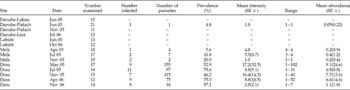
Caryophyllaeus laticeps was not found in the nase from the Danube-Lobau site, the Danube-Linz site nor from the Lafnitz River. At the Danube-Pielach site, only a single parasite was recovered in June and none in November. In the C. nasus from the Melk River, the prevalence of C. laticeps increased from 5.6% in April, to 11.8% in July and 20.0% in November. The intensity of infection remained low, ranging from 4 worms per host in April to only 1 in November. At the Enns site, 75.0% of fish were infected in April with a mean intensity of 8.8, whereas in November the prevalence was 57.0% with a mean intensity of 2.0. The highest number of parasites (155 worms) was found in the nase population in the Drau site, where high prevalence values of 52.9% in May, 78.6% in July and 46.2% in November were recorded, with respective mean intensities of 17.2, 8.8 and 16.4. The highest intensity of infection also occurred in fish from the Drau site with 102 individuals of C. laticeps being recovered from the intestine (table 1).
Levels of infection of Caryophyllaeus laticeps in the nase from Austrian rivers between April 2003 and November 2006.

The majority of C. laticeps were mature and gravid at most times of the year. Worms were found exclusively in the anterior part of the alimentary tract, which accounted for up to 20% of the entire length.
Discussion
Studies on the helminth community of C. nasus are scarce. As many intestinal parasites use invertebrates as intermediate hosts which are eaten by the definitive host, the nase rarely becomes infected in its natural environment due to its predominantly herbivorous diet (Lawrynowicz, Reference Lawrynowicz1968). The present study has shown that the nase is very susceptible to infections with C. laticeps in areas where the feeding ground of nase and the habitat of tubificids, as intermediate hosts, overlap. The study reports for the first time the occurrence of C. laticeps in the nase from Austrian rivers and also reports the highest prevalence and intensity of infections recorded. Žitňan (Reference Žitňan1966) reports intensities of 1–3 for Caryophyllaeus fennica in the nase from the Tisza River and Macko et al. (Reference Macko, Ryšavy, Špakulova and Kralova1993) list C. laticeps among ‘other hosts’, with no infection values given.
The areas of the Drau or the Enns River, where fish samples were taken, exhibit conditions that are normally not favoured by C. nasus as its habitat. Zitek et al. (Reference Zitek, Schmutz and Jungwirth2004) have shown the nase in the Melk River to evade slow flowing areas and ponds. Following the opening of fish ladders in 2003, up to 75% of the autochthonous population left the dammed area near Melk Monastery and wandered approximately 20 km upstream to more pristine areas.
One effect on the population dynamics of C. laticeps in its definitive host is the amount of uptake of larvae by the fish (Anderson, Reference Anderson1976). Whereas predatory cyprinid fish show varying food preferences in response to prey densities (Ivlev, Reference Ivlev1961), C. nasus feed on algae during the entire season. In areas where fish are obstructed from migrating and large gravel banks are absent as feeding grounds, for example in the Drau or the Enns River, C. nasus will feed on a high proportion of detritus and mud, including infected tubificids. This might explain the high levels of infection in these sites, which are similar to the infection levels found in the bream shown by Anderson (Reference Anderson1974), Evlanov & Kolokolnikova (Reference Evlanov and Kolokolnikova1991) and Karanis & Taraschewski (1993), among others.
Despite the high level of infection in the nase population, other sympatric cyprinid species show much lower levels or no infection, probably due to their different feeding habits. Laimgruber et al. (Reference Laimgruber, Schludermann, Konecny and Chovanec2005) found no C. laticeps in B. barbus from the Danube-Pielach site, nor from the Drau site. Caryophyllaeus laticeps was also not detected in the population of adult chub Leuciscus cephalus (L.) from the Danube-Pielach site nor the Melk River by Jirsa (Reference Jirsa2004). Karanis & Taraschewski (1993) report its occurrence in chub sympatric to bream from the Ruhr-lake near Bochum, Germany, but with a much lower prevalence.
Within the nase, C. laticeps was confined to the anterior region of the intestine, unlike the wider distribution of C. laticeps in the intestine of bream as described by Pojmanska & Choloniewski (Reference Pojmanska and Choloniewski1991) and Karanis & Taraschewski (Reference Karanis and Taraschewski1993). The only other intestinal helminth species found in the present study was the acanthocephalan Pomphorhynchus laevis and in only small numbers. Therefore interspecific competition can be excluded as the reason for such a restricted intestinal distribution shown by C. laticeps. On the other hand, it is possible that the intestinal morphology is a determining factor. Due to its herbivorous diet, the intestine of nase is much longer and thinner than that of other cyprinid fish (Gerstmeier & Roming, Reference Gerstmeier and Roming2003). Only the first third of the intestine possesses a thick mucosa, comparable to bream or carp for example, whereas the rest of the intestinal wall is relatively thin. Caryophyllaeus laticeps becomes attached to the mucosal epithelium using its scolex (Karanis & Taraschewski, Reference Karanis and Taraschewski1993). We consider that the epithelium in the posterior region of the intestine is too thin to allow C. laticeps a firm adhesion, as the scolex lacks hooks, thereby accounting for its absence in this area.
The loss of spawning and feeding grounds caused by severe anthropogenic changes in the habitat of the nase are considered to be the major reasons for the abatement of nase populations in Austrian rivers (Keckeis, Reference Keckeis2001). We suggest that the parasitic pressure on the nase population in rivers like the Drau or the Enns, due to unusually high infections with C. laticeps, might have an additional negative influence on population development. Severe damage to the intestine was not observed, even in highly infected adult fish. However, the mortality of juvenile carp due to blockage of the intestine with Caryophyllidae has been well documented (Schäperclaus, Reference Schäperclaus1954; Kanaev, Reference Kanaev1956). Therefore, C. laticeps infections may well be a major factor in contributing to the mortality of juvenile nase population in these rivers, but this requires further investigation. For the same reason the frequent occurrence of C. laticeps in these rivers might also increase mortality amongst other juvenile fish species that are regularly stocked in these rivers (G. Kerschbaumer, personal communication; N. Schotzko, personal communication).
The present study therefore provides a good example of the possible consequences of anthropogenic intervention to a host–parasite system; altering the river morphology of the Enns and the Drau led to a change in the structure of the macro-zoobenthic community and a strong colonization of the river beds with tubificids. Additionally, the presence of a suitable host such as C. nasus has allowed C. laticeps to establish in fish in parts of the river where, due to the lack its natural major host, the bream, the parasite had previous occurred less frequently.
Acknowledgements
The authors sincerely thank Mag. Gerald Kerschbaumer, Mag. Nikolaus Schotzko, Gerhard Woschitz, Dr Gerald Zauner and Dr Andreas Zitek and their crews for their efforts in providing the fish samples, the local fishery authorities for authorizing the catch, Dr Tomáš Scholz for confirming the identification of C. laticeps, and Leonard V. Diplock for reviewing the English of this article.