Implications
Epididymal sperm is an important source of germplasm for animal genetic resource conservation. When semen collection through standard procedures is problematic, the postmortem recovery of epididymal sperm can be the only possibility to preserve male gametes from animals of high value or from endangered species. For each species, standard protocols for the recovery and cryopreservation of epididymal sperm are required. This study was conducted to understand how goat epididymal sperm quality under field conditions was preserved, in particular considering time and temperature of the testicle conservation. Results of this study may improve the use of epididymal sperm in local breed genebanking.
Introduction
Nowadays, examples of application of postmortem sperm collection from the epididymis for the conservation of endangered species as in ibex (Santiago-Moreno et al., Reference Santiago-Moreno, Toledano-Díaz, Pulido-Pastor, Gómez-Brunet and López-Sebastián2006) and in constructing semen banks (Ehling et al., Reference Ehling, Rath, Struckmann, Frenzel, Schindler and Niemann2006; Bagirov et al., Reference Bagirov, Nasibov and Klenovitskii2009; León-Quinto et al., Reference León-Quinto, Simón, Cadenas, Jones, Martínez-Hernández, Moreno, Vargas, Martínez and Soria2009) are reported. However, sometimes, epididymal sperm extraction is not easily practicable in marginal regions, owing to the lack of facilities and expertise near the farming areas of local breeds. Different studies have been conducted to determine the entity of decay of epididymal spermatozoa quality recovered postmortem in different species, under several experimental conditions, including time elapsed between semen collection and freezing and different testicle storage temperatures (James et al., Reference James, Green, Hoffman, Landry, Paccamonti and Godke2002; Martins et al., Reference Martins, Driessen, Melo Costa, Carvalho-Neto, de Sousa, Rumpf and Dode2009; Fernández-Santos et al., Reference Fernández-Santos, Soler, Ramón, Ros-Santaella and Maroto-Morales2011). Overall, it has been observed that the resistance over the time of the spermatozoa collected from the testicles is species specific (Killian et al., Reference Killian, Lubbe, Bartels, Friedmann and Denniston2000; Soler et al., Reference Soler, Perez-Guzman and Garde2003). In goat species, it was demonstrated that epididymal sperm can be successfully cryopreserved and used for in vitro fertilisation and artificial insemination if they were immediately processed after animal death (Blash et al., Reference Blash, Melican and Gavin2000); no information is available in the literature on the quality decay of goat epididymal spermatozoa after animal death. In this study, to establish an optimal protocol for the recovery and cryopreservation of goat epididymal sperm, the pre-freeze and post-thaw quality of epididymal spermatozoa as function of postmortem storage, constituted by time elapsed between animal’s death and sperm recovery (0, 24, 48, 72 h) and testicle storage temperature (environment or +5°C), was investigated.
Material and methods
Experimental design
Testicles from 50 Alpine bucks (35.33±1.29 weeks; 25.49±0.85 kg) were collected postmortem at the local abattoir during the breeding season (October–November). The testicles from each animal were removed on average 1.30 h after slaughter and transported to the laboratory, half (n=50) at environment temperature of 21.48±2.22°C (E) in a Styrofoam box, half (n=50) at refrigeration temperature of +5°C (R) with a portable refrigerator (WAECO, CF-35 Cool freezer, Jointlab, Italy). In the two groups (E and R), the right testicle from each pair was processed after slaughter forming the time 0 groups (0E and 0R). The left testicle was stored at E temperature or at R temperature in a closed plastic bag in a Styrofoam box, then processed after 24 h (T24E, n=8; T24R, n=8), 48 h (T48E, n=8; T48R, n=8) or 72 h (T72E, n=9; T72R, n=9) after animal death.
Testicle preparation, sperm recovery and quality assessment
Testes and epididymides were removed and cleaned as described by Turri et al. (Reference Turri, Madeddu, Gliozzi, Gandini and Pizzi2012). The lumen of the ductus deferens was cannulated before flushing, with a blunted 25-gauge needle to avoid losses of material. Sperm cells were then flushed in a retrograde direction from the ductus deferens through the cauda epididymidis with a syringe loaded with 2 ml of warmed (37°C) Extender 1 (Tris buffer (2.42% wt/vol), fructose (1.0% wt/vol), citric acid (1.38% wt/vol), egg yolk (20% wt/wt) and an antibiotic cocktail containing 5.5 mg/100 ml of tylosin, 27.5 mg/100 ml of gentamycin, 16.5 mg/100 ml of lincospectin and 33.0 mg/100 ml of spectinomycin; pH 7.0, osmolarity 330 mOsm; Blash et al., Reference Blash, Melican and Gavin2000).
Immediately after extraction, epididymal sperm evaluation was carried out. Collected volume (ml), epididymal yield (ml), sperm concentration (109/ml), total number of spermatozoa (109), motility and kinetic parameters, viability and sperm morphology were evaluated.
Epididymal sperm recovery
Collected volume (ml) was assessed using a graduated glass tube; epididymal yield (ml) was calculated as the difference between the amount of collected volume and the amount of diluent loaded in the syringe to recover epididymal sperm. Sperm concentration was estimated by a Corning Colorimeter 253 (Corning Limited, Halstead, Essex, UK; Wavelength: 540 nm, dilution of semen aliquots 10 : 1000 vol/vol in NaCl 7%; two replicates per sample) by converting transmittance in sperm concentration applying a pre-established conversion curve, calculated using an egg yolk diluent. The total number of sperms was calculated by multiplication of the sperm concentration by the semen volume. The number of semen doses producible was calculated by dividing the total number of sperm per 300×106 sperm/straw.
Sperm motility
Sperm motility parameters were assessed using a CASA (computer-assisted semen analysis) system (The Hobson sperm tracker 7V2B; Hobson Tracking Systems Ltd, Baslow, UK). Each sample was diluted (30×106 cells/ml) in saline solution (NaCl 0.9%) and incubated for 20 min in a 37°C water bath. Then a pre-warmed (37°C) Makler Counting Chamber (10 µm depth) was loaded with 10 µl of sample. At least three fields per sample were acquired. The following parameters were recorded: total motility (MOT TOT, %), active cells (ACT, % of sperm with VAP>25 µm/s and STR>75%), hyperactive cells (HYP, % of sperm with VCL>70 µm/s, ALH>5 µm and LIN <30%), average path velocity (VAP, µm/s; the average velocity of the smoothed cell path), curvilinear velocity (VCL, µm/s; the average velocity measured over the actual point to point track followed by the cell), straight-line velocity (VSL, µm/s; the average velocity measured in a straight line from the beginning to the end of the track), linearity (LIN, %; the average value of the ratio VSL/VCL), straightness (STR, %; the average value of the ratio VSL/VAP), amplitude of lateral head displacement (ALH, µm; the mean width of the head oscillation as the sperm swim) and beat cross-frequency (BCF, Hz; the frequency of sperm head crossing the average path in either direction).
Sperm viability
Sperm viability was assessed by means of a dual-staining technique using SYBR-14 in combination with Propidium Iodide (PI; LIVE/DEAD Sperm Viability Kit, Molecular Probes, Invitrogen Corp., Carlsbad, CA, USA). The two stains were prepared as indicated by Garner and Johnson (Reference Garner and Johnson1995). Samples were kept 15 min in the dark before being analysed with a fluorescence microscope (Leica DM-LB 30 FLUO; Leica Microsystems Imaging Solutions Ltd, Cambridge, UK; X40 objective, 450 to 490 nm excitation dual blue/green filters). Two drops of 10 µl of stained semen sample for each epididymidis were prepared on a single slide. Two hundred cells for drop were counted and the percentage of live cells (green stain) and death cells (red stain) was noted. The mean of the two drops per epididymidis was used for statistical analysis.
Sperm morphology
Sperm cell morphology was assessed by the examination of eosin–nigrosin stain-fixed samples. The stain was prepared as indicated by Bakst and Cecil (Reference Bakst and Cecil1997). Ten microlitres of semen were mixed with 500 µl of eosin–nigrosin stain (Sigma-Aldrich, St Louis, MO, USA) for 2 min before preparing each smear, after that it was allowed to air dry. Then slides were permanently sealed with Eukitt mounting medium (O. Kindler GmbH, Freiburg, Germany) and topped with a 22×40 mm coverslip. Two separate smears were prepared for each epididymidis. Two hundred cells for smear were assessed by using a phase contrast microscope (Leica DM-LB 30 FLUO; Leica Microsystems Imaging Solutions Ltd, Cambridge, UK) with a ×100 oil immersion objective, and the percentage of each morphological category was noted. The following morphological categories have been observed: abnormal heads (small, giant, pyriform, narrow at the base head), midpiece (filiform, deformed, double) and tail (coiled around the head, single bent, double bent, angle tail implantation, absent). The mean of the proportions of the morphological categories from the two independent smears per group was used for statistical analysis. Furthermore, the percentage of spermatozoa with proximal or distal cytoplasmic droplet was recorded.
Freezing and thawing of epididymal spermatozoa
After collection, epididymal semen samples were diluted using a two-step procedure, first adding the 75% of the Extender 1 and then the 25% of the Extender 2 necessary to achieve a final concentration of 600×106 sperms/ml. The Extender 2 differed from the Extender 1 by the presence of glycerol, thus obtaining a final concentration of 7% wt/vol in the epididymal sperm solution. Samples were then refrigerated to 5°C on average within 1 h. When samples reached the 5°C, the Extender 2 was added and samples were equilibrated (at 5°C) over a period of 2h and subsequently loaded into 0.5 ml CBS™ High Security Straws (Cryo Bio System, Group IMV Technologies, l’Aigle, France) by using a semi-automatic system of packaging (Cryo Bio System, Group IMV Technologies). Then straws were frozen in nitrogen vapour by placing on a rack at 4 cm above the nitrogen level for 15 min. Subsequently, straws were plunged into liquid nitrogen and stored in liquid nitrogen tanks. After cryostorage of 4 months, two straws per animal were thawed at 37°C for 2 min to determine the post-thaw epididymal semen quality.
Statistical analysis
Statistical analyses were carried out using the SASTM package v 9.2 (SAS Institute Inc., Cary, NC, USA). The two-way analysis of variance procedure (General Linear Model, PROC GLM) was used to analyse the effects of postmortem storage, constituted by postmortem time (PMT=0, 24, 48, 72 h), testicle storage temperature (TEMP=E, R), and their interaction (P×T) on pre-freeze and post-thaw goat epididymal sperm samples. The LSMEANS procedure was used to evaluate the significance of any differences. Results are expressed as adjusted least square means. The root mean square error was used as a measure of precision of the model.
Results
Effects of postmortem storage on pre-freeze epididymal spermatozoa
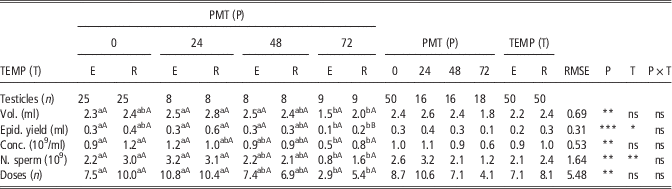
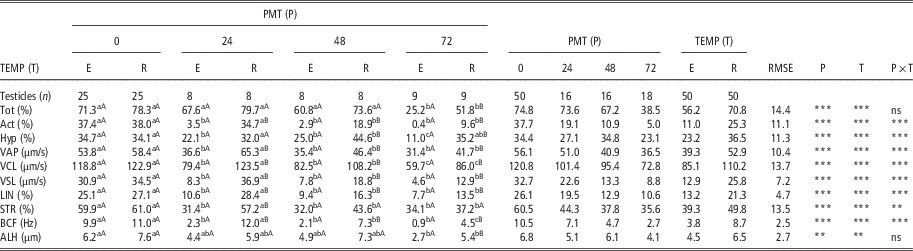
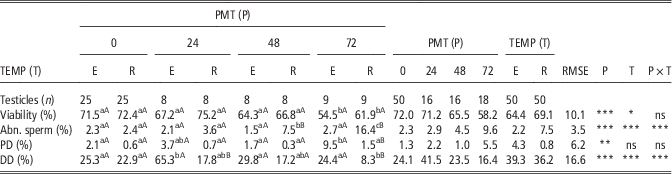
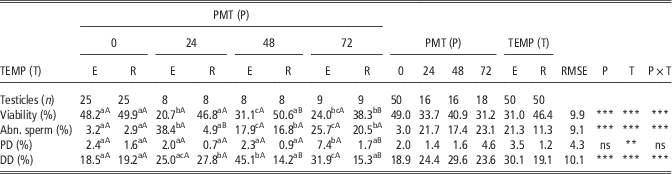
Epididymal sperm was successfully collected from all 100 testicles. The effects of PMT and TEMP on the variable indexes of sperm production are shown in Table 1. The effects of PMT and TEMP on total motility and kinetic parameters, and sperm viability and abnormalities, on pre-freeze epididymal sperm are shown, respectively, in Table 2 and Table 3. Generally, all the parameter indexes of sperm production decrease over time (Table 1). PMT induced a significant reduction in most of these variables at 72 h of testicle conservation (0E v. 72E), with the exception of collected volume and epididymal yield in R samples.
Effects of PMT, TEMP and their interaction on collected volume, epididymal yield, sperm concentration, total number of spermatozoa and number of semen doses of goat epididymal sperm

PMT=postmortem time; TEMP=testicle storage temperature; E=environment temperature; R=refrigeration temperature; RMSE=root mean square error; Vol.=collected volume; Epid. yield=epididymal yield; Conc.=sperm concentration; N. sperm=total number of sperm; Doses=semen doses.
Probability of significant effect because of PMT, TEMP and their interaction (P×T) for goat epididymal sperm quantitative traits (*P<0.05, **P<0.01, ***P<0.001).
Different superscripts in a same line corresponding to a significant difference (P<0.05) between PMT (lower character) and TEMP (upper character).
Effects of PMT, TEMP and their interaction on total motility and kinetic parameters of pre-freeze goat epididymal sperm

PMT=postmortem time; TEMP=testicles storage temperature; E=environment temperature; R=refrigeration temperature; RMSE=root mean square error; Tot=total motility; Act=active cells; Hyp=hyperactive cells; VAP=average path velocity; VCL=curvilinear velocity; VSL=straight-line velocity; LIN=linearity; STR=straightness; BCF=beat cross-frequency; ALH=amplitude of lateral head displacement.
Probability of significant effect because of PMT, TEMP and their interaction (P×T) for pre-freeze goat epididymal sperm qualitative traits (**P<0.01, ***P<0.001).
Different superscripts in a same line corresponding to a significant difference (P<0.05) between PMT (lower character) and TEMP (upper character).
Effects of PMT, TEMP and their interaction on the percentage of viable sperm, abnormal sperm, proximal and distal droplets of pre-freeze goat epididymal sperm

PMT=postmortem time; TEMP=testicles storage temperature; E=environment temperature; R=refrigeration temperature; RMSE=root mean square error; Abn. sperm=abnormal sperm; PD=proximal droplets; DD=distal droplets.
Probability of significant effect because of PMT, TEMP and their interaction (P×T) for pre-freeze goat epididymal sperm qualitative traits (*P<0.05, **P<0.01, ***P<0.001).
Different superscripts in a same line corresponding to a significant difference (P<0.05) between PMT (lower character) and TEMP (upper character).
Concerning motility assessment on pre-freeze samples (Table 2), PMT induced a significant reduction in total motility and ALH kinetic parameter at 72 h of testicle conservation (0E v. 72E; 0R v. 72R; P<0.001; respectively). In the other sperm kinetic parameters, PMT induced a significant reduction over time from the 24E and 48R groups, if compared with the respective time 0 group. Results relating to viability and sperm morphology assessment are shown in Table 3. At 72 h of testicle storage, a significant decrease in the percentage of viable epididymal sperm cells occurred at both temperatures of testicle storage (72E, P=0.0001; 72R, P=0.0088), compared with the respective time 0 group. Considering sperm abnormalities, no significant differences were observed among different times in the E groups. Even in the R samples until the 48 h of testicle conservation, no difference was detected; however, after this time, a significant increase (P=0.0001) in sperm abnormalities was manifested. The majority of morphological defects in pre-freeze samples observed were in tail (97%), consisting mostly part of double bent (69%), coiled around the head (16%), single bent (11%), tail absent (1.5%) and angle tail implantation (1.26%). PMT did not influence the presence of cytoplasmic droplets in pre-freeze samples, with the exception of the percentage of proximal droplets in the 72E group and of distal droplets in the 72R group, where significant higher (0E v. 72E, P=0.0027) and lower (0R v. 72R P=0.0125) values occurred. On average, the percentage of proximal droplets was lower than distal droplets (2.52±3.06% and 26.04±4.52%; respectively).
In the case of testicle conservation temperature (TEMP), refrigeration temperature, at the same PMT, corresponded on average to significant better epididymal sperm quality considering total motility, sperm kinetic parameters and viability parameters. Refrigeration had a significant effect on epididymal yield in the 72R group (Table 1) where higher values were observed (P=0.0162). In case of the percentage of total motility, active and hyperactive cells (Table 2), TEMP had a significant positive effect, respectively, in the 72R (P=0.0003), 24R (P=0.0001) and 48R (P=0.0008) groups, allowing to obtain higher values of these variables in samples stored under R temperature. For the main kinetic parameters (Table 2), refrigeration temperature preserved the epididymal spermatozoa quality, allowing to obtain significantly higher values (24R, P<0.001) from the 24 h of testicle storage.
In the pre-freeze samples, the percentage of viable sperm was not affected by TEMP; however, the percentage of viable sperm in the R groups generally appeared to be higher than in the E groups (Table 3). Storage temperatures did not affect the percentage of abnormal sperm in pre-freeze samples until the 24 h of testicle storage (Table 3). After this period, higher values of sperm abnormalities occurred (48E v. 48R, P=0.0009). Lower values of distal droplets (72E v. 72R, P=0.0233) were manifested in the 72R group (Table 3).
Effects of postmortem storage on post-thaw epididymal spermatozoa
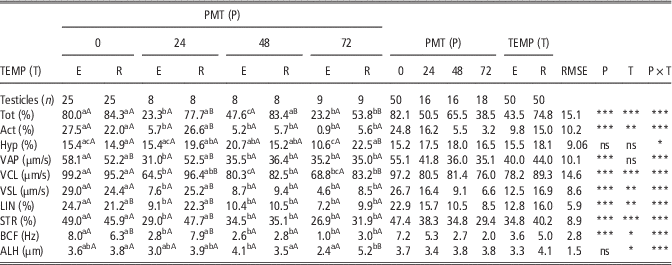
The effects of PMT and TEMP on total motility, kinetic parameters, sperm viability and abnormalities on post-thaw epididymal sperm are shown, respectively, in Tables 4 and 5. In the post-thaw samples, PMT had a significant effect (P<0.01) on the percentage of motile cells, active cells, most of the kinetic parameters (Table 4) and percentage of viable sperm (Table 5) in the 24E group. In the R group, active cells (P=0.0002), VAP, VCL, VSL (P=0.0002, P=0.0355, P=0.0001, respectively), LIN (P=0.0001), STR (P=0.0035), BCF (P=0.0253) and abnormal sperm (P=0.0003) variables were significantly affected at 48 h of storage (Tables 4 and 5). Percentage of motile and viable sperm on post-thaw refrigerated samples decreased in a significant way in the 72R group (P=0.0001; P=0.0036; Table 4 and Table 5; respectively). Only in the E group, PMT had a significant effect on the percentage of proximal cytoplasmic droplets at 72 h of testicle conservation (P=0.0031; Table 5). The percentage of distal droplet instead increased in a significant way at 48 h of testicle storage in the 48E group (P=0.0001; Table 5).
Effects of PMT, TEMP and their interaction on total motility and kinetic parameters of post-thaw goat epididymal sperm

PMT=postmortem time; TEMP=testicles storage temperature; E=environment temperature; R=refrigeration temperature; RMSE=root mean square error; Tot=total motility; Act=active cells; Hyp=hyperactive cells; VAP=average path velocity; VCL=curvilinear velocity; VSL=straight-line velocity; LIN=linearity; STR=straightness; BCF=beat cross-frequency; ALH=amplitude of lateral head displacement.
Probability of significant effect because of PMT, TEMP and their interaction (P×T) for post-thaw goat epididymal sperm qualitative traits (*P<0.05, **P<0.01, ***P<0.001).
Different superscripts in a same line corresponding to a significant difference (P<0.05) between PMT (lower character) and TEMP (upper character).
Effects of PMT, TEMP and their interaction on the percentage of viable sperm, abnormal sperm, proximal and distal droplets of post-thaw goat epididymal sperm

PMT=postmortem time; TEMP=testicles storage temperature; E=environment temperature; R=refrigeration temperature; RMSE=root mean square error; Abn. sperm=abnormal sperm; PD=proximal droplets; DD=distal droplets.
Probability of significant effect because of PMT, TEMP and their interaction (P×T) for post-thaw goat epididymal sperm qualitative traits (**P<0.01, ***P<0.001).
Different superscripts in a same line corresponding to a significant difference (P<0.05) between PMT (lower character) and TEMP (upper character).
Comparing TEMP effects, R temperature showed a significant effect over time on the percentage of total motility and active cells (P=0.0001; Table 4) from the 24 h of testicle conservation. Moreover, refrigeration induced a positive impact on viability from the 24R group (P=0.001; Table 5). Testicle storage temperature did not influence sperm abnormalities, with the exception of the 24E group, where E temperature caused an increase of abnormal forms (P=0.0001; Table 5). TEMP had a significant effect on the percentage of proximal droplets in the 72R group (P=0.0056; Table 5), and on the percentage of distal droplets, from the 48 h of testicle conservation in the E group (P=0.0001; Table 5).
Discussion
Recovery and cryopreservation of viable sperm from the epididymidis can be an alternative tool to collect male gametes, expecially in wild species or in situations where traditional collection is difficult owing to the lack of expertise and/or facilities, such as in local farm breeds farmed in marginal areas. Considering that no data are available in the literature on the quality decay of goat epididymal sperm, the aim of this work was to evaluate the effects of testicle postmortem storage, as a function of time elapsed between animal’s death and sperm recovery and testicle storage temperature, in pre-freeze and post-thaw samples, to understand how to maintain epididymal semen quality in field conditions before arriving to the laboratories.
Comparing our data on epididymal sperm with the results obtained in a preliminary investigation on buck ejaculates semen quality carried out in our laboratory, it was shown that pre-freeze motility and viability of refrigerated goat epididymal spermatozoa (T0R and T24R) appear to be even higher than those of ejaculates (not centrifuged and diluted with animal protein-free diluent) stored after collection at +5°C until 24 h (6 buck ejaculates: total motility (%) 60.86±7.22 and 52.71±7.22, at 0 and 24 h, respectively; viability (%) 59.77±4.31; 64.44±4.31, at 0 and 24 h, respectively) (F. Turri and F. Pizzi Reference Turri, Madeddu, Gliozzi, Gandini and Pizzi2012, unpublished results). These findings are in agreement with Blash’s et al. (Reference Blash, Melican and Gavin2000) who justified the better quality of the epididymal sperm with respect to the ejaculated semen by the fact that sperm, in the epididymidis environment, were not exposed to the detrimental effects of seminal plasma.
Considering PMT effects, our data reveal that time elapsed after death, in particular at 72 h, has significant effects on some parameter indexes of epididymal sperm production, reducing the amount of epididymal sperm cells extracted from the cauda epididymidis and consequently the number of semen doses obtainable per epididymidis. This depends on the decomposition and dehydration process of the tissues of the vas deferens lumen and of the cauda epididymidis that occurs progressively after death, as also suggested by other authors in ibex, boar and mice (Kikuchi et al., Reference Kikuchi, Nagai, Kashiwazaki, Ikeda, Noguchi, Shimada, Soloy and Kaneko1998; Songsasen et al., Reference Songsasen, Tong and Leibo1998; Santiago-Moreno et al., Reference Santiago-Moreno, Astorga, Luque, Coloma, Toledano-Dıaz, Pulido-Pastor, Gomez-Guillamon, Salas-Vega and Lopez-Sebastian2009).
Pre-freeze spermatozoa quality parameters as total motility, viability, sperm abnormalities and cytoplasmatic droplets were not significantly affected by PMT until 48 h of testicle conservation probably because of the cold shock protective effect of factor(s), such as lecithin (Robaire and Hermo, Reference Robaire and Hermo1994), contained in the epididymal fluid. These protective factors are effective within ∼48 h after death (Santiago-Moreno et al., Reference Santiago-Moreno, Astorga, Luque, Coloma, Toledano-Dıaz, Pulido-Pastor, Gomez-Guillamon, Salas-Vega and Lopez-Sebastian2009). However, in this period of time, a decay of total motility and viability, and an increase in abnormal sperm and proximal droplets, were observed. Motility was the variable most affected by PMT as found by other authors in bovine (Martins et al., Reference Martins, Driessen, Melo Costa, Carvalho-Neto, de Sousa, Rumpf and Dode2009) and in Ibex (Fernández-Santos et al., Reference Fernández-Santos, Soler, Ramón, Ros-Santaella and Maroto-Morales2011). After 48 h of testicle conservation, a significant decrease in total motility and viability occurred, with particular incidence in samples stored at environmental temperature (total motility: −59% from 48E to 72E group, with respect to −30% from 48R to 72R group; viability: −15% from 48E to 72E group, with respect to −8% from 48R to 72R group). The main sperm kinetic parameters (ACT (%), HYP (%), VAP (µm/s), VCL (µm/s), VSL (µm/s), LIN (%), STR(%) and BCF (Hz)) decreased significantly in advance with respect to total motility, already at 24 h postmortem in the E samples and after 48 h of PMT in the R samples, as confirmed by other authors (Soler et al., Reference Soler, Perez-Guzman and Garde2003; Chatizaa et al., Reference Chatizaa, Bartelsb, Nedambalec and Wagenaara2012).
PMT did not influence the percentage of sperm abnormalities and cytoplasmatic droplets within 48 h of testicle conservation. However, during this time, an increase in abnormal sperm was manifested, as observed in red deer and eland species (Soler et al., Reference Soler, Perez-Guzman and Garde2003; Bisset and Bernard, Reference Bisset and Bernard2005). At 72 h of testicle storage, an increase in sperm abnormalities occurred in the 72R group and in proximal droplets in the 72E group with respect to the time 0 groups. After 48 h of testicle conservation, a significant decrease in distal droplets was manifested in the 72R group with respect to the time 0 group. This reduction was probably a result of the continued migration of the droplet through the midpiece, whereas the sperms were in the epididymidis, as suggested by Fawcett and Phillips (Reference Fawcett and Phillips1969).
In relation to the testicle storage temperature (TEMP), samples of the R group in general showed a better sperm quality than those of the E group. After 48 h of testicle conservation, refrigeration temperature was essential to prevent epididymal sperm quality decay over time. Concerning sperm production, no significant differences were observed between the two temperatures of conservation (0E and 0R groups) as observed in rams (Lone et al., Reference Lone, Islam, Khan and Sofi2011). However, at 72 h of testicle storage, R temperature can influence the amount of epididymal yield, probably because of the better conservation of the tissues, vas deferens lumen and cauda epididymidis. Refrigerated samples showed better quantitative and qualitative values than samples maintained at environment temperature (Total motility: +9% in the 0R group with respect to the 0E group; number of semen doses: +25% in the 0R group with respect to the 0E group). Considering our results, even for a short period, goat epididymides should be transported at +5°C. Over time (24, 48, 72 h), the beneficial effects of refrigeration temperature allowed us to obtain a significant better epididymal sperm quality considering the percentage of total motility, sperm kinetic parameters and percentage of live sperm cells. In particular, refrigeration temperature induced an increase in total motility of the +51% in the 72R group than in the 72E group. The same condition was observed by other authors in rams at 24 h (Kaabi et al., Reference Kaabi, Paz, Alvarez, Anel, Boixo, Rouissi, Herraez and Anel2003) and bulls at 48 h of PMT (Martins et al., Reference Martins, Driessen, Melo Costa, Carvalho-Neto, de Sousa, Rumpf and Dode2009). As stated in our study, refrigeration had a significant positive effect already after the 24 h of testicle conservation also on the most important sperm kinetic parameters. Considering that these parameters are reputed as fertility indicators (Amann et al., Reference Amann, Seidel and Mortimer2000; Farrell et al., Reference Farrell, Presicce, Brockett and Foote2000; Kathiravan et al., Reference Kathiravan, Kalatharan, Edwin and Veerapandian2008), if cryopreservation is not immediately feasible, it becomes essential to prevent the loss of speed and linearity of epididymal sperm cells through the testicle refrigeration over time. The refrigeration temperature seems to prevent the decay of epididymal sperm quality over time, in particular in sperm motility, inducing a reduction in the metabolism of sperm cells, in terms of mitochondrial oxidative phosphorylation and glycolytic activities (Salamon and Maxweel, Reference Salamon and Maxweel2000).
Testicle conservation at +5°C after animal death seemed to induce an increase in epididymal sperm abnormalities in red deer (Soler et al., Reference Soler, Perez-Guzman and Garde2003) probably because of the chilling injury. We have observed this phenomenon from the 48 h of testicle conservation, more marked at 72 h, when the R-stored samples had significantly higher percentage of abnormal sperm form (+83%) than the E-stored samples. Cold shock seems to influence in a significant way the percentage of cytoplasmatic droplets (both proximal and distal) at 72 h after death, inducing the loss of sperm droplets (Nichi et al., Reference Nichi, Goovaerts, Cortada, Barnabe, de Clercq and Bols2007), phenomenon confirmed in our experiment where these spermatic structures were lower in refrigerated samples.
Considering the effects of PMT and TEMP on post-thaw samples, our data showed that samples obtained by testicles stored under E temperature decrease their sperm quality in a significant way at thawing (total motility, active cells, the main kinetic parameters, viability and sperm abnormalities) already at 24 h of testicle conservation. In pre-freeze samples, this situation occurred later, between the 48 and 72 h after death. Consequently, the detrimental effects of cryopreservation on samples of testicles conserved at E temperature occurred in advance over time. In rams, at least for total motility, this situation occurred at 48 h of testicle conservation at environment temperature (Kaabi et al., Reference Kaabi, Paz, Alvarez, Anel, Boixo, Rouissi, Herraez and Anel2003). In refrigerated goat samples instead, a significant decrease in these parameters occurred later, at 48 h of testicle conservation, which was also observed in boars (Kikuchi et al., Reference Kikuchi, Nagai, Kashiwazaki, Ikeda, Noguchi, Shimada, Soloy and Kaneko1998). Therefore, the effect of 5°C refrigeration also has a positive impact on post-thaw samples, allowing a lower decline in buck epididymal sperm quality through the different PMTs.
In conclusion, in goat species (Capra hircus), a decay of epididymal sperm quality occurred later than other species as eland, horse, sheep and deer. To ensure a satisfactory sperm quality, when sperm cryopreservation is not immediately practicable, goat testicles should be transported and stored at 5°C up to a maximum of 48 h after death. By using this protocol in young sexually mature bucks, good epididymal semen quality, comparable to that of goat ejaculate, can be easily achieved at reduced costs, improving the use of this source of germplasm in genebanking.
Acknowledgements
This work was supported by Accordo Quadro CNR-Regione Lombardia progetto ‘Risorse Biologiche e Tecnologie per lo Sviluppo Sostenibile del Sistema Agro-Alimentare’ WP 4 Caratterizzazione e gestione genetica di popolazioni zootecniche, Obiettivo 2: Creazione della ‘Banca delle Risorse Genetiche Animali Lombarde’.