Introduction
Apple replant disease (ARD) is a multiple disease complex occurring in soils where apple trees have been previously growing. Although the biotic origin of this phenomenon has been widely demonstrated (Mazzola, Reference Mazzola1998; Manici et al., Reference Manici, Kelderer, Franke-Whittle, Rühmer, Baab, Nicoletti, Caputo, Topp, Insam and Naef2013), the primary causal agent has not yet been fully elucidated. Nonetheless, several soil-borne fungal pathogens and nematodes have been found to be the most frequently associated biotic components of ARD (Mazzola and Manici, Reference Mazzola and Manici2012). Due to the complexity of biological mechanisms involved in this phenomenon, it is often referred to as a ‘non-specific replant disease’ or as ‘orchard decline’. ARD commonly appears as a progressive reduction in the yield and quality of adult apple orchards; however, the most evident symptoms occur in newly planted orchards. Indeed, the post-plant period is the growing phase showing most susceptibility to ARD, with symptoms that can vary from shoot length reduction, delay of production and reduced plant vigor to plant death. However, growth tests on native soil samples in comparison with the corresponding pasteurized or sterilized soil samples are still considered the most effective method for estimating the extent of replant disease (Mazzola and Manici, Reference Mazzola and Manici2012).
Owing to this complexity, progress in the management of ARD has been slow, and effective strategies to control ARD are limited. Increasing restrictions on the application of fumigants for controlling replant diseases due to environmental concerns have been implemented over the last 20 years, such that the usage of some fumigants is now banned in various countries, e.g. methyl bromide application banned in Europe since 2010 (MBTOC, 2011). In any case, the application of such soil fumigants is not allowed in organic farming, and consequently, much research is being conducted to find safer alternatives to minimizing the losses from ARD.
One non-chemical-based approach for reducing disease is the application of organic matter to soils. Composting is an effective waste management strategy for converting decomposable organic materials into a usable and stable product and can be conducted at different scales, from the small-scale householder to the large-scale public or private composting facility. The simplicity of the process implies that wastes do not have to be transported great distances away from where they were generated, rather, that they can be treated locally, thus offering further environmental and ecological benefits. The process, which is conducted under aerobic conditions, is dependent on the successive action of different communities of microorganisms (Dees and Ghiorse, Reference Dees and Ghiorse2001; Insam et al., Reference Insam, Franke-Whittle, Goberna and Insam2010). Composting, a process with worldwide popularity, has considerable economic importance and is one of the most sustainable ways of managing organic waste.
Composts are generally very heterogeneous materials, their composition dependent on the parent waste material used, the compost maturity level, and the method of composting applied (Kannangara et al., Reference Kannangara, Utkhede, Paul and Punja2000). As a result of this heterogeneity, the effects of various composts on different plants can vary immensely, and a particular compost type produced in one country can be very different to the same compost type produced in another country. Similarly, the compost produced by one producer can, due to the influence of the seasonality in waste properties, vary hugely between compost production runs. Numerous studies have shown that organic amendments have a variety of beneficial properties in addition to their ability to supply nutrients and improve soil water-holding capacity. These include disease-suppressive effects, mostly attributed to the activity of the microbial communities inherent to the composts (Hoitink et al., Reference Hoitink, Stone and Han1997; Noble and Coventry, Reference Noble and Coventry2005; Mehta et al., Reference Mehta, Palni, Franke-Whittle and Sharma2014). Soils with an increased diversity of beneficial microorganisms are more likely to be suppressive to disease development (Lazarovits, Reference Lazarovits2001). Although examples of the suppression of soil pathogens by amendment with composts have been reported for a variety of plants (Hoitink et al., Reference Hoitink, Stone and Han1997; Pérez-Piqueres et al., Reference Pérez-Piqueres, Edel-Hermann, Alabouvette and Steinberg2006; Termorshuizen et al., Reference Termorshuizen, van Rijn, van der Gaag, Alabouvette, Chen, Lagerlöf, Malandrakis, Paplomatas, Rämert, Ryckeboer, Steinberg and Zmora-Nahum2006), studies describing the successful use of compost in ARD management are limited. Some studies refer to experiments performed under very different agro-environmental conditions (van Schoor et al., Reference van Schoor, Denman and Cook2009; Braun et al., Reference Braun, Fuller, McRae and Fillmore2010), while others found compost application to be mainly ineffective (Rumberger et al., Reference Rumberger, Yao, Merwin, Nelson and Thies2004; Wilson et al., Reference Wilson, Andrews and Nair2004; Leinfelder and Merwin, Reference Leinfelder and Merwin2006; Yao et al., Reference Yao, Merwin, Abawi and Thies2006). However, compost amendments have overall been reported as being able to improve the growth of trees in newly planted orchards due to an improvement of nutritional aspects (Moran and Schupp, Reference Moran and Schupp2003).
These rather limited and inconclusive findings prompted the current study, focusing on available low-input tools to improve soil health in organic fruit tree orchards. A variety of locally produced organic amendments were tested for their ability to reduce the effects of ARD in soils from specialized apple-growing regions of Austria, Germany, Italy and Switzerland. The aim was to determine if specific compost types derived from each of the countries involved were able to reduce the negative effects of ARD in newly planted orchards, the growth phase of the crop more susceptible to the disease. Investigation of the microbial communities present in the composts and determination of whether disease suppressiveness could be attributed to particular bacterial species or genera were secondary objectives.
Materials and methods
Soil sampling and compost collection
In Austria, Germany, Switzerland and Italy, soil samples were collected from replanted apple orchards that were affected by replant disease. This diagnosis had been performed with a plant growth assay using Malling 9 (M.9) apple rootstock plantlets in a previous transnational study on ARD in Europe (Manici et al., Reference Manici, Kelderer, Franke-Whittle, Rühmer, Baab, Nicoletti, Caputo, Topp, Insam and Naef2013). Malling 9 has been the most commonly used apple rootstock in the specialized apple growing areas of central Europe over the last thirty years. In the previous study, apple shoot lengths were found to be 42% greater overall in γ-ray sterilized soils compared within non-sterilized replanted soils. The sum of the total length of shoots and shoot dry matter are, indeed, the plant growth parameters measured and used as an indicator of replant disease in greenhouse bioassays using apple rootstock plantlets (Kelderer et al., Reference Kelderer, Manici, Caputo and Thalheimer2012). In addition to confirming the predominantly biotic origin of replant disease, the previous studies showed that soil fungi were the principal biota responsible for the disease excluding a role of root-endophytic nematodes. Furthermore, Cylindrocarpon-like fungi (Dactylonectria torresensis and Ilyonectria spp.) and Pythium spp. had been found to be associated with the disease, while Fusarium spp. and binucleate Rhizoctonia sp. were not associated with the disease. The latter two genera represent, however, a majority of the soil-borne fungal community that colonize apple roots (Manici et al., Reference Manici, Kelderer, Franke-Whittle, Rühmer, Baab, Nicoletti, Caputo, Topp, Insam and Naef2013).
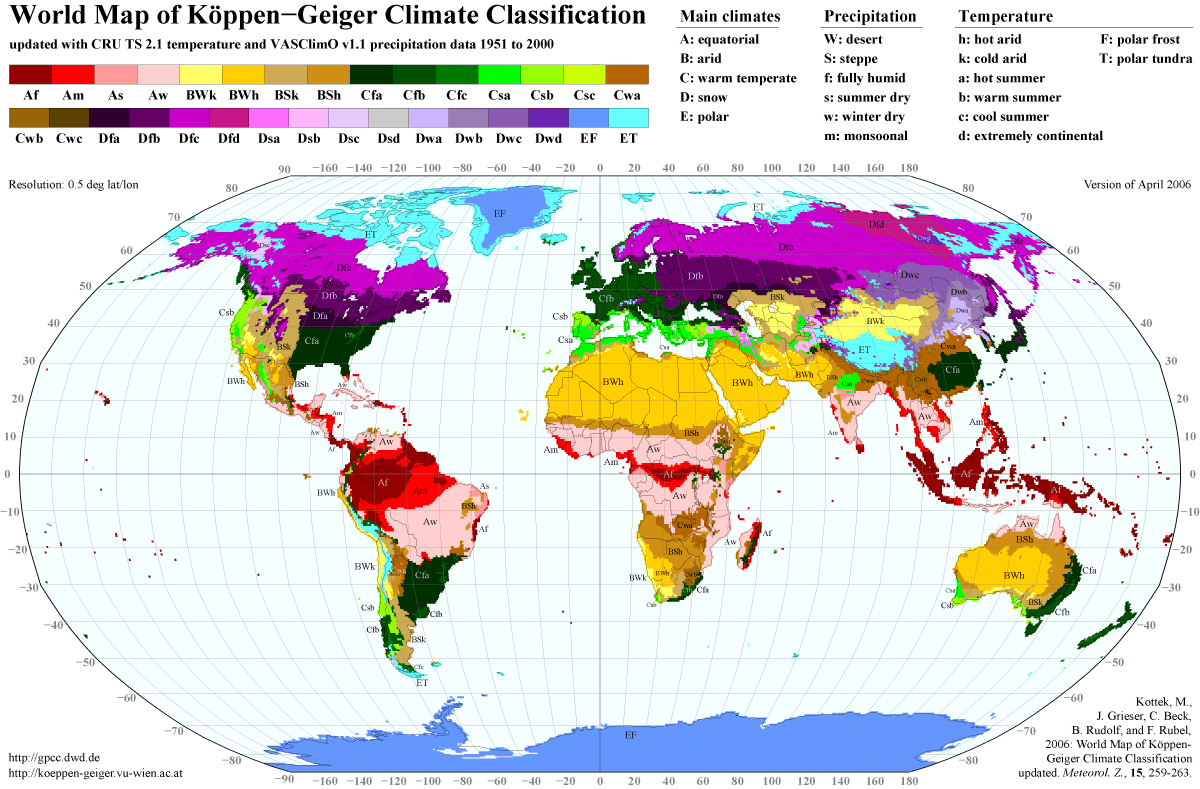
Soil sampling was performed in four apple orchards located near the following research stations: Laimburg Research Centre in Italy (Ora, 46°41′ N, 11°30′ E), the Fruit Experimental Station Graz-Haidegg in Austria (Styria, 47°57′ N 13°45′ E), Agroscope, Institute for Plant Production Sciences, Wädenswil in Switzerland (47°13′ N, 8°40′ E) and Rheinpfalz Center of competence, Nachtweih-Rhineland Palatinate in Germany (50°62′ N, 6°96′ E). These research stations are specialized in apple production and are located in intensive apple-growing areas belonging to the same climate (Cfb) according to the world map of Köppen–Geiger climate classification (http://koeppen-geiger.vu-wien.ac.at/pics/kottek_et_al_2006.gif).
Soil samples for plant growth assays were taken from below the canopy of three plants at a depth of 25 cm; four sub-samples per plant were taken in four opposite points with respect to the trunk, mixed and stored at room temperature for 1–2 weeks before the beginning of the bioassay at each research station. In addition, soil samples (500 g) were arranged in a cooled box and sent to the Institute of Microbiology, the University of Innsbruck, for physicochemical and biological analyses.
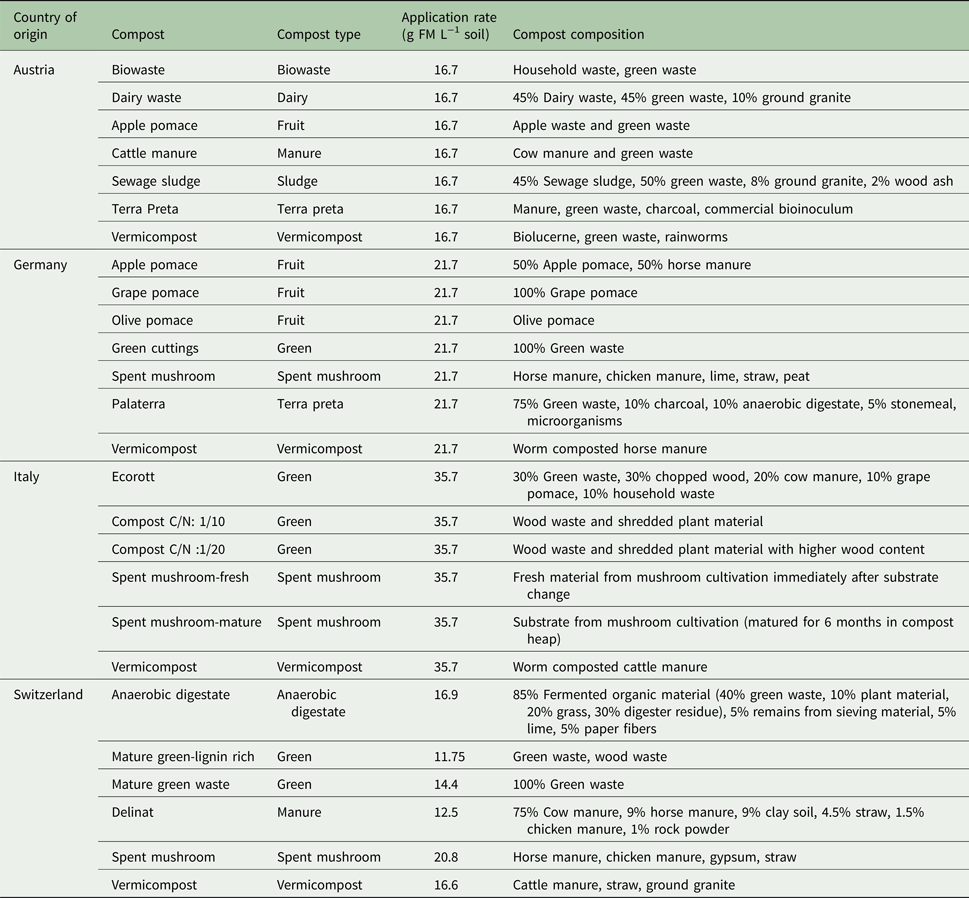
Composts were selected by each of the four research stations involved in the study throughout 2012–2013 according to the availability of materials and interest of local farmers. As the four agro-ecosystems under study largely differed in productive activities (agri-food and livestock farming) and showed a different proximity to urban areas, no constraints other than the two above mentioned were considered when choosing composts. Therefore, given the large variability of composts included in the study and the need for performing a transnational study, composts were grouped into one of ten types depending on the main materials used in the composting process (Table 1).
Locally available composts used in the study

FM, fresh mass.
Details of composition as provided by compost producers.
Physicochemical and biological parameters of composts, native soils and amended soils
All composts, soil samples and compost-amended soil samples were sieved (Ø ≤ 2 mm) immediately after sampling and prior to analysis. Prior to application, composts were sent to the Institute of Microbiology, University of Innsbruck, where the physicochemical and biological properties were analyzed in three independent samples per treatment coming from each country.
At the end of the greenhouse plant growth assays, soil samples from control and amended treatments were arranged in cooled boxes and sent to the Institute of Microbiology, University of Innsbruck, for physicochemical and biological analysis. The analyses of native and compost-amended soil samples were performed on four independent samples per compost treatment from each country, with the exception of Italy (n = 3).
Electrical conductivity (EC) and pH were determined in distilled water and 0.01 M CaCl2 extracts (10 : 25, v/v), respectively, using an LF 330 conductivity meter with a standard cell TetraCon 325 (WTW, Weilheim, Germany) and a pH-meter (MLP4, WTW, Weilheim, Germany). Fresh samples were oven-dried (105 °C) for 24 h, and re-weighed to calculate total solids (TS). The total organic matter (volatile solids (VS)) content was determined from the weight loss following ignition in a muffle furnace (Carbolite, CWF 1000) at 550 °C for 5 h. Total C (Ctot) and N (Ntot) were analyzed in oven-dried and ground (Ø < 500 µm) samples, using a CN analyzer (TruSpec CHN; LECO, Michigan, USA).
Soil basal respiration (Rmic) was measured as CO2 evolution from moist (60% water-holding capacity) soil samples at 22 °C, using continuous flow infrared gas analysis (Heinemeyer et al., Reference Heinemeyer, Insam, Kaiser and Walenzik1989). Microbial biomass carbon (Cmic) was determined by substrate-induced respiration (SIR) after the addition of 1% glucose (TS basis), using the continuous flow infrared gas analysis as above (Anderson and Domsch, Reference Anderson and Domsch1978). The metabolic quotient (qCO2) was obtained by dividing Rmic by Cmic (Insam and Öhlinger, Reference Insam, Öhlinger, Schinner, Öhlinger, Kandeler and Margesin1996).
DNA extraction from composts
DNA extraction was conducted from 0.25 g amounts of −20 °C stored composts using the NucleoSpin®Soil extraction kit for DNA, RNA and protein purification (Macherey-Nagel, Düren, Germany), according to the instructions provided by the manufacturer. The SL1 buffer provided with the kit was used during the extraction process.
Microbial community analysis using the COMPOCHIP microarray
Given the biotic origin of replant disease and that the root rot fungal complex has been identified as the major cause of replant disease in soils to amend, bacterial communities in the composts were investigated. The aim was to estimate the composition of bacterial communities associated with diverse composts before their application and to identify bacterial populations having the potential to exert beneficial functions in soil, such as plant growth promotion and antagonism toward soil-borne fungal pathogens, suitable for combating the negative effects of ARD. For this purpose, the COMPOCHIP microarray was used (Franke-Whittle et al., Reference Franke-Whittle, Klammer and Insam2005, Reference Franke-Whittle, Knapp, Fuchs, Kaufmann and Insam2009). The array is spotted with 414 probes targeting compost-relevant microorganisms, including plant, animal and human pathogens, bacteria involved in plant disease suppression and bacteria important in composting processes. Fluorescence labeling of target DNA by PCR using the 8F and 1492R primers, hybridization, scanning of arrays and image analysis was conducted as described elsewhere (Franke-Whittle et al., Reference Franke-Whittle, Knapp, Fuchs, Kaufmann and Insam2009). All 26 composts in this study were subjected to this analysis; three replicates randomly taken from each of 26 original composts pile, were analyzed using the microarray.
Plant growth assays
Plant growth assays were conducted in high tunnels during the spring/summer period, which corresponds to the local transplant time of new orchards. Each trial started from mid-March to early April and the trial period varied from 10 weeks in Italy to 12 weeks in Germany/Austria and 14 weeks in Switzerland. The experiments implemented in each country had minor variations in their respective setups. Compost application rates are shown in Table 1. In some cases, application rates were defined according to those applied in the pre-plant phase of fruit tree orchards in previous trials on low-input practices for reducing replant problems. In the case of Laimburg Reseach Centre (Italy), a higher dosage was adopted following the poor success obtained in previous field trials with the same local composts. The soil/compost mixtures were placed in 1.5 l plastic pots, and an non-amended soil control was included in each set-up. The trial was organized with a completely randomized block design with three replicates of eight pots each in Austria, Germany and Italy, and six pots each in Switzerland. Rooted cuttings of clonal M.9 rootstock plantlets were obtained from local commercial nurseries. At each experimental station, plantlets were selected with homogeneous diameter values (8 to 10 mm). Planting into pots (one per pot) was followed by removing buds throughout the experiment to obtain two (Italy and Switzerland) or three (Austria and Germany) main shoots per plant. During the growing period, pots were subjected to periodic supplemental irrigation.
At the end of the experiment, shoots were measured and expressed as the sum of shoot lengths per plant (cm), as this parameter was significantly correlated with a root health score in a previous study on ARD (Kelderer et al., Reference Kelderer, Manici, Caputo and Thalheimer2012). Shoot lengths (cm) obtained in each of the four greenhouse assays were subjected to a one-way ANOVA to evaluate differences in effectiveness between the locally available compost tested (Table 1).
Conversely, to analyze plant growth response across the four European countries, data were standardized as follows:
 $$\eqalign{{\rm Relative}\;{\rm plant}\;{\rm response}\;{\rm \;} ({\rm \%} ) =& \displaystyle{{{\rm sum\;} \;{\rm of}\;{\rm shoot}\;{\rm length\;} ({\rm cm}){\rm \; \;}} \over {{\rm sum\;} \;{\rm of\;} \;{\rm shoot\;} \;{\rm length}\;{\rm control\;} ({\rm cm})}} \cr & \times 100}$$
Data of relative plant response were subjected to appropriate statistical analysis to evaluate differences between the ten compost types (Table 1) in growth response by apple plants.
Statistical analysis
Physicochemical and biological data of soils and composts from each country were tested for normality. When normality conditions were not met and it could not be reached through appropriate transformation, data were subjected to non-parametric tests for several independent samples (Kruskal–Wallis test). These analyses were performed using the Statistica software program v9.1 (2010 StatSoft Inc. Tulsa, USA).
As biological and chemical features of compost types across the four countries did not meet the normality condition, they were analyzed, after appropriate data transformation, with a multivariate approach using the PAST program software for data analysis (Hammer et al., Reference Hammer, Harper and Ryan2001). Non-parametric multivariate analysis of variance and pairwise comparison were performed using Bray Curtis distance, which is suitable for analyzing quantitative data. Principal component analysis (PCA) between groups was performed using a correlation matrix. The ‘view loading’ option was used to estimate to what degree the different variables enter into PC1 and PC2; in this way, only the most significant variable vectors were shown in PCA.
The similarity of chemical and biological properties of control soils originating from the four countries under study was inferred from cluster analysis with paired group (UMPGA) algorithm and Bray Curtis similarity index.
Data of shoot elongation in response to compost amendment recorded in each country were subjected to a one-way ANOVA using the Statgraphics centurion software (2005 STATPOINT Inc. Virginia, USA). When significant F-values were obtained and the P value of the variance check was higher than 0.05, mean separation testing was performed using the Fisher's least significant difference (LSD) procedure.
Relative plant response (%) to the ten compost types across four countries did not meet the normality condition; therefore, a Box-and-Whisker Plot was used to present data distribution of each compost type referred to the median (Kampstra and Beanplot, Reference Kampstra2008).
PCA of the total signal-to-noise ratio (SNR) from microarray data of the study was conducted using CANOCO for windows 5 (ter Braak and Smilauer, Reference ter Braak and Smilauer2002).
Results
Chemical and biological properties of composts
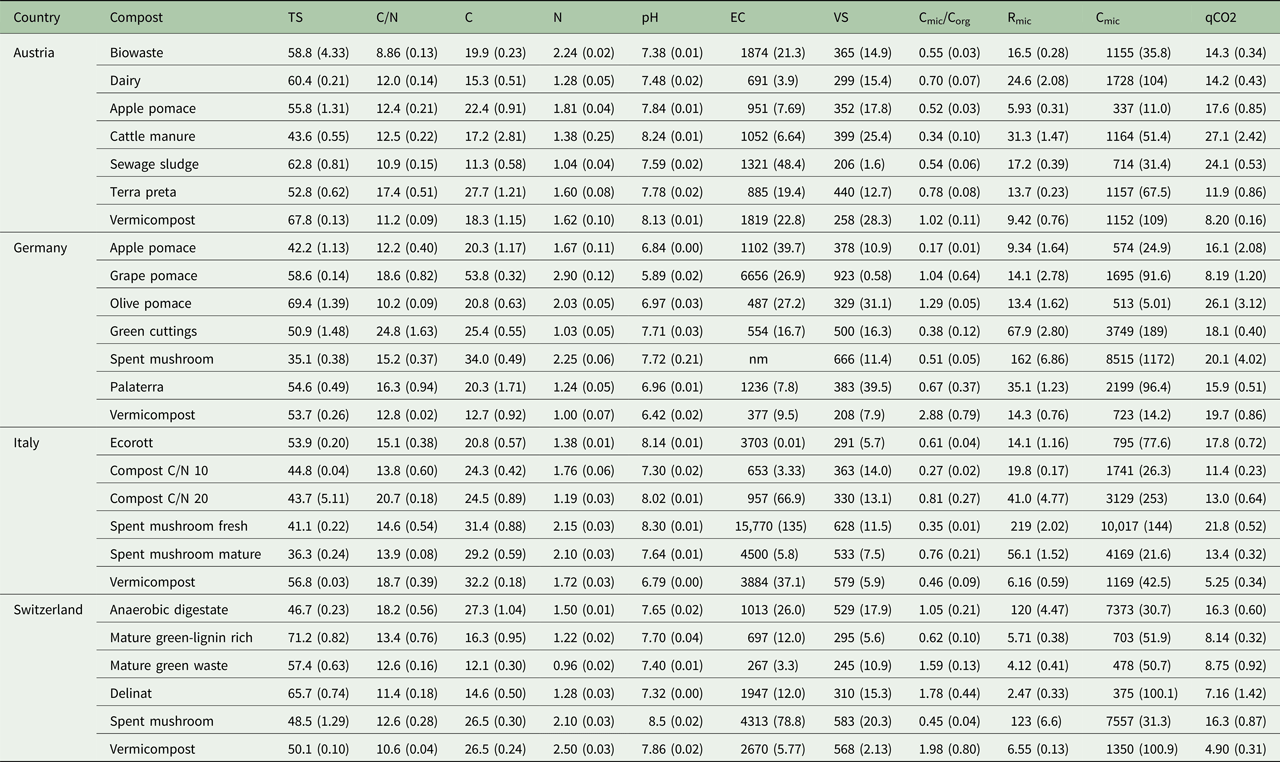
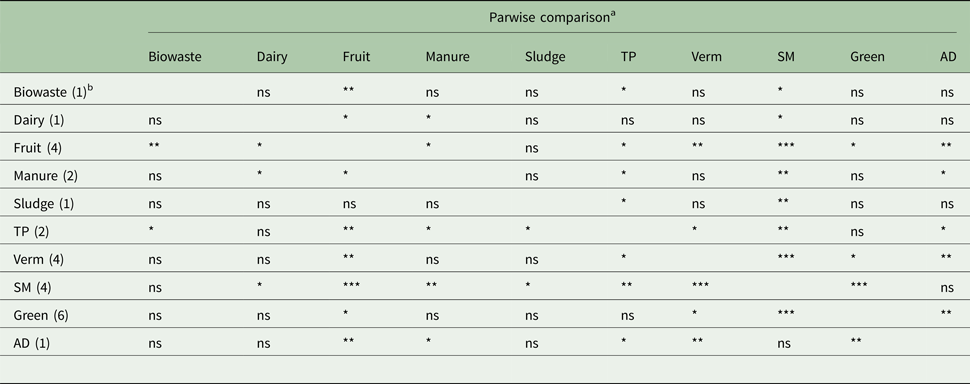
Biological and chemical features of composts analyzed across the four countries did not meet the normality condition, therefore averages and standard deviations of 26 composts are presented in Table 2. However, non-parametric multivariate analysis and related pairwise comparison among ten compost types, compost types, defined in Table 1, allowed for statistical comparison. The biowaste, dairy and sewage sludge composts did not significantly differ in chemical and biological properties from most compost types (Table 3). In contrast, the green, anaerobic digestate and vermicompost composts differed from half of the other compost types, whilst the fruit, terra preta and spent mushroom composts differed significantly from most of the compost types (Table 3).
Chemical parameters and biological properties of the composts used in this study

TS, total solids; C/N, carbon/nitrogen ratio; C, carbon (mg g−1); N, nitrogen (mg g−1); EC, electrical conductivity (μS cm−1); VS, volatile solids (mg g−1); Cmic, microbial biomass (μg Cmic g DM−1); Corg, organic carbon; Rmic, basal respiration (μg CO2-C g DM−1 h−1); qCO2, metabolic quotient (mg CO2-C g−1 h−1); nm, not measured.
The averages of three replicates are shown with the standard deviation in brackets.
Note: Values expressed on a dry mass basis for n = 3 (standard error in brackets).
Pairwise comparison of physicochemical and biological parameters of compost types after npMultivariate analysis of variance (npMANOVA) performed using Bray curtis distance

TP, Terra preta; Verm, vermicompost; SM, spent mushroom; AD, anaerobic digestate; ns, not significant.
Note: Numbers in parentheses represent the number of composts per type included in analyses.
a Permutation n = 9999.
b Number of locally available composts per type.
*P = 0.05; **P < 0.01 , ***P < 0.001. ns, not significantly different.
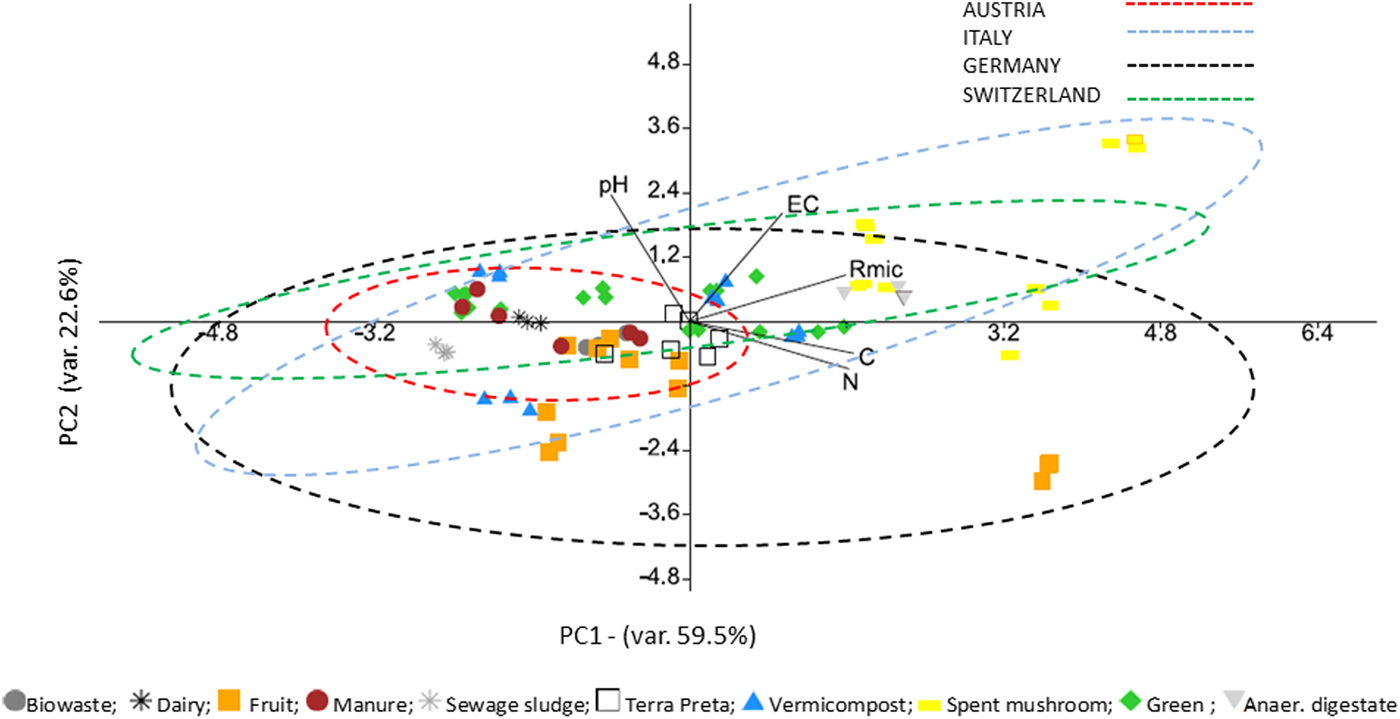
PCA showed that certain chemical and biological properties of compost types were common to all countries (Fig. 1). The spent mushroom composts which were mostly displayed in the PCA quadrant +X + Y, impacted highly on the characterization of Italian and German composts. Additionally, variable chemical and biological features of fruit composts in Germany strongly differentiated compost composition from this country (Fig. 1), whilst anaerobic digestate compost was the most discriminating compost type for Switzerland (Table 2, Fig. 1). The large overlapping of ellipses indicated high similarity of the compost types across Austria, Germany, Italy and Switzerland (Fig. 1).
Principal component analysis (PCA) of chemical and biological properties of compost types (see color legend). PCA was inferred between groups (countries) using a correlation matrix. Each ellipse groups composts coming from that country at P = 95%.

The vector orientation in quadrant +X + Y of the PCA indicated that Rmic and EC were the variables that impacted most significantly on compost-type distribution in this analysis (Fig. 1). Indeed, the highest EC values (4313– 15,770 µS cm−1) were recorded in spent mushroom composts from Italy, Germany and Switzerland (Table 2). The highest R mic values (120–219 µg CO2-C g DM−1 h−1) were recorded in the anaerobic digestate and spent mushroom composts originating from Switzerland and Italy, which were mostly displayed in the quadrant +X + Y. The nitrogen vector oriented toward the +X − Y quadrant (Fig. 1) reflected the finding that the highest nitrogen (N) values (>2 mg g−1) were observed in biowaste, spent mushroom and fruit composts (Table 1). The latter two composts were also characterized by the highest C values, especially in Germany and Italy, as shown by the C vector (Fig. 1). Finally, the pH vector displayed in the PCA quadrant −X + Y, indicated that the Austrian composts were mostly differentiated by their high pH values (from 7.4 to 8.2).
Compost microbial community analyses
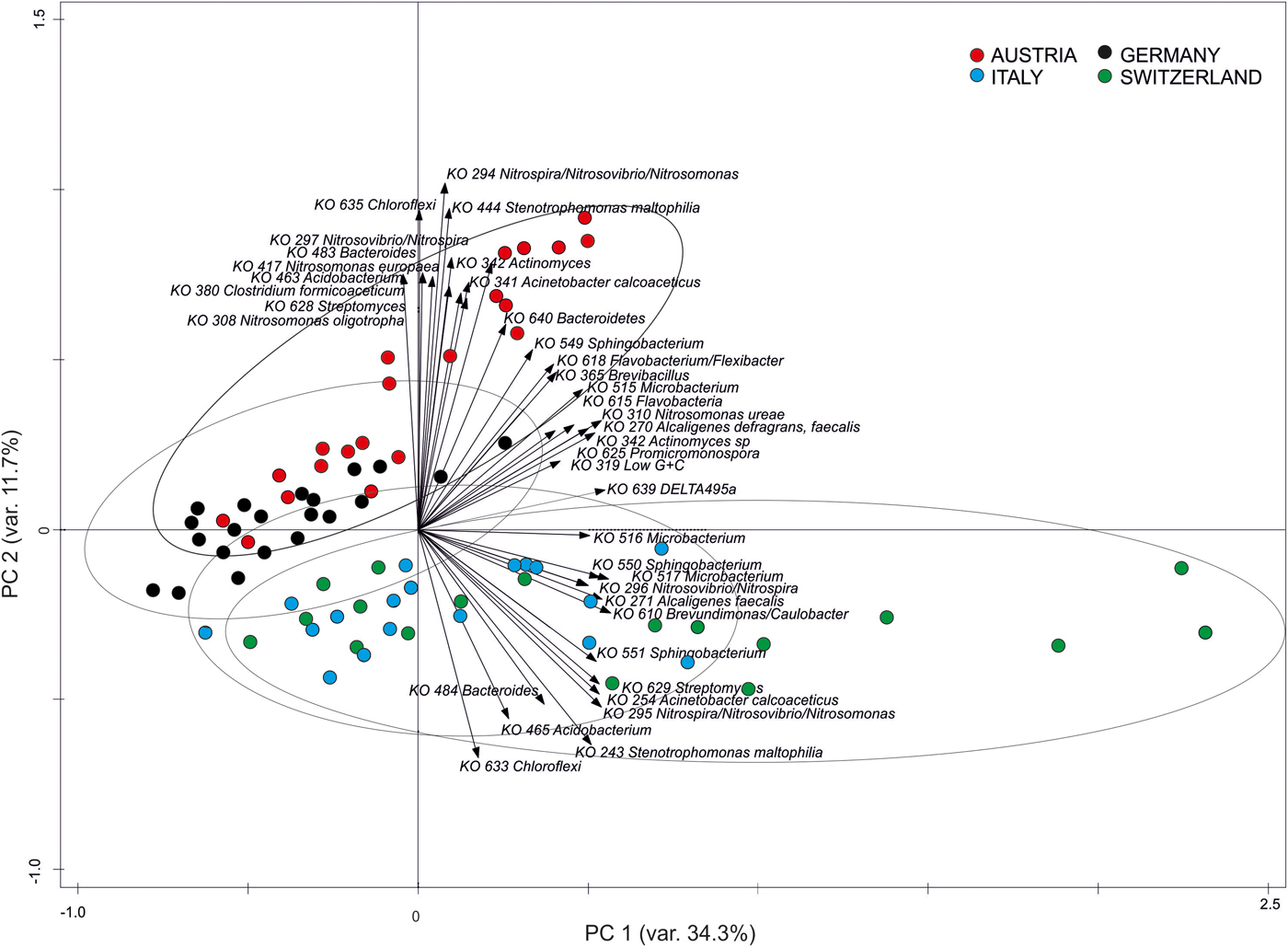
A PCA loading plot of COMPOCHIP microarray data is shown in Figure 2. In total, the first two axes explain 46.0% of the variance, the first axis representing 34.3% and the second representing 11.7%.
Principal component analysis (PCA) of COMPOCHIP microarray data of composts from Austria, Germany, Italy and Switzerland. The organisms responsible for community differences amongst the samples are indicated. The lengths of the vectors indicate their significance for compost differentiation (longer arrow length means higher SNR of probe). The four ellipses group composts at 95% of significance.

Probes are indicated as vectors, and the vector length indicates the significance for compost sample differentiation. As a preliminary analysis of COMPOCHIP microarray data grouped the composts according to the country of origin rather than to the compost type, the different compost treatments were represented according to the country of origin using different colors to facilitate an overall analysis of the microbial variables (probes) across the four countries involved in this study (Fig. 2). The probe targeting Actinomyces was detected upon hybridization with most composts. The probes targeting the nitrifying bacteria Nitrospira, Nitrosovibrio and Nitrosomonas, as well as those targeting Stenotrophomonas maltophilia, Chloroflexi and Actinomyces exerted the greatest influence on the differentiation of the composts. Sphingobacterium, an aerobic bacterium with reported broad degradation activity and targeted by the probes KO448–KO451 (Shemekite et al., Reference Shemekite, Gomez-Brandon, Franke-Whittle, Praehauser, Insam and Assefa2014), was detected in many of the composts, but found in high levels in spent mushroom composts. A high level of Thermoactinomyces (KO24) was detected only in the spent mushroom compost from Switzerland. Finally, the probes targeting Xylella/Xanthomonas/St. maltophilia gave high hybridization signals in vermicompost from Austria and Switzerland but not in the other vermicomposts.
Physicochemical and biological properties of native soils
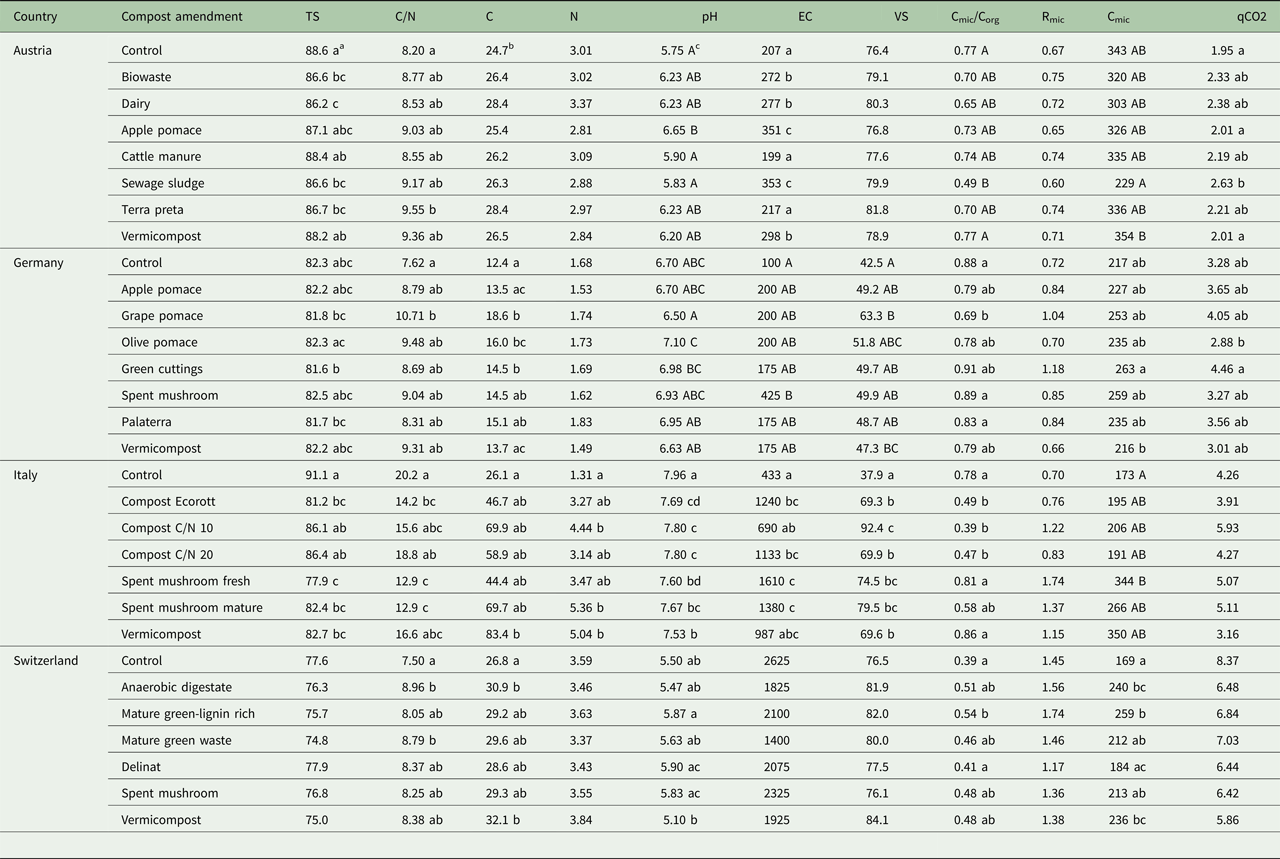
Physicochemical parameters and biological properties of untreated native control soils differed significantly (P < 0.01) between the four countries involved in this study. The soils from Austria and Switzerland were classified as sandy clay loam, while those from Italy as sandy loam, and from Germany as clay loam. The control soils from Germany and Austria showed a similarity above 80% and grouped with 75% similarity to the control soil from Italy (Table 4 and Supplementary Material S1). In contrast, the soil from Switzerland showed a similarity of approximately 50% to the control soils of the other countries.
Physicochemical and biological properties of compost-amended and control soils

Note: Values expressed on a dry mass basis for n = 3 (Italy) and n = 4 (Austria, Germany and Switzerland). Standard error is indicated in brackets. Abbreviations: TS, total solids; C/N, carbon/nitrogen ratio; C, carbon (mg g−1); N, nitrogen (mg g−1); EC, electrical conductivity (μS cm−1); VS, volatile solids (mg g−1); Cmic, microbial biomass (μg Cmic g DM−1); Corg, organic carbon; Rmic, basal respiration (μg CO2-C g DM−1 h−1); qCO2, metabolic quotient (mg CO2-C g−1 h−1); nm, not measured.
a Different lower-case letters indicate significant differences between treatments (P < 0.05) according to Tukey's HSD test.
b No significant differences between treatments.
c Different capital letters indicate significant differences between treatments (P < 0.05) according to the Mann–Whitney test.
The separate grouping of the soil from Switzerland was mainly due to the high EC (2625 µS cm−1), low pH (5.5) and low soil organic matter content (inferred from VS values), as seen in Table 4. Nonetheless, the soil organic matter level corresponded to values above the critical level of organic matter in temperate agricultural soils (Loveland, Reference Loveland2003). Total nitrogen (N) varied from 1.3 to 3.6 mg g−1 in soil content (Table 4), indicating general optimal nitrogen availability in control soils (Haygarth et al., Reference Haygarth, Bartgett, Candron, Gregory and Northcliff2013).
Physicochemical and biological properties of amended soils
Average values for physicochemical and biological parameters of soils amended with composts and planted with M.9 apple rootstocks are shown in Table 4. The majority of amendments did not substantially alter soil pH and soil treatment either did not or only slightly affected the control soil properties in each country. Overall, compost amendment increased versus values (proportional to organic matter), but significant increases were only observed in Italy and, to a less extent, Germany (Table 4).
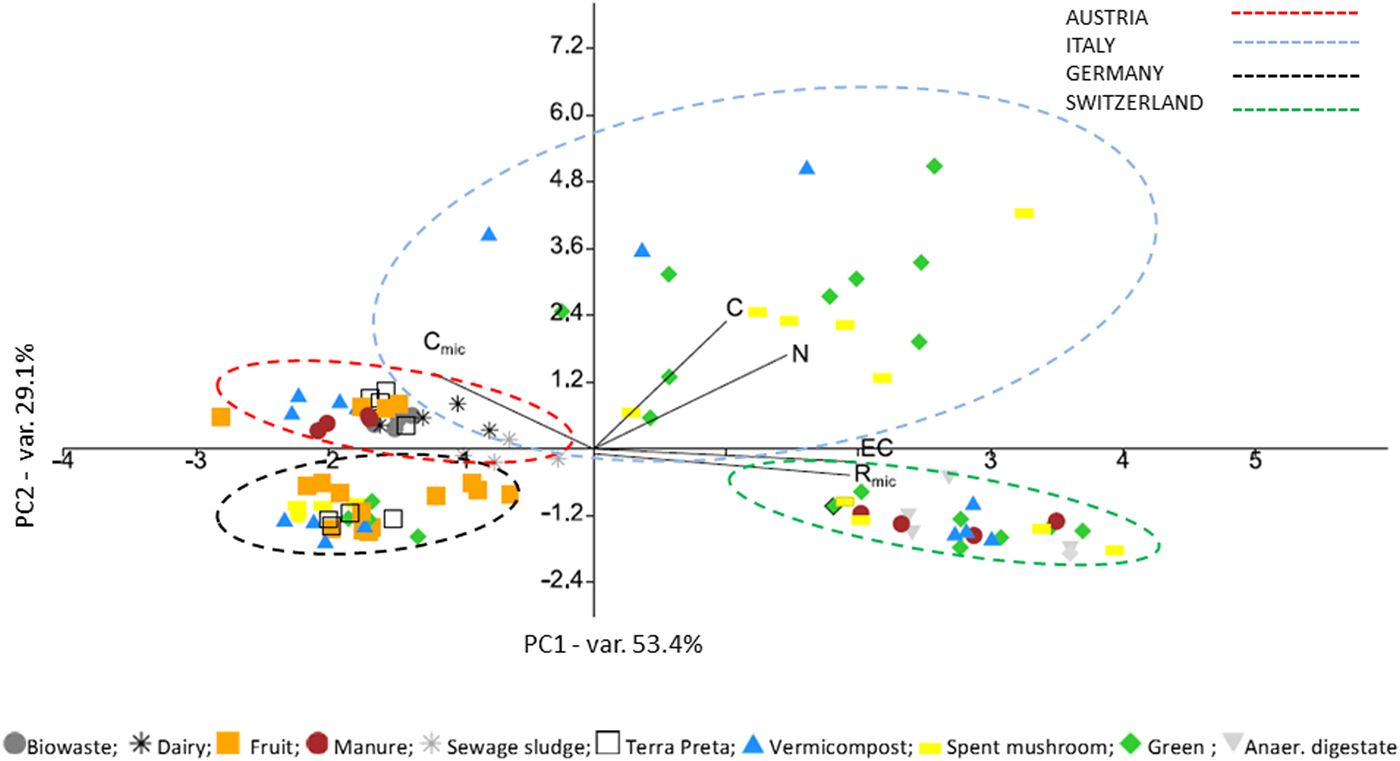
PCA inferred from soil properties further confirmed the predominant effect of soil origin on amended soils. Indeed, the latter was displayed in PCA (Fig. 3) based on the similarity observed between the original control soils, where Switzerland differed to the other countries, rather than on compost type. Amended soils from Germany and Austria grouped closely but were separated in the quadrants (Fig. 3), in line with the 80% similarity observed between the original soils. Italian amended soils showed the highest variability in chemical and biological parameters, which were most similar to those of Austrian treated soils, and clearly separated from the amended soils of Germany and Switzerland (Fig. 3). This finding was in contrast to what was observed by PCA of compost chemical and biological properties (Fig. 1), where a large overlapping of the compost features across the four European countries was shown. Figure 3 shows that the Swiss amended soils were seen to be the most different, in line with what observed in the original soils (Supplementary Material S1). The latter finding further confirmed the high resilience of soils.
Principal component analysis (PCA) of physicochemical and biological features of soils amended with different compost types (see color legend). PCA was inferred between groups using a correlation matrix. Each ellipse groups the amended soils of each country at P = 95%.

Plant growth tests in compost-amended soils
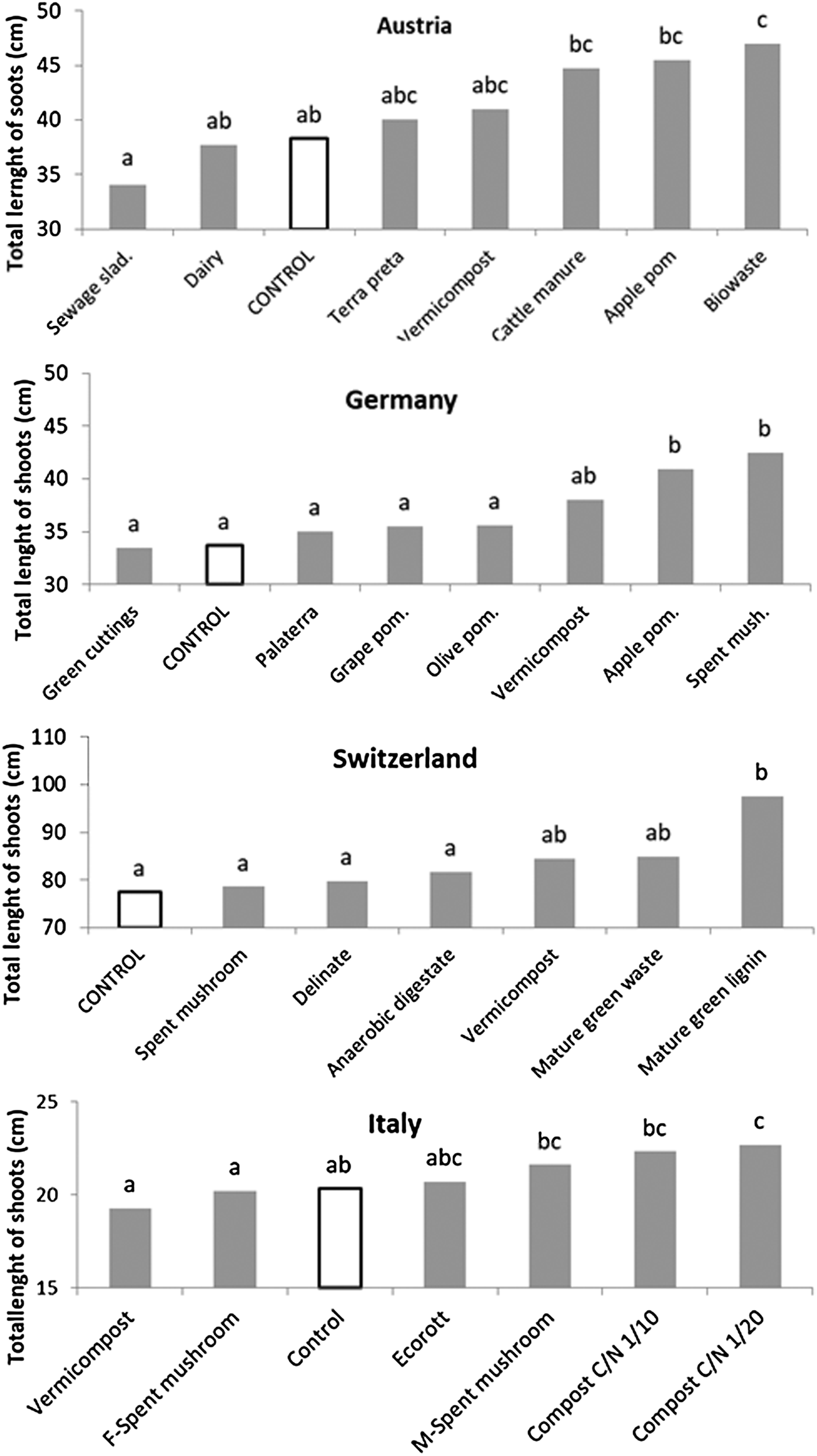
Shoot elongation of clonal M.9 rootstocks in bioassays implemented at each research station in the four countries showed different responses to compost treatments (five/six composts and non-amended control whose mean of sum of shoot lengths per plant was 38.3, 33.7, 77.4 and 20.3 cm in Austria, Germany, Switzerland and Italy, respectively). Treatments significantly differed in shoot elongation in Austria and Italy (P < 0.05), and Germany (P < 0.01), but not in Switzerland; the corresponding mean separation test at each experimental station is shown in Figure 4. In soils from Austria, Italy and Switzerland, only one of the tested composts significantly increased plant growth (P = 0.05) as compared with the non-amended control, while in German soils, the apple pomace and spent mushroom compost resulted in shoot elongation significantly higher than that of the non-amended control. Two composts of mixed composition resulted in the highest and lowest plant growth in the Austrian soil amendments, namely the biowaste and sewage sludge composts, respectively (Fig. 4, Table 1). Apple pomace compost was associated with a consistent shoot elongation in Austria and Germany, while terra preta compost did not show any significant growth increase in either country. Green composts gave the best growth performance in soils from Italy and from Switzerland. Although there was no significant treatment effect in Switzerland, contrast analysis suggests that green compost was different from three out of six of the tested composts, aside from the control (Fig. 4). All other composts gave variable responses. In the case of amendment with spent mushroom compost (in Italy, where the two mushroom composts were characterized by variable degradation and differences in EC, Cmic and Rmic; Table 2), mature spent mushroom compost resulted in greater plant growth than fresh (Fig. 4). Spent mushroom gave the best performance in Germany, as plant growth was significantly greater than four of the seven composts tested, besides the control (Table 4). Conversely in Switzerland, spent mushroom compost ranked among the worst, giving, according to contrast analysis (P = 0.05), a significant growth reduction only in comparison with manure green lignin (Fig. 4). Finally, no correlation between plant growth in compost-amended soils and soil properties were found.
Means of shoot elongation of apple rootstocks grown in soil amended with a set of 7–8 locally available composts per each country. LSD test was performed at 95% confidence level.

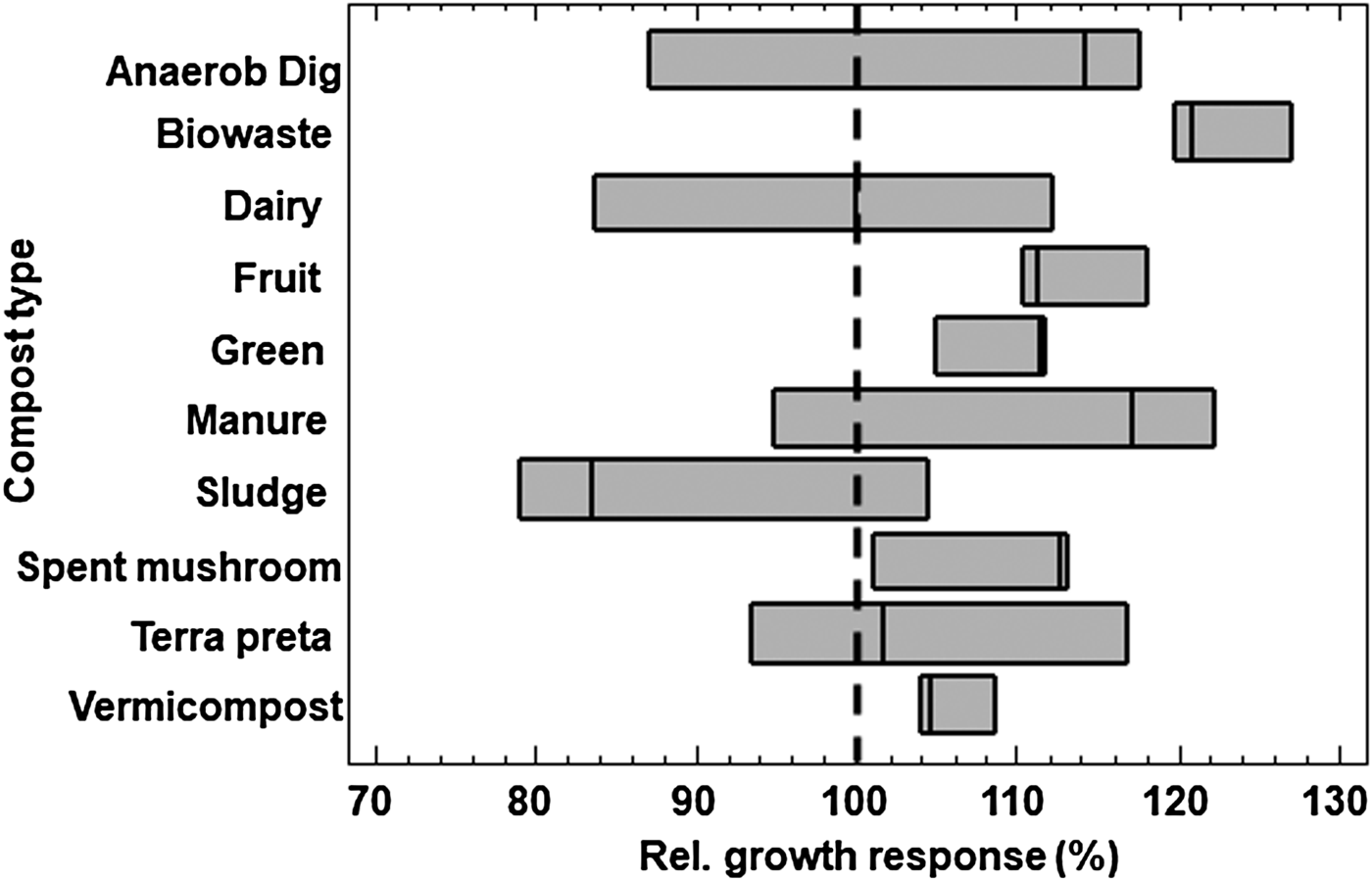
Relative plant response (%) measured plant growth response in treated amendments versus the untreated control at each research station. This procedure gave a transnational set of standardized data, thus allowing the comparison of the effect of diverse compost types across grouping the 26 composts overall locally tested in four countries. In nine out of ten compost types, the median exceeded 100% relative growth response (Fig. 5); among them, anaerobic digestate, dairy, sludge, manure and terra preta-derived composts showed the largest variation in plant responses. The sludge compost type gave the worst response (Fig. 5).
Box-and-Whisker plot of relative plant growth data across Austria, Germany, Italy and Switzerland. Relative plant growth (%) is a measure of plant response to soil treatment versus that obtained in the non-amended control at each research station. The vertical line within each box corresponds to the median of relative growth observed within each of ten types grouping 26 compost based on their composition (Table 1).

Discussion
The growth response of apple rootstock plantlets indicated the potential of composts to reduce the major symptoms of ARD in newly planted orchards. The large variation in plant growth performance observed in response to compost amendments can be partly attributed to the maturity degree, amendment rate and non-homogenous nature of composts. Findings suggest that the single application of composts to soils did not substantially change the physical, chemical and biological properties of the soils. Moreover, the high similarity in physicochemical properties between amended and unamended soils was interpreted as the result of a high soil resilience due to the raised organic matter content and absence of fertility limiting factors in the soils of the intensive apple-growing areas under study. This has already been reported as the base for the highly productive standard of the multi-generation orchards of Central Europe (Manici et al., Reference Manici, Ciavatta, Kelderer and Erschbaumer2003; Reference Manici, Kelderer, Franke-Whittle, Rühmer, Baab, Nicoletti, Caputo, Topp, Insam and Naef2013; Franke-Whittle et al., Reference Franke-Whittle, Manici, Insam and Stres2015). The findings of this study indicate that the complexity of biological processes and plant–microbial interactions induced by compost treatments played a major role in the general ability of composts to increase plant growth in the bioassay using replanted orchard soils. This hypothesis is consistent with previous studies that have shown variable levels of disease suppression using apparently similar composts at the same application rates (Noble and Coventry, Reference Noble and Coventry2005).
The parameters more frequently associated with soil suppression in literature are microbial biomass and activity (Noble and Coventry, Reference Noble and Coventry2005). An increase of microbial activity following incorporation of available carbon sources increases the antagonism toward soil-borne pathogens (Postma et al., Reference Postma, Geraats, Pastoor and van Elsas2005; Bonilla et al., Reference Bonilla, Gutiérrez-Barranquero, de Vicente and Cazorla2012), which survive saprophytically in soils, such as the complex of pathogens involved in ARD and many other root rot complexes which affect long-term and intensive cropping systems (LaMondia et al., Reference LaMondia, Gent, Ferrandino, Elmer and Stoner1999; Manici et al., Reference Manici, Kelderer, Franke-Whittle, Rühmer, Baab, Nicoletti, Caputo, Topp, Insam and Naef2013). Pythium is a soil borne pathogen particularly susceptible to the suppressive effect from microbial competition for C sources (Erhart et al., Reference Erhart, Burian, Hartl and Stich1999; Postma et al., Reference Postma, Willemsen-De Klein and Van Elsas2000; Hunter et al., Reference Hunter, Petch, Calvo-Bado, Pettitt, Parsons, Morgan and Whipps2006). Considering that Pythium is known to be the major agent in the complex of organisms causing ARD in soils from Germany (Manici et al., Reference Manici, Kelderer, Franke-Whittle, Rühmer, Baab, Nicoletti, Caputo, Topp, Insam and Naef2013), a positive effect of the compost with the greatest microbial activity, such as green cuttings and spent mushroom (Table 2), was expected. Nevertheless, of the two composts found to significantly enhance plant growth in the German soils, only the spent mushroom compost produced results in line with those expected, suggesting that biological factors other than microbial biomass were involved in suppression of Pythium spp.
The high organic matter content of soils in this study seems to have nullified the expected positive effect of soil carbon enrichment in this study. Indeed, although soils from Italy were amended at a rate higher than the rates used in the other three countries, the higher rates did not translate to greater increases in plant growth upon application. The overall amendment rates applied in this study were considerably lower than 20% (v/v), which was the amendment rate (in peat-based media) published by Noble and Coventry (Reference Noble and Coventry2005) that should increase disease suppressiveness. Furthermore, no correlation was found in this study between amendment ratio and plant growth improvement; indeed, while the soils from Austria were amended at a rate of less than half that of Italy (Table 1), higher increases in plant growth were seen after the amendment of some of the Austrian composts. In general, the minimal increases in microbial biomass after compost amendment suggested that soil biological properties were only slightly modified by the single compost application. However, periodical soil organic amendment and permanent vegetal groundcover are conventional practices that are applied across the intensive apple-growing areas of Central Europe, including the sites included in this study. This has undoubtedly guaranteed good soil organic matter and a general improvement of soil physical and biological properties (Peck et al., Reference Peck, Merwin, Thies, Shindelbeck and Brown2011). This long-term soil quality improvement quite possibly forms the basis of the high production standard of the multi-generation apple orchards, despite being affected by ARD as demonstrated in a previous study (Manici et al., Reference Manici, Ciavatta, Kelderer and Erschbaumer2003; Reference Manici, Kelderer, Franke-Whittle, Rühmer, Baab, Nicoletti, Caputo, Topp, Insam and Naef2013; Kelderer et al., Reference Kelderer, Manici, Caputo and Thalheimer2012).
The variable plant growth response to compost treatments observed in replanted soils further confirmed that ARD is a complicated disease, for which most likely, various biotic factors are responsible (Termorshuizen et al., Reference Termorshuizen, van Rijn, van der Gaag, Alabouvette, Chen, Lagerlöf, Malandrakis, Paplomatas, Rämert, Ryckeboer, Steinberg and Zmora-Nahum2006; Spath et al., Reference Spath, Insam, Peintner, Kelderer, Kuhnert and Franke-Whittle2015). Therefore, the specific disease suppression mechanisms can be induced by cropping practices or amendments (compost, green manure or other) able to increase the dominance of specific beneficial microbial populations inhabiting soils or from the introduction of new beneficial populations (Mazzola and Gu, Reference Mazzola and Gu2002; Chen and Nelson, Reference Chen and Nelson2008).
Based on microbial community composition, the composts used as amendments were found to cluster depending on their country of origin. Overall, the composts from Austria and Germany were characterized by bacterial communities differing from those of composts from Italy and Switzerland, suggesting that microbial communities of composts were much more affected by the agro-environment from where the composts originated than the chemical and biological properties of the starting raw materials. The COMPOCHIP microarray analysis detected in composts several biologically active bacterial genera, thus able to exert antagonistic activity toward soil-borne pathogens as well as growth promotion, bio-fertilization and several other positive functionalities acting in soil suppressiveness. They included: Bacillus species, Burkholderia, Chryseobacterium, Flavobacterium, Pseudomonas species, St. maltophila, Streptomyces and Xanthomonas (Compant et al., Reference Compant, Duffy, Nowak, Clément and Barka2005; Zhang et al., Reference Zhang, Huang, Harvey, Ren, Zhang, Zhou and Yang2012; Mansoori et al., Reference Mansoori, Heydari, Hassanzadeh, Rezaee and Naraghi2013). The bacterial genera Nitrospira/Nitrosovibrio/Nitrosomonas were detected in all composts, although with varying abundances. These bacterial genera are involved in nitrification and have been commonly reported in composts (Danon et al., Reference Danon, Franke-Whittle, Insam, Chen and Hadar2008; Cayuela et al., Reference Cayuela, Mondini, Insam, Sinicco and Franke-Whittle2009; Franke-Whittle et al., Reference Franke-Whittle, Confalonieri, Insam, Schlegelmilch and Korner2014). The genus Chloroflexi has also been previously reported in composts (Danon et al., Reference Danon, Franke-Whittle, Insam, Chen and Hadar2008), and is considered to play a specialized role in polysaccharide degradation suggesting an active biological activity in soil. Thus, although it was not possible to directly relate specific bacterial populations with the plant growth observed in compost-amended soils, it is possible to hypothesize that beneficial microbial populations inhabiting composts may have induced a series of direct and indirect mechanisms responsible for increased soil suppressiveness, resulting in higher shoot lengths.
As all composts tested in this study had a heavy metal content below the limit for their use in each country, the lack of effectiveness of particular composts on plant growth would appear to be due to some biotic issue. Considering the occurrence of a complex of fungal agents responsible for root necrosis in the soils used in this study (demonstrated previously by Manici et al., Reference Manici, Kelderer, Franke-Whittle, Rühmer, Baab, Nicoletti, Caputo, Topp, Insam and Naef2013; Franke-Whittle et al., Reference Franke-Whittle, Manici, Insam and Stres2015), it is possible that in these cases, a higher content of non-decomposed material acted as a nutrient source for such soil-borne fungal pathogens (Manici et al., Reference Manici, Caputo and Babini2004; Rivera and Wright, Reference Rivera and Wright2009).
The green and fruit composts generally showed a positive impact on plant growth, suggesting a capacity to increase soil suppressiveness. Green waste composts are constituted of plant materials, which are decomposed with difficulty in the short term, and act mainly as a long-term source of nutrients (Pérez-Piqueres et al., Reference Pérez-Piqueres, Edel-Hermann, Alabouvette and Steinberg2006). Nonetheless, amendment with all green waste composts in this study raised respiration and biomass values in the soils more than other compost types although differences from the control were not significant in most cases. Amendment with composts containing large proportions of lignocellulosic materials has been reported to result in an effective level of suppression against soil-borne plant pathogens by several authors (Hoitink and Boehm, Reference Hoitink and Boehm1999; de Bertoldi, Reference de Bertoldi, Insam, Franke-whittle and Goberna2010). The positive performance of the green composts may, in part, have been due to an increase in microbial activity over the brief period immediately following incorporation because of a residual effect of the non-decomposed material of vegetal origin, and in part to the introduction into the soil of new bacterial populations associated with the green composts.
Among the fruit waste composts, apple pomace induced a significant plant growth increase in Germany and improved plant growth in Austria, even if to a statistically not significant extent. The beneficial effects of such composts were in line with those previously obtained using an apple pomace containing compost in newly planted apple trees (Moran and Schupp, Reference Moran and Schupp2003). In the other cases (grape and olive pomace), the effect of fruit waste composts was not so impressive. Wastes from the food industry are particularly convenient for composting, as they are uniform in nature, rich in organic matter, and can generally be obtained in high amounts. Therefore, in the light of findings of this study, composts obtained from green and fruit wastes are potentially interesting for their re-use in fruit tree cropping systems affected by replanting problems.
Spent mushroom composts, resulted in increases of plant growth in Germany, but not in Switzerland and Italy. Spent mushroom composts contain high levels of salt and unstable organic materials, and thus should normally be aged for approximately two years before application (Uzun, Reference Uzun2004). The extremely high EC value of the fresh spent mushroom compost from Italy may have had a role in the lack difference from control for this treatment. Spent mushroom application resulted in an increase in microbial biomass in all cases, as a result of the high microbial biomass in the compost itself. Such composts have been reported to help to mitigate potato early dying disease (LaMondia et al., Reference LaMondia, Gent, Ferrandino, Elmer and Stoner1999) and to suppress soil-borne pathogens of tomato (Ntougias et al., Reference Ntougias, Papadopoulou, Zervakis, Kavroulakis and Ehaliotis2008); therefore, spent mushroom compost may be interesting as an orchard management strategy aiming at mitigating ARD severity or at counteracting the decline of soil microbial diversity.
Amendment with manure composts often increased plant growth relative to controls, although differences were not always significant (e.g., delineate in Switzerland and cattle manure in Austria). Amendment with manure composts did not result in significant increases in the Rmic and Cmic of soils at the end of the plant growth assay, however, based on compost properties, an increase in microbial activity should have occurred immediately after soil incorporation. This is especially the case for the cattle manure from Austria, which was characterized by a high basal respiration, probably derived from the microbial colonization of non-decomposed organic matter. Additionally, bacterial populations that characterized different manure composts were very variable suggesting that the suppressiveness induced in this case may have been due to a combination of antagonism toward carbon sources (an increase of microbial activity) and specific biological interactions between microbial populations added into the soil after compost amendment. The overall findings suggest a good performance of manure composts for controlling plant growth reduction in soils coming from orchards affected by replanting problems. These results are consistent with two other studies on apple replant soils In which manure compost amended during the pre-plant was found to be as effective as soil fumigation both in a long-term experiment at the field level (Braun et al., Reference Braun, Fuller, McRae and Fillmore2010) and in a separate greenhouse experiment (van Schoor et al., Reference van Schoor, Denman and Cook2009).
Vermicompost and terra preta were the two compost types that showed the least positive effects in terms of increasing plant growth. Vermicomposts are known to have high levels of microbial diversity, as a result of the mucus secreted by the earthworms used to produce the vermicompost (Szczech, Reference Szczech1999). The increase in plant disease suppression resulting from amendment with such composts is mostly attributed to the higher microbial activity of the soil after amendment (Chaoui et al., Reference Chaoui, Brickner, Lee and Arancon2002). However, in the four bioassays of this study, vermicompost induced a plant response that did not differ from untreated control soils. The poor or null plant growth increase observed may be also due to the high compost application rate in the case of Italy. Indeed, although numerous publications indicate the ability of vermicompost to stimulate plant growth and to suppress crop diseases, conflicting findings have been reported by several authors (Szczech, Reference Szczech1999; Noble and Coventry, Reference Noble and Coventry2005; Rivera and Wright, Reference Rivera and Wright2009). Electrical conductivity is generally high in vermicomposts and often constitutes a limitation for their use in crop production. Moreover, as the mobilization of trace metals by humic substances is regulated by the complexation capacity of metal ions that are pH-dependent, phytotoxic effects may be due to the release of trace elements induced by pH changes after compost incorporation into the soil (Rivera and Wright, Reference Rivera and Wright2009).
The two biochar-containing composts (terra preta) included in this study had no effect on plant growth. Although extensive literature exists regarding the improvement of soil properties with biochar (Githinji Reference Githinji2014), studies on the potential impact of biochar soil amendment on plant pathogens indicate action through an indirect effect (Akhter et al., Reference Akhter, Hage-Ahmed, Soja and Steinkellner2015). Therefore, it can be concluded that the compost of mixed origin which included 10% biochar, did not induce an increase in plant growth in soils where most likely, multiple biotic factors caused growth reduction.
Sewage sludge and dairy waste composts, which were considered for this study solely in Austria, did not increase plant growth. Conversely, biowaste, another compost type tested only in Austria, gave the best growth performance. The nature of biowastes can vary in composting, but it can vary dramatically based on heterogeneity of input materials as observed for municipal solid waste which is commonly composed of a mixture of household and green waste, as was the case for the biowaste compost used in this study (Hargreaves et al., Reference Hargreaves, Adl and Warman2008; Farrell and Jones, Reference Farrell and Jones2009). The impressive performance of the biowaste compost considered in this study (Fig. 5), was consistent with a series of results for the control of Pythium and other soil-borne pathogens. Those positive results were mostly linked to biological factors, as demonstrated by the loss of effectiveness when the same composts were sterilized (Noble and Coventry, Reference Noble and Coventry2005). Nevertheless, humic acids and other chemical compounds have been reported as related to the increase in soil suppressiveness in compost-amended soils (Pascual et al., Reference Pascual, Garcia, Hernandez, Lerma and Lynch2002). Therefore, further investigations into the effectiveness of this type of compost are suggested based on findings of this study.
Conclusions
Amendments with locally produced composts offer a cost-effective, environmentally friendly and practical approach to counteract replant problems. Findings from this study support the hypothesis that high soil quality achieved with a periodical organic amendment in the intensive apple growing areas in central Europe have permitted the replant of apple orchards for decades without evidence of vigor reduction attributable to replant disease (Manici et al., Reference Manici, Ciavatta, Kelderer and Erschbaumer2003). Nevertheless, results suggest that, in these agro-environments, pre-plant compost amendment often increases shoot growth immediately after transplanting. Our results suggest that this plant growth promotion is likely related to the microbial properties of compost introduced into the soil. These findings are consistent with all previous studies that indicated a positive effect of changes in microbial communities in soils where perennial or continuous cultivation has reduced biological diversity and selected a series of saprophytic soil-borne fungal pathogens causing rooting reduction (Rumberger et al., Reference Rumberger, Yao, Merwin, Nelson and Thies2004; Mazzola, Reference Mazzola and Reynolds2010; Peck et al., Reference Peck, Merwin, Thies, Shindelbeck and Brown2011). This transnational survey further indicates that compost is a dynamic medium, and in order to be able to ensure consistent results, quality of the compost needs to be controlled. Moreover, suppression of ARD will be likely better predicted based on soil–compost combinations, rather than on just composts alone.
Supplementary material
The supplementary material for this article can be found at https://doi.org/10.1017/S1742170518000091
Acknowledgements
We kindly thank Ljubica Begovic and Sieglinde Farbmacher for their analytical help, as well as Sebastian Waldhuber for his assistance with molecular work. Financial support for the BIO-INCROP project was provided by the CORE Organic II Funding Body, partners of the FP7 ERA-Net project, CORE Organic II (Coordination of European Transnational Research in Organic Food and Farming systems, project no. 249667).