Introduction
Insects have evolved a broad range of adaptations to circumvent the negative impact of extreme seasonal variation in temperature (Tauber et al. Reference Tauber, Tauber and Masaki1986). Diapause, defined as a period of suspended activity and development, is a common physiological adaptation to adverse conditions, in particular cold weather during the winter (Leather et al. Reference Leather, Walters and Bale1993). Overwintering diapause in the egg stage is prevalent in Lepidoptera with flightless females (Barbosa et al. Reference Barbosa, Krischnik and Lance1989), including the bagworm Thyridopteryx ephemeraeformis Haworth (Lepidoptera: Psychidae) (Neal et al. Reference Neal, Raupp and Douglass1987). In the fall, a female bagworm lays its eggs within its pupal case inside a bag it constructed as a larva, and the eggs undergo an obligatory overwintering diapause. The bag, which is made of silk and plant material, moderates fluctuations in temperature and enhances winter egg survival (Rivers et al. Reference Rivers, Antonelli and Yoder2002; see also Barbosa et al. Reference Barbosa, Waldvogel and Breisch1983). Under laboratory conditions, eggs enclosed in their bag and exposed to −10 °C for up to 4 days suffer minimal (<5%) mortality, whereas >75% of eggs die after being exposed to −17 °C for 24 hours (Rivers et al. Reference Rivers, Antonelli and Yoder2002). These results suggest that (1) the maximum temperature during the coldest day of winter (24-hour period) may be used to predict the survival of eggs in the field; and (2) the threshold associated with significant egg mortality ranges between −10 °C to −17 °C.
In some insect species, the number of eggs laid by a female in a cluster influences survival, e.g., large clutches buffer against cold temperature and desiccation for diapausing eggs (Stamp Reference Stamp1980; Danks Reference Danks2002). Mated female bagworms lay a variable number of eggs in their pupal cases (from <100 to >1700; Rhainds et al. Reference Rhainds, Leather and Sadof2008), which may affect overwintering survival. In the present study, we analysed the effects of cold temperature exposure and cluster weight on survival of bagworm eggs under natural conditions.
Methods
Between 5 and 35 bags containing egg masses were collected at the end of the winter in March–April 2009 on juniper or arborvitae at each of 104 locations in the mid-western United States of America (Fig. 1 in Rhainds and Fagan Reference Rhainds and Fagan2010). The pupal cases containing eggs were removed from their bags, weighed to the nearest 0.01 g, placed individually in Solo® (Solo Cup Co., Chicago, Illinois, United States of America) cups (n = 1359), and kept at room temperature in the laboratory. After 7 days, a subsample including two clutches for most locations (n = 190) was randomly selected. These egg clutches were cut open and a subsample of 50 eggs was classified as either live or dead based on their colour, as white eggs are alive and black eggs are dead (Sadof and Rhainds Reference Sadof and Rhainds2009). The remaining egg clusters were monitored daily over 12 weeks to determine hatching of early instars. At the end of that period, larvae had ceased to emerge and the unhatched clutches (n = 61) were dissected; all of them contained only shrunken, dead, black eggs.
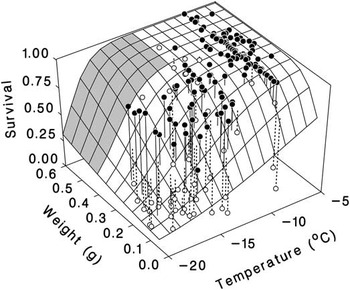
Proportion of live (white) eggs among subsamples of 50 eggs from egg masses after 7 days (•: above the response surface; ○: beneath the surface). The shaded portion of the graph represents an area of extrapolation.

The maximum temperature during the coldest day of winter (15 or 16 January 2009) was estimated at the 104 sampling locations by interpolation using inverse squared-distance weighting of the data from 39 nearby meteorological stations.
The relationship between survival of eggs after 7 days of incubation (s), temperature (T), and egg clutch weight (w) was determined by logistic regression using the model:
 $$\quad\quad {{\rm {logit}}(s)\: = &\:{{{\rm{\alpha }}}_1}\: + \:{{{\rm{\alpha }}}_2}T\: + \:{{{\rm{\alpha }}}_3}w\: + \:{{{\rm{\alpha }}}_4}{{T}^2} \cr &\! + \:{{{\rm{\alpha }}}_5}{{w}^2} \: + \:{{{\rm{\alpha }}}_6}Tw\quad\quad\quad\quad\ \ \,\quad[1]$$
where α1–α6 are parameters associated with each effect, its square or their interaction.
Observations of egg clutch hatch after 12 weeks provided binary values (1: some hatch, 0: no hatch). The probability of hatch at the clutch level was also related to temperature and clutch weight by a logistic model analogous to equation [1].
Data analysis was conducted with PROC LOGISTIC of SAS/9.2 (SAS Institute Inc., Cary, North Carolina, United States of America). Full models (equation [1]) were reduced, one term at a time, until all remaining terms were significantly different from zero (α = 0.05). With the 1-week incubation experiment, because samples of 50 eggs were tested in each temperature/cluster weight combination, it was possible to test directly and correct for overdispersion. To test for overdispersion among the 12-week cluster hatch data, which were not replicated at specific temperature and weight combinations, equation [1] was first fitted after grouping the data into 1 °C temperature classes and 0.1 g weight classes.
Results
The deviance goodness-of-fit test for 1-week egg survival data fitted to equation [1] was highly significant ( $$${\rm{\chi }}_{{184}}^{2} \: = \:15.7$$$, P < 0.0001). The final (reduced) model had three highly significant terms (P < 0.0001):
 $$\quad {{\rm {logit}}(s)\: = &\:0.122\,\left( { \pm 0.030} \right)\;T\: + \:31.0\,\left( { \pm 3.4} \right)w\: \cr & \!+ \:1.45\,\left( { \pm 0.25} \right)\;Tw \ \ \quad\quad\quad\quad\quad[2]$$
This model had 90.9% concordance, likelihood ratio = 463 (null hypothesis: all slopes = 0; P < 0.0001) and adjusted  $$$R_{{MF}}^{2} \: = \:0.569$$$ (Menard Reference Menard2000). Survival rate data were overdispersed, as indicated by the majority of observations that aligned near either 0% or 100% survival (159 clutches with survival rates <10 or >90%, compared with only 32 clutches with intermediate survival rates between 10% and 90%). This overdispersion pattern suggests nonindependence of egg survival within clutches, so that eggs in a given clutch tend to have similar fates (either survive or die).
There was no evidence of overdispersion in the 12-week incubation cluster survival data (deviance  $$${\rm{\chi }}_{{43}}^{2} \: = \:0.464$$$, P = 0.999). Equation [1] fitted those data very well, with three highly significant terms (P < 0.005) in the reduced model:
 $$\quad\ {{\rm {logit}}(s)\: = & \:0.14\,\left( { \pm 0.05} \right)T\: + \:65.8\,\left( { \pm 6.9} \right)w\: \cr &\!\!+ \:3.29\,\left( { \pm 0.36} \right)\;Tw\ \,\quad\quad\quad\quad\quad[3]$$
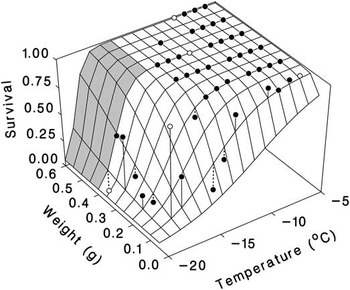
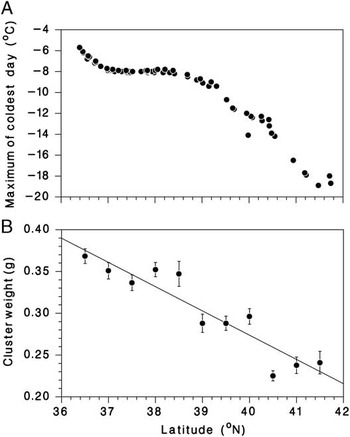
This model had 98.3% concordance, likelihood ratio = 1450 (P < 0.0001), and adjusted  $$$R_{{MF}}^{2} \: = \:0.894$$$ (Fig. 2). It should be noted that for both measures of survival (1-week or 12-week incubation period), a portion of the range of independent variables (w > 0.4 g and T<−15 °C) was not represented in our data, and that the survival response surface in that region is based on the extrapolation of the response surface (shaded area in Figs. 1, 2). This situation is due to strong latitudinal clines in both temperature and egg cluster weight (Fig. 3).
Proportion of eggs clusters from which some hatch was observed after 12 weeks incubation (•: observed data; ○: groups with only one or two clusters). Data summarised into 1 °C and 0.1 g classes for graphical presentation (but not for model fitting); the surface is delineated by equation [3]. The shaded portion of the graph represents an area of extrapolation.

Relationship between (a) maximum temperature on the coldest day of winter (2009) or (b) mean cluster egg weight (±SE), and latitude.

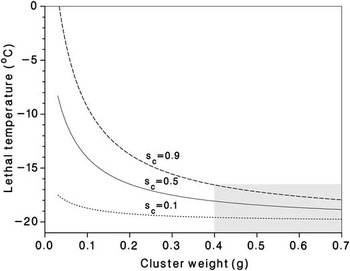
The cluster survival function (equation [3]) can be rearranged to estimate the temperature Tc whether at which specific critical survival rates s c can be expected to occur in clusters of weight w (Fig. 4):
 $${{T}_c}\: = \:\frac{{{\rm{ - }}\ln (1/{{s}_{\rm{c}}}{\rm{ - }}1){\rm{ - }}65.8w}}{{0.14\: + \:3.29w}}\eqno[4]$$
Lethal temperature corresponding to 10%, 50%, and 90% survival of bagworm egg clusters of increasing weight (equation [4]). The shaded portion of the graph represents an area of extrapolation.

Discussion
Our data indicate that the overwintering survival of bagworm eggs inside clusters is nonindependent, and that most eggs within a cluster tend to have the same fate (to either survive or die), a phenomenon that is consistent with field observations (Balduf Reference Balduf1937). This survival is affected very strongly by the weight of the cluster and by whether the cluster is exposed to extreme temperatures in winter. The eggs of T. ephemeraeformis are not freeze tolerant and have low levels of cryoprotectants; resistance to cold weather may be enhanced by physical protection provided by the maternal bag (Rivers et al. Reference Rivers, Antonelli and Yoder2002). The physical or physiological mechanisms underlying the enhanced survival in large egg clutches remain to be investigated.
The survival of eggs in the field is dependent upon the maximum temperature during the coldest day of winter (Figs. 1, 2; see also Rivers et al. Reference Rivers, Antonelli and Yoder2002), and this temperature is highly dependent on latitude in the mid-western United States of America (Fig. 3A). Elevation, in contrast, played a minor role in our data set as it ranged only from 100–300 m. There was also a strong negative correlation between latitude and egg cluster weight (−0.03 g/ °N, Fig. 3B). These sources of geographical variation in egg survival are undoubtedly important determinants of the insect's potential range in North America.
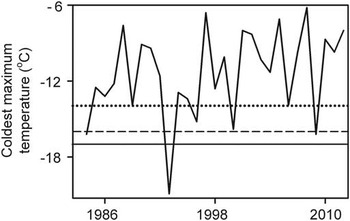
Ongoing trends of global warming in the northern hemisphere influence the geographic range distribution of herbivorous insects in large part due to an increase of temperature in the winter (Bale et al. Reference Bale, Masters, Hodkinson, Awmack, Bezemer and Brown2002). The geographic range of bagworms has been remarkably constant over the last 40 years, with a boundary corresponding to northern Indiana in the mid-western United States of America (Wollerman Reference Wollerman1971; Rhainds and Fagan Reference Rhainds and Fagan2010). In recent years, however, bagworm populations have invaded novel areas far outside their core range, in northern Michigan, United States of America (Russell Reference Russell2011) and southern Ontario, Canada (M. Rhainds, personal observations). Expansion of the geographic range of bagworms in the area of Windsor, Ontario, near the border with Detroit, Michigan, is of particular concern due to relatively mild winter conditions combined with heavy commercial traffic resulting in human-assisted spread of ballooning larvae. The historic weather record in Windsor suggests a high level of overwintering survival because for most years the minimum temperature exceeds the median lethal temperature of even small egg clusters (−14 °C for 0.1 g clusters; Fig. 5). Contingency plans to manage bagworm populations along major highways near Windsor need to be implemented, in particular by taking into account abundance data, population distribution, weather records, and size (weight) of egg clusters.
Maximum temperature during the coldest day of the year over the last 28 years in Windsor, Ontario, Canada. Values were obtained from the National Climate Date and Information Archive from Environment Canada. The lines correspond to lethal temperatures associated with 50% egg mortality for small clusters (0.1 g; dotted line), intermediate-sized clusters (0.2 g; dashed line), and large clusters (0.3 g; solid line)

Acknowledgements
The authors thank C. Quesada and C. Sadof for logistic support.